
This research focuses on elucidating the tectonic processes in the Eastern Pontides by investigating the Çambaşı Quartz Syenite and Bektaş Yaylası Quartz Monzonite, situated south of Ordu province in northeastern Turkey. To achieve this, mineralogical and petrographic characteristics of the acidic granitoids were analyzed alongside 40Ar/39Ar biotite age dating and comprehensive whole-rock and mineral geochemical analyses. Samples collected from Bektaş Yaylası Quartz Monzodiorite and Çambaşı Quartz Syenite underwent crushing, grinding, sieving, and washing to prepare for age determination. The biotite minerals were embedded in epoxy, polished, and examined. After processing the rock sample, geochemical analyses, including trace and rare earth element studies, were carried out at Actlabs laboratory in Canada. The 40Ar/39Ar biotite dating yielded ages ranging from 44.50 ± 0.35 million years to 81.12 ± 0.25 million years, indicating that these intrusions formed during the Late Cretaceous and Late Paleocene periods. Geochemical data classify the acidic intrusive rocks as calc-alkaline, high-potassium calc-alkaline, and shoshonitic. Integrating geochronological and geochemical evidence, the study suggests that the Çambaşı Quartz Syenite and Bektaş Yaylası Quartz Monzonite originated from the partial melting of the mafic lower crust, driven by continental collision. These results highlight the crucial role of continental collision in the geodynamic evolution of the Eastern Pontides.. This study on the geochronology and geochemistry of the Çambaşı Quartz Syenite and Bektaş Yaylası Quartz Monzonite offers valuable insights into the tectonic processes of the Eastern Pontides. The results demonstrate that the region’s geodynamic evolution is characterized by a complex and multi-phase history.
| Published in | Advances in Biochemistry (Volume 13, Issue 2) |
| DOI | 10.11648/j.ab.20251302.13 |
| Page(s) | 30-43 |
| Creative Commons |
This is an Open Access article, distributed under the terms of the Creative Commons Attribution 4.0 International License (http://creativecommons.org/licenses/by/4.0/), which permits unrestricted use, distribution and reproduction in any medium or format, provided the original work is properly cited. |
| Copyright |
Copyright © The Author(s), 2025. Published by Science Publishing Group |
Geochronology, Granitoids, Eastern Pontides
step | T (C) | t (min.) | 36Ar | 37Ar | 38Ar | 39Ar | 40Ar | %40Ar* | %39Ar rlsd | Ca/K | 40Ar*/39ArK | Age (Ma) | 1s.d. |
|---|---|---|---|---|---|---|---|---|---|---|---|---|---|
1 | 650 | 12 | 6,371 | 0,288 | 2,314 | 11,382 | 1982,65 | 9,4 | 1,5 | 0,451151 | 16,516533 | 45,49 | 3,07 |
2 | 725 | 12 | 1,9 | 0,173 | 1,312 | 13,334 | 764,949 | 30,4 | 1,7 | 0,231315 | 17,438244 | 47,99 | 1,09 |
3 | 790 | 12 | 1,509 | 0,218 | 4,235 | 52,372 | 1279,45 | 67,5 | 6,8 | 0,074209 | 16,48675 | 45,41 | 0,5 |
4 | 850 | 12 | 1,393 | 0,328 | 9,593 | 123,493 | 2400,23 | 84,1 | 16 | 0,047350 | 16,423145 | 45,23 | 0,43 |
5 | 905 | 12 | 0,962 | 0,321 | 7,794 | 102,169 | 1923,99 | 96,5 | 13,2 | 0,056012 | 16,34668 | 45,03 | 0,42 |
6 | 960 | 12 | 0,862 | 0,231 | 6,02 | 80,669 | 1546,65 | 85,3 | 10,5 | 0,051050 | 16,306981 | 44,92 | 0,43 |
7 | 1015 | 12 | 0,914 | 0,24 | 5,543 | 74,484 | 1452,15 | 83,3 | 9,6 | 0,057444 | 16,182016 | 44,58 | 0,43 |
8 | 1050 | 12 | 0,766 | 0,196 | 3,973 | 52,667 | 1060,52 | 81,1 | 6,8 | 0,066346 | 16,176504 | 44,56 | 0,44 |
9 | 1080 | 12 | 0,669 | 0,164 | 3,157 | 41,24 | 850,789 | 79,7 | 5,3 | 0,07089 | 16,193777 | 44,61 | 0,44 |
10 | 1110 | 12 | 0,624 | 0,172 | 2,923 | 37,844 | 784,282 | 79,6 | 4,9 | 0,081027 | 16,211785 | 44,66 | 0,45 |
11 | 1140 | 12 | 0,65 | 0,221 | 3,139 | 40,404 | 829,772 | 79,9 | 5,2 | 0,097514 | 16,155924 | 44,51 | 0,44 |
12 | 1170 | 12 | 0,683 | 0,353 | 3,588 | 45,741 | 926,62 | 81 | 5,9 | 0,13758 | 16,204802 | 44,64 | 0,44 |
13 | 1400 | 12 | 1,182 | 1,492 | 7,481 | 96,1 | 1875,9 | 83,9 | 12,4 | 0,276803 | 16,202597 | 44,63 | 0,43 |
Cumulative%39Ar rlsd = | 100 | Total gas age = | 44,92 | 0,29 | |||||||||
Plateau age = | 44,79 | 0,29 | |||||||||||
(steps 3-13) | |||||||||||||
Isochron age = | 44,7 | 0,18 | |||||||||||
(steps 1-13) |
step | T (C) | t (min.) | 36Ar | 37Ar | 38Ar | 39Ar | 40Ar | %40 Ar* | %39Ar rlsd | Ca/K | 40Ar*/ 39ArK | Age (Ma) | 1s.d. |
|---|---|---|---|---|---|---|---|---|---|---|---|---|---|
1 | 650 | 12 | 2,768 | 2,364 | 4,501 | 30,168 | 1027,38 | 24,5 | 2,8 | 1,1865031 | 8,335057 | 22,59 | 0,66 |
2 | 725 | 12 | 3,715 | 0,539 | 2,822 | 19,615 | 1630,91 | 36,1 | 1,8 | 0,4159756 | 30,124847 | 80,36 | 1,61 |
3 | 790 | 12 | 0,876 | 0,279 | 3,904 | 39,13 | 1380,89 | 82,8 | 3,6 | 0,1079249 | 29,309668 | 78,23 | 0,81 |
4 | 850 | 12 | 0,743 | 0,396 | 7,211 | 79,479 | 2518,92 | 92,1 | 7,4 | 0,075416 | 29,37437 | 78,4 | 0,76 |
5 | 905 | 12 | 0,398 | 0,395 | 8,242 | 93,651 | 2813,53 | 96,4 | 8,7 | 0,063842 | 29,156929 | 77,83 | 0,74 |
6 | 960 | 12 | 0,564 | 1,422 | 10,973 | 119,5 | 3637,28 | 95,9 | 11,1 | 0,1801227 | 29,424532 | 78,53 | 0,75 |
7 | 1015 | 12 | 0,839 | 2,353 | 15,246 | 149,616 | 4726,79 | 95,2 | 13,9 | 0,2380609 | 30,339911 | 80,92 | 0,77 |
8 | 1050 | 12 | 0,596 | 1,714 | 15,356 | 151,4 | 4596,13 | 96,6 | 14 | 0,1713643 | 29,564691 | 78,9 | 0,75 |
9 | 1085 | 12 | 0,424 | 1,801 | 14,391 | 147,421 | 4350,58 | 97,5 | 13,7 | 0,184923 | 29,01226 | 77,45 | 0,73 |
10 | 1125 | 12 | 0,38 | 2,394 | 11,369 | 125,141 | 3625,79 | 97,4 | 11,6 | 0,289585 | 28,42892 | 75,93 | 0,72 |
11 | 1175 | 12 | 0,289 | 4,212 | 7,614 | 89,62 | 2596,92 | 97,4 | 8,3 | 0,7115238 | 28,40024 | 75,85 | 0,72 |
12 | 1235 | 12 | 0,24 | 7,124 | 2,724 | 27,226 | 827,424 | 93,6 | 2,5 | 3,9652474 | 28,405593 | 75,87 | 0,73 |
13 | 1400 | 12 | 0,434 | 24,553 | 1,949 | 5,62 | 269,923 | 61,1 | 0,5 | 67,467772 | 28,000044 | 74,81 | 0,98 |
Cumulative%39Ar rlsd = | 100 | Total gas age = | 76,54 | 0,49 |
step | T (C) | t (min.) | 36Ar | 37Ar | 38Ar | 39Ar | 40Ar | %40Ar* | %39Ar rlsd | Ca/K | 40Ar*/39ArK | Age (Ma) | 1s.d. |
|---|---|---|---|---|---|---|---|---|---|---|---|---|---|
1 | 650 | 12 | 3,292 | 0,685 | 2,359 | 22,503 | 1192,24 | 22,3 | 1,5 | 0,463479 | 11,87317 | 31,66 | 1,01 |
2 | 725 | 12 | 3,732 | 0,667 | 4,11 | 51,072 | 1861,03 | 43,8 | 3,4 | 0,1988328 | 16,019896 | 42,59 | 0,73 |
3 | 790 | 12 | 1,236 | 0,82 | 9,285 | 136,638 | 2540,59 | 86,6 | 9 | 0,0913636 | 16,213291 | 43,09 | 0,44 |
4 | 850 | 12 | 0,976 | 0,791 | 8,225 | 123,081 | 2251 | 88,2 | 8,1 | 0,0978402 | 16,224332 | 43,12 | 0,44 |
5 | 905 | 12 | 0,652 | 0,655 | 5,932 | 90,385 | 1635,38 | 89,4 | 5,9 | 0,1103261 | 16,234613 | 43,15 | 0,43 |
6 | 960 | 12 | 0,87 | 0,939 | 6,135 | 93,037 | 1744,45 | 86,5 | 6,1 | 0,1536558 | 16,290207 | 43,3 | 0,44 |
7 | 1015 | 12 | 1,344 | 1,822 | 8,519 | 126,834 | 2423,1 | 84,8 | 8,3 | 0,2187058 | 16,293253 | 43,3 | 0,45 |
8 | 1050 | 12 | 0,843 | 0,861 | 9,245 | 143,891 | 2530,74 | 91 | 9,5 | 0,0910963 | 16,104785 | 42,81 | 0,42 |
9 | 1085 | 12 | 0,54 | 0,645 | 11,041 | 172,507 | 2879 | 95 | 11,3 | 0,0569219 | 15,971176 | 42,46 | 0,41 |
10 | 1125 | 12 | 0,426 | 0,88 | 17,338 | 261,447 | 4254,86 | 97,4 | 17,2 | 0,0512419 | 15,977266 | 42,47 | 0,4 |
11 | 1175 | 12 | 0,339 | 1,629 | 16,764 | 240,516 | 3908,03 | 97,8 | 15,8 | 0,103112 | 16,01647 | 42,58 | 0,41 |
12 | 1235 | 12 | 0,242 | 1,58 | 3,739 | 50,547 | 874,739 | 93,5 | 3,3 | 0,4759298 | 16,153135 | 42,94 | 0,42 |
13 | 1400 | 12 | 0,233 | 1,968 | 0,767 | 9,268 | 217,408 | 77,4 | 0,6 | 3,2357885 | 16,673392 | 44,3 | 0,5 |
Cumulative%39Ar rlsd = | 100 | Total gas age = | 42,66 | 0,29 | |||||||||
Plateau age = | 42,89 | 0,3 | |||||||||||
(steps 2-12) | |||||||||||||
Isochron age = | 42,93 | 0,14 | |||||||||||
(steps 2-12) |
ELEMENT | Rb | Sr | Ba | Zr | Th | Pb | Zn | Nb | Y | Co |
|---|---|---|---|---|---|---|---|---|---|---|
D 22 | 138 | 398 | 875 | 181 | 14 | 31 | 83 | 11 | 30 | 21 |
D 37 | 117 | 421 | 919 | 116 | 11 | 20 | 66 | 10 | 25 | 23 |
D 38 | 126 | 414 | 805 | 144 | 12 | 18 | 64 | 9 | 26 | 24 |
D 40 | 153 | 380 | 795 | 183 | 19 | 22 | 79 | 12 | 35 | 19 |
D 41 | 109 | 409 | 1004 | 133 | 8 | 32 | 66 | 10 | 26 | 22 |
D 42 | 123 | 388 | 982 | 109 | 9 | 20 | 53 | 9 | 27 | 24 |
D 57 | 120 | 531 | 723 | 130 | 7 | 24 | 81 | 9 | 26 | 22 |
D 58 | 128 | 526 | 803 | 145 | 7 | 19 | 92 | 10 | 29 | 24 |
D 61 | 118 | 546 | 755 | 113 | 5 | 31 | 109 | 7 | 25 | 22 |
D 62 | 114 | 605 | 1041 | 136 | 3 | 26 | 106 | 7 | 27 | 22 |
D 65 | 112 | 539 | 713 | 126 | 10 | 15 | 81 | 8 | 25 | 24 |
ELEMENT | Rb | Sr | Ba | Zr | Th | Pb | Zn | Nb | Y | Co |
|---|---|---|---|---|---|---|---|---|---|---|
D 67 | 224 | 488 | 919 | 262 | 32 | 43 | 81 | 24 | 48 | 15 |
D 71 | 332 | 228 | 350 | 401 | 109 | 96 | 99 | 38 | 67 | 12 |
D 74 | 221 | 483 | 1058 | 356 | 25 | 34 | 84 | 19 | 44 | 13 |
D 75 | 206 | 542 | 953 | 235 | 20 | 52 | 80 | 15 | 41 | 19 |
D 76 | 342 | 225 | 351 | 448 | 96 | 186 | 158 | 30 | 65 | 10 |
D 77 | 233 | 429 | 584 | 192 | 50 | 105 | 153 | 21 | 47 | 19 |
D 78 | 231 | 452 | 717 | 254 | 27 | 136 | 118 | 19 | 45 | 18 |
D 79 | 244 | 525 | 1131 | 206 | 32 | 61 | 94 | 16 | 45 | 11 |
D 80 | 235 | 542 | 1290 | 244 | 12 | 79 | 122 | 15 | 43 | 12 |
D 81 | 254 | 331 | 520 | 250 | 22 | 54 | 98 | 20 | 51 | 12 |
D 83 | 170 | 424 | 850 | 216 | 9 | 56 | 86 | 12 | 34 | 17 |
D 86 | 234 | 378 | 910 | 255 | 12 | 12 | 80 | 15 | 46 | 7 |
D 90 | 172 | 510 | 995 | 190 | 7 | 10 | 87 | 11 | 34 | 15 |
D 93 | 284 | 393 | 836 | 398 | 31 | 67 | 84 | 26 | 56 | 12 |
D 94 | 328 | 281 | 326 | 315 | 34 | 109 | 144 | 28 | 63 | 13 |
D 95 | 304 | 339 | 500 | 423 | 29 | 245 | 89 | 28 | 60 | 15 |
D 96 | 317 | 282 | 367 | 424 | 42 | 89 | 91 | 31 | 63 | 14 |
D 97 | 230 | 519 | 1170 | 311 | 20 | 48 | 74 | 19 | 43 | 12 |
D 104 | 228 | 564 | 1201 | 241 | 20 | 63 | 97 | 18 | 43 | 14 |
D 105 | 221 | 517 | 951 | 254 | 25 | 52 | 86 | 19 | 44 | 13 |
D 116 | 250 | 432 | 758 | 289 | 30 | 83 | 112 | 21 | 46 | 10 |
D 117 | 202 | 265 | 1014 | 266 | 22 | 57 | 95 | 18 | 39 | 14 |
EPOB | The Eastern Pontides Orogenic Belt |
|---|---|
EAF | East Anatolian Fault |
NAF | North Anatolian Fault |
REE | Trace and Rare Earth Element |
LPFC | Low-Pressure Fractional Crystallization |
HPFC | High-Pressure Fractional Crystallization |
| [1] | Altherr R, Topuz G, Siebel W, Şen C, Meyer H-P, Satır M, (2008). Geochemical and Sr-Nd-Pb isotopic characteristics of Paleocene plagioleucitites from the Eastern Pontides (NE Turkey). Lithos, 105, 149-161. |
| [2] | Arslan M, Temizel İ, Abdioğlu E, Kolaylı H, Yücel C, Boztuğ D, Şen C (2013). 40Ar-39Ar dating, whole-rock and Sr-Nd-Pb isotope geochemistry of post-collisional Eocene volcanic rocks in the southern part of the Eastern Pontides (NE Turkey): implications for magma evolution in extension-induced origin. Contrib. Mineral. Petrol., 166 pp. 113-142. |
| [3] | Aydınçakır E., Şen C. (2013). Petrogenesis of the postcollisional volcanic rocks from the Borçka (Artvin) area: implications for the evolution of the Eocene magmatism in the eastern Pontides (NE Turkey), Lithos, 172–173, 98–117. |
| [4] | Aydınçakır E., Yücel C., Ruffet G., Gücer M. A., Akaryalı E., Kaygusuz A. (2022). Petrogenesis of post-collisional Middle Eocene volcanism in the Eastern Pontides (NE, Turkey): insights from geochemistry, whole-rock Sr-Nd-Pb isotopes, zircon U-Pb and 40Ar-39Ar geochronology. Geochemistry, 125871. |
| [5] | Aydınçakır E., Yücel C., Kaygusuz A., Bilici Ö., Jeong K., Yi Y.-Z., Güloğlu Z. S. (2023). Magmatic evolution of the calc-alkaline Middle Jurassic igneous rocks in the Eastern Pontides, NE Turkey: İnsights from geochemistry, whole-rock Sr-Nd-Pb, in situ zircon Lu-Hf isotopes, and U-Pb geochronology. International Geology Review, 65(20), 3146-3167. |
| [6] | Barka A. A. (1992). The North Anatolian Fault Zone. Anal Tecto, 6, 164-195. |
| [7] | Bozkurt, E., & Mittwede, S. (2001). Introduction to the geology of Turkey: A synthesis. International Geology Review, 43(7), 578–594. |
| [8] | Boztuğ D., Erçin A. I., Kuruçelik M. K., Göç D., Kömür I., Iskenderoğlu A. (2006). Geochemical characteristics of the composite Kaçkar batholith generated in a Neo-Tethyan convergence system, Eastern Pontides, Turkey. Journal of Asian Earth Sciences, 27, 286-302. |
| [9] | Boztuğ, D., Jonckheere, R., Wagner, G. A., Erçin, A. I., Yeğingil, Z. (2007). Titanite and zircon fission-track dating resolves successive igneous episodes in the formation of the composite Kaçkar batholith in the Turkish Eastern Pontides. International Journal of Earth Sciences, 96, 875-886. |
| [10] | Castıllo P. R., Janney P. E., Solidum R. U. (1999). Petrology and geochemistry of Camiguin Island, southern Philippines: insights to the source of adakites and other lavas in a complex arc setting. Contributions to Mineralogy and Petrology, 134, 33-51. |
| [11] | Dewey J. F., Hemptone M. R., Kidd W. S. F., Şaroğlu F., Şengör A. M. C. (1986). Shortening of continental lithosphere: the neotectonics of Eastern Anatolia-a young collision zone. In: Coward MP, Ries AC (eds), Collision Tectonics, Special Publication, Geological Society of London, 3-36. |
| [12] |
Dewey J. F., Şengör A. M. C. (1979). Aegean and surrounding regions: complex multiplate and continuum tectonics in a convergent zone. Journal of Geological Society of America Bulletin, 90, 84-92.
https://doi.org/10.1130/0016-7606(1979)90<84:AASRCM>2.0.CO;2 |
| [13] | Elinç G. (2013). Study of the 40Ar/39Ar Petrology and Geochronology Method of the Çambaşı Plateau and Bektaşyayla Intrusive Rocks in Southern Ordu. Master's Thesis, Munzur University. |
| [14] | Eyüboğlu Y., Dudas F. O., Zhu D., Liu Z., Chatterjee N. (2019). Late Cretaceous I- and A-Type Magmas in Eastern Turkey: Magmatic Response to Double-Sided Subduction of Paleo- and Neo-Tethyan Lithospheres. Lithos, 326, 39-70. |
| [15] | Eyüboğlu, Y., Dudás, F. Ö., Zhu, D. C., Santosh, M., Liu, Z., Chatterjee, N., Yi, K. (2021). Late Cretaceous alkaline magmas of the Eastern Pontides Orogenic Belt (NE Turkey): A review with new geological, geochemical, and geochronological data. Gondwana Research, 97, 204-239. |
| [16] | Güloğlu, Z. S. (2022). Petrography, Petrokinetics, U-Pb Zircon Geochronology, Whole-Rock Sr-Nd-Pb and Zircon Lu-Hf Isotope Geochemistry and Petrology of the Eocene-Aged Kazıkbeli Pluton (Kürtün-Gümüşhane). Doctoral Thesis, Gümüşhane University. |
| [17] | Karslı O., Aydın F., Sadıklar M. B. (2002). Geothermobarometric investigation of the Zigana Granitoid, Eastern Pontides, Turkey. International Geology Review, 44, 277-286. |
| [18] | Karslı, O., Uysal, İ., Ketenci, M., Dokuz, A., Aydın, F., Chen, B., Kandemir, R., & Wijbrans, J. (2011). Adakite-like granitoid porphyries in Eastern Pontides, NE Turkey: potential parental melts and geodynamic implications. Lithos, 127, 354–372. |
| [19] | Kayguzuz, A., & Şen, C. (2011). Calc-alkaline I-type plutons in the eastern Pontides, NE Turkey: U-Pb zircon ages, geochemical and Sr-Nd isotopic compositions. Chemie der Erde, 71, 59–75. |
| [20] | Kayguzuz, A., Yücel, C., Aydınçakır, E., Gücer, M. A., & Ruffet, G. (2022). 40Ar–39Ar dating, whole-rock and Sr-Nd isotope geochemistry of the Middle Eocene calc-alkaline volcanic rocks in the Bayburt area, Eastern Pontides (NE Turkey): implications for magma evolution in an extension-related setting. Mineralogy and Petrology, 116, 379–399. |
| [21] | Kayguzuz, A., Güloğlu, Z. S., Aydınçakır, E., Yücel, C., Vural, A., Siebel, W., & Jeong, Y. (2024). U–Pb zircon dating, Sr-Nd whole-rock and Lu-Hf zircon isotope analyses of the Eocene Arslandede pluton, Eastern Pontides, NE Turkey: Implications for mantle source and magma evolution. Geochemistry. |
| [22] | Krystopowicz, N. J., Schoenbohm, L. M., Rimando, J., Brocard, G., & Rojay, B. (2020). Tectonic geomorphology and Plio-Quaternary structural evolution of the Tuzgölü fault zone, Turkey: Implications for deformation in the interior of the Central Anatolian Plateau. Geosphere, 16(5), 1107–1124. |
| [23] | Koçyiğit, A., Yılmaz, A., Adamia, S., & Kuloshvili, S. (2001). Neotectonics of East Anatolian Plateau (Turkey) and Lesser Caucasus: Implications for transition from thrusting to strike-slip faulting. Geod Acta, 14, 177–195. |
| [24] | Levent, G. (2024). Petrology and 40Ar/39Ar Geochronology of the Çambaşı and Bektaş Plateaus Intrusive Rocks in Southern Ordu. International Participation Sedimentology Working Group 2024 Workshop, Turkey. |
| [25] | Liu, S., Hu, R.-Z., Feng, C.-X., Zhou, H.-B., Li, C., Chi, X.-G., Peng, J.-T., Zhong, H., Qi, L., Qi, Y.-Q., & Wang, T. (2008). Cenozoic high Sr/Y volcanic rocks in the Qiangtang terrane, northern Tibet: Geochemical and isotopic evidence for the origin of delaminated lower continental melts. Geological Magazine, 145, 463–474. |
| [26] | Manetti, P., Peccerillo, A., Poli, G., & Corsini, F. (1983). Petrochemical constraints on the models of Cretaceous-Eocene tectonic evolution of the Eastern Pontic chain (Turkey). Elsevier. Cretaceous Research, 4(2), 159–172. |
| [27] | Macpherson, C. G., Dreher, S. T., & Thirwall, M. F. (2006). Adakites without slab melting: high pressure differentiation of island arc magma, Mindanao, the Philippines. Earth and Planetary Science Letters, 243, 581–59. |
| [28] |
Maniar, P. D., & Piccoli, P. M. (1989). Tectonic discrimination of granitoids. Bulletin of the American Geophysical Union, 101, 635–643.
https://doi.org/10.1130/0016-7606(1989)101<0635:TDOG>2.3.CO;2 |
| [29] | Middlemost, E. A. K. (1994). Naming materials in the magma/igneous rock system. Earth Science Review, 37, 215–224. |
| [30] | Nikishin, A. M., Wannier, M., Alekseev, A. S., Almendiger, O. A., Fokin, P. A., Gabdullin, R. R., Khudoley, A. K., Kopaevich, L. F., Mityukov, A. V., Petrov, E. I., & Rubtsova, E. V. (2017). Mesozoic to recent geological history of southern Crimea and the Eastern Black Sea region. In M. Sosson, R. A. Stephenson, & S. A. Adamia (Eds.), Tectonic Evolution of the Eastern Black Sea and Caucasus (pp. 241–264). Geological Society, London, Special Publications, 428. |
| [31] | Patino Douce, A. E. (1999). What do experiments tell us about the relative contributions of crust and mantle to the origin of granitic magmas? In A. Castro, C. Fernandez, & J. L. Vigneresse (Eds.), Understanding Granites: Integrating New and Classical Techniques (pp. 55–75). Special Publications Geol. Soc. London, 168. |
| [32] | Peccerillo, A., & Taylor, S. R. (1976). Geochemistry of Eocene calc-alkaline volcanic rocks from Kastamonu area, northern Turkey. Contributions to Mineralogy and Petrology, 58, 63–81. |
| [33] | Okay, A. I., Şahintürk, Ö., & Yakar, H. (1997). Stratigraphy and tectonics of the Pulur (Bayburt) region in the eastern Pontides. Mineral. Res. Exp. Bulletin, 119, 1–24. |
| [34] | Okay, A. I., & Tüysüz, Ö. (1999). Tethyan sutures of northern Turkey. In B. Durand, L. Jolivet, F. Horváth, & M. Séranne (Eds.), The Mediterranean Basins: Tertiary Extension within the Alpine Orogen (pp. 475–515). Geological Society London Special Publications, 156. |
| [35] | Özdamar, Ş. (2016). Geochemistry and geochronology of late Mesozoic volcanic rocks in the northern part of the Eastern Pontide Orogenic Belt (NE Turkey): Implications for the closure of the Neo-Tethys Ocean. Lithos, 248–251, 240–256. |
| [36] | Robinson, A. G., Banks, C. J., Rutherford, M. M., & Hirst, J. P. P. (1995). Stratigraphic and structural development of the Eastern Pontides, Turkey. Journal of the Geological Society London, 152, 861–872. |
| [37] | Rolland, Y., Perincek, D., Kaymakçı, N., Sosson, M., Barrier, E., & Avagyan, A. (2012). Evidence for ∼80–75 Ma subduction jump during Anatolide–Tauride–Armenian block accretion and ∼48 Ma Arabia–Eurasia collision in Lesser Caucasus–East Anatolia. Journal of Geodynamics, 56–57, 76–85. |
| [38] | Sosson, M., Stephenson, R., Sheremet, Y., Rolland, Y., Adamia, S., Melkonian, R., Kangarli, T., Yegorova, T., Avagyan, A., Galoyan, G., Danielian, T., Hässig, M., Meijers, M., Müller, C., Sahakyan, L., Sadradze, N., Alania, V., Enukidze, O., & Mosar, J. (2016). The eastern Black Sea–Caucasus region during the Cretaceous: New evidence to constrain its tectonic evolution. Comptes Rendus Geoscience, 348(1), 23–32. |
| [39] | Şengör, A. M. C., & Yılmaz, Y. (1981). Tethyan evolution of Turkey: A plate tectonic approach. Tectonophysics, 181, 241–981. |
| [40] | Şengör, A. M. C., Görür, N., & Şaroğlu, F. (1985). Strike-slip faulting and related basin formation in zones of tectonic escape: Turkey as a case study. Strike-slip Deformation, Basin Formation and Sedimentation. In K. T. Biddle & N. Christie-Blick (Eds.), Soc Eco, Palaeo, Mineral Special Publication, 37, 227–264. |
| [41] | Şengör, A. M. C., Özeren, S., Genç, T., & Zor, E. (2003). East Anatolian high plateau as a mantle-supported, north-south shortened domal structure. Geophysical Research Letters, 30(24), 8045. |
| [42] | Temizel, İ., Arslan, M., Yücel, C., Abdioğlu, E., & Ruffet, G. (2016). Geochronology and geochemistry of Eocene-aged volcanic rocks around the Bafra (Samsun, N Turkey) area: Constraints for the interaction of lithospheric mantle and crustal melts. Lithos, 258–259, 92–114. |
| [43] | Temizel, İ., Arslan, M., Yücel, C., Yazar, E. A., Kaygusuz, A., & Aslan, Z. (2019). U-Pb geochronology, bulk-rock geochemistry and petrology of Late Cretaceous syenitic plutons in the Gölköy (Ordu) area (NE Turkey): Implications for magma generation in a continental arc extension triggered by slab roll-back. Journal of Asian Earth Sciences, 171, 305–320. |
| [44] | Temizel, İ., Arslan, M., Yücel, C., Abdioğlu, Yazar, E., Kaygusuz, A., & Aslan, Z. (2020). Eocene tonalite–granodiorite from the Havza (Samsun) area, northern Turkey: Adakite-like melts of lithospheric mantle and crust generated in a post-collisional setting. International Geology Review, 62, 1131–1158. |
| [45] | Topuz, G., Okay, A. I., Altherr, R., Schwarz, W. H., Siebel, W., Zack, T., Satir, M., & Şen, C. (2011). Post-collisional adakite-like magmatism in the Ağvanis massif and implications for the evolution of the Eocene magmatism in the Eastern Pontides (NE Turkey). Lithos, 125, 131–150. |
| [46] | Vural, A., & Kaygusuz, A. (2021). Geochronology, petrogenesis and tectonic importance of Eocene I-type magmatism in the Eastern Pontides, NE Turkey. Arabian Journal of Geosciences, 14(6). |
| [47] | Yılmaz, Y., Tüysüz, O., Yiğitbaş, E., Genç, Ş. C., & Şengör, A. M. C. (1997). Geology and tectonic evolution of the Pontides. In A. G. Robinson (Ed.), Regional and Petroleum Geology of the Black Sea and Surrounding Region (pp. 183–226). American Association of Petroleum Geologists Memoir, 68. |
| [48] | Yılmaz, S., & Boztuğ, D. (1996). Space and time relations of three plutonic phases in the Eastern Pontides, Turkey. International Geology Review, 38, 935–956. |
| [49] | Yücel, C., Arslan, M., Temizel, İ., Abdioğlu, E. (2014). Volcanic facies and mineral chemistry of tertiary volcanics in the northern part of the Eastern Pontides, Northeast Turkey: Implications for pre-eruptive crystallization conditions and magma chamber processes. Minerals and Petrology, 108(3), 439–467. |
| [50] | Yücel, C., Temizel, İ., Abdioğlu, E., Arslan, M., & Yağcıoğlu, U. C. (2014). Origin of analcimes in the tertiary volcanic rocks from the Eastern Pontides (NE Turkey): A textural, mineralogical and geochemical approach. Journal of Mineralogy and Geochemistry, 191(3), 277–299. |
| [51] | Yücel, C. (2017). Petrography, geochemistry, geochronology, and petrogenesis of Campanian-aged volcanic rocks in the south of Akçaabat (Trabzon) and surrounding area. GÜFBED/GUSTIJ, 7(1), 79–101. |
| [52] | Yücel, C., Arslan, M., Temizel, İ., Abdioğlu-Yazar, E., & Ruffet, G. (2017). Evolution of K-rich magmas derived from a net-veined lithospheric mantle in an ongoing extensional setting: Geochronology and geochemistry of Eocene and Miocene volcanic rocks from Eastern Pontides (Turkey). Gondwana Research, 45, 65–86. |
| [53] | Yücel, C. (2019). Geochronology, geochemistry, and petrology of adakitic Pliocene-Quaternary volcanism in the Şebinkarahisar (Giresun) area, NE Turkey. International Geology Review, 61(6), 754–777. |
APA Style
Levent, G., Boztuğ, D. (2025). Investigation of Intrusive Rocks in the Çambaşı Plateau and Bektaşyayla Region Located South of Ordu Using 40Ar/39Ar Petrology and Geothermochronology Methods. Advances in Biochemistry, 13(2), 30-43. https://doi.org/10.11648/j.ab.20251302.13
ACS Style
Levent, G.; Boztuğ, D. Investigation of Intrusive Rocks in the Çambaşı Plateau and Bektaşyayla Region Located South of Ordu Using 40Ar/39Ar Petrology and Geothermochronology Methods. Adv. Biochem. 2025, 13(2), 30-43. doi: 10.11648/j.ab.20251302.13
@article{10.11648/j.ab.20251302.13,
  author = {Gülşah Levent and Durmuş Boztuğ},
  title = {Investigation of Intrusive Rocks in the Çambaşı Plateau and Bektaşyayla Region Located South of Ordu Using 40Ar/39Ar Petrology and Geothermochronology Methods
},
  journal = {Advances in Biochemistry},
  volume = {13},
  number = {2},
  pages = {30-43},
  doi = {10.11648/j.ab.20251302.13},
  url = {https://doi.org/10.11648/j.ab.20251302.13},
  eprint = {https://article.sciencepublishinggroup.com/pdf/10.11648.j.ab.20251302.13},
  abstract = {This research focuses on elucidating the tectonic processes in the Eastern Pontides by investigating the Çambaşı Quartz Syenite and Bektaş Yaylası Quartz Monzonite, situated south of Ordu province in northeastern Turkey. To achieve this, mineralogical and petrographic characteristics of the acidic granitoids were analyzed alongside 40Ar/39Ar biotite age dating and comprehensive whole-rock and mineral geochemical analyses. Samples collected from Bektaş Yaylası Quartz Monzodiorite and Çambaşı Quartz Syenite underwent crushing, grinding, sieving, and washing to prepare for age determination. The biotite minerals were embedded in epoxy, polished, and examined. After processing the rock sample, geochemical analyses, including trace and rare earth element studies, were carried out at Actlabs laboratory in Canada. The 40Ar/39Ar biotite dating yielded ages ranging from 44.50 ± 0.35 million years to 81.12 ± 0.25 million years, indicating that these intrusions formed during the Late Cretaceous and Late Paleocene periods. Geochemical data classify the acidic intrusive rocks as calc-alkaline, high-potassium calc-alkaline, and shoshonitic. Integrating geochronological and geochemical evidence, the study suggests that the Çambaşı Quartz Syenite and Bektaş Yaylası Quartz Monzonite originated from the partial melting of the mafic lower crust, driven by continental collision. These results highlight the crucial role of continental collision in the geodynamic evolution of the Eastern Pontides.. This study on the geochronology and geochemistry of the Çambaşı Quartz Syenite and Bektaş Yaylası Quartz Monzonite offers valuable insights into the tectonic processes of the Eastern Pontides. The results demonstrate that the region’s geodynamic evolution is characterized by a complex and multi-phase history.
},
 year = {2025}
}
TY  - JOUR
T1  - Investigation of Intrusive Rocks in the Çambaşı Plateau and Bektaşyayla Region Located South of Ordu Using 40Ar/39Ar Petrology and Geothermochronology Methods

AU  - Gülşah Levent
AU  - Durmuş Boztuğ
Y1  - 2025/05/29
PY  - 2025
N1  - https://doi.org/10.11648/j.ab.20251302.13
DO  - 10.11648/j.ab.20251302.13
T2  - Advances in Biochemistry
JF  - Advances in Biochemistry
JO  - Advances in Biochemistry
SP  - 30
EP  - 43
PB  - Science Publishing Group
SN  - 2329-0862
UR  - https://doi.org/10.11648/j.ab.20251302.13
AB  - This research focuses on elucidating the tectonic processes in the Eastern Pontides by investigating the Çambaşı Quartz Syenite and Bektaş Yaylası Quartz Monzonite, situated south of Ordu province in northeastern Turkey. To achieve this, mineralogical and petrographic characteristics of the acidic granitoids were analyzed alongside 40Ar/39Ar biotite age dating and comprehensive whole-rock and mineral geochemical analyses. Samples collected from Bektaş Yaylası Quartz Monzodiorite and Çambaşı Quartz Syenite underwent crushing, grinding, sieving, and washing to prepare for age determination. The biotite minerals were embedded in epoxy, polished, and examined. After processing the rock sample, geochemical analyses, including trace and rare earth element studies, were carried out at Actlabs laboratory in Canada. The 40Ar/39Ar biotite dating yielded ages ranging from 44.50 ± 0.35 million years to 81.12 ± 0.25 million years, indicating that these intrusions formed during the Late Cretaceous and Late Paleocene periods. Geochemical data classify the acidic intrusive rocks as calc-alkaline, high-potassium calc-alkaline, and shoshonitic. Integrating geochronological and geochemical evidence, the study suggests that the Çambaşı Quartz Syenite and Bektaş Yaylası Quartz Monzonite originated from the partial melting of the mafic lower crust, driven by continental collision. These results highlight the crucial role of continental collision in the geodynamic evolution of the Eastern Pontides.. This study on the geochronology and geochemistry of the Çambaşı Quartz Syenite and Bektaş Yaylası Quartz Monzonite offers valuable insights into the tectonic processes of the Eastern Pontides. The results demonstrate that the region’s geodynamic evolution is characterized by a complex and multi-phase history.

VL  - 13
IS  - 2
ER  -
Rare Earth Elements Research Centre, Munzur University, Tunceli, Turkiye
Department of Geological Engineering, Faculty of Engineering, Cumhuriyet University, Sivas, Turkiye
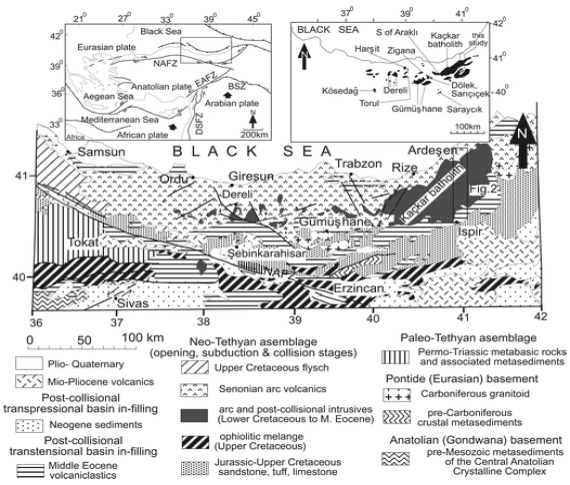
Figure 1. The study locations of granitoid rocks in the Eastern Pontides. (Modified from [7, 9]).
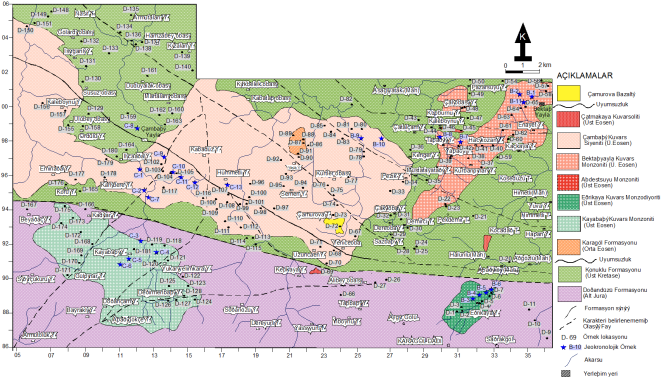
Figure 2. Geological map of the Bektaşyayla and Çambaşı region. (Modified from mta.gov.tr. and [13]).
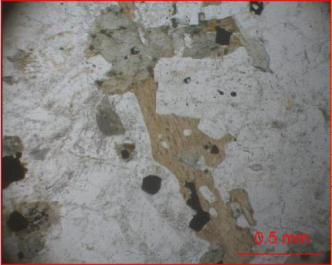
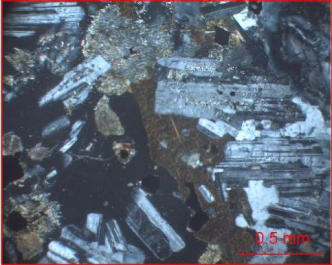
Figure 3. Appearances of the biotite mineral under crossed and plane-polarized light.
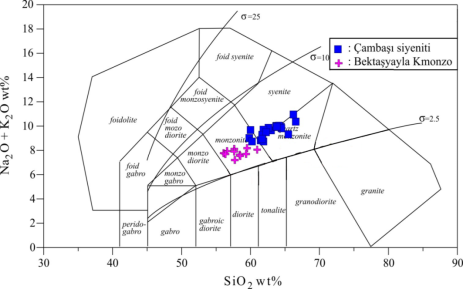
Figure 4. (a) Classification of Bektaşyayla and Çambaşı granitoids on the SiO2 diagram based on total alkali content [29].
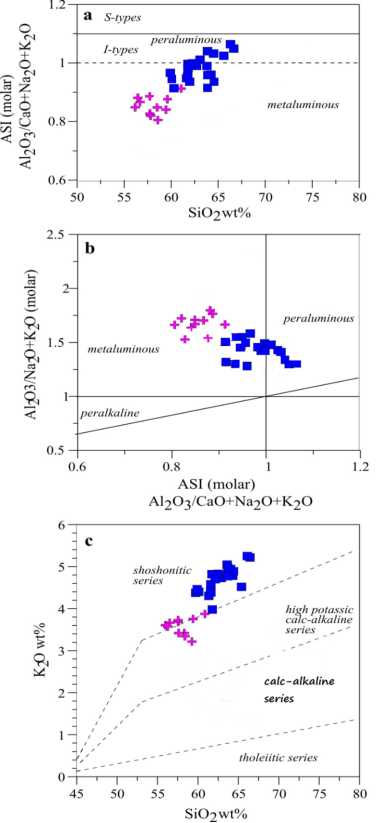
Figure 5. (a) The distributions of the Bektaşyayla and Çambaşı granitoids in: the SiO₂ vs. alkali saturation index diagram, (b) the molar Al₂O₃/(Na₂O + K₂O) vs. alkali saturation index diagram [28], and (c) the K₂O vs. SiO₂ variation diagram [32].
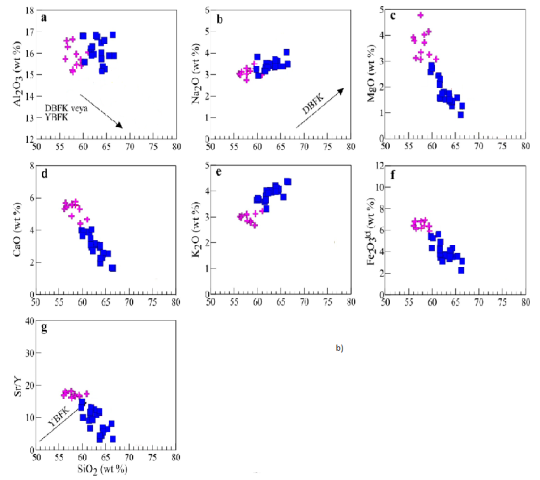
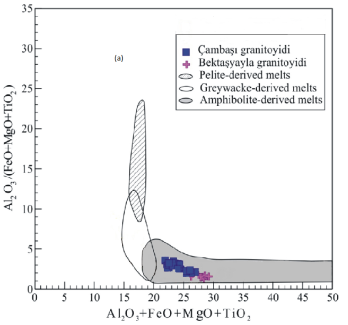
Figure 6. (a) The Bektaşyayla and Çambaşı plutons in the northern part of the Eastern Pontides: a) Al2O3 contents versus SiO2 contents, b) Na2O contents versus SiO2 contents, c) MgO contents versus SiO2 contents, d) CaO contents versus SiO2 contents, e) K2O contents versus SiO2 contents, f) total iron oxide contents versus SiO2 contents, g) Sr/Y ratios versus SiO2 contents. Low-pressure fractional crystallization (LPFC) trend containing olivine + clinopyroxene + plagioclase + hornblende + titanomagnetite is from Castillo et al. [10]. and high-pressure fractional crystallization (HPFC) trend containing garnet is from [27]. (b) The positions of Bektaşyayla and Çambaşı granitoids in the Al2O3/(FeO+MgO+TiO2) versus Al2O3+FeO+MgO+TiO2 variation diagram. The experimentally produced amphibolite melt fields are from [31].

Information



 Share This Article
 Twitter
 Linked In
 Facebook

 Copy
 Download