Abstract
Moringa oleifera is generally considered to have numerous therapeutic properties in traditional Ivorian medicine. The objective of this study was to evaluate the acute toxicity and blood glucose regulation in rats of an aqueous extract of Moringa oleifera leaves. Phytochemical analysis of the aqueous extract of Moringa oleifera leaves was performed using the standard staining and precipitation method. The toxicity study was conducted in accordance with OECD 423, by administering a single dose of the extract at 5,000 mg/kg body weight. The antihyperglycemic and hypoglycemic activities of Moringa oleifera extract were evaluated by administering a single dose of 75 mg/kg μg, 150 mg/kg μg, 300 mg/kg μg, 600 mg/kg μg, and 1200 mg/kg μg of aqueous Moringa oleifera extract to normoglycemic and hyperglycemic animals. The effects of the different Moringa oleifera extracts on rats were monitored for 120 minutes. Blood glucose levels were measured at 0, 30, 60, 90, 120, and 180 minutes. Phytochemical analysis showed that the extract is rich in secondary compounds such as polyphenols, flavonoids, sterols, tannins, and saponins. Moringa oleifera extract is non-toxic, with an LD50 greater than 5,000 mg/kg body weight. Aqueous Moringa oleifera extract administered to normoglycemic rats did not induce hypoglycemia or hyperglycemia. Aqueous Moringa oleifera extract significantly reduced anhydrous glucose-induced hyperglycemia in hyperglycemic rats, from 170 mg/dL to approximately 78 mg/dL. These results confirm the regulatory properties of Moringa oleifera on blood glucose levels in Wistar rats.
|
Published in
|
Advances in Biochemistry (Volume 14, Issue 2)
|
|
DOI
|
10.11648/j.ab.20261402.11
|
|
Page(s)
|
21-27 |
|
Creative Commons
|

This is an Open Access article, distributed under the terms of the Creative Commons Attribution 4.0 International License (http://creativecommons.org/licenses/by/4.0/), which permits unrestricted use, distribution and reproduction in any medium or format, provided the original work is properly cited.
|
|
Copyright
|
Copyright © The Author(s), 2026. Published by Science Publishing Group
|
Keywords
Moringa oleifera, Rattus Norvegicus, Hypoglycemic, Anti-hyperglycemic
1. Introduction
Diabetes is a metabolic disease characterized by chronic hyperglycemia linked to a deficiency or insufficiency of insulin secretion, abnormalities in insulin action, or a combination of these two mechanisms
| [1] | Abodo, J., Lokrou, A., Yoboué, L., & Sanogo, A. Le diabète sucré à l’Hôpital Militaire d’Abidjan: une série ambulatoire de 473 cas. Médecine des maladies métaboliques. 2008, 2(6), 639-642. https://doi.org/10.4236/jdm.2015.53016 |
[1]
. For some time now, diabetes has represented a fundamental threat to human health and development. More than 80% of diabetes-related deaths occur in low- and middle-income countries. Thus, in 2013, nearly 20 million people in sub-Saharan Africa had diabetes, representing a prevalence of 4.9%
. The current global prevalence of diabetes is approximately 347 million people
| [3] | Danaei G., Finucane MM, Lu Y., Sing GM, Cowan M. J & Paciorek CJ. National regional and global trends in fasting plasma glucose and diabetes prevalence since 1980: systematic analysis of health examination surveys and epidemiological studies with 370 country-years and 2.7 million participants. Lancet. 2011, 378: 31-40; https://doi.org/10.1016/S0140-6736(11)60679-X |
[3]
. Estimates for 2030 project that it will affect approximately 4.7% of the world's population
. In Côte d'Ivoire, the International Diabetes Federation (IDF) estimated the prevalence of diabetes at 9.6% in 2014. Diabetes clearly appears to be a major public health problem
| [5] | Kroa, E., Doh, SK, Soko, YN, Yohou, KS, Koulaï, OJJD, Gbogbo, M.,... & Kouassi, D. Effect of aqueous extract of stem bark of Anthocleista djalonensis A. Chev (Gentianaceae) on blood glucose in rabbits. International Journal of Biological and Chemical Sciences, 2016. 10(2), 552-558. http://dx.doi.org10.4314/ijbcs.v10i2.9 |
[5]
. The concern surrounding the morbidity caused by hyperglycemia is a concern for several countries, including Côte d'Ivoire
| [6] | Mamadou, Z., Assouan Kouame, AE, & Tanoh, C. Stroke of diabetic subject: experience of The Neurology Service of Cocody Teaching Hospital at Abidjan (Ivory Coast). Journal of Neurological Disorders. 2016, 4(07), 10-4172.
https://doi.org/10.4172/2329-6895.1000304 |
[6]
. In this country, the therapeutic management of diabetes currently relies on strict diets and the use of oral antidiabetic drugs such as sulfonylureas, biguanides, alpha-glucosidase inhibitors, glinides, and thiazolidinediones
| [7] | Singh, S., & Singh, R. Ethnomedicinal use of Pteridophytes in reproductive health of tribal women of Pachmarhi Biosphere Reserve, Madhya Pradesh, India. International Journal of Pharmaceutical Sciences and Research. 2016, 3(12), 4780.
https://doi.org/10.31254/phyto.2021.10610 |
[7]
.
Generally, chemical antidiabetic agents cause various side effects that vary depending on the class and generation of the drug. Specifically, sulfonamides, insulin secretagogues, cause hypoglycemia. This effect leads to hematological disorders, possible dermatological reactions, and weight gain due to hyperinsulinemia. Due to these adverse side effects, some biguanides, inhibitors of gluconeogenesis and intestinal glucose absorption, have been withdrawn from the market
| [8] | Di Magno L, Di Pastena F, Bordone R, Coni S, Canettieri G. The Mechanism of Action of Biguanides: New Answers to a Complex Question. Cancers (Basel). 2022 Jun 30; 14(13): 3220. https://doi.org/10.3390/cancers14133220 |
[8]
. Faced with the failures of conventional medicine, several studies have been conducted on traditional plants to treat these chronic conditions
| [9] | Gnagne AS, Djeneba C., Kouadio B., Zirihi GN. Ethnobotanical study of a medicinal plant used in the treatment of diabetes in the department of Zuénoula (Côte d'Ivoire). Journal of Applied Biosciences, 2017, vol. 113: 11257-11266.
https://doi.org/10.4314/jab.v113i1.14 |
[9]
. Among these plants,
Moringa oleifera appears to be one of the most promising species based on its nutrient content, antioxidant activity, phytochemical compounds, ease of cultivation and processing, and organoleptic qualities
| [10] | Yang RayYu, Yang RayYu, et al. "Nutritional and functional properties of Moringa leaves of germplasm, plant, food and health." (2006): 1-9. |
[10]
. This plant is used in traditional medicine for the treatment of inflammatory, infectious, parasitic, and tumorous diseases, and for the prevention of oxidative damage
| [11] | Kumbhare, M. R., Guleha, V., & Sivakumar, T. Estimation of total phenolic content, cytotoxicity and in–vitro antioxidant activity of stem bark of Moringa oleifera. Asian Pacific Journal of Tropical Disease. 2012, 2(2), 144-150.
https://doi.org/10.1016/S2222-1808(12)60033-4 |
[11]
. This study aims to verify the anti-hypoglycemic and anti-hyperglycemic effects of the aqueous extract of
Moringa oleifera leaves in rats.
2. Material and Methods
2.1. Material
The animal material consists of thirty adult rats (Muridae), of the Wistar strain, weighing between 180 and 200 grams. The animals are fed daily with pellets from the company FACI (Manufacturing of Ivorian Compound Feed) and have free access to water.
The plant material consisted of Moringa oleifera leaves, collected in the commune of Cocody, in the Abidjan District in southern Côte d'Ivoire. A sample of this plant was identified at the National Floristic Center (CNF) of the Felix Houphouët-Boigny University.
2.2. Methods
2.2.1. Method for Extracting the Aqueous Extract from Moringa oleifera Leaves
The harvested leaves are rinsed with water, dried on benches in the laboratory in the shade, at a temperature of 30 ±2°C. The dried leaves were ground into a powder.
The resulting powder is macerated by mixing 50 g with 1.5 L of distilled water and stirring for 24 hours using a magnetic stirrer. After five filtrations through poplin and then five more through absorbent cotton, the filtrate is placed in an oven at 50°C until a dry extract is obtained.
2.2.2. Phytochemical Screening Study
The phytochemical screening test allows for the identification of certain chemical constituents of the studied plant that have therapeutic potential. To this end, several physicochemical reactions requiring characterization reagents were carried out according to the method of
| [12] | Bekro, YA, Mamyrbekova, JA, Boua, BB, Bi, FT, & Ehile, EE. Ethnobotanical study and phytochemical screening of Caesalpinia benthamiana (Baill.) Herend. and Zarucchi (Caesalpiniaceae). Science & Nature. 2007, 4(2), 217-225.
https://doi.org/10.4314/scinat.v4i2.42146 |
[12]
. The phytochemical tests were performed on the aqueous extract of
Moringa leaves.
oleifera by qualitative characterization techniques.
2.2.3. Acute Oral Toxicity
This study was conducted according to OECD Guideline 423 for Chemical Testing
| [13] | OECD. Toxicity–up, acute oral. oecd guideline for testing of chemicals. organisation for economic co-operation and development: paris, france, 2001, vol. 1. |
[13]
. Six (6) healthy, nulliparous, non-pregnant young female rats, weighing between 100 g and 120 g and aged 8 to 10 weeks, were used. The animals were divided into two groups and fasted overnight prior to the administration of the total aqueous extract of
Moringa. oleifera, but they had access to water. This test consisted of administering orally to selected rats a dose of 5000 mg/kg of BW from the aqueous extract of
Moringa oleifera. The animals were deprived of food for 24 hours before and 3 hours after administration of the extract, but had access to water. The animals were observed individually and regularly over 24 hours, then daily for 14 days. Observations included fur, eye color, mucous membranes, salivation, lethargy, sleep, coma, convulsions, tremors, diarrhea, morbidity, mortality, heart rate, food intake, and water intake.
2.2.4. Demonstration of the Effect of Aqueous Extract of Moringa oleifera on Blood Glucose Levels in Normoglycemic Rats
The effects of aqueous extracts of Moringa oleifera on blood glucose levels in normoglycemic rats were evaluated for two hours after the animals were gagged with different doses of the extract. Thirty Wistar rats weighing between 200 and 210 g were used for this experiment. These animals were divided into six groups of five rats and fasted for 14 hours. Before administration of the test substances, baseline blood glucose was measured in all animals at time T0. Rats in group 1 (negative control group) received 2 ml of distilled water. Rats in groups 2, 3, 4, 5, and 6 (test groups) received 2 ml of 75 mg/kg MC, 150 mg/kg MC, 300 mg/kg BW, 600 mg/kg BW, and 1200 mg/kg BW of aqueous Moringa oleifera extract, respectively. Blood glucose levels were then measured at regular time intervals of 30, 60, 90 and 120 minutes after administration of the test substances.
2.2.5. Demonstration of the Effect of Aqueous Extract of Moringa oleifera on Blood Glucose Levels in Hyperglycemic Rats
(i). Demonstration of the Effect of Aqueous Extract of Moringa oleifera on Blood Glucose Levels in Pre-treated Hyperglycemic Rats
Normal rats, weighing between 200 g and 210 g, were fasted for 14 hours before the start of the experiment. Six groups of five (5) rats were formed: group 1 (negative control) received 2 ml of distilled water, and group 2 (positive control) consisted of hyperglycemic control rats. The rats in this group received distilled water and, 30 minutes later, 4 g/kg body weight of anhydrous glucose. Group 3 consisted of rats that received glibenclamide at a dose of 10⁻² g /kg of BW and, 30 minutes later, 4 g/kg of BW of anhydrous glucose. Group 4 consisted of rats that received 75 mg/kg of BW of an aqueous extract of Moringa oleifera and, 30 minutes later, 4 g/kg of BW of anhydrous glucose. Group 5 consisted of rats that received 1200 mg/kg of BW of an aqueous extract of Moringa oleifera and, 30 minutes later, 4 g/kg of BW of anhydrous glucose.
Moringa oleifera extracts on rats were evaluated over a 120-minute period. Blood glucose levels were measured in these rats at 0 min, 30 min, 60 min, 90 min, 120 min, and 180 min.
(ii). Demonstration of the Effect of the Extract on Blood Glucose Levels in Post-treated Hyperglycemic Rats
Six (6) groups of five (5) rats were formed. Group 1 was the negative control, where the rats received 2 ml of distilled water, and Group 2 was the positive control. This group consisted of hyperglycemic rats that received 4 g/kg BW of anhydrous glucose. Group 3 consisted of rats that received 4 g/kg BW of anhydrous glucose and then, 30 minutes later, glibenclamide at a dose of 10⁻² g /kg BW. In Group 4, the rats received 4 g/kg BW of anhydrous glucose and then, 30 minutes later, 75 mg/kg BW of aqueous extract of Moringa oleifera. Group 5 consisted of rats that received 4 g/kg BW of anhydrous glucose and then, 30 minutes later, 1200 mg/kg BW of aqueous extract of Moringa oleifera. The evaluation of the effects of different doses of the aqueous extract of Moringa oleifera on the blood glucose of rats is monitored for 120 minutes at regular time intervals (0, 30, 60, 90, 120 and 180 min).
3. Statistical Analyses
The results were analyzed using GraphPad Prism 8 software with a significance threshold of p < 0.05. All values are presented as mean ± SEM (Standard Error of the Mean). Means were compared using ANOVA followed by the Tukey-Kramer comparison test.
4. Results
4.1. Chemical Compounds Present in the Aqueous Extract
The results of the phytochemical analysis revealed the presence or absence of certains groups of chemical compounds of therapeutic interest (
Table 1). Polyterpenes, polyphenols, flavonoids, and tannins were the chemical compounds identified by these analyses. Their presence in the aqueous extract of
Moringa oleifera is relatively abundant. However, this extract does not contain alkaloids or quinonic substances.
4.2. Effect of the Aqueous Extract of Moringa oleifera on the Body Mass of Rats Treated with a Single Dose of 5000 mg/kg of BW
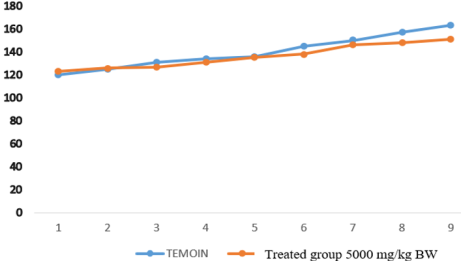
Oral administration of the aqueous extract of the plant at a dose of 5000 mg/kg BW to rats caused no signs of toxicity. Furthermore, the rats exhibited no changes in physical appearance, nor did they experience tremors or convulsions. Also, no mortality or morbidity was observed during the 14-day observation period. During the experiment, no growth disturbances were observed in the rats. However, statistical analysis showed no significant difference (p > 0.05) between the body mass of the rats receiving the single dose of extract and that of the control rats (
Figure 1).
4.3. Effects of Aqueous Extract of Moringa oleifera on Rat Blood Glucose
4.3.1. Effects of Moringa oleifera on Blood Glucose Levels in Normoglycemic Rats
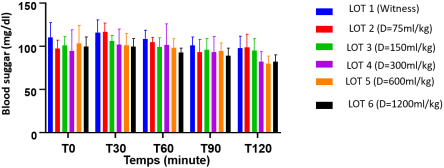
The blood glucose level of the control rats, which received only distilled water, did not vary significantly (p > 0.05) throughout the duration of this study (2 hours). It remained at 110 ± 7.662 mg/dl. Blood glucose levels in normoglycemic rats treated with aqueous extract of
Moringa oleifera leaves decreased from 97.40 ± 4.39 mg/dL to 98.60 ± 6.90 mg/dL (75 mg/kg BW dose), from 101.20 ± 4.39 mg/dL to 94.80 ± 6.30 mg/dL (150 mg/kg BW dose), from 94.40 ± 10.95 mg/dL to 82 ± 5.29 mg/dL (300 mg/kg BW dose), from 103.40 ± 9.27 mg/dL to 79.80 ± 3.94 mg/dL (600 mg/kg BW dose), and from 99.40 ± 5.10 mg/dl to 82 ± 3.64 mg/dl (1200 mg/kg BW dose). The aqueous extract of
Moringa oleifera did not cause a significant change (p > 0.05) in blood glucose levels in treated rats compared to controls (
Figure 2).
4.3.2. Effects of Aqueous Extract of Moringa oleifera on Blood Glucose Levels in Pre-treated Hyperglycemic Rats
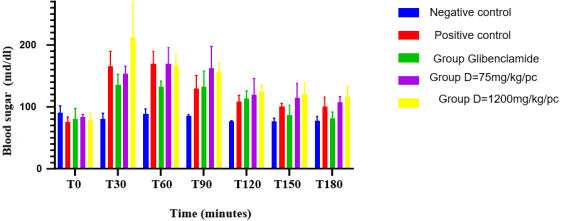
Thirty (30) minutes after administration of glucose at 4 mg/kg of BW to rats pretreated with the different substances, a significant increase (p < 0.05) in blood glucose levels was observed in the test groups and the positive control group compared to the negative control group. Blood glucose levels in the rats of the different groups increased from 76 ± 4.58 to 165.3 ± 13.90 mg/dL of BW (positive controls), from 80.33 ± 9.83 to 136 ± 9.53 mg/dL of BW (glibenclamide group), and from 83.67 ± 2.43 to 153.3 ± 6.89 mg/dL of BW in the Moringa extract group. oleifera and from 78.67 ± 6.38 to 213 ± 44.10 respectively for the groups receiving the aqueous extract at doses of 75 and 1200 mg/kg of BW. At the sixtieth (60th) minute, blood glucose levels increased to 170 ± 10.67 mg/dl, 132.3 ± 5.45 mg/dl, 169.3 ± 15.37 mg/dl and 167 ± 9.54 mg/dl respectively for the positive control group, the groups receiving glibenclamide and the extract at doses of 75 and 1200 mg/kg of BW compared to those of the negative control (88.67 ± 4.70 mg/dl of BW).
From the 120th minute onwards, a decrease in blood glucose levels was observed in all groups receiving glucose. However, these values remained significantly different compared to rats that did not receive glucose solution. The glucose levels recorded at this time were 148.3 ± 5.67, 113.7 ± 7.21, 120 ± 14.7, and 124.7 ± 5.6 mg/dL, representing reduction rates of 14.19 ± 9.89%, 16.91 ± 3.21%, 24.1 ± 14.7%, and 59.03 ± 3%, respectively, for the positive control group, the groups receiving glibenclamide, and the extract at doses of 75 and 1200 mg/kg of body mass index (BMI). At the end of the experiment (180 min), these percentage reductions in blood glucose levels were 34.27 ± 3.9%, 64.85 ± 14%, 42.13 ± 14%, and 73.39 ± 23%, respectively. It should be noted that the aqueous extract of
M. oleifera at a dose of 1200 mg/kg of BW significantly reduced blood glucose levels compared to glibenclamide (
Figure 3).
4.3.3. Effects of Aqueous Extract of Moringa oleifera on Blood Glucose Levels in Post-treatment Hyperglycemic Rats
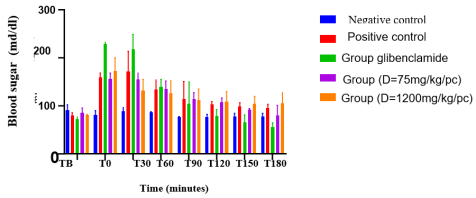
Thirty (30) minutes after administration of glucose, peaks of hyperglycemia were observed in all groups of animals that received glucose at 4 mg/kg of BW with an average of 172.333 ± 15.962 mg/dl.
Following administration of the test substances (glibenclamide or plant extract), a significant decrease in blood glucose levels was observed in treated rats starting at 60 minutes.
In the presence of glibenclamide, the rats' blood glucose levels decreased from 139 ± 9.074 mg/dL at 60 minutes to 78.67 ± 8 mg/dL (120 minutes) and then to 55.33 mg/dL at 180 minutes. In hyperglycemic rats treated with the extract, blood glucose levels decreased from 135 ± 9.20 to 126 ± 15.71 at 60 minutes, from 107 ± 5.68 to 108.3 ± 12.38 at 120 minutes, and from 80.3 ± 13.12 to 105.3 ± 12.44 at 180 minutes. The extract at doses of 75 and 1200 mg/kg of BW resulted in a decrease in blood glucose levels. Blood glucose levels increased from 135 ± 9.20 to 126 ± 15.71 at the 60th minutes, from 107 ± 5.68 to 108.3 ± 12.38 at the 120th minutes, and from 80.3 ± 13.12 to 105.3 ± 12.44 at the 180th minutes.
At the end of the experiment, glibenclamide significantly reduced blood glucose compared to the aqueous extract of
M. oleifera (
Figure 4).
Table 1. Phytochemical screening of the aqueous extract of Moringa oleifera.
Sterols | Polyphenols | Flavonoids | Tannins | Quinonic substances | Alkaloids | Saponosides |
+ | + | + | + | - | - | + |
+: presence of chemical compounds,
-: absence of chemical compounds
Figure 1. Variation in body mass of rats.
Figure 2. Effects of aqueous extract of Moringa oleifera on blood glucose levels in normoglycemic rats.
Figure 3. Effects of aqueous extract of Moringa oleifera on blood glucose levels in pre-treated hyperglycemic rats.
Figure 4. Effects of aqueous extract of Moringa oleifera on blood glucose levels in post-treated hyperglycemic rats.
5. Discussion
Phytochemical screening of the aqueous extract of Moringa oleifera revealed the presence of polyterpenes, polyphenols, alkaloids, and catecholic tannins. However, the aqueous extract of Moringa oleifera did not contain gallic tannins, flavonoids, saponins, or quinonic substances.
The presence of these various chemical compounds in the aqueous extract of
M. oleifera would explain the properties of this plant and its common use in traditional medicine. Furthermore, studies have shown that the plant's leaves contain numerous molecules with pharmacological properties, including antioxidant, anti-inflammatory, and immune-regulating properties
| [14] | Chigurupati, S., Al-Murikhy, A., Almahmoud, SA, Almoshari, Y., Ahmed, AS, Vijayabalan, S.,... & Palanimuthu, VR. Molecular docking of phenolic compounds and screening of antioxidant and antidiabetic potential of Moringa oleifera ethanolic leaves extract from Qassim region, Saudi Arabia. Saudi Journal of Biological Sciences, 2022, 29(2), 854-859.
https://doi.org/10.1016/j.sjbs.2021.10.021 |
| [15] | ShanmugaveL, G. Evaluation of phytochemical constituents of Moringa oleifera (Lam.) leaves collected from Puducherry region, South India. 2018. |
| [16] | Ajantha, A., Kathirvelan, C., Purushothaman, M. R., & Visha, P. Effect of Moringa oleifera leaf meal supplementation in broiler chicken on serum and muscle lipid profile. Journal of Pharmacognosy and Phytochemistry, 2020, 9, 464-466. |
[14-16]
.
The acute toxicity study of the aqueous extract of
M. oleifera in rats showed that this extract, administered orally, caused no mortality or clinical signs at a single dose of 5000 mg/kg of BW. These results demonstrate the non-toxicity of the aqueous extract of
Moringa oleifera. Nevertheless, based on these results, according to OECD guideline 423,
Moringa oleifera leaves would have an LD
50 greater than 5000 mg/kg of BW. These findings are consistent with the studies by
| [17] | Gupta HC, Raj J., Rathi A., Sundarame. N., Kumar S. and Manchanda RK. Morpho-anatomy of leaf, stem and root of Alternanthera sessilis (L.) R. Br. ex DC and Alternanthera pungens Kunth (Amaranthaceae) and its significance in drug Identification, Indian Journal of Medical Research-Homeopathy. 2012, 6(4): 52p.
http://dx.doi.org/10.53945/2320-7094.1843 |
[17]
. which also showed that the acetic extract of
Moringa oleifera seeds was non-toxic. Kouakou and Tahiri showed that the aqueous extract of
Moringa oleifera was not toxic orally at a dose of 5000 mg/kg DM
| [18] | Kouakou KR & Tahiri A. Phytochemical screening, acute and subacute toxicity of aqueous extract of Moringa oleifera (Moringaceae) Lam 1885 on wistar rats. Journal of Medicinal Plants. 2018, 6: 96-102. |
[18]
. Similar results were also obtained with the aqueous extract of
Amaranthus viridis by Affy and collaborateurs
| [19] | Affy ME, Blahi AN, Coulibaly FA & Kouakou K. Evaluation of acute and subacute toxicity induced by methanol extract of Amaranthus viridis (Amaranthaceae) leaves in wistar rats (Rattus norvegicus). Journal of the Pharma Innovation,. 2018, 7: 625-630. |
[19]
. Pierre and collaborateur
| [20] | Pierre M., Oya M., Madeleine OV, Ehoulé K. & Sébastien DD. Study of acute and subacute toxicities of the "natural" remedy used in the treatment of malaria, Ivorian Journal of Science and Technology, 2017, 29: 145-158. |
[20]
showed that the LD
50 of the plant-based extract was greater than 5000 mg/kg body weight. Aqueous extract of
Moringa oleifera administered to rats with normal blood glucose levels did not alter blood glucose levels compared to control rats. However, when blood glucose levels were elevated, the extract lowered blood glucose, as did glibenclamide. Furthermore, glibenclamide lowered blood glucose levels more than aqueous extract of
Moringa oleifera.The effects of the aqueous extract of
Moringa oleifera on blood glucose levels showed significant antihyperglycemic activity in treated hyperglycemic rats. Specifically, thirty minutes after the peak of hyperglycemia observed in post-treated rats, blood glucose levels decreased. Glibenclamide administered to the rats significantly reduced blood glucose levels compared to the aqueous extract of
Moringa oleifera. These properties of the
M. oleifera extract are similar to those of many medicinal plants from the African pharmacopoeia. Indeed
| [21] | Shaik AN, Ramesh BK, Swapna S., Thandaiah KT, Malaka VJK and Chippada AR. Antidiabetic and antihyperlipidemic activity of Piper longum root aqueous extract in STZ induced diabetes c rats. BMC Complementary Medicine and Therapies., 2013, 13: 37. https://doi.org/10.1186/1472-6882-13-37 |
[21]
, having studied the activity of the extract of
Piper longum (Piperaceae) roots in rats, showed that this extract had an antihyperglycemic effect. Similar results were obtained with extracts of
Nauclea latifolia (Rubiaceae)
| [22] | Mgbeje, BI, & Abu, C. Chemical fingerprinting of Nauclea latifolia, an antidiabetic plant, using GC-MS. Journal of Complementary and Alternative Medical Research, 2020, 9(4), 25-34. https://doi.org/10.9734/jocamr/2020/v9i430148 |
[22]
, Boscia
senegalensis (Capparaceae), and
Colocynthis vulgaris (Cucurbitaceae)
| [23] | Adam SMN, Mahmout1 Y., Gbenou J., Agbodjogbe W. & Moudachirou M. Antihyperglycemic effect of extracts of Boscia senegalensis (Pers.) Lam. ex Poiret and of Colocynthis vulgaris (L.) Schrad, Phytothérapie, 2011, 9: 268-273.
https://doi.org/10.1007/s10298-011-0650-5 |
[23]
, which exhibited antihyperglycemic effects in rats. These results suggest that aqueous extract of
Moringa oleifera and glibenclamide, a hypoglycemic sulfonylurea, act similarly to regulate blood glucose levels. These findings indicate that
Moringa oleifera, in addition to regulating blood glucose, may play a protective role, and therefore regular consumption could prevent cases of diabetes.
6. Conclusion
*M. oleifera* leaves on blood glucose regulation in rats. The study showed that *M. oleifera* leaves are not orally toxic. This study also demonstrated that *M. oleifera* leaves possess hypoglycemic properties, exhibiting antihyperglycemic effects. The polyterpenes, polyphenols, and alkaloids present in the aqueous extract of *M. oleifera * could be responsible for these pharmacological effects.
This experimental study will only have full scientific value if it is conducted over a relatively long period. Since the treatment of diabetes mellitus is individualized, the mechanism of action of M. oleifera must be elucidated in order to optimize its use.
Abbreviations
IDF | International Diabetes Federation |
CNF | National Floristic Center |
FACI | Manufacturing of Ivorian Compound Feed |
OECD | Organization for Economic Co-operation and Development |
BW | Boby Weight |
ANOVA | Analysis of Variance |
LD50 | Median Lethal Dose |
Acknowledgments
Authors are thankful to Translam Institute of Pharmaceutical Education and Research, Meerut, Uttar Pradesh, India for providing the necessary support and the facilities for research.
Author Contributions
Kouakou Koffi Roger: Conceptualization, Resources, Data curation, Investigation, Writing – review & editing
Kouadio Kouakou John: Data curation, Methodology, Software, Writing – original draft
Affi Mataphouet Emmanuel Guy Joslin: Supervision
Tahiri Annick: Validation
Conflicts of Interest
The authors declare no conflict of interest.
References
| [1] |
Abodo, J., Lokrou, A., Yoboué, L., & Sanogo, A. Le diabète sucré à l’Hôpital Militaire d’Abidjan: une série ambulatoire de 473 cas. Médecine des maladies métaboliques. 2008, 2(6), 639-642.
https://doi.org/10.4236/jdm.2015.53016
|
| [2] |
Peer, Nasheeta, Kengne, Andre-Pascal, Motala, Ayesha A.. Diabetes in the Africa Region: an update. Diabetes research and clinical practice, 2014, vol. 103, no 2, p. 197-205.
https://doi.org/10.1016/j.diabres.2013.11.006
|
| [3] |
Danaei G., Finucane MM, Lu Y., Sing GM, Cowan M. J & Paciorek CJ. National regional and global trends in fasting plasma glucose and diabetes prevalence since 1980: systematic analysis of health examination surveys and epidemiological studies with 370 country-years and 2.7 million participants. Lancet. 2011, 378: 31-40;
https://doi.org/10.1016/S0140-6736(11)60679-X
|
| [4] |
Shaw, JE, Sicree, RA, & Zimmet, PZ. Global estimates of the prevalence of diabetes for 2010 and 2030. Diabetes research and clinical practice, 2010, 87(1), 4-14.
https://doi.org/10.1016/j.diabres.2009.10.007
|
| [5] |
Kroa, E., Doh, SK, Soko, YN, Yohou, KS, Koulaï, OJJD, Gbogbo, M.,... & Kouassi, D. Effect of aqueous extract of stem bark of Anthocleista djalonensis A. Chev (Gentianaceae) on blood glucose in rabbits. International Journal of Biological and Chemical Sciences, 2016. 10(2), 552-558.
http://dx.doi.org10.4314/ijbcs.v10i2.9
|
| [6] |
Mamadou, Z., Assouan Kouame, AE, & Tanoh, C. Stroke of diabetic subject: experience of The Neurology Service of Cocody Teaching Hospital at Abidjan (Ivory Coast). Journal of Neurological Disorders. 2016, 4(07), 10-4172.
https://doi.org/10.4172/2329-6895.1000304
|
| [7] |
Singh, S., & Singh, R. Ethnomedicinal use of Pteridophytes in reproductive health of tribal women of Pachmarhi Biosphere Reserve, Madhya Pradesh, India. International Journal of Pharmaceutical Sciences and Research. 2016, 3(12), 4780.
https://doi.org/10.31254/phyto.2021.10610
|
| [8] |
Di Magno L, Di Pastena F, Bordone R, Coni S, Canettieri G. The Mechanism of Action of Biguanides: New Answers to a Complex Question. Cancers (Basel). 2022 Jun 30; 14(13): 3220.
https://doi.org/10.3390/cancers14133220
|
| [9] |
Gnagne AS, Djeneba C., Kouadio B., Zirihi GN. Ethnobotanical study of a medicinal plant used in the treatment of diabetes in the department of Zuénoula (Côte d'Ivoire). Journal of Applied Biosciences, 2017, vol. 113: 11257-11266.
https://doi.org/10.4314/jab.v113i1.14
|
| [10] |
Yang RayYu, Yang RayYu, et al. "Nutritional and functional properties of Moringa leaves of germplasm, plant, food and health." (2006): 1-9.
|
| [11] |
Kumbhare, M. R., Guleha, V., & Sivakumar, T. Estimation of total phenolic content, cytotoxicity and in–vitro antioxidant activity of stem bark of Moringa oleifera. Asian Pacific Journal of Tropical Disease. 2012, 2(2), 144-150.
https://doi.org/10.1016/S2222-1808(12)60033-4
|
| [12] |
Bekro, YA, Mamyrbekova, JA, Boua, BB, Bi, FT, & Ehile, EE. Ethnobotanical study and phytochemical screening of Caesalpinia benthamiana (Baill.) Herend. and Zarucchi (Caesalpiniaceae). Science & Nature. 2007, 4(2), 217-225.
https://doi.org/10.4314/scinat.v4i2.42146
|
| [13] |
OECD. Toxicity–up, acute oral. oecd guideline for testing of chemicals. organisation for economic co-operation and development: paris, france, 2001, vol. 1.
|
| [14] |
Chigurupati, S., Al-Murikhy, A., Almahmoud, SA, Almoshari, Y., Ahmed, AS, Vijayabalan, S.,... & Palanimuthu, VR. Molecular docking of phenolic compounds and screening of antioxidant and antidiabetic potential of Moringa oleifera ethanolic leaves extract from Qassim region, Saudi Arabia. Saudi Journal of Biological Sciences, 2022, 29(2), 854-859.
https://doi.org/10.1016/j.sjbs.2021.10.021
|
| [15] |
ShanmugaveL, G. Evaluation of phytochemical constituents of Moringa oleifera (Lam.) leaves collected from Puducherry region, South India. 2018.
|
| [16] |
Ajantha, A., Kathirvelan, C., Purushothaman, M. R., & Visha, P. Effect of Moringa oleifera leaf meal supplementation in broiler chicken on serum and muscle lipid profile. Journal of Pharmacognosy and Phytochemistry, 2020, 9, 464-466.
|
| [17] |
Gupta HC, Raj J., Rathi A., Sundarame. N., Kumar S. and Manchanda RK. Morpho-anatomy of leaf, stem and root of Alternanthera sessilis (L.) R. Br. ex DC and Alternanthera pungens Kunth (Amaranthaceae) and its significance in drug Identification, Indian Journal of Medical Research-Homeopathy. 2012, 6(4): 52p.
http://dx.doi.org/10.53945/2320-7094.1843
|
| [18] |
Kouakou KR & Tahiri A. Phytochemical screening, acute and subacute toxicity of aqueous extract of Moringa oleifera (Moringaceae) Lam 1885 on wistar rats. Journal of Medicinal Plants. 2018, 6: 96-102.
|
| [19] |
Affy ME, Blahi AN, Coulibaly FA & Kouakou K. Evaluation of acute and subacute toxicity induced by methanol extract of Amaranthus viridis (Amaranthaceae) leaves in wistar rats (Rattus norvegicus). Journal of the Pharma Innovation,. 2018, 7: 625-630.
|
| [20] |
Pierre M., Oya M., Madeleine OV, Ehoulé K. & Sébastien DD. Study of acute and subacute toxicities of the "natural" remedy used in the treatment of malaria, Ivorian Journal of Science and Technology, 2017, 29: 145-158.
|
| [21] |
Shaik AN, Ramesh BK, Swapna S., Thandaiah KT, Malaka VJK and Chippada AR. Antidiabetic and antihyperlipidemic activity of Piper longum root aqueous extract in STZ induced diabetes c rats. BMC Complementary Medicine and Therapies., 2013, 13: 37.
https://doi.org/10.1186/1472-6882-13-37
|
| [22] |
Mgbeje, BI, & Abu, C. Chemical fingerprinting of Nauclea latifolia, an antidiabetic plant, using GC-MS. Journal of Complementary and Alternative Medical Research, 2020, 9(4), 25-34.
https://doi.org/10.9734/jocamr/2020/v9i430148
|
| [23] |
Adam SMN, Mahmout1 Y., Gbenou J., Agbodjogbe W. & Moudachirou M. Antihyperglycemic effect of extracts of Boscia senegalensis (Pers.) Lam. ex Poiret and of Colocynthis vulgaris (L.) Schrad, Phytothérapie, 2011, 9: 268-273.
https://doi.org/10.1007/s10298-011-0650-5
|
Cite This Article
-
APA Style
Roger, K. K., John, K. K., Joslin, A. M. E. G., Nicole, K., Annick, T. (2026). Phytochemical Analysis, Acute Toxicity and Glycemic Regulation of the Aqueous Extract of Moringa oleifera Leaves in Normoglycemic and Hyperglycemic Rats. Advances in Biochemistry, 14(2), 21-27. https://doi.org/10.11648/j.ab.20261402.11
 Copy
|
Copy
|
 Download
ACS Style
Roger, K. K.; John, K. K.; Joslin, A. M. E. G.; Nicole, K.; Annick, T. Phytochemical Analysis, Acute Toxicity and Glycemic Regulation of the Aqueous Extract of Moringa oleifera Leaves in Normoglycemic and Hyperglycemic Rats. Adv. Biochem. 2026, 14(2), 21-27. doi: 10.11648/j.ab.20261402.11
Copy
|
Download
AMA Style
Roger KK, John KK, Joslin AMEG, Nicole K, Annick T. Phytochemical Analysis, Acute Toxicity and Glycemic Regulation of the Aqueous Extract of Moringa oleifera Leaves in Normoglycemic and Hyperglycemic Rats. Adv Biochem. 2026;14(2):21-27. doi: 10.11648/j.ab.20261402.11
Copy
|
Download
-
@article{10.11648/j.ab.20261402.11,
  author = {Kouakou Koffi Roger and Kouadio Kouakou John and Affi Mataphouet Emmanuel Guy Joslin and Kaltouma Nicole and Tahiri Annick},
  title = {Phytochemical Analysis, Acute Toxicity and Glycemic Regulation of the Aqueous Extract of Moringa oleifera Leaves in Normoglycemic and Hyperglycemic Rats},
  journal = {Advances in Biochemistry},
  volume = {14},
  number = {2},
  pages = {21-27},
  doi = {10.11648/j.ab.20261402.11},
  url = {https://doi.org/10.11648/j.ab.20261402.11},
  eprint = {https://article.sciencepublishinggroup.com/pdf/10.11648.j.ab.20261402.11},
  abstract = {Moringa oleifera is generally considered to have numerous therapeutic properties in traditional Ivorian medicine. The objective of this study was to evaluate the acute toxicity and blood glucose regulation in rats of an aqueous extract of Moringa oleifera leaves. Phytochemical analysis of the aqueous extract of Moringa oleifera leaves was performed using the standard staining and precipitation method. The toxicity study was conducted in accordance with OECD 423, by administering a single dose of the extract at 5,000 mg/kg body weight. The antihyperglycemic and hypoglycemic activities of Moringa oleifera extract were evaluated by administering a single dose of 75 mg/kg μg, 150 mg/kg μg, 300 mg/kg μg, 600 mg/kg μg, and 1200 mg/kg μg of aqueous Moringa oleifera extract to normoglycemic and hyperglycemic animals. The effects of the different Moringa oleifera extracts on rats were monitored for 120 minutes. Blood glucose levels were measured at 0, 30, 60, 90, 120, and 180 minutes. Phytochemical analysis showed that the extract is rich in secondary compounds such as polyphenols, flavonoids, sterols, tannins, and saponins. Moringa oleifera extract is non-toxic, with an LD50 greater than 5,000 mg/kg body weight. Aqueous Moringa oleifera extract administered to normoglycemic rats did not induce hypoglycemia or hyperglycemia. Aqueous Moringa oleifera extract significantly reduced anhydrous glucose-induced hyperglycemia in hyperglycemic rats, from 170 mg/dL to approximately 78 mg/dL. These results confirm the regulatory properties of Moringa oleifera on blood glucose levels in Wistar rats.},
 year = {2026}
}
Copy
|
Download
-
TY  - JOUR
T1  - Phytochemical Analysis, Acute Toxicity and Glycemic Regulation of the Aqueous Extract of Moringa oleifera Leaves in Normoglycemic and Hyperglycemic Rats
AU  - Kouakou Koffi Roger
AU  - Kouadio Kouakou John
AU  - Affi Mataphouet Emmanuel Guy Joslin
AU  - Kaltouma Nicole
AU  - Tahiri Annick
Y1  - 2026/04/16
PY  - 2026
N1  - https://doi.org/10.11648/j.ab.20261402.11
DO  - 10.11648/j.ab.20261402.11
T2  - Advances in Biochemistry
JF  - Advances in Biochemistry
JO  - Advances in Biochemistry
SP  - 21
EP  - 27
PB  - Science Publishing Group
SN  - 2329-0862
UR  - https://doi.org/10.11648/j.ab.20261402.11
AB  - Moringa oleifera is generally considered to have numerous therapeutic properties in traditional Ivorian medicine. The objective of this study was to evaluate the acute toxicity and blood glucose regulation in rats of an aqueous extract of Moringa oleifera leaves. Phytochemical analysis of the aqueous extract of Moringa oleifera leaves was performed using the standard staining and precipitation method. The toxicity study was conducted in accordance with OECD 423, by administering a single dose of the extract at 5,000 mg/kg body weight. The antihyperglycemic and hypoglycemic activities of Moringa oleifera extract were evaluated by administering a single dose of 75 mg/kg μg, 150 mg/kg μg, 300 mg/kg μg, 600 mg/kg μg, and 1200 mg/kg μg of aqueous Moringa oleifera extract to normoglycemic and hyperglycemic animals. The effects of the different Moringa oleifera extracts on rats were monitored for 120 minutes. Blood glucose levels were measured at 0, 30, 60, 90, 120, and 180 minutes. Phytochemical analysis showed that the extract is rich in secondary compounds such as polyphenols, flavonoids, sterols, tannins, and saponins. Moringa oleifera extract is non-toxic, with an LD50 greater than 5,000 mg/kg body weight. Aqueous Moringa oleifera extract administered to normoglycemic rats did not induce hypoglycemia or hyperglycemia. Aqueous Moringa oleifera extract significantly reduced anhydrous glucose-induced hyperglycemia in hyperglycemic rats, from 170 mg/dL to approximately 78 mg/dL. These results confirm the regulatory properties of Moringa oleifera on blood glucose levels in Wistar rats.
VL  - 14
IS  - 2
ER  -
Copy
|
Download





 Share This Article
 Twitter
 Linked In
 Facebook