
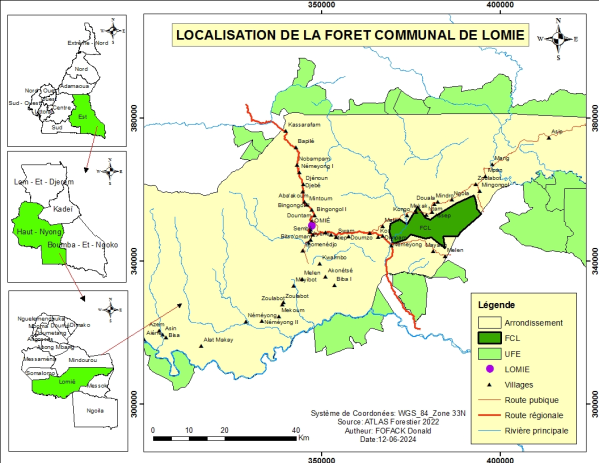
This study examined the environmental impacts of logging and strategies aimed at minimising damage: the case of BK Business Sarl in the Eastern Region of Cameroon. The methodological approach focused on two plots, each 250 m long by 20 m wide, covering a total area of 0.5 ha. Surveys were carried out using four transects to cover each plot. A survey was carried out on tree trunks with a diameter of ≥ 10 cm, measured using a dendrometric tape at chest height (1.30 m). 125 people were interviewed (70 Baka, 35 Zime, 17 loggers from BK Business and 3 loggers from the Lomie communal forest). These individuals were selected on the basis of their connection to the Lomie communal forest and the various activities they carry out. Descriptive statistics were used to analyse logging damage, whilst a participatory, goal-oriented approach was adopted to gather proposals for priority measures aimed at reducing damage caused by logging operations. The results show that skidding is the forestry operation that causes the most damage (10.53 per cent) due to the type of formation and equipment used in the process; felling comes second with a disturbance rate of 10.15 per cent; road construction causes less damage, with a rate of 9.24 per cent; and clearing timber yards is the forestry operation that causes the least damage to the ground, at just 6.2 per cent. In order to limit the environmental impact of forestry operations, various strategies have been considered: controlled felling; the implementation of staff training programmes; mapping the locations of trees to be felled; limiting the width of skid trails to 4-5 metres and the area of timber yards to a maximum of 0.5 hectares; and holding site managers accountable through the introduction of a remuneration system based on the nature of the damage caused and on their performance bonuses.
| Published in | Agriculture, Forestry and Fisheries (Volume 15, Issue 5) |
| DOI | 10.11648/j.aff.20261505.14 |
| Page(s) | 181-188 |
| Creative Commons |
This is an Open Access article, distributed under the terms of the Creative Commons Attribution 4.0 International License (http://creativecommons.org/licenses/by/4.0/), which permits unrestricted use, distribution and reproduction in any medium or format, provided the original work is properly cited. |
| Copyright |
Copyright © The Author(s), 2026. Published by Science Publishing Group |
Environmental Impact, Logging, Strategies, Damage, BK Business Sarl
Types of damage | Main road | Secondary road | Timber yard | Felling | Skid track | Total |
|---|---|---|---|---|---|---|
Damaged | 364 | 321 | 121 | 1,445 | 520 | 2,771 |
Stripped of bark | 83 | 63 | 3 | 301 | 377 | 827 |
De-branched | 160 | 142 | 0 | 497 | 0 | 799 |
Broken | 121 | 116 | 118 | 647 | 143 | 1145 |
Lost | 576 | 527 | 1079 | 522 | 1,521 | 4,225 |
Uprooted | 468 | 409 | 1062 | 0 | 1314 | 3,253 |
Toppled | 7 | 21 | 17 | 422 | 112 | 579 |
Crushed | 101 | 97 | 0 | 100 | 95 | 393 |
Total | 940 | 848 | 1,200 | 1967 | 2,041 | 6,996 |
(%)/ residual stem (19.371) | 4.85 | 4.37 | 6.19 | 10.15% | 10.53 | 36.09 |
Forestry operation | Number of stems lost | % of total lost stems | % of the remaining stand |
|---|---|---|---|
Main road | 940 | 13.44 | 4.85 |
Secondary road | 848 | 12.13 | 4.37 |
Timber yard | 1,200 | 17.15 | 6.19 |
Felling | 1967 | 28.11 | 10.15 |
Logging track | 2041 | 29.17 | 10.53 |
Total damage | 6,996 | 100.00 | 36.09 |
Total remaining stand | 19,371 |
Sectors of activity | Priority actions | Responsible parties |
|---|---|---|
Planning of logging operations | Priority 1: Draw up a sampling and clearing plan prior to the actual logging operations | Operator: BK Business Sarl |
Priority 2: Mark trees for felling, future tree species and skid roads | Operator: BK Business Sarl | |
Priority 3: Avoid steep slopes and low-lying areas | Operator: BK Business Sarl | |
Felling, Delimbing and Logging Sector | Priority 4: Train staff in best practices for low-impact forestry operations (directional felling) | MINFOF / Operator: BK Business Sarl |
Priority 5: Protect future stems of primary and secondary tree species during logging operations (use wedges and winches to control the direction in which large-diameter trees fall) | Logging operator: BK Business Sarl | |
Priority 6: Comply with the standards (diameter) for harvestable tree species whilst prohibiting the felling of seed trees and future-generation tree species | MINFOF / Logging operator: BK Business Sarl | |
Sector: Skidding, Marking of skid trails | Priority 7: Adhere to the skid trails that have been marked out for the inventory | MINFOF / Operator: BK Business Sarl |
Priority 8: During the logging process, the team in charge must ensure that low-impact machinery is used | Operator: BK Business Sarl | |
Priority 9: Carry out skidding in dry weather to minimise the formation of ruts, ridges and holes in the ground caused by the repeated passage of skidding machinery | Operator: BK Business Sarl | |
Infrastructure (creation of log yards and skid trails) | Priority 10: Limit the width of tracks to 4-5 m and log yards to 0.5 ha | MINFOF / Operator: BK Business Sarl |
Priority 11: Reduce skidding distances by increasing the density of the network | Operator: BK Business Sarl | |
Priority 12: Install structures to combat soil erosion | Operator: BK Business Sarl | |
Monitoring, Auditing and Training | Priority 13: Annual training and refresher courses for staff on health, safety and the environment (HSE) | MINFOF / Operator: BK Business Sarl |
Priority 14: Implement a quarterly audit to ensure compliance with standards during the logging phase | MINFOF | |
Priority 15: Implement a payment system for compensation linked to damage rates for each logging operation | MINFOF | |
Post-logging | Priority 16: Plant cover species on degraded and/or bare areas | Operator: BK Business Sarl |
Priority 17: Close tracks and skid trails not used during the logging period | Operator: BK Business Sarl | |
Priority 18: Assess damage over a six-month period following logging operations | MINFOF / Operator: BK Business Sarl |
UFE | Forest Management Unit |
AAC | Annual Felling Quota |
FCL | Lomie Communal Forest |
DBH | Diameter at Breast Height |
PGOA | Participatory, Goal-Oriented Approach |
HSE | Health, Safety and the Environment |
EFIR | Low-Impact Forestry |
| [1] | Asad, S., V. Vitalis, R. Guharajan, J. F. Abrams, P. Lagan, J. Kissing, J. Sikui, A. Wilting, and M.-O. Rödel. Variable species but similar amphibian community responses across habitats following reduced impact logging. Global Ecology and Conservation 35: e02061. 2022. |
| [2] | Doucet J.-L., Daïnou K., Ligot G., Ouédraogo D. Y., Bourland N., Ward S. E., Tekam P., Lagoute P. & Fayolle A. Enrichment of logged forests in Central Africa with high-value tree species: testing a new approach to regenerating degraded forests. International Journal of Biodiversity Science, Ecosystem Services & Management. 2016, |
| [3] | Dzeudjou K. L. A., Foudjet A. E. and Asseng V. A. Contribution to reducing logging impacts on woody vegetation and the soil: The case of the Minta communal forest, AAC 1-4, in Cameroon. Network of Forestry and Environmental Training Institutions in Central Africa - RIFFEAC. 2019, |
| [4] | Eba’a Atyi R., Guillaume, L., Jonas, N., Poufoun, T. M. F., Abdon, A., Betti, J-L., Cerutti, P. O., Chupezi, T. J., Defo, L, Foundjem, T. D., Kana, R., Mvondo, A. J-P., Ngassi, M., Ngoungoure, M. A., Nkou, J-P., Nlom, J-H., Sonwa, D. J., Walde, Z., Study of the economic and social importance of the forestry and wildlife sector in Cameroon. The Centre for International Cooperation in Agricultural Research for Development (CIRAD). 2013, (accessed on 10 May 2026) |
| [5] | Food and Agriculture Organisation (FAO). Global Forest R sources Assessment. Rome. 2025. |
| [6] | Food and Agriculture Organisation FAO. The State of the World’s Forests. Forests, biodiversity and people. Rome. 2020. |
| [7] | Fosso C. L., Assessment of damage caused by logging to young trees: the case of UFA 10 060, AAC 2-4 of the SCTB. Final-year dissertation for the degree of Engineer in Water, Forestry and Game Management. Faculty of Agronomy and Agricultural Sciences, University of Dschang, Cameroon, 2013, 101 pp. |
| [8] | Halloran, K. M., J. C. Guzy, J. A. Homyack, and J. D. Willson. Effects of timber harvest on survival and movement of stream salamanders in a managed forest landscape. Ecosphere 12: e03489. 2021. |
| [9] | Hansen M. C., Potapov P. V., Moore R., Hancher M., Turubanova S. A., Tyukavina A., Thau D., Stehman S. V., Goetz S. J., Loveland T. R., Kommareddy A., Egorov A., Chini L., Justice C. O. & Townshend J. R. G., High-resolution global maps of 21st-century forest cover change. Science. 2013, |
| [10] | Hardy, C., C. Messier, O. Valeria, and E. Filotas. A LANDIS-II extension for simulating forest road networks. Canadian Journal of Forest Research 53: 503-518. 2023. |
| [11] |
International Technical Association for Tropical Timber ATIBT. Activity-report-2023 Available from:
https://www.atibt.org/files/upload/Activity_report/ATIBT (accessed on 15 June 2026). |
| [12] |
International Tropical Timber Organisation ITTO. ITTO Biennial Review and Global Timber Situation Report 2017-2018. Available from:
https://www.itto.int/biennal_review (accessed on 17 July 2026). |
| [13] | Kleinschroth, F., and J. R. Healey. Impacts of logging roads on tropical forests. Biotropica 49: 620-635. 2017. |
| [14] | Mbete, P., Mopoundza, P., Mbete, R., Bienet, M., Ngokaka, C., Assessment of the impact of logging operations on vegetation and wildlife in the Mokabi Forest Management Unit. Single-volume doctoral thesis. Faculty of Science and Technology. Marien NGOUABI University. Congo-Brazzaville, 2014, 217 pp. |
| [15] | Nasi R., Taber A. & Vliet N. V., Empty forests, empty stomachs? Bushmeat and livelihoods in the Congo and Amazon Basins. International Forestry Review. 13, 355-368. 2011, |
| [16] | Ozer E. J., Youth-Led Participatory Action Research: Developmental and Equity Perspectives. Science Direct. 2016, |
| [17] | Torterotot, J.-B., C. Perrier, N. E. Bergeron, and L. Bernatchez. Influence of forest road culverts and waterfalls on the fine-scale distribution of brook trout genetic diversity in a boreal watershed. Transactions of the American Fisheries Society 143: 1577-1591. 2014. |
APA Style
Dadem, C., Atchombou, J. B., Fofack, D. (2026). Environmental Impact of Logging and Strategies for Reducing Damage: A Case Study of BK Business Sarl in Eastern Cameroon. Agriculture, Forestry and Fisheries, 15(5), 181-188. https://doi.org/10.11648/j.aff.20261505.14
ACS Style
Dadem, C.; Atchombou, J. B.; Fofack, D. Environmental Impact of Logging and Strategies for Reducing Damage: A Case Study of BK Business Sarl in Eastern Cameroon. Agric. For. Fish. 2026, 15(5), 181-188. doi: 10.11648/j.aff.20261505.14
@article{10.11648/j.aff.20261505.14,
  author = {Christelle Dadem and Jean Baurel Atchombou and Donald Fofack},
  title = {Environmental Impact of Logging and Strategies for Reducing Damage: A Case Study of BK Business Sarl in Eastern Cameroon},
  journal = {Agriculture, Forestry and Fisheries},
  volume = {15},
  number = {5},
  pages = {181-188},
  doi = {10.11648/j.aff.20261505.14},
  url = {https://doi.org/10.11648/j.aff.20261505.14},
  eprint = {https://article.sciencepublishinggroup.com/pdf/10.11648.j.aff.20261505.14},
  abstract = {This study examined the environmental impacts of logging and strategies aimed at minimising damage: the case of BK Business Sarl in the Eastern Region of Cameroon. The methodological approach focused on two plots, each 250 m long by 20 m wide, covering a total area of 0.5 ha. Surveys were carried out using four transects to cover each plot. A survey was carried out on tree trunks with a diameter of ≥ 10 cm, measured using a dendrometric tape at chest height (1.30 m). 125 people were interviewed (70 Baka, 35 Zime, 17 loggers from BK Business and 3 loggers from the Lomie communal forest). These individuals were selected on the basis of their connection to the Lomie communal forest and the various activities they carry out. Descriptive statistics were used to analyse logging damage, whilst a participatory, goal-oriented approach was adopted to gather proposals for priority measures aimed at reducing damage caused by logging operations. The results show that skidding is the forestry operation that causes the most damage (10.53 per cent) due to the type of formation and equipment used in the process; felling comes second with a disturbance rate of 10.15 per cent; road construction causes less damage, with a rate of 9.24 per cent; and clearing timber yards is the forestry operation that causes the least damage to the ground, at just 6.2 per cent. In order to limit the environmental impact of forestry operations, various strategies have been considered: controlled felling; the implementation of staff training programmes; mapping the locations of trees to be felled; limiting the width of skid trails to 4-5 metres and the area of timber yards to a maximum of 0.5 hectares; and holding site managers accountable through the introduction of a remuneration system based on the nature of the damage caused and on their performance bonuses.},
 year = {2026}
}
TY  - JOUR
T1  - Environmental Impact of Logging and Strategies for Reducing Damage: A Case Study of BK Business Sarl in Eastern Cameroon
AU  - Christelle Dadem
AU  - Jean Baurel Atchombou
AU  - Donald Fofack
Y1  - 2026/10/20
PY  - 2026
N1  - https://doi.org/10.11648/j.aff.20261505.14
DO  - 10.11648/j.aff.20261505.14
T2  - Agriculture, Forestry and Fisheries
JF  - Agriculture, Forestry and Fisheries
JO  - Agriculture, Forestry and Fisheries
SP  - 181
EP  - 188
PB  - Science Publishing Group
SN  - 2328-5648
UR  - https://doi.org/10.11648/j.aff.20261505.14
AB  - This study examined the environmental impacts of logging and strategies aimed at minimising damage: the case of BK Business Sarl in the Eastern Region of Cameroon. The methodological approach focused on two plots, each 250 m long by 20 m wide, covering a total area of 0.5 ha. Surveys were carried out using four transects to cover each plot. A survey was carried out on tree trunks with a diameter of ≥ 10 cm, measured using a dendrometric tape at chest height (1.30 m). 125 people were interviewed (70 Baka, 35 Zime, 17 loggers from BK Business and 3 loggers from the Lomie communal forest). These individuals were selected on the basis of their connection to the Lomie communal forest and the various activities they carry out. Descriptive statistics were used to analyse logging damage, whilst a participatory, goal-oriented approach was adopted to gather proposals for priority measures aimed at reducing damage caused by logging operations. The results show that skidding is the forestry operation that causes the most damage (10.53 per cent) due to the type of formation and equipment used in the process; felling comes second with a disturbance rate of 10.15 per cent; road construction causes less damage, with a rate of 9.24 per cent; and clearing timber yards is the forestry operation that causes the least damage to the ground, at just 6.2 per cent. In order to limit the environmental impact of forestry operations, various strategies have been considered: controlled felling; the implementation of staff training programmes; mapping the locations of trees to be felled; limiting the width of skid trails to 4-5 metres and the area of timber yards to a maximum of 0.5 hectares; and holding site managers accountable through the introduction of a remuneration system based on the nature of the damage caused and on their performance bonuses.
VL  - 15
IS  - 5
ER  -
Department of Forestry & Faculty of Agronomy and Agricultural Sciences, University of Dschang, Dschang, Cameroon
Department of Forestry & Faculty of Agronomy and Agricultural Sciences, University of Dschang, Dschang, Cameroon

Information



 Share This Article
 Twitter
 Linked In
 Facebook

 Copy
 Download