Research Article | | Peer-Reviewed

Evaluation, Resource Potential and Industrial Field of Application for Omo River Valley Marble, Southern Ethiopia

Received: 14 May 2026     Accepted: 22 June 2026     Published: 18 August 2026
Views:       Downloads:
Abstract

This research work was currently found in the Southern National Regional State of Debub Omo river valley, southern Ethiopia. It is conducted for mainly to delineate a marble resource found within the Korcho, Wolayte and Basa localitie in order to specify its field of application accordingly the field observation and study. The geological mapping, geochemical analysis and other bulk physical study have been applied and the main methodologies during the study. The study area consists marble, granite, quartz, feldspar and other base metals. Based on geochemical result indicates the presence of 26.68 to 35.16 wt% of CaO recorded about 30.07 in average and 14.18 to 20.8wt% MgO with an average value of 19.5wt%. The combined result of geological and geochemical result indicates that the original source rock is dolomite and it is categorized as dolomitic marble. Marble is used as a filler, coloring agent for industrial uses for instance as a paper, cosmetics, for plastic as well as pottery also important for the acid neutralization of soils and other in rivers, lakes, soils and ponds, inert filler in pills, pharmaceutical industry, in making sculptures and ornaments and for many others are commune application fields of marble (and it is also used as building or dimension stone and for others. The quantitative determination of marble from section logging and profile description indicate a total of based on our study about 8.71*106 ton marble resource is calculated during this study. However, this marble deposit investigated is over the figure if all the marble deposit of the area is studied and estimated. Therefore, the marble deposit of the area is dolomitic marble in its originated.

Published in American Journal of Applied and Industrial Chemistry (Volume 10, Issue 1)
DOI 10.11648/j.ajaic.20261001.12
Page(s) 12-29
Creative Commons

This is an Open Access article, distributed under the terms of the Creative Commons Attribution 4.0 International License (http://creativecommons.org/licenses/by/4.0/), which permits unrestricted use, distribution and reproduction in any medium or format, provided the original work is properly cited.

Copyright

Copyright © The Author(s), 2026. Published by Science Publishing Group

Keywords

Origin, Dolomitic Marble, Industrial field of Applications

1. Introduction
Igneous, the metamorphic as well as the sedimentary formations are practically cropped out within all direction preferable of Ethiopia, . the Clastic sedimentary successions rock depositions in the geologically depressed basin is the primary depositional site for in order to accumulate a number of industrial and other metallic minerals. The crystalline basement rocks of Ethiopia are geologically found in association with the sedimentary and igneous rocks are contains different minerals because subjecting to metamorphic process as well as continues surface and subsurface alterations process taken place . Those metamorphosed and crystalline and basement formations of the country are geologically cropped out the in four corners of Ethiopia . The southern Ethiopian geology is affected by both the Mozambique belt and east African rift extension and truncated by the NE–SW trending border faults . The crystalline basement rocks, metallic minerals with other associated bulk resources found in region of Sidamo and other south and western (Wollega) area were studied during the project work of United Nation pro-gram in join tinting with Ethiopian . The Omo river basins sedimentary and crystalline basements and Kenya and South Sudan studied by . This river valley and the metamorphic terrain of the region consist of various indus-trial and other bulk resources . The southern Omo river basin is one of the main studied site for the natural resource of oil and gas researching area for numerous interpretation and conclusions But, for this time this basin was the targeted sit for exploration work and evaluation for industrial minerals resources specifically to explore and investigate marble mineral and others like a granite resource as well as other base metals and gemstone minerals. The Omo basin valley is characterized by its abundant geological formations like sediments of siliclastic rocks metasedimentary, altered quartzo feldespatic, with associated mafic to ultramafic met-amorphic rock combinations . The interest of industrial re-source demands with scarce supply for those industrial minerals take attentions for exploring the marble resource within the southern Omo river basin and other related basins other basins . Therefore, current exploration work for marble resource was the best and critical solution for the deficient supply of marble resource for the building, kitchen cabinets, boarding as well as for a number of industrial uses.
1.1. Location of the Sty Area
Omo river valley was currently found in the Southern National Regional State of Debub Omo Zone with in Dimeka woreda. The target areas are accessed through about 720 km main asphalt of Addis Ababa Hawassa-Arbaminch and take to Turmi town.
Figure 1. Location and accessibility map of the area.
1.2. Physiographic Conditions of the Study Area
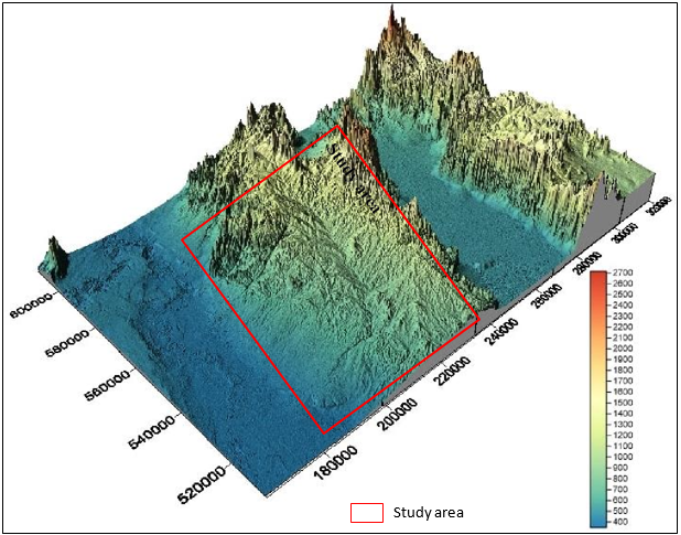
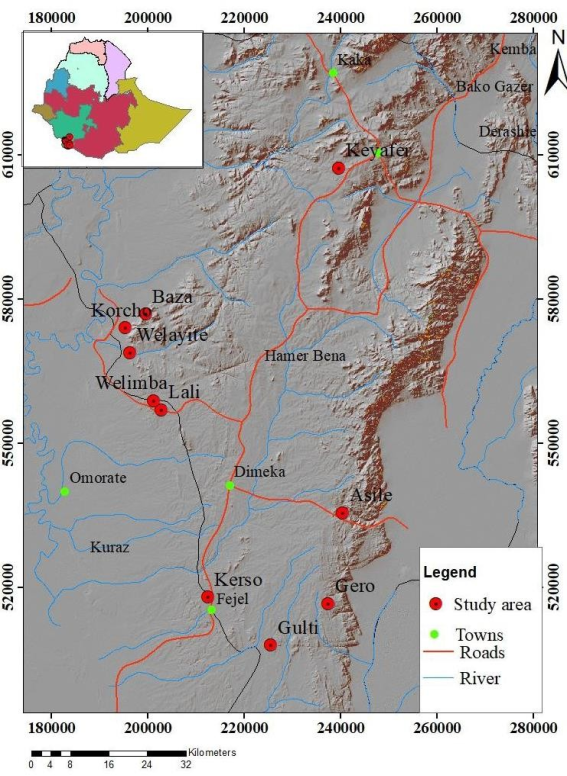
The physiographic features of Omo river basin is described by its irregular fashions which is formed due to the tectonic activities, river cuts and volcanic activities.
Figure 2. Physiographic map of the study area and surroundings.
2. Objective of the Study
The main objective of this work is to delineate the marble resource of Omo river valley and to characterize the industrial field of applications based on its quality.
2.1. Regional Geology
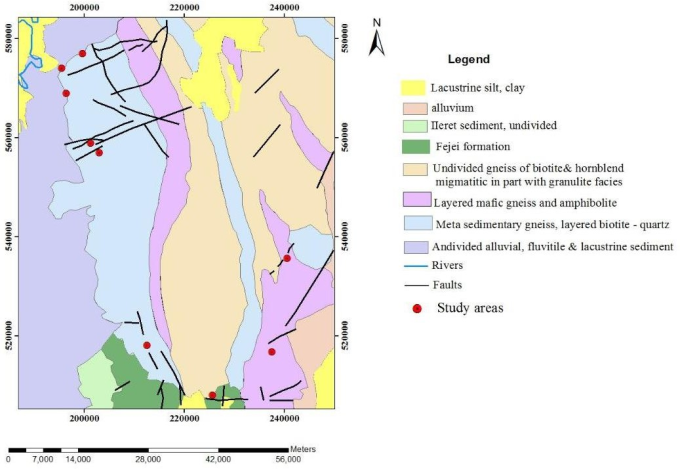
The regional geological formation of the southern and south western Ethiopia was studied in detail by different scientists and other local investors for the area. Southern Ethiopia including Konso and its surroundings are geologically described by high grade metamorphism, pre and plutonic of intrusions and recent alluvial sediments to tertiary volcanic of rock varieties . The southern Ethiopian intrusive and granitic rocks are typical characteristics of post tectonic formations that show the Pan African Mozambique (high grade) belt evolution . Geological and geochemical works of Omo river area were done by . This project work indications of other base metals including copper, Zinc cobalt, Nickel and kaolin occurrences.
2.2. Marble Resource of Ethiopia
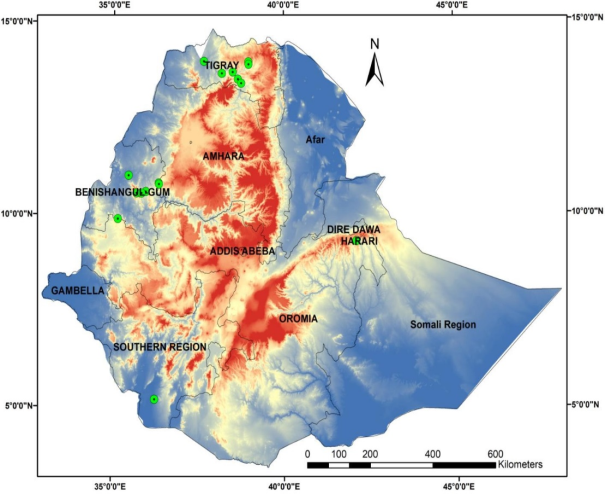
Most of the marble resource of Ethiopia its outcrops are characterized as ridge varies from former steep cliff-forming, white color to gray and coarse grained compositionally dominated by calcite mineral. A major geological and geochemical works has been done by a joint Ethio-Canadian Project from at a scale of 1: 250,000 and the results were briefly discussed, interpreted and compiled at a scale of 1: 500,000 . A calcite marble at least 60m thick is located 15km northeast of the junction of the Sagan and Galana Dulei, but its extent is concealed by recent sediments in the Woito valley. This marble exposure lies very close to the truck route west of Konso . The marble deposit is found on the other different parts of Ethiopia in addition to this study area such as; western part of Ethiopian, well known deposits found around the Daleti, Bulen, Mora, Zigi, Baruda and Mankush as illustrated on the marble map of Ethiopia below (see the green dots).
Figure 3. Regional geological map of the area (Ethio- Canadan, 1972-1974). Regional geological map of the area (Ethio- Canadan, 1972-1974).
Figure 4. Marble resource distribution map of Ethiopia .
3. Methodology
3.1. Geological Mapping of the Study Area
Conducting the geological mapping during the field work was the main methodology that applied for this research work. It is mapped for marble re-source exploration conducting the field work and practical observation using map at 1: 10000. Mapping was done for identification and descriptions of the marble, lithological and structural identification and collection of representative samples of marble minerals as a rock and from the surrounding rock variability. Logging of pits and thickness estimation from the gully and river cuts are conducted during mapping.
3.2. Geochemical Analysis
Geochemical analysis was used to understand the geochemical behaviors of the rock and marble mineralization mechanisms for the study area. Major and, trace element and some other element analysis were conducted by this method.
3.3. Satellite Image Analysis and Interpretations
The satellite image study were used in order to distinguishing the lithological variations and mineralized zones of the area. This method is used to clearly understand the felsic and mafic compositions of the rock from the ultramafic compositions of the study area. By using this remote sensing method the marble resource could have been easily differentiated and explored from the crystalline basement rock of southern Ethiopia.
4. Geology of the Study Area
Current research work is found in the southern Ethiopia which is geologically comprises of the Mozambique belt of high grade gneisses including the migmatitic rocks variations. The geological formation of the area was mainly characterized by its highly deformed and metamorphosed with secondary alteration of the felsic to mafic as well as ultramafic rock compositions. The main and dominant geologic formation of the area is described in detail as listed below:-
4.1. Amphibolite Gneiss
This rock unit is exposed mainly at the welayte area as quarry site and other localities in small extent. It varies in composition from very mafic rich to felsic rich ones. It has alternations of variable in color vary from dark green to light green mafic bands with the grayish alternation sialic bands (Figure 5).
Figure 5. Amphibolite gneiss interbeded with other sialic bands.
4.2. Quartzo Feldespatic Gneiss
This project site is dominantly characterized by its leucocratic and melanocritic rock formations of varieties . The quartzo feldspatic rock unit is the main lithology within current study area. This rock type is consists of both quartz and feldspar composition and other mica minerals. It is light gray color with medium and coarse grained texture characteristics and frequently weathered from the field observation. The quartzo feldspathic gneiss are compositionally layered by k-feldspar and biotitic rich as well as deformed and metamorphosed (Figure 6).
Figure 6. Compositional layering and deformed quartzo feldspatic and amphibolite gneiss.
4.3. The Meta Sedimentary Gneissic Formation
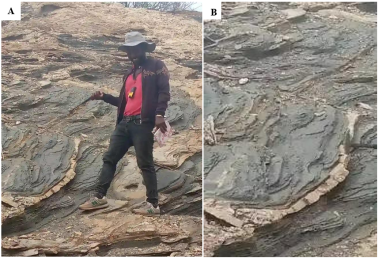
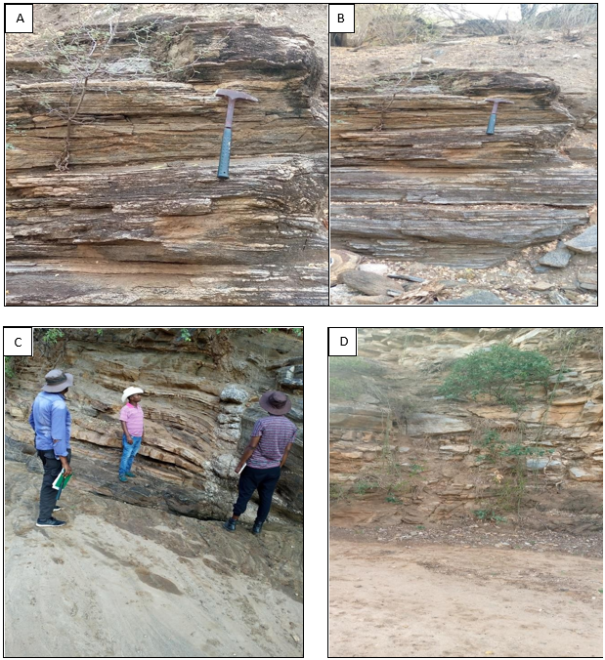
In general the southern Ethiopian basement and associated intrusive rocks was characterized by its variable high grade gneiss. It is predominantly originated tectonically altered from the crustal sediments as well as plutonic intrusions. This metasedimentary rock variability and gneisses was typical of sedimentary origin with the highly degree of deformed rocks. The tectonic deformation of this rocks types was governs the general orientation to the N-S striking and little deviations to the N-W to E of general orientations. The composition characteristics of this meta-sedimentary gneiss are different from felsic to mafic and shows the preferred horizontal layering (Figure 7). It shows high degree of foliations and has well developed layers of banded felsic and mafic variability of rock formation. The metasedimentary rock a formation of the research area was extremely metamorphosed with tectonically deformed and affected by plutonic intrusions (Figure 7). Those rock units are mainly on the account of its preferable layered and characteristics as shown in the (Figure 7).
Figure 7. Horizontally bedded gneiss.
4.4. Feldspars and Pegmatite
The feldspatic gneiss is the most common rock compositions in the area. It is characterized by mainly pegmatite and feldspars. The pegmatite of the area is exposed in dike and vein fillings. It is very coarse grain pegmatite is exposed as a vein form especially at the adjacent contact of feldspar and met sedimentary gneisses. K- Feldspar dominated and pink colors are the typical pegmatite. Beside that there are huge potential of feldspar derived from metasedimentary and quartzo feldspatic gneiss.
Figure 8. Feldspar bearing gneiss cut by stream.
5. Geology of the Deposit
The current study areas in which the Omo river basin found at the southwest parts of the country at Ethio-Kenya boundary in the rift system characterized by various mineral resources including geothermal energies and the rift kaolinite deposits . Several marble beds interbedded with metasedimentary gneiss were the most considerable and described lithological formation of study areas. The marble resource of the area was commonly non foliated and metamorphosed rocks formed as aresult of metamorphism processes that govern for high pressure temperature conditions and compositionally contains calcite, dolomite, and other carbonate mineral-bearing rocks of the area and surrounding. The main areas of under investigation that consisted of marble resource are described below.
5.1. Korcho Marble
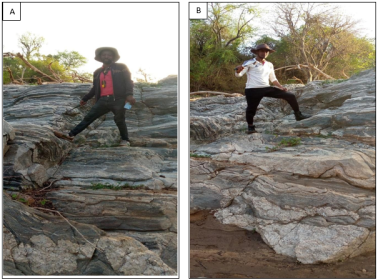
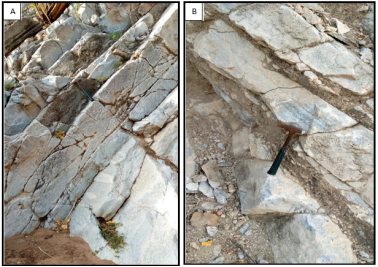
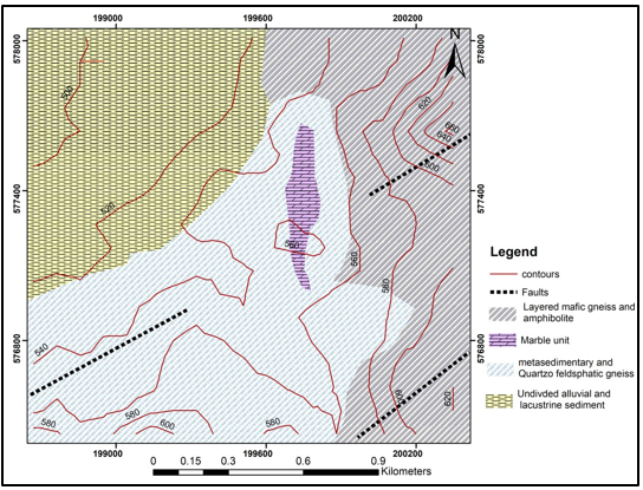
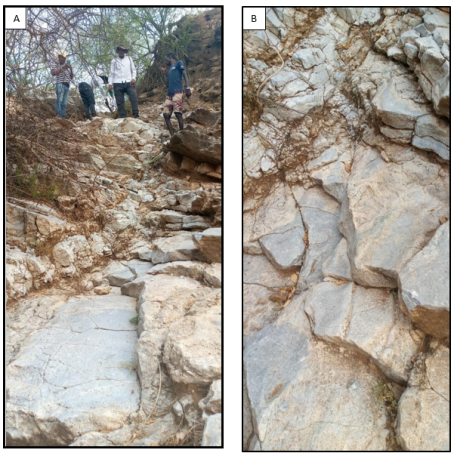
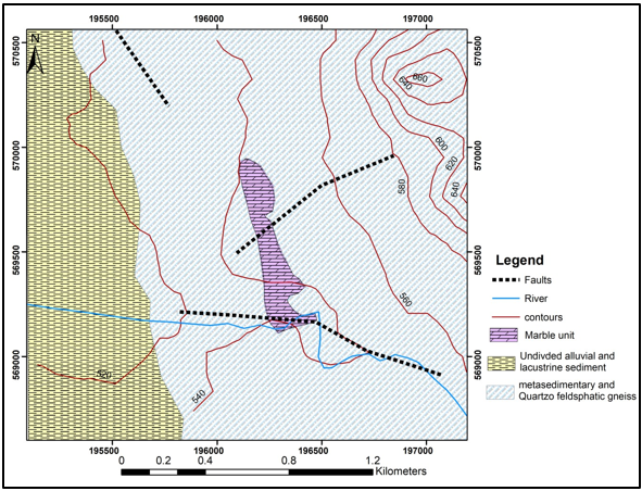
This is the most extensive marble deposit of the area which is found at Korcho kebele. It is oriented at N530E. These marble exposures are due to quarry site. The nature of the outcrop varies from boulders to block size usually in small block and show rough surfaces and shows some fractured. The dolomitic marble mostly occurs as interlayer within other gneiss rocks show as infilling veinlets or other. The marble deposit of the area is relatively white in color and boulders to blocks of massive marble are found. Therefore, it has been of considerable interest as dimension stone. This is fine to medium grained and at some parts shows medium to coarse grained texture, commonly dull to grey color with subordinate white to light grey.
Figure 9. Marble exposures of Korcho site that is tilted.
Figure 10. Geological map of Korcho block.
5.2. Gulti Marble
The dolomitic marble has usually smooth surface in the outcrop and the color varies from light grey to dull grey and rarely white, it also sometimes contains dark spots within the white variety. The Gulti marble is exposed near the river cut and in the hill topography of the area. It is systematically jointed and surficially fractured marble. Gulti marble is texturally coarse grained and massive to slightly fractured in morphology. This marble is characterized by the surface alteration and oxidized by secondary minerals. The marble bedding of this site shows sharp contact and confirmable orientation with the lower meta-sedimentary rock. The grain size generally varies from medium to coarse with few fine grained at places.
Figure 11. Dolomitic marble exposures at Minwegelty locality.
Figure 12. Geological map of Gulty block.
5.3. Kersa Marble
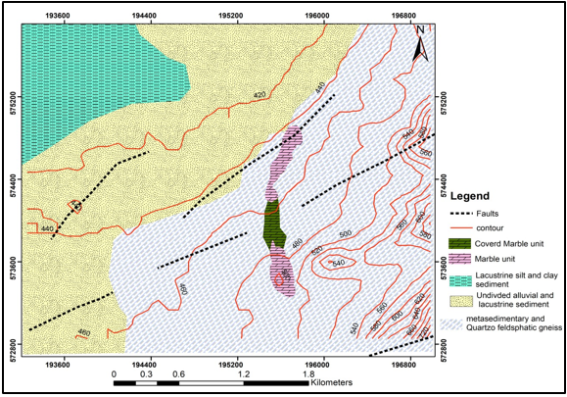
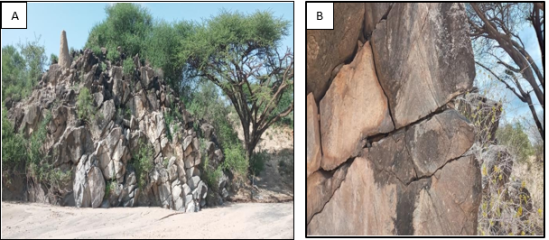
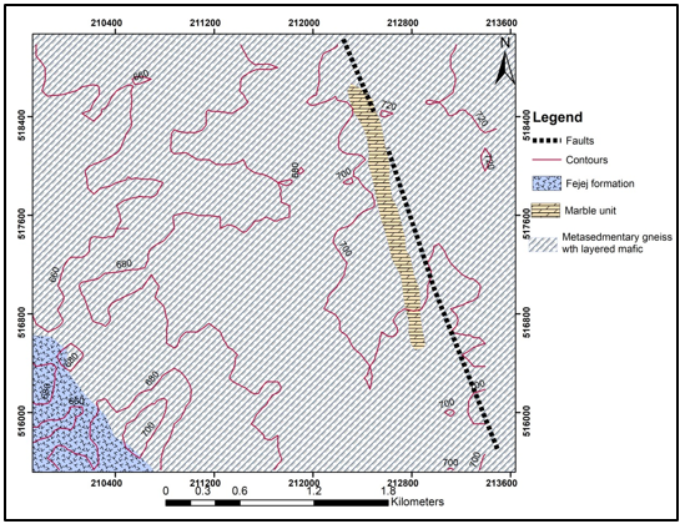
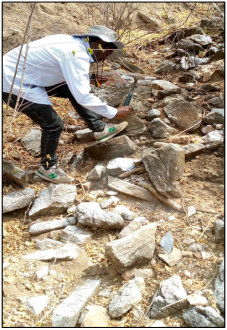
Kerso marble is located in the south east of Turmi within Minwegeliti kebele. It is thin and elongated layers of marble reach up to 2 km length. This exposure is typically characterized by extensive beading and oriented to the N-S to N100W direction which is conformable to the surrounding rock. The marble mineralization of this site is coarse to medium in texture and white in color. It is very long in length to the north direction and narrower in width to the east and west. This marble is exposed on the ridge of the area however the exposure is not continuous throughout the ridge. The marble exposure is systematically exposed and at the same time covered by the surrounding feldspar, pegmatite and quartz veins of the area. This site contains boulders, massive, floated and fragmented exposures of marble mineralization. The marble of this area is slightly jointing and fracturing as compared with other sites of marble mineralization. Compositionally it is calcite dominated and contains very few impurities of other mineral. Slightly affected by geological deformations and the marble mineralization cover large area of the flat and ridges of the area. However the marble of this site is surficially weathered and altered due to other secondary minerals.
Figure 13. Hill to ridge forming lithology of Kersa marble.
Figure 14. Geological map of Kersa block.
5.4. Baza Marble
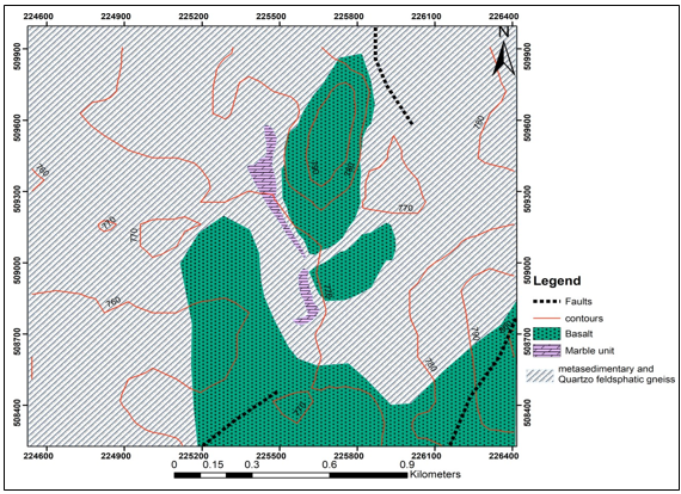
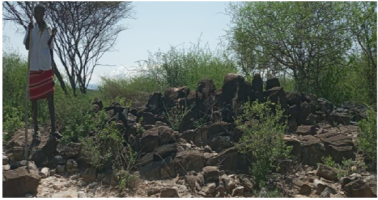
Baza marble exposure is found in the south west direction of Turmi town. The area is characterized by the highly ragged topography and highly forest cover. It is exposed in the ridge and within the valise of the area. The marble of this site is characterized by very white in color and massive to fragment. Ridges and valleys of the site have orientations of N-S and the marble is exposed within this ridge topography. The marble mineralization of this area is affected by pegmatite and feldspar vines. Baza marble is very coarse in texture and has fewer impurities of any clay and other minerals. The thickness of baza marble varies in the ridge (1-2m) and river (3-4) section. The Baza marble mineralization is characterized by massive and non-surface alteration especially in the river cut. Whereas the marble exposed in the hills and ridges are show frequent surface oxidization of copper with green color alteration to the marble surface. This surface alteration is due to the ionic substitutions of Ca2+ and Cu2+ during surface oxidation process.
Figure 15. Blocks to boulder exposures of Baza marble.
Figure 16. Geological map of Baza block.
5.5. Welayite Marble
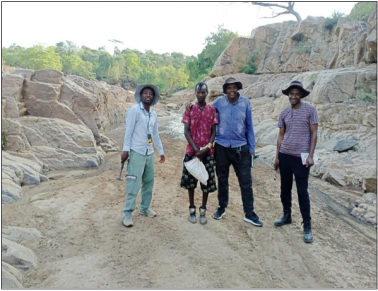
Wolayite marble exposure is mainly exposed by the wolayite river cut and quarry conducted for the concrete of Omo Kuraz factory and construction purposes. The marble mineralization of the area has two layers of marble that is exposed by the stream. The thickness of the upper layer is reach up to 6m thick while, the exact thickness of the lower marble is not known. The marble of this site is compositionally dolomitic. It is alternating in color from white to partially white grey. This marble is hosted by highly affected by tectonic faulting and feldspatic vines and dyke.
Figure 17. Stream cut exposures of marble at Welayite locality.
Figure 18. Geological map of Welayite block.
6. Result and Discussion
Table 1. Major element analysis result of marble and other rocks.

FIELD NO

SiO2

Al2O3

Fe2O3

CaO

MgO

Na2O

K2O

MnO

P2O5

TiO2

H2O

LOI

KCM 1

2.26

1.25

0.08

30.1

19.66

0.28

<0.01

<0.01

<0.01

<0.01

0.3

44.75

KCM 2

1.42

2.22

0.4

29.92

19.94

0.04

<0.01

<0.01

0.01

<0.01

0.09

44.86

KCM 3

3.28

1.67

<0.01

31.08

20.06

0.1

<0.01

<0.01

<0.01

<0.01

0.05

45.02

KCM 4

4.98

1.11

<0.01

30.06

19.78

<0.01

<0.01

<0.01

<0.01

<0.01

0.08

45.26

KCM 2-1

2.9

2.5

0.04

30.26

20.32

0.22

<0.01

<0.01

<0.01

<0.01

0.09

44.26

KCM 2-9

65.48

19.7

0.42

<0.01

1.02

2.74

9.56

<0.01

<0.01

<0.01

0.31

1.45

KCM 2-6

1.3

<0.01

<0.01

30.38

20.64

<0.01

0.52

<0.01

<0.01

<0.01

0.53

45.34

KCM 2-7

5.78

<0.01

<0.01

30.2

20.58

<0.01

0.34

<0.01

<0.01

<0.01

0.26

42.03

Wtm 1

4.16

<0.01

<0.01

29.82

20.6

<0.01

0.36

<0.01

<0.01

<0.01

0.27

44.86

Wtm -4

6.02

<0.01

0.3

31

18.66

<0.01

0.3

<0.01

0.02

<0.01

0.1

43.85

KW-3

3

1.55

0.16

30.3

20.8

<0.01

<0.01

<0.01

<0.01

0.01

0.76

44.45

BAZM-3

3.28

1.48

0.24

31.26

19.92

<0.01

<0.01

<0.01

<0.01

0.02

0.62

44.58

BAZM-2

3.72

1.55

0.2

31.06

18.76

<0.01

<0.01

<0.01

<0.01

<0.01

0.4

44.26

KIZ 2-1

4.5

3.02

0.56

31.78

18

<0.01

<0.01

<0.01

<0.01

<0.01

0.45

43.14

KIZ 1-1

30.2

1.78

0.56

26.68

17.6

<0.01

0.1

<0.01

<0.01

<0.01

0.77

23.6

KIZ-1

55.2

20.79

8.86

2.48

5.5

2.18

1.94

0.08

0.35

0.4

1.1

1.51

Table 2. Major element analysis result of marble and other rocks.

FIELD NO

SiO2

Al2O3

Fe2O3

CaO

MgO

Na2O

K2O

MnO

P2O5

TiO2

H2O

LOI

GOMR-1

4.24

1.72

0.5

30.16

19

<0.01

<0.01

0.04

<0.01

0.03

1.53

42.83

LM 1-1

11.84

1.82

<0.01

27.66

19.64

<0.01

<0.01

<0.01

0.02

<0.01

0.94

38.22

UM-2

41

18.4

13.16

12.32

9.24

1.44

0.48

0.18

0.02

0.79

0.48

1.32

WRD-1

53.06

16.2

8.6

11.28

5.54

3.66

0.72

0.12

0.12

0.35

0.42

1.14

GRP-1

45.84

9.51

5.12

13.58

5.82

1.04

1.78

0.08

0.1

0.2

1.29

17.05

ZLG-2

74.98

12.95

2.58

0.66

0.28

4.04

4.3

0.04

<0.01

0.1

0.26

0.63

ZBG-1

73.34

13.14

2.58

0.56

0.62

2.88

5.72

0.02

<0.01

0.19

0.24

0.91

GMG-1

73.66

12.13

4.64

1.54

0.82

2.98

4.64

0.06

0.33

0.31

0.21

0.52

GMG-3

68.54

13.87

4.54

2.2

1.08

3.24

5.58

0.04

0.16

0.31

0.21

0.5

KIZM-1

76.72

12.84

0.04

<0.01

0.04

1.74

9.24

<0.01

<0.01

<0.01

0.22

0.42

UM-1

54.1

4.16

7.34

10.78

18.34

0.9

0.36

0.14

<0.01

0.09

0.49

4.49

WRS-4

97.96

<0.01

0.2

<0.01

0.02

<0.01

0.08

<0.01

<0.01

0.03

0.17

0.19

JQ-1

98.94

<0.01

0.22

<0.01

0.6

<0.01

0.08

<0.01

<0.01

<0.01

0.19

0.47

KM-5

6

<0.01

<0.01

29.84

20.36

1.2

0.36

<0.01

<0.01

<0.01

0.24

43.39

GM 1-1

4.76

1.31

<0.01

27.9

20.6

0.12

0.4

<0.01

<0.01

0.06

0.19

44.63

WT-1

5.06

1.68

<0.01

27.72

20.56

0.02

0.34

0.02

<0.01

0.02

0.21

43.02

KM-5

53.46

6.91

10.58

12.18

14.68

1.26

0.94

0.2

<0.01

0.1

0.22

0.82

Wt-6

50.64

7.59

8.14

19.22

10.34

0.68

0.8

0.14

<0.01

0.1

0.23

1.33

KM-3

4.46

3.17

0.16

29.2

20.06

<0.01

<0.01

<0.01

0.23

<0.01

<0.01

43.56

KM-1

4.42

0.43

0.76

35.16

14.18

<0.01

<0.01

0.06

0.24

<0.01

<0.01

43.59

Table 3. Trace element (RRE) analysis result of marble, mafic ultramafic rocks and others.

Sample code

Cu (ppm)

Zn (ppm)

Pb (ppm)

Co (ppm)

Ni (ppm)

KM-6

5.2

5.4

13.8

8.4

17

Wt -4

10

62.2

<0.01

55.6

89.2

Wt-2

<0.01

7.8

13.2

8.6

30.8

Wt-5

3

64.8

13.8

44

142.2

GM-1

<0.01

5

14

9.2

25.2

GM-3

<0.01

11.2

20

9.8

25

GM-4

0.4

6

14.8

8.2

25.8

GM-6

<0.01

7.6

17.4

9

26.2

GOM -1

<0.01

5.2

17.6

10

26.4

KIZ-1-1

<0.01

31

18

20.6

51.6

Um-2

0.4

91.6

18.2

59.2

96.8

UM-1

5.6

34.2

15.6

47.8

428.6

KM-5

<0.01

5

23.8

9

30.8

Wt-6

0.8

48.4

14.2

45.6

158.6

Table 4. Physical property laboratory result of marble and granite samples.

Sample Code

Bulk density (g/cm3)

Water absorption

Porosity

KCM 1-3

2.84

0.21

0.6

BAZM -1

2.82

0.36

1.01

GMG-2

2.66

0.54

1.46

GM-5

2.81

0.29

0.84

KM-2

2.84

0.23

0.66

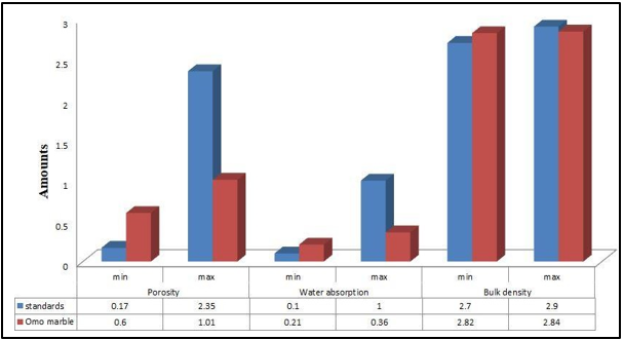
Figure 19. Physical properties of marble and granite.
6.1. Discussion on Major Element Composition
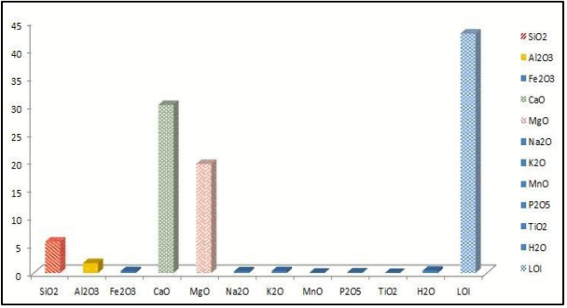
The major oxide elements of geochemical analyses for 24 marble samples as a rock form and 13 granite, feldspar and other mafic to ultramafic rocks were studied for their chemical analysis. From analyzed result the average chemical analyses of 24 marble samples indicate about 5.6 (SiO2), 30.07 (CaO), 19.5 (MgO), 1.76 (Al2O3), 0.33 (Fe2O3), 42.8 (LOI) and minor other oxides and elemental concentrations. This analyzed outcome result of the collected samples indicates that the dolomite marble is high quality resource this type of marble can be used for various field of applications. The bulk or physical property tests also fall within acceptable limits that seated by different industries. The Korcho, Wolaite and gult marble resources are compared with resources of other different countries, its quality and compositional variability is of shows a general similar resources used by various industries. The marble of the targeted area concentration in terms of CaO has inversely relationship with SiO2, Al2O3, K2O, Fe2O3, and its MgO concentration is correlated with the concentration of those major elements are decreases with increase of CaO concentration.
Figure 20. Major element compositions of marble.
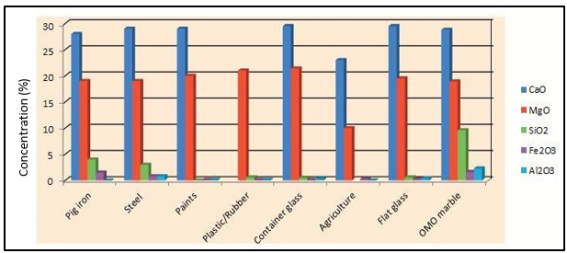
The major oxide analysis results of Omo dolomitic marble has been compared with the raw material specifications (standard values) of dolomite mineral used for direct application with different industries that use marble. As indicated on the graph below more than 74% of CaO of the study area marble was fulfill for industrial fields of applications, were as more than 65% MgO concentration fulfill the industrial application for pig iron, steel, flat glass and agriculture purposes. The Fe2O3 concentration of the current marble resource of this research work is fulfill for all industrial applications mention below. The main drawback of this marble is contains a relatively higher concentrations of Al2O3 and SiO2. Because the most industries require less concentration of Al2O3 and SiO2 however, concentrations of those major oxides are higher than the standards or specification (Figure 21). The USSR standard specifications for Dolomite marble for glass field of application include the <34 (CaO), >18 (MgO), < 1 (Al2O3), < 0.4 (Fe2O3), <1.5 (SiO2).
Figure 21. Major element comparison of Omo marble with other standards.
6.2. Origin of Marble
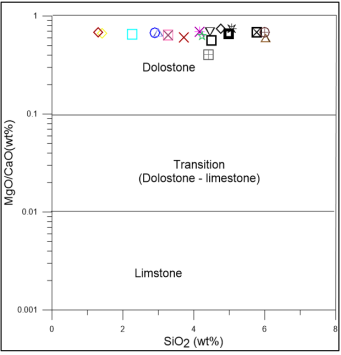
The origin of marble is understood from its high content of the major oxide MgO that related with dolomitic marble origin. In the other cause the high concentration of CaO oxide with the low concentration of MgO oxide rivals that the genetic origin is limestone. The geochemical results of MgO/CaO vs. SiO2 major oxide diagram (Figure 22) given below shows that all of the analyzed marble and host rock samples are failed within the dolostone zone of the diageram. Therefore this indicates the origin of the marble is dolomite. It is formed when the dolomitic protolithic were affected by metamorphism processes and altered to marble.
Figure 22. Binary diagram on the origin of marble.
6.3. Comparison with Other National and International Deposits
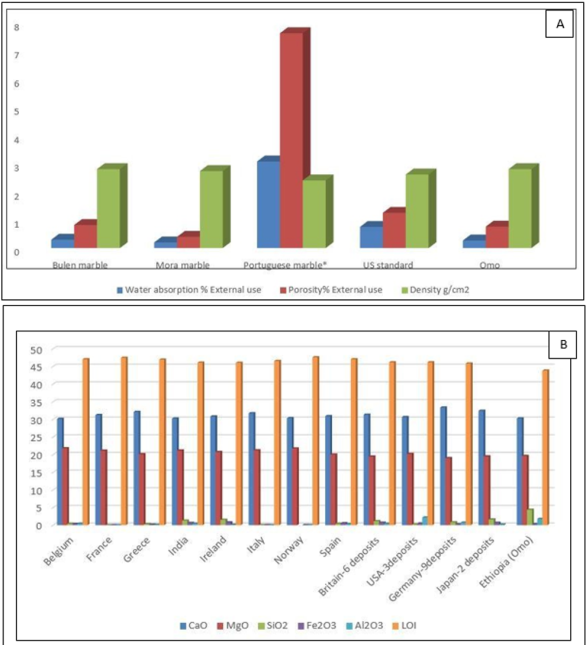
The geochemical results and other the physical property of the Omo river valley marble is compared with other international marble deposit for its industrial uses. This comparison is important due to those major oxides and elements and a physical property of the marble resource is play a great role on its industrial use. Among those main constitute of major oxide and trace element value of analyzed marble resource is close relationship in order to feat with other international marble deposit except the higher content of SiO2 and Al2O3. The physical properties of Omo river valley marble were compared with the marble deposit of Ethiopia in the same manner. Therefore, its water absorption, porosity and bulk density of the Omo basin marble is best correlation with other marble deposit found in Ethiopia see (Figure 23). As compared this marble with USA standard it shows the low value of porosity and the bulk density. This international and country wise comparison indicates that the highly compacted Omo marble is due to the presence of high degree of metamorphism in the region.
Figure 23. Physical properties (A) and major element (B) comparison of marble with other international deposit.
7. Conclusions
The geological study of Omo basin marble indicates that there is a number of geological and geochemical processes the presence for the genetic formation. The felsic to mafic intrusive rocks, alluvial sediments and other volcanic rocks are the common formations. Among those meta sedimentary and gneiss of the study area is the main host of marble resource of Omo. The physical and geochemical analysis and properties of the Omo marble indicates that it is field is application is for various industrial purposes. The most and main uses of the Omo marble are for the dimension stone, for agriculture, for pig iron and steel and for the flat glass. Generally marble is characterized by common non-foliated and metamorphic rock formation that could be originated from carbonate rock (limestone or dolomite) however, according to the binary diagram of the MgO/CaO vs. SiO2 major oxide diagram shows that most of analyzed marble and surrounding rock samples are failed within the dolostone zone and the origin of protolithic rock is dolomite. From common two types of major marble types such as calcite and dolomitic marble, based on the ternary diagram CaO, MgO, and SiO2 all of the collected samples of Omo marbles are found in the region of dolomitic marble range and this Omo river basin marble is originated from the dolomitic type of marble by its genetic formation. According to the result Omo marble is applicable for the dimension stone (partially due to slightly jointed on the field observation), important for the filler and used as coloring and agent for industries like paper, cosmetics for beauty, for plastic and putty and, acid neutralization of soils and in rivers, lakes and pond water, inert filler in pills, pharmaceutical industry, in making sculptures and ornaments. In addition to those uses marble is for the calcium addictive feeds for the dairy of animals for instance chickens and for cows, used for floor tiles, stair treads, for window sills and for other industrial field of applications.
Abbreviations

USA

United State of America

REE

Rare Earth Elements

Acknowledgments
We would like to give our sincere gratitude to Geological Institute of Ethiopia for providing an opportunity to study the project. Also we have thanks Southern Nations and Nationals mine office who follow up our work and for their encouragements.
Author Contributions
Belayneh Digafe Tulu: Conceptualization, Data curation, Formal Analysis, Investigation, Methodology, Software, Visualization, Writing – original draft
Getenet Gezahegn Yemer: Conceptualization, Data curation, Formal Analysis, Methodology, Software, Visualization
Mastewal Tamene Mekonen: Data curation, Formal Analysis, Investigation, Methodology, Software
Data Availability Statement
The data is available from the corresponding and other authors were generated during the field study.
Conflicts of Interest
The authors declare no conflicts of interest.
References
[1] Mohr, P. (1987). Patterns of faulting in the Ethiopian Rift Valley. Tectonophysics, 143: 169–179.
[2] Danilo A. J., 1966. About the geology of southwestern Ethiopia and Mineral occurrences of Ethiopia, Ministry of mine, Addis Ababa, Ethiopia.
[3] Davidson A. et al., 1975. Omo River project Preliminary Report No. 2, 10pp.
[4] Davidson A., 1983. Reconnaissance Geology and Geochemistry of Parts of Ilubabor, Kefa, Gemu Gofa and Sidamo, Ethiopia Bulletin no. 2, p. 19-30.
[5] Davidson A., et al., 1973. Omo River project Preliminary Report NO. 1, P. 20-22.
[6] Said Mohammed, Tigistu Melka and Tutan Negash (2009). Report onDetail Exploration of Marble Resource of Mankush Area, Benishangul-Gumuz National Regional State, Metekel Zone, Guba wereda, Ministry of Mines and Energy, Geological Survey of Ethiopia.
[7] Gilboy, C. F., 1970. The geology of the Gariboro region of southern Ethiopia.
[8] Kazmin V., 1975. The Precambrian geology of Ethiopia and some aspects of the geology of the Mozambique belt. Bulletin of geophysical observatory Addis Ababa.
[9] Kazmine, V., 1972. Geology of Ethiopia, Explanatory notes to Geological Map of Ethiopia 1: 2,000,000, Ethiopian Institute of Geological Surveys, addis Ababa, Ethiopia.
[10] Melesse M. and Demerew Y., 2003. Report on the Geology, Geochemistry and Geophysics of Konso area, Southwestern Ethiopia, p. 17-40.
[11] Mohr. 1960. Described the geology of the southern Ethiopian rift valley.
[12] United Nation program (1967 and 1971). The Southern (Sidamo) and south western (Wollega) crystalline basements of Ethiopia are studied for metallic and associated industrial mineral potentials.
[13] Hutchison, J.W., Mather, T. A., Pyle, D. M., Biggs, J. and Gezahegn Yirgu (2015). Structural controls on fluid pathways in an active rift system: A case study of the Aluto volcanic complex. Geosphere, 11(3): 1-21.
[14] A. Asrta, P. Barbey and G. Gleizes (2001). The Precambrian geology of Ethiopia. Africa Geoscience review, vol. 8 No. 3, pp 271-288.
[15] Ionut Octavian Zăuleț, Rodica-Mariana Ion, Claudiu Eduard Rizescu (2022). Evaluation of marble alteration processes. Vol. 18.
[16] Syed Amjad Ali Bukhari, Muhammad Basharat, Haluk Akgün, Yasir Sarfraz and Muhammad Tayyib Riaz (2021). An evaluation of the geotechnical characteristics of Gahirat marble using empirical methods: A case study from the Chitral area, Khyber Pakhtunkhwa, North Pakistan. Journal of Himalayan Earth Sciences, Vol. 54 No. 2, pp 28-39.
[17] Alemu Shiferaw, Eyobe Gebere Leule, Mengeshs Tefra, Alemayehuwolde Rufaele, A. Davidson, J. M. Moore and J. C. Davies (1972-74). Geological map for Omo river project area.
[18] Yafet gebrewold birhane (2019). Characterization and evaluation of structural permeability of the northern Lake Abaya geothermal field, southern main Ethiopian rift.
[19] Getnet Gezahegn (2019). Genesis and characterization of Alem Tena kaolin occurrences, Koka area, main Ethiopian rift.
Cite This Article
  • APA Style

    Tulu, B. D., Yemer, G. G., Mekonen, M. T. (2026). Evaluation, Resource Potential and Industrial Field of Application for Omo River Valley Marble, Southern Ethiopia. American Journal of Applied and Industrial Chemistry, 10(1), 12-29. https://doi.org/10.11648/j.ajaic.20261001.12

    Copy | Download

    ACS Style

    Tulu, B. D.; Yemer, G. G.; Mekonen, M. T. Evaluation, Resource Potential and Industrial Field of Application for Omo River Valley Marble, Southern Ethiopia. Am. J. Appl. Ind. Chem. 2026, 10(1), 12-29. doi: 10.11648/j.ajaic.20261001.12

    Copy | Download

    AMA Style

    Tulu BD, Yemer GG, Mekonen MT. Evaluation, Resource Potential and Industrial Field of Application for Omo River Valley Marble, Southern Ethiopia. Am J Appl Ind Chem. 2026;10(1):12-29. doi: 10.11648/j.ajaic.20261001.12

    Copy | Download

  • @article{10.11648/j.ajaic.20261001.12,
      author = {Belayneh Digafe Tulu and Getenet Gezahegn Yemer and Mastewal Tamene Mekonen},
      title = {Evaluation, Resource Potential and Industrial Field of Application for Omo River Valley Marble, Southern Ethiopia},
      journal = {American Journal of Applied and Industrial Chemistry},
      volume = {10},
      number = {1},
      pages = {12-29},
      doi = {10.11648/j.ajaic.20261001.12},
      url = {https://doi.org/10.11648/j.ajaic.20261001.12},
      eprint = {https://article.sciencepublishinggroup.com/pdf/10.11648.j.ajaic.20261001.12},
      abstract = {This research work was currently found in the Southern National Regional State of Debub Omo river valley, southern Ethiopia. It is conducted for mainly to delineate a marble resource found within the Korcho, Wolayte and Basa localitie in order to specify its field of application accordingly the field observation and study. The geological mapping, geochemical analysis and other bulk physical study have been applied and the main methodologies during the study. The study area consists marble, granite, quartz, feldspar and other base metals. Based on geochemical result indicates the presence of 26.68 to 35.16 wt% of CaO recorded about 30.07 in average and 14.18 to 20.8wt% MgO with an average value of 19.5wt%. The combined result of geological and geochemical result indicates that the original source rock is dolomite and it is categorized as dolomitic marble. Marble is used as a filler, coloring agent for industrial uses for instance as a paper, cosmetics, for plastic as well as pottery also important for the acid neutralization of soils and other in rivers, lakes, soils and ponds, inert filler in pills, pharmaceutical industry, in making sculptures and ornaments and for many others are commune application fields of marble (and it is also used as building or dimension stone and for others. The quantitative determination of marble from section logging and profile description indicate a total of based on our study about 8.71*106 ton marble resource is calculated during this study. However, this marble deposit investigated is over the figure if all the marble deposit of the area is studied and estimated. Therefore, the marble deposit of the area is dolomitic marble in its originated.},
     year = {2026}
    }
    

    Copy | Download

  • TY  - JOUR
    T1  - Evaluation, Resource Potential and Industrial Field of Application for Omo River Valley Marble, Southern Ethiopia
    AU  - Belayneh Digafe Tulu
    AU  - Getenet Gezahegn Yemer
    AU  - Mastewal Tamene Mekonen
    Y1  - 2026/08/18
    PY  - 2026
    N1  - https://doi.org/10.11648/j.ajaic.20261001.12
    DO  - 10.11648/j.ajaic.20261001.12
    T2  - American Journal of Applied and Industrial Chemistry
    JF  - American Journal of Applied and Industrial Chemistry
    JO  - American Journal of Applied and Industrial Chemistry
    SP  - 12
    EP  - 29
    PB  - Science Publishing Group
    SN  - 2994-7294
    UR  - https://doi.org/10.11648/j.ajaic.20261001.12
    AB  - This research work was currently found in the Southern National Regional State of Debub Omo river valley, southern Ethiopia. It is conducted for mainly to delineate a marble resource found within the Korcho, Wolayte and Basa localitie in order to specify its field of application accordingly the field observation and study. The geological mapping, geochemical analysis and other bulk physical study have been applied and the main methodologies during the study. The study area consists marble, granite, quartz, feldspar and other base metals. Based on geochemical result indicates the presence of 26.68 to 35.16 wt% of CaO recorded about 30.07 in average and 14.18 to 20.8wt% MgO with an average value of 19.5wt%. The combined result of geological and geochemical result indicates that the original source rock is dolomite and it is categorized as dolomitic marble. Marble is used as a filler, coloring agent for industrial uses for instance as a paper, cosmetics, for plastic as well as pottery also important for the acid neutralization of soils and other in rivers, lakes, soils and ponds, inert filler in pills, pharmaceutical industry, in making sculptures and ornaments and for many others are commune application fields of marble (and it is also used as building or dimension stone and for others. The quantitative determination of marble from section logging and profile description indicate a total of based on our study about 8.71*106 ton marble resource is calculated during this study. However, this marble deposit investigated is over the figure if all the marble deposit of the area is studied and estimated. Therefore, the marble deposit of the area is dolomitic marble in its originated.
    VL  - 10
    IS  - 1
    ER  - 

    Copy | Download

Author Information
  • Mineral Exploration and Evaluation, Geological Institute of Ethiopia, Addis Ababa, Ethiopia
  • Mineral Exploration, Bero Mining P.L.C., Addis Ababa, Ethiopia

  • Mineral Exploration and Evaluation, Geological Institute of Ethiopia, Addis Ababa, Ethiopia

  • Abstract
  • Keywords
  • Document Sections

    1. 1. Introduction
    2. 2. Objective of the Study
    3. 3. Methodology
    4. 4. Geology of the Study Area
    5. 5. Geology of the Deposit
    6. 6. Result and Discussion
    7. 7. Conclusions
    Show Full Outline
  • Abbreviations
  • Acknowledgments
  • Author Contributions
  • Data Availability Statement
  • Conflicts of Interest
  • References
  • Cite This Article
  • Author Information