
In this research, simulated technical and economic analysis of off-grid photovoltaic power system with back-up generators for GSM base station using PVsyst simulation software is presented. The case study load profile comprising of 9 key components has peak power demand of 3325 W and daily energy demand of 58580 Wh. The solar radiation has annual mean of 4.2041 and standard deviation of 1.6018 while the temperature has annual mean of 25.32 and standard deviation of 1.1595. There is no outlier in the solar radiation but the temperature has three outliers, which are, 21.8, 28.7, 28.8. The PV power system has 60 units of PV modules and 112 units of battery for the battery bank. There is solar fraction of 1.0 is all the months except in the month of July where the solar fraction is 0.934 which required the backup generator to supply the energy short fall of 119.4 kWh in July for a total duration of for 39.83 hours. The economic analysis results show that the installation cost according is 10,969,000 Naira while the operating cost is 940,422.08 Naira per year. The unused energy cost is 56,883 naira per kWh. The feed-in-tariff for the energy generated from the solar power system is 170 naira per kWh. The payback period for the system is 4.3 years. That means after 4.3 years, the investment cost of the project will be recovered. The return on investment is 377.7% which means the project is very profitable.
| Published in | American Journal of Energy Engineering (Volume 14, Issue 2) |
| DOI | 10.11648/j.ajee.20261402.15 |
| Page(s) | 83-98 |
| Creative Commons |
This is an Open Access article, distributed under the terms of the Creative Commons Attribution 4.0 International License (http://creativecommons.org/licenses/by/4.0/), which permits unrestricted use, distribution and reproduction in any medium or format, provided the original work is properly cited. |
| Copyright |
Copyright © The Author(s), 2026. Published by Science Publishing Group |
Economic Analysis of PV System, Off-grid Photovoltaic Power System, PVsyst Simulation Software, Solar Powered GSM Base Station, Technical Analysis of PV System
S/N | Load Description | Q T Y | Power Rating (W) | Total Power Demand (W) | Duration of opera tion (h) | Energy Demand (Wh) |
|---|---|---|---|---|---|---|
1 | Base station transceiver | 2 | 40 | 80 | 24 | 1920 |
2 | Connecting microwave | 1 | 75 | 75 | 24 | 1800 |
3 | Air conditioner | 1 | 1200 | 1200 | 24 | 28800 |
4 | Halogen lamp | 3 | 200 | 600 | 12 | 7200 |
5 | Aviation warning light | 5 | 160 | 800 | 12 | 9600 |
6 | LED light | 5 | 20 | 100 | 24 | 2400 |
7 | Security light | 3 | 120 | 360 | 12 | 4320 |
8 | Motion and proximity sensor | 1 | 30 | 30 | 24 | 720 |
9 | CCTV setup | 1 | 80 | 80 | 24 | 1920 |
3325 | 58680 |
GSM | Global System for Mobile Communications |
CBT | Computer-based Testing |
PV | Photovoltaic |
LOL | Loss of Load |
PVOGS | PV Off-grid Solar |
| [1] | U. S. Omoruyi, Y. T. Olasunkanmi, T. F. Gandonu, O. B. John, O. O. Adebayo, S. A. Nurein and B. O. Oke, "Impact of Global System for Mobile Communication (GSM) on the Development of Small-Scale Enterprises in Nigeria," Path of Science, vol. 11, no. 1, pp. 2018-2025, 2025. |
| [2] | M. A. Enahoro and D. B. Olawade, "GSM and the Nigerian Economy: The Journey from 2004 to 2019," International Journal of Economics and Finance, vol. 13, no. 7, p. 69, 2021. |
| [3] | R. USIADE and F. Obianke, "Comparative Analysis of 4G GSM Network Services in Nigeria using the ABCD Model," Innovative Journal of Engineering, vol. 2, no. 2, pp. 36-47, 2021. |
| [4] | J. A. Anitha, "Revolutionizing Education: The Multifaceted Role of Cloud in Modern e-Learning Environment," in In Cloud Computing for Smart Education and Collaborative Learning, 2025. |
| [5] | P. Parini, S. N. Rahmi, F. G. Bili and A. Ayaka, "Implementation of a Cloud-Based E-Learning System for Integrated Learning in Higher Education," Journal of Computer Science Advancements, vol. 2, no. 6, pp. 420-433, 2024. |
| [6] | U. O. Matthew, J. S. Kazaure and N. U. Okafor, "Contemporary development in E-Learning education, cloud computing technology & internet of things.," EAI Endorsed Trans. Cloud Syst, vol. 7, no. 20, p. e3, 2021. |
| [7] | A. F. Silas, A. T. Umoette and B. D. Ekanem, "Energy Analytical model for the selection of peak sun hour and days of power autonomy for pv solar power system components sizing," Journal of Multidisciplinary Engineering Science and Technology (JMEST), pp. 2458-9403, 2024. |
| [8] | C. Okeyia and N. M. Almeida, "Factors affecting the quality of network services in emerging telecoms operating environment and markets," in In Advances in asset management: Strategies, technologies, and industry applications, 2024. |
| [9] | A. T. Umoette, U. J. Paul and E. A. Ubom, "Energy audit and standalone solar power generation design for Akwa Ibom State University Main Campus," Energy, vol. 8, no. 6, 2023. |
| [10] | P. Vargas and I. Tien, "Impacts of 5G on cyber-physical risks for interdependent connected smart critical infrastructure systems," International Journal of Critical Infrastructure Protection, vol. 42, p. 100617, 2023. |
| [11] | B. Adebanji, A. Ojo, T. Fasina, S. Adeleye and J. Abere, "Integration of renewable energy with smart grid application into the Nigeria’s power network: Issues, challenges and Opportunities," European Journal of Engineering and Technology Research, vol. 7, no. 3, pp. 18-24, 2022. |
| [12] | A. V. Adebayo and P. K. Ainah, "Addressing Nigeria's electricity challenges: past, present, and future strategies," American Journal of Applied Sciences and Engineering, vol. 5, no. 2, pp. 1-16, 2024. |
| [13] | A. T. Umoette, A. F. Silas and B. C. Kingsley, "Clearness index–based computation and evaluation of mean daily insolation and optimal fixed tilt angle for PV Installation in Uyo, Akwa Ibom State," International Multilingual Journal of Science and Technology (IMJST), pp. 2528-9810, 2024. |
| [14] | W. J. UKPABIO, A.T. UMOETTE and I.E. NKAN, Enhancement of Power Flow on Nigerian 33kV network using solar system distribution generation system, open access research journal of Engineering and Technology, 10(02), 076-091 |
| [15] | O. John and H. E. Uguru, "Acute epileptic electricity supply in Isoko North Local Government Area of Delta State: Its causes and remediation," Applied Journal of Physical Science, vol. 3, no. 1, pp. 13-20, 2021. |
| [16] | U. A. Bassey, E. E. Okpo, G. Ekong and A. T. Umoette, "Fault mitigation in an interconnected network using artificial intelligence technique," World Journal of Advanced Engineering Technology and Sciences, vol. 15, no. 3, pp. 647-662, 2025. |
| [17] | J. U. Cletus, A. T. Umoette, E. E. Okpo and I. E. Nkan, "Comparative performance analysis of PID and sliding mode controllers in speed control of permanent magnet synchronous motor," World Journal of Advanced Engineering Technology and Sciences, vol. 15, no. 3, pp. 2655-2670, 2025. |
| [18] | T. R. Ayodele, A. S. O. Ogunjuyigbe, O. D. Ajayi, A. A. Yusuff and T. C. Mosetlhe, "Willingness to pay for green electricity derived from renewable energy sources in Nigeria," Renewable and Sustainable Energy Reviews, vol. 148, p. 111279, 2021. |
| [19] | O. A. Lawal, A. A. Jimoh, K. A. Abdullah, B. A. Bello and E. D. Awoyemi, "Economic and environmental impact of energy audit and efficiency: A report from a Nigeria household," Energy for sustainable development, vol. 79, p. 101387, 2024. |
| [20] | I. E. Abasi-obot, A. T. Umoette and C. Effiong, "Backward/Forward Sweep Power Flow Analysis for Radial Distribution Network in Uyo Akwa Ibom State," Journal of Research and Innovation in Engineering, vol. 9, no. 1, 2024. |
| [21] | A. Offiong, G. Diton and K. Kalu, "Analysis of carbon balance, aging effect, energy production and loss factors for a grid-connected solar power system used for powering GSM base station," Journal of Multidisciplinary Engineering Science and Technology (JMEST), vol. 12, no. 1, 2025. |
| [22] | CJ Diji, DD Ekpo, CA Adadu. Design of a biomass power plant for a major commercial cluster in IbadanNigeria. Energies, 3(2), 23 - 29. (2013). |
| [23] | Diji, C. J; Ekpo, D. D; Adadu, C. A, Exergoenvironmental Evaluation of a Cement Manufacturing Process in Nigeria International Journal of Engineering Research and Development e-ISSN: 2278-067X, p-ISSN: 2278-800X Volume 7, Issue 12 (July 2013) |
| [24] | DD Ekpo, Challenges of Municipal, Solid Waste Disposal A Case Study of Uyo Township - Education & Science Journal of Policy Review & …, 2012. |
| [25] | Bassey Nkanang, Fidelis Abam, Macmanus Ndukwu, Hyginus Ugwu, Agnes Oboh (Comparative Analysis of Biodiesel Produced from Blends of Palm Kernel Shell and Cocoa Pods Oils with Conventional Diesel Fuel: Characterizations, FTIR, GC-MS, XRD and SEM … ABUAD Journal of Engineering Research and Development (AJERD), vol. 7, (2) 372-390. |
| [26] | Isuamfon Friday Edem, Vincent Aizebeoje Balogun, Bassey Dominic Nkanang, EA John, AE Archibong, Daniel Ephraim Obio, AK Kelvin Joseph Surface roughness optimisation in turning using Taguchi approach, ABUAD Journal of Engineering Research and Development (AJERD) vol. 3, (1), 147-153. |
APA Style
Mohammed, U. N., Tim, U. A., Ekpo, D., Dominic, N. B. (2026). Simulated Technical and Economic Analysis of Off-grid Photovoltaic Power System with Back-up Generators for GSM Base Station Using PVsyst Simulation Software. American Journal of Energy Engineering, 14(2), 83-98. https://doi.org/10.11648/j.ajee.20261402.15
ACS Style
Mohammed, U. N.; Tim, U. A.; Ekpo, D.; Dominic, N. B. Simulated Technical and Economic Analysis of Off-grid Photovoltaic Power System with Back-up Generators for GSM Base Station Using PVsyst Simulation Software. Am. J. Energy Eng. 2026, 14(2), 83-98. doi: 10.11648/j.ajee.20261402.15
@article{10.11648/j.ajee.20261402.15,
  author = {Umar Nurudeen Mohammed and Umoette Anyanime Tim and Dominic Ekpo and Nkanang Bassey Dominic},
  title = {Simulated Technical and Economic Analysis of Off-grid Photovoltaic Power System with Back-up Generators for GSM Base Station Using PVsyst Simulation Software},
  journal = {American Journal of Energy Engineering},
  volume = {14},
  number = {2},
  pages = {83-98},
  doi = {10.11648/j.ajee.20261402.15},
  url = {https://doi.org/10.11648/j.ajee.20261402.15},
  eprint = {https://article.sciencepublishinggroup.com/pdf/10.11648.j.ajee.20261402.15},
  abstract = {In this research, simulated technical and economic analysis of off-grid photovoltaic power system with back-up generators for GSM base station using PVsyst simulation software is presented. The case study load profile comprising of 9 key components has peak power demand of 3325 W and daily energy demand of 58580 Wh. The solar radiation has annual mean of 4.2041 and standard deviation of 1.6018 while the temperature has annual mean of 25.32 and standard deviation of 1.1595. There is no outlier in the solar radiation but the temperature has three outliers, which are, 21.8, 28.7, 28.8. The PV power system has 60 units of PV modules and 112 units of battery for the battery bank. There is solar fraction of 1.0 is all the months except in the month of July where the solar fraction is 0.934 which required the backup generator to supply the energy short fall of 119.4 kWh in July for a total duration of for 39.83 hours. The economic analysis results show that the installation cost according is 10,969,000 Naira while the operating cost is 940,422.08 Naira per year. The unused energy cost is 56,883 naira per kWh. The feed-in-tariff for the energy generated from the solar power system is 170 naira per kWh. The payback period for the system is 4.3 years. That means after 4.3 years, the investment cost of the project will be recovered. The return on investment is 377.7% which means the project is very profitable.},
 year = {2026}
}
TY  - JOUR
T1  - Simulated Technical and Economic Analysis of Off-grid Photovoltaic Power System with Back-up Generators for GSM Base Station Using PVsyst Simulation Software
AU  - Umar Nurudeen Mohammed
AU  - Umoette Anyanime Tim
AU  - Dominic Ekpo
AU  - Nkanang Bassey Dominic
Y1  - 2026/05/28
PY  - 2026
N1  - https://doi.org/10.11648/j.ajee.20261402.15
DO  - 10.11648/j.ajee.20261402.15
T2  - American Journal of Energy Engineering
JF  - American Journal of Energy Engineering
JO  - American Journal of Energy Engineering
SP  - 83
EP  - 98
PB  - Science Publishing Group
SN  - 2329-163X
UR  - https://doi.org/10.11648/j.ajee.20261402.15
AB  - In this research, simulated technical and economic analysis of off-grid photovoltaic power system with back-up generators for GSM base station using PVsyst simulation software is presented. The case study load profile comprising of 9 key components has peak power demand of 3325 W and daily energy demand of 58580 Wh. The solar radiation has annual mean of 4.2041 and standard deviation of 1.6018 while the temperature has annual mean of 25.32 and standard deviation of 1.1595. There is no outlier in the solar radiation but the temperature has three outliers, which are, 21.8, 28.7, 28.8. The PV power system has 60 units of PV modules and 112 units of battery for the battery bank. There is solar fraction of 1.0 is all the months except in the month of July where the solar fraction is 0.934 which required the backup generator to supply the energy short fall of 119.4 kWh in July for a total duration of for 39.83 hours. The economic analysis results show that the installation cost according is 10,969,000 Naira while the operating cost is 940,422.08 Naira per year. The unused energy cost is 56,883 naira per kWh. The feed-in-tariff for the energy generated from the solar power system is 170 naira per kWh. The payback period for the system is 4.3 years. That means after 4.3 years, the investment cost of the project will be recovered. The return on investment is 377.7% which means the project is very profitable.
VL  - 14
IS  - 2
ER  -
Department of Electrical and Electronic Engineering, Akwa Ibom State University, Ikot Akpaden, Nigeria
Department of Mechanical Engineering, Akwa Ibom State University, Ikot Akpaden, Nigeria
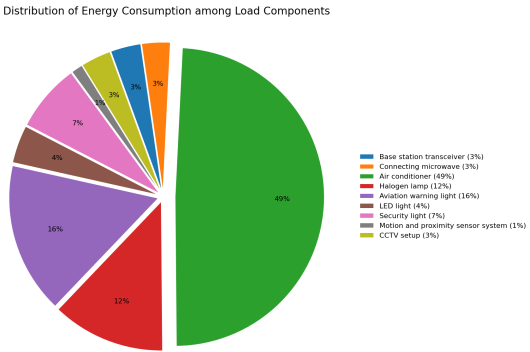
Figure 1. The distribution of the energy consumption among the load components.
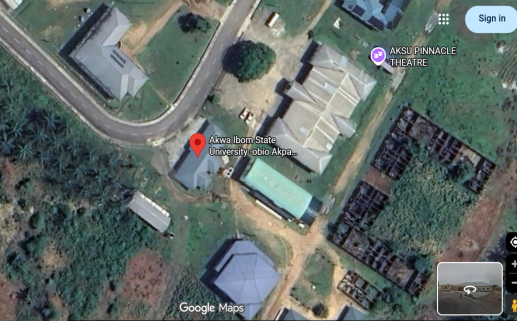
Figure 2. The Google maps visualization of the case study site in Akwa Ibom State University Obiokpa Campus with latitude and longitude of 4.96451929968801, 7.759789035138503 respectively.
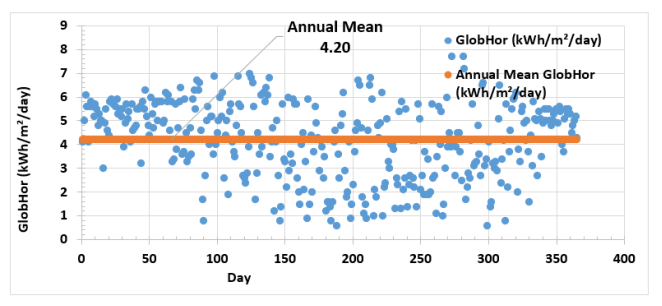
Figure 3. The scatter plot of the daily solar radiation, (GlobHor) of the case study site done with Visual basic for application programming tool in Excel.
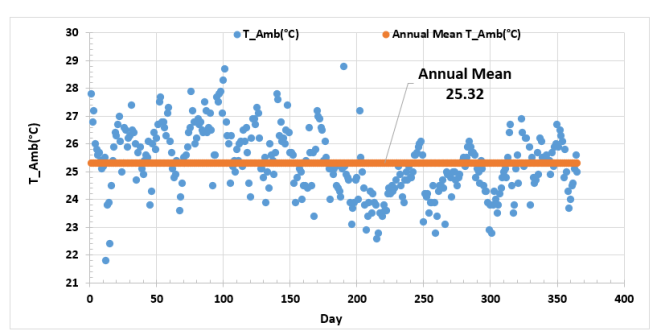
Figure 4. The scatter plot of the daily atmospheric temperature, (T_Amb) of the case study site done with Visual basic for application programming tool in Excel.
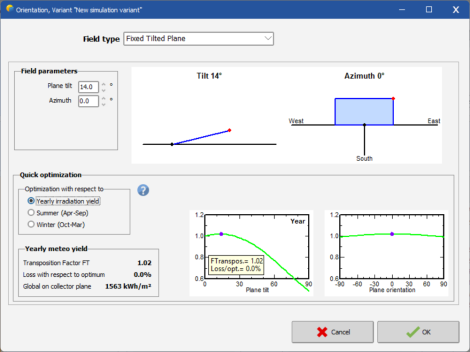
Figure 5. The screenshot showing the settings for the PV tilt orientation in the PVsyst 7.3.1 simulation software.
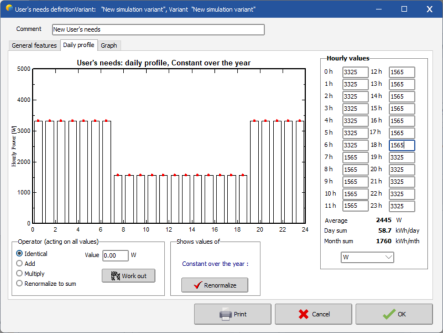
Figure 6. The screenshot showing the daily load profile settings for the PV in the PVsyst 7.3.1 simulation software.
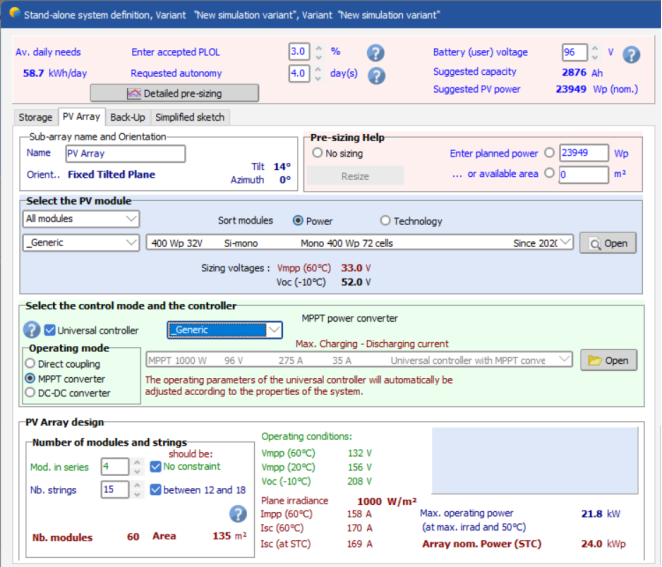
Figure 7. The PVsyst settings for the PV array.
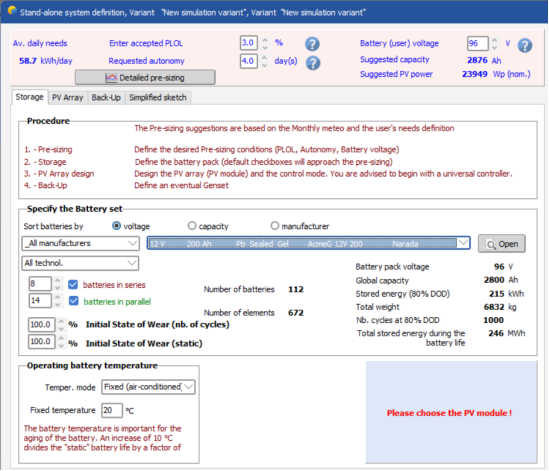
Figure 8. The PVsyst settings for the battery bank.
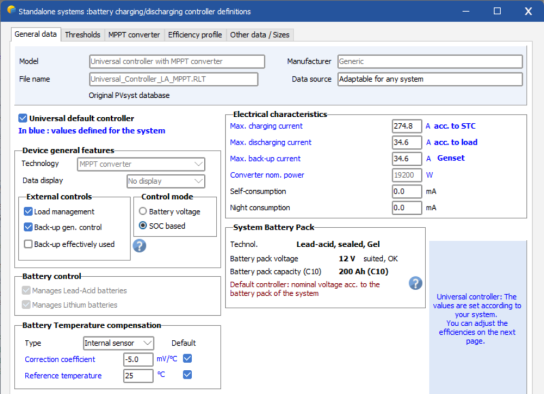
Figure 9. The PVsyst settings for the charger controller.
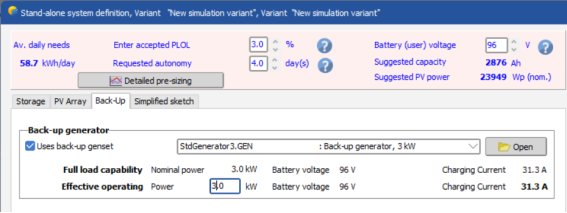
Figure 10. The PVsyst settings for the back-up generator.
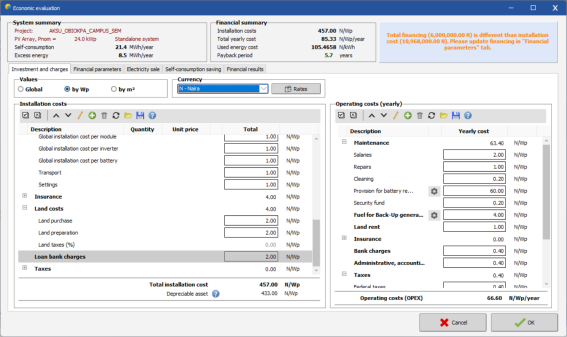
Figure 11. The screenshot showing the input for the investment and charges in the PVSyst economic analysis dialogue box.
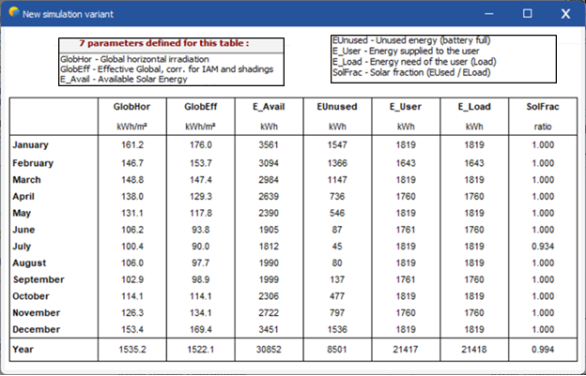
Figure 12. The screenshot showing the Result on the Energy Yield, Energy Delivered and Solar Fraction.
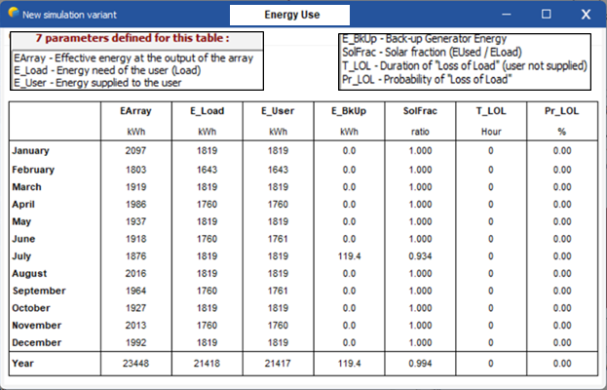
Figure 13. The screenshot showing the Result on Loss of Load (LOL) and Power Supply from the Backup Generator.
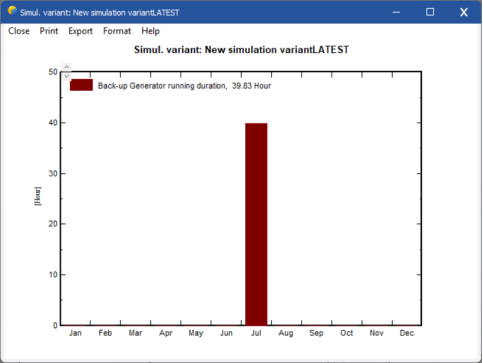
Figure 14. The screenshot showing the Result on Loss of Load Duration which is also the Backup Generator Running Per Month for a Whole Year.
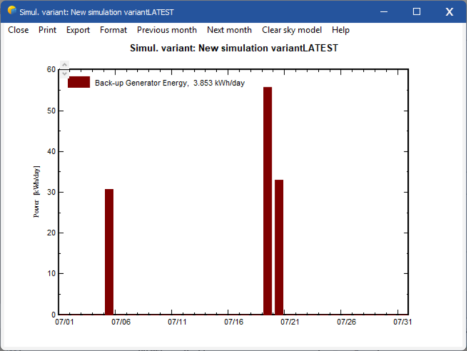
Figure 15. The screenshot showing the Result on Loss of Load Energy per day in July which is also the amount of energy supplied by the Backup Generator per day in July.
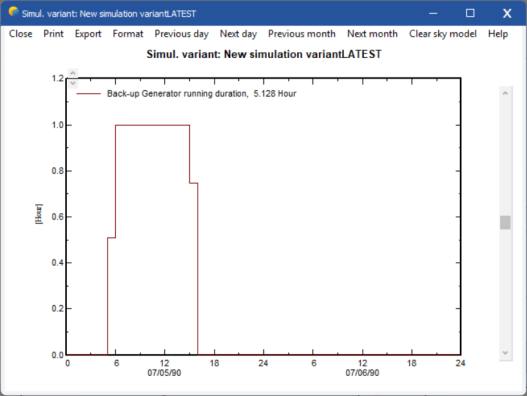
Figure 16. The screenshot showing the Exact Time the Loss of Load will Occur on 5th of July.
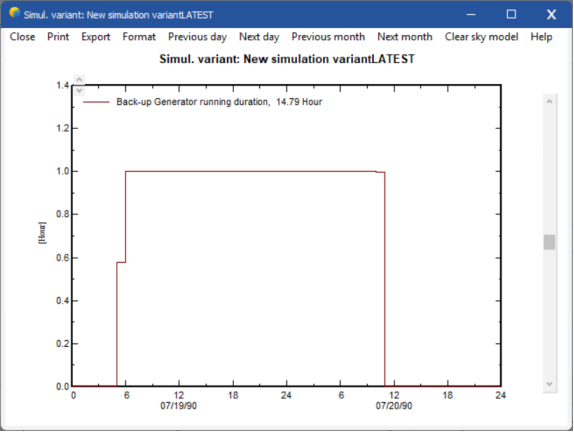
Figure 17. The screenshot showing the Exact Time the Loss of Load will Occur from 19th to 20th of July.
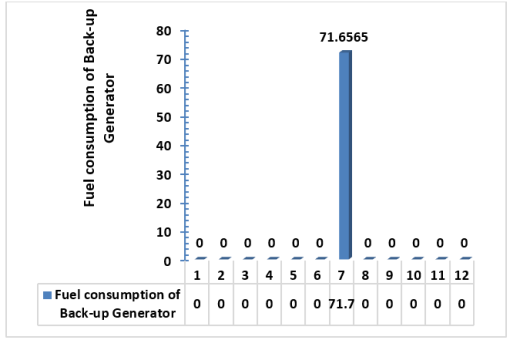
Figure 18. The screenshot showing the fuel consumption of the Back-up Generator per month for a whole year.
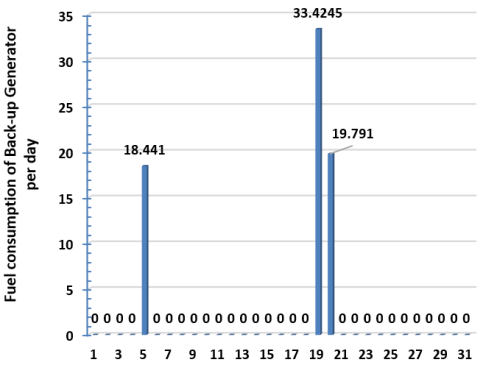
Figure 19. The screenshot showing the fuel consumption of the Back-up Generator per day for the month of July.
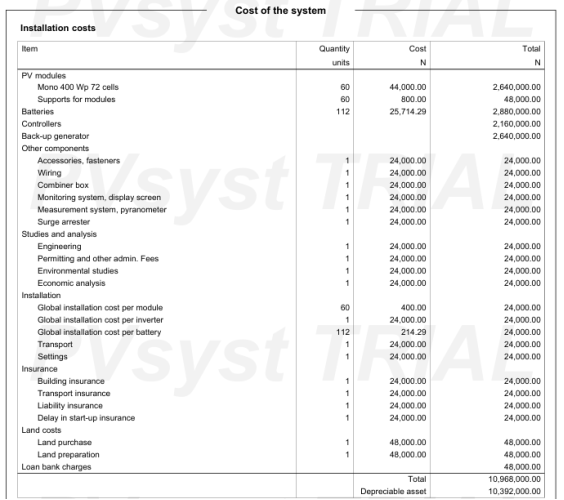
Figure 20. The screenshot showing the part I of the results for the cost of the system.
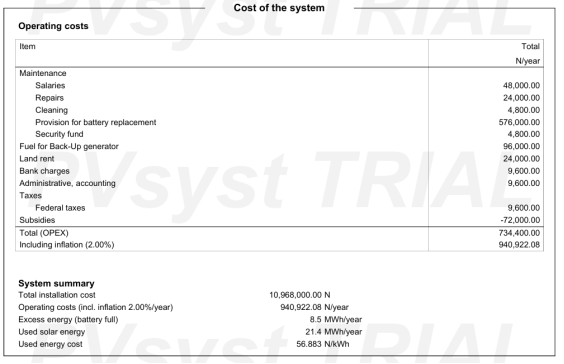
Figure 21. The screenshot showing the part II of the results for the cost of the system.
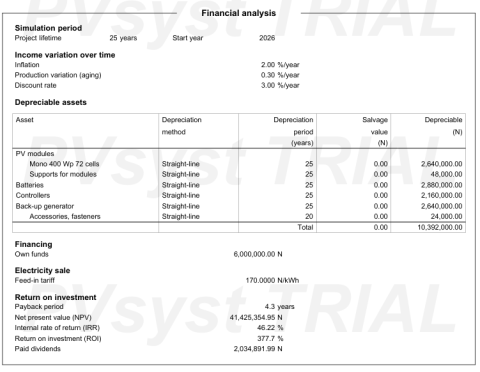
Figure 22. The screenshot showing the of the results for the financial analysis of the system.
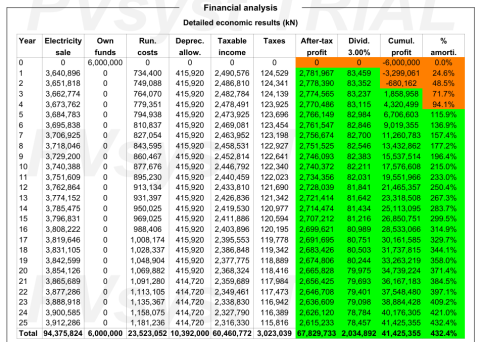
Figure 23. The screenshot showing the of the detailed economic analysis results for the financial analysis of the system.

Information



 Share This Article
 Twitter
 Linked In
 Facebook
 Copy
Copy Download