
The extensive discharge of synthetic organic dyes from the textile and leather industries has become a major environmental concern due to their toxic, persistent, and non-biodegradable nature. Among these pollutants, methyl red dye poses significant risks to aquatic ecosystems and human health. The present study aims to evaluate the adsorption efficiency of cetyltrimethylammonium bromide (CTAB)-modified bentonite as a low-cost and effective adsorbent for the removal of methyl red from aqueous solutions. Bentonite powder was modified using 0.5 mol L-1 CTAB to enhance its surface properties and adsorption capacity. Batch adsorption experiments were carried out at pH 7 with initial dye concentrations ranging from 10 to 30 ppm. The adsorption process was monitored using UV–Vis spectrophotometry at a wavelength of 360 nm. The experimental results demonstrated excellent adsorption performance, with removal efficiencies exceeding 98% across all studied concentrations. A maximum removal efficiency of 99.62% was achieved at an initial concentration of 30 ppm within 90 minutes of contact time. The superior adsorption behavior is attributed to the increased surface area, mesoporous structure, and improved surface functionality resulting from CTAB modification. Structural and functional characterization using X-ray diffraction (XRD) and Fourier transform infrared spectroscopy (FTIR) confirmed successful modification of bentonite and the interaction between dye molecules and active surface sites. Overall, the findings indicate that CTAB-modified bentonite is a promising, economical, and environmentally friendly adsorbent for the efficient removal of organic dyes from wastewater, offering potential application in sustainable wastewater treatment processes.
| Published in | American Journal of Environmental Protection (Volume 15, Issue 2) |
| DOI | 10.11648/j.ajep.20261502.12 |
| Page(s) | 60-66 |
| Creative Commons |
This is an Open Access article, distributed under the terms of the Creative Commons Attribution 4.0 International License (http://creativecommons.org/licenses/by/4.0/), which permits unrestricted use, distribution and reproduction in any medium or format, provided the original work is properly cited. |
| Copyright |
Copyright © The Author(s), 2026. Published by Science Publishing Group |
Bentonite, Methyl Red, Adsorption, Dye Removal, Wastewater Treatment
Initial Concentration in PPM | pH | Time | Absorbance | % Removal |
|---|---|---|---|---|
5 | 8 | 15 | 0.09 | 98.2 |
30 | 0.061 | 98.78 | ||
45 | 0.06 | 98.8 | ||
60 | 0.065 | 98.7 | ||
90 | 0.095 | 98.1 | ||
10 | 8 | 15 | 0.107 | 98.93 |
30 | 0.113 | 98.87 | ||
45 | 0.121 | 98.79 | ||
60 | 0.112 | 98.88 | ||
90 | 0.102 | 98.98 | ||
15 | 8 | 15 | 0.134 | 99.1 |
30 | 0.128 | 99.146 | ||
45 | 0.122 | 99.186 | ||
60 | 0.118 | 99.213 | ||
90 | 0.115 | 99.233 | ||
20 | 8 | 15 | 0.133 | 99.55 |
30 | 0.104 | 99.48 | ||
45 | 0.122 | 99.39 | ||
60 | 0.121 | 99.395 | ||
90 | 0.129 | 99.355 | ||
25 | 8 | 15 | 0.208 | 99.168 |
30 | 0.101 | 99.154 | ||
45 | 0.038 | 99.848 | ||
60 | 0.09 | 99.64 | ||
90 | 0.144 | 99.424 | ||
30 | 8 | 15 | 0.15 | 99.5 |
30 | 0.139 | 99.53 | ||
45 | 0.139 | 99.56 | ||
60 | 0.122 | 99.59 | ||
90 | 0.133 | 99.62 |
CTAB | Cetyltrimethylammonium Bromide |
SEM | Scanning Electron Microscopy |
| [1] | United States Environmental Protection Agency. (n.d.). Environmental criteria and assessment office reports. U.S. Environmental Protection Agency. |
| [2] | Ahmed, M. A., Ahmed, M. A., & Mohamed, A. A. (2023). Adsorptive removal of dyes using modified clay materials. RSC Advances, 13, 5337. |
| [3] | Bhatt, A. S., Sakaria, P. L., Vasudevan, M., Pawar, R. R., Sudheesh, N., Bajaj, H. C., & Mody, H. M. (2012). Adsorption of an anionic dye from aqueous medium by organoclays: Equilibrium, kinetic, and thermodynamic studies. RSC Advances, 2, 8663-8671. |
| [4] | Akçay, M. (2015). Adsorptive removal of basic dyes by surfactant-modified bentonite clay. Process Safety and Environmental Protection, 95, 215-225. |
| [5] | Springer, J. (2022). Adsorption characteristics of methyl red dye by Na₂CO₃-treated jute fibre. Applied Water Science, 12, 179. |
| [6] | Jha, A. K., & Mishra, B. (2012). Removal of fluoride by Bentonite minerals of Rajmahal Hills. Journal of the Indian Chemical Society, 89(4), 519. |
| [7] | Jha, A. K. (2018). Bentonite for chemical industries. Journal of the Indian Chemical Society, 95, 35. |
| [8] | Jha, A. K., Mishra, A. K., Kumari, V., & Mishra, B. (2011). Softening of Hard Water by Bentonite Mineral. Asian Journal of Water, Environment and Pollution, 8(4), 93. |
| [9] | Majumder, S., & Jha, A. K. (2020). Kinetic and Adsorption Study for Removal of Arsenic from Aqueous Medium by Low-Cost Bentonite of Rajmahal Hills and Hazaribagh, Jharkhand. Nature Environment and Pollution Technology, 19(5), 1847. |
| [10] | Jha, A. K. (2016) Bentonite minerals and their TGA, DSC, and PXRD studies. Journal of the Indian Chemical Society, 93(4), 437. |
| [11] | Jha, A. K., Mishra, K. K., & Majumder, S. (2020). "Application of Bentonite and Modified Bentonite as Green Adsorbent for Cadmium Removal from Aqueous Medium". Journal of the Indian Chemical Society, 97(9B), 1604. |
| [12] | Majumder, S., & Jha, A. K. (2020). Removal of Cr and Mn from aqueous medium using bentonites and their derivatives. Journal of Chemical Sciences, 132, 135. |
| [13] | Modified bentonite adsorption of organic pollutants of dye wastewater. (2017). Materials Chemistry and Physics, 202, 266-276. |
| [14] | Application of modified clays as an adsorbent for the removal of Basic Red 46 and Reactive Yellow 181. (2016). Desalination and Water Treatment, 57(29), 13561-13572. |
| [15] | Ho, Y. S., & McKay, G. (1999). Pseudo-second-order model for sorption processes. Process Biochemistry, 34(5), 451-465. |
| [16] | Bulut, E., Özacar, M., & Şengil, İ. A. (2012). Adsorption characteristics, isotherm, kinetics, and diffusion of modified natural bentonite for removing diazo dye. Chemical Engineering Journal, 187, 79-88. |
| [17] | Fernandes, J. V., Rodrigues, A. M., Menezes, R. R., & Neves, G. d. A. (2020). Adsorption of an anionic dye on acid-functionalized bentonite. Materials, 13, 3600. |
| [18] | Zhihui Huang, Yuzhen Li, Wenjun Chen, Jianhui Shi, Ning Zhang, Xiaojin Wang, Zhen Li, Lijhen Gao, Yuxin Zhang. Modified bentonite adsorption of organic pollutants in dye wastewater. (2017). Materials Chemistry and Physics, 202, 266-276. |
| [19] | Bousemat, H., Ziane-Hezil, S., Benatmane, S., Bessaha, F., Bessaha, G., Çoruh, A., Sillanpää, M., & Khan, M. A. (2025). Experimental and modeling studies for simultaneous removal of anionic dyes using activated clay. Scientific Reports, 15, Article 30039. |
| [20] | Gupta V. K. & Ali I. (2004). Removal of lead and chromium from wastewater using bagasse fly ash—a sugar industry waste. Journal of Colloid and Interface Science, 271, 321-328. |
| [21] | Özcan, A., & Özcan, A. S. (2005). Adsorption thermodynamics of dyes. Colloids and Surfaces A: Physicochemical and Engineering Aspects, 266, 73-81. |
APA Style
Kumar, S., Jha, A. K. (2026). Efficient Removal of Methyl Red from Aqueous Solutions Using Chemically Modified Bentonite Clays: A Study of Adsorption Dynamics. American Journal of Environmental Protection, 15(2), 60-66. https://doi.org/10.11648/j.ajep.20261502.12
ACS Style
Kumar, S.; Jha, A. K. Efficient Removal of Methyl Red from Aqueous Solutions Using Chemically Modified Bentonite Clays: A Study of Adsorption Dynamics. Am. J. Environ. Prot. 2026, 15(2), 60-66. doi: 10.11648/j.ajep.20261502.12
@article{10.11648/j.ajep.20261502.12,
  author = {Shailesh Kumar and Ashok Kumar Jha},
  title = {Efficient Removal of Methyl Red from Aqueous Solutions Using Chemically Modified Bentonite Clays: A Study of Adsorption Dynamics},
  journal = {American Journal of Environmental Protection},
  volume = {15},
  number = {2},
  pages = {60-66},
  doi = {10.11648/j.ajep.20261502.12},
  url = {https://doi.org/10.11648/j.ajep.20261502.12},
  eprint = {https://article.sciencepublishinggroup.com/pdf/10.11648.j.ajep.20261502.12},
  abstract = {The extensive discharge of synthetic organic dyes from the textile and leather industries has become a major environmental concern due to their toxic, persistent, and non-biodegradable nature. Among these pollutants, methyl red dye poses significant risks to aquatic ecosystems and human health. The present study aims to evaluate the adsorption efficiency of cetyltrimethylammonium bromide (CTAB)-modified bentonite as a low-cost and effective adsorbent for the removal of methyl red from aqueous solutions. Bentonite powder was modified using 0.5 mol L-1 CTAB to enhance its surface properties and adsorption capacity. Batch adsorption experiments were carried out at pH 7 with initial dye concentrations ranging from 10 to 30 ppm. The adsorption process was monitored using UV–Vis spectrophotometry at a wavelength of 360 nm. The experimental results demonstrated excellent adsorption performance, with removal efficiencies exceeding 98% across all studied concentrations. A maximum removal efficiency of 99.62% was achieved at an initial concentration of 30 ppm within 90 minutes of contact time. The superior adsorption behavior is attributed to the increased surface area, mesoporous structure, and improved surface functionality resulting from CTAB modification. Structural and functional characterization using X-ray diffraction (XRD) and Fourier transform infrared spectroscopy (FTIR) confirmed successful modification of bentonite and the interaction between dye molecules and active surface sites. Overall, the findings indicate that CTAB-modified bentonite is a promising, economical, and environmentally friendly adsorbent for the efficient removal of organic dyes from wastewater, offering potential application in sustainable wastewater treatment processes.},
 year = {2026}
}
TY  - JOUR
T1  - Efficient Removal of Methyl Red from Aqueous Solutions Using Chemically Modified Bentonite Clays: A Study of Adsorption Dynamics
AU  - Shailesh Kumar
AU  - Ashok Kumar Jha
Y1  - 2026/04/21
PY  - 2026
N1  - https://doi.org/10.11648/j.ajep.20261502.12
DO  - 10.11648/j.ajep.20261502.12
T2  - American Journal of Environmental Protection
JF  - American Journal of Environmental Protection
JO  - American Journal of Environmental Protection
SP  - 60
EP  - 66
PB  - Science Publishing Group
SN  - 2328-5699
UR  - https://doi.org/10.11648/j.ajep.20261502.12
AB  - The extensive discharge of synthetic organic dyes from the textile and leather industries has become a major environmental concern due to their toxic, persistent, and non-biodegradable nature. Among these pollutants, methyl red dye poses significant risks to aquatic ecosystems and human health. The present study aims to evaluate the adsorption efficiency of cetyltrimethylammonium bromide (CTAB)-modified bentonite as a low-cost and effective adsorbent for the removal of methyl red from aqueous solutions. Bentonite powder was modified using 0.5 mol L-1 CTAB to enhance its surface properties and adsorption capacity. Batch adsorption experiments were carried out at pH 7 with initial dye concentrations ranging from 10 to 30 ppm. The adsorption process was monitored using UV–Vis spectrophotometry at a wavelength of 360 nm. The experimental results demonstrated excellent adsorption performance, with removal efficiencies exceeding 98% across all studied concentrations. A maximum removal efficiency of 99.62% was achieved at an initial concentration of 30 ppm within 90 minutes of contact time. The superior adsorption behavior is attributed to the increased surface area, mesoporous structure, and improved surface functionality resulting from CTAB modification. Structural and functional characterization using X-ray diffraction (XRD) and Fourier transform infrared spectroscopy (FTIR) confirmed successful modification of bentonite and the interaction between dye molecules and active surface sites. Overall, the findings indicate that CTAB-modified bentonite is a promising, economical, and environmentally friendly adsorbent for the efficient removal of organic dyes from wastewater, offering potential application in sustainable wastewater treatment processes.
VL  - 15
IS  - 2
ER  -
University Department of Chemistry, Tilka Manjhi University, Bhagalpur, India
University Department of Chemistry, Tilka Manjhi University, Bhagalpur, India;Kamleshwari Prasad College, Madhepura University, Madhepura, India
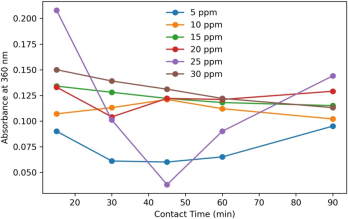
Figure 1. Absorbance versus Contact time for different initial concentrations of methyl red solution at 360nm.
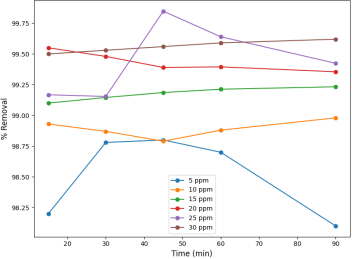
Figure 2. Percentage removal versus contact time for different initial concentrations of methyl red solutions at 360 nm.
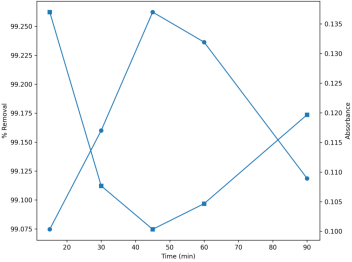
Figure 3. Combined effect of contact time on absorbance and percentage removal at different initial dye concentrations (5–30 ppm) at pH 8.
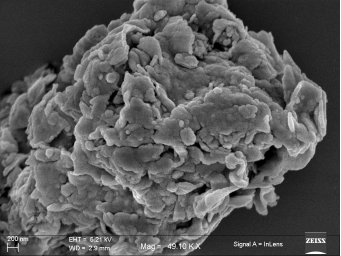
Figure 4. Sem Image of Barmer Bentonite (BB2).
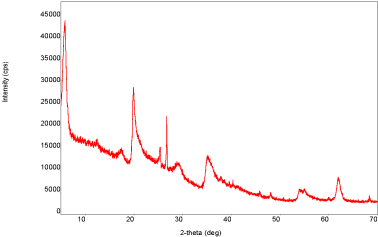
Figure 5. XRD pattern of CTAB-modified bentonite confirming the montmorillonite structure and interlayer modification.
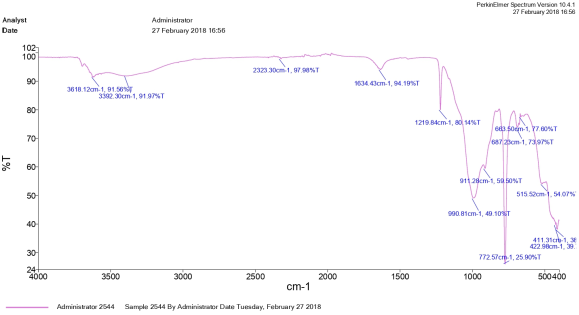
Figure 6. FTIR spectra of raw and CTAB-modified bentonite showing functional group interactions after chemical modification.

Information



 Share This Article
 Twitter
 Linked In
 Facebook
 Copy
Copy Download