Abstract
Urban energy infrastructure (e.g. HVAC systems, power distribution networks, and renewable energy technologies) represents a persistent and often unavoidable source of environmental noise in modern cities. Conventional noise assessment and mitigation approaches are primarily based on physical indicators such as sound pressure level, which do not fully capture the complexity of human auditory perception and contextual sound appraisal. This case study investigates whether natural sound sources, specifically birdsong, can improve the perceived acoustic quality of urban environments affected by continuous technical noise. The study is based on a reinterpretation of previously published controlled listening experiment results, in which participants evaluated recorded urban sound environments with and without added birdsong components. Subjective perception was assessed using semantic differential scales, while psychoacoustic parameters were considered to support interpretation of perceptual trends. The findings indicate that the inclusion of birdsong significantly improves perceived soundscape quality by increasing pleasantness and calmness and reducing annoyance, even when overall sound pressure levels remain unchanged. In addition, clear species-dependent differences were observed, suggesting that certain bird vocalizations provide a stronger benefit than others. Among the evaluated species, the chaffinch produced the strongest positive effect, followed by the Eurasian blackcap and European robin, whereas the great tit showed comparatively weaker influence. The results support the potential of soundscape-based strategies as a complementary approach to conventional noise management for urban energy infrastructure. Enhancing natural acoustic elements through biodiversity-supporting urban planning may improve public acceptance and environmental quality in locations where technical noise reduction is limited by spatial, operational, or economic constraints.
Keywords
Urban Noise, Energy Infrastructure, Soundscape, Psychoacoustics, Birdsong, Perception, Case Study
1. Introduction
Urban environments are increasingly shaped by the widespread presence of energy infrastructure, including heating, ventilation, and air-conditioning (HVAC) systems, electrical substations, power distribution networks, and renewable energy technologies
| [1] | Wang, L.; et al. Noise Characteristics and Control of HVAC Systems in Buildings. Building and Environment. 2022, 214, 108908. https://doi.org/10.1016/j.buildenv.2022.108908 |
| [2] | Basner, M.; et al. Auditory and Non-Auditory Effects of Noise on Health. The Lancet. 2014, 383(9925), 1325-1332.
https://doi.org/10.1016/S0140-6736(13)61613-X |
| [3] | European Environment Agency. Environmental Noise in Europe 2020. European Environment Agency: Copenhagen, Denmark, 2020. |
| [4] | Schmidt, J. H.; Klokker, M. Health Effects Related to Wind Turbine Noise Exposure: A Review. Noise & Health. 2014, 16(69), 1-11. https://doi.org/10.4103/1463-1741.127847 |
| [14] | European Commission. Energy Performance of Buildings Directive (EPBD). Official Journal of the European Union. 2018. |
| [15] | International Energy Agency. Buildings Sector Energy Consumption Report. International Energy Agency: Paris, France, 2023. |
| [16] | Ürge-Vorsatz, D.; et al. Heating and Cooling Energy Trends in Buildings. Renewable and Sustainable Energy Reviews. 2015, 41, 85-98. https://doi.org/10.1016/j.rser.2014.08.039 |
[1-4, 14-16]
. Although these systems are essential for ensuring energy efficiency and reliable operation of cities, they often contribute to continuous environmental noise exposure, particularly in densely populated residential areas
| [1] | Wang, L.; et al. Noise Characteristics and Control of HVAC Systems in Buildings. Building and Environment. 2022, 214, 108908. https://doi.org/10.1016/j.buildenv.2022.108908 |
| [2] | Basner, M.; et al. Auditory and Non-Auditory Effects of Noise on Health. The Lancet. 2014, 383(9925), 1325-1332.
https://doi.org/10.1016/S0140-6736(13)61613-X |
| [3] | European Environment Agency. Environmental Noise in Europe 2020. European Environment Agency: Copenhagen, Denmark, 2020. |
| [4] | Schmidt, J. H.; Klokker, M. Health Effects Related to Wind Turbine Noise Exposure: A Review. Noise & Health. 2014, 16(69), 1-11. https://doi.org/10.4103/1463-1741.127847 |
[1-4]
. Unlike traffic noise, which is frequently intermittent, noise emitted by energy-related systems is often characterized by steady-state operation, tonal components, and low-frequency dominance, making it especially intrusive and difficult to ignore
| [4] | Schmidt, J. H.; Klokker, M. Health Effects Related to Wind Turbine Noise Exposure: A Review. Noise & Health. 2014, 16(69), 1-11. https://doi.org/10.4103/1463-1741.127847 |
| [5] | ISO 12913-1. Acoustics—Soundscape—Part 1: Definition and Conceptual Framework; International Organization for Standardization: Geneva, Switzerland, 2014. Available online: ISO 12913-1 official page (accessed on 7 March 2026). |
| [6] | Persson Waye, K.; Bengtsson, J. Low Frequency Noise and Its Effects on Humans. Journal of Sound and Vibration. 2001, 205(4), 467-474. |
| [17] | Berglund, B.; Lindvall, T.; Schwela, D. H. Guidelines for Community Noise. World Health Organization: Geneva, Switzerland, 1999. |
| [18] | Leventhall, G. Low Frequency Noise and Annoyance. Noise & Health. 2004, 6(23), 59-72. |
| [19] | van den Berg, F. Wind Turbine Noise: Annoyance and Perception. The Journal of the Acoustical Society of America. 2008, 123(5), 3478-3478. https://doi.org/10.1121/1.2935166 |
| [20] | Persson Waye, K. Effects of Low-Frequency Noise on Sleep and Well-Being. Journal of Sound and Vibration. 2003, 277(3-5), 483-491. |
[4-6, 17-20]
.
Noise management strategies traditionally rely on physical indicators such as sound pressure level. However, it has been repeatedly demonstrated that physical sound level alone does not fully explain subjective human response to noise exposure
| [7] | Kang, J.; et al. Ten Questions on the Soundscapes of the Built Environment. Building and Environment. 2016, 108, 284-294.
https://doi.org/10.1016/j.buildenv.2016.08.011 |
| [8] | Axelsson, Ö.; Nilsson, M. E.; Berglund, B. A Principal Components Model of Soundscape Perception. The Journal of the Acoustical Society of America. 2010, 128(5), 2836-2846.
https://doi.org/10.1121/1.3493436 |
| [9] | Alvarsson, J. J.; Wiens, S.; Nilsson, M. E. Stress Recovery during Exposure to Nature Sound and Environmental Noise. International Journal of Environmental Research and Public Health. 2010, 7(3), 1036-1046. https://doi.org/10.3390/ijerph7031036 |
| [21] | ISO 1996-1. Acoustics—Description, Measurement and Assessment of Environmental Noise—Part 1: Basic Quantities and Assessment Procedures. International Organization for Standardization: Geneva, Switzerland. |
| [22] | Janssen, S.; et al. Annoyance Due to Environmental Noise: A Comparison of Disturbance Curves. The Journal of the Acoustical Society of America. 2011, 130(6), 3747-3760.
https://doi.org/10.1121/1.3653984 |
| [23] | ISO 1996-2. Acoustics—Description, Measurement and Assessment of Environmental Noise—Part 2: Determination of Environmental Noise Levels. International Organization for Standardization: Geneva, Switzerland. |
| [24] | Fastl, H.; Zwicker, E. Psychoacoustics: Facts and Models, 3rd ed.; Springer: Berlin, Germany, 2007. |
[7-9, 21-24]
. Two acoustic environments with similar measured levels may be perceived very differently depending on temporal variation, spectral composition, and contextual meaning
| [8] | Axelsson, Ö.; Nilsson, M. E.; Berglund, B. A Principal Components Model of Soundscape Perception. The Journal of the Acoustical Society of America. 2010, 128(5), 2836-2846.
https://doi.org/10.1121/1.3493436 |
| [9] | Alvarsson, J. J.; Wiens, S.; Nilsson, M. E. Stress Recovery during Exposure to Nature Sound and Environmental Noise. International Journal of Environmental Research and Public Health. 2010, 7(3), 1036-1046. https://doi.org/10.3390/ijerph7031036 |
| [24] | Fastl, H.; Zwicker, E. Psychoacoustics: Facts and Models, 3rd ed.; Springer: Berlin, Germany, 2007. |
| [25] | Zwicker, E.; Fastl, H. Psychoacoustic Parameters and Their Applicability to Soundscape Research. Springer Handbook of Acoustics. 2007, 1, 239-267. |
[8, 9, 24, 25]
. These limitations have increased interest in the soundscape framework, which considers the interaction between acoustic conditions and human perception instead of treating noise solely as a physical quantity
| [5] | ISO 12913-1. Acoustics—Soundscape—Part 1: Definition and Conceptual Framework; International Organization for Standardization: Geneva, Switzerland, 2014. Available online: ISO 12913-1 official page (accessed on 7 March 2026). |
| [7] | Kang, J.; et al. Ten Questions on the Soundscapes of the Built Environment. Building and Environment. 2016, 108, 284-294.
https://doi.org/10.1016/j.buildenv.2016.08.011 |
| [28] | Schafer, R. M. The Soundscape: Our Sonic Environment and the Tuning of the World; Destiny Books: Rochester, NY, USA, 1977. |
| [29] | Aletta, F.; et al. Soundscape Approach Integrating Noise Mapping Techniques and Perceptual Assessment in Urban Environments. Applied Acoustics. 2016, 105, 1-12.
https://doi.org/10.1016/j.apacoust.2015.11.012 |
[5, 7, 28, 29]
. Previous research has also demonstrated that annoyance caused by environmental noise is strongly influenced by non-acoustic factors, including expectation, contextual interpretation, and perceived controllability of the sound source
| [22] | Janssen, S.; et al. Annoyance Due to Environmental Noise: A Comparison of Disturbance Curves. The Journal of the Acoustical Society of America. 2011, 130(6), 3747-3760.
https://doi.org/10.1121/1.3653984 |
| [26] | Guski, R.; et al. Standardized Noise Annoyance Reactions and Their Associations with Health Outcomes. International Journal of Environmental Research and Public Health. 2017, 14(12), 1539. https://doi.org/10.3390/ijerph14121539 |
| [27] | Moore, B. C. J. An Introduction to the Psychology of Hearing, 6th ed.; Brill: Leiden, The Netherlands, 2012. |
[22, 26, 27]
.
Natural sound sources, particularly birdsong, have been widely associated with positive soundscape appraisal, increased perceived pleasantness, and stress recovery
| [9] | Alvarsson, J. J.; Wiens, S.; Nilsson, M. E. Stress Recovery during Exposure to Nature Sound and Environmental Noise. International Journal of Environmental Research and Public Health. 2010, 7(3), 1036-1046. https://doi.org/10.3390/ijerph7031036 |
| [10] | Van Renterghem, T. Bird Sounds and Their Role in Soundscape Perception. Applied Acoustics. 2019, 151, 70-77.
https://doi.org/10.1016/j.apacoust.2019.02.009 |
| [11] | Zhao, W.; et al. Effect of Birdsong Soundscape on Perceived Restorativeness. International Journal of Environmental Research and Public Health. 2020, 17(18), 6541.
https://doi.org/10.3390/ijerph17186541 |
| [12] | Šegota, T.; et al. Influence of Birdsong on the Perception of Urban Soundscapes. Applied Sciences. 2024, 14, 11124. |
| [30] | Ratcliffe, E.; et al. Bird Sounds and Their Contributions to Perceived Attention Restoration and Stress Recovery. Journal of Environmental Psychology. 2013, 36, 221-228.
https://doi.org/10.1016/j.jenvp.2013.08.004 |
[9-12, 30]
. Previous studies indicate that natural sounds may improve perceived environmental quality not necessarily by reducing overall sound level, but by altering subjective interpretation and balance within a sound environment
| [10] | Van Renterghem, T. Bird Sounds and Their Role in Soundscape Perception. Applied Acoustics. 2019, 151, 70-77.
https://doi.org/10.1016/j.apacoust.2019.02.009 |
| [11] | Zhao, W.; et al. Effect of Birdsong Soundscape on Perceived Restorativeness. International Journal of Environmental Research and Public Health. 2020, 17(18), 6541.
https://doi.org/10.3390/ijerph17186541 |
| [12] | Šegota, T.; et al. Influence of Birdsong on the Perception of Urban Soundscapes. Applied Sciences. 2024, 14, 11124. |
| [28] | Schafer, R. M. The Soundscape: Our Sonic Environment and the Tuning of the World; Destiny Books: Rochester, NY, USA, 1977. |
| [29] | Aletta, F.; et al. Soundscape Approach Integrating Noise Mapping Techniques and Perceptual Assessment in Urban Environments. Applied Acoustics. 2016, 105, 1-12.
https://doi.org/10.1016/j.apacoust.2015.11.012 |
| [30] | Ratcliffe, E.; et al. Bird Sounds and Their Contributions to Perceived Attention Restoration and Stress Recovery. Journal of Environmental Psychology. 2013, 36, 221-228.
https://doi.org/10.1016/j.jenvp.2013.08.004 |
[10-12, 28-30]
. However, the application of such findings in the context of urban energy infrastructure noise remains limited.
This paper presents a case study focused on the influence of birdsong in urban acoustic environments relevant to energy infrastructure. Rather than conducting a new listening experiment, the study reinterprets previously published experimental results
| [13] | Suhanek, M.; et al. Exploring the Influence of Avian Vocal Presence on Appraisal of Urban Soundscapes. Applied Sciences. 2024, 14(23), 11124.
https://doi.org/10.3390/app142311124 |
[13]
within an applied engineering context, with a specific emphasis on practical implications for energy-related noise management. In addition, this work highlights species-dependent differences in perceptual effectiveness and proposes the concept of ranking natural sound sources based on their potential to improve perceived acoustic quality.
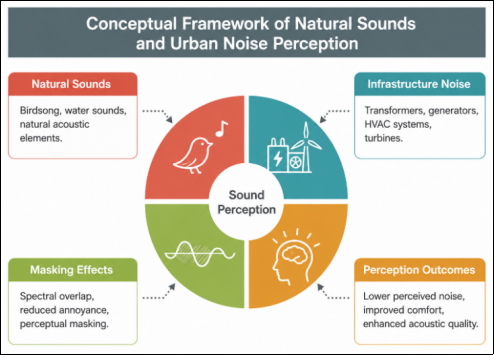
This case study translates psychoacoustic and soundscape findings into a context relevant to energy infrastructure planning and explores how such knowledge may support complementary sensory mitigation strategies that may support conventional technical mitigation measures, particularly in urban areas where noise reduction is constrained by spatial, economic, or operational limitations (shown in
Figure 1).
Figure 1. Conceptual framework illustrating the influence of natural sound sources on the perception of urban energy infrastructure noise.
Based on the above considerations, the aim of this case study is to evaluate whether the inclusion of birdsong can improve the acoustic quality of urban environments in a manner relevant to noise emitted by urban energy infrastructure. The study focuses on psychoacoustic changes that occur without necessarily altering overall sound pressure levels, emphasizing the role of contextual and qualitative sound components. In addition, the study explores whether different bird species produce measurably different subjective outcomes, supporting the concept of species-dependent soundscape design.
Accordingly, the analysis addresses the following research questions:
(1) To what extent does the inclusion of birdsong improve subjective soundscape appraisal in urban environments dominated by technical and anthropogenic noise components?
(2) Do different bird species produce significantly different sensorial effects, enabling the establishment of a ranking framework based on their psychoacoustic effectiveness?
By answering these questions, the present work aims to contribute an applied soundscape-oriented perspective to urban energy infrastructure noise management and to support the development of complementary strategies that enhance perceived environmental quality through natural acoustic enrichment.
2. Materials and Methods
2.1. Data Source and Study Design
This case study is based on a reinterpretation of previously published experimental results investigating the influence of birdsong in urban soundscapes
| [13] | Suhanek, M.; et al. Exploring the Influence of Avian Vocal Presence on Appraisal of Urban Soundscapes. Applied Sciences. 2024, 14(23), 11124.
https://doi.org/10.3390/app142311124 |
[13]
. The original study employed a controlled listening experiment in which participants evaluated recorded urban sound environments reproduced under standardized laboratory conditions. The full experimental protocol, including audio recording procedures, playback calibration, participant recruitment, and detailed stimulus preparation, is described in detail in
| [13] | Suhanek, M.; et al. Exploring the Influence of Avian Vocal Presence on Appraisal of Urban Soundscapes. Applied Sciences. 2024, 14(23), 11124.
https://doi.org/10.3390/app142311124 |
[13]
. The urban sound recordings were originally collected in Zagreb, Croatia, as part of the controlled listening experiment described in
| [13] | Suhanek, M.; et al. Exploring the Influence of Avian Vocal Presence on Appraisal of Urban Soundscapes. Applied Sciences. 2024, 14(23), 11124.
https://doi.org/10.3390/app142311124 |
[13]
. The recording represents typical urban outdoor environment characterized by dominant anthropogenic background noise, providing a realistic context for reinterpretation in relation to urban energy infrastructure noise.
Rather than replicating the original analysis, the present work interprets the findings from the perspective of urban energy infrastructure noise and its practical mitigation challenges. In particular, this paper emphasizes the implications of natural sound integration as a sensory mitigation approach for continuous technical noise sources and examines the possibility of ranking bird species according to their perceptual effectiveness.
Two soundscape conditions were considered: (1) baseline recordings representing typical urban acoustic environments dominated by anthropogenic noise components, and (2) modified recordings enriched with birdsong as an additional natural sound component. The enrichment process was designed to preserve the overall acoustic context of the baseline environments while introducing natural auditory elements typical of urban green areas.
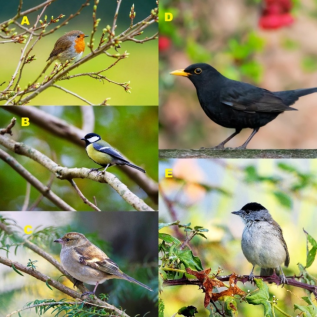
The natural sound stimuli consisted of vocalizations from several songbird species commonly present in European urban habitats. These species were selected due to their ecological relevance and frequent occurrence in everyday city environments. The evaluated species included the European robin (
Erithacus rubecula), great tit (
Parus major), chaffinch (
Fringilla coelebs), common blackbird (
Turdus merula), and Eurasian blackcap (
Sylvia atricapilla), as illustrated in
Figure 2.
Figure 2. Bird species used in the study: A) European robin, B) Great tit, C) Chaffinch, D) Common blackbird and E) Eurasian blackcap.
2.2. Subjective Evaluation Procedure
Subjective perception was assessed using semantic differential scales with a 7-point rating system, following the procedure described in
| [13] | Suhanek, M.; et al. Exploring the Influence of Avian Vocal Presence on Appraisal of Urban Soundscapes. Applied Sciences. 2024, 14(23), 11124.
https://doi.org/10.3390/app142311124 |
[13]
. Participants listened to the sound recordings and evaluated each stimulus using five descriptive dimensions related to soundscape appraisal. The evaluated dimensions included pleasantness, calmness, and additional descriptors reflecting perceived acoustic quality and comfort.
A total of 300 participants took part in the listening experiment. The sample consisted primarily of university students aged 19-24 years with self-reported normal hearing. The mean participant age was 22 years, with an approximately balanced gender distribution. Participation was voluntary and conducted under controlled conditions.
2.3. Psychoacoustic Analysis
In addition to subjective evaluations, psychoacoustic descriptors were used to support interpretation of the psychoacoustic improvement. The analysis included parameters commonly applied in psychoacoustics and soundscape research, such as loudness, sharpness, and fluctuation strength. These metrics were selected due to their established relationship with auditory perception and their relevance in explaining differences in sound quality beyond conventional sound pressure level indicators.
The psychoacoustic values used in this paper were derived from the sound recordings described in
| [13] | Suhanek, M.; et al. Exploring the Influence of Avian Vocal Presence on Appraisal of Urban Soundscapes. Applied Sciences. 2024, 14(23), 11124.
https://doi.org/10.3390/app142311124 |
[13]
. The present study uses these descriptors primarily as interpretative indicators rather than as the primary outcome measures.
2.4. Applied Interpretation for Urban Energy Infrastructure Noise
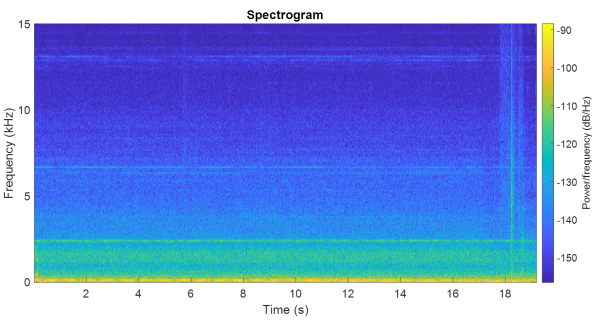
Although the analyzed recordings represent general urban sound environments rather than isolated energy infrastructure noise sources, the identified mechanisms are relevant to many types of technical noise emissions typical of urban energy systems. Such sources include HVAC outdoor units, electrical substations, transformers, power converters, and renewable energy installations. These systems often generate continuous broadband noise with low-frequency dominance and tonal components, which are known to contribute strongly to annoyance and long-term disturbance (illustrated in
Figure 3).
Figure 3. Spectrogram of a typical noise source from urban energy infrastructure.
In realistic outdoor conditions, technical noise is rarely experienced in isolation; rather, it is perceived as part of a broader acoustic environment shaped by both anthropogenic and natural sources. For this reason, the present case study focuses on the role of natural sound integration as a complementary strategy that may enhance perceived acceptability of technical infrastructure, particularly in urban settings where conventional engineering mitigation is limited by already mentioned constraints.
3. Results
The results of this case study demonstrate a clear and consistent influence of natural sound inclusion on the subjective perception of urban acoustic environments. Sound recordings enriched with birdsong were systematically evaluated as more pleasant, calmer, and more natural compared to baseline recordings without natural elements. This effect was observed across all evaluated dimensions and was consistent among participants, indicating a robust perceptual response.
Notably, subjective ratings improved even though the overall sound pressure level remained largely unchanged, suggesting that the effect is not driven by physical noise reduction but rather by a sensorial and contextual modification of the acoustic environment. This indicates that the perceived acceptability of urban noise may be improved through soundscape composition even under identical acoustic exposure conditions.
In addition to the general improvement caused by birdsong presence, the results indicate that different bird species did not contribute equally to subjective improvement. Differences in the spectral and temporal structure of birdsong were reflected in subjective evaluations, suggesting that certain vocal characteristics are more effective in improving soundscape appraisal. This supports the concept of a species-dependent ranking framework for natural sound sources based on their perceptual effectiveness.
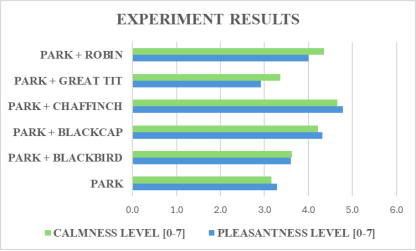
Clear differences were observed between evaluated bird species regarding their influence on subjective perception (as presented in
Figure 4).
Figure 4. Experiment results.
Among all tested sound sources, the chaffinch produced the strongest positive effect, achieving the highest pleasantness rating (4.8 compared to 3.3 for the baseline recording without birdsong) and the highest calmness rating (4.7 compared to 3.2). Regarding pleasantness, the chaffinch was followed by the Eurasian blackcap and European robin, whereas calmness ratings showed a slightly different ranking, with the European robin outperforming the blackcap. In contrast, the great tit produced comparatively weaker subjective improvement.
These results are shown in
Table 1.
Table 1. Ranking of bird species based on perceptual effectiveness.
Rank | Bird species | Pleasantness (mean value) | Calmness (mean value) | Overall perceptual effectiveness | Observed perceptual impact |
1 | Chaffinch | 4.8 | 4.7 | Highest | Strongest improvement in pleasantness and calmness; most effective enhancement |
2 | Eurasian blackcap | 4.5 | 4.4 | Very high | Consistently strong positive effect, slightly lower calmness than chaffinch |
3 | European robin | 4.3 | 4.6 | High | Strong calming effect; calmness higher than blackcap despite slightly lower pleasantness |
4 | Common blackbird | 4.0 | 4.1 | Moderate | Moderate improvement; perceptual benefit present but less pronounced |
5 | Great tit | 3.7 | 3.8 | Lowest | Weakest improvement; least effective species among tested birds |
- | Baseline (no birdsong) | 3.3 | 3.2 | Reference | Dominated by anthropogenic noise; lowest perceived quality |
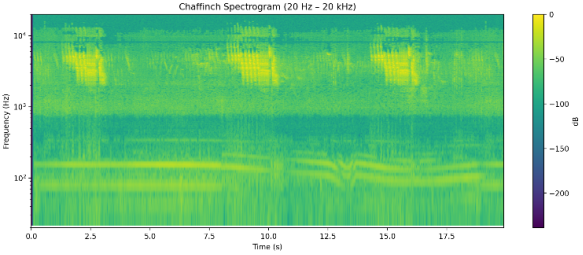
These findings suggest that birdsong is not a uniform acoustic modifier but rather a tunable acoustic component whose effectiveness depends on the specific species and vocal structure. The superior performance of the chaffinch may be associated with its melodic variability and broad spectral distribution (shown in
Figure 5), which may support both auditory masking and restorative effects.
Figure 5. Spectrogram of chaffinch singing.
4. Discussion
The results of this case study confirm that subjective perception of urban acoustic environments is strongly influenced by contextual and qualitative characteristics of sound, rather than by sound pressure level alone
| [5] | ISO 12913-1. Acoustics—Soundscape—Part 1: Definition and Conceptual Framework; International Organization for Standardization: Geneva, Switzerland, 2014. Available online: ISO 12913-1 official page (accessed on 7 March 2026). |
| [7] | Kang, J.; et al. Ten Questions on the Soundscapes of the Built Environment. Building and Environment. 2016, 108, 284-294.
https://doi.org/10.1016/j.buildenv.2016.08.011 |
| [24] | Fastl, H.; Zwicker, E. Psychoacoustics: Facts and Models, 3rd ed.; Springer: Berlin, Germany, 2007. |
[5, 7, 24]
. The addition of natural sound elements, particularly birdsong, significantly improved subjective evaluations of the acoustic environment, increasing perceived pleasantness and calmness and reducing annoyance, despite the absence of measurable changes in physical noise intensity
. These findings support previous soundscape research showing that acoustic perception depends not only on sound intensity, but also on how listeners interpret and associate particular sound sources
| [5] | ISO 12913-1. Acoustics—Soundscape—Part 1: Definition and Conceptual Framework; International Organization for Standardization: Geneva, Switzerland, 2014. Available online: ISO 12913-1 official page (accessed on 7 March 2026). |
| [7] | Kang, J.; et al. Ten Questions on the Soundscapes of the Built Environment. Building and Environment. 2016, 108, 284-294.
https://doi.org/10.1016/j.buildenv.2016.08.011 |
[5, 7]
.
These findings are particularly relevant for urban energy infrastructure noise. Technical noise emitted by HVAC outdoor units, transformers, electrical substations, and renewable energy installations is often continuous, spectrally stable, and partially dominated by low-frequency components
| [1] | Wang, L.; et al. Noise Characteristics and Control of HVAC Systems in Buildings. Building and Environment. 2022, 214, 108908. https://doi.org/10.1016/j.buildenv.2022.108908 |
| [6] | Persson Waye, K.; Bengtsson, J. Low Frequency Noise and Its Effects on Humans. Journal of Sound and Vibration. 2001, 205(4), 467-474. |
[1, 6]
. Such acoustic characteristics may lead to increased annoyance even at moderate levels, because continuous exposure reduces the ability of individuals to ignore or adapt to the sound
| [2] | Basner, M.; et al. Auditory and Non-Auditory Effects of Noise on Health. The Lancet. 2014, 383(9925), 1325-1332.
https://doi.org/10.1016/S0140-6736(13)61613-X |
| [18] | Leventhall, G. Low Frequency Noise and Annoyance. Noise & Health. 2004, 6(23), 59-72. |
[2, 18]
. In this context, the results suggest that natural sound enrichment may provide a practical complementary approach for improving perceived acoustic comfort in urban areas where physical noise reduction is limited
| [5] | ISO 12913-1. Acoustics—Soundscape—Part 1: Definition and Conceptual Framework; International Organization for Standardization: Geneva, Switzerland, 2014. Available online: ISO 12913-1 official page (accessed on 7 March 2026). |
[5]
.
The improvement observed in this study is consistent with the concept that natural sounds can modify perception through combined masking and restorative mechanisms
| [9] | Alvarsson, J. J.; Wiens, S.; Nilsson, M. E. Stress Recovery during Exposure to Nature Sound and Environmental Noise. International Journal of Environmental Research and Public Health. 2010, 7(3), 1036-1046. https://doi.org/10.3390/ijerph7031036 |
| [24] | Fastl, H.; Zwicker, E. Psychoacoustics: Facts and Models, 3rd ed.; Springer: Berlin, Germany, 2007. |
[9, 24]
. Although the sound pressure level remains unchanged, the presence of structured natural sound components may alter auditory attention and reduce the dominance of technical noise
| [24] | Fastl, H.; Zwicker, E. Psychoacoustics: Facts and Models, 3rd ed.; Springer: Berlin, Germany, 2007. |
[24]
. Because birdsong contains temporal variation and recognizable frequency patterns, listeners may perceive the environment as more dynamic and acoustically pleasant
.
From an applied engineering perspective, this indicates that perceived acceptability of technical infrastructure may be enhanced not only by reducing emissions but also by improving the acoustic context in which the infrastructure is experienced
| [5] | ISO 12913-1. Acoustics—Soundscape—Part 1: Definition and Conceptual Framework; International Organization for Standardization: Geneva, Switzerland, 2014. Available online: ISO 12913-1 official page (accessed on 7 March 2026). |
[5]
.
A key contribution of this case study is the identification of species-dependent differences in perceptual effectiveness. The results show that birdsong does not represent a uniform natural sound stimulus. Instead, individual species produced clearly different subjective outcomes
. This supports the possibility of establishing a ranking framework for bird species based on their sensory benefit. Such an approach is relevant for applied soundscape planning, because it suggests that biodiversity measures may have different acoustic outcomes depending on which species are promoted or supported in the local habitat
| [5] | ISO 12913-1. Acoustics—Soundscape—Part 1: Definition and Conceptual Framework; International Organization for Standardization: Geneva, Switzerland, 2014. Available online: ISO 12913-1 official page (accessed on 7 March 2026). |
| [7] | Kang, J.; et al. Ten Questions on the Soundscapes of the Built Environment. Building and Environment. 2016, 108, 284-294.
https://doi.org/10.1016/j.buildenv.2016.08.011 |
[5, 7]
.
In the context of urban energy infrastructure, this introduces a potential pathway for species-oriented soundscape design. Landscape planning, green corridor design, and habitat-supporting measures could be considered not only for ecological value but also as perceptual mitigation tools
| [5] | ISO 12913-1. Acoustics—Soundscape—Part 1: Definition and Conceptual Framework; International Organization for Standardization: Geneva, Switzerland, 2014. Available online: ISO 12913-1 official page (accessed on 7 March 2026). |
| [7] | Kang, J.; et al. Ten Questions on the Soundscapes of the Built Environment. Building and Environment. 2016, 108, 284-294.
https://doi.org/10.1016/j.buildenv.2016.08.011 |
[5, 7]
. For example, increasing vegetation density and supporting urban bird habitats near substations or HVAC-dominated courtyards may improve the perceived acoustic quality and reduce public annoyance, thereby improving acceptance of technical infrastructure
.
However, several limitations should be acknowledged. The findings are based on controlled playback environments that may not fully reflect real-world conditions, including long-term adaptation, visual context, and weather-dependent sound propagation
| [24] | Fastl, H.; Zwicker, E. Psychoacoustics: Facts and Models, 3rd ed.; Springer: Berlin, Germany, 2007. |
[24]
. The sample also consisted mainly of young adults with similar educational backgrounds, and the study does not isolate energy infrastructure noise as a standalone source
. Future research should therefore include field studies near operational energy infrastructure and a more diverse participant population, particularly those more vulnerable to long-term noise exposure, such as older adults, individuals with chronic health conditions, and residents near HVAC systems or substations. This would improve generalizability and better reflect real-life soundscape perception.
Despite these limitations, the findings provide a clear applied indication that perceptual noise mitigation strategies can complement conventional engineering approaches. While traditional noise reduction remains essential, soundscape-based enrichment may offer an additional tool for improving acoustic comfort in densely built urban areas where physical noise mitigation is economically or spatially constrained
| [5] | ISO 12913-1. Acoustics—Soundscape—Part 1: Definition and Conceptual Framework; International Organization for Standardization: Geneva, Switzerland, 2014. Available online: ISO 12913-1 official page (accessed on 7 March 2026). |
[5]
.
5. Conclusion
Noise generated by urban energy infrastructure represents a persistent environmental challenge due to its continuous operation and specific acoustic characteristics, often including low-frequency and tonal components. While conventional engineering approaches remain necessary for controlling emissions, they do not fully address the perceptive and contextual dimension of acoustic environments.
This case study demonstrates that the inclusion of natural sound sources can significantly enhance perceived acoustic quality without altering overall sound pressure levels. Recordings enriched with birdsong were consistently rated as more pleasant and calmer and less annoying compared to baseline urban recording. The results indicate that acoustic comfort depends not only on noise intensity, but also on the overall composition and interpretation of the surrounding soundscape.
A further key outcome of this study is the observation of clear species-dependent differences in perceptual effectiveness. Among the evaluated bird species, the chaffinch produced the strongest positive effect on both pleasantness and calmness, followed by the Eurasian blackcap and European robin, whereas the great tit showed the weakest improvement. This supports the concept of a ranking framework for natural sound sources based on their sensory benefit and suggests that birdsong can be considered a tunable acoustic element rather than a generic natural background sound.
From an applied perspective, the results support the integration of soundscape-based strategies into noise management approaches for urban energy infrastructure. Biodiversity-supporting urban design, preservation of green areas, and habitat enhancement measures that encourage acoustically effective bird species may contribute to improved perceived environmental quality and increased public acceptance of technical infrastructure. Such measures should be considered complementary to conventional mitigation methods, particularly in urban environments where physical noise reduction options are limited by different constraints.
Future research should focus on field-based validation near real energy infrastructure systems, long-term exposure studies, and the development of practical guidelines for selecting and integrating natural acoustic elements as part of applied urban soundscape planning.
Abbreviations
HVAC | Heating, Ventilation and Air Conditioning |
Author Contributions
Mia Suhanek: Conceptualization, Data curation, Methodology, Visualization, Writing – original draft
Antonio Petosic: Software, Validation, Writing – review & editing
Ivan Djurek: Formal Analysis, Investigation, Supervision, Writing – review & editing
Data Availability Statement
The data supporting the findings of this study are available from the corresponding author upon reasonable request.
Conflicts of Interest
The authors declare no conflicts of interest.
References
| [1] |
Wang, L.; et al. Noise Characteristics and Control of HVAC Systems in Buildings. Building and Environment. 2022, 214, 108908.
https://doi.org/10.1016/j.buildenv.2022.108908
|
| [2] |
Basner, M.; et al. Auditory and Non-Auditory Effects of Noise on Health. The Lancet. 2014, 383(9925), 1325-1332.
https://doi.org/10.1016/S0140-6736(13)61613-X
|
| [3] |
European Environment Agency. Environmental Noise in Europe 2020. European Environment Agency: Copenhagen, Denmark, 2020.
|
| [4] |
Schmidt, J. H.; Klokker, M. Health Effects Related to Wind Turbine Noise Exposure: A Review. Noise & Health. 2014, 16(69), 1-11.
https://doi.org/10.4103/1463-1741.127847
|
| [5] |
ISO 12913-1. Acoustics—Soundscape—Part 1: Definition and Conceptual Framework; International Organization for Standardization: Geneva, Switzerland, 2014. Available online: ISO 12913-1 official page (accessed on 7 March 2026).
|
| [6] |
Persson Waye, K.; Bengtsson, J. Low Frequency Noise and Its Effects on Humans. Journal of Sound and Vibration. 2001, 205(4), 467-474.
|
| [7] |
Kang, J.; et al. Ten Questions on the Soundscapes of the Built Environment. Building and Environment. 2016, 108, 284-294.
https://doi.org/10.1016/j.buildenv.2016.08.011
|
| [8] |
Axelsson, Ö.; Nilsson, M. E.; Berglund, B. A Principal Components Model of Soundscape Perception. The Journal of the Acoustical Society of America. 2010, 128(5), 2836-2846.
https://doi.org/10.1121/1.3493436
|
| [9] |
Alvarsson, J. J.; Wiens, S.; Nilsson, M. E. Stress Recovery during Exposure to Nature Sound and Environmental Noise. International Journal of Environmental Research and Public Health. 2010, 7(3), 1036-1046.
https://doi.org/10.3390/ijerph7031036
|
| [10] |
Van Renterghem, T. Bird Sounds and Their Role in Soundscape Perception. Applied Acoustics. 2019, 151, 70-77.
https://doi.org/10.1016/j.apacoust.2019.02.009
|
| [11] |
Zhao, W.; et al. Effect of Birdsong Soundscape on Perceived Restorativeness. International Journal of Environmental Research and Public Health. 2020, 17(18), 6541.
https://doi.org/10.3390/ijerph17186541
|
| [12] |
Šegota, T.; et al. Influence of Birdsong on the Perception of Urban Soundscapes. Applied Sciences. 2024, 14, 11124.
|
| [13] |
Suhanek, M.; et al. Exploring the Influence of Avian Vocal Presence on Appraisal of Urban Soundscapes. Applied Sciences. 2024, 14(23), 11124.
https://doi.org/10.3390/app142311124
|
| [14] |
European Commission. Energy Performance of Buildings Directive (EPBD). Official Journal of the European Union. 2018.
|
| [15] |
International Energy Agency. Buildings Sector Energy Consumption Report. International Energy Agency: Paris, France, 2023.
|
| [16] |
Ürge-Vorsatz, D.; et al. Heating and Cooling Energy Trends in Buildings. Renewable and Sustainable Energy Reviews. 2015, 41, 85-98.
https://doi.org/10.1016/j.rser.2014.08.039
|
| [17] |
Berglund, B.; Lindvall, T.; Schwela, D. H. Guidelines for Community Noise. World Health Organization: Geneva, Switzerland, 1999.
|
| [18] |
Leventhall, G. Low Frequency Noise and Annoyance. Noise & Health. 2004, 6(23), 59-72.
|
| [19] |
van den Berg, F. Wind Turbine Noise: Annoyance and Perception. The Journal of the Acoustical Society of America. 2008, 123(5), 3478-3478.
https://doi.org/10.1121/1.2935166
|
| [20] |
Persson Waye, K. Effects of Low-Frequency Noise on Sleep and Well-Being. Journal of Sound and Vibration. 2003, 277(3-5), 483-491.
|
| [21] |
ISO 1996-1. Acoustics—Description, Measurement and Assessment of Environmental Noise—Part 1: Basic Quantities and Assessment Procedures. International Organization for Standardization: Geneva, Switzerland.
|
| [22] |
Janssen, S.; et al. Annoyance Due to Environmental Noise: A Comparison of Disturbance Curves. The Journal of the Acoustical Society of America. 2011, 130(6), 3747-3760.
https://doi.org/10.1121/1.3653984
|
| [23] |
ISO 1996-2. Acoustics—Description, Measurement and Assessment of Environmental Noise—Part 2: Determination of Environmental Noise Levels. International Organization for Standardization: Geneva, Switzerland.
|
| [24] |
Fastl, H.; Zwicker, E. Psychoacoustics: Facts and Models, 3rd ed.; Springer: Berlin, Germany, 2007.
|
| [25] |
Zwicker, E.; Fastl, H. Psychoacoustic Parameters and Their Applicability to Soundscape Research. Springer Handbook of Acoustics. 2007, 1, 239-267.
|
| [26] |
Guski, R.; et al. Standardized Noise Annoyance Reactions and Their Associations with Health Outcomes. International Journal of Environmental Research and Public Health. 2017, 14(12), 1539.
https://doi.org/10.3390/ijerph14121539
|
| [27] |
Moore, B. C. J. An Introduction to the Psychology of Hearing, 6th ed.; Brill: Leiden, The Netherlands, 2012.
|
| [28] |
Schafer, R. M. The Soundscape: Our Sonic Environment and the Tuning of the World; Destiny Books: Rochester, NY, USA, 1977.
|
| [29] |
Aletta, F.; et al. Soundscape Approach Integrating Noise Mapping Techniques and Perceptual Assessment in Urban Environments. Applied Acoustics. 2016, 105, 1-12.
https://doi.org/10.1016/j.apacoust.2015.11.012
|
| [30] |
Ratcliffe, E.; et al. Bird Sounds and Their Contributions to Perceived Attention Restoration and Stress Recovery. Journal of Environmental Psychology. 2013, 36, 221-228.
https://doi.org/10.1016/j.jenvp.2013.08.004
|
Cite This Article
-
APA Style
Suhanek, M., Petosic, A., Djurek, I. (2026). A Case Study on the Influence of Birdsong on the Perception of Urban Energy Infrastructure Noise:
A Psychoacoustic Approach. American Journal of Environmental Science and Engineering, 10(2), 54-62. https://doi.org/10.11648/j.ajese.20261002.12
 Copy
|
Copy
|
 Download
ACS Style
Suhanek, M.; Petosic, A.; Djurek, I. A Case Study on the Influence of Birdsong on the Perception of Urban Energy Infrastructure Noise:
A Psychoacoustic Approach. Am. J. Environ. Sci. Eng. 2026, 10(2), 54-62. doi: 10.11648/j.ajese.20261002.12
Copy
|
Download
AMA Style
Suhanek M, Petosic A, Djurek I. A Case Study on the Influence of Birdsong on the Perception of Urban Energy Infrastructure Noise:
A Psychoacoustic Approach. Am J Environ Sci Eng. 2026;10(2):54-62. doi: 10.11648/j.ajese.20261002.12
Copy
|
Download
-
@article{10.11648/j.ajese.20261002.12,
  author = {Mia Suhanek and Antonio Petosic and Ivan Djurek},
  title = {A Case Study on the Influence of Birdsong on the Perception of Urban Energy Infrastructure Noise:
A Psychoacoustic Approach},
  journal = {American Journal of Environmental Science and Engineering},
  volume = {10},
  number = {2},
  pages = {54-62},
  doi = {10.11648/j.ajese.20261002.12},
  url = {https://doi.org/10.11648/j.ajese.20261002.12},
  eprint = {https://article.sciencepublishinggroup.com/pdf/10.11648.j.ajese.20261002.12},
  abstract = {Urban energy infrastructure (e.g. HVAC systems, power distribution networks, and renewable energy technologies) represents a persistent and often unavoidable source of environmental noise in modern cities. Conventional noise assessment and mitigation approaches are primarily based on physical indicators such as sound pressure level, which do not fully capture the complexity of human auditory perception and contextual sound appraisal. This case study investigates whether natural sound sources, specifically birdsong, can improve the perceived acoustic quality of urban environments affected by continuous technical noise. The study is based on a reinterpretation of previously published controlled listening experiment results, in which participants evaluated recorded urban sound environments with and without added birdsong components. Subjective perception was assessed using semantic differential scales, while psychoacoustic parameters were considered to support interpretation of perceptual trends. The findings indicate that the inclusion of birdsong significantly improves perceived soundscape quality by increasing pleasantness and calmness and reducing annoyance, even when overall sound pressure levels remain unchanged. In addition, clear species-dependent differences were observed, suggesting that certain bird vocalizations provide a stronger benefit than others. Among the evaluated species, the chaffinch produced the strongest positive effect, followed by the Eurasian blackcap and European robin, whereas the great tit showed comparatively weaker influence. The results support the potential of soundscape-based strategies as a complementary approach to conventional noise management for urban energy infrastructure. Enhancing natural acoustic elements through biodiversity-supporting urban planning may improve public acceptance and environmental quality in locations where technical noise reduction is limited by spatial, operational, or economic constraints.},
 year = {2026}
}
Copy
|
Download
-
TY  - JOUR
T1  - A Case Study on the Influence of Birdsong on the Perception of Urban Energy Infrastructure Noise:
A Psychoacoustic Approach
AU  - Mia Suhanek
AU  - Antonio Petosic
AU  - Ivan Djurek
Y1  - 2026/06/02
PY  - 2026
N1  - https://doi.org/10.11648/j.ajese.20261002.12
DO  - 10.11648/j.ajese.20261002.12
T2  - American Journal of Environmental Science and Engineering
JF  - American Journal of Environmental Science and Engineering
JO  - American Journal of Environmental Science and Engineering
SP  - 54
EP  - 62
PB  - Science Publishing Group
SN  - 2578-7993
UR  - https://doi.org/10.11648/j.ajese.20261002.12
AB  - Urban energy infrastructure (e.g. HVAC systems, power distribution networks, and renewable energy technologies) represents a persistent and often unavoidable source of environmental noise in modern cities. Conventional noise assessment and mitigation approaches are primarily based on physical indicators such as sound pressure level, which do not fully capture the complexity of human auditory perception and contextual sound appraisal. This case study investigates whether natural sound sources, specifically birdsong, can improve the perceived acoustic quality of urban environments affected by continuous technical noise. The study is based on a reinterpretation of previously published controlled listening experiment results, in which participants evaluated recorded urban sound environments with and without added birdsong components. Subjective perception was assessed using semantic differential scales, while psychoacoustic parameters were considered to support interpretation of perceptual trends. The findings indicate that the inclusion of birdsong significantly improves perceived soundscape quality by increasing pleasantness and calmness and reducing annoyance, even when overall sound pressure levels remain unchanged. In addition, clear species-dependent differences were observed, suggesting that certain bird vocalizations provide a stronger benefit than others. Among the evaluated species, the chaffinch produced the strongest positive effect, followed by the Eurasian blackcap and European robin, whereas the great tit showed comparatively weaker influence. The results support the potential of soundscape-based strategies as a complementary approach to conventional noise management for urban energy infrastructure. Enhancing natural acoustic elements through biodiversity-supporting urban planning may improve public acceptance and environmental quality in locations where technical noise reduction is limited by spatial, operational, or economic constraints.
VL  - 10
IS  - 2
ER  -
Copy
|
Download








 Share This Article
 Twitter
 Linked In
 Facebook