Review Article | | Peer-Reviewed

Advances in Nanofluid-Enhanced Pool and Flow Boiling Heat Transfer: A Comprehensive Review

Received: 24 March 2026     Accepted: 20 July 2026     Published: 17 August 2026
Views:       Downloads:
Abstract

Boiling heat transfer is an important thermal management mechanism in power generation, chemical processing, high-heat-flux electronics, refrigeration, nuclear reactors, and automotive systems because it enables large heat removal at comparatively small temperature differences. Nanofluids have emerged as promising working fluids for further improving boiling performance; however, published results remain highly scattered because critical heat flux and heat transfer coefficient depend simultaneously on nanoparticle composition, concentration, stability, surface condition, heater material, mass flux, pressure, vapor quality, and flow regime. This review addresses this gap by critically comparing experimental studies on nanofluid-enhanced pool and flow boiling and by organizing the available evidence according to working fluid, nanoparticle type, heater configuration, operating condition, HTC response, and CHF response. Al2O3 and TiO2 are the most extensively investigated nanoparticles, whereas CuO, SiO2, ZnO, Fe3O4, MgO, graphene oxide, carbon nanotubes, SiC, and graphite have also shown notable but condition-dependent performance. In pool boiling, reported CHF enhancements reach 200% for Al2O3 and TiO2, 117% for ZnO, 100% for Al2O3-TiO2 combinations, and 60% for SiO2, while HTC improvements include 43% for Fe3O4, 20 to 30% for CuO, 28.7% for carbon nanotubes, and 22% for ZnO. Additional studies report study-specific pool-boiling maxima of 145 to 245% in CHF for reduced-graphene-oxide/water and 75% in HTC for Al2O3/water on smooth surfaces. In flow boiling, CHF enhancements of 100% for graphene oxide, 70% for Al2O3, 35% for SiC, and 13% for Al2O3 Cu are reported, whereas HTC increases reach 126% for ZnO, 86% for Al2O3, 30% for CuO, 27.97% for TiO2, and 23.7% for MgO. The review shows that nanofluid boiling enhancement is governed by coupled fluid-surface-hydrodynamic interactions rather than thermal conductivity alone and identifies standardization, long-term stability, fouling, pressure-drop penalties, and predictive model validation as the principal unresolved challenges, requiring coordinated testing before reliable industrial implementation can be achieved across thermal systems and operating conditions.

Published in American Journal of Mechanical and Industrial Engineering (Volume 11, Issue 4)
DOI 10.11648/j.ajmie.20261104.11
Page(s) 57-80
Creative Commons

This is an Open Access article, distributed under the terms of the Creative Commons Attribution 4.0 International License (http://creativecommons.org/licenses/by/4.0/), which permits unrestricted use, distribution and reproduction in any medium or format, provided the original work is properly cited.

Copyright

Copyright © The Author(s), 2026. Published by Science Publishing Group

Keywords

Nanofluids, Nanoparticle, Pool Boiling, Flow Boiling, Heat Transfer Enhancement, Surface Wettability, Critical Heat Flux, Nanoparticle Deposition, Surface Wettability

1. Introduction
The analysis of heat transfer is of importance from the viewpoints of engineering and technology. According to thermodynamics, heat is the term used to describe heat energy transfer. The analysis is used to predict the potential energy transfer between material bodies as a result of a temperature difference . Conduction, convection, and radiation are the three fundamental methods of heat transport, wherein conduction is the process by which, through interactions between the particles of a substance, energy is transferred from the more energetic particles to the nearby, less energetic ones. On the other hand, convection is a method of transferring heat from a stationary solid surface to a moving liquid or gas nearby. In addition, the energy that matter emits as electromagnetic waves (or photons) as a result of changes to the electronic structures of atoms or molecules is known as radiation. In thermodynamics, the ratio between the heat flux and the thermodynamic force that propels the flow of heat is known as the heat transfer coefficient or film coefficient, or film efficiency, which is used to determine how much heat is transferred, usually by convection or a change in the phase between a fluid and a solid .
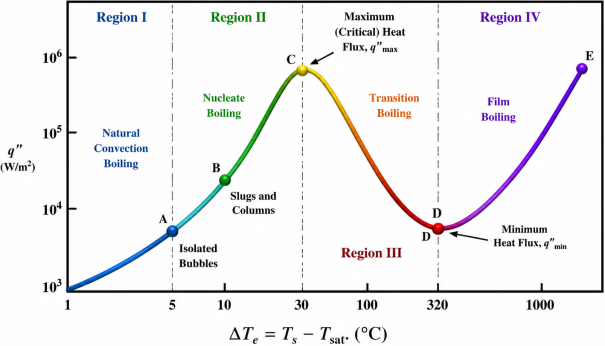
On the other hand, boiling happens at the solid-liquid interface when the surface temperature exceeds the saturation temperature, which corresponds to the liquid's pressure and causes a phase transition from liquid to vapor. The major characteristic of the boiling process is the rapid production of vapor bubbles at the solid-liquid interface. Once they reach a particular size, the vapor bubbles start to travel away from the liquid's surface and toward the free surface. Figure 1 shows the boiling curve of water . In addition, boiling is a rare thermal-hydraulic phenomenon in nature compared to many others. It’s caused by hot rocks or magma near the Earth's surface, subsurface volcano eruptions, or, in an extreme instance. Also, after a few opportunities to study this process in nature, humans eventually discovered boiling and began using it to prepare food for both simple and complex technical purposes .
Figure 1. Boiling curve of water showing the variation in heat flux with surface superheat, ΔTe=Ts−Tsat, across the natural-convection, nucleate-boiling, transition-boiling, and film-boiling regimes. The critical and minimum heat-flux points are also indicated .
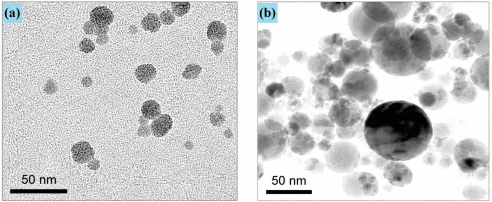
Nanofluids are mixtures of metal, metal-oxide, and carbon nanotube nanoparticles which ranging from 1 to 100 nm in base fluids like water, oil, and ethylene glycol. In applications, nanofluids are used in fuel cells, hybrid engines, refrigeration, heat exchangers, and coolants in nuclear reactors due to their unique features . Furthermore, nanofluids are suspensions of nanoparticles with small particle sizes and lower concentrations in common or base fluids. These fluids have been identified by researchers as unique heat transfer transporters due to their thermophysical properties and a variety of potential benefits in conventional thermal engineering applications . Figure 2 shows the TEM images of water-based carbonic nanofluids prepared using the one-step method (As shown in Figure 2(a)), and alumina nanofluids using the two-step method (As shown in Figure 2(b)) .
Figure 2. Transmission electron microscopy (TEM) images of water-based nanofluids prepared using different synthesis routes: (a) carbon-based nanofluid produced by the one-step method and (b) alumina nanofluid prepared by the two-step method. Scale bars: 50 nm .
On the other hand, phase change materials (PCMs) are used for volume fluctuations, good thermal stability, and the ability to freeze without requiring a lot of supercooling. The charging and discharging of energy in a passive energy system are provided by the temperature difference between the PCMs and the environment. PCMs also used in the manner described above have the ability to automatically store or release energy depending on the ambient temperature. Gypsum is a PCM material for use in building materials, wall partitions, and as an interior wall cladding material . Microchannels are widely used in many industrial applications. To address the issues with thermal management in electronic components, it is essential to suggest a more efficient and compact device. In addition, with the advantages of superior heat transfer performance, smaller geometric size and volume per heat load, lower coolant requirement, and lower operational cost, microchannel heat sinks (MCHS) are seen to be an innovative cooling technology for electronic systems. It is acknowledged that MCHS can work in conjunction with other technologies to address the complex thermal challenges that the industry is currently facing .
The dimensions of the channel are of great importance in the process of flow boiling heat transfer. Depending on the size of the channel cross-section, different physical phenomena take place during the flow. The presented one of the main classifications of channels is presented, which includes two main groups: mini-channels (dh less than 6 mm) and conventional channels (dh greater than 6 mm) . The thermal conductivity and viscosity of Al2O3 nanofluid based on car engine coolant were found to result in a significant enhancement of the heat transfer coefficient . The analysis regarding the assessment of the effectiveness of nanofluids for single-phase and two-phase heat transfer in microchannels . An experimental investigation of convective heat transfer of Al2O3/water nanofluid in a circular tube . The experimental investigation of laminar convective heat transfer and pressure drop of water-based Al2O3 nanofluids in a fully developed flow regime . The effect of Cu/water hybrid nanofluids on heat transfer. The above discussion depicts the fundamental analysis of heat, heat transfer, boiling, nanofluids, phase change materials, and microchannels. The following section deals with boiling heat transfer in terms of pool boiling and flow boiling .
2. Nanofluid Boiling Heat Transfer
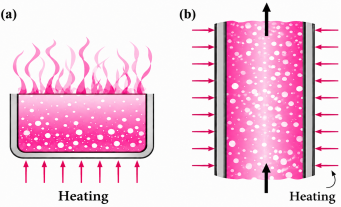
Figure 3. Schematic comparison of boiling heat-transfer configurations: (a) pool boiling, in which a stationary liquid is heated from below, and (b) flow boiling, in which the liquid flows through a heated channel .
Boiling heat transfer is seen to have occurred in many engineering applications such as in the cooling of nuclear reactors, the cooling of high-power electronic components, and heat exchangers. The industrialized world largely depends on the widespread use of fossil fuels to solve many undesirable issues, such as diminishing energy sources and causing global warming, which is thought to be the main driver of climate change. As a result, improving energy efficiency and environmental protection has become a must for the globe . Figure 3 shows the types of pool boiling and flow boiling heat transfer .
The modeling of boiling heat transfer for prospects. One of the most frequent phenomena in heat transfer processes occurring in numerous industrial applications is boiling heat transfer, which also involves a phase change from liquid to vapor. In heat exchange systems and high-tech applications, boiling is both a challenging process and a highly effective way to transfer heat . When a liquid comes into contact with a surface that is kept at a temperature higher than the liquid's saturation temperature, boiling eventually takes place at the liquid-solid interface. Pool boiling and convective flow boiling are the two categories into which boiling is traditionally divided based on the relative bulk motion of a liquid's body to the heating surface .
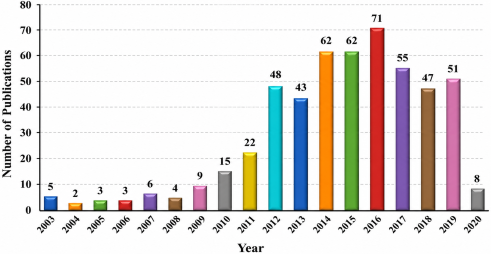
The boiling heat transfer properties of Al2O3-water nanofluids in swirl microchannels under terrestrial acceleration and gravity fields . The boiling heat transfer performance and phenomena of Al2O3–water nanofluids from a plain surface in a pool . The analysis of nanofluids and CHF through an experimental and analytical study . The above discussion in this section depicts the investigation of boiling heat transfer with nanofluids, and hence, it is seen in Figure 4 that annual publications on boiling heat transfer with nanofluids since 2003 .
Figure 4. Annual number of publications on boiling heat transfer using nanofluids from 2003 to 2020 .
2.1. Pool Boiling Heat Transfer with Nanofluids
Pool boiling is involved in many chemical and petrochemical processes, including distillation, air separation, refrigeration, and power cycles. It is revealed that in several decades of pool boiling research, the basic mechanism remains poorly understood . The commonly used particle-fluid combinations include diamond and carbon nanotubes suspended in water, ethylene glycol, ethanol, and other liquids, as well as metal nanoparticles Cu, Au, and Ag and oxide nanoparticles Al2O3, CuO, SiO2, TiO2, and CeO2. In the presence of nanoparticles, particle-particle and particle-molecule interactions play a crucial role in improving the thermal conductivity of the nanofluids, which boosts heat transfer . The experimental investigation of the pool boiling heat transfer properties of nanofluids in nucleate pool boiling was done on a horizontal, flat, square copper surface with heat fluxes ranging from 10 to 200 kW/m2 . It is seen in the study that when the particle concentration is 0.001 vol. %, the addition of the SDBS reduces the enhancement of the boiling heat transfer characteristics by nanoparticles. However, when the particle concentrations are 0.01 vol. % and 0.1 vol. %, the addition of the SDBS increases the enhancement of the boiling heat transfer characteristics by nanoparticles. An experimental design to examine how a nanofluid made of Fe3O4 and water, or ferrofluid, transferred heat during pool boiling under atmospheric pressure. The analysis of various volume concentrations of nanofluids showed that boiling heat transfer increased with concentration at low concentrations but decreased at high concentrations. It was determined that the boiling heat transfer coefficient increased up to 43% at a 0.1% volume concentration of nanofluid. Additionally, experimental research demonstrated that boiling heat transfer was decreased and increased, respectively, by the presence of positive and negative magnetic field gradients .
The pool-boiling heat transfer of non-Newtonian Al2O3/CMC nanofluids was investigated within the broader context of mechanical and thermal engineering research . The CMC solution carboxymethyl cellulose dissolved in water was mixed mechanically and ultrasonically to disperse the Al2O3 nanoparticles, resulting in a stable nanofluid. The effect of nanoparticles on the critical heat flux of water in pool boiling heat transfer of base fluids H2O was studied using a Cu plate-type heater . Pool boiling heat transfer to aqueous alumina nanofluids on the plain and concentric circular micro-structured (CCM) surfaces . Pool boiling heat transfer experiments in silica-water nanofluids . An experimental investigation into the pool boiling heat transfer of aqueous-based γ alumina nanofluids . The theoretical analysis of pool boiling characteristics of Al2O3 nanofluid according to volume concentration and nanoparticle size . The preparation and pool boiling characteristics of copper nanofluids over a flat plate heater . In addition, the role of ions in pool boiling heat transfer of pure and silica nanofluids . The pool boiling characteristics of nanofluid on a flat plate based on heater surface analysis . The nucleate pool boiling heat transfer characteristics of TiO2-water nanofluids at very low concentrations . On the other hand, the pool boiling heat transfer of non-Newtonian nanofluids .
2.2. Flow Boiling Heat Transfer with Nanofluids
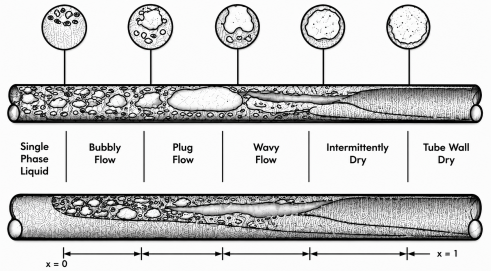
The analysis of flow boiling was experimentally carried out not only to measure the forced and nucleate flow boiling heat transfer coefficient of CuO/water nanofluids but also to investigate the effects of various operating conditions on the single-phase and two-phase flow-boiling of test nanofluids, including heat flux, flow rate, and dilute volumetric concentrations of test nanofluid . In addition, it was seen in convective-dominated flow boiling that the heat transfer coefficient increased with increasing mass flux and vapor quality and was independent of heat flux . The above discussion depicts that flow boiling has various regimes as shown in Figure 5 .
Figure 5. Schematic illustration of flow boiling regimes in a heated channel, showing the transition from single-phase liquid to bubbly, plug, wavy, intermittently dry, and tube wall dry flow patterns along the flow direction .
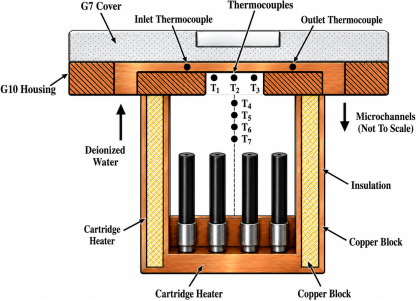
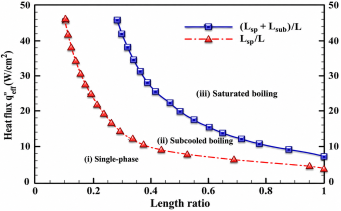
According to the findings of a study, at mass fluxes of 2000 to 2500 kg/m2s, the CHF values of the nanofluids were increased by up to 40 to 50% compared to pure water, but not at 1500 kg/m2s. The enhancement was attributed to the deposition of nanoparticles, and it appeared to be weakly dependent on nanoparticle concentration for the alumina nanofluids compared to the zinc-oxide and diamond nanofluids . There is a requirement for a cooling system that offers a high HTC and high CHF due to the increase in the rate of heat dissipation in devices (CHF). The size of the devices decreases as a result of the increased energy efficiency of the boiling systems due to HTC. High CHF is also necessary to dissipate the heater's extremely high heat flux before it reaches the dry-out point. . Figures 6 and 7 show the cross-sectional view of the microchannel test piece and three boiling regimes in a microchannel, case II-10, G = 330 kg/m2s, Tf, in = 92.1°C .
Figure 6. Cross-sectional schematic of the microchannel flow boiling test section, illustrating the heating assembly, thermocouple arrangement, insulation, and coolant flow configuration .
Figure 7. Heat flux distribution along a microchannel under single-phase, subcooled boiling, and saturated boiling regimes at G = 330 kg/m2.s and Tf,in = 92.1°C .
The flow boiling heat transfer properties of the MgO/terminal 66 nanofluid as a potential coolant were experimentally investigated on a copper-made disc. The results showed that bubble formation caused a pressure drop inside the test section. The heat transfer coefficient improvement was at its highest at wt. % = 0.1, or 23.7%, and the maximum improvement was 16.2% and 13.3%, respectively . The effects of nanoparticles on the heat transfer properties of a refrigerant-based nanofluid flowing inside a horizontal smooth tube were presented, and a correlation for forecasting the heat transfer performance of a refrigerant-based nanofluid. The results of the experiments demonstrated that the heat transfer coefficient of refrigerant-based nanofluids based on refrigerants was greater than that of pure refrigerants, with a maximum enhancement of 29.7% . The experimental investigation subsequently made a comparison of subcooled flow boiling of TiO2 nanofluid in a vertical and horizontal tube . The subcooled flow boiling heat transfer of dilute alumina, zinc oxide, and diamond nanofluids at atmospheric pressure. The above discussion presents an analysis of boiling heat transfer in pool and flow boiling for various nanofluids . The following section deals with boiling heat transfer enhancement in pool and flow boiling.
3. Boiling Heat Transfer Enhancement
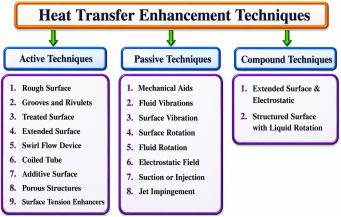
This review article's goal is to analyze, discuss, and contrast recent research on boiling heat transfer enhancement methods. This would make it easier for the research and industry communities to decide on the best surface structure and surface manufacturing process for a specific fluid. Figure 8 shows the heat transfer enhancement techniques . In Figure 8, the above discussion depicts that the heat transfer enhancement techniques can be classified as active, passive, and compound.
Figure 8. Classification of heat transfer enhancement techniques, including active, passive, and compound methods used to improve thermal performance .
Two main categories of methodologies have been suggested to enhance nucleate boiling heat transfer: active and passive. The active techniques require external power, and passive techniques do not directly apply external power . The nucleate boiling is an effective heat-transfer mechanism in terms of boiling regimes; it must not exceed the CHF. In addition, localized overheating at the heated surface and a reduction in the rate of heat transmission occur together with the development of CHF . Islam et al. illustrated recent developments in advanced automotive-engine technology, including thermal engineering concepts . Boiling phenomena and nanofluids have been investigated in various engineering and non-engineering applications. The purpose of this paper was to discuss how surface coating affected the heat transfer coefficient and critical heat flux in pools and the flow boiling phenomenon . The research on improving phase change heat transfer into two categories: first, an investigation into the fluid flow or transport mechanism over a micro- or nano-structured surface, which is of utmost importance; second, actual computational and experimental methods to increase the CHF for a given surface or device .
Enhancing CHF was necessary to prevent boiling crises and to improve the HTC to improve the efficiency of energy conversion in the boiling process . Hu et al. Efficient heat transfer mechanisms were essential for achieving high power densities and optimal system efficiency in all power generation, refrigeration, and advanced electronic systems. Additionally, improved the CHF by 112% and increased the LPT by 40K when compared to a conventional aluminum surface . On the other hand, the nucleate boiling heat transfer enhancement for water and FC-72 on titanium oxide and silicon oxide surfaces . In addition, the boiling of refrigerants on enhanced surfaces and the boiling of nanofluids .
3.1. Pool Boiling Heat Transfer Enhancement
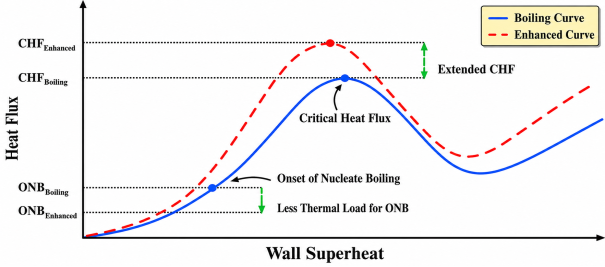
Surface enhancements can take the shape of area or geometrical changes, changes in roughness, or changes in the material. The area or geometry is modified by mini- or micro-structures. These adjustments increase surface area without growing the footprint. Implementing nano- and porous structures on a heated surface has the power to change the surface energy, which changes the surface's wettability . The CHF phenomena can lead to a substantial HTC reduction, which is followed by a notable increase in surface temperature. Therefore, HTC should be maximized to improve the boiling heat transfer, which would increase to CHF. As soon as the CHF threshold is reached, the efficiency of heat transfer abruptly decreases, leading to localized overheating of the heated surface. Maintaining CHF within a believable limit is essential for maintaining the system's safety since there is a direct correlation between the boiling limit and actual physical burnout of the heated surface. Figure 9 shows the comparison between common and ameliorated pool boiling curves .
Figure 9. Comparison of conventional and enhanced pool boiling curves, illustrating reduced onset of nucleate boiling (ONB), increased critical heat flux (CHF), and improved boiling heat transfer performance achieved by surface enhancement techniques .
A liquid containing a colloidal dispersion of solid particles with diameters generally below 100 nm is referred to as a nanofluid. Nanoparticle-based materials and suspensions have also been considered in broader engineering and effluent-treatment applications . Nanofluids commonly exhibit higher thermal conductivity than their base fluids. However, nanoparticle deposition on the heating surface can increase surface wettability, reduce the density of active nucleation sites, and consequently weaken the heat-transfer coefficient. The changes in the heating surface morphology, such as a reduction in active nucleation sites and the contact angle, are to blame for the CHF enhancement and HTC degradation caused by the use of nanofluids during pool boiling. However, for low nanofluid concentrations, the nucleation sites that are created by the deposition of nanoparticles can also help to improve the HTC . Despite the consistency of the databases for the CHF, convective heat transfer coefficient, and thermal conductivity of nanofluids, the boiling HTC of alumina nanofluids is not as well standardized. To put it another way, some researchers have reported that there has been no change in the nucleate boiling regime's heat transfer, but others have reported a reduction or an increase in heat transfer . The Marangoni effect on nucleate pool boiling with various working fluids. According to the experimental findings, the surface tension gradient caused Marangoni convection, which increased the CHF of the binary fluid up to 1.52 times that of water and the CHF of the self-rewetting fluid up to 1.91 times that of water .
The pool boiling experiments were carried out to investigate the relationship between the CHF, surface wettability, and nucleate boiling heat transfer as they relate to the boiling time in nanofluids using TiO2-water nanofluids as the test liquid. In the experiments, the maximum CHF enhancement was found to be 91%, and a significant correlation between CHF and the contact angle was also observed. These thermal phenomena are relevant to the broader study of fire prevention and industrial safety . Reduced graphene oxide (rGO) was produced from graphite using chemical reduction and the modified Hummers’ method. The influence of rGO/water nanofluids on CHF enhancement during pool-boiling heat transfer was then investigated. Results showed that for the tested concentrations, CHF was increased by 145 to 245% . The heat transfer coefficient for DI water and an Al2O3-water-based nanofluid boiling in a pool at saturation conditions. The applied heat flux ranged from 100 to 800 kW/m2, and the average size of the nanoparticles was 10 nm. In comparison to DI water, it was found that the heat transfer coefficient for boiling nanofluid pools increased by up to 75% and 15% for smooth and rough surfaces, respectively . The effect of nanoparticles on the CHF of water in pool boiling heat transfer . On the other hand, the nucleate boiling heat transfer enhancement for water and FC-72 on titanium oxide and silicon oxide surfaces . The boiling of refrigerants on enhanced surfaces and the boiling of nanofluids . In addition, the pool boiling heat transfer to aqueous alumina nanofluids on the plain and concentric circular micro-structured (CCM) surfaces .
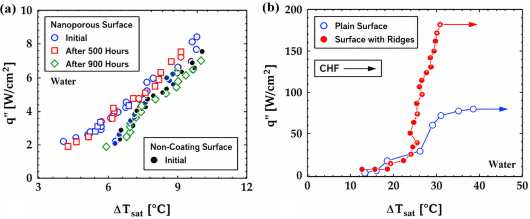
Pool boiling heat transfer experiments in silica-water nanofluids . The experimental investigation into the pool boiling heat transfer of aqueous-based γ alumina nanofluids . The thermal conductivity and viscosity of Al2O3 nanofluid based on car engine coolant . The boiling heat transfer performance and phenomena of Al2O3–water nanofluids from a plain surface in a pool . The theoretical analysis of pool boiling characteristics of Al2O3 nanofluid according to volume concentration and nanoparticle size . The preparation and pool boiling characteristics of copper nanofluids over a flat plate heater . Boiling time effect on CHF enhancement in pool boiling of nanofluids . The role of ions in pool boiling heat transfer of pure and silica nanofluids . Pool boiling characteristics of nanofluid on a flat plate based on heater surface analysis . The experimental study of critical heat flux enhancement during forced convective flow boiling of nanofluid on a short heated surface . The nanofluids and critical heat flux are explained in the pool boiling . Figure 10 shows (a) long-term boiling performance with saturated water on an Al2O3 nano-porous surface at atmospheric pressure and (b) boiling curves for both enhanced and plain surfaces in water .
Figure 10. Boiling performance of enhanced heat transfer surfaces: (a) Long-term pool boiling performance of saturated water on an Al2O3 nano-porous surface under atmospheric pressure, and (b) Comparison of boiling curves for enhanced and plain surfaces in water .
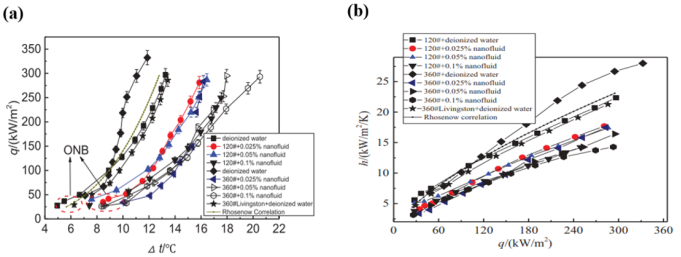
Figure 11 shows the (a) boiling curves of deionized water and SiO2 nanofluids on hydrophilic surfaces and (b) variation of boiling heat transfer coefficient versus heat flux for deionized water and SiO2 nanofluids on hydrophilic surfaces .
Figure 11. Boiling characteristics of deionized water and SiO2 nanofluids on hydrophilic surfaces: (a) Pool boiling curves at different nanoparticle concentrations, and (b) Variation of the heat transfer coefficient with heat flux .
3.2. Flow Boiling Heat Transfer Enhancement
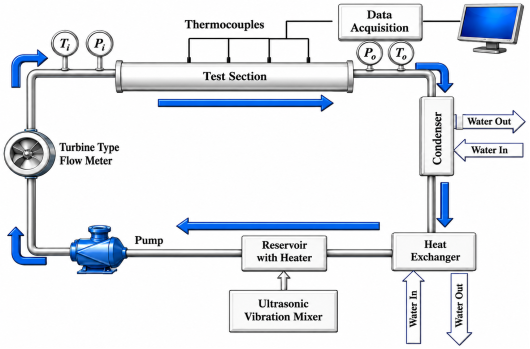
The enhancement of flow-boiling heat transfer is important in many engineering applications. Kim et al. illustrated the CHF of flow boiling heat transfer for its augmentation. In this study, the CHF of Al2O3 nanofluids increased during flow boiling by up to 70%. At 0.01 vol. % concentrations and a mass flux of 100 kg/m2s, the maximum CHF enhancement of 70.24% was observed. Figure 12 shows the flow boiling experiment . In addition to nanofluid-assisted boiling enhancement, optimization of heat transfer equipment through advanced surface geometries and thermal system design has also demonstrated significant improvements in heat transfer efficiency. Louvered fin configurations can effectively enhance convective heat transfer by increasing fluid mixing and reducing thermal resistance, making them attractive for compact heat exchanger applications . Furthermore, efficient thermal management remains a key consideration in high-temperature energy systems, including nuclear power plants, where enhanced boiling heat transfer contributes to improved operational safety, cooling reliability, and overall system performance .
Figure 12. Schematic diagram of the experimental setup for flow boiling heat transfer using nanofluids .
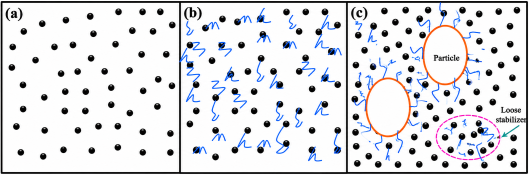
Experimentally, the heat transfer characteristics of SiC/H2O and Graphite/H2O nanofluids during flow boiling. When compared to deionized water, the flow boiling heat transfer capacities of 0.1vol% SiC/H2O nanofluid increased from 24.7% to 30.6%. Instead, it changed for 0.1 vol. % Graphite/H2O nanofluid from 29.4% to 13.3% . The use of nanofluid boiling to improve heat transfer. Figure 13 shows the two-step method for nanofluid formulation .
Figure 13. Schematic illustration of the two-step nanofluid preparation method: (a) pure base fluid, (b) base fluid with stabilizers, and (c) nanofluid with dispersed nanoparticles stabilized in the liquid .
The effects of nanoparticles on the heat transfer properties of a refrigerant-based nanofluid flowing inside a horizontal smooth tube and predicted a correlation for forecasting the heat transfer performance of a refrigerant-based nanofluid. The results of the experiments demonstrated that the heat transfer coefficient of nanofluids based on refrigerants was greater than that of pure refrigerants, with a maximum enhancement of 29.7% . The improvement of thermal performance through enhanced heat transfer mechanisms is also important in various engineering systems, including steam power plants, biomass energy systems, and industrial thermal equipment. Recent studies have shown that optimizing heat transfer processes can significantly improve energy efficiency, exergy performance, and system reliability in thermal power applications . Moreover, advances in manufacturing technologies and material processing contribute to the development of durable heat transfer components capable of operating under severe thermal conditions . Experimental investigations on engineering materials further support the importance of selecting appropriate materials with improved mechanical and thermal characteristics for reliable long-term operation of heat transfer systems .
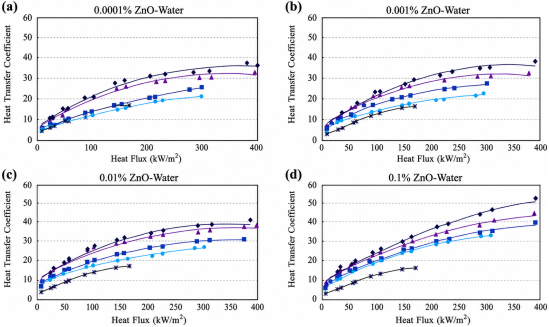
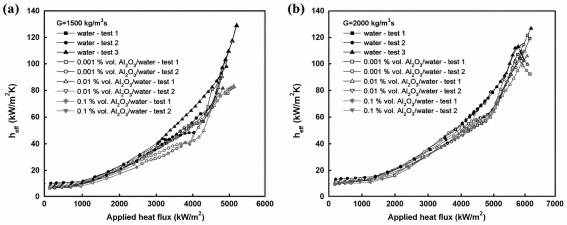
A mechanism of heat transfer enhancement or deterioration of nanofluid flow boiling heat transfer . The pool boiling heat transfer of non-Newtonian nanofluids. Figure 14 shows the variation of the heat transfer coefficient, h (kW/m2K), of ZnO-water nanofluid with heat flux at different ZnO nanoparticle volume fractions and 400 kg/m2s mass flow rate . Figure 14 illustrates the variation of the heat transfer coefficient (kW/m2·K) of ZnO-water nanofluids with heat flux at different ZnO nanoparticle volume fractions and a mass flow rate of 400 kg/m2·s . Figure 15 shows the effective heat transfer coefficient of water and alumina nanofluids at G = 1500 kg/m2s and G = 2000 kg/m2s .
Figure 14. Variation of the heat transfer coefficient (HTC) of ZnO water nanofluids with heat flux at a mass flow rate of 400 kg m-2 s-1 for nanoparticle volume fractions of (a) 0.0001 vol.%, (b) 0.001 vol.%, (c) 0.01 vol.%, and (d) 0.1 vol.% .
Figure 15. Effect of Al2O3 Water Nanofluids on the Heat Transfer Coefficient Under Different Mass Flow Rates: (a) Heat Transfer Coefficient at G = 1500 kg/m2·s and (b) Heat Transfer Coefficient at G = 2000 kg/m2·s .
4. Comparative Analysis of Pool and Flow Boiling Performance
The analysis of heat, heat transfer, boiling heat transfer, including pool boiling and flow boiling, and boiling heat transfer enhancement, including pool boiling and flow boiling heat transfer enhancement, is carried out in the previous section. The findings of the heat transfer enhancement in pool boiling and flow boiling are provided in the following table.
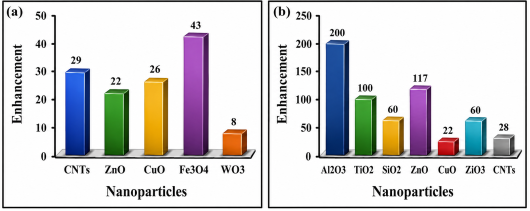
Figure 16. Bar chart to illustrate maximum increase (%) of (a) HTC and (b) CHF in pool boiling for different nanoparticles.
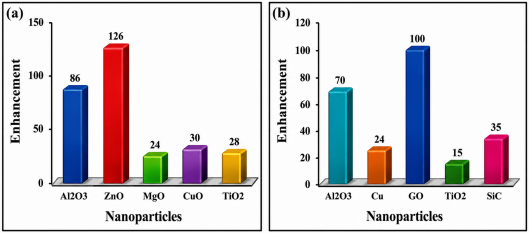
Table 1. Summary of experimental studies on pool boiling heat transfer enhancement using various nanofluids.

SL No.

Nanofluids

Heater Type

Observation

Ref.

Nano-particles

Base Fluids

01.

Al2O3

H2O

Copper plate

CHF enhancement reported up to approximately 200%; enhancement was not attributed solely to bulk thermal conductivity

02.

TiO2

Copper surface

CHF increased by a maximum of 38.2%

03.

Alumina

Copper plate

BHT enhanced between 11 and 21%. With rising particle concentration, BHT increased.

04.

Alumina

Copper plate

CHF Enhancement and HTC increased

05.

SiO2

NiCr wire

CHF enhancement up to 60%

06.

Al2O3

Stainless steel plate

CHF increased by about 40%.

07.

ZiO3

Ethylene glycol

Cu plate

CHF Enhancement and HTC increased

08.

Al2O3

H2O

Stainless steel

BHT decreased.

CHF increased up to 50%.

09.

Al2O3

0.025vol.%, 50 nm

CHF of the nanofluid increased

10.

Cu

Stainless-steel plate

CHF Enhancement and deterioration

11.

TiO2

NiCr wire

CHF increased up to 200%

12.

SiO2

H2O

NiCr wire

Constant BHT. CHF increased up to 60%

13.

Alumina

Cu plate

CHF Enhancement and HTC deterioration

14.

CNTs

H2O and R-22

Stainless steel tube

HTC was observed to increase up to 28.7% at heat fluxes of fewer than 30 kW/m 2

15.

Al2O3

H2O

Cu plate

CHF Enhancement

16.

Al2O3 and TiO2

H2O

NiCr wire

CHF increased up to 100%

17.

ZnO

EG

0.5 to 3.7 vol.%

HTC increased about 22% at a concentration of 1.6 %. Maximum enhancement of CHF was found to be 117% at φ=2.6 %

18.

CuO

Pentane

0.005% and 0.01%

HTC increased up to 20–30% for brass surface and 15–25% at the nanoparticle concentration of 0.005%

19.

Fe3O4

H2O

0.1 vol.%

HTC increased up to 43%

20.

WO3

0.005%, 0.01% vol.

HTC ratio was increased by about 6.7%

Figure 17. Comparison of the maximum enhancement in (a) heat transfer coefficient (HTC) and (b) critical heat flux (CHF) during flow boiling for different nanoparticles.
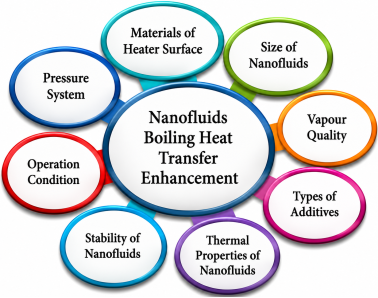
Table 2. Summary of experimental studies on flow boiling heat transfer enhancement using various nanofluids.

Sl No.

Nanofluids

Heater Type

Observation

Ref.

Nano-particles

Base Fluids

01.

Metal Oxide

H2O

0.2 wt. %, NP 40nm

HTC increased by 17%

02.

Copper

50 nm parallel mini channels of dh = 800 μm.

With increasing nanoparticle concentration, BHT enhanced.

03.

Al2O3

Stainless steel

CHF enhancement 70%

04.

TiO2

0.001, 0.005 and 0.01wt.%

At a given mass flux, HTC increased up to 27.97%.

05.

Al2O3

Cu tube

CHF enhancement

06.

TiO2

Cu surface

Enhancement up to 15%

07.

ZnO

0.0001-0.1vol.%; NPs, D-100 (30 to 50) nm

At higher concentration, HTC increased by 126%.

08.

Al2O3

Cu tube

CHF enhancement 32%

09.

CuO

DI- H2O

0.1 to 0.3 wt.%

HTC increased with the mass flow rate.

10.

GO

H2O

0.01 vol.%

CHF increased by about 100%.

11.

Al2O3, Cu

Heated circular tube

CHF enhancement 13%

12.

SiC and Graphite

0.1 vol.%

At 0.1 vol.% SiC / H2O and Graphite / H2O nanofluid, BHT increased.

13.

CuO

R-113

Cu surface

Enhancement up to 30%

14.

Al2O3

H2O

Stainless-steel heater

Enhancement up to 25%

15.

MgO

Therminol 66

0.1.0.2 and 0.3 wt.%

Maximum HTC enhancement was 23.7% at wt.% = 0.1.

16.

ZnO

H2O

0.005 to 0.02 vol.%

Heat transfer rate of Al2O3/H2O nanofluid was increased by flow boiling by roughly 86%.

Figure 18. Key factors influencing the enhancement of pool and flow boiling heat transfer using nanofluids.
In the above discussion, the boiling heat transfer enhancement with nanofluids has been analyzed. The above discussion depicts that the boiling heat transfer with nanofluids can be augmented using various factors such as system pressure, materials of the heater surface, and size. Figure 16 illustrated a bar chart to illustrate the maximum increase (%) of (a) heat transfer coefficient (HTC) and (b) critical heat flux (CHF) in pool boiling for different nanoparticles. Figure 17 represented a bar chart to illustrate the maximum increase (%) (a) heat transfer coefficient (HTC) and (b) critical heat flux (CHF) in flow boiling for different nanoparticles or binary nanoparticles. Figure 18 demonstrate the factors affecting boiling heat transfer enhancement with nanofluids.
5. Discussion of Boiling Heat Transfer Performance
5.1. Cross-Study Trends and Comparative Assessment
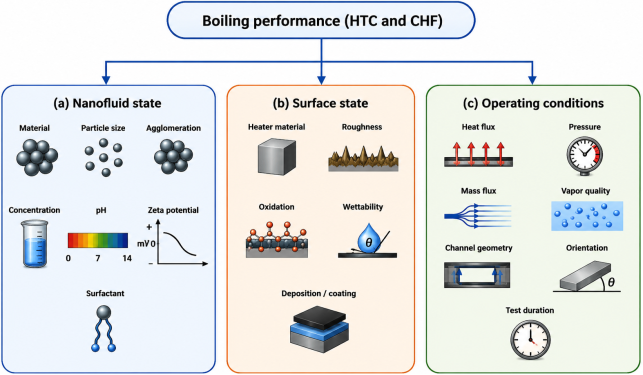
The reviewed literature confirms that nanofluids can improve both pool- and flow-boiling performance, but the magnitude and direction of the response are controlled by the complete experimental system. As summarized in Figure 19, boiling performance (HTC and CHF) is governed by the coupled interactions among the nanofluid state, boiling-surface characteristics, and operating conditions rather than by any individual parameter. Nanoparticle material, primary particle size, agglomerate size, concentration, base-fluid composition, pH, zeta potential, surfactant type, ultrasonication history, and sedimentation stability determine the state of the suspension before boiling begins. During operation, heater material, roughness, oxidation state, wettability, orientation, pressure, heat flux, mass flux, vapor quality, channel geometry, and boiling duration further influence the measured HTC and CHF.
Al2O3 and TiO2 dominate the literature because they are comparatively available, chemically stable, and compatible with water-based systems. Their frequent use, however, should not be interpreted as evidence that they are intrinsically superior to ZnO, SiO2, CuO, Fe3O4, MgO, ZrO2, WO3, or carbon-based nanomaterials. The relationships illustrated in Figure 19 also explain why different studies often report contrasting boiling behaviors, as variations in nanofluid preparation, surface condition, and operating parameters modify the governing boiling mechanisms. HTC reflects the rate of heat transfer at a given wall superheat and is highly sensitive to nucleation-site density, bubble departure, microlayer evaporation, and thermal resistance at the interface. CHF represents the upper heat-flux limit before persistent dryout or vapor blanketing occurs and is strongly influenced by wettability, capillary liquid supply, and vapor removal. A surface modification can therefore improve CHF while leaving HTC unchanged or even reducing it.
Figure 19. Cross-study comparison of the key factors governing nanofluid boiling performance: (a) Nanofluid state, (b) Boiling surface, and (c) Operating conditions.
5.2. Pool-Boiling Performance and Mechanisms
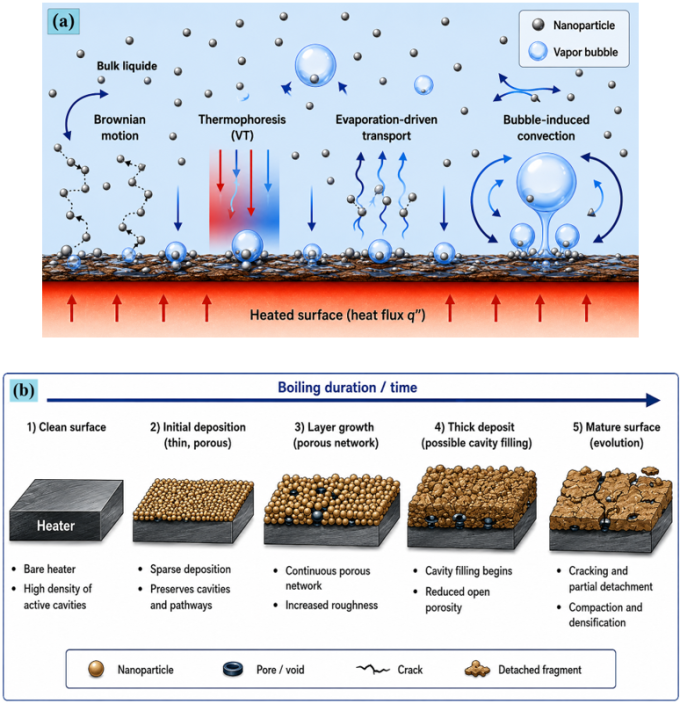
Figure 20. Pool-boiling enhancement mechanisms: (a) Nanoparticle transport to the heated surface and (b) Surface deposition and morphology evolution.
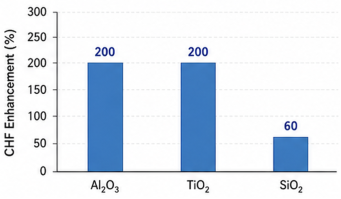
Pool-boiling studies show a comparatively consistent tendency toward CHF enhancement. As illustrated in Figure 20, nanoparticle transport toward the heated wall and the subsequent evolution of the deposited surface layer plays a central role in modifying nucleation characteristics and boiling performance. Selected Al2O3 and TiO2-water studies report increases approaching 200%, while silica-water systems report increases of approximately 60% (Figure 21). These large values are associated primarily with changes in the heater surface rather than with the modest increase in the bulk thermal conductivity of the suspension .
During boiling, nanoparticles are transported toward the heated wall and may form a porous or textured deposit. The sequential transport and surface-evolution mechanisms summarized in Figure 20 explain how deposition modifies wettability, capillary liquid supply, and nucleation-site density, thereby influencing both HTC and CHF. If the deposit increases wettability and capillary wicking, liquid can more readily penetrate hot or partially dry regions, delaying the formation of a stable vapor blanket and increasing CHF .
The effect of concentration is generally non-monotonic. Increasing concentration raises the particle flux toward the wall and can accelerate favorable surface modification, but beyond an optimum range it also promotes agglomeration, sedimentation, uneven deposition, and viscosity increase. s demonstrated in Figure 21, the magnitude of CHF enhancement varies substantially among different nanoparticle materials, emphasizing that the reported performance is strongly dependent on the complete experimental conditions rather than nanoparticle composition alone. The optimum concentration is not transferable among systems because it depends on particle chemistry, base fluid, preparation method, surface material, heat flux, and test duration. For magnetic Fe3O4 water nanofluids, the direction and strength of a magnetic-field gradient can further redistribute particles and modify boiling behavior . Several statements in the original manuscript combined numerical results with unrelated references. In particular, the rGO synthesis and 91% CHF/contact-angle claims require the correct primary publication before they can be retained. Similarly, the claimed 75% HTC improvement for Al2O3/water cannot be assigned to the TiO2 synthesis paper listed as reference . Removing unsupported maxima produces a more conservative but scientifically defensible synthesis.
Figure 21. Representative CHF enhancement of selected nanofluids under pool-boiling conditions.
5.3. Flow-Boiling Performance and Hydrodynamic Effects
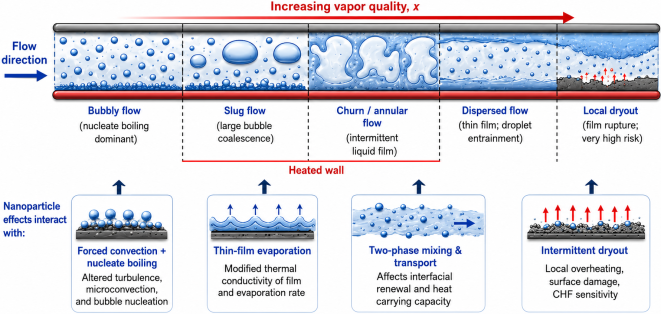
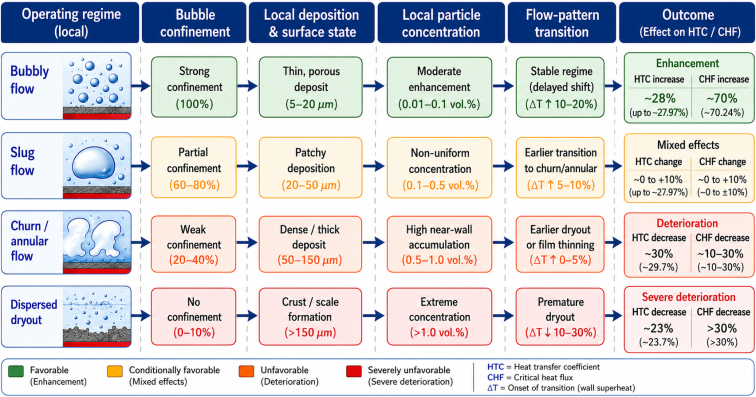
low boiling exhibits greater cross-study variability because the nanofluid interacts with an evolving two-phase flow. As illustrated in Figure 22, the transition from bubbly flow to slug, churn/annular, dispersed flow, and local dryout continuously changes the dominant heat-transfer mechanisms, causing the contribution of nanofluids to vary throughout the flow path. The relative contribution of forced convection, nucleate boiling, thin-film evaporation, and intermittent dryout vary with mass flux and vapor quality. Pressure changes, saturation temperature, density ratio, bubble size, and latent heat; channel size controls bubble confinement; and orientation changes the balance between buoyancy and imposed flow. Figure 24 further demonstrates that the final boiling performance depends on the coupled interaction among the operating regime, bubble confinement, particle deposition, and local particle concentration rather than on any single parameter.
Figure 22. Flow-boiling hydrodynamics and nanofluid interactions across two-phase flow regimes.
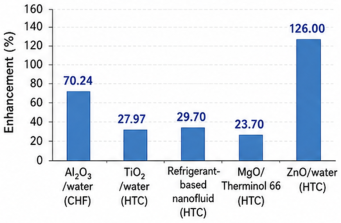
Figure 23. Representative HTC and CHF enhancement of selected nanofluids under flow-boiling conditions.
Representative findings include a maximum CHF enhancement of approximately 70.24% for Al2O3-water at 0.01 vol.% and a mass flux of 100 kg m-2 s-1, HTC enhancement up to approximately 27.97% for TiO2-water, approximately 29.7% for a refrigerant-based nanofluid, approximately 23.7% for MgO Therminol 66, and up to approximately 126% for ZnO-water under the reported conditions (Figure 23) . As summarized in Figure 23, these reported enhancements differ substantially among nanofluid systems because boiling performance is governed by the combined effects of nanoparticle properties, flow regime, heat flux, mass flux, vapor quality, and channel geometry rather than by nanoparticle composition alone . The large ZnO value should be interpreted cautiously because a single maximum does not establish reproducibility across different channels, heat-flux ranges, or stability conditions.
The SiC water and graphite-water results illustrate the importance of operating conditions: the same nominal concentration produced The SiC/water and graphite/water results illustrate the importance of operating conditions: the same nominal concentration produced deterioration in some regimes and enhancement in others. As summarized in Figure 24, nanofluids can either enhance or deteriorate boiling performance depending on the combined effects of local flow regime, bubble confinement, deposition characteristics, particle concentration, and flow-pattern transition. Such behavior may arise from changes in bubble confinement, local particle concentration, deposition, or flow-pattern transition. It also shows why a single average HTC enhancement can conceal important local behavior. Axial wall-temperature measurements, flow visualization, local vapor quality, and pressure-fluctuation data are needed to identify the mechanisms responsible for the observed response. Figure 24 further emphasizes that both thermal enhancement and hydrodynamic penalties should be evaluated simultaneously, since improved HTC or CHF may be accompanied by increased pressure drop, fouling, erosion, or flow instability.
Figure 24. Conceptual framework illustrating the conditions leading to enhancement or deterioration of flow-boiling performance in nanofluids.
5.4. Integrated Mechanisms Governing Boiling Enhancement
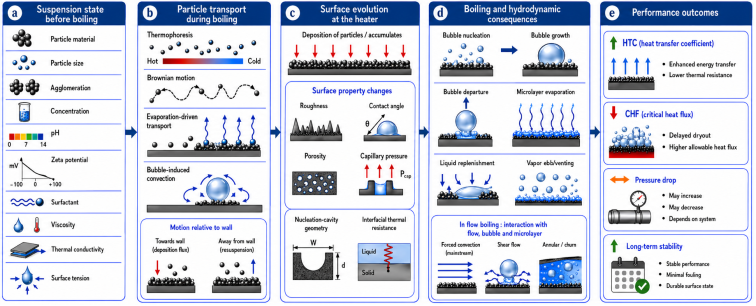
Figure 25. Integrated mechanisms governing nanofluid boiling enhancement: (a) Suspension state, (b) Particle transport, (c) Surface evolution, (d) Flow-boiling hydrodynamics, and (e) Performance outcomes.
The available evidence supports a unified interpretation in which nanofluid boiling is governed by coupled fluid, surface, and hydrodynamic processes. As illustrated in Figure 25, boiling enhancement is a multistage process that begins with the suspension state, progresses through nanoparticle transport and surface evolution, and culminates in hydrodynamic interactions that determine the overall thermal-hydraulic performance. Before boiling, the suspension state determines viscosity, thermal conductivity, surface tension, and particle mobility. During boiling, thermophoresis, Brownian motion, evaporation-driven transport, and bubble-induced convection carry particles toward or away from the wall. Figure 25 further highlights that these coupled mechanisms collectively regulate nucleation behavior, liquid replenishment, vapor removal, and ultimately the measured HTC and CHF.
This interpretation explains why thermal conductivity alone cannot predict boiling performance. As summarized in Figure 25, improvements in boiling performance arise from the synergistic interaction between nanofluid properties, surface modification, and two-phase flow dynamics rather than from any single enhancement mechanism. An increase in effective conductivity may improve single-phase convection, but boiling is controlled by interfacial events occurring over multiple length and time scales.
5.5. Standardization, Reproducibility and Industrial Scale-up
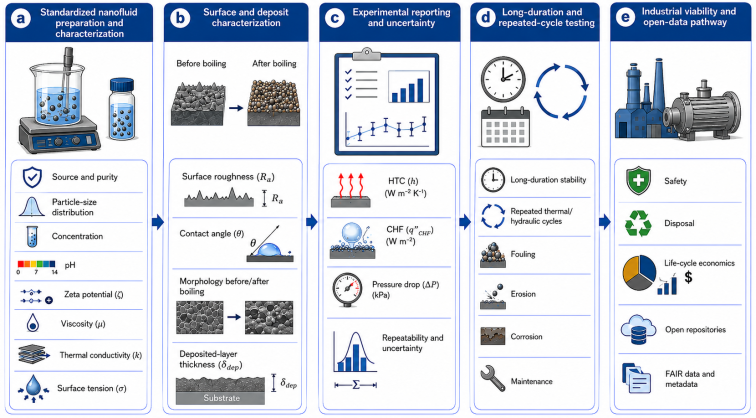
A quantitative meta-analysis is not presently justified because the available studies employ widely different particle sizes, particle-size distributions, concentrations, preparation methods, heater materials, surface conditions, pressures, geometries, heat-flux ranges, and data-reduction procedures. As summarized in Figure 26, improving the reproducibility of nanofluid boiling research requires standardized protocols covering nanofluid preparation, surface characterization, experimental reporting, uncertainty analysis, long-term testing, and industrial evaluation. Several studies also provide incomplete information regarding measurement uncertainty, nanofluid stability, surface characteristics, and deposited-layer properties. Figure 26 further emphasizes that consistent documentation of these variables is essential for meaningful comparison among independent studies and for reliable technology translation.
Figure 26. Framework for standardization and industrial implementation: (a) Nanofluid preparation and characterization, (b) Surface and deposit characterization, (c) Experimental reporting and uncertainty, (d) Long-term testing, and (e) Industrial viability and open-data practices.

Long-duration and repeated-cycle experiments are required to quantify particle sedimentation, agglomeration, fouling, erosion, corrosion, and the persistence of HTC and CHF enhancement. As illustrated in Figure 26, long-term stability testing, uncertainty quantification, and standardized reporting are equally important as thermal-performance measurements for evaluating the practical viability of nanofluid boiling systems. These experiments should include start-stop cycles, standby periods, and post-test inspection of pumps, valves, channels, and heat-transfer surfaces. Future mechanistic models should connect nanoparticle transport and deposition with surface evolution, nucleation-site activation, bubble growth and departure, capillary liquid replenishment, flow-regime transitions, HTC, CHF, and pressure loss. Figure 26 highlights that future progress toward industrial deployment will require integrating mechanistic understanding with standardized experimental protocols, transparent data reporting, uncertainty-qualified datasets, and open-access repositories. Physics-informed machine-learning approaches may assist prediction, but they should be trained using transparent, uncertainty-qualified datasets and validated against independent experiments.
6. Conclusions
This review critically assessed nanofluid-enhanced pool and flow boiling, with emphasis on the effects of nanoparticle properties, fluid stability, heater-surface condition, operating parameters, and two-phase hydrodynamics on the heat transfer coefficient and critical heat flux. The principal conclusions and recommendations are as follows:
1) Nanofluid boiling enhancement is a system-level response. It cannot be predicted from nanoparticle thermal conductivity or composition alone because the fluid, heated surface, boiling regime, and operating condition interact continuously.
2) Al2O3 and TiO2 are the most frequently studied materials, but the current evidence does not establish a universally optimal nanoparticle. ZnO, SiO2, Fe3O4, MgO, ZrO2, WO3, and carbon-based materials also show potential under selected conditions.
3) Pool boiling generally produces more consistent CHF improvement than HTC improvement. Representative Al2O3- and TiO2-water studies report CHF increases approaching 200%, while silica-water systems report increases of approximately 60%; these values are specific to the tested fluids, surfaces, and procedures.
4) Flow boiling is more sensitive to hydrodynamic conditions. Selected studies report CHF enhancement of approximately 70.24% for Al2O3-water and HTC enhancement up to approximately 126% for ZnO-water, but the response changes with mass flux, vapor quality, pressure, channel geometry, orientation, and flow regime.
5) Nanoparticle deposition is the central mechanism linking the fluid to the surface. Increased wettability, porosity, and capillary wicking can improve liquid replenishment and delay vapor blanketing, thereby increasing CHF. Excessive or compact deposition can block nucleation cavities and add thermal resistance, reducing HTC.
6) An optimum concentration and a controlled deposited-layer state are more important than high particle loading. Excessive concentration can increase agglomeration, sedimentation, viscosity, pressure drop, fouling, and pumping-power demand.
7) Surface aging must be treated as a time-dependent design variable. Long-duration, repeated-cycle, and start-stop testing is necessary because short-term HTC or CHF enhancement may not persist after deposition, erosion, corrosion, or sedimentation.
8) Thermal and hydraulic performance should be evaluated simultaneously. Future flow-boiling studies should report HTC, CHF, pressure drop, pumping power, flow instability, and dryout using a common thermal-hydraulic performance metric.
9) The present literature does not support ranking nanoparticles solely by reported maximum percentage enhancement. Standard benchmark fluids, surfaces, geometries, operating conditions, preparation protocols, data-reduction methods, and uncertainty reporting are required for meaningful comparison.
10) Characterize both the nanofluid and the heater surface before and after boiling. Essential measurements include particle-size distribution, zeta potential, pH, viscosity, thermal conductivity, sedimentation stability, surface roughness, contact angle, deposit thickness, and surface morphology.
11) Predictive models should couple particle transport, deposition, surface evolution, bubble dynamics, liquid replenishment, flow-regime transition, HTC, CHF, and pressure loss. Data-driven models should be validated using independent and uncertainty-qualified experiments.
12) Industrial implementation requires assessment of material compatibility, corrosion and erosion, particle recovery, occupational and environmental safety, maintenance, filtration, scale-up reliability, and techno-economic performance.
13) Nanofluid-assisted boiling remains a promising approach for high-heat-flux thermal management, but reliable deployment will depend on coordinated optimization of fluid formulation, surface engineering, and system design rather than on short-duration laboratory enhancement values alone.
Abbreviations

BHTE

Boiling Heat Transfer Enhancement

BC

Boiling Curve

CHF

Critical Heat Flux

COP

Coefficient Of Performance

DI

Deionized

PBHT

Pool Boiling Heat Transfer

FBHT

Flow Boiling Heat Transfer

FBHTE

Flow Boiling Heat Transfer Enhancement

GO

Graphene Oxide

HT

Heat Transfer

HTC

Heat Transfer Coefficient

HTE

Heat Transfer Enhancement

PCM

Phase Change Materials

LPT

Leidenfrost Point Temperature

MCHS

Microchannel Heat Sinks

MWCNTs

Multi-Wall Carbon Nanotubes

NB

Nanofluids Boiling

PBHTE

Pool Boiling Heat Transfer Enhancement

SDBS

Sodium Dodecylbenzene Sulfonate

TEM

Transmission Electron Microscopy

A

Area (m2)

Cpl

Liquid Specific Heat (J/kg⋅K)

K

Thermal Conductivity (W/m⋅K)

G

Mass Flux (kg m-2 s-1)

h

Heat Transfer Coefficient (W m-2 K-1)

q″

Heat Flux (W m-2)

T

Temperature (°C or K)

ΔTₑ

Wall Superheat, Ts − Tsat (K)

φ

Nanoparticle Volume Fraction

Acknowledgments
The authors express their sincere gratitude to the Dhaka University of Engineering & Technology, Gazipur-1707, Bangladesh, and Abedin Research Lab (ARL), Bangladesh, for their invaluable cooperation and guidance throughout this compiled work.
Author Contributions
Md. Rezaul Karim Sikder: Conceptualization, Methodology, Writing – original draft
Mohammad Zoynal Abedin: Funding acquisition, Supervision, Writing – review & editing
Samsul Islam: Methodology, Writing – original draft
Md. Jakir Hossen: Project administration, Resources
Jahirul Islam: Visualization, Writing – review & editing
Ruman Uddin: Formal Analysis, Investigation
Abdul Ahad: Data curation, Software
Md. Shah Mamunur Rashid: Validation, Visualization
Nurul Hoda Sanid: Resources, Investigation
Mohammad Monirul Kabir Mridha: Formal Analysis, Resources
Conflicts of Interest
The authors declare no conflicts of interest.
References
[1] Holman, J. P. (2010). Heat Transfer. 10th Edition, McGraw-Hill, New York.
[2] Çengel, Y. A., & Ghajar, A. J. (2011). Heat and mass transfer: Fundamentals & applications (4th ed.). McGraw-Hill Education.
[3] Bergman, T. L., Lavine, A. S., Incropera, F. P., & DeWitt, D. P. (2011). Fundamentals of heat and mass transfer (7th ed.). John Wiley & Sons.
[4] Al-Sukaini, B. Q. A. (2014). Enhancement techniques of boiling heat transfer [Master’s thesis, Embry-Riddle Aeronautical University]. Scholarly Commons.
[5] Ilić, M., Petrović, M. M., & Stevanović, V. (2019). Boiling heat transfer modelling: A review and future prospectus. Thermal Science, 23(1), 87–107.
[6] Gopalakrishnan, V. (2015). Characterization of pool boiling heat transfer of nanofluids [Master’s thesis, University of Cincinnati]. OhioLINK Electronic Theses and Dissertations Center.
[7] Ali, M. O., Abedin, M. Z., Ali, M. D., & Rasel, M. R. (2021). Effect of nanofluids on the enhancement of boiling heat transfer: A review. International Journal of Engineering Materials and Manufacture, 6(4), 259–283.
[8] Liang, G., & Mudawar, I. (2019). Review of single-phase and two-phase nanofluid heat transfer in macro-channels and micro-channels. International Journal of Heat and Mass Transfer, 136, 324–354.
[9] Senthil, R., & Sundaram, P. (2017). Effect of phase change materials for thermal management of buildings. International Journal of Civil Engineering and Technology, 8(9), 761–767.
[10] Gao, J., Hu, Z., Yang, Q., Liang, X., & Wu, H. (2022). Fluid flow and heat transfer in microchannel heat sinks: Modelling review and recent progress. Thermal Science and Engineering Progress, 29, Article 101203.
[11] Piasecka, M., & Strąk, K. (2022). Boiling heat transfer during flow in vertical mini-channels with a modified heated surface. Energies, 15(19), Article 7050.
[12] Kole, M., & Dey, T. K. (2010). Thermal conductivity and viscosity of Al2O3 nanofluid based on car engine coolant. Journal of Physics D: Applied Physics, 43(31), Article 315501.
[13] Lee, J., & Mudawar, I. (2007). Assessment of the effectiveness of nanofluids for single-phase and two-phase heat transfer in micro-channels. International Journal of Heat and Mass Transfer, 50(3–4), 452–463.
[14] Heris, S. Z., Esfahany, M. N., & Etemad, S. G. (2007). Experimental investigation of convective heat transfer of Al2O3/water nanofluid in a circular tube. International Journal of Heat and Fluid Flow, 28(2), 203–210.
[15] Heyhat, M. M., Kowsary, F., Rashidi, A. M., Momenpour, M. H., & Amrollahi, A. (2013). Experimental investigation of laminar convective heat transfer and pressure drop of water-based Al2O3 nanofluids in a fully developed flow regime. Experimental Thermal and Fluid Science, 44, 483–489.
[16] Suresh, S., Venkitaraj, K. P., Selvakumar, P., & Chandrasekar, M. (2012). Effect of Al2O3–Cu/water hybrid nanofluid in heat transfer. Experimental Thermal and Fluid Science, 38, 54–60.
[17] Kamel, M. S., & Lezsovits, F. (2019). Boiling heat transfer of nanofluids: A review of recent studies. Thermal Science, 23(1), 109–124.
[18] Dong, S., Jiang, H., Xie, Y., Wang, X., Hu, Z., & Wang, J. (2019). Experimental investigation on boiling heat transfer characteristics of Al2O3–water nanofluids in swirl microchannels subjected to an acceleration force. Chinese Journal of Aeronautics, 32(5), 1136–1144.
[19] Bang, I. C., & Chang, S. H. (2005). Boiling heat transfer performance and phenomena of Al2O3–water nanofluids from a plain surface in a pool. International Journal of Heat and Mass Transfer, 48(12), 2407–2419.
[20] Golubovic, M. N., Hettiarachchi, H. M., Worek, W. M., & Minkowycz, W. J. (2009). Nanofluids and critical heat flux: Experimental and analytical study. Applied Thermal Engineering, 29(7), 1281–1288.
[21] Alavi Fazel, S. A., & Roumana, S. (2010). Pool boiling heat transfer to pure liquids. In Continuum mechanics, fluids, heat (pp. 211–216). WSEAS Press.
[22] Milanova, D., & Kumar, R. (2008). Heat transfer behavior of silica nanoparticles in pool boiling experiment. Journal of Heat Transfer, 130(4), Article 042401.
[23] Tang, X., Zhao, Y. H., & Diao, Y. (2014). Experimental investigation of the nucleate pool boiling heat transfer characteristics of δ-Al2O3–R141b nanofluids on a horizontal plate. Experimental Thermal and Fluid Science, 52, 88–96.
[24] Abdollahi, A., Salimpour, M. R., & Etesami, N. (2017). Experimental analysis of magnetic field effect on the pool boiling heat transfer of a ferrofluid. Applied Thermal Engineering, 111, 1101–1110.
[25] Islam, S., Abedin, M. Z., Ahsan, Z., Miah, M. A. H., Iqubal, A. M. S., Ahmed, M. M. S., Rahman, M., Hye, M. A., Sikder, M. R. K., Gani, M. O., Islam, M. A., & Kiron, M. S. M. (2023). Questionnaires with Answers on the Automotive Engine Fundamentals: Bangladesh Perspective. American Journal of Mechanical and Industrial Engineering, 8(3), 55-82.
[26] You, S. M., Kim, J. H., & Kim, K. H. (2003). Effect of nanoparticles on critical heat flux of water in pool boiling heat transfer. Applied Physics Letters, 83(16), 3374–3376.
[27] Sarafraz, M. M., Hormozi, F., & Peyghambarzadeh, S. M. (2016). Pool boiling heat transfer to aqueous alumina nanofluids on plain and concentric circular microstructured surfaces. Experimental Thermal and Fluid Science, 72, 125–139.
[28] Vassallo, P., Kumar, R., & D’Amico, S. (2004). Pool boiling heat transfer experiments in silica–water nanofluids. International Journal of Heat and Mass Transfer, 47(2), 407–411.
[29] Wen, D., & Ding, Y. (2005). Experimental investigation into the pool boiling heat transfer of aqueous based γ-alumina nanofluids. Journal of Nanoparticle Research, 7(2–3), 265–274.
[30] Ham, J., & Cho, H. (2016). Theoretical analysis of pool boiling characteristics of Al2O3 nanofluid according to volume concentration and nanoparticle size. Applied Thermal Engineering, 108, 158–171.
[31] Kathiravan, R., Kumar, R., Gupta, A., & Chandra, R. (2010). Preparation and pool boiling characteristics of copper nanofluids over a flat plate heater. International Journal of Heat and Mass Transfer, 53(9–10), 1673–1681.
[32] Milanova, D., & Kumar, R. (2005). Role of ions in pool boiling heat transfer of pure and silica nanofluids. Applied Physics Letters, 87(23), Article 233107.
[33] Shahmoradi, Z., Etesami, N., & Esfahany, M. N. (2013). Pool boiling characteristics of nanofluid on a flat plate based on heater surface analysis. International Communications in Heat and Mass Transfer, 47, 113–120.
[34] Suriyawong, A., & Wongwises, S. (2010). Nucleate pool boiling heat transfer characteristics of TiO2–water nanofluids at very low concentrations. Experimental Thermal and Fluid Science, 34(8), 992–999.
[35] Soltani, S., Etemad, S. G., & Thibault, J. (2010). Pool boiling heat transfer of non-Newtonian nanofluids. International Communications in Heat and Mass Transfer, 37(1), 29–33.
[36] Sarafraz, M. M., & Hormozi, F. (2014). Scale formation and subcooled flow boiling heat transfer of CuO–water nanofluid inside a vertical annulus. Experimental Thermal and Fluid Science, 52, 205–214.
[37] Callizo, C. M. (2010). Flow boiling heat transfer in single vertical channels of small diameter [Doctoral dissertation, KTH Royal Institute of Technology]. DiVA.
[38] Leong, K. C., Ho, J. Y., & Wong, K. K. (2017). A critical review of pool and flow boiling heat transfer of dielectric fluids on enhanced surfaces. Applied Thermal Engineering, 112, 999–1019.
[39] Kim, S. J., McKrell, T., Buongiorno, J., & Hu, L.-W. (2009). Experimental study of flow critical heat flux in alumina–water, zinc-oxide–water, and diamond–water nanofluids. Journal of Heat Transfer, 131(4), Article 043204.
[40] Sudheer, S. V. S., Kumar, K. K., & Balasubramanian, K. (2019). Experimental studies of heat transfer and flow regimes during flow boiling of water and alumina nanofluids at different heat and mass fluxes. Proceedings of the Institution of Mechanical Engineers, Part C: Journal of Mechanical Engineering Science, 233(19–20), 7155–7169.
[41] Liu, D., & Garimella, S. V. (2007). Flow boiling heat transfer in microchannels. Journal of Heat Transfer, 129(10), 1321–1332.
[42] Sarafraz, M. M., Arya, H., Saeedi, M., & Ahmadi, D. (2018). Flow boiling heat transfer to MgO–Therminol 66 heat transfer fluid: Experimental assessment and correlation development. Applied Thermal Engineering, 138, 552–562.
[43] Peng, H., Ding, G., Jiang, W., Hu, H., & Gao, Y. (2009). Heat transfer characteristics of refrigerant-based nanofluid flow boiling inside a horizontal smooth tube. International Journal of Refrigeration, 32(6), 1259–1270.
[44] Abedini, E., Behzadmehr, A., Rajabnia, H., Sarvari, S. M. H., & Mansouri, S. H. (2013). Experimental investigation and comparison of subcooled flow boiling of TiO2 nanofluid in a vertical and horizontal tube. Proceedings of the Institution of Mechanical Engineers, Part C: Journal of Mechanical Engineering Science, 227(8), 1742–1753.
[45] Kim, S. J., McKrell, T., Buongiorno, J., & Hu, L.-W. (2010). Subcooled flow boiling heat transfer of dilute alumina, zinc oxide, and diamond nanofluids at atmospheric pressure. Nuclear Engineering and Design, 240(5), 1186–1194.
[46] Meena, C. S., Kumar, A., Roy, S., Cannavale, A., & Ghosh, A. (2022). Review on boiling heat transfer enhancement techniques. Energies, 15(15), Article 5759.
[47] Liang, G., & Mudawar, I. (2019). Review of pool boiling enhancement by surface modification. International Journal of Heat and Mass Transfer, 128, 892–933.
[48] Barber, J., Brutin, D., & Tadrist, L. (2011). A review on boiling heat transfer enhancement with nanofluids. Nanoscale Research Letters, 6, Article 280.
[49] Islam, S., Abedin, M. Z., Miah, M. A. H., Ahsan, Z., Iqubal, A. M. S., Rahman, M., Ahmed, M. M. S., Islam, M. A., Gani, M. O., & Hye, M. A. (2023). Questionnaires with Answers on the Advanced Technology of Automotive Engine: Bangladesh Perspective. American Journal of Mechanical and Industrial Engineering, 8(2), 18-44.
[50] Mogra, A., Pandey, P. K., & Gupta, K. K. (2020). Enhancement of boiling heat transfer performance using nano coating: A review. Journal of Advanced Research in Fluid Mechanics and Thermal Sciences, 71(1), 100–116.
[51] Agarwal, S., & Kumar, R. (2019). Advances in boiling heat transfer enhancement using micro/nano structured surfaces. European Journal of Engineering and Technology Research, 4(11), 82–85.
[52] Chen, J., Ahmad, S., Cai, J., Liu, H., Lau, K. T., & Zhao, J. (2021). Latest progress on nanotechnology-aided boiling heat transfer enhancement: A review. Energy, 215, Article 119114.
[53] Hu, H., Xu, C., Zhao, Y., Ziegler, K. J., & Chung, J. N. (2017). Boiling and quenching heat transfer advancement by nanoscale surface modification. Scientific Reports, 7, Article 6117.
[54] Wu, W., Bostanci, H., Chow, L. C., Hong, Y., Su, M., & Kizito, J. P. (2010). Nucleate boiling heat transfer enhancement for water and FC-72 on titanium oxide and silicon oxide surfaces. International Journal of Heat and Mass Transfer, 53(9–10), 1773–1777.
[55] Witharana, S. (2003). Boiling of refrigerants on enhanced surfaces and boiling of nanofluids [Doctoral dissertation, KTH Royal Institute of Technology].
[56] Mejia, V. (2015). Pool boiling heat transfer surface enhancement using electrodeposition with a non-electrolyte bath [Master’s thesis, Rochester Institute of Technology]. RIT Scholar Works.
[57] Moghadasi, H., Malekian, N., Saffari, H., Gheitaghy, A. M., & Zhang, G. Q. (2020). Recent advances in the critical heat flux amelioration of pool boiling surfaces using metal oxide nanoparticle deposition. Energies, 13(15), Article 4026.
[58] Hasan, M. N., Islam, S., & Abedin, M. Z. (2022). Performance Evaluation of Textile Effluent Treatment Plant: Bangladesh Perspective. International Journal of Engineering Materials and Manufacture, 7(1), 25-34.
[59] Manetti, L. L., Stephen, M. T., Beck, P. A., & Cardoso, E. M. (2017). Evaluation of the heat transfer enhancement during pool boiling using low concentrations of Al2O3–water-based nanofluid. Experimental Thermal and Fluid Science, 87, 191–200.
[60] Raveshi, M. R., Keshavarz, A., Mojarrad, M. S., & Amiri, S. (2013). Experimental investigation of pool boiling heat transfer enhancement of alumina–water–ethylene glycol nanofluids. Experimental Thermal and Fluid Science, 44, 805–814.
[61] Hu, Y., Chen, S., Huang, J., & Song, M. (2018). Marangoni effect on pool boiling heat transfer enhancement of self-rewetting fluid. International Journal of Heat and Mass Transfer, 127, 1263–1270.
[62] Islam, S., Mia, M. A. H., & Abedin, M. Z. (2022). Evaluation of Causes and Effects of Fire and Other Safety Incidents in Readymade Garment Industry of Bangladesh. American Journal of Mechanical and Industrial Engineering, 7(2), 13-30.
[63] Kamatchi, R., Venkatachalapathy, S., & Nithya, C. (2016). Experimental investigation and mechanism of critical heat flux enhancement in pool boiling heat transfer with nanofluids. Heat and Mass Transfer, 52(11), 2357–2366.
[64] Yu, Y., Hou, J., Ma, L., Li, D., Zhang, Y., Gao, Q., Zhu, H., Zhao, X., Chen, Z., & Hao, N. (2025). Microreactor-enabled one-step high-throughput flow synthesis of titanium dioxide nanofluids for efficient pool boiling thermal management of power electronics. Langmuir, 41(49), 33463–33471.
[65] Okawa, T., Takamura, M., & Kamiya, T. (2012). Boiling time effect on CHF enhancement in pool boiling of nanofluids. International Journal of Heat and Mass Transfer, 55(9–10), 2719–2725.
[66] Ahn, H. S., Kim, H., Jo, H., Kang, S., Chang, W., & Kim, M. H. (2010). Experimental study of critical heat flux enhancement during forced convective flow boiling of nanofluid on a short-heated surface. International Journal of Multiphase Flow, 36(5), 375–384.
[67] Ji, W.-T., Zhao, P.-F., Zhao, C.-Y., Ding, J., & Tao, W.-Q. (2018). Pool boiling heat transfer of water and nanofluid outside the surface with higher roughness and different wettability. Nanoscale and Microscale Thermophysical Engineering, 22(4), 296–323.
[68] Kim, T. I., Jeong, Y. H., & Chang, S. H. (2010). An experimental study on CHF enhancement in flow boiling using Al2O3 nanofluid. International Journal of Heat and Mass Transfer, 53(5–6), 1015–1022.
[69] Prajapati, O. S., & Rohatgi, N. (2014). Flow boiling heat transfer enhancement by using ZnO–water nanofluids. The Scientific World Journal, 2014, Article 890316.
[70] Islam, S., Islam, M. S., & Abedin, M. Z. (2021). Review on Heat Transfer Enhancement by Louvered Fin. International Journal of Engineering Materials and Manufacture, 6(1), 60-80.
[71] Islam, S., Hossen, M. J., Rahman, M. A., Abedin, M. Z., Islam, J., Sanid, N. H., Ahsan, Z., Moral, A., Islam, M. S., Al-Amin, Hasan, M. T., Islam, M. S., Sakib, M. E. H., Korais, M. A. A., Muin, A. R., Hosain, M. M., Alam, M. F., Mridha, M. M. K., Ali, M. H., Sikder, M. R. K., Islam, S., & Bhuiyan, M. A. I. (2026). Radioactive Waste Management and Safety Frameworks for VVER-1200 Reactors at the Rooppur Nuclear Power Plant: A Comprehensive Review. American Journal of Energy Engineering, 14(2), 45-55.
[72] Wang, Y., Deng, K., Wu, J. M., Su, G., & Qiu, S. (2020). A mechanism of heat transfer enhancement or deterioration of nanofluid flow boiling heat transfer. International Journal of Heat and Mass Transfer, 158, Article 119985.
[73] Mali, S., Pise, A., & Acharya, A. (2014). Review on flow boiling heat transfer enhancement with nanofluids. IOSR Journal of Mechanical and Civil Engineering, 11(2), 43–48.
[74] Sanid, N. H., Abedin, M. Z., & Islam, S. (2026). Exergetic Analysis of Boiler Feed Water System with Deaerator in Steam Power Plant. International Journal of Engineering Materials and Manufacture, 11(2), 40-48.
[75] Roni, M. A. R., Abedin, M. Z., Islam, S., Miah, M. A. H., & Ahsan, Z. (2024). Thermodynamic Analysis and Performance Improvement in Biomass Power Plant: A Comprehensive Review. American Journal of Mechanical and Materials Engineering, 8(1), 1-14.
[76] Miah, M. A. H., Abedin, M. Z., Hossain, M. S., Ali, M. A., Rana, M. M., Islam, S., Ahsan, Z., & Islam, S. (2023). Welding Defects Analysis with Various Alloys using TIG and MIG Welding Process. Transactions on Engineering and Computing Sciences, 11(4). 99-116.
[77] Akram, M. A. R. B., Islam, S., Islam, M. M., Masum, M. S. I., & Abedin, M. Z. (2025). An Experimental Investigation of Mechanical Properties of uPVC Pipes Manufactured in Bangladesh. International Journal of Engineering Materials and Manufacture, 10(3), 85-94.
[78] Kamel, M. S. (2020). Numerical and experimental investigation on pool boiling heat transfer performance using nanofluids [Doctoral dissertation, Budapest University of Technology and Economics].
[79] Sarafraz, M. M., Kiani, T., & Hormozi, F. (2016). Critical heat flux and pool boiling heat transfer analysis of synthesized zirconia aqueous nanofluids. International Communications in Heat and Mass Transfer, 70, 75–83.
[80] Kamel, M. S., & Lezsovits, F. (2020). Experimental investigation on pool boiling heat transfer performance using tungsten oxide WO3 nanomaterial-based water nanofluids. Materials, 13(8), Article 1922.
[81] Wang, Y., & Su, G. H. (2016). Experimental investigation on nanofluid flow boiling heat transfer in a vertical tube under different pressure conditions. Experimental Thermal and Fluid Science, 77, 116–123.
[82] Afrand, M., Abedini, E., & Teimouri, H. (2017). Experimental investigation and simulation of flow boiling of nanofluids in different flow directions. Physica E: Low-Dimensional Systems and Nanostructures, 87, 248–253.
[83] Wang, Y., & Wu, J. M. (2015). Numerical simulation on single bubble behavior during Al2O3/H2O nanofluids flow boiling using the moving particle semi-implicit method. Progress in Nuclear Energy, 85, 130–139.
Cite This Article
  • APA Style

    Sikder, M. R. K., Abedin, M. Z., Islam, S., Hossen, M. J., Islam, J., et al. (2026). Advances in Nanofluid-Enhanced Pool and Flow Boiling Heat Transfer: A Comprehensive Review. American Journal of Mechanical and Industrial Engineering, 11(4), 57-80. https://doi.org/10.11648/j.ajmie.20261104.11

    Copy | Download

    ACS Style

    Sikder, M. R. K.; Abedin, M. Z.; Islam, S.; Hossen, M. J.; Islam, J., et al. Advances in Nanofluid-Enhanced Pool and Flow Boiling Heat Transfer: A Comprehensive Review. Am. J. Mech. Ind. Eng. 2026, 11(4), 57-80. doi: 10.11648/j.ajmie.20261104.11

    Copy | Download

    AMA Style

    Sikder MRK, Abedin MZ, Islam S, Hossen MJ, Islam J, et al. Advances in Nanofluid-Enhanced Pool and Flow Boiling Heat Transfer: A Comprehensive Review. Am J Mech Ind Eng. 2026;11(4):57-80. doi: 10.11648/j.ajmie.20261104.11

    Copy | Download

  • @article{10.11648/j.ajmie.20261104.11,
      author = {Md. Rezaul Karim Sikder and Mohammad Zoynal Abedin and Samsul Islam and Md. Jakir Hossen and Jahirul Islam and Ruman Uddin and Abdul Ahad and Md. Shah Mamunur Rashid and Nurul Hoda Sanid and Mohammad Monirul Kabir Mridha},
      title = {Advances in Nanofluid-Enhanced Pool and Flow Boiling Heat Transfer: A Comprehensive Review},
      journal = {American Journal of Mechanical and Industrial Engineering},
      volume = {11},
      number = {4},
      pages = {57-80},
      doi = {10.11648/j.ajmie.20261104.11},
      url = {https://doi.org/10.11648/j.ajmie.20261104.11},
      eprint = {https://article.sciencepublishinggroup.com/pdf/10.11648.j.ajmie.20261104.11},
      abstract = {Boiling heat transfer is an important thermal management mechanism in power generation, chemical processing, high-heat-flux electronics, refrigeration, nuclear reactors, and automotive systems because it enables large heat removal at comparatively small temperature differences. Nanofluids have emerged as promising working fluids for further improving boiling performance; however, published results remain highly scattered because critical heat flux and heat transfer coefficient depend simultaneously on nanoparticle composition, concentration, stability, surface condition, heater material, mass flux, pressure, vapor quality, and flow regime. This review addresses this gap by critically comparing experimental studies on nanofluid-enhanced pool and flow boiling and by organizing the available evidence according to working fluid, nanoparticle type, heater configuration, operating condition, HTC response, and CHF response. Al2O3 and TiO2 are the most extensively investigated nanoparticles, whereas CuO, SiO2, ZnO, Fe3O4, MgO, graphene oxide, carbon nanotubes, SiC, and graphite have also shown notable but condition-dependent performance. In pool boiling, reported CHF enhancements reach 200% for Al2O3 and TiO2, 117% for ZnO, 100% for Al2O3-TiO2 combinations, and 60% for SiO2, while HTC improvements include 43% for Fe3O4, 20 to 30% for CuO, 28.7% for carbon nanotubes, and 22% for ZnO. Additional studies report study-specific pool-boiling maxima of 145 to 245% in CHF for reduced-graphene-oxide/water and 75% in HTC for Al2O3/water on smooth surfaces. In flow boiling, CHF enhancements of 100% for graphene oxide, 70% for Al2O3, 35% for SiC, and 13% for Al2O3 Cu are reported, whereas HTC increases reach 126% for ZnO, 86% for Al2O3, 30% for CuO, 27.97% for TiO2, and 23.7% for MgO. The review shows that nanofluid boiling enhancement is governed by coupled fluid-surface-hydrodynamic interactions rather than thermal conductivity alone and identifies standardization, long-term stability, fouling, pressure-drop penalties, and predictive model validation as the principal unresolved challenges, requiring coordinated testing before reliable industrial implementation can be achieved across thermal systems and operating conditions.},
     year = {2026}
    }
    

    Copy | Download

  • TY  - JOUR
    T1  - Advances in Nanofluid-Enhanced Pool and Flow Boiling Heat Transfer: A Comprehensive Review
    AU  - Md. Rezaul Karim Sikder
    AU  - Mohammad Zoynal Abedin
    AU  - Samsul Islam
    AU  - Md. Jakir Hossen
    AU  - Jahirul Islam
    AU  - Ruman Uddin
    AU  - Abdul Ahad
    AU  - Md. Shah Mamunur Rashid
    AU  - Nurul Hoda Sanid
    AU  - Mohammad Monirul Kabir Mridha
    Y1  - 2026/08/17
    PY  - 2026
    N1  - https://doi.org/10.11648/j.ajmie.20261104.11
    DO  - 10.11648/j.ajmie.20261104.11
    T2  - American Journal of Mechanical and Industrial Engineering
    JF  - American Journal of Mechanical and Industrial Engineering
    JO  - American Journal of Mechanical and Industrial Engineering
    SP  - 57
    EP  - 80
    PB  - Science Publishing Group
    SN  - 2575-6060
    UR  - https://doi.org/10.11648/j.ajmie.20261104.11
    AB  - Boiling heat transfer is an important thermal management mechanism in power generation, chemical processing, high-heat-flux electronics, refrigeration, nuclear reactors, and automotive systems because it enables large heat removal at comparatively small temperature differences. Nanofluids have emerged as promising working fluids for further improving boiling performance; however, published results remain highly scattered because critical heat flux and heat transfer coefficient depend simultaneously on nanoparticle composition, concentration, stability, surface condition, heater material, mass flux, pressure, vapor quality, and flow regime. This review addresses this gap by critically comparing experimental studies on nanofluid-enhanced pool and flow boiling and by organizing the available evidence according to working fluid, nanoparticle type, heater configuration, operating condition, HTC response, and CHF response. Al2O3 and TiO2 are the most extensively investigated nanoparticles, whereas CuO, SiO2, ZnO, Fe3O4, MgO, graphene oxide, carbon nanotubes, SiC, and graphite have also shown notable but condition-dependent performance. In pool boiling, reported CHF enhancements reach 200% for Al2O3 and TiO2, 117% for ZnO, 100% for Al2O3-TiO2 combinations, and 60% for SiO2, while HTC improvements include 43% for Fe3O4, 20 to 30% for CuO, 28.7% for carbon nanotubes, and 22% for ZnO. Additional studies report study-specific pool-boiling maxima of 145 to 245% in CHF for reduced-graphene-oxide/water and 75% in HTC for Al2O3/water on smooth surfaces. In flow boiling, CHF enhancements of 100% for graphene oxide, 70% for Al2O3, 35% for SiC, and 13% for Al2O3 Cu are reported, whereas HTC increases reach 126% for ZnO, 86% for Al2O3, 30% for CuO, 27.97% for TiO2, and 23.7% for MgO. The review shows that nanofluid boiling enhancement is governed by coupled fluid-surface-hydrodynamic interactions rather than thermal conductivity alone and identifies standardization, long-term stability, fouling, pressure-drop penalties, and predictive model validation as the principal unresolved challenges, requiring coordinated testing before reliable industrial implementation can be achieved across thermal systems and operating conditions.
    VL  - 11
    IS  - 4
    ER  - 

    Copy | Download

Author Information