Review Article | | Peer-Reviewed

Financial Sector Liberalization in Ethiopia: A Structured Literature Review of Banking Reform, Foreign Bank Entry, and Implications for Stability

Received: 16 October 2026     Accepted: 31 October 2026     Published: 16 November 2026
Views:       Downloads:
Abstract

Purpose: Ethiopia's Banking Business Proclamation No. 1360/2025 ended a 50-year ban on foreign banks. This paper synthesizes evidence on Ethiopian banking liberalization to establish what is known about repression, competition, efficiency, stability and foreign bank entry, and what is not. Design/methodology/approach: A structured narrative review of 23 peer-reviewed and grey studies published between 1994 and 2025, combining descriptive mapping with thematic synthesis and triangulated with National Bank of Ethiopia supervisory data for 2021 to 2025. Findings: Six themes emerge. The 2011 to 2019 NBE-bill rule and negative real interest rates depressed private-bank profitability and private investment, and the one study of the rule's repeal finds that it improved private-bank efficiency. The market remains monopolistically competitive, and concentration is rising: the state-owned Commercial Bank of Ethiopia held 49.1% of commercial bank assets in 2025. Aggregate soundness is strong, yet stress tests reveal fragile smaller banks. Evidence on foreign bank entry is entirely ex ante and grey, and no study evaluates the reforms causally. Research limitations/implications: The post-reform window is short, the search was iterative, and database coverage of African and non-English outlets is uneven, so relevant studies may have been missed. A sequenced agenda for causal and bank-level research is proposed. Practical implications: The benefits of liberalization depend on sequencing, cross-border supervision, a credible resolution regime and active monitoring of concentration. Originality/value: To our knowledge, and within the limits of the search reported here, this is the first structured review of Ethiopian banking liberalization to cover the 2024 to 2025 reforms and to link the evidence to competition-stability and sequencing theory.

Published in American Journal of Management Science and Engineering (Volume 11, Issue 6)
DOI 10.11648/j.ajmse.20261106.11
Page(s) 122-141
Creative Commons

This is an Open Access article, distributed under the terms of the Creative Commons Attribution 4.0 International License (http://creativecommons.org/licenses/by/4.0/), which permits unrestricted use, distribution and reproduction in any medium or format, provided the original work is properly cited.

Copyright

Copyright © The Author(s), 2026. Published by Science Publishing Group

Keywords

Financial Liberalization, Financial Repression, Foreign Bank Entry, Bank Competition, Financial Stability, Banking Reform, Literature Review, Ethiopia

1. Introduction
Ethiopia is moving from one of Africa's most repressed financial systems toward a market-based one, and the evidence base has not kept pace. Between July 2024 and June 2025 the country floated the birr, adopted an interest-rate-based monetary policy framework, launched the Ethiopian Securities Exchange (ESX) and enacted Banking Business Proclamation No. 1360/2025, which permits foreign banks to operate for the first time since the 1975 nationalizations . Combining exchange-rate, monetary, capital-market and banking-entry reforms within 12 months makes the Ethiopian sequence unusually compressed.
The stakes are high. Banks hold 87.5% of Ethiopia's financial system assets, and a single state-owned institution, the Commercial Bank of Ethiopia (CBE), holds 49.1% of commercial bank assets . For five decades the sector was closed to foreign capital and shaped by directed credit, administered deposit rates and a requirement, in force from 2011 to 2019, that private banks invest 27% of new loan disbursements in low-yielding National Bank of Ethiopia (NBE) bills . Liberalization therefore changes not only who may compete but the rules under which competition, credit allocation and risk-taking occur.
Theory offers no single prediction. The McKinnon-Shaw hypothesis holds that removing repression raises savings, deepens intermediation and improves allocative efficiency. A long counter-tradition warns that liberalization without adequate supervision precedes banking crises . Theory also allows the effect of competition on stability to be positive, negative or non-linear . Cross-country work on foreign bank entry finds efficiency gains alongside risks of cream-skimming and reduced lending to opaque borrowers in low-income settings .
The Ethiopian literature is fragmented across working papers, theses, local journals and international open-access outlets. Existing reviews are narrative and were completed before the foreign bank entry law was enacted . None applies a transparent protocol, maps the strength of evidence by theme, or connects findings to the competition-stability and sequencing debates that should inform the current reform. This gap matters for regulators designing licensing and ownership rules, for domestic banks preparing to compete, and for researchers choosing where marginal evidence is most valuable.
This paper addresses five research questions (RQs):
1) RQ1: What does the literature show about the effects of financial repression, and of its partial unwinding, on Ethiopian banks and the real economy?
2) RQ2: How have market structure, competition and efficiency evolved under successive reform regimes?
3) RQ3: What is known about bank stability and risk, and how does it relate to competition?
4) RQ4: What does the literature anticipate about foreign bank entry, and how strong is that evidence?
5) RQ5: What research agenda follows for the post-2024 reform period?
The paper makes four contributions. First, to our knowledge and within the limits of the search described in Section 4, it provides the first structured review of Ethiopian banking liberalization with explicit eligibility, coding and appraisal criteria, covering 1994 to 2025. Second, it maps the evidence by theme, method and publication type, showing where findings rest on peer-reviewed empirical work and where they rest on grey, ex ante assessments. Third, it triangulates the literature with NBE supervisory data for 2021 to 2025, so that conclusions reflect current conditions. Fourth, it proposes a conceptual framework and a prioritized research agenda.
The remainder of the paper is organized as follows. Section 2 traces the institutional evolution of Ethiopian banking. Section 3 sets out the theoretical framework. Section 4 describes the review method. Section 5 reports descriptive results, and Section 6 presents the thematic synthesis. Section 7 discusses the findings and proposes a research agenda, and Section 8 concludes.
2. Institutional Background
After a mixed public and private system under the monarchy, in which the NBE and CBE were established as separate institutions in 1963, Ethiopian banking has passed through four regimes: state monopoly, domestic liberalization under state dominance, reform acceleration, and opening to foreign capital. Each regime left institutional legacies that condition how the current reforms can work.
State monopoly (1975 to 1991). The Derg nationalized all private and foreign banks in 1975 and consolidated the sector into three state institutions: CBE, the Agricultural and Industrial Development Bank and the Housing and Savings Bank . Credit and foreign exchange were allocated administratively in favour of state enterprises and cooperatives, and private sector credit fell sharply as a share of total bank credit .
Domestic liberalization under state dominance (1994 to 2018). Proclamations No. 83/1994 and No. 84/1994 permitted private banks owned exclusively by Ethiopian nationals, restored NBE supervisory powers and replaced sector-specific interest rates with a deposit floor and, initially, a lending ceiling . Proclamation No. 592/2008 retained the exclusion of foreign banks, and no shareholder other than the government could hold more than 5% of a bank . From 2011 the NBE-bill directive, known as the 27% rule, required private banks to invest 27% of new loan disbursements in five-year NBE bills whose yield was set below the regulated minimum savings deposit rate (latterly 5% against 7%), producing a structural loss on part of private balance sheets .
Reform acceleration (2019 to 2023). Under the Homegrown Economic Reform Agenda, the 27% rule was repealed in 2019 . Directive SBB/78/2021 then raised the minimum paid-up capital of banks from Ethiopian birr (ETB) 0.5 billion to ETB 5 billion, to be met by 30 June 2026 . The number of banks rose to 32 by June 2025 (31 commercial banks with 13,120 branches, plus the Development Bank of Ethiopia), and 23 banks offered interest-free products as of June 2025 .
Opening to foreign capital (2024 onward). Table 1 summarizes regulatory milestones since 1963, including the compressed sequence of reforms after July 2024. Banking Business Proclamation No. 1360/2025, promulgated on 12 March 2025, allows five entry routes: subsidiary, branch, representative office, minority equity stake, and acquisition of a distressed or strategic bank . The NBE licensing directive SBB/94/2025, in force from 25 June 2025, sets the requirements that foreign applicants must meet . Aggregate foreign ownership of a domestic bank is capped at 49%, a strategic investor at 40%, and foreign juridical persons and individuals at 10% and 7% respectively, and a foreign subsidiary or branch must bring at least ETB 5 billion of paid-up capital in foreign currency . As of August 2026, at least seven African banking groups had signalled interest, but no foreign branch or subsidiary had begun operations .
Table 1. Milestones in Ethiopian banking regulation, 1963 to 2025.

Date

Milestone

Significance

1963

NBE and CBE established as separate institutions

Central and commercial banking functions separated

1975

Derg nationalizes all banks

Foreign and private banking ends for five decades

1994

Proclamations No. 83/1994 and No. 84/1994

Domestic private banks permitted; foreign entry barred

2008

Proclamation No. 592/2008

Foreign exclusion and ownership limits restated

2011

NBE-bill directive (the 27% rule)

Directed lending to public investment via private banks

2019

27% rule repealed; reform agenda launched

Main asset-side repression instrument removed

2021

Directive SBB/78/2021

Minimum paid-up capital raised to ETB 5 billion

Jul 2024

Policy rate set at 15%; market-based exchange rate (FXD/01/2024)

Move to price-based monetary and foreign-exchange regimes

Oct 2024

Interbank money market launched

Market-based liquidity management

Dec 2024

Parliament passes the banking business bill (later Proclamation No. 1360/2025)

Legal basis for foreign bank entry

Jan 2025

Ethiopian Securities Exchange launched

Domestic equity channel for bank recapitalization

Mar 2025

Proclamation No. 1360/2025 promulgated (12 March 2025)

Foreign bank entry, resolution and crisis-management regime in force

Jun 2025

Licensing and renewal directive for banks and representative offices (SBB/94/2025), in force 25 June 2025

Operational rules for foreign applicants

Source(s): Compiled from .
3. Theoretical Framework
Four bodies of theory frame the review. Together they generate testable expectations about how Ethiopia's reforms should affect intermediation, competition, stability and the role of foreign banks.
3.1. Financial Repression and Liberalization
McKinnon and Shaw argue that interest-rate ceilings, directed credit and high reserve requirements hold real deposit rates below equilibrium, suppress savings and ration credit toward low-yield uses. Liberalization should therefore raise real rates, deepen financial intermediation and improve the quality of investment. Empirical work links repression to lower growth . The debate nevertheless remains unresolved .
The financial restraint view offers a qualified defence of intervention. Stiglitz and Hellmann et al. argue that mild, positive real-rate restraint can create franchise value that disciplines bank risk-taking where information problems are severe. Ethiopia's developmental state drew implicitly on this reasoning, and Oberholzer and Haylemariam defend elements of the state-led model. The distinction matters: restraint with positive real rates differs from repression with deeply negative ones.
3.2. Sequencing and Fragility
Diaz-Alejandro documents how liberalization without supervisory capacity led to crises in Latin America. McKinnon argues for an order of liberalization in which fiscal consolidation and macroeconomic stability precede domestic financial liberalization, which in turn precedes capital-account opening. Demirgüç-Kunt and Detragiache find that financial liberalization raises the probability of banking crises, especially where institutions are weak. For Ethiopia, the sequencing question is acute because exchange-rate, monetary and foreign bank entry reforms were introduced within 12 months.
3.3. Competition and Stability
The competition-fragility view holds that competition erodes franchise value and induces risk-taking . The competition-stability view holds that market power raises loan rates, which worsens borrower moral hazard and increases default risk . Martinez-Miera and Repullo reconcile the two with a U-shaped relationship. Cross-country evidence also suggests that concentration is not the same as a lack of competition . Ethiopia combines high concentration with a dominant state bank, so ownership as well as market structure shapes the relationship .
3.4. Foreign Bank Entry
Foreign bank entry can raise efficiency, lower margins and transfer technology and risk-management practices to domestic banks . In poor countries, however, foreign banks may lend less to informationally opaque firms, such as small and medium-sized enterprises (SMEs), and cherry-pick large corporate clients . Their effects depend on host-country institutions, entry mode and the size of the gap between entrant and incumbents . Table 2 summarizes the prediction each theory implies for Ethiopia.
Table 2. Theoretical predictions for the Ethiopian reforms.

Theory

Core mechanism

Prediction for Ethiopia

Financial repression

Negative real rates and directed credit misallocate savings

Repeal of the 27% rule and positive real rates raise private credit and efficiency

Financial restraint

Rents from mild restraint discipline risk-taking

Rapid removal of rents may raise risk-taking by weaker banks

Sequencing

Macro stability and supervision must precede opening

Compressed reforms raise transition risk unless supervision keeps pace

Competition-fragility

Lower margins erode franchise value

Foreign bank entry may destabilize small domestic banks

Competition-stability

Lower loan rates reduce borrower default

More competition lowers credit risk

Foreign bank entry in poor countries

Entrants serve transparent borrowers

Efficiency gains with limited SME lending unless entry mode or regulation offsets it

Source(s): Authors' synthesis.
4. Methodology
This paper is a structured narrative review that follows the principles of transparency and explicit selection set out by Tranfield et al. . It combines an iterative, documented search with explicit eligibility criteria, coding and quality appraisal, but it does not report a single exported database query and therefore does not claim compliance with the Preferred Reporting Items for Systematic Reviews and Meta-Analyses (PRISMA) 2020 statement. Because much Ethiopian banking research appears outside indexed journals, grey literature is included, following the guidance of Adams et al. .
4.1. Search Strategy
Sources were identified through iterative keyword searches using general web and scholarly search engines, including Google Scholar. Results were retrieved from journal platforms, repositories and institutional websites, including African Journals Online, Research Papers in Economics (RePEc)/IDEAS, the Social Science Research Network (SSRN), the Addis Ababa University electronic thesis repository, and the publication pages of the NBE, World Bank, International Monetary Fund (IMF) and United Nations University World Institute for Development Economics Research (UNU-WIDER). Each search string combined "Ethiopia" with "bank" or "financial sector" and one of ten topic terms (liberalization, repression, reform, competition, concentration, efficiency, stability, risk, foreign bank and entry); the exact strings are given in Appendix I and the sources in Table A1. All sources were searched during September 2026. Search dates were not logged separately for each source, and all online sources used in the review were last accessed on 26 September 2026. Backward citation tracking screened the reference lists of key included studies, and forward citation tracking screened the Google Scholar "Cited by" lists of the same studies; candidates found in this way were assessed against the same criteria as all other records (Table 3). Searches for existing reviews of Ethiopian banking liberalization found only the four narrative reviews cited in Section 1 . Because international databases index African journals, university repositories and local-language outlets unevenly, and because searches were run in English only, relevant regional and non-English studies may have been missed; Section 8.2 returns to this limitation.
4.2. Eligibility Criteria
Table 3 sets out the eligibility criteria. News reports, official statistics and legal instruments used for context (Section 4.6) are not included studies, so these criteria do not apply to them.
Table 3. Inclusion and exclusion criteria.

Criterion

Included

Excluded

Context

Ethiopian banking sector, alone or as a distinct case

Multi-country panels without Ethiopia-specific results

Topic

Liberalization, repression, regulation, competition, efficiency, stability, foreign bank entry

Bank marketing, service quality, human resources and branch-level operations

Publication type

Journal articles, working papers, doctoral and master's theses, policy reports

Newspaper articles, blogs, conference abstracts without full text

Evidence

Empirical, conceptual or review studies with an explicit analytical approach

Opinion pieces without data or argument structure

Language

English

Other languages

Period

1994 to 2025

Earlier publications, except as background

Source(s): Authors' protocol.
4.3. Selection
Candidate sources were screened against Table 3 in two stages, first on title and abstract and then on full text or, where the full text was unavailable, on the abstract and bibliographic record. The authors screened all candidate sources and agreed the inclusion and coding decisions. Where one study appeared in several versions, the most complete version was retained; Geda's 2008 book chapter duplicates his 2006 research paper, so the two reports were merged and counted as one study . Twenty-four eligible reports were therefore retained, corresponding to 23 unique studies: 14 journal articles and 9 grey-literature items. Because the search was run iteratively through search engines whose result counts are neither stable nor exportable, the numbers of records identified and excluded before full-text assessment were not logged, and reconstructed figures are not reported. Instead, Table A3 (Appendix III) sets out each selection stage as a structured screening record, with the procedure, the exclusion criteria applied and the documented outcome. The 23 included studies are listed with their reference numbers in Table 4; all other references are background, method or contextual sources and are not part of the evidence base.
4.4. Quality Appraisal
Each study was appraised on four criteria: clarity of research question, transparency of data and sample, appropriateness of method to question, and whether conclusions follow from evidence. Each criterion was rated high, medium or low against explicit anchors, which are reported in the note to Table A2 (Appendix II). In short, a high rating means that the element is stated or reported fully enough to be checked or replicated, a medium rating that it is present but incomplete or has to be inferred, and a low rating that it is missing or does not match the research question. The overall rating follows a fixed rule: high where a study has at least three high ratings and no low rating; low where it has two or more low ratings, or one low rating and no high rating; and medium otherwise. The two authors agreed every rating by discussion, and borderline cases were resolved by returning to the anchors; ratings were not made independently, so no inter-rater agreement statistic is reported. Outlet indexing in Scopus or Web of Science was recorded separately as descriptive information about each outlet. It did not enter the ratings, and it is not treated as a measure of research quality. Appraisal results for all 23 studies are reported in Table A2 (Appendix II). Studies were not excluded on quality grounds, because the aim is to map the whole evidence base. Instead, Section 6 flags findings that rest on grey literature, perception surveys or a single study.
4.5. Data Extraction and Synthesis
For each study we extracted author, year, outlet type, sample period, number of banks, method and principal findings. Studies were assigned to one primary theme using a codebook derived from the theories in Section 3 and refined inductively . The synthesis combines descriptive mapping (Section 5) with thematic narrative (Section 6). To test whether the literature reflects current conditions, findings are compared with NBE Financial Stability Report data for June 2021 to September 2025 .
4.6. Supervisory Data and Contextual Sources
Three kinds of source support the synthesis without being included studies. First, NBE supervisory data from the Financial Stability Report of March 2026 provide the indicators in Figures 4 to 6. Real interest rates in Figure 4 are ex post rates, computed as the weighted average lending rate or the Treasury-bill yield minus year-on-year headline inflation at each reference date, using the series in the report's Figure 4. Market shares in Figure 5 come from the report's bank size-class market-share data, and soundness indicators in Figure 6 from its statistical annex. Data were extracted on 26 September 2026, and values for 2024/25 are provisional. Unless another date is given, each NBE statistic cited in the text refers to the end of June 2025, the close of the 2024/25 fiscal year.
Second, two news analyses are used only for implementation facts after March 2025 that official sources do not yet cover, such as the status of foreign applicants. Third, the Banking Business Proclamation and two NBE directives are cited to date the regulatory milestones in Section 2 and Table 1. These contextual sources are not counted in Section 5 or appraised in Appendix II.
5. Descriptive Results
The evidence base is small, recent and methodologically thin. Of 23 included studies, 13 were published in or after 2019, and 9 are grey literature. Table 4 summarizes each study and gives its reference number.
Table 4. Summary of included studies.

Study

Type

Data and sample

Method

Theme

Principal finding

Harvey (1996)

Working paper

1990s reform

Policy analysis

Reform trajectory and regulation

Early reform kept state banks and barred foreign partners; new banking law had prudential gaps

Addison and Geda (2001)

Working paper

1990s

Policy analysis

Reform trajectory and regulation

Documents post-1994 structure and NBE regulation; private credit share had collapsed under the Derg

Geda (2006)

Working paper

Pre- and post-1992

Descriptive

Market structure and competition

State dominance persisted after reform

Kiyota et al. (2007)

Working paper

Cross-country

Comparative

Foreign bank entry

Case for liberalization, including foreign participation

Fanta (2012)

Journal

Manufacturing SMEs

Survey

Repression and credit allocation

SME access constraints persisted after reform

Eshete et al. (2013)

Journal

Industry data

Descriptive and econometric

Market structure and competition

Concentrated, highly profitable industry with monopolistic price competition

Lelissa (2014)

Doctoral thesis

Bank panel and interviews

Mixed

Market structure and competition

Efficiency, not market power, drives performance; NBE-bill purchases reduce profitability

Bezabeh and Desta (2014)

Journal

Secondary sources

Narrative review

Reform trajectory and regulation

Slow, state-dominated reform; recommends privatization and foreign entry

Zenebe Lema (2017)

Journal

Commercial banks

DEA

Efficiency and performance

Measures technical efficiency and its bank-level determinants

Menza and Eshete (2018)

Journal

Secondary sources

Narrative review

Reform trajectory and regulation

Reviews micro-level liberalization policy

Chauffour and Gobezie (2019)

Working paper

Macro-financial data

Policy analysis

Repression and credit allocation

Standard repression tools produced large macro-financial imbalances

World Bank (2019)

Policy report

Sector diagnostic

Policy analysis

Repression and credit allocation

Path to an efficient, stable and inclusive sector

Fisseha (2023)

Journal

1980 to 2020

DOLS time series

Repression and credit allocation

Repression index significantly reduces private investment

Yitayaw et al. (2023)

Journal

Banks, 2014 to 2020

System GMM

Stability and risk

Banks stable on average (mean z-score 10.74)

Abate and Kaur (2023)

Journal

Secondary sources

Narrative review

Market structure and competition

Rapid growth but lags regional peers

Tesfaye (2023)

Master's thesis

17 banks, 135 respondents

Survey and comparison

Foreign bank entry

Entry brings technology and credit; incumbents need preparation

Tura (2024)

Journal

Private banks, 2015 to 2020

DEA and CAMEL

Efficiency and performance

Combines efficiency scores with CAMEL indicators to assess private banks' survival constraints

Berhe (2024)

Journal

17 banks, 2012 to 2022

System GMM

Efficiency and performance

Political instability significantly lowers profitability

Oberholzer and Haylemariam (2024)

Journal

Macro-monetary analysis

Conceptual

Repression and credit allocation

Defends developmental banking; foreign entry not needed for birr finance

Lelissa (2024)

Journal

Secondary sources

Narrative review

Reform trajectory and regulation

Historical review of liberalization phases

Boresa (2024)

Working paper

Banks in Adama

Mixed

Foreign bank entry

Expects market-share loss and competitive pressure on incumbents

Arebo et al. (2025)

Journal

17 banks, 2015 to 2023

System GMM

Stability and risk

Inverted-U between financial inclusion and stability (threshold 30.3%)

Gebremichael and Gessesse (2025)

Journal

Banks, 2011 to 2022

DEA and Panzar-Rosse

Market structure and competition

H = 0.497 (monopolistic competition); repeal of 27% rule raised private-bank efficiency

Note(s): CAMEL, capital adequacy, asset quality, management, earnings and liquidity; DEA, data envelopment analysis; DOLS, dynamic ordinary least squares; GMM, generalized method of moments; SME, small and medium-sized enterprise.
Source(s): Authors' coding.
5.1. Publication Trends and Outlets
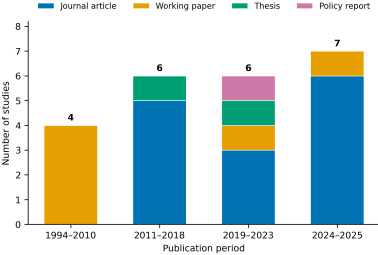
Publication activity tracks reform episodes (Figure 1). Early work consists entirely of working papers by development economists; peer-reviewed empirical studies appear only after 2011, and output peaks in 2024 to 2025 as foreign bank entry became imminent. The 14 journal articles are spread across 13 outlets, most of them open-access or regional, and no single journal anchors the field. Seven of the 14 journal articles appear in outlets indexed in Scopus or Web of Science (Table A2); indexing is reported here as descriptive information about outlets, not as a measure of study quality.
Source(s): Authors' coding.

Download: Download full-size image

Figure 1. Included studies by reform period and outlet type (n = 23).
5.2. Themes and Strength of Evidence
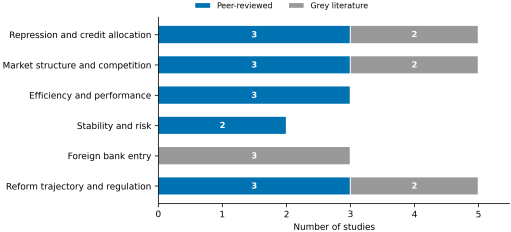
Evidence strength differs sharply by theme (Figure 2). Efficiency and stability rest entirely on peer-reviewed studies, but only five studies cover them in total. Foreign bank entry, the defining feature of the 2024 to 2025 reforms, is addressed only by grey, ex ante work.
Source(s): Authors' coding.

Download: Download full-size image

Figure 2. Peer-reviewed and grey evidence by primary theme (n = 23).
5.3. Methods
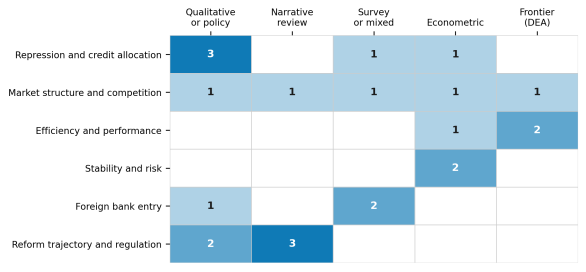
Qualitative and policy analysis is the most common approach (7 studies), followed by econometric designs (5), narrative reviews (4), surveys or mixed methods (4) and frontier efficiency analysis (3) (Figure 3). The largest reported bank panels cover 17 banks, about half of the 31 commercial banks now operating, and no bank-level study uses data after 2023. No study applies a quasi-experimental design, even though the 2011 introduction and 2019 repeal of the 27% rule are natural experiments that affected private and state banks differently.
Note(s): Cells show the number of studies; blank cells indicate none. Source(s): Authors' coding.

Download: Download full-size image

Figure 3. Research methods by theme (n = 23).
6. Thematic Synthesis
The literature converges on three conclusions: repression was costly, concentration has survived liberalization, and stability indicators are strong in aggregate but fragile at the margin. It is weakest precisely where the current reform is most consequential, on foreign bank entry and on the interaction between competition and stability. In this section, findings of the reviewed studies are attributed to those studies, NBE supervisory indicators are identified as such and cited to the NBE report , and the authors' own calculations and inferences are labelled explicitly.
6.1. Financial Repression and Credit Allocation
The evidence that repression imposed real costs is consistent across methods. Chauffour and Gobezie document the full toolkit: central bank financing of government, a dominant state bank, directed credit, administered deposit rates, a captive market for public debt, high liquidity requirements and strict exchange controls. They conclude that the framework produced large macro-financial imbalances. Using a principal-component repression index for 1980 to 2020, Fisseha finds that repression significantly reduced private investment, with the real deposit rate negative throughout the sample.
Bank-level studies identify the transmission channel. Lelissa finds that NBE-bill purchases reduced profitability. Gebremichael and Gessesse , the only included study to examine the repeal, show that the 2019 repeal of the 27% rule significantly raised private banks' operational efficiency. At the firm level, Fanta reports that manufacturing SMEs continued to face credit constraints after the 1994 reforms. Oberholzer and Haylemariam offer the main dissent: they argue that public ownership served a successful public-investment strategy and that Ethiopia's problems were macro-monetary rather than structural.
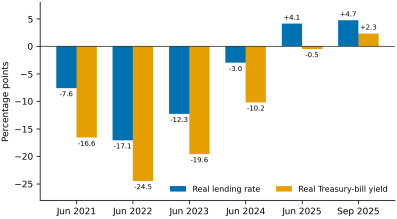
NBE supervisory indicators show that liability-side repression ended only recently (Figure 4). Real Treasury-bill yields were below minus 10 percentage points every June from 2021 to 2024 and turned positive only in September 2025. The literature therefore describes a regime that ended only in 2025, and no study yet observes banks operating under positive real rates. Allocation also remains skewed: trade absorbed 41.5% of commercial bank loans in June 2025 against 16.2% for manufacturing, a share partly reduced by CBE's conversion of some manufacturing loans into bonds . This trade bias is the imbalance the 27% rule was officially meant to correct .
Note(s): Weighted average nominal rate minus headline inflation. Source(s): Authors' calculation from NBE data .

Download: Download full-size image

Figure 4. Ex post real lending rate and real Treasury-bill yield, June 2021 to September 2025.
6.2. Market Structure and Competition
Concentration has proved remarkably durable. Geda found state dominance intact a decade after domestic liberalization. Eshete et al. characterized the industry as concentrated, highly profitable and monopolistically competitive. More than a decade later, Gebremichael and Gessesse estimate a Panzar-Rosse H-statistic of 0.497 for 2011 to 2022, again indicating monopolistic competition, and find that reforms had not yet produced revenue-level competitive gains. This finding rests on a single study, rated medium in the appraisal (Table A2), and has not been replicated. H-statistics estimated on short panels in markets with administered prices are also sensitive to specification and to the long-run equilibrium assumption , so monopolistic competition should be read as an indicative rather than an established characterization.
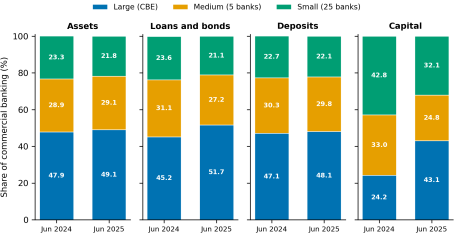
The number of commercial banks has risen to 31, yet CBE's share increased across every balance-sheet indicator between June 2024 and June 2025 (Figure 5). Its share of loans and bonds rose from 45.2% to 51.7%, and its share of capital nearly doubled after government-backed recapitalization . Entry of many small banks has fragmented the private segment without contesting the leader: 25 of 31 banks are classified as small.
How to read this concentration is disputed. Lelissa rejects the structure-conduct-performance hypothesis and attributes performance to efficiency rather than collusion. Eshete et al. , by contrast, emphasize market power. Both positions are consistent with Beck et al. , who show that concentration and competition are distinct. The ETB 5 billion capital requirement and NBE pressure toward mergers are, in our assessment, likely to raise concentration further before foreign banks arrive, a sequencing issue no study has examined.
Note(s): Bank counts by size class refer to June 2025. Source(s): NBE .

Download: Download full-size image

Figure 5. Commercial banking market shares by bank size class, June 2024 and June 2025.
6.3. Efficiency and Performance
Efficiency studies agree on direction but not on mechanism. Zenebe Lema and Tura apply data envelopment analysis (DEA), the latter combined with CAMEL (capital adequacy, asset quality, management, earnings and liquidity) indicators to assess the competition, survival and performance constraints of private banks for 2015 to 2020. Gebremichael and Gessesse report improving technical and cost efficiency, with private and state banks diverging after 2019. Berhe , using the system generalized method of moments (GMM) on 17 banks for 2012 to 2022, shows that political instability significantly lowers profitability, an under-appreciated risk for foreign entrants.
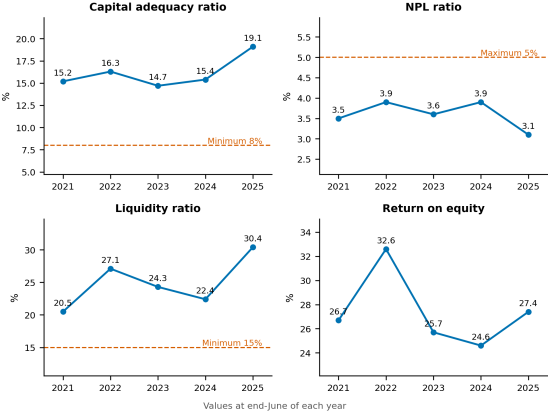
Profitability is high. The industry earned a record ETB 93.4 billion after tax in 2024/25, with return on equity of 27.4% . Whether these returns reflect efficiency or protected rents is the central unresolved question, because it determines how much margin foreign competition would compress. No study benchmarks Ethiopian bank efficiency against the Kenyan, Nigerian or South African groups most likely to enter.
6.4. Stability and Risk
Only two studies model stability directly. Yitayaw et al. find that banks were stable on average for 2014 to 2020, with a mean z-score of 10.74 but wide dispersion across banks. Arebo et al. identify an inverted-U relationship between financial inclusion and stability: inclusion enhances stability up to a threshold of 30.3%, and real interest rates, bank size and income diversification are destabilizing.
Aggregate NBE indicators improved markedly in 2024/25 (Figure 6), with the capital adequacy ratio reaching 19.1% and the non-performing loan (NPL) ratio its lowest level in five years. Three qualifications matter. First, part of the NPL improvement reflects balance-sheet restructuring at CBE, which converted some manufacturing loans into bonds, and provision coverage fell from 104.1% in June 2024 to 80.0% in June 2025 . Second, the NBE's June 2025 stress tests reveal fragility at the margin: 4 banks would fall below the minimum capital adequacy ratio under a severe credit shock, and 16 of 31 fail a top-ten-depositor withdrawal test . Third, Arebo et al. find real interest rates destabilizing, so the shift to positive real rates is itself a transition risk.
No Ethiopian study estimates the competition-stability relationship with bank-level competition measures such as the Lerner index or Boone indicator. We expect competitive pressure from foreign bank entry to fall first on smaller banks. The NBE does not identify which banks fail its liquidity test, but its size classes give a lower bound: even if all 6 medium and large banks failed, at least 10 of the 16 failing banks must be small (authors' calculation). This makes the competition-stability link the most policy-relevant gap in the literature.
Note(s): Dashed lines show regulatory limits; NPL, non-performing loan. Source(s): NBE [36], statistical annex.

Download: Download full-size image

Figure 6. Commercial banking soundness indicators, June 2021 to June 2025.
6.5. Foreign Bank Entry
Studies focused on foreign bank entry are anticipatory and entirely grey. Kiyota et al. made an early case for liberalization including foreign participation. Tesfaye , drawing on 135 survey respondents and data from 17 banks, finds expectations of innovation, technology transfer and credit growth, alongside a view that incumbents need capacity building first. Boresa reports concerns among Adama bank staff about loss of market share, reputational pressure and possible instability. Among studies coded to other themes, Oberholzer and Haylemariam argue that foreign banks are not needed to expand birr credit, because domestic-currency lending originates within the domestic banking system.
Cross-country theory helps interpret these expectations. Entrants in low-income markets tend to serve large, transparent borrowers . In Ethiopia that segment is trade and corporate finance, which also accounts for the largest share of incumbents' loan books . Entry mode shapes spillovers . In our assessment, the 49% ownership cap pushes large groups toward greenfield subsidiaries rather than acquisitions. Standard Bank, for example, is reported to be weighing a wholly owned greenfield operation . Greenfield entry would add direct competition while limiting the governance and technology transfer that an acquisition would bring.
No foreign branch or subsidiary was operating as of August 2026. Reported deterrents include the ownership caps, foreign-currency paid-up capital, profit-repatriation risk, and Ethiopia's unresolved Eurobond default . The literature has not yet modelled these frictions or used comparable African episodes to estimate likely effects.
6.6. Reform Trajectory and Regulation
Early assessments stressed gradualism and state retention . Later reviews called for privatization, foreign bank entry and market-determined prices . The 2024 to 2025 package delivered several of these recommendations at once, though not privatization of the state bank, alongside new NBE powers under Proclamation No. 1359/2025, a bank resolution regime and a recovery-planning directive .
McKinnon's ordering , macro stabilization before domestic liberalization before external opening, is only partly satisfied. Inflation fell to 13.9% and the budget deficit to 0.4% of gross domestic product (GDP) by June 2025 . Gross reserves, however, covered less than two months of imports at the end of the 2024/25 fiscal year, and Eurobond restructuring remained unresolved in August 2026 . No study assesses whether the NBE's risk-based supervision, home-host coordination and resolution capacity are adequate for cross-border banking.
7. Discussion and Research Agenda
Read together, the reviewed studies and the NBE indicators suggest that Ethiopia is liberalizing into concentration. The country is opening a profitable, well-capitalized banking system dominated by a recapitalized state bank, while regulation simultaneously pushes small private banks to consolidate. Because no causal evaluation of the reforms exists yet, this section keeps four kinds of evidence apart: empirical findings of the reviewed studies, NBE supervisory indicators, theoretical expectations and the authors' own inferences. Table 5 classifies the main conclusions of the review in these terms.
7.1. Evidence Against Theory
Set against the predictions in Table 2, the empirical evidence is consistent with the repression hypothesis, although it rests on few studies and none uses a causal design. Directed credit and negative real rates reduced private investment and private-bank efficiency, and removing the 27% rule improved efficiency in the one study that examines it . The financial restraint defence receives little support, because Ethiopian real rates were deeply negative rather than mildly positive, which is repression rather than restraint in the sense of Hellmann et al. .
The competition predictions remain untested. The literature documents persistent monopolistic competition but has not linked competition to stability, so neither the competition-fragility nor the competition-stability view can be confirmed for Ethiopia. The foreign bank entry predictions rest on cross-country theory and stakeholder perceptions, not on Ethiopian outcomes.
Combining the literature with current data, we conjecture a likely market configuration. A dominant state bank and well-capitalized foreign subsidiaries could compete for the same large corporate and trade clients, squeezing medium and small private banks. By our calculation from NBE data , at least 10 of these smaller banks already fail the NBE's liquidity stress test. This is the scenario in which competition-fragility effects are most likely. It is the authors' inference, not a finding of the reviewed studies, and is offered as a hypothesis for testing.
Table 5. Evidence base for the main conclusions of the review.

Conclusion

Type of evidence

Strength and main caveat

Financial repression reduced private investment and private-bank profitability

Empirical studies

and policy analysis

Moderate: consistent across methods, but no causal design

Repeal of the 27% rule improved private-bank efficiency

One empirical study

Limited: a single study, rated medium in the appraisal

The banking industry is monopolistically competitive

Empirical studies

Limited: one H-statistic estimate, sensitive to specification

Concentration rose in 2024/25

NBE supervisory indicators

Descriptive; 2024/25 data are provisional

Aggregate soundness is strong, but smaller banks are fragile

NBE indicators and stress tests

; studies with data to 2023 , 49]

Descriptive; the NBE does not identify individual banks

Foreign bank entry will bring competition, technology and credit

Ex ante grey studies

and cross-country theory

Weak: perception-based, with no Ethiopian outcome data

Medium and small private banks face competition-fragility risk after entry

Authors' inference from NBE data

and theory

Conjecture; not yet tested

Policy implications (Section 8.1)

Authors' inferences from the evidence above

Precautionary; not based on causal evidence

Source(s): Authors' synthesis.
7.2. Conceptual Framework
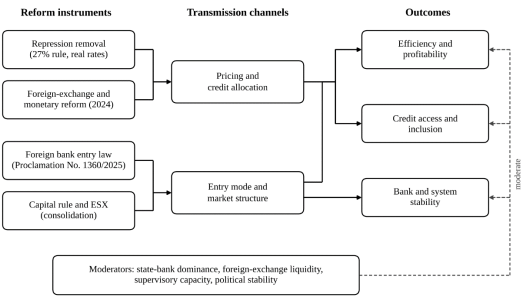
Figure 7 organizes these links. Four reform instruments act through two transmission channels on three outcome domains, and four contextual conditions moderate the effects.
Source(s): Authors' elaboration.

Download: Download full-size image

Figure 7. Conceptual framework for Ethiopian banking liberalization.

Four propositions follow for empirical testing. They are theoretical expectations derived from Table 2 and the evidence above, not established findings.
P1. Positive real rates and the removal of directed credit raise private-bank efficiency and deposit mobilization, but by less where the state bank retains a funding-cost advantage.
P2. Consolidation under the ETB 5 billion capital rule raises concentration before foreign bank entry; its effect on stability depends on whether merged banks gain efficiency or only scale.
P3. Greenfield foreign entrants concentrate on trade and corporate finance, compressing incumbent margins there and pushing smaller banks toward riskier SME and retail lending.
P4. The effect of competition on stability is non-linear and conditional on supervisory capacity and foreign-exchange liquidity.
7.3. Research Agenda
Table 6 sets out priorities. The reform sequence provides unusually clean identification opportunities: the 2011 introduction and 2019 repeal of the 27% rule affected private banks but not CBE, and foreign bank entry will affect market segments unevenly.
Table 6. Future research agenda.

Priority

Gap

Research questions

Data and methods

1

No causal estimate of repression or its removal

Did the 2011 rule and its 2019 repeal change private banks' loan mix, maturity and efficiency?

Difference-in-differences and event studies, private banks against CBE, 2008 to 2025

2

Competition measured only at industry level

How competitive are loan and deposit markets bank by bank?

Lerner index and Boone indicator from translog cost functions

3

Competition-stability link untested

Is the relationship U-shaped, and where are Ethiopian banks on the curve?

Bank-level z-scores with threshold panel models or system GMM

4

Foreign bank entry evidence is ex ante

How will entry affect margins, SME lending and incumbent efficiency?

Synthetic control and event studies once entry occurs; comparative East African cases

5

Consolidation effects unknown

Do mergers induced by the capital rule improve efficiency or only size?

Pre- and post-merger DEA and stochastic frontier analysis

6

Capital-market channel unstudied

Does ESX listing improve bank disclosure, governance and cost of capital?

Listing event studies and disclosure indices

7

Accounting quality under reform

Does International Financial Reporting Standard (IFRS) 9 expected-credit-loss provisioning change reported NPL and coverage ratios?

Bank-level provisioning models and earnings-management tests

8

Digital finance and stability

How do 135.9 million mobile money accounts

and non-bank providers affect deposit competition and stability?

Account and transaction data with non-linear panel models

9

Supervisory readiness

Is NBE capacity adequate for home-host supervision and bank resolution?

Institutional analysis, Basel Core Principles benchmarking, elite interviews

Source(s): Authors' synthesis.
Three methodological shifts would raise the field's standard. Studies should use the full population of 31 commercial banks rather than convenience samples, report bank-level heterogeneity rather than industry averages, and move from perception surveys to outcome data as post-reform observations accumulate. Cross-country designs that place Ethiopia alongside Kenya, Tanzania and Rwanda would also let researchers separate effects of foreign bank entry from those of the macroeconomic reforms that accompanied it.
8. Conclusion
This review synthesized 23 studies on Ethiopian banking liberalization published between 1994 and 2025 and triangulated them with NBE supervisory data. Its contribution is to map what the evidence shows, how strong it is and where it is missing. It cannot yet establish whether liberalization has improved efficiency, competition or stability, because post-reform outcome data are limited and no study evaluates the reforms causally. The answers to the five research questions should be read in that light.
On repression (RQ1), the evidence is consistent: directed credit and negative real rates reduced private investment and private-bank efficiency, and the one study of the 27% rule's repeal finds that it improved efficiency. On structure and competition (RQ2), the industry remains monopolistically competitive on the available estimate, and NBE indicators show that concentration rose in 2024/25 despite the growth in bank numbers. On stability (RQ3), aggregate indicators are strong, but provisioning coverage has fallen, stress tests reveal fragile small banks, and the competition-stability relationship has never been estimated for Ethiopia. On foreign bank entry (RQ4), the evidence is ex ante, perception-based and entirely grey, and no foreign branch or subsidiary was operating by August 2026. On the agenda (RQ5), the priorities are causal evaluation of repression and its removal, bank-level competition measures, direct tests of competition and stability, and outcome-based studies of entry and consolidation.
8.1. Policy Implications
The following implications are the authors' inferences from the reviewed studies, the NBE indicators and theory (Table 5). Because no causal evaluation of the reforms exists yet, they are precautionary judgements rather than evidence-based prescriptions.
1) Treat concentration as a supervisory variable. The state bank now holds about half of industry assets and loans, and the NBE itself flags rising concentration risk . Competitive neutrality in funding, government deposits and access to foreign exchange should accompany entry.
2) Sequence consolidation before competition. Mergers under the capital rule should be assessed for efficiency gains, not only size, and small banks' liquidity weaknesses addressed before entrants compete for their best clients.
3) Build cross-border supervisory capacity. Home-host cooperation agreements, consolidated supervision and an operational resolution framework should be in place before the first foreign subsidiary opens.
4) Revisit entry design. The 49% ownership cap steers large groups toward greenfield entry. Allowing majority acquisitions of weak domestic banks under the strategic-investment clause could combine resolution with technology transfer.
5) Open supervisory data. Publishing bank-level supervisory data would enable the causal research that policy now needs.
8.2. Limitations
The review is limited to English-language sources and to a small evidence base in which grey literature carries substantial weight. The language restriction is unlikely to omit much empirical work, because NBE statistical publications and federal proclamations are issued in English as well as Amharic and academic research in the field is published mainly in English, but it may omit Amharic-language research and policy commentary. The search was iterative rather than a single reproducible database query, and record counts before full-text assessment were not logged (Table A3), so the selection cannot be fully reproduced and relevant studies may have been missed. This risk is greatest for regional and non-English research, because international databases index African journals, university repositories and local-language outlets unevenly; locally published studies are therefore the most likely omissions. Some studies were assessed on their abstract and bibliographic record where the full text was unavailable, and quality ratings were agreed by the authors rather than made independently. The NBE data for 2024/25 are provisional rather than audited. Finally, the post-reform window is short: the review describes the evidence at the start of the transition rather than its outcomes, so its conclusions about the effects of liberalization remain provisional.
Ethiopia's reform is one of the most significant financial openings in Africa in a generation. Its outcome will depend less on the entry law itself than on sequencing, supervision and the treatment of a dominant state bank, which are the questions this literature has so far left open.
Abbreviations

CAMEL

Capital Adequacy, Asset Quality, Management, Earnings and Liquidity

CBE

Commercial Bank of Ethiopia

DEA

Data Envelopment Analysis

DOAJ

Directory of Open Access Journals

DOLS

Dynamic Ordinary Least Squares

ESX

Ethiopian Securities Exchange

ETB

Ethiopian Birr

GDP

Gross Domestic Product

GMM

Generalized Method of Moments

IFRS

International Financial Reporting Standard

IMF

International Monetary Fund

NBE

National Bank of Ethiopia

NPL

Non-Performing Loan

PRISMA

Preferred Reporting Items for Systematic Reviews and Meta-Analyses

RePEc

Research Papers in Economics

RQ

Research Question

SME

Small and Medium-Sized Enterprise

SSRN

Social Science Research Network

UNU-WIDER

United Nations University World Institute for Development Economics Research

WoS

Web of Science

Author Contributions
Kidusan Merkneh Mena: Conceptualization, Data curation, Formal Analysis, Investigation, Writing – original draft
Desta Dawit Ekaso: Conceptualization, Methodology, Validation, Visualization, Writing – review & editing
Data Availability Statement
The coded dataset of the 23 included studies (bibliographic details, outlet type, theme, method, sample, findings and appraisal) is reported in Table 4 and Appendix II, and the search strings, sources and selection stages are reported in Appendix I and Appendix III. All supervisory data, including the NBE series used in Figures 4 to 6, are drawn from the publicly available NBE Financial Stability Report . The coded spreadsheet (Supplementary File S1, Excel) is available from the corresponding author on reasonable request.
Conflicts of Interest
The authors declare no conflict of interest.
Appendix
Appendix I: Search Terms and Sources
Each search used the string Ethiopia AND (bank OR "financial sector") AND topic, with topic replaced in turn by each of the following ten terms: liberalization, repression, reform, competition, concentration, efficiency, stability, risk, "foreign bank" and entry. This gives ten search strings, for example Ethiopia AND (bank OR "financial sector") AND liberalization. Searches were run during September 2026 for publications from January 1994 to December 2025, in English, and were supplemented by backward and forward citation tracking of key included studies (Section 4.1). Table A1 lists the sources searched.
Table A1. Sources searched and material retrieved.

Source

Access route

Material retrieved

Google Scholar

Scholarly search engine

Journal articles, theses, working papers

African Journals Online

Journal platform, via search engines

Articles in African journals

RePEc/IDEAS and SSRN

Working-paper repositories, via search engines

Working papers and journal metadata

Addis Ababa University electronic thesis repository

Institutional repository, via search engines

Master's and doctoral theses

NBE, World Bank, IMF and UNU-WIDER

Institutional publication pages

Policy reports, working papers, supervisory statistics

Reference lists and Google Scholar "Cited by" lists of key included studies

Backward and forward citation tracking

Additional studies meeting Table 3 criteria

Source(s): Authors' search records.
Appendix II: Quality Appraisal of Included Studies
Table A2. Quality appraisal and outlet indexing (n = 23).

Study

Outlet indexing

Question

Data

Method

Conclusions

Overall

Harvey (1996)

Grey

H

M

M

M

Medium

Addison and Geda (2001)

Grey

H

M

M

M

Medium

Geda (2006)

Grey

H

H

M

M

Medium

Kiyota et al. (2007)

Grey

M

L

M

M

Low

Fanta (2012)

Not indexed

H

M

M

M

Medium

Eshete et al. (2013)

Not indexed

H

M

M

M

Medium

Lelissa (2014)

Grey

H

H

H

H

High

Bezabeh and Desta (2014)

Not indexed

M

L

L

M

Low

Zenebe Lema (2017)

Scopus, WoS

H

H

H

M

High

Menza and Eshete (2018)

Not indexed

M

L

L

L

Low

Chauffour and Gobezie (2019)

Grey

H

H

M

H

High

World Bank (2019)

Grey

H

H

M

H

High

Fisseha (2023)

WoS, DOAJ

H

H

H

H

High

Yitayaw et al. (2023)

Scopus, WoS

H

H

H

M

High

Abate and Kaur (2023)

Not indexed

M

L

L

M

Low

Tesfaye (2023)

Grey

H

M

M

M

Medium

Tura (2024)

Scopus, WoS

H

M

M

M

Medium

Berhe (2024)

Scopus, WoS

H

H

H

H

High

Oberholzer and Haylemariam (2024)

Scopus, WoS

H

M

H

M

Medium

Lelissa (2024)

Not indexed

M

L

L

M

Low

Boresa (2024)

Grey

M

L

M

M

Low

Arebo et al. (2025)

Scopus

H

H

H

M

High

Gebremichael and Gessesse (2025)

Not indexed

H

M

M

M

Medium

Note(s): H, high; M, medium; L, low; DOAJ, Directory of Open Access Journals; WoS, Web of Science. Criteria as defined in Section 4.4. Rating anchors: question, H if the research question or objective is stated explicitly and specifically, M if it is stated generally or must be inferred from the aims, L if it is not stated; data, H if the source, sample, period and variables are reported fully enough to replicate, M if the source and period are reported but the sample or variable construction is incomplete, L if the source or sample is not reported; method, H if the method matches the question and its assumptions or diagnostics are reported, M if an appropriate method is used with limited diagnostics or a descriptive method is used for an explanatory question, L if the method is not described or does not match the question; conclusions, H if they follow from and stay within the evidence, M if they generalize somewhat beyond it, L if they are largely unsupported. Overall: High, at least three H and no L; Low, two or more L, or one L and no H; Medium, otherwise. Outlet indexing refers to Scopus or Web of Science coverage; it is descriptive and did not enter the ratings.
Source(s): Authors' appraisal.
Appendix III: Structured Screening Record
Table A3 reports the selection of studies stage by stage. Counts are given where they were documented; record counts before full-text assessment were not logged, for the reasons given in Section 4.3.
Table A3. Structured screening record.

Stage

Procedure and criteria

Documented outcome

Identification

Ten search strings (Appendix I) run in the sources listed in Table A1 during September 2026; backward and forward citation tracking of key included studies

Records retrieved were not logged, because searching was iterative and search-engine result counts are neither stable nor exportable

Title and abstract screening

Context, topic, publication-type, language and period criteria (Table 3). Exclusion criteria applied: multi-country panels without Ethiopia-specific results; bank marketing, service quality, human resources and branch-level operations; newspaper articles, blogs and conference abstracts without full text; opinion pieces without data or argument structure

Number of records excluded was not logged

Full-text eligibility

All Table 3 criteria applied to the full text or, where it was unavailable, to the abstract and bibliographic record

24 eligible reports retained

Merging of versions

Reports of the same study merged and the most complete version retained

2 reports merged into 1 study

Included in the review

Data extraction, thematic coding and quality appraisal (Sections 4.4 and 4.5)

23 studies: 14 journal articles and 9 grey-literature items (Table 4)

Contextual sources, not included studies

Official statistics, news analyses and legal instruments used for context (Section 4.6)

NBE report

, news analyses and legal instruments

Background references, not included studies

Theory and method sources used to frame and interpret the evidence

23 references

Source(s): Authors' search and screening records.
References
[1] Abate, M. T. and Kaur, R. (2023), "Banking sector in Ethiopia: origin and present state", EPH - International Journal of Business and Management Science, Vol. 9 No. 2, pp. 1-13, available at:
[2] Adams, R. J., Smart, P. and Huff, A. S. (2017), "Shades of grey: guidelines for working with the grey literature in systematic reviews for management and organizational studies", International Journal of Management Reviews, Vol. 19 No. 4, pp. 432-454,
[3] Addison, T. and Geda, A. (2001), "Ethiopia's new financial sector and its regulation", WIDER Discussion Paper No. 2001/55, UNU-WIDER, Helsinki.
[4] Arebo, M., Hando, F. and Mekonnen, A. (2025), "Financial inclusion and stability in Ethiopia using bank-level data: a two-step system GMM estimation", F1000Research, Vol. 13, 1369 (version 2),
[5] Beck, T., Demirgüç-Kunt, A. and Levine, R. (2006), "Bank concentration, competition, and crises: first results", Journal of Banking and Finance, Vol. 30 No. 5, pp. 1581-1603,
[6] Berhe, A. G. (2024), "Determinants of bank profitability in Ethiopia: does political stability matter?", Cogent Business and Management, Vol. 11 No. 1, 2410406,
[7] Bezabeh, A. and Desta, A. (2014), "Banking sector reform in Ethiopia", International Journal of Business and Commerce, Vol. 3 No. 8, pp. 25-38.
[8] Boresa, S. T. (2024), "Challenges of foreign banks entry on emerging market economy: evidence from Ethiopia", SSRN Working Paper No. 5074203,
[9] Boyd, J. H. and De Nicoló, G. (2005), "The theory of bank risk taking and competition revisited", Journal of Finance, Vol. 60 No. 3, pp. 1329-1343,
[10] Braun, V. and Clarke, V. (2006), "Using thematic analysis in psychology", Qualitative Research in Psychology, Vol. 3 No. 2, pp. 77-101,
[11] Chauffour, J.-P. and Gobezie, M. A. (2019), "Exiting financial repression: the case of Ethiopia", Policy Research Working Paper No. 9082, World Bank, Washington, DC.
[12] Claessens, S., Demirgüç-Kunt, A. and Huizinga, H. (2001), "How does foreign entry affect domestic banking markets?", Journal of Banking and Finance, Vol. 25 No. 5, pp. 891-911,
[13] Claessens, S. and van Horen, N. (2014), "Foreign banks: trends and impact", Journal of Money, Credit and Banking, Vol. 46 No. s1, pp. 295-326,
[14] Demirgüç-Kunt, A. and Detragiache, E. (1998), "The determinants of banking crises in developing and developed countries", IMF Staff Papers, Vol. 45 No. 1, pp. 81-109,
[15] Detragiache, E., Tressel, T. and Gupta, P. (2008), "Foreign banks in poor countries: theory and evidence", Journal of Finance, Vol. 63 No. 5, pp. 2123-2160,
[16] Diaz-Alejandro, C. (1985), "Good-bye financial repression, hello financial crash", Journal of Development Economics, Vol. 19 Nos 1-2, pp. 1-24,
[17] Eshete, Z. S., Tesome, K. W. and Abebe, T. K. (2013), "Competition in Ethiopian banking industry", African Journal of Economics, Vol. 1 No. 5, pp. 176-190.
[18] Fanta, A. B. (2012), "Banking reform and SME financing in Ethiopia: evidence from the manufacturing sector", African Journal of Business Management, Vol. 6 No. 19, pp. 6057-6069.
[19] Fisseha, F. L. (2023), "Does financial repression inhibit or facilitate private investment? The case of Ethiopia", Future Business Journal, Vol. 9, 51,
[20] Gebremichael, B. Z. and Gessesse, H. T. (2025), "Competition and efficiency in Ethiopia's banking sector", International Journal of Business and Development, Vol. 2 No. 1, pp. 1-16,
[21] Geda, A. (2006), "The structure and performance of Ethiopia's financial sector in the pre- and post-reform period with a special focus on banking", Research Paper No. 2006/112, UNU-WIDER, Helsinki.
[22] Geda, A. (2008), "The structure and performance of Ethiopia's financial sector in the pre- and post-reform periods, with a special focus on banking", in Mavrotas, G. (Ed.), Domestic Resource Mobilization and Financial Development, Palgrave Macmillan, London.
[23] Harvey, C. (1996), "Banking reform in Ethiopia", IDS Working Paper No. 37, Institute of Development Studies, Brighton.
[24] Hellmann, T., Murdock, K. and Stiglitz, J. (1997), "Financial restraint: toward a new paradigm", in Aoki, M., Kim, H.-K. and Okuno-Fujiwara, M. (Eds), The Role of Government in East Asian Economic Development: Comparative Institutional Analysis, Clarendon Press, Oxford, pp. 163-207.
[25] Keeley, M. C. (1990), "Deposit insurance, risk, and market power in banking", American Economic Review, Vol. 80 No. 5, pp. 1183-1200.
[26] Kiyota, K., Peitsch, B. and Stern, R. M. (2007), "The case for financial sector liberalization in Ethiopia", Discussion Paper No. 565, Research Seminar in International Economics, University of Michigan, Ann Arbor, MI.
[27] La Porta, R., Lopez-de-Silanes, F. and Shleifer, A. (2002), "Government ownership of banks", Journal of Finance, Vol. 57 No. 1, pp. 265-301,
[28] Lelissa, T. B. (2014), "The impact of industry concentration on performance, exploring a comprehensive bank performance model: the case of the Ethiopian banking sector", Doctoral thesis, University of South Africa, Pretoria.
[29] Lelissa, T. B. (2024), "Financial liberalization in Ethiopia: historical perspectives and future directions (review of literatures)", International Journal of Economics, Commerce and Management, Vol. 12 No. 10, available at:
[30] Loizos, K. (2018), "The financial repression-liberalization debate: taking stock, looking for a synthesis", Journal of Economic Surveys, Vol. 32 No. 2, pp. 440-468,
[31] Martinez-Miera, D. and Repullo, R. (2010), "Does competition reduce the risk of bank failure?", Review of Financial Studies, Vol. 23 No. 10, pp. 3638-3664,
[32] McKinnon, R. I. (1973), Money and Capital in Economic Development, Brookings Institution, Washington, DC.
[33] McKinnon, R. I. (1991), The Order of Economic Liberalization: Financial Control in the Transition to a Market Economy, Johns Hopkins University Press, Baltimore, MD.
[34] Menza, S. K. and Eshete, Z. S. (2018), "Financial liberalization policy at micro perspective, the case of banking sector in Ethiopia: literature review", Research Journal of Finance and Accounting, Vol. 9 No. 19, pp. 82-86.
[35] Mian, A. (2006), "Distance constraints: the limits of foreign lending in poor economies", Journal of Finance, Vol. 61 No. 3, pp. 1465-1505,
[36] National Bank of Ethiopia (NBE) (2026), Financial Stability Report, March 2026, National Bank of Ethiopia, Addis Ababa, available at:
[37] Oberholzer, B. and Haylemariam, D. A. (2024), "Making the Ethiopian banking system ready for green growth and development", Review of Political Economy, Vol. 38 No. sup1, pp. 308-329 (published online 2024),
[38] Orjiude-Ndibe, A. (2026a), "Why Ethiopia's banking sector reform hasn't landed a single foreign bank", Businessfront, 5 August, available at:
[39] Orjiude-Ndibe, A. (2026b), "Ethiopia's banking reforms at risk as state-control nears 50%", Businessfront, 27 March, available at:
[40] Panzar, J. C. and Rosse, J. N. (1987), "Testing for 'monopoly' equilibrium", Journal of Industrial Economics, Vol. 35 No. 4, pp. 443-456,
[41] Roubini, N. and Sala-i-Martin, X. (1992), "Financial repression and economic growth", Journal of Development Economics, Vol. 39 No. 1, pp. 5-30,
[42] Shaw, E. S. (1973), Financial Deepening in Economic Development, Oxford University Press, New York, NY.
[43] Snyder, H. (2019), "Literature review as a research methodology: an overview and guidelines", Journal of Business Research, Vol. 104, pp. 333-339,
[44] Stiglitz, J. E. (1994), "The role of the state in financial markets", in Bruno, M. and Pleskovic, B. (Eds), Proceedings of the World Bank Annual Conference on Development Economics 1993, World Bank, Washington, DC, pp. 19-52.
[45] Tesfaye, A. T. (2023), "Challenges and prospects of foreign bank entry in Ethiopia's banking sector", Master's thesis, Addis Ababa University, Addis Ababa, available at:
[46] Tranfield, D., Denyer, D. and Smart, P. (2003), "Towards a methodology for developing evidence-informed management knowledge by means of systematic review", British Journal of Management, Vol. 14 No. 3, pp. 207-222,
[47] Tura, D. (2024), "Competition, survival issue, and performance constraints of banks: evidence from Ethiopian private commercial banks", Discrete Dynamics in Nature and Society, Vol. 2024, 6314479,
[48] World Bank (2019), Ethiopia Financial Sector Development: The Path to an Efficient, Stable and Inclusive Financial Sector, World Bank, Washington, DC.
[49] Yitayaw, M. K., Mogess, Y. K., Feyisa, H. L., Mamo, W. B. and Abdulahi, S. M. (2023), "Determinants of bank stability in Ethiopia: a two-step system GMM estimation", Cogent Economics and Finance, Vol. 11 No. 1, 2161771,
[50] Zenebe Lema, T. (2017), "Determinants of bank technical efficiency: evidence from commercial banks in Ethiopia", Cogent Business and Management, Vol. 4 No. 1, 1268356,
[51] Federal Democratic Republic of Ethiopia (2025), Banking Business Proclamation No. 1360/2025, Federal Negarit Gazette, Addis Ababa, 12 March 2025, available at:
[52] National Bank of Ethiopia (NBE) (2021), Minimum Capital Requirement for Banks Directive No. SBB/78/2021, National Bank of Ethiopia, Addis Ababa, available at:
[53] National Bank of Ethiopia (NBE) (2025), Requirements for Licensing and Renewal of Banking Business and Representative Office Directive No. SBB/94/2025, National Bank of Ethiopia, Addis Ababa, available at:
Cite This Article
  • APA Style

    Mena, K. M., Ekaso, D. D. (2026). Financial Sector Liberalization in Ethiopia: A Structured Literature Review of Banking Reform, Foreign Bank Entry, and Implications for Stability. American Journal of Management Science and Engineering, 11(6), 122-141. https://doi.org/10.11648/j.ajmse.20261106.11

    Copy | Download

    ACS Style

    Mena, K. M.; Ekaso, D. D. Financial Sector Liberalization in Ethiopia: A Structured Literature Review of Banking Reform, Foreign Bank Entry, and Implications for Stability. Am. J. Manag. Sci. Eng. 2026, 11(6), 122-141. doi: 10.11648/j.ajmse.20261106.11

    Copy | Download

    AMA Style

    Mena KM, Ekaso DD. Financial Sector Liberalization in Ethiopia: A Structured Literature Review of Banking Reform, Foreign Bank Entry, and Implications for Stability. Am J Manag Sci Eng. 2026;11(6):122-141. doi: 10.11648/j.ajmse.20261106.11

    Copy | Download

  • @article{10.11648/j.ajmse.20261106.11,
      author = {Kidusan Merkneh Mena and Desta Dawit Ekaso},
      title = {Financial Sector Liberalization in Ethiopia: A Structured Literature Review of Banking Reform, Foreign Bank Entry, and Implications for Stability},
      journal = {American Journal of Management Science and Engineering},
      volume = {11},
      number = {6},
      pages = {122-141},
      doi = {10.11648/j.ajmse.20261106.11},
      url = {https://doi.org/10.11648/j.ajmse.20261106.11},
      eprint = {https://article.sciencepublishinggroup.com/pdf/10.11648.j.ajmse.20261106.11},
      abstract = {Purpose: Ethiopia's Banking Business Proclamation No. 1360/2025 ended a 50-year ban on foreign banks. This paper synthesizes evidence on Ethiopian banking liberalization to establish what is known about repression, competition, efficiency, stability and foreign bank entry, and what is not. Design/methodology/approach: A structured narrative review of 23 peer-reviewed and grey studies published between 1994 and 2025, combining descriptive mapping with thematic synthesis and triangulated with National Bank of Ethiopia supervisory data for 2021 to 2025. Findings: Six themes emerge. The 2011 to 2019 NBE-bill rule and negative real interest rates depressed private-bank profitability and private investment, and the one study of the rule's repeal finds that it improved private-bank efficiency. The market remains monopolistically competitive, and concentration is rising: the state-owned Commercial Bank of Ethiopia held 49.1% of commercial bank assets in 2025. Aggregate soundness is strong, yet stress tests reveal fragile smaller banks. Evidence on foreign bank entry is entirely ex ante and grey, and no study evaluates the reforms causally. Research limitations/implications: The post-reform window is short, the search was iterative, and database coverage of African and non-English outlets is uneven, so relevant studies may have been missed. A sequenced agenda for causal and bank-level research is proposed. Practical implications: The benefits of liberalization depend on sequencing, cross-border supervision, a credible resolution regime and active monitoring of concentration. Originality/value: To our knowledge, and within the limits of the search reported here, this is the first structured review of Ethiopian banking liberalization to cover the 2024 to 2025 reforms and to link the evidence to competition-stability and sequencing theory.},
     year = {2026}
    }
    

    Copy | Download

  • TY  - JOUR
    T1  - Financial Sector Liberalization in Ethiopia: A Structured Literature Review of Banking Reform, Foreign Bank Entry, and Implications for Stability
    AU  - Kidusan Merkneh Mena
    AU  - Desta Dawit Ekaso
    Y1  - 2026/11/16
    PY  - 2026
    N1  - https://doi.org/10.11648/j.ajmse.20261106.11
    DO  - 10.11648/j.ajmse.20261106.11
    T2  - American Journal of Management Science and Engineering
    JF  - American Journal of Management Science and Engineering
    JO  - American Journal of Management Science and Engineering
    SP  - 122
    EP  - 141
    PB  - Science Publishing Group
    SN  - 2575-1379
    UR  - https://doi.org/10.11648/j.ajmse.20261106.11
    AB  - Purpose: Ethiopia's Banking Business Proclamation No. 1360/2025 ended a 50-year ban on foreign banks. This paper synthesizes evidence on Ethiopian banking liberalization to establish what is known about repression, competition, efficiency, stability and foreign bank entry, and what is not. Design/methodology/approach: A structured narrative review of 23 peer-reviewed and grey studies published between 1994 and 2025, combining descriptive mapping with thematic synthesis and triangulated with National Bank of Ethiopia supervisory data for 2021 to 2025. Findings: Six themes emerge. The 2011 to 2019 NBE-bill rule and negative real interest rates depressed private-bank profitability and private investment, and the one study of the rule's repeal finds that it improved private-bank efficiency. The market remains monopolistically competitive, and concentration is rising: the state-owned Commercial Bank of Ethiopia held 49.1% of commercial bank assets in 2025. Aggregate soundness is strong, yet stress tests reveal fragile smaller banks. Evidence on foreign bank entry is entirely ex ante and grey, and no study evaluates the reforms causally. Research limitations/implications: The post-reform window is short, the search was iterative, and database coverage of African and non-English outlets is uneven, so relevant studies may have been missed. A sequenced agenda for causal and bank-level research is proposed. Practical implications: The benefits of liberalization depend on sequencing, cross-border supervision, a credible resolution regime and active monitoring of concentration. Originality/value: To our knowledge, and within the limits of the search reported here, this is the first structured review of Ethiopian banking liberalization to cover the 2024 to 2025 reforms and to link the evidence to competition-stability and sequencing theory.
    VL  - 11
    IS  - 6
    ER  - 

    Copy | Download

Author Information
  • Abstract
  • Keywords
  • Document Sections

    1. 1. Introduction
    2. 2. Institutional Background
    3. 3. Theoretical Framework
    4. 4. Methodology
    5. 5. Descriptive Results
    6. 6. Thematic Synthesis
    7. 7. Discussion and Research Agenda
    8. 8. Conclusion
    Show Full Outline
  • Abbreviations
  • Author Contributions
  • Data Availability Statement
  • Conflicts of Interest
  • Appendix
  • References
  • Cite This Article
  • Author Information