
The contamination of aquatic environments can be caused by several types of pollutants, notably heavy metals. Heavy metals present in ecosystems have become a significant environmental risk. Thus, sediments, which are the major sinks of these contaminants, may represent a significant environmental concern to human well-being, aquatic plants, and various benthic organisms. The objective of this study was to assess sediment quality in order to examine the potential ecological and health risks associated with heavy metal concentrations in sediments. Sediment samples streams and the river of the Koko watershed were collected and analyzed for the presence of Pb, As, Zn, Cu, Ni and Cr using atomic absorption spectrophotometry (AAS). The heavy metal concentrations obtained from the analysis revealed that highest average concentrations for Pb, Zn, Cu, Ni, and Cr were recorded during the dry season, with 35.60, 101.26, 23.36, 26.80, and 80.12 mg kg-1, respectively, whereas As reached its highest average concentration during the rainy season (1.51 mg kg-1). The results generally indicate that the accumulation of trace metals varies according to both the sampling site and the season. Comparison of our data with Upper Continental Crust (UCC) values indicates that the studied sediments are contaminated with Pb, As, Zn, Cu, Ni, and Cr in the dry season. This result is supported by the geo-accumulation index (Igeo), which generally indicates moderate contamination of sediments 1, 2, 3, and 5 by Pb, As, Zn, Cu, Ni, and Cr. The quality of the sediments indicates a potential toxic risk to benthic organisms at sediment 3 (PERI: 393.72) during the rainy season and in the dry season (PERI: 342.34). In the rainy season, the m-ERM-Q indicates a moderate-to-low probability of ecosystem hazard, although Ni poses a high-risk level in all sediments. But in the dry season, Ni has a moderate-to-high ecological impact on biota in all sediments.
| Published in | American Journal of Physical Chemistry (Volume 15, Issue 2) |
| DOI | 10.11648/j.ajpc.20261502.13 |
| Page(s) | 42-60 |
| Creative Commons |
This is an Open Access article, distributed under the terms of the Creative Commons Attribution 4.0 International License (http://creativecommons.org/licenses/by/4.0/), which permits unrestricted use, distribution and reproduction in any medium or format, provided the original work is properly cited. |
| Copyright |
Copyright © The Author(s), 2026. Published by Science Publishing Group |
Heavy Metals, Sediment Quality Indices, Potential Ecological Risk, Potential Human Health Risk
Tributary an river | Sediment | X | Y |
|---|---|---|---|
Tributary 1 | S1 | 30 P 0209281 | 1047317 |
Tributary 2 | S2 | 31 P 0208769 | 1047848 |
Tributary 3 | S3 | 30 P 0209231 | 1048197 |
Tributary 4 | S4 | 30 P 0209598 | 1047910 |
River | S5 | 30 P 0209432 | 1047899 |
Class | Value | Pollution intensity |
|---|---|---|
0 | Igeo ≤ 0 | unpolluted |
1 | 0 < Igeo < 1 | unpolluted to moderately polluted |
2 | 1 < Igeo < 2 | moderately polluted |
3 | 2 < Igeo < 3 | Moderately to strongly polluted |
4 | 3 < Igeo < 4 | Strongly polluted |
5 | 4 < Igeo < 5 | Strongly to extremely polluted |
6 | 5 < Igeo | Extremely polluted |
Values of | Level of ecological risk |
|---|---|
< 40 | Low potential ecological risk |
40 < < 80 | Moderate potential ecological risk |
80 < <160 | Considerable potential ecological risk |
160 < < 320 | High potential ecological risk |
> 320 | Very high ecological risk |
Values of PERI | Level of ecological risk |
|---|---|
PERI < 150 | Low ecological risk |
150 < PERI <300 | Moderate ecological risk |
300 < PERI <600 | Considerable ecological risk |
PERI > 600 | Very high ecological risk |
Values of m-ERM-Q | Probability of toxic biological effects | Values de m-PEL-Q | Probability of toxic biological effects |
|---|---|---|---|
m−ERM−Q>1.5 | high | >2.3 | high |
1.5 > m −ERM−Q>0.51 | moderate to high | 2.3 > m −PEL−Q>1.51 | moderate to high |
0.5 > m −ERM−Q>0.11 | Low to moderate | 1.5 > m −PEL−Q>0.11 | Low to moderate |
m−ERM−Q<0.1 | Low | m−PEL−Q<0.1 | Low |
Parameters | Pb (mg/kg/day) | As (mg/kg/day) | Zn (mg/kg/day) | Cu (mg/kg/day) | Ni (mg/kg/day) | Cr (mg/kg/day) |
|---|---|---|---|---|---|---|
RFDing | 0.0035 | 3.00E-04 | 0,3 | 0,0371 | 0,02 | 0.003 |
RFDinh | 3.50E-02 | 1.00E-03 | - | - | - | 0.0001 |
RFDdermal | 5.25E-04 | 1.00E-05 | 0,009 | 0,0012 | 8,0 × 10⁻⁴ | 0.00006 |
CSFing | 0.0085 | 1.5 | - | - | - | 0.5 |
CSFinh | 4.20E-02 | 1.50E+01 | - | - | 0,84 | 4.10E-01 |
CSFdermal | - | 1.5 | - | - | - | 2.0E+1 |
Parameters | Symbol | ADULT | CHILD |
|---|---|---|---|
Ingestion rate | IngR | 100 mg | 200 mg |
Exposure duration | ED | 24 years | 6 years |
Exposure frequency | EF | 350 days | 350 days |
Average body weight | BW | 70 | 15 kg |
Averaging time (AT) | ATnon-carcinogenic | ED × 365 days | ED × 365 days |
ATcarcinogenic | 70 × 365 days | 70 × 365 days | |
Conversion factor | CF | 1 × 10⁻⁶ kg/mg | 1 × 10⁻⁶ kg/mg |
Surface area of skin | SA children | 5800 cm2 | 2800 cm2 |
Skin adherence factor | AFdust | 0.07 mg/cm2/day | 0.2 mg/cm2/day |
Dermal absorption factor | ABS non-carcinogenic | 0.001 mg/cm2 | 0.001 mg/cm2 |
ABS carcinogenic | 0.03 mg/cm2 | 0.03 mg/cm2 | |
Inhalation rate | InhR | 20 | 10 m3/day |
Particle emission factor | PEF | 1.36 × 10⁹ m3/kg | 1.36 × 10⁹ m3/kg |
Dermal exposure ratio | FE | 0.61 | 0.61 |
ETM | Rainy season | Dry season | Value UCC | ||||
|---|---|---|---|---|---|---|---|
Minimum | Maximum | Mean | Minimum | Maximum | Mean | ||
Pb | 1,09 | 3,06 | 1,73 | 15,07 | 57,18 | 35,60 | 17 |
As | 0,97 | 2,69 | 1,60 | 0,00 | 7,53 | 1,51 | 2 |
Zn | 17,01 | 44,13 | 27,27 | 45,90 | 150,22 | 101,76 | 52 |
Cu | 12,30 | 19,26 | 15,59 | 0,00 | 38,03 | 23,36 | 14 |
Ni | 10,25 | 21,12 | 15,90 | 0,00 | 43,94 | 26,80 | 19 |
Cr | 22,10 | 39,70 | 28,70 | 31,17 | 104,46 | 80,12 | 35 |
Adults | |||||||
|---|---|---|---|---|---|---|---|
Sample | Pb | As | Zn | Cu | Ni | Cr | |
S1 | HQing | 3,90E-03 | 1,18E-02 | 1,14E-04 | 3,47E-04 | 8,37E-04 | 1,54E-02 |
HQder | 6,32E-05 | 7,17E-05 | 9,24E-06 | 2,61E-05 | - | - | |
HQInh | 5,73E-08 | 5,20E-07 | - | - | - | 6,79E-05 | |
HI | 3,96E-03 | 1,19E-02 | 1,23E-04 | 3,73E-04 | 8,37E-04 | 1,54E-02 | |
S2 | HQing | 5,88E-03 | - | 1,99E-04 | 4,47E-04 | - | 1,44E-02 |
HQder | 9,54E-05 | - | 1,61E-05 | 3,36E-05 | - | - | |
HQInh | 8,65E-08 | - | - | - | - | 6,33E-05 | |
HI | 5,97E-03 | - | 2,15E-04 | 4,81E-04 | - | 1,44E-02 | |
S3 | HQing | 4,42E-03 | - | 1,77E-04 | 2,03E-04 | 6,15E-04 | 1,17E-02 |
HQder | 7,17E-05 | - | 1,43E-05 | 1,53E-05 | - | - | |
HQInh | 6,50E-08 | - | - | - | - | 5,18E-05 | |
HI | 4,49E-03 | - | 1,91E-04 | 2,19E-04 | 6,15E-04 | 1,18E-02 | |
S4 | HQing | 2,02E-03 | - | 7,19E-05 | - | 6,63E-04 | 4,88E-03 |
HQder | 3,28E-05 | - | 5,83E-06 | - | - | - | |
HQInh | 2,97E-08 | - | - | - | - | 2,15E-05 | |
HI | 2,06E-03 | - | 7,77E-05 | - | 6,63E-04 | 4,90E-03 | |
S5 | HQing | 7,67E-03 | - | 2,35E-04 | 4,81E-04 | 1,03E-03 | 1,64E-02 |
HQder | 1,25E-04 | - | 1,91E-05 | 3,62E-05 | - | - | |
HQInh | 1,13E-07 | - | - | - | - | 7,21E-05 | |
HI | 7,80E-03 | - | 2,54E-04 | 5,18E-04 | 1,03E-03 | 1,64E-02 | |
Children | |||||||
|---|---|---|---|---|---|---|---|
Sample | Pb | As | Zn | Cu | Ni | Cr | |
S1 | HQing | 4,24E-02 | 1,28E-01 | 1,24E-03 | 3,77E-03 | 9,11E-03 | 1,67E-01 |
HQder | 1,38E-03 | 1,56E-03 | 2,01E-04 | 5,68E-04 | - | - | |
HQInh | 3,12E-07 | 2,83E-06 | - | - | - | 3,69E-04 | |
HI | 4,38E-02 | 1,30E-01 | 1,44E-03 | 4,34E-03 | 9,11E-03 | 1,68E-01 | |
S2 | HQing | 6,40E-02 | - | 2,17E-03 | 4,87E-03 | - | 1,56E-01 |
HQder | 5,19E-04 | - | 8,79E-05 | 1,83E-04 | - | - | |
HQInh | 2,35E-07 | - | - | - | - | 1,72E-04 | |
HI | 6,45E-02 | - | 2,25E-03 | 5,05E-03 | - | 1,56E-01 | |
S3 | HQing | 4,81E-02 | - | 1,92E-03 | 2,22E-03 | 6,70E-03 | 1,28E-01 |
HQder | 3,90E-04 | - | 7,81E-05 | 8,33E-05 | - | - | |
HQInh | 1,77E-07 | - | - | - | - | 1,41E-04 | |
HI | 4,85E-02 | - | 2,00E-03 | 2,30E-03 | 6,70E-03 | 1,28E-01 | |
S4 | HQing | 2,20E-02 | - | 7,82E-04 | - | 7,22E-03 | 5,31E-02 |
HQder | 1,79E-04 | - | 3,17E-05 | - | - | - | |
HQInh | 8,10E-08 | - | - | - | - | 5,86E-05 | |
HI | 2,22E-02 | - | 8,14E-04 | - | 7,22E-03 | 5,32E-02 | |
S5 | HQing | 8,36E-02 | - | 2,56E-03 | 5,24E-03 | 1,12E-02 | 1,78E-01 |
HQder | 6,78E-04 | - | 1,04E-04 | 1,97E-04 | - | - | |
HQInh | 3,07E-07 | - | - | - | - | 1,96E-04 | |
HI | 8,42E-02 | - | 2,66E-03 | 5,44E-03 | 1,12E-02 | 1,78E-01 | |
Adults | |||||||
|---|---|---|---|---|---|---|---|
Sample | Pb | As | Zn | Cu | Ni | Cr | |
S1 | HQing | 1,46E-04 | 1,52E-03 | 2,66E-05 | 1,69E-04 | 2,75E-04 | 3,46E-03 |
HQder | 2,37E-06 | 9,24E-06 | 2,16E-06 | 1,27E-05 | - | - | |
HQInh | 2,15E-09 | 6,70E-08 | - | - | - | 1,53E-05 | |
HI | 1,49E-04 | 1,53E-03 | 2,88E-05 | 1,81E-04 | 2,75E-04 | 3,48E-03 | |
S2 | HQing | 4,11E-04 | 4,21E-03 | 6,91E-05 | 2,36E-04 | 4,96E-04 | 6,22E-03 |
HQder | 6,66E-06 | 2,56E-05 | 5,61E-06 | 1,77E-05 | - | - | |
HQInh | 6,04E-09 | 1,86E-07 | - | - | - | 2,74E-05 | |
HI | 4,17E-04 | 4,24E-03 | 7,47E-05 | 2,53E-04 | 4,96E-04 | 6,24E-03 | |
S3 | HQing | 1,48E-04 | 1,58E-03 | 2,98E-05 | 1,56E-04 | 2,41E-04 | 3,95E-03 |
HQder | 2,40E-06 | 9,62E-06 | 2,42E-06 | 1,17E-05 | - | - | |
HQInh | 2,17E-09 | 6,98E-08 | - | - | - | 1,74E-05 | |
HI | 1,50E-04 | 1,59E-03 | 3,22E-05 | 1,67E-04 | 2,41E-04 | 3,97E-03 | |
S4 | HQing | 1,76E-04 | 1,96E-03 | 3,61E-05 | 1,83E-04 | 3,91E-04 | 3,63E-03 |
HQder | 2,85E-06 | 1,19E-05 | 2,93E-06 | 1,38E-05 | - | - | |
HQInh | 2,59E-09 | 8,63E-08 | - | - | - | 1,60E-05 | |
HI | 1,79E-04 | 1,97E-03 | 3,91E-05 | 1,97E-04 | 3,91E-04 | 3,65E-03 | |
S5 | HQing | 2,78E-04 | 3,24E-03 | 5,18E-05 | 2,44E-04 | 4,64E-04 | 5,21E-03 |
HQder | 4,51E-06 | 1,97E-05 | 4,20E-06 | 1,83E-05 | - | - | |
HQInh | 4,08E-09 | 1,43E-07 | - | - | - | 2,30E-05 | |
HI | 2,82E-04 | 3,26E-03 | 5,60E-05 | 2,62E-04 | 4,64E-04 | 5,23E-03 | |
Children | |||||||
|---|---|---|---|---|---|---|---|
Sample | Pb | As | Zn | Cu | Ni | Cr | |
S1 | HQing | 1,59E-03 | 1,65E-02 | 2,90E-04 | 1,84E-03 | 3,00E-03 | 3,77E-02 |
HQder | 5,17E-05 | 2,01E-04 | 4,71E-05 | 2,77E-04 | - | - | |
HQInh | 1,17E-08 | 3,65E-07 | - | - | - | 8,31E-05 | |
HI | 1,64E-03 | 1,67E-02 | 3,37E-04 | 2,11E-03 | 3,00E-03 | 3,78E-02 | |
S2 | HQing | 4,47E-03 | 4,59E-02 | 7,52E-04 | 2,57E-03 | 5,40E-03 | 6,77E-02 |
HQder | 3,63E-05 | 1,40E-04 | 3,05E-05 | 9,65E-05 | - | - | |
HQInh | 1,64E-08 | 5,06E-07 | - | - | - | 7,46E-05 | |
HI | 4,51E-03 | 4,60E-02 | 7,83E-04 | 2,66E-03 | 5,40E-03 | 6,78E-02 | |
S3 | HQing | 1,61E-03 | 1,72E-02 | 3,24E-04 | 1,70E-03 | 2,62E-03 | 4,30E-02 |
HQder | 1,30E-05 | 5,24E-05 | 1,32E-05 | 6,38E-05 | - | - | |
HQInh | 5,91E-09 | 1,90E-07 | - | - | - | 4,74E-05 | |
HI | 1,62E-03 | 1,73E-02 | 3,37E-04 | 1,76E-03 | 2,62E-03 | 4,31E-02 | |
S4 | HQing | 1,91E-03 | 2,13E-02 | 3,94E-04 | 1,99E-03 | 4,26E-03 | 3,95E-02 |
HQder | 1,55E-05 | 6,48E-05 | 1,60E-05 | 7,50E-05 | - | - | |
HQInh | 7,04E-09 | 2,35E-07 | - | - | - | 4,36E-05 | |
HI | 1,93E-03 | 2,14E-02 | 4,10E-04 | 2,07E-03 | 4,26E-03 | 3,96E-02 | |
S5 | HQing | 3,02E-03 | 3,53E-02 | 5,64E-04 | 2,65E-03 | 5,06E-03 | 5,67E-02 |
HQder | 2,45E-05 | 1,07E-04 | 2,29E-05 | 9,99E-05 | - | - | |
HQInh | 1,11E-08 | 3,89E-07 | - | - | - | 6,25E-05 | |
HI | 3,05E-03 | 3,54E-02 | 5,87E-04 | 2,75E-03 | 5,06E-03 | 5,68E-02 | |
Adults | |||||
|---|---|---|---|---|---|
Sample | Pb | As | Ni | Cr | |
S1 | LCRing | 1,60E-03 | 2,36E-06 | - | 9,23E-05 |
LCRdermal | - | 5,74E-09 | - | 5,62E-09 | |
LCRinh | 4,77E-08 | 3,47E-11 | 2,93E-09 | 1,65E-08 | |
TLCR | 1,60E-03 | 2,36E-06 | 2,93E-09 | 9,23E-05 | |
S2 | LCRing | 2,42E-03 | - | - | 8,61E-05 |
LCRdermal | - | - | - | 5,24E-09 | |
LCRinh | 7,20E-08 | - | - | 1,54E-08 | |
TLCR | 2,42E-03 | - | - | 8,62E-05 | |
S3 | LCRing | 1,82E-03 | - | - | 7,05E-05 |
LCRdermal | - | - | - | 4,29E-09 | |
LCRinh | 5,42E-08 | - | 2,15E-09 | 1,26E-08 | |
TLCR | 1,82E-03 | - | 2,15E-09 | 7,05E-05 | |
S4 | LCRing | 8,33E-04 | - | - | 2,93E-05 |
LCRdermal | - | - | - | 1,78E-09 | |
LCRinh | 2,48E-08 | - | 2,32E-09 | 5,25E-09 | |
TLCR | 8,33E-04 | - | 2,32E-09 | 2,93E-05 | |
S5 | LCRing | 3,16E-03 | - | - | 9,81E-05 |
LCRdermal | - | - | - | 5,97E-09 | |
LCRinh | 9,40E-08 | - | 3,61E-09 | 1,76E-08 | |
TLCR | 3,16E-03 | - | 3,61E-09 | 9,81E-05 | |
Children | |||||
|---|---|---|---|---|---|
Sample | Pb | As | Ni | Cr | |
S1 | LCRing | 1,75E-02 | 2,57E-05 | - | 1,00E-03 |
LCRdermal | - | 1,25E-07 | - | 1,22E-07 | |
LCRinh | 2,60E-07 | 1,89E-10 | 1,60E-08 | 9,01E-08 | |
TLCR | 1,75E-02 | 2,58E-05 | 1,60E-08 | 1,01E-03 | |
S2 | LCRing | 2,64E-02 | - | - | 9,38E-04 |
LCRdermal | - | - | - | 2,85E-08 | |
LCRinh | 1,96E-07 | - | - | 4,21E-08 | |
TLCR | 2,64E-02 | - | - | 9,38E-04 | |
S3 | LCRing | 1,98E-02 | - | - | 7,67E-04 |
LCRdermal | - | - | - | 2,33E-08 | |
LCRinh | 1,47E-07 | - | 5,86E-09 | 3,44E-08 | |
TLCR | 1,98E-02 | - | 5,86E-09 | 7,67E-04 | |
S4 | LCRing | 9,07E-03 | - | - | 3,19E-04 |
LCRdermal | - | - | - | 9,70E-09 | |
LCRinh | 6,75E-08 | - | 6,32E-09 | 1,43E-08 | |
TLCR | 9,07E-03 | - | 6,32E-09 | 3,19E-04 | |
S5 | LCRing | 3,44E-02 | - | - | 1,07E-03 |
LCRdermal | - | - | - | 3,25E-08 | |
LCRinh | 2,56E-07 | - | 9,84E-09 | 4,79E-08 | |
TLCR | 3,44E-02 | - | 9,84E-09 | 1,07E-03 | |
Adults | |||||
|---|---|---|---|---|---|
Sample | Pb | As | Ni | Cr | |
S1 | LCRing | 6,02E-05 | 3,04E-07 | - | 2,08E-05 |
LCRdermal | - | 7,39E-10 | - | 1,26E-09 | |
LCRinh | 1,79E-09 | 4,47E-12 | 9,64E-10 | 3,72E-09 | |
TLCR | 6,02E-05 | 3,04E-07 | 9,64E-10 | 2,08E-05 | |
S2 | LCRing | 1,69E-04 | 8,42E-07 | - | 3,73E-05 |
LCRdermal | - | 2,05E-09 | - | 2,27E-09 | |
LCRinh | 5,03E-09 | 1,24E-11 | 1,74E-09 | 6,69E-09 | |
TLCR | 1,69E-04 | 8,44E-07 | 1,74E-09 | 3,73E-05 | |
S3 | LCRing | 6,08E-05 | 3,16E-07 | - | 2,37E-05 |
LCRdermal | - | 7,70E-10 | - | 1,44E-09 | |
LCRinh | 1,81E-09 | 4,65E-12 | 8,43E-10 | 4,25E-09 | |
TLCR | 6,08E-05 | 3,17E-07 | 8,43E-10 | 2,37E-05 | |
S4 | LCRing | 7,24E-05 | 3,91E-07 | - | 2,18E-05 |
LCRdermal | - | 9,53E-10 | - | 1,33E-09 | |
LCRinh | 2,15E-09 | 5,76E-12 | 1,37E-09 | 3,91E-09 | |
TLCR | 7,24E-05 | 3,92E-07 | 1,37E-09 | 2,18E-05 | |
S5 | LCRing | 1,14E-04 | 6,48E-07 | - | 3,12E-05 |
LCRdermal | - | 1,58E-09 | - | 1,90E-09 | |
LCRinh | 3,40E-09 | 9,53E-12 | 1,63E-09 | 5,60E-09 | |
TLCR | 1,14E-04 | 6,50E-07 | 1,63E-09 | 3,12E-05 | |
Children | |||||
|---|---|---|---|---|---|
Sample | Pb | As | Ni | Cr | |
S1 | LCRing | 6,56E-04 | 3,31E-06 | - | 2,26E-04 |
LCRdermal | - | 1,61E-08 | - | 2,75E-08 | |
LCRinh | 9,76E-09 | 2,43E-11 | 5,25E-09 | 2,03E-08 | |
TLCR | 6,56E-04 | 3,32E-06 | 5,25E-09 | 2,26E-04 | |
S2 | LCRing | 1,84E-03 | 9,17E-06 | - | 4,06E-04 |
LCRdermal | - | 1,12E-08 | - | 1,24E-08 | |
LCRinh | 1,37E-08 | 3,37E-11 | 4,73E-09 | 1,82E-08 | |
TLCR | 1,84E-03 | 9,18E-06 | 4,73E-09 | 4,06E-04 | |
S3 | LCRing | 6,62E-04 | 3,44E-06 | - | 2,58E-04 |
LCRdermal | - | 4,19E-09 | - | 7,85E-09 | |
LCRinh | 4,92E-09 | 1,27E-11 | 2,29E-09 | 1,16E-08 | |
TLCR | 6,62E-04 | 3,45E-06 | 2,29E-09 | 2,58E-04 | |
S4 | LCRing | 7,88E-04 | 4,26E-06 | - | 2,37E-04 |
LCRdermal | - | 5,19E-09 | - | 7,22E-09 | |
LCRinh | 5,86E-09 | 1,57E-11 | 3,73E-09 | 1,06E-08 | |
TLCR | 7,88E-04 | 4,27E-06 | 3,73E-09 | 2,37E-04 | |
S5 | LCRing | 1,25E-03 | 7,06E-06 | - | 3,40E-04 |
LCRdermal | - | 8,59E-09 | - | 1,03E-08 | |
LCRinh | 9,27E-09 | 2,59E-11 | 4,43E-09 | 1,53E-08 | |
TLCR | 1,25E-03 | 7,07E-06 | 4,43E-09 | 3,40E-04 | |
TMEs | Trace Metals Elements |
S | Sediment |
UCC | Upper Confidence Limit of the Mean Concentration |
USEPA | United States Environmental Protection Agency |
TLCR | Total Life Cancer Risk |
PERI | The Potential Ecological Risk Index |
m-ERM-Q | Mean ERM Quotient |
m-PEL-Q | Mean PEL Quotient |
ADD | Average Daily Doses |
HI | Hazard Quotient (HQ) and the Hazard Index |
HM | Concentration the Contaminant |
LCR | Lifetime Cancer Risk |
| [1] | Marcela C., Mariana V. C., Carolina N., Gabriel M. M., Isa bel L., Monica D. G., Daniela A., Gabriel M. Moulat., Andreu R. (2023). Effects of intensive agriculture and urbanization on water quality and pesticide risks in freshwater ecosystems of the Ecuadorian Amazon. Received 9 March 2023; Re ceived in revised form 17 June 2023; Accepted 19 June 2023. Journal Chemosphere, |
| [2] | Arife Ş. (2025). Toxicity, health risks, environmental effects of trace metals in the sediments of the Middle Black Sea (Samsun) and bioaccumulation in Hyallella azteca amphi pods. Scientific Reports | (2025) 15: 27873 |
| [3] | Yang Y, Zhou Z, Bai Y, Cai Y, Chen W (2016) Risk Assessment of Heavy Metal Pollution in Sediments of the Fenghe River by the Fuzzy Synthetic Evaluation Model and Multi variate Statistical Methods. Pedosphere 26: 326–334. |
| [4] | Jiang, T., Lin, W. W., Cao, Y. J., Li, K., Xuan, Y. X., Li, R., et al. (2020). Heavy metal pollution, ecological risk assess -ment, and source analysis of sediments in Qing Liangshan Reservoir in the Meijiang River Basin. Environ. Sci. 41(12), 5410–5418. |
| [5] | Deng, X. D., Zhang, C., Zhai, F. J., Li, S. M., and Shan, B. Q. (2023). Heavy metal speciation and ecological risk assess ment of soil in potential new submerged areas of Baiyangdian Lake. Acta Sci. Circumstantiae 43(5), 398–408. |
| [6] | Meador, J. P. Rationale and procedures for using the tissue- residue approach for toxicity assessment and determination of tissue, water, and sediment quality guidelines for aquatic organisms. Hum. Ecol. Risk Assess. 12, 1018–1073 (2006). |
| [7] | Yao, K. M., Métongo, S. B., Trokourey, A., & Yobou, B. (2009). Assessment of sediments contamination by heavy metals in a tropical lagoon urban area (Ebrié lagoon, Côte d’Ivoire). International Journal of Biological and Chemical Sciences, 3, 755–770. |
| [8] | Coulibaly, A. S., Monde, S., Wognin, A. V., & Aka, K. (2010). Dynamics of trace metal elements in sediments of Abidjan of Bays (baie Banco of Bay and the port Roadstead). European Journal of Scientific Research, 46, 204–215. |
| [9] | Gopal V., Krishnamurthy R. R., Bhuvaneswari M., Deepika R., Sabari Nathan C., Bharath M. K., Magesh S. N., Kalai vanan R., Ayyamperumal R. (2025). Hazardous trace ele mental contamination in urban river sediments: Distribution, source identification, and Environmental impacts. Journal of Hazardous Materials 18(2025) 100733. |
| [10] | Gnamba F. M., Baka D., Brahima S., Brou Y. Y. A., and Oga. M. S. (2020). Monitoring from 2016 to 2018 of some physico-chemical parameters and trace metals elements in the raw water stations of SODECI in the districts of Savanes and Den guélé in northern Côte d'Ivoire. Africa SCIENCE 17(5): pp 70 – 84. |
| [11] | Wedepohl, K. H. (1995). The composition of the continental crust. Geochemical et Cosmochimica Acta, 59(7), 1217–1232. |
| [12] | USEPA. Baseline Human Health Risk Assessment Vasquez Boulevard and I-70 Superfund Site Demver, Co; U. S. Environmental Protection Agency: Washington, DC, USA, 2001. |
| [13] | USEPA. Superfund Public Health Evaluation Manual; U. S. Environmental Protection Agency: Washington, DC, USA, 1986; pp. 1–86. |
| [14] | Bouih B. H., Nassali H., Leblancs M. and Srhiri A., 2005. Contamination by trace metals of the sediments of the lake FOUARAT (Morocco). Afr. Sc., 1(1), pp 109-125. |
| [15] | Müller G., 1979. Heavy Metals in the Sediment of the Rhine-Changes Seity. Umschau in Wissenschaft und Technik, 79, 778-783. |
| [16] | Hakanson, L. An ecological risk index for aquatic pollution control: A sedimentological approach. Water Res. 1980, 14, 975–1001. |
| [17] | Aknaf, A.; Akodad, M.; Layachi, M.; Baghour, M.; Oudra, B.; Vasconcelos, V. The Chemical Characterization and Its Relationship with Heavy Metals Contamination in Surface Sediment of Marchica Mediterranean Lagoon (North of Mo rocco). Environ. Sci. Pollut. Res. 2022, 29, 4159–4169. |
| [18] | Long E. R., Ingersoll C. G. et Macdonal D. D., 2006. Calcu lation and use of mean sediment quality guideline quotients: a critical review. Environmental science and Technology. 40, pp 1726-1736. |
| [19] | Chibuike, G.; Obiora, S. Heavy Metal Polluted Soils: Effect on Plants and Bioremediation Methods. Appl. Environ. Soil Sci. 2014, 2014, 752708. |
| [20] | El Zokm, G. M.; Ibrahim, M. I. A.; Mohamed, L. A.; El-Mamoney, M. Critical Geochemical Insight into Alexandria Coast with Special Reference to Diagnostic Ratios (TOC/TN & Sr/ca) and Heavy Metals Ecotoxicological Hazards. Egypt. J. Aquat. Res. 2020, 46, 27–33. |
| [21] |
USEPA (1989) Risk Assessment Guidance for Superfund (RAGS): Part A. In: U. S. Environmental Protection Agency.
https://www.epa.gov/risk/risk-assessment-guidance-superfund-rags-part Accessed 26 May 2024. |
| [22] |
USEPA (2011) Exposure Factors Handbook 2011 Edition (Final Report). In: U.S. Environmental Protection Agency.
https://cfpub.epa.gov/ncea/risk/recordisplay.cfm?deid=236252 Accessed 26 May 2024. |
| [23] | Jia Z, Li S, Wang L (2018) Assessment of soil heavy metals for eco environment and human health in a rapidly urbanization area of the upper Yangtze Basin. Sci Rep 8: 3256. |
| [24] | Mama CN, Nnaji CC, Emenike PC, Chibueze CV (2020) Potential environmental and human health risk of soil and roadside dust in a rapidly growing urban settlement. Int J Environ Sci Technol 17: 2385–2400. |
| [25] | Fryer M, Collins C, Ferrier H et al (2006) Human exposure modelling for chemical risk assessment: A review of current approaches and research and policy implications. Environ Sci Policy 9: 261–274. |
| [26] | Hu X, Zhang Y, Ding Z et al (2012) Bioaccessibility and health risk of arsenic and heavy metals (Cd Co, Cr, Cu, Ni, Pb, Zn and Mn) in TSP and PM2.5 in Nanjing. China Atmos Environ 57: 146–152. |
| [27] | Tuo K. (2021). Metal contamination of the waters and sediments of the Bandama River in the ram region in central Côte d'Ivoire. Thesis of the University Peleforo GONCOULIBALY of Korhogo. 48 p. |
| [28] | Benjalin and Tara (2020). Inventory of atmospheric pollutant emissions and greenhouse gases in France. Citepa, June 2020. 1-459. |
| [29] | Hamssa D., Saliha K. N., Dounia K. and Fatima Z. A. M. (2018). Contents of Trace Metal Elements Cu, Zn, and Pb in the Sediments of the Béni Haroun Dam (Northeast of Algeria). European Scientific Journal May 2018 edition Vol. 14, No. 15 ISSN: pp 1857 – 7881. |
| [30] | Malle M. (2024). Dynamics of trace metal elements (Cu, Hg, Pb, and Cd) during flood and low water periods in the Bandama watershed in Côte d'Ivoire. Master's thesis from Université Peleforo GON COULIBALY of Korhogo. 71 pages. |
| [31] | Koudjo A., Kamilou O. S., Hodabalo D. S., Gnon T., Sadikou A., Tchaa E. E. B., Housseni A., Kissao G. (2021). State of trace element contamination in the sediments of the Nangbéto hydroelectric dam lake (Togo), Environment, Engineering & Development, 85, pp 12-25 |
| [32] | Imane S. H., Zohra A. M. F., Dounia K., Smail M. (2019). Level of contamination by trace metal elements cadmium, cobalt, copper and zinc of two cyprinids and sediments of the Koudiet Medouar dam (Batna, Algeria), Journal of Applied Biosciences 143: 14606 – 14621. |
| [33] | Y. N’guessan, J. Probst, T. Bur & A. Probst, Trace elements in stream bed sediments from agricultural catchments (Gascogne region, S-W France): where do they come from? Science of the Total Environment, 2009, 407: 2939-2952. |
| [34] | Y. Ouyang, P. Nkedikizza, Q. Wu, D. Shinde & C. Huang, Assessment of seasonal variations in surface water quality. Water Ressources, 2006, 40: 3800-3810. |
| [35] | A. R. Mermut, J. C. Jain, L. Song, R. Kerrich, L. Kozak & S. Jana, Trace element concentrations of select soils and fertilizers in Saskatchewan, Canada. Journal of Environmental Quality, 1996, 25, 845-853. |
| [36] | D. Calamari & H. Naeve, Review of pollution in the African aquatic environment. Technical document of the CPCA (In land Fisheries Committee for Africa), 1994, No. 25, Rome, FAO, 129 p. |
| [37] | Tessier E., Garnier C., Mullot J. U., Lenoble V., Arnaud M., Raynaud M. (2011). Study of the spatial and historical distribution of metal contamination in sediments from the Toulon Bay (France). Environmental Pollution, 159(10), 2733–2740. |
| [38] |
United States of Environmental Protection Agency (USEPA). Integrated. risk information system. Washington, DC: USEPA, 2011. Available at:
http://www.epa.gov/IRIS/Retrieved 02/07/2017 |
| [39] | Bat, L.; Öztekin, A.; Arici, E.; ¸Sahin, F. Health risk assessment: Heavy metals in fish from the southern Black Sea. Foods Raw Mater. 2020, 8, 115–124. |
APA Style
Toe-Bi, K. K. K., Sako, A., Bi, T. J. I. (2026). Trace Metal Contamination and Associated Ecological and Human Health Risk Assessment in Before Sediments of the Koko Watershed (Korhogo, Côte D’Ivoire). American Journal of Physical Chemistry, 15(2), 42-60. https://doi.org/10.11648/j.ajpc.20261502.13
ACS Style
Toe-Bi, K. K. K.; Sako, A.; Bi, T. J. I. Trace Metal Contamination and Associated Ecological and Human Health Risk Assessment in Before Sediments of the Koko Watershed (Korhogo, Côte D’Ivoire). Am. J. Phys. Chem. 2026, 15(2), 42-60. doi: 10.11648/j.ajpc.20261502.13
@article{10.11648/j.ajpc.20261502.13,
  author = {Kahou Katel Kizito Toe-Bi and Aboubakar Sako and Trazie Jean-Gael Irie Bi},
  title = {Trace Metal Contamination and Associated Ecological and Human Health Risk Assessment in Before Sediments of the Koko Watershed (Korhogo, Côte D’Ivoire)},
  journal = {American Journal of Physical Chemistry},
  volume = {15},
  number = {2},
  pages = {42-60},
  doi = {10.11648/j.ajpc.20261502.13},
  url = {https://doi.org/10.11648/j.ajpc.20261502.13},
  eprint = {https://article.sciencepublishinggroup.com/pdf/10.11648.j.ajpc.20261502.13},
  abstract = {The contamination of aquatic environments can be caused by several types of pollutants, notably heavy metals. Heavy metals present in ecosystems have become a significant environmental risk. Thus, sediments, which are the major sinks of these contaminants, may represent a significant environmental concern to human well-being, aquatic plants, and various benthic organisms. The objective of this study was to assess sediment quality in order to examine the potential ecological and health risks associated with heavy metal concentrations in sediments. Sediment samples streams and the river of the Koko watershed were collected and analyzed for the presence of Pb, As, Zn, Cu, Ni and Cr using atomic absorption spectrophotometry (AAS). The heavy metal concentrations obtained from the analysis revealed that highest average concentrations for Pb, Zn, Cu, Ni, and Cr were recorded during the dry season, with 35.60, 101.26, 23.36, 26.80, and 80.12 mg kg-1, respectively, whereas As reached its highest average concentration during the rainy season (1.51 mg kg-1). The results generally indicate that the accumulation of trace metals varies according to both the sampling site and the season. Comparison of our data with Upper Continental Crust (UCC) values indicates that the studied sediments are contaminated with Pb, As, Zn, Cu, Ni, and Cr in the dry season. This result is supported by the geo-accumulation index (Igeo), which generally indicates moderate contamination of sediments 1, 2, 3, and 5 by Pb, As, Zn, Cu, Ni, and Cr. The quality of the sediments indicates a potential toxic risk to benthic organisms at sediment 3 (PERI: 393.72) during the rainy season and in the dry season (PERI: 342.34). In the rainy season, the m-ERM-Q indicates a moderate-to-low probability of ecosystem hazard, although Ni poses a high-risk level in all sediments. But in the dry season, Ni has a moderate-to-high ecological impact on biota in all sediments.},
 year = {2026}
}
TY  - JOUR
T1  - Trace Metal Contamination and Associated Ecological and Human Health Risk Assessment in Before Sediments of the Koko Watershed (Korhogo, Côte D’Ivoire)
AU  - Kahou Katel Kizito Toe-Bi
AU  - Aboubakar Sako
AU  - Trazie Jean-Gael Irie Bi
Y1  - 2026/05/29
PY  - 2026
N1  - https://doi.org/10.11648/j.ajpc.20261502.13
DO  - 10.11648/j.ajpc.20261502.13
T2  - American Journal of Physical Chemistry
JF  - American Journal of Physical Chemistry
JO  - American Journal of Physical Chemistry
SP  - 42
EP  - 60
PB  - Science Publishing Group
SN  - 2327-2449
UR  - https://doi.org/10.11648/j.ajpc.20261502.13
AB  - The contamination of aquatic environments can be caused by several types of pollutants, notably heavy metals. Heavy metals present in ecosystems have become a significant environmental risk. Thus, sediments, which are the major sinks of these contaminants, may represent a significant environmental concern to human well-being, aquatic plants, and various benthic organisms. The objective of this study was to assess sediment quality in order to examine the potential ecological and health risks associated with heavy metal concentrations in sediments. Sediment samples streams and the river of the Koko watershed were collected and analyzed for the presence of Pb, As, Zn, Cu, Ni and Cr using atomic absorption spectrophotometry (AAS). The heavy metal concentrations obtained from the analysis revealed that highest average concentrations for Pb, Zn, Cu, Ni, and Cr were recorded during the dry season, with 35.60, 101.26, 23.36, 26.80, and 80.12 mg kg-1, respectively, whereas As reached its highest average concentration during the rainy season (1.51 mg kg-1). The results generally indicate that the accumulation of trace metals varies according to both the sampling site and the season. Comparison of our data with Upper Continental Crust (UCC) values indicates that the studied sediments are contaminated with Pb, As, Zn, Cu, Ni, and Cr in the dry season. This result is supported by the geo-accumulation index (Igeo), which generally indicates moderate contamination of sediments 1, 2, 3, and 5 by Pb, As, Zn, Cu, Ni, and Cr. The quality of the sediments indicates a potential toxic risk to benthic organisms at sediment 3 (PERI: 393.72) during the rainy season and in the dry season (PERI: 342.34). In the rainy season, the m-ERM-Q indicates a moderate-to-low probability of ecosystem hazard, although Ni poses a high-risk level in all sediments. But in the dry season, Ni has a moderate-to-high ecological impact on biota in all sediments.
VL  - 15
IS  - 2
ER  -
Department Geosciences, University Peleforo Gon Coulibaly, Korhogo, Côte d’Ivoire
Département of Earth Sciences, University Daniel Ouezzin Coulibaly, Dedougou, Burkina Faso
Department of Marine Geosciences, University Felix Houphouet- Boigny, Abidjan, Côte d’Ivoire
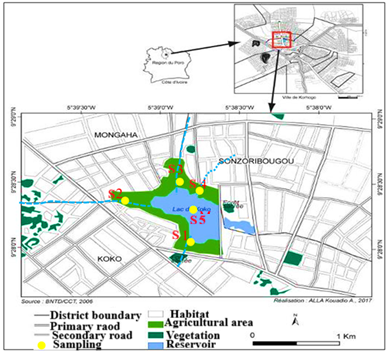
Figure 1. Location of the study area ([3], modified by [4]).
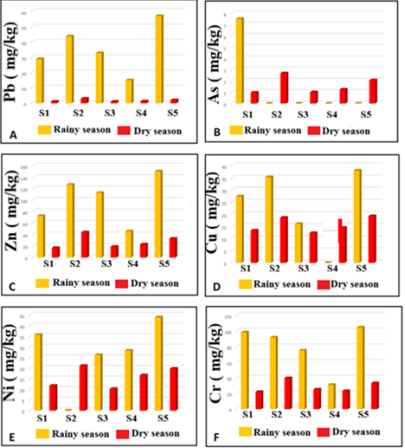
Figure 2. Temporal distributions of heavy metal concentrations in sediments.
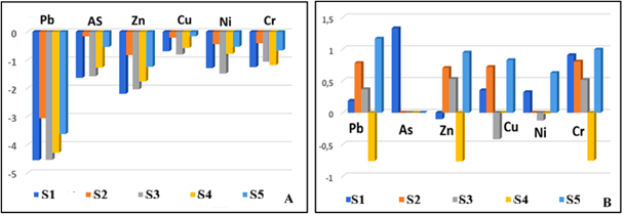
Figure 3. Geo-accumulation indices of metals in the sediments of the Koko watershed: A (rainy season) and B (dry season).
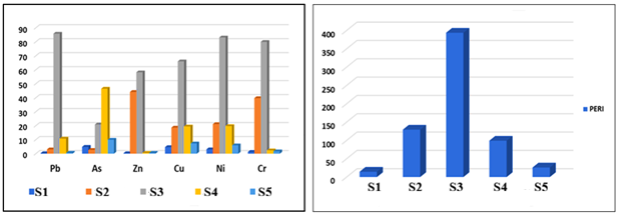
Figure 4. Variation in the potential ecological risk (Er; PERI) in surficial sediment in the rainy season.
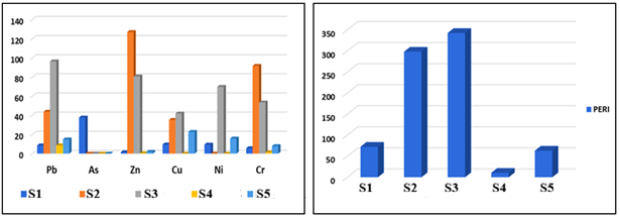
Figure 5. Variation in the potential ecological risk (Er; PERI) in surficial sediment in the dry season.
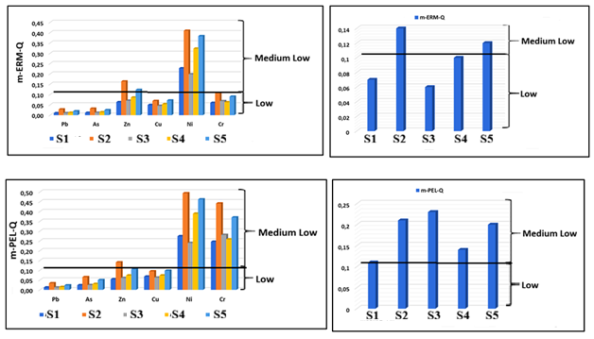
Figure 6. Variation in the mean ERM Quotient (m-ERM-Q) and mean PEL Quotient (m-PEL-Q) in the rainy season.
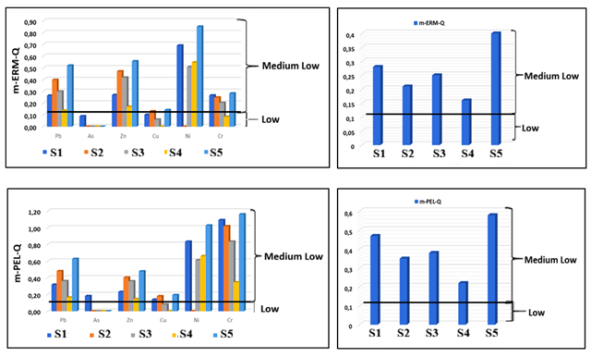
Figure 7. Variation in the mean ERM Quotient (m-ERM-Q) and mean PEL Quotient (m-PEL-Q) in the dry season.

Information



 Share This Article
 Twitter
 Linked In
 Facebook
 Copy
Copy Download