Research Article | | Peer-Reviewed

The Effect of Food Quality, Price, and Menu Variety on Consumer Repurchase in Restaurant

Received: 7 June 2026     Accepted: 27 June 2026     Published: 22 July 2026
Views:       Downloads:
Abstract

Repurchase intention is essential for sustaining the competitiveness of hotel restaurants because repeat guests contribute to long-term profitability and customer loyalty. Although previous studies have examined the effects of food quality, price, and menu variety on customer behaviour, limited research has simultaneously investigated their relationships with repurchase intention through the mediating role of guest satisfaction in the context of hotel restaurants. Therefore, this study aims to examine the direct and indirect effects of food quality, price, and menu variety on repurchase intention, with guest satisfaction serving as a mediating variable. A quantitative causal research design was employed using a survey of 220 guests who had dined at Tjokro Restaurant, Grand Tjokro Hotel Yogyakarta. Data were collected through a structured questionnaire and analyzed using Partial Least Squares Structural Equation Modelling (PLS-SEM). The findings reveal that food quality and menu variety have positive and significant effects on both guest satisfaction and repurchase intention. Price has a significant negative effect on guest satisfaction but does not directly influence repurchase intention. Guest satisfaction positively affects repurchase intention and significantly mediates the relationships between food quality, price, menu variety, and repurchase intention. These findings demonstrate that repeat-purchase behaviour in hotel restaurants is driven not only by product-related attributes but also by guests' overall satisfaction with their dining experience. The study contributes to hospitality marketing literature by clarifying the mediating role of guest satisfaction and provides practical guidance for hotel managers in designing effective menu, pricing, and food quality strategies to encourage repeat patronage.

Published in American Journal of Science, Engineering and Technology (Volume 11, Issue 3)
DOI 10.11648/j.ajset.20261103.12
Page(s) 104-114
Creative Commons

This is an Open Access article, distributed under the terms of the Creative Commons Attribution 4.0 International License (http://creativecommons.org/licenses/by/4.0/), which permits unrestricted use, distribution and reproduction in any medium or format, provided the original work is properly cited.

Copyright

Copyright © The Author(s), 2026. Published by Science Publishing Group

Keywords

Food Quality, Menu Variety, Price Perception, Guest Satisfaction, Repurchase Intention, Hotel Restaurant

1. Introduction
Over the past decade, Indonesia's tourism industry has grown significantly and become a key contributor to the national economy. The Ministry of Tourism and Creative Economy (2023) reported that this growth has strengthened its contribution to GDP and supported related sectors such as hospitality and food services. In the hotel industry, food and beverage (F&B) services play a crucial role in shaping guest experience and influencing customer satisfaction and revisit intentions research by Davis et al., (2008); and Ryu & Han, (2010) .
According to service marketing literature, customer satisfaction is shaped by evaluations of food quality, price fairness, and menu variety. In hospitality, these factors influence the dining experience, which in turn affects loyalty and repurchase intention. Satisfied customers are more likely to maintain long-term relationships and repeat purchases research by Zeithaml et al., (2021) . This is supported by restaurant studies showing that food quality and perceived price are key drivers of satisfaction and behavioural intentions research by Ryu et al., (2010) ; Namkung et al., (2007) . In addition, research shows that good food quality, competitive prices, and a wide range of relevant menu options are important factors in providing an enjoyable experience for consumers and encouraging them to buy something again, research by Siregar et al., (2024); Carranza et al., (2018) .
In practice, many hotel restaurants continue to face challenges in meeting customer expectations regarding food quality, price fairness, and menu variety. Previous studies have shown that dissatisfaction with these attributes frequently appears in customer reviews and may reduce overall satisfaction, customer loyalty, and repurchase intention research by Davis et al., (2008); Pantelidis, (2010); Berezina et al., (2016); Gan et al., (2017) .
Despite extensive research on food service quality and customer satisfaction, limited studies have simultaneously examined the effects of food quality, price, and menu variety on repurchase intention in hotel restaurant settings. In addition, the mediating role of guest satisfaction in linking these factors to repurchase intention remains underexplored, particularly in the context of starred hotel restaurants. Addressing this gap, the present study investigates the influence of food quality, price, and menu variety on repurchase intention through guest satisfaction. Drawing on customer satisfaction, perceived value, and consumer behaviour theories, this study contributes to hospitality marketing literature and provides practical insights for restaurant managers seeking to enhance customer retention and repeat patronage.
Source: Processed researcher, 2024

Download: Download full-size image

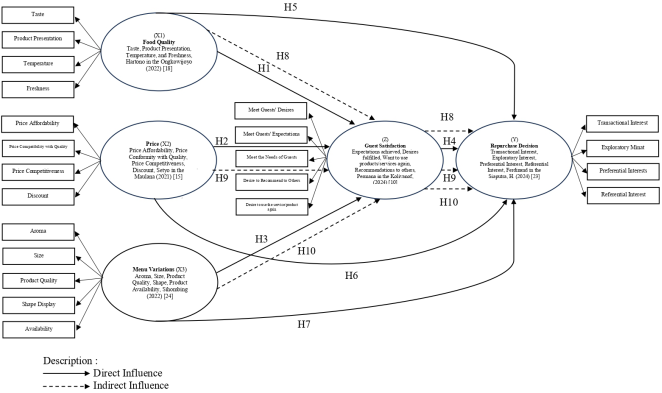
Figure 1. Conceptual Framework.
Figure 1 The Conceptual Framework shows the relationship between the variables involved in this study:
1) Food quality (X1), Food quality is conceptualized using the dimensions proposed by Hartono, namely taste, freshness, temperature, and product presentation. These dimensions represent customers' evaluations of food attributes that influence dining experiences and subsequent behavioral intentions research by Hartono, as cited in Ongkowijoyo, (2022) ; Price (X2), it is measured according to Setyo's framework, which includes price affordability, price conformity with quality, price competitiveness, and discounts. These dimensions reflect customers' perceptions of whether the monetary sacrifice is justified by the value received research by Setyo, as cited in Maulana (2021) ; and Menu Variety (X3), according to Sihombing et al (2022) , menu variation comprises aroma, product quality, size, shape or presentation, and product availability. A diverse menu is expected to satisfy different customer preferences and improve dining satisfaction; they are all independent variables.
2) Guest satisfaction (Z) is the mediating variable and measured using the indicators developed by Permana, including fulfilled expectations, fulfilled needs, willingness to reuse the product or service, and willingness to recommend it to others research by Permana, as cited in Kolivanof & Ferdian, (2024) .
3) The dependent variable is the decision to buy back (Y), repurchase decision is based on Ferdinand's behavioral intention concept, consisting of transactional, referential, preferential, and exploratory interests. These dimensions reflect customers' intentions to repurchase and maintain future relationships with the restaurant research by Ferdinand, as cited in Siaputra (2024) .
This model emphasizes that repurchase decisions are not only directly influenced by consumers' perception of the restaurant's attributes, but also indirectly through guest satisfaction.
Hypothesis 1
1) H0: There is no effect of food quality on guest satisfaction at Tjokro restaurant, Grand Tjokro hotel Yogyakarta.
2) H1: There is an influence of food quality on guest satisfaction in the restaurant Tjokro, hotel Grand Tjokro Yogyakarta.
Hypothesis 2
1) H0: There is no influence of price on guest satisfaction at Tjokro restaurant, Grand Tjokro hotel Yogyakarta.
2) H1: There is an influence of price on guest satisfaction at Tjokro restaurant, Grand Tjokro hotel Yogyakarta.
Hypothesis 3
1) H0: There is an effect of menu variations on guest satisfaction at Tjokro restaurant, Grand Tjokro hotel Yogyakarta.
2) H1: There is no effect of menu variations on guest satisfaction at Tjokro restaurant, Grand Tjokro hotel Yogyakarta.
Hypothesis 4
1) H0: There is no influence of guest satisfaction on the repurchase decision at Tjokro restaurant, Grand Tjokro hotel Yogyakarta.
2) H1: There is an influence of guest satisfaction on the repurchase decision at Tjokro restaurant, Grand Tjokro hotel Yogyakarta.
Hypothesis 5
1) H0: There is no influence of food quality on the purchase decision at Tjokro restaurant, Grand Tjokro hotel Yogyakarta.
2) H1: There is an influence of food quality on the decision to buy a repurchase at Tjokro restaurant, Grand Tjokro hotel Yogyakarta.
Hypothesis 6
1) H0: There is no effect of price on the repurchase decision at Tjokro Restaurant, Grand Tjokro hotel Yogyakarta.
2) H1: There is an influence of price on the repurchase decision at Tjokro restaurant, Grand Tjokro hotel Yogyakarta.
Hypothesis 7
1) H0: There is no effect of menu variations on the repurchase decision at Tjokro restaurant, Grand Tjokro hotel Yogyakarta.
2) H1: There is an influence of menu variations on the purchase decision at Tjokro Restaurant, Grand Tjokro hotel Yogyakarta.
Hypothesis 8
1) H0: There is no effect of food quality on repurchase decisions through guest satisfaction at Tjokro restaurant, Grand Tjokro hotel Yogyakarta.
2) H1: There is an influence of food quality on repurchase decisions through guest satisfaction at Tjokro restaurant, Grand Tjokro hotel Yogyakarta.
Hypothesis 9
1) H0: There is no influence of price on the repurchase decision through guest satisfaction at Tjokro restaurant, Grand Tjokro hotel Yogyakarta.
2) H1: There is an influence of price on repurchase decisions through guest satisfaction at Tjokro restaurant, Grand Tjokro hotel Yogyakarta.
Hypothesis 10
1) H0: There is no effect of menu variations on repurchase decisions through guest satisfaction at Tjokro restaurant, Grand Tjokro hotel Yogyakarta.
2) H1: There is an influence of variation on repurchase decisions through guest satisfaction at Tjokro restaurant, Grand Tjokro hotel Yogyakarta.
This study employed a quantitative approach with a causal research design to examine the effects of food quality, price, and menu variety on repurchase intention, with guest satisfaction serving as a mediating variable. The population consisted of customers who had dined at Tjokro Restaurant and two comparable restaurants in Yogyakarta between February and July 2024. Using purposive sampling, respondents were required to have visited the restaurant at least twice. Following the recommendation of Hair et al. (2022) for Partial Least Squares Structural Equation Modeling (PLS-SEM), a total of 220 respondents were selected . Data were collected through a structured questionnaire using a five-point Likert scale. The measurement instrument was evaluated for validity and reliability, while data analysis was conducted using SmartPLS 3.2.9. The analysis consisted of two stages: assessment of the measurement model (convergent validity, discriminant validity, and reliability) and assessment of the structural model to test the proposed hypotheses and mediation effects. Participation was voluntary, and respondents' confidentiality was maintained throughout the study.
2. Results
2.1. Characteristics of Respondents
2.1.1. Respondent Gender
Of the 220 respondents, 52.3% were male and 47.7% were female, indicating a slight predominance of male visitors at Tjokro Restaurant. According to Davis et al., (2008) , restaurant evaluation is influenced not only by food quality but also by factors such as service, atmosphere, cleanliness, accessibility, and price, which collectively form the meal experience. Differences in dining behaviour and expectations between men and women may influence restaurant preferences. As noted by Wardle et al., (2004) , male consumers tend to prefer independent or stand-alone restaurants, which may explain the higher proportion of male visitors at hotel restaurants such as Tjokro Restaurant.
2.1.2. Respondent's Age
Most respondents (33.6%) were between 26 and 35 years old, indicating that the majority belonged to the productive working-age group. Consumers in this age category generally have stable employment, greater purchasing power, and more active lifestyles, making them an important market segment for hospitality and food service businesses. Age is also recognized as one of the key demographic factors influencing consumer behaviour, purchasing decisions, and dining preferences by Kotler & Armstrong, (2018); Schiffman & Wisenblit, (2019) .
2.1.3. Respondent’s Education
Most respondents (44.1%) held a bachelor's degree (D4/S1), followed by those with a master's degree (16.8%), indicating that the majority had relatively high educational attainment. Education is an important demographic characteristic that influences consumer behavior, including information processing, product evaluation, and purchasing decisions by Kotler & Armstrong, (2018); Schiffman & Wisenblit, (2019) . These findings suggest that well-educated customers are likely to have higher expectations regarding food quality, service, and the overall dining experience.
2.1.4. Respondent's Occupation
Regarding respondents' occupations, civil servants constituted the largest group (33.6%), followed by private-sector employees (22.7%). This distribution is consistent with the market profile of Grand Tjokro Hotel Yogyakarta, where government institutions represent a significant segment of meeting and event customers. The findings suggest that most respondents were employed individuals with stable incomes, enabling them to engage in restaurant and café consumption activities. This result is consistent with Susanti (2021) , who found that customers frequently visit restaurants and cafés for work-related purposes, business meetings, social interactions, and leisure consumption.
2.1.5. Respondent's Country of Origin
Based on respondents' country of origin, domestic guests accounted for the majority of the sample (64.5%). This finding is consistent with the customer profile of Grand Tjokro Hotel Yogyakarta, where domestic visitors represent the dominant market segment. The presence of international respondents reflects the hotel's role in hosting meetings, conferences, and business-related activities, attracting foreign participants who also utilize the restaurant's food and beverage services. These results indicate that hotel restaurant customers are predominantly domestic travelers, while international guests contribute a smaller but important segment of the market.
2.1.6. Intensity of Respondent’s Visits
Regarding visit frequency, the largest proportion of respondents (29.1%) had visited Tjokro Restaurant three times, indicating a relatively high level of repeat patronage. This finding suggests that the restaurant has been successful in encouraging return visits among its customers. Consistent with Pratiwi (2021) , repeat visits are often driven by customers' desire for a comfortable environment, satisfactory products, and quality service. Positive dining experiences contribute to customer satisfaction, which in turn increases the likelihood of repurchase and repeat visitation.
2.2. Evaluation of Measurement Models (Outer Model)
2.2.1. Convergent Validity Test
Convergent validity is measuring the validity of an indicator as a measure of variables that can be seen from the outer loading of each variable indicator. An indicator is said to have good reliability if the outer loading value of each indicator > 0.70 (undeveloped research fields can use 0.5-0.6). If you use the standard Convergent Validity value > 0.70, then the outer loading value below 0.70 is removed from the model.
Table 1. Convergent Validity Test.

Variable

Item

Loading Factor

AVE

Remark

Food Quality

X1.1

0.867

0.715

Valid

X1.2

0.858

Valid

X1.3

0.851

Valid

X1.4

0.802

Valid

X1.5

0.856

Valid

X1.6

0.864

Valid

X1.7

0.840

Valid

X1.8

0.826

Valid

Pricing

X2.1

0.867

0.708

Valid

X2.2

0.806

Valid

X2.3

0.797

Valid

X2.4

0.874

Valid

X2.5

0.884

Valid

X2.6

0.864

Valid

X2.7

0.827

Valid

X2.8

0.816

Valid

Menu

X3.1

0.862

0.736

Valid

X3.10

0.874

Valid

X3.2

0.767

Valid

X3.3

0.870

Valid

X3.4

0.838

Valid

X3.5

0.861

Valid

X3.6

0.872

Valid

X3.7

0.894

Valid

X3.8

0.863

Valid

X3.9

0.871

Valid

Guest Satisfaction

Z1

0.890

0.774

Valid

Z10

0.873

Valid

Z2

0.866

Valid

Z3

0.872

Valid

Z4

0.875

Valid

Z5

0.894

Valid

Z6

0.893

Valid

Z7

0.870

Valid

Z8

0.899

Valid

Z9

0.866

Valid

Repurchase Decision

Y1

0.859

0.714

Valid

Y2

0.823

Valid

Y3

0.841

Valid

Y4

0.849

Valid

Y5

0.846

Valid

Y6

0.828

Valid

Y7

0.848

Valid

Y8

0.866

Valid

Source: Smart-PLS v.3.2.9. (2024)
Indicator reliability aims to assess whether a latent variable measurement indicator is reliable or not. The trick is to evaluate the results of the outer loading of each indicator. The outer loading value of > 0.7 indicates that the construct can explain more than 50% of the indicator variants (Wong K. K., 2013; Sarstedt et al., 2017).
From Table 1, all items or indicators have an outer loading value of > 0.7 (marked with green which means > 0.7 which means it is valid. The limit of the outer loading value > 0.5 is still acceptable as long as the validity and reliability of the construct are eligible.
From the outer loading values above, it can be seen that all indicators of the outer loading value have been > 0.6 so that based on the validity of outer loading, it is stated that all indicators have been validated in convergent validity.
2.2.2. Discriminating Validity Test
Discriminant validity aims to determine whether a reflective indicator is indeed a good gauge of its construct based on the principle that each indicator must be highly correlated to its construct only. Different construct gauges should not be highly correlated by Ghozali (2014) . Discriminant validity assesses the extent to which a construct is empirically distinct from other constructs in the model. In PLS-SEM, discriminant validity is commonly evaluated using the Fornell-Larcker criterion, cross-loadings, and the Heterotrait-Monotrait ratio (HTMT). Among these approaches, Henseler et al. (2015) recommend HTMT as a more reliable criterion for assessing discriminant validity in variance-based structural equation modelling, while the Fornell-Larcker criterion and cross-loadings continue to be widely reported as complementary measures by Hanseler et al., (2015) .
(i). Fornell-Larcker Criteria
Discriminant validity assesses whether each construct is empirically distinct from other constructs in the model. In this study, discriminant validity was evaluated using the Fornell-Larcker criterion, which compares the square root of the Average Variance Extracted (AVE) for each construct with its correlations with other constructs. Discriminant validity is established when the square root of AVE exceeds the corresponding inter-construct correlations, indicating that each construct shares more variance with its own indicators than with other constructs research by Fornell & Larcker, (1981); Henseler et al., (2015) .
Table 2. Fornell-Larcker Criterion Test.

Variabel

Pricing

Guest Satisfaction

Repurchase Decision

Food Quality

Menu

Pricing

0.842

Guest Satisfaction

0.288

0.880

Repurchase Decision

0.374

0.832

0.845

Food Quality

0.316

0.331

0.396

0.846

Menu

0.153

0.208

0.311

0.124

0.858

Source: Smart-PLS v.3.2.9 (2024)
Based on Table 2, all the roots of the AVE (Fornell-Larcker Criterion) of each construct are greater than the correlation with the other variables. For example, Food Quality: the AVE value is 0.715, then the root of AVE is 0.846.
(ii). Cross Loading
The cross-loading assessment supported discriminant validity, as all indicators showed stronger loadings on their associated constructs than on any other construct in the model.
2.2.3. Reliability Test
The next step is to conduct an analysis of Construct Reliability. Construct Reliability is a measure of the reliability of a latent variable construct. The value that is considered reliable must be above 0.70. Construct reliability is the same as Cronbach's alpha.
Table 3. Reliability Test.

Variabel

Cronbach's Alpha

Composite Reliability

Pricing

0.941

0.951

Guest Satisfaction

0.968

0.972

Repurchase Decision

0.943

0.952

Food Quality

0.943

0.953

Menu

0.960

0.965

Source: Smart-PLS v.3.2.9 (2024)
The reliability of the measurement model was evaluated using Cronbach’s alpha and Composite Reliability (CR). All constructs achieved values above the recommended thresholds, demonstrating adequate internal consistency and reliability. These findings confirm that the indicators consistently measure their respective latent constructs and support the robustness of the measurement model.
2.2.4. Uji Variance Inflation Factor (VIF)
The multicollinearity assessment was conducted using the Variance Inflation Factor (VIF) values. All constructs demonstrated acceptable VIF levels below the recommended threshold, indicating that collinearity was not a concern in the model. These results confirm that the indicators adequately represent their respective latent constructs and support the reliability of the measurement model.
2.3. Evaluation of Structural Models (Inner Model)
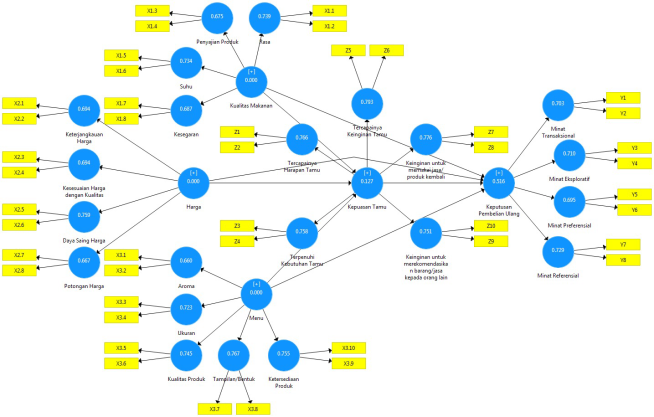
After conducting the outer model test, the next step is to conduct an inner model test. Internal model testing or structural model is carried out to see the relationship between the construct, significance value and R-square (R2) of the research model.
Source: Smart-PLS v.3.2.9. (2024)

Download: Download full-size image

Figure 2. Structural Models.
The evaluation of the PLS structural model begins with looking at the R-square of each dependent latent variable. Table 4 is the result of the R-square estimate using PLS.
2.3.1. Determination Coefficient Test - R-Square (R2)
The structural model was evaluated using the coefficient of determination (R2), which measures the proportion of variance in each endogenous construct explained by its predictor constructs. R2 values of 0.75, 0.50, and 0.25 indicate substantial, moderate, and weak explanatory power, research by Hair et al., (2022) .
Table 4. R-Square (R2).

Variabel

R-Square

R-Square Adjusted

Guest Satisfaction (Z)

0.168

0.157

Repurchase Decision (Y)

0.736

0.731

Source: Smart-PLS v.3.2.9 (2024)
The coefficient of determination (R²) was used to evaluate the explanatory power of the structural model. As presented in Table 4, Food Quality, Price, and Menu Variation explained a relatively small proportion of the variance in Guest Satisfaction (R² = 0.168). In contrast, the model demonstrated substantial explanatory power for Repurchase Decision (R² = 0.736), indicating that the predictor variables accounted for a considerable proportion of its variance. Overall, the structural model exhibited stronger explanatory power for Repurchase Decision than for Guest Satisfaction.
2.3.2. Prediction Relevance Test - Q-Square (Q2)
Predictive relevance was evaluated using the cross-validated redundancy measure (Q2) generated through the blindfolding procedure. A Q2 value greater than zero indicates that the model has predictive relevance for the endogenous construct. Values of approximately 0.02, 0.15, and 0.35 indicate small, medium, and large predictive relevance, respectively by Hanseler et al., (2015) and Hair et al., (2022) .
Table 5. Prediction Relevance - Q-Square (Q2).

Variabel

Q2 (=1-SSE/SSO)

Remarks

Guest Satisfaction

0.127

Has a predictive relevance value

Repurchase Decision

0.516

Has a predictive relevance value

Source: Smart-PLS v.3.2.9 (2024)
As per Table 5, the predicted Q-Square value for Guest Satisfaction (Z) and Repurchase Decision (Y) is accurate due to the Q-Square value > 0.05.
3. Hypothesis Conclusion on Research Variables
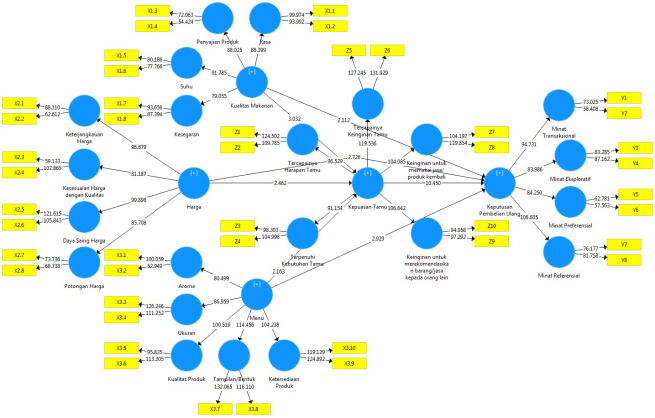
The relationships among the constructs were assessed through structural model analysis using SmartPLS. The significance of each hypothesized relationship was evaluated based on the path coefficients, t-statistics, and p-values obtained from the bootstrapping procedure. Following the recommended criteria, hypotheses were accepted when the p-value was below 0.05 and the t-statistic was greater than 1.96. The results are summarized in Table 6.
Table 6. Hypothesis Testing.

Variabel

Original Sample (O)

T Statistics (|O/STDEV|)

P-Values

Conclusion

Price -> Guest Satisfaction

-0.185

2.462

0.014

Significance P-Value < 0.05

Price -> Repurchase Decision

0.128

1.834

0.067

Insignificant P-Value > 0.05

Guest Satisfaction -> Repurchase Decisions

0.740

10.450

0.000

Significance P-Value < 0.05

Food Quality -> Guest Satisfaction

0.254

3.032

0.003

Significance P-Value < 0.05

Food Quality -> Repurchase Decision

0.101

2.112

0.035

Significance P-Value < 0.05

Menu -> Guest Satisfaction

0.149

2.163

0.031

Significance P-Value < 0.05

Menu -> Repurchase Results

0.128

2.929

0.004

Significance P-Value < 0.05

Pricing -> Guest Satisfaction -> Repurchase Decision

-0.137

2.277

0.023

Significance P-Value < 0.05

Food Quality -> Guest Satisfaction -> Repurchase Decision

0.188

2.838

0.005

Significance P-Value < 0.05

Menu -> Guest Satisfaction -> Repurchase Decision

0.110

2.002

0.046

Significance P-Value < 0.05

Source: Smart-PLS v.3.2.9 (2024)
Source: Smart-PLS v.3.2.9. (2024)

Download: Download full-size image

Figure 3. Hypothesis Testing.
As presented in Table 6, hypotheses H1, H2, H3, H4, H5, and H7 were supported, while H6 was not supported. Food Quality and Menu Variation positively affected both Guest Satisfaction and Repurchase Decision. Price negatively affected Guest Satisfaction but did not have a significant effect on Repurchase Decision. In addition, Guest Satisfaction exhibited a strong positive influence on Repurchase Decision, highlighting its important role in encouraging customers repurchase behavior.
4. Discussion
The findings indicate that Food Quality, Price, and Menu Variation significantly influence Guest Satisfaction. Food Quality exhibited a positive effect, suggesting that customers are more satisfied when food is perceived as fresh, appealing, and of high quality. This finding is consistent with previous studies highlighting the importance of food quality in shaping customer satisfaction and loyalty by Kurniawan et al., (2021; Ongkowijoyo, (2022) . Menu Variation also positively affected Guest Satisfaction, indicating that diverse and attractive menu offerings enhance customers’ dining experiences and increase satisfaction levels research by Maria, (2023) . Conversely, Price demonstrated a significant negative effect on Guest Satisfaction, implying that higher perceived prices may reduce customer satisfaction when they are not aligned with perceived value research by Wardhana et al., (2021) .
Guest Satisfaction was found to have a strong positive effect on Repurchase Intention, confirming its important role in encouraging customers to revisit and repurchase. This result supports previous studies suggesting that satisfied customers are more likely to develop loyalty and maintain long-term relationships with service providers research by Zullaihah et al., (2021) .
Regarding direct effects on Repurchase Intention, Food Quality and Menu Variation were significant predictors, indicating that customers tend to revisit restaurants that consistently offer high-quality food and diverse menu choices by Laela, (2021); Antika et al., (2023) . However, Price did not significantly affect Repurchase Intention, suggesting that customers may place greater emphasis on overall dining experiences than on price considerations alone.
The mediation analysis further revealed that Guest Satisfaction serves as an important mechanism linking Food Quality, Price, and Menu Variation to Repurchase Intention. Food Quality and Menu Variation enhanced Repurchase Intention indirectly through increased Guest Satisfaction, while the negative indirect effect of Price indicates that higher perceived prices may reduce satisfaction and consequently lower the likelihood of repeat purchases. These findings highlight the critical role of Guest Satisfaction in translating customers’ evaluations of restaurant attributes into future behavioral intentions.
5. Suggestion
Based on the findings of this study, several practical recommendations can be proposed. First, restaurant managers should continuously maintain and improve food quality, as high-quality food enhances guest satisfaction and encourages repurchase behavior. Second, pricing strategies should be carefully designed to balance customer affordability with business profitability, since perceived price fairness significantly influences guest satisfaction and subsequent repurchase intentions. Third, continuous menu innovation and diversification are essential to meet evolving customer preferences, enhance dining experiences, and strengthen customer loyalty. By focusing on these areas, hotel restaurants can improve guest satisfaction and increase the likelihood of repeat patronage.
6. Research Implications
The findings suggest that restaurant management should prioritize maintaining food quality, implementing fair and competitive pricing strategies, and continuously innovating menu offerings to enhance guest satisfaction and encourage repurchase behavior. As guest satisfaction has been shown to play a central role in driving repeat purchases, managers should focus on delivering high-quality products and positive dining experiences that meet customer expectations. In addition, pricing decisions should consider customers' perceived value and the characteristics of different market segments, as price sensitivity may vary among consumers. By aligning food quality, menu variety, and pricing strategies with customer needs, hotel restaurants can strengthen customer loyalty and improve long-term competitiveness.
7. Research Limitations
This study only focuses and is limited to analyzing independent variables, namely Food Quality, Price, and Menu Variation with all indicators on each variable contained in the questionnaire that has been distributed. The questionnaire answers from the respondents were processed and analyzed by the researcher with SEM-PLS, so that the direct and indirect influence between the variables to answer the problem formulation and the objectives in this study was known.
Abbreviations

PLS-SEM

Partial Least Squares - Structural Equation Modeling

GDP

Gross Domestic Product

F&B

Food & Beverage

HTMT

Heterotrait-Monotrait

Author Contributions
Fajar Tri Amboro: Conceptualization, Data curation, Formal Analysis, Funding acquisition, Investigation, Methodology, Project administration, Resources
Conflicts of Interest
The authors declare that they have no known competing financial interests or personal relationships that could have appeared to influence the work reported in this paper.
References
[1] Antika, N. W. P. F., & Indiani, N. L. P. (2023). The role of menu variation, location, and service quality in repurchase decisions: A case study of Zactie Bar and Restaurant. Warmadewa Management and Business Journal, 5(1), 1–13.
[2] Berezina, K., Bilgihan, A., Cobanoglu, C., & Okumus, F. (2016). Understanding satisfied and dissatisfied hotel customers: Text mining of online hotel reviews. Journal of Hospitality Marketing & Management, 25(1), 1-24.
[3] Carranza, R., Díaz, E., & Martín-Consuegra Navarro, D. (2018). The influence of quality on satisfaction and customer loyalty with an importance-performance map analysis: Exploring the mediating role of trust. Journal of Hospitality and Tourism Technology, 9(3), 380-396.
[4] Davis, B., Lockwood, A., Pantelidis, I., & Alcott, P. (2008). Food and beverage management (4th ed.). Routledge.
[5] Fornell, C., & Larcker, D. F. (1981). Evaluating structural equation models with unobservable variables and measurement error. Journal of Marketing Research, 18(1), 39-50.
[6] Gan, Q., Ferns, B. H., Yu, Y., & Jin, L. (2017). A text mining and multidimensional sentiment analysis of online restaurant reviews. Journal of Quality Assurance in Hospitality & Tourism, 18(4), 465-492.
[7] Ghozali, I. (2014). Structural equation modeling: Metode alternatif dengan PLS. Badan Penerbit Universitas Diponegoro.
[8] Hair, J. F., Hult, G. T. M., Ringle, C. M., & Sarstedt, M. (2022). A Primer on Partial Least Squares Structural Equation Modeling (PLS-SEM) (3rd ed.).
[9] Henseler, J., Ringle, C. M., & Sarstedt, M. (2015). A new criterion for assessing discriminant validity in variance-based structural equation modeling. Journal of the Academy of Marketing Science, 43(1), 115-135.
[10] Kolivanof, I., & Ferdian, F. (2024). The effect of room price and room amenities on guest satisfaction at Rocky Plaza Hotel Padang. Journal of Tourism and Hospitality Management, 2(1).
[11] Kotler, P., & Armstrong, G. (2018). Principles of marketing (17th ed.). Pearson.
[12] Kurniawan, R., & Valencia, V. (2021). Analysis of the influence of food quality, service quality, and physical environment quality on interest in behaving with customer satisfaction as a mediating variable in cafes in Batam City. In Conference on Business, Social Sciences and Technology (CoNeScINTech) (Vol. 1, No. 1, pp. 261-274).
[13] Laela, E. (2021). Food quality, service quality and price perception on the interest in repurchase at Ciganea Purwakarta Restaurant. Eqien: Jurnal Ekonomi dan Bisnis, 8(1), 180-186.
[14] Maria, A. D. (2023). Analyze the impact of promotions and menu innovations on customer satisfaction. Journal of Management of STIE Muhammadiyah Palopo, 9(1), 13-20.
[15] Maulana, M. I. N. (2021). The influence of price, product quality, and promotion on the purchase decision of Art fresh products. Performance, 5(6), 512-521.
[16] Ministry of Tourism and Creative Economy:
[17] Namkung, Y., & Jang, S. (2007). Does food quality really matter in restaurants? Its impact on customer satisfaction and behavioral intentions. Journal of Hospitality & Tourism Research, 31(3), 387-409.
[18] Ongkowijoyo, T. E. (2022). The effect of price and product quality on consumer satisfaction and repurchase interest at Cipork Keriyuk (Cab. G-Walk). International Journal of Review Management Business and Entrepreneurship, 2(1), 11-23.
[19] Pantelidis, I. S. (2010). Electronic meal experience: A content analysis of online restaurant comments. Cornell Hospitality Quarterly, 51(4), 483-491.
[20] Pratiwi, A., Junaedi, D., & Prasetyo, A. (2021). The Influence of Price on Consumer Purchasing Decisions: A Case Study of 212 Mart Cikaret. El-Mal: Journal of Islamic Economic and Business Studies, 2(2), 150-159.
[21] Ryu, K., & Han, H. (2010). Influence of the quality of food, service, and physical environment on customer satisfaction in quick-casual restaurants: Moderating role of perceived price. Journal of Hospitality & Tourism Research, 34(3), 310-329.
[22] Schiffman, L. G., & Wisenblit, J. (2019). Consumer Behavior (12th ed.). Pearson.
[23] Siaputra, H. (2024). The influence of food quality, service quality and price perception on repurchase interest at XYZ Surabaya Restaurant. Journal of Hospitality Management, 10(1), 13-23.
[24] Sihombing, M. M., Arifin, M. H., & Maryono, M. (2022). The influence of menu variants, prices, and café atmosphere on consumer satisfaction of Mulawarman Banjarmasin Miltie Garden Cafe. Smart Business Journal, 1(1), 26-35.
[25] Siregar, E. N., Rini, E. S., & Sembiring, B. K. F. (2024). The effect of food quality and service quality on consumer loyalty, with satisfaction as the intervening variable. In Proceedings of the 7th Global Conference on Business, Management, and Entrepreneurship (GCBME 2022) (pp. 810-827).
[26] Susanti, A., Dewi, T. S. P., & Putra, A. Y. W. I. (2021). Coffee shop interior design in Denpasar and consumer loyalty: Generation Y and Z. Read Cipta Ruang: Scientific Journal of Interior Design, 7(1).
[27] Wardhana, F. A., & Sitohang, F. M. (2021). The influence of products, prices, place & store atmosphere thd customer satisfaction at Warkop Benpadang Sidoarjo. Journal of Management Science and Research, 10(3).
[28] Wardle, J., Haase, A. M., Steptoe, A., Nillapun, M., Jonwutiwes, K., & Bellisle, F. (2004). Gender differences in food choice: The contribution of health beliefs and dieting. Annals of Behavioral Medicine, 27(2), 107–116.
[29] Zeithaml, V. A., Bitner, M. J., & Gremler, D. D. (2021). Services Marketing: Integrating Customer Focus Across the Firm (8th ed.). McGraw-Hill.
[30] Zullaihah, R., & Setyawati, H. A. (2021). Analysis of the influence of advertising, brand identity, and customer satisfaction with repurchase interest. Mnjm Student Scientific Journal, Business & Accounting, 3(1), 169-184.
Cite This Article
  • APA Style

    Amboro, F. T. (2026). The Effect of Food Quality, Price, and Menu Variety on Consumer Repurchase in Restaurant. American Journal of Science, Engineering and Technology, 11(3), 104-114. https://doi.org/10.11648/j.ajset.20261103.12

    Copy | Download

    ACS Style

    Amboro, F. T. The Effect of Food Quality, Price, and Menu Variety on Consumer Repurchase in Restaurant. Am. J. Sci. Eng. Technol. 2026, 11(3), 104-114. doi: 10.11648/j.ajset.20261103.12

    Copy | Download

    AMA Style

    Amboro FT. The Effect of Food Quality, Price, and Menu Variety on Consumer Repurchase in Restaurant. Am J Sci Eng Technol. 2026;11(3):104-114. doi: 10.11648/j.ajset.20261103.12

    Copy | Download

  • @article{10.11648/j.ajset.20261103.12,
      author = {Fajar Tri Amboro},
      title = {The Effect of Food Quality, Price, and Menu Variety on Consumer Repurchase in Restaurant},
      journal = {American Journal of Science, Engineering and Technology},
      volume = {11},
      number = {3},
      pages = {104-114},
      doi = {10.11648/j.ajset.20261103.12},
      url = {https://doi.org/10.11648/j.ajset.20261103.12},
      eprint = {https://article.sciencepublishinggroup.com/pdf/10.11648.j.ajset.20261103.12},
      abstract = {Repurchase intention is essential for sustaining the competitiveness of hotel restaurants because repeat guests contribute to long-term profitability and customer loyalty. Although previous studies have examined the effects of food quality, price, and menu variety on customer behaviour, limited research has simultaneously investigated their relationships with repurchase intention through the mediating role of guest satisfaction in the context of hotel restaurants. Therefore, this study aims to examine the direct and indirect effects of food quality, price, and menu variety on repurchase intention, with guest satisfaction serving as a mediating variable. A quantitative causal research design was employed using a survey of 220 guests who had dined at Tjokro Restaurant, Grand Tjokro Hotel Yogyakarta. Data were collected through a structured questionnaire and analyzed using Partial Least Squares Structural Equation Modelling (PLS-SEM). The findings reveal that food quality and menu variety have positive and significant effects on both guest satisfaction and repurchase intention. Price has a significant negative effect on guest satisfaction but does not directly influence repurchase intention. Guest satisfaction positively affects repurchase intention and significantly mediates the relationships between food quality, price, menu variety, and repurchase intention. These findings demonstrate that repeat-purchase behaviour in hotel restaurants is driven not only by product-related attributes but also by guests' overall satisfaction with their dining experience. The study contributes to hospitality marketing literature by clarifying the mediating role of guest satisfaction and provides practical guidance for hotel managers in designing effective menu, pricing, and food quality strategies to encourage repeat patronage.},
     year = {2026}
    }
    

    Copy | Download

  • TY  - JOUR
    T1  - The Effect of Food Quality, Price, and Menu Variety on Consumer Repurchase in Restaurant
    AU  - Fajar Tri Amboro
    Y1  - 2026/07/22
    PY  - 2026
    N1  - https://doi.org/10.11648/j.ajset.20261103.12
    DO  - 10.11648/j.ajset.20261103.12
    T2  - American Journal of Science, Engineering and Technology
    JF  - American Journal of Science, Engineering and Technology
    JO  - American Journal of Science, Engineering and Technology
    SP  - 104
    EP  - 114
    PB  - Science Publishing Group
    SN  - 2578-8353
    UR  - https://doi.org/10.11648/j.ajset.20261103.12
    AB  - Repurchase intention is essential for sustaining the competitiveness of hotel restaurants because repeat guests contribute to long-term profitability and customer loyalty. Although previous studies have examined the effects of food quality, price, and menu variety on customer behaviour, limited research has simultaneously investigated their relationships with repurchase intention through the mediating role of guest satisfaction in the context of hotel restaurants. Therefore, this study aims to examine the direct and indirect effects of food quality, price, and menu variety on repurchase intention, with guest satisfaction serving as a mediating variable. A quantitative causal research design was employed using a survey of 220 guests who had dined at Tjokro Restaurant, Grand Tjokro Hotel Yogyakarta. Data were collected through a structured questionnaire and analyzed using Partial Least Squares Structural Equation Modelling (PLS-SEM). The findings reveal that food quality and menu variety have positive and significant effects on both guest satisfaction and repurchase intention. Price has a significant negative effect on guest satisfaction but does not directly influence repurchase intention. Guest satisfaction positively affects repurchase intention and significantly mediates the relationships between food quality, price, menu variety, and repurchase intention. These findings demonstrate that repeat-purchase behaviour in hotel restaurants is driven not only by product-related attributes but also by guests' overall satisfaction with their dining experience. The study contributes to hospitality marketing literature by clarifying the mediating role of guest satisfaction and provides practical guidance for hotel managers in designing effective menu, pricing, and food quality strategies to encourage repeat patronage.
    VL  - 11
    IS  - 3
    ER  - 

    Copy | Download

Author Information
  • Tourism Hospitality, Trisakti Tourism Institute, South Jakarta, Indonesia