Abstract
Pregnancy among Adolescents is still a major public health challenges in Somalia, where high fertility rates (118/1,000 adolescents) and maternal mortality (692 / 100,000 live births) are further exacerbated by child marriage and female genital mutilation. This study was aimed to assess the utilization of skilled birth attendants (SBAs) and associated factors among adolescent mothers in Afgooyo District. A mixed-methods cross-sectional study was applied, involving 339 teenage mothers using structured questionnaires and qualitative interviews. Quantitative data were analyzed using SPSS version 27. The findings revealed that only 17.7% of respondents utilized SBAs, a Figure far below the national estimate of 32%. Factors significantly associated with lower SBA utilization included having non formal education (aOR = 0.062, 95% CI: 0.015–0.263), earning less than USD 50 per month (aOR = 0.125, 95% CI: 0.034–0.465), and delivery decisions being made by partners or in-laws (aOR = 0.130, 95% CI: 0.048–0.355). In contrast, belief in the importance of SBAs increased the likelihood of utilization (aOR = 3.651, 95% CI: 1.202–11.094), while preference for home delivery reduced the likelihood of SBA use (aOR = 0.190, 95% CI: 0.067–0.542). SBAs utilization among teenage mothers in Afgooyo District remains low and is significantly influenced by education, household income, decision-making autonomy, perceptions of SBA importance, and preferred place of delivery. Strengthening girls’ education, economic empowerment, women’s autonomy in healthcare decisions, and positive community perceptions of skilled delivery care could improve SBA utilization.
|
Published in
|
Central African Journal of Public Health (Volume 12, Issue 3)
|
|
DOI
|
10.11648/j.cajph.20261203.20
|
|
Page(s)
|
216-224 |
|
Creative Commons
|

This is an Open Access article, distributed under the terms of the Creative Commons Attribution 4.0 International License (http://creativecommons.org/licenses/by/4.0/), which permits unrestricted use, distribution and reproduction in any medium or format, provided the original work is properly cited.
|
|
Copyright
|
Copyright © The Author(s), 2026. Published by Science Publishing Group
|
Keywords
Skilled Birth Attendants, Adolescent Mothers, Aged 13-19 Years, Afgooyo District
1. Introduction
Due to the higher risks of mother and newborn morbidity and death, adolescent pregnancy continues to threaten the health and wellbeing of young mothers and their babies across many parts of the world, particularly in developing countries where healthcare systems are often limited. Every year, twenty-one million of girls between the ages of 15 and 19 experience pregnancy, and nearly twelve million having a child, constituting eleven percent of all global births.
. Teenagers are more vulnerable to pregnancy and childbirth since their bodies are still developing and many may not have access to high-quality medical care, and socio-economic vulnerabilities
.
While many countries have achieved improvements in maternal healthcare services over the years, sub-Saharan Africa continues to face a disproportionate burden, accounting for approximately seventy percent of universal maternal deaths
. Studies also show that the proportion of deliveries assisted by skilled health personnel has increased globally from 64% to about 84%. However, coverage remains much lower in sub-Saharan Africa, at approximately 63%
. These variances are more significant in low-income households, rural communities, and teenagers, where sociocultural factors, financial limitations, and inadequate access to healthcare facilities limit the utilization of skilled delivery services
| [5] | Muchemwa, G., & Khozah, M. Y. (2025). Exploring the experiences and perceptions of adolescent mothers regarding maternal health services in Chiredzi district, Zimbabwe: a qualitative inquiry. Therapeutic advances in reproductive health, 19, 26334941251387213.
https://doi.org/10.1177/26334941251387213 |
[5]
.
World Bank reports that Somalia still has one of the worst rates of maternal death in the world, with an estimated 563 maternal fatalities per 100,000 live births. At the same time, the adolescent fertility rate remains high at 117 births per 1,000 girls. These Figures reflect the serious reproductive health challenges facing the country
.
The situation is further influenced by widespread early marriage practices. According to UNICEF, nearly 45% of girls in Somalia marry before reaching 18 years, while 16% are married before the age of 15
. In addition, female genital mutilation is nearly universal, affecting about 98% of women aged 15–49 years, both of which increase adolescents’ vulnerability to adverse reproductive health outcomes
. Use of skilled delivery care remains limited across the country. Findings from the Somalia Demographic and Health Survey indicate that only about 32% of births are attended by qualified health personnel. Furthermore, just 21% of deliveries occur in health facilities, while and 79% of births occurring at home
. Limited healthcare access, poverty, and reliance on traditional birth attendants further make worse the situation
| [10] | Abdillahi, A. M., Farih, O. A., Ali, M. A., Abokor, A. H., Abdikarim, H., Mohamed, S. H., Omer, A. A., Ali, S. M., & Muse, A. H. (2025). Maternal health inequity in Somalia: A multivariate analysis of poverty and service utilization using nationwide cross-sectional survey data. Public health in practice (Oxford, England), 10, 100647.
https://doi.org/10.1016/j.puhip.2025.100647 |
[10]
.
Adolescent mothers often encounter greater difficulties in accessing maternity services than older women. Factors such as low educational attainment, inadequate access to healthcare services, and reproductive health information, combined with financial hardship and restrictive sociocultural practices increase the likelihood of early pregnancy and reduces their ability to seek and utilize skilled delivery care.
. As a result, adolescent pregnancy is linked to a higher risk of poor maternal and newborn outcomes, including maternal death, preterm delivery, low birth weight, and neonatal mortality
| [12] | Rahman, M. A., Khan, M. N., & Rahman, M. M. (2020). Maternal anaemia and risk of adverse obstetric and neonatal outcomes in South Asian countries: A systematic review and meta-analysis. Public health in practice (Oxford, England), 1, 100021. https://doi.org/10.1016/j.puhip.2020.100021 |
[12]
.
Although a number of studies have examined skilled birth attendant utilization in different settings, there is no known research focusing specifically on adolescent mothers in Somalia, particularly at the community level. Most of data that is currently available comes from women of reproductive age, which may mask the specific challenges faced by adolescents. Therefore, this research aimed to determine the proportion of skilled birth attendant utilization and identify the factors associated with its use among adolescent mothers in Afgooye District, Somalia.
2. Material and Methods
2.1. Study Design
A cross-sectional analytical study that included quantitative and qualitative data collection techniques was conducted using a mixed methods approach. This design is preferred since it may reach a large sample of individuals at an affordable price and in a short length of time.
2.2. Study Setting
The study was carried out in Afgooye District, located in Lower Shabelle Region of Somalia, which is about 30 km west of Mogadishu. The district is officially organized into twelve villages and is made up of both rural and semi-urban communities. According to UNDP (2014), Afgooyo has an estimated population of 67,350, farming is the primary source of income. There is only one district hospital and four mother and child health centers in the area. Poor road networks and seasonal flooding frequently limit access to health services.
2.3. Study Population
The study population consisted of adolescent mothers between the ages 13 and 19 who gave birth within the 12 months preceding the survey and lived in Afgooye District.
2.4. Inclusion and Exclusion Criteria
Adolescent mothers between the ages of 13 and 19 who had resided in the study area for at least two years and had given their agreement to participate were included. Participants under the age of eighteen provided assent together with parental or guardian consent. Adolescents who were severely ill or incapable of responding during the data collecting period were not included.
2.5. Sampling and Sample Size Determination
2.5.1. Sampling Technique
A multistage cluster sampling approach was used. Initially, six villages randomly selected out of the total twelve using simple random sampling Within the selected villages, households were then chosen through systematic random sampling, and eligible participants were identified accordingly. In cases where more than one eligible adolescent mother was found in a single household, one participant was randomly selected to ensure equal representation.
2.5.2. Sample Size Determination
The sample size was calculated using Slovin’s formula:
Where: n= Sample size, N= Population, e=desired margin of error (set at 5% or 0.05).
n=N/(1+Ne2)==308.18
This resulted in a sample size of 308.18, which was rounded to 309.
After adding a 10% non-response rate, the final sample size was adjusted to 339. Out of these, a total of 328 completed questionnaires were considered valid and included in the analysis.
2.5.3 Pre-testing
A pre-test was carried out using 10% of the calculated sample size (31 adolescent mothers) in Marka District, a setting with similar characteristics to the study area. The Feedback obtained during the pre-test was used to enhance the appropriateness, flow, and clarity of the questionnaire before the actual data collection.
2.5.4. Validity Content
Validity was confirmed through expert review by academic supervisors and alignment of the data collection tools with the study objectives. The questionnaire was designed to fully capture all relevant variables.
2.5.5. Reliability
The questionnaire was pre-tested to increase reliability, and research assistants received training on data collection methods. Consistency was maintained by using the same structured questionnaire for all respondents.
2.6. Data Collection
2.6.1. Data Collection Techniques
Interviewer-administered structured questionnaires were used to gather quantitative data. Focus groups (FGDs) and key informant interviews (KIIs) were used to gather qualitative data.
2.6.2. Data Collection Process
Trained research assistants collected data from May to June of 2025. Before taking a part, written informed consent was sought. A total of eight key informant interviews and two focus group discussions were conducted to investigate the determinants influencing the use of skilled birth attendants.
2.7. Data Analysis
SPSS version 27 was used for quantitative data analysis. Descriptive statistics, including percentages and frequencies, were used to summarize the data. To assess associations, the chi-square test was used. After binary logistic regression was performed to identify predictors of SBAs use, multivariable (AORs) and 95% confidence intervals were presented. P < 0.05 was set as the significant level.
For qualitative data, all interviews were transcribed, translated, and analyzed thematically. Results were triangulated with quantitative data.
2.8. Ethical Considerations
Kenyatta University Ethical Review Committee (PKU/3044/12068) and the NIH of Somalia had provided ethical approval. Written informed consent (and assent where applicable) has been obtained from each participants. Privacy, confidentiality, and voluntary participation were kept throughout the research.
3. Results
3.1. Socio-Demographic Characteristics of Respondents
A total of 339 adolescences were enrolled into the study out of which 328 accepted to be interviewed resulting in a 96.8% response rate. Most 322 (98.2%) of the respondents were between the ages of 15 and 19. More than half 177 (54.0%) had no formal education, and the overwhelming majority 296 (93.3%) were married. Nearly half 151 (46.0%) of the respondents earned a household income of less than 50 USD, while the majority 217 (66.2%) were primiparous.
Table 1.
Table 1. The respondents' demographic characteristics.
Independent Variables | Frequency (n=328) | Percentage (%) |
Age group | | |
10-14 | 6 | 1.8 |
15-19 | 322 | 98.2 |
Level of Education | | |
No formal education | 177 | 54.0 |
Primary | 116 | 35.4 |
Secondary/above | 35 | 10.7 |
Marital status | | |
Married | 306 | 93.3 |
Divorced/ Widowed | 22 | 6.7 |
Occupation | | |
Housewife | 296 | 90.2 |
Others | 32 | 9.8 |
Monthly income | | |
<50 | 151 | 46.0 |
50_100 | 135 | 41.2 |
Above 101 | 42 | 12.8 |
Age at first birth | | |
10-14 years | 19 | 5.8 |
15-19 years | 309 | 94.2 |
Number of children | | |
One | 217 | 66.2 |
Two or more | 111 | 33.8 |
3.2. Socio-cultural Characteristics of the Respondents
The socio-cultural characteristics of respondents showed that more than half 184 (56.1%) reported that their partner or spouse as the main decision-maker regarding place of delivery, followed by in-laws/others 93 (28.4%), while only 51 (15.5%) reported joint decision-making. Regarding the preferred place of delivery, the majority of respondents 222 (67.7%), preferred home delivery while 106 (32.3%) preferred a medical facility with skilled health personnel. In terms of beliefs regarding the importance of trained birth attendants, a large proportion of respondents 230 (70.1%) did not believe in the importance of SBA, while less than one-third 98 (29.9%) acknowledged its importance.
Table 2.
Table 2. Socio-cultural characteristics of the Respondents.
Independent Variables | Frequency (n=328) | Percentage (%) |
Decision-Maker | | |
Joined with partner | 51 | 15.5 |
Partner/Spouse | 184 | 56.1 |
In-laws/ others | 93 | 28.4 |
Preferred place of delivery | | |
Healthcare facility | 106 | 32.3 |
Home | 222 | 67.7 |
Believe of SBA importance | | |
Yes | 98 | 29.9 |
No | 230 | 70.1 |
3.3. Reasons for Preference of Home Delivery Among Adolescent Mothers Who Preferred Home Delivery (n=222)
Among adolescents who preferred home delivery (n = 222), the most frequently reported reason was financial constraints 126 (56.8%), followed by previous positive home delivery experience 100 (45%), familiarity with traditional birth attendants 96 (43.2%), and perceived privacy and comfort at home 43 (19.4%).
Table 3. Reasons for preference of home delivery.
Reason | Frequency (n=222) | Percentage (%) |
Financial barriers | 126 | 56.8 |
Familiarity with TBAs | 100 | 45 |
Previous home delivery | 96 | 43.2 |
Privacy/comfort | 43 | 19.4 |
3.4. Utilization of Skilled Birth Attendants
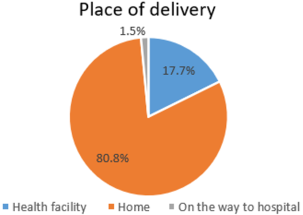
Out of the 328 adolescent mothers who participated in this study, a large proportion (265; 80.8%), reported that they delivered at home without skilled birth attendants, while 58 (17.7%) indicated that they delivered at a health facility, and only 5 (1.5%) delivered on the way to the hospital. Deliveries that occurred at a health facility were considered as births attended by a skilled birth attendant (
Figure 1).
Figure 1. Proportion of adolescent mothers by place of delivery.
3.5. Bivariate Analysis of Factors Associated with SBA Utilization
The chi-square test showed that socio-demographic and socio-cultural factors were significantly associated with skilled birth attendant utilization. Education level was significantly associated with SBA utilization (χ2 = 104.441, df = 2, p < 0.001), with adolescents who had secondary education indicating higher utilization compared to those with no formal education. Similarly, household income showed a significant association (χ2 = 83.908, df = 2, p<0.001), with higher household-income adolescents more likely to utilize skilled delivery services. Decision-making autonomy (χ2 = 107.6752, df = 1, p < 0.001) and preferred place of delivery (χ2 = 66.013, df = 1, p < 0.001) were significantly associated with SBA use. However, belief in the importance of SBA was not significantly associated with SBA use (χ2 =1.347, df=1, p =0.246).
Table 4. Bivariate analysis of factors associated with SBA utilization.
Variable | SBA utilization | Chi-square statistic | Degree of freedom (df) | P-value |
Yes (%) | No (%) |
Level of Education | No-formal education | 9 (5.1) | 168 (94.9) | χ2=104.441, | 2 | p<0.001 |
Primary | 22 (19.0) | 94 (81.0) |
Secondary / Higher | 27 (77.1) | 8 (22.9) |
Monthly Income (USD) | < 50 | 9 (6.0) | 142 (94.0) | χ2=83.908, | 2 | p<0.001 |
50–100 | 21 (15.6) | 114 (84.4) |
> 100 | 28 (76.7) | 14 (33.3) |
Decision Maker | Joined | 35 (68.6) | 16 (31.4) | χ2=107.6752 | 1 | p<0.001 |
Partner/In-laws | 23 (12) | 254 (88) |
Preferred place of delivery | Home | 13 (5.9) | 209 (94.1) | χ2 = 66.013 | 1 | p<0.001 |
Health facility | 45 (42.5) | 61 (57.5) |
Believe of SBA importance | Yes | 21 (17.3) | 77 (82.7) | χ2 =1.347 | 1 | p=0.246 |
No | 37 (16.1) | 193 (83.9) |
3.6. Binary Logistic Regression Analysis
Analysis of Multivariable binary logistic regression showed that education level, household income, decision-making autonomy, belief in the importance of SBA, and preferred place of delivery were associated with utilization of SBAs. Mothers with lower levels of education were significantly not as likely to use SBAs than those with higher education (AOR = 0.062, p < 0.001; AOR = 0.261, p = 0.039). similarly, Similarly, mothers with lower household income had reduced odds of SBA utilization (AOR = 0.125, p = 0.002; AOR = 0.093, p < 0.001). Decision-making autonomy was also a significant predictor, with women who had limited decision-making power being less likely to utilize SBA (AOR = 0.130, p < 0.001; AOR = 0.026, p = 0.001). However, mothers who believed that skilled birth attendance is important were more likely to utilize SBAs (AOR = 3.651, p = 0.022). Additionally, mothers who preferred to deliver at home had significantly lower odds of utilizing SBAs (AOR = 0.190, p = 0.002).
Table 5. Binary logistic regression analysis of factors associated with SBA utilization.
Variable | Category | AOR (95%CI) | P-value |
Education | No formal education | 0.062 (0.015 – 0.263) | <0.001 |
Primary education | 0.261 (0.073 – 0.936) | 0.039 |
Secondary/higher education | 1 (Reference) | — |
Household Income (USD) | <50 | 0.125 (0.034 – 0.465) | 0.002 |
50–100 | 0.093 (0.029 – 0.297) | <0.001 |
>101 | 1 (Reference) | — |
Decision Maker | Partner | 0.130 (0.048 – 0.355) | <0.001 |
In-laws/others | 0.026 (0.003 – 0.239) | 0.001 |
Self | 1 (Reference) | — |
Belief in Importance of SBA | Yes | 3.651 (1.202 – 11.094) | 0.022 |
No | 1 (Reference) | — |
Preferred Place of Delivery | At home | 0.190 (0.067 – 0.542) | 0.002 |
Health facility | (Reference) | — |
4. Discussion
This study assessed the proportion and factors of utilization of skilled birth attendants among teenage mothers in Afgooye District. The finding showed less than 20% of adolescent mothers delivered with a skilled birth attendant, indicating low utilization of skilled delivery services in this area. This proportion is lower than sub-national estimates reported in the SHDS, including Benadir (45–50%), South West State (30%), Jubaland (27%), Galmudug (≈30%), and Hirshabelle (18%)
. However, these regional estimates were based on women of reproductive age, where the present study specifically focused on adolescent mothers, who are often use maternal health services less frequently.
The proportion observed in this study was also lower than studies from East African countries such as Kenya (89%), Uganda (57.3%), and Tanzania (85.3%)
| [13] | KNBS 2022, Kenya Demographic and Health Survey;
https://www.knbs.or.ke/reports/kdhs-2022/ |
| [14] | Kamya Daniel, Bruce Nabaasa, Deo Nsubuga, Derrick Kimuli, Prevalence and predictors of utilisation of maternal healthcare services among teenagers in Kamuli District, Uganda, Heliyon, Volume 12, Issue 1, 2026, e44278, ISSN 2405-8440,
https://doi.org/10.1016/j.heliyon.2025.e44278 |
| [15] | Kimario, F. F., Festo, C., Shabani, J., & Mrisho, M. (2020). Determinants of Home Delivery among Women Aged 15-24 Years in Tanzania. International journal of MCH and AIDS, 9(2), 191–199. https://doi.org/10.21106/ijma.361 |
[13-15]
. similarly, this result was lower than those of research done in Ethiopia and Nigeria, where skilled birth attendance among young women between the ages of 15 and 24 ranged from approximately 33% to 43.7%
| [16] | Afape, A. O., Azubuike, P. C., Ibikunle, O. O., & Barrow, A. (2024). Prevalence and determinants of skilled birth attendance among young women aged 15-24 years in Northern Nigeria: evidence from multiple indicator cluster survey 2011 to 2021. BMC public health, 24(1), 2471.
https://doi.org/10.1186/s12889-024-19976-8 |
| [17] | Gebeyehu, A. A., Damtie, D. G., & Yenew, C. (2022). Trends and factors contributing to health facility delivery among adolescent women in Ethiopia: multivariate decomposition analysis. BMC women's health, 22(1), 487.
https://doi.org/10.1186/s12905-022-02069-2 |
[16, 17]
. The lower utilization observed in this study may be explained by contextual factors such as limited availability of skilled providers, poor health infrastructure, restricted physical access to facilities, and socio-cultural norms that favor home delivery
| [18] | Mohamed, A. A., Akın, A., Mihciokur, S., Üner, S., & Gele, A. (2025). Where and why mothers discontinue healthcare services: a qualitative study exploring the maternity continuum of care gaps in Somalia. BMC pregnancy and childbirth, 25(1), 1338. https://doi.org/10.1186/s12884-025-08361-x |
| [19] | Dahie HA, Osman MA, Jimale YA, Mohamud FI, Hussein HA, Alasow MO, et al. Institutional and home delivery practices and their predictors among women in Benadir region, Somalia: a community-based cross-sectional study. Gynecology and Obstetrics Clinical Medicine. 2026; 6: e000276.
https://doi.org/10.1136/gocm-2025-000276 |
[18, 19]
.
In this study, the utilization of SBAs was statistically significant associated with mother’s education household income, decision making, belief in the importance of SBA, and preferred place of delivery. Teenage mothers who had completed secondary education had higher likelihood of using SBAs services than those who did not. This finding may be explained by the fact that mothers with higher levels of education are more likely to understand pregnancy related risks, recognize the importance of professional delivery care, and make informed decisions regarding maternal health services. similar findings were reported in different part of the country, where mothers without formal education had significantly higher odds of home delivery and lower utilization of health care delivery services
| [20] | Ibrahim, S. H., Zhou, Z., Lu, J. et al. Home birth and its associated factors among mothers aged 15–49 years in Somalia: a nationwide population-based cross-sectional study. BMC Women's Health 25, 394 (2025).
https://doi.org/10.1186/s12905-025-03781-5 |
[20]
. A study done in Somaliland also found that women with higher education were more likely to deliver at health facilities than uneducated women
| [21] | Mohamed, M., Abdeeq, B. A., Mohamed, A. I. et al. Level of institutional delivery service utilization and associated factors among women who gave birth in the past 12 months, Ga’an libah district, Marodijeh region, Somaliland: a community-based cross-sectional study. BMC Health Serv Res 24, 1085 (2024). https://doi.org/10.1186/s12913-024-11330-3 |
[21]
.
This finding is also aligns with research done in Sierra Leone, Niger, Mali and across 37 low- and middle-income countries, which reported that maternal education was a strong predictor of SBA utilization, as educated women were more likely to seek skilled maternity care
| [22] | Ameyaw, E. K., Dickson, K. S. Skilled birth attendance in Sierra Leone, Niger, and Mali: analysis of demographic and health surveys. BMC Public Health 20, 164 (2020).
https://doi.org/10.1186/s12889-020-8258-z |
| [23] | Priebe, J., Amuasi, J., Dartanto, T., Mombo-Ngoma, G., & Guigas, M. (2024). Factors associated with skilled birth attendance in 37 low-income and middle-income countries: a secondary analysis of nationally representative, individual-level data. The Lancet. Global health, 12(7), e1104–e1110.
https://doi.org/10.1016/S2214-109X(24)00145-1 |
[22, 23]
.
Mothers from households with higher income had a higher likelihood to use SBAs than those from low-income households. This could be because financially stable families are better able to afford transportation, medical expenses, and other indirect costs related to facility delivery. This finding is consistent with evidence from Uganda and other SSA countries showing that poverty limits women’s ability to afford transport and service-related costs, thereby reducing SBA use
| [24] | Sserwanja Q, Mukunya D, Musaba MW, Kawuki J, Kitutu FE, et al. Factors associated with health facility utilization during childbirth among women in Uganda: evidence from the 2016 demographic health survey. 2021:
https://d-nb.info/1249625769/34 |
| [25] | Bain, A. R. (2022). Prevalence and determinants of maternal healthcare utilisation among young women in sub-Saharan Africa: Cross-sectional analyses of demographic and health survey data. BMC Public Health, 22, 647.
https://doi.org/10.1186/s12889-022-13037-8 |
[24, 25]
.
Decision-making autonomy was also statistically associated with SBAs, adolescents involved in joint decision-making were more likely to utilize SBA services. A possible explanation is that adolescents who participate in healthcare decisions may have greater autonomy, confidence, and support to seek professional delivery care. In contrast, limited decision-making power may delay or prevent access to maternity services, especially in patriarchal societies where husbands or older family members largely influence healthcare choices.
| [26] | Belay, D. G., Dunne, J., Lassi, Z., Mengistu, T. S., Alemu, M. B., Pereira, G., Norman, R., & Tessema, G. A. (2026). Healthcare access barriers and maternal healthcare service uptake in 14 sub-Saharan African countries (2017-2021): a propensity score matched analysis. BMJ public health, 4(1), e001391. https://doi.org/10.1136/bmjph-2024-001391 |
[26]
.
A qualitative study done in the country reported that men are commonly regarded as the primary household decision-makers and control family resources, including decisions related to healthcare utilization. The study further noted that women’s limited autonomy and dependence on husbands often affect decisions regarding health facility delivery and skilled birth attendance
| [18] | Mohamed, A. A., Akın, A., Mihciokur, S., Üner, S., & Gele, A. (2025). Where and why mothers discontinue healthcare services: a qualitative study exploring the maternity continuum of care gaps in Somalia. BMC pregnancy and childbirth, 25(1), 1338. https://doi.org/10.1186/s12884-025-08361-x |
[18]
. Similar results have been documented in Kenya, Uganda, and other Sub-Saharan African countries, where higher use of maternal health services was linked to women's involvement in healthcare decision-making
| [27] | Olwanda, E., Opondo, K., Oluoch, D. et al. Women’s autonomy and maternal health decision making in Kenya: implications for service delivery reform - a qualitative study. BMC Women's Health 24, 181 (2024).
https://doi.org/10.1186/s12905-024-02965-9 |
| [28] | Dickson, K. S., Adde, K. S., & Ameyaw, E. K. (2021). Women empowerment and skilled birth attendance in sub-Saharan Africa: A multi-country analysis. PloS one, 16(7), e0254281.
https://doi.org/10.1371/journal.pone.0254281 |
| [29] | Benti, N. B., Tebeje, B., Mamo, F. et al. Association between women’s empowerment dimensions and use of skilled birth attendance in southwest Ethiopia: a community-based cross-sectional study design. BMC Pregnancy Childbirth (2026).
https://doi.org/10.1186/s12884-026-09091-4 |
[27-29]
. This is also consistent with studies from Pakistan and Nigeria, where women’s participation in healthcare decisions improves maternal service utilization
| [30] | Iqbal S, Maqsood S, Zakar R, et al. Trend analysis of multi-level determinants of maternal and newborn postnatal care utilization in Pakistan from 2006 to 2018. BMC Public Health. 2023; 23: 642. https://doi.org/10.1186/s12889-023-15286-7 |
| [31] | Ononokpono, D. N., Gayawan, E., & Adedini, S. A. (2020). Regional variations in the use of postnatal care in Nigeria. Women’s Health, 60, 440–455.
https://doi.org/10.1080/03630242.2019.1643816 |
[30, 31]
.
Belief in the importance of SBAs had a positively association with utilization of skilled delivery. The likelihood of using SBAs was 3.65 times higher among mothers who believed skilled delivery attendance was important, highlighting the role of knowledge and perception in influencing maternal health-seeking behavior. This finding is supported by research done in Ethiopia, which reported that positive perceptions, awareness, women’s empowerment, and favorable attitudes toward maternal health services significantly increased the likelihood of utilizing skilled birth attendance
| [32] | Tarekegn, W., Tsegaye, S. & Berhane, Y. Skilled birth attendant utilization trends, determinant and inequality gaps in Ethiopia. BMC Women's Health 22, 466 (2022).
https://doi.org/10.1186/s12905-022-01995-5 |
[32]
. The possible explanation is that mothers who perceive skilled birth attendance as beneficial may have better awareness of obstetric complications and greater trust in health facilities, which encourages them to seek professional assistance during delivery.
Additionally, preference for home delivery was negatively associated with SBA utilization in this study, as mothers who preferred home delivery were less likely to utilize skilled birth attendance services. Similar results were documented in the country, where women were more likely to deliver at home if they had less understanding of the significance of giving birth in a medical facility
| [33] | Sheikh, N. S., Hussein, A. M., Mohamed, S. S., & Gele, A. (2024). Does living in major towns favor institutional delivery in Somalia? Frontiers in global women's health, 5, 1216290.
https://doi.org/10.3389/fgwh.2024.1216290 |
[33]
. Study from Ethiopia also found that preference for home delivery, poor perception of facility delivery, cultural norms, and limited partner support reduced utilization of skilled birth attendance services
| [34] | Hailu, D., Tadele, H., Tadesse, B. T., Alemayehu, A., Abuka, T., Woldegebriel, F., Gedefaw, A., Mengesha, S., & Haji, Y. (2021). Home delivery practice and its predictors in South Ethiopia. PloS one, 16(8), e0254696.
https://doi.org/10.1371/journal.pone.0254696 |
[34]
. These findings suggest that continued preference for home birth remains an important barrier to maternal healthcare utilization in many African settings.
5. Conclusion
Utilization of skilled birth attendants among teenage mothers in Afgooyo District is low. It is influenced by education, household income, decision-making autonomy, belief in the importance of SBA, and preferred place of delivery. Addressing these determinants is essential to improve skilled birth attendants.
6. Recommendations
1) The Ministry of Health should strength maternal health education programs targeting adolescent mothers, with a focus on the risks of giving birth at home and the significance of skilled delivery service.
2) Health authorities should improve access to affordable and adolescent friendly maternal health services, especially for low-income households and rural communities.
3) Health workers should involve husbands and family members in maternal health counseling session to support informed and collaborative decision making regarding the place of delivery.
Abbreviations
FGM | Female Genital Mutilation |
MMR | Maternal Mortality Ratio |
SBA | Skilled Birth Attendance |
SHDS | Somali Health and Demographic Survey |
TBAs | Traditional Birth Attendants |
UNFPA | United Nations Population Fund |
UNICEF | United Nations Children’s Fund |
WHO | World Health Organization |
Acknowledgments
The author expresses deep gratitude to her supervisors for providing the invaluable guidance, and assistance during this research. Appreciation is extended to all adolescent mothers who took part in this study as well as the health authorities and medical personnel in Afgooye District for their assistance throughout data collecting. The author also acknowledges the contribution of research assistants involved in data collection. Finally, special thanks are given to Shukri Abdullah Omar for her continued encouragement and support.
Author Contributions
Astahil Nor: Conceptualization, Formal Analysis, Investigation, Methodology, Visualization, Writing – original draft
Isaac Mwanzo: Methodology, Supervision, Writing – review & editing
Anthony Wanjohi: Methodology, Supervision, Writing – review & editing
Data Availability Statement
Data available upon writing to the corresponding author.
Conflicts of Interest
The authors declare no conflicts of interest.
References
| [1] |
World Health Organization. (2024). Adolescent pregnancy.;
https://www.who.int/news-room/fact-sheets/detail/adolescent-pregnancy
|
| [2] |
UNFPA. Adolescent pregnancy (2026):
https://esaro.unfpa.org/en/topics/adolescent-pregnancy
|
| [3] |
World Health Organization. (2025). Maternal mortality.;
https://www.who.int/news-room/fact-sheets/detail/maternal-mortality
|
| [4] |
World bank, 2026; Births attended by skilled health staff
https://data.worldbank.org/indicator/SH.STA.BRTC.ZS
|
| [5] |
Muchemwa, G., & Khozah, M. Y. (2025). Exploring the experiences and perceptions of adolescent mothers regarding maternal health services in Chiredzi district, Zimbabwe: a qualitative inquiry. Therapeutic advances in reproductive health, 19, 26334941251387213.
https://doi.org/10.1177/26334941251387213
|
| [6] |
World bank, 2026; Maternal mortality ratio;
https://data.worldbank.org/indicator/SH.STA.MMRT
|
| [7] |
UNICIEF (2025), Synthesis of the risks and likelihood of pushback against the abandonment of harmful practices Country.
www.unicef.org/media/176596/file/Somalia%20Country%20Brief.pdf
|
| [8] |
World Health Organization. (2021). In Somalia, health workers, girls and women are experts in preventing female genital mutilation;
https://www.who.int/news-room/feature-stories/detail/in-somalia-health-workers-girls-and-women-are-experts-in-preventing-female-genital-mutilation
|
| [9] |
Somalia National Bureau of Statistics. Somali Health and Demographic Survey 2020:
https://nbs.gov.so/wp-content/uploads/2023/07/Somali-Health-Demographic-Survey-2020.pdf
|
| [10] |
Abdillahi, A. M., Farih, O. A., Ali, M. A., Abokor, A. H., Abdikarim, H., Mohamed, S. H., Omer, A. A., Ali, S. M., & Muse, A. H. (2025). Maternal health inequity in Somalia: A multivariate analysis of poverty and service utilization using nationwide cross-sectional survey data. Public health in practice (Oxford, England), 10, 100647.
https://doi.org/10.1016/j.puhip.2025.100647
|
| [11] |
Maharaj NR (2022) Adolescent pregnancy in sub-Saharan Africa – a cause for concern. Front. Reprod. Health 4: 984303.
https://doi.org/10.3389/frph.2022.984303
|
| [12] |
Rahman, M. A., Khan, M. N., & Rahman, M. M. (2020). Maternal anaemia and risk of adverse obstetric and neonatal outcomes in South Asian countries: A systematic review and meta-analysis. Public health in practice (Oxford, England), 1, 100021.
https://doi.org/10.1016/j.puhip.2020.100021
|
| [13] |
KNBS 2022, Kenya Demographic and Health Survey;
https://www.knbs.or.ke/reports/kdhs-2022/
|
| [14] |
Kamya Daniel, Bruce Nabaasa, Deo Nsubuga, Derrick Kimuli, Prevalence and predictors of utilisation of maternal healthcare services among teenagers in Kamuli District, Uganda, Heliyon, Volume 12, Issue 1, 2026, e44278, ISSN 2405-8440,
https://doi.org/10.1016/j.heliyon.2025.e44278
|
| [15] |
Kimario, F. F., Festo, C., Shabani, J., & Mrisho, M. (2020). Determinants of Home Delivery among Women Aged 15-24 Years in Tanzania. International journal of MCH and AIDS, 9(2), 191–199.
https://doi.org/10.21106/ijma.361
|
| [16] |
Afape, A. O., Azubuike, P. C., Ibikunle, O. O., & Barrow, A. (2024). Prevalence and determinants of skilled birth attendance among young women aged 15-24 years in Northern Nigeria: evidence from multiple indicator cluster survey 2011 to 2021. BMC public health, 24(1), 2471.
https://doi.org/10.1186/s12889-024-19976-8
|
| [17] |
Gebeyehu, A. A., Damtie, D. G., & Yenew, C. (2022). Trends and factors contributing to health facility delivery among adolescent women in Ethiopia: multivariate decomposition analysis. BMC women's health, 22(1), 487.
https://doi.org/10.1186/s12905-022-02069-2
|
| [18] |
Mohamed, A. A., Akın, A., Mihciokur, S., Üner, S., & Gele, A. (2025). Where and why mothers discontinue healthcare services: a qualitative study exploring the maternity continuum of care gaps in Somalia. BMC pregnancy and childbirth, 25(1), 1338.
https://doi.org/10.1186/s12884-025-08361-x
|
| [19] |
Dahie HA, Osman MA, Jimale YA, Mohamud FI, Hussein HA, Alasow MO, et al. Institutional and home delivery practices and their predictors among women in Benadir region, Somalia: a community-based cross-sectional study. Gynecology and Obstetrics Clinical Medicine. 2026; 6: e000276.
https://doi.org/10.1136/gocm-2025-000276
|
| [20] |
Ibrahim, S. H., Zhou, Z., Lu, J. et al. Home birth and its associated factors among mothers aged 15–49 years in Somalia: a nationwide population-based cross-sectional study. BMC Women's Health 25, 394 (2025).
https://doi.org/10.1186/s12905-025-03781-5
|
| [21] |
Mohamed, M., Abdeeq, B. A., Mohamed, A. I. et al. Level of institutional delivery service utilization and associated factors among women who gave birth in the past 12 months, Ga’an libah district, Marodijeh region, Somaliland: a community-based cross-sectional study. BMC Health Serv Res 24, 1085 (2024).
https://doi.org/10.1186/s12913-024-11330-3
|
| [22] |
Ameyaw, E. K., Dickson, K. S. Skilled birth attendance in Sierra Leone, Niger, and Mali: analysis of demographic and health surveys. BMC Public Health 20, 164 (2020).
https://doi.org/10.1186/s12889-020-8258-z
|
| [23] |
Priebe, J., Amuasi, J., Dartanto, T., Mombo-Ngoma, G., & Guigas, M. (2024). Factors associated with skilled birth attendance in 37 low-income and middle-income countries: a secondary analysis of nationally representative, individual-level data. The Lancet. Global health, 12(7), e1104–e1110.
https://doi.org/10.1016/S2214-109X(24)00145-1
|
| [24] |
Sserwanja Q, Mukunya D, Musaba MW, Kawuki J, Kitutu FE, et al. Factors associated with health facility utilization during childbirth among women in Uganda: evidence from the 2016 demographic health survey. 2021:
https://d-nb.info/1249625769/34
|
| [25] |
Bain, A. R. (2022). Prevalence and determinants of maternal healthcare utilisation among young women in sub-Saharan Africa: Cross-sectional analyses of demographic and health survey data. BMC Public Health, 22, 647.
https://doi.org/10.1186/s12889-022-13037-8
|
| [26] |
Belay, D. G., Dunne, J., Lassi, Z., Mengistu, T. S., Alemu, M. B., Pereira, G., Norman, R., & Tessema, G. A. (2026). Healthcare access barriers and maternal healthcare service uptake in 14 sub-Saharan African countries (2017-2021): a propensity score matched analysis. BMJ public health, 4(1), e001391.
https://doi.org/10.1136/bmjph-2024-001391
|
| [27] |
Olwanda, E., Opondo, K., Oluoch, D. et al. Women’s autonomy and maternal health decision making in Kenya: implications for service delivery reform - a qualitative study. BMC Women's Health 24, 181 (2024).
https://doi.org/10.1186/s12905-024-02965-9
|
| [28] |
Dickson, K. S., Adde, K. S., & Ameyaw, E. K. (2021). Women empowerment and skilled birth attendance in sub-Saharan Africa: A multi-country analysis. PloS one, 16(7), e0254281.
https://doi.org/10.1371/journal.pone.0254281
|
| [29] |
Benti, N. B., Tebeje, B., Mamo, F. et al. Association between women’s empowerment dimensions and use of skilled birth attendance in southwest Ethiopia: a community-based cross-sectional study design. BMC Pregnancy Childbirth (2026).
https://doi.org/10.1186/s12884-026-09091-4
|
| [30] |
Iqbal S, Maqsood S, Zakar R, et al. Trend analysis of multi-level determinants of maternal and newborn postnatal care utilization in Pakistan from 2006 to 2018. BMC Public Health. 2023; 23: 642.
https://doi.org/10.1186/s12889-023-15286-7
|
| [31] |
Ononokpono, D. N., Gayawan, E., & Adedini, S. A. (2020). Regional variations in the use of postnatal care in Nigeria. Women’s Health, 60, 440–455.
https://doi.org/10.1080/03630242.2019.1643816
|
| [32] |
Tarekegn, W., Tsegaye, S. & Berhane, Y. Skilled birth attendant utilization trends, determinant and inequality gaps in Ethiopia. BMC Women's Health 22, 466 (2022).
https://doi.org/10.1186/s12905-022-01995-5
|
| [33] |
Sheikh, N. S., Hussein, A. M., Mohamed, S. S., & Gele, A. (2024). Does living in major towns favor institutional delivery in Somalia? Frontiers in global women's health, 5, 1216290.
https://doi.org/10.3389/fgwh.2024.1216290
|
| [34] |
Hailu, D., Tadele, H., Tadesse, B. T., Alemayehu, A., Abuka, T., Woldegebriel, F., Gedefaw, A., Mengesha, S., & Haji, Y. (2021). Home delivery practice and its predictors in South Ethiopia. PloS one, 16(8), e0254696.
https://doi.org/10.1371/journal.pone.0254696
|
Cite This Article
-
APA Style
Nor, A., Mwanzo, I., Wanjohi, A. (2026). Socio-Demographic and Socio-Cultural Factors Associated in SBAs Utilization Among Adolescent Mothers Aged 13 - 19 Years in Afgooye District, Somalia. Central African Journal of Public Health, 12(3), 216-224. https://doi.org/10.11648/j.cajph.20261203.20
 Copy
|
Copy
|
 Download
ACS Style
Nor, A.; Mwanzo, I.; Wanjohi, A. Socio-Demographic and Socio-Cultural Factors Associated in SBAs Utilization Among Adolescent Mothers Aged 13 - 19 Years in Afgooye District, Somalia. Cent. Afr. J. Public Health 2026, 12(3), 216-224. doi: 10.11648/j.cajph.20261203.20
Copy
|
Download
AMA Style
Nor A, Mwanzo I, Wanjohi A. Socio-Demographic and Socio-Cultural Factors Associated in SBAs Utilization Among Adolescent Mothers Aged 13 - 19 Years in Afgooye District, Somalia. Cent Afr J Public Health. 2026;12(3):216-224. doi: 10.11648/j.cajph.20261203.20
Copy
|
Download
-
@article{10.11648/j.cajph.20261203.20,
  author = {Astahil Nor and Isaac Mwanzo and Anthony Wanjohi},
  title = {Socio-Demographic and Socio-Cultural Factors Associated in SBAs Utilization Among Adolescent Mothers Aged 13 - 19 Years in Afgooye District, Somalia},
  journal = {Central African Journal of Public Health},
  volume = {12},
  number = {3},
  pages = {216-224},
  doi = {10.11648/j.cajph.20261203.20},
  url = {https://doi.org/10.11648/j.cajph.20261203.20},
  eprint = {https://article.sciencepublishinggroup.com/pdf/10.11648.j.cajph.20261203.20},
  abstract = {Pregnancy among Adolescents is still a major public health challenges in Somalia, where high fertility rates (118/1,000 adolescents) and maternal mortality (692 / 100,000 live births) are further exacerbated by child marriage and female genital mutilation. This study was aimed to assess the utilization of skilled birth attendants (SBAs) and associated factors among adolescent mothers in Afgooyo District. A mixed-methods cross-sectional study was applied, involving 339 teenage mothers using structured questionnaires and qualitative interviews. Quantitative data were analyzed using SPSS version 27. The findings revealed that only 17.7% of respondents utilized SBAs, a Figure far below the national estimate of 32%. Factors significantly associated with lower SBA utilization included having non formal education (aOR = 0.062, 95% CI: 0.015–0.263), earning less than USD 50 per month (aOR = 0.125, 95% CI: 0.034–0.465), and delivery decisions being made by partners or in-laws (aOR = 0.130, 95% CI: 0.048–0.355). In contrast, belief in the importance of SBAs increased the likelihood of utilization (aOR = 3.651, 95% CI: 1.202–11.094), while preference for home delivery reduced the likelihood of SBA use (aOR = 0.190, 95% CI: 0.067–0.542). SBAs utilization among teenage mothers in Afgooyo District remains low and is significantly influenced by education, household income, decision-making autonomy, perceptions of SBA importance, and preferred place of delivery. Strengthening girls’ education, economic empowerment, women’s autonomy in healthcare decisions, and positive community perceptions of skilled delivery care could improve SBA utilization.},
 year = {2026}
}
Copy
|
Download
-
TY  - JOUR
T1  - Socio-Demographic and Socio-Cultural Factors Associated in SBAs Utilization Among Adolescent Mothers Aged 13 - 19 Years in Afgooye District, Somalia
AU  - Astahil Nor
AU  - Isaac Mwanzo
AU  - Anthony Wanjohi
Y1  - 2026/06/26
PY  - 2026
N1  - https://doi.org/10.11648/j.cajph.20261203.20
DO  - 10.11648/j.cajph.20261203.20
T2  - Central African Journal of Public Health
JF  - Central African Journal of Public Health
JO  - Central African Journal of Public Health
SP  - 216
EP  - 224
PB  - Science Publishing Group
SN  - 2575-5781
UR  - https://doi.org/10.11648/j.cajph.20261203.20
AB  - Pregnancy among Adolescents is still a major public health challenges in Somalia, where high fertility rates (118/1,000 adolescents) and maternal mortality (692 / 100,000 live births) are further exacerbated by child marriage and female genital mutilation. This study was aimed to assess the utilization of skilled birth attendants (SBAs) and associated factors among adolescent mothers in Afgooyo District. A mixed-methods cross-sectional study was applied, involving 339 teenage mothers using structured questionnaires and qualitative interviews. Quantitative data were analyzed using SPSS version 27. The findings revealed that only 17.7% of respondents utilized SBAs, a Figure far below the national estimate of 32%. Factors significantly associated with lower SBA utilization included having non formal education (aOR = 0.062, 95% CI: 0.015–0.263), earning less than USD 50 per month (aOR = 0.125, 95% CI: 0.034–0.465), and delivery decisions being made by partners or in-laws (aOR = 0.130, 95% CI: 0.048–0.355). In contrast, belief in the importance of SBAs increased the likelihood of utilization (aOR = 3.651, 95% CI: 1.202–11.094), while preference for home delivery reduced the likelihood of SBA use (aOR = 0.190, 95% CI: 0.067–0.542). SBAs utilization among teenage mothers in Afgooyo District remains low and is significantly influenced by education, household income, decision-making autonomy, perceptions of SBA importance, and preferred place of delivery. Strengthening girls’ education, economic empowerment, women’s autonomy in healthcare decisions, and positive community perceptions of skilled delivery care could improve SBA utilization.
VL  - 12
IS  - 3
ER  -
Copy
|
Download





 Share This Article
 Twitter
 Linked In
 Facebook