
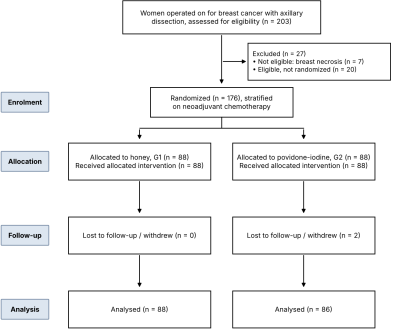
Aims: To determine whether honey applied to the skin twice a day gives better results than povidone-iodine in managing the operative wound of women treated for breast cancer by mastectomy and axillary lymph node dissection. Study Design: Open-label randomized controlled trial with two parallel arms, run in one centre; the primary endpoint was judged by an assessor kept blind to the allocated treatment. Place and Duration of Study: The trial ran from 1 October 2024 to 30 September 2026 in the Department of Gynaecology-Obstetrics and Reproductive Medicine of Bogodogo University Teaching Hospital (Ouagadougou, Burkina Faso). Methodology: Adult women (18 years and above) with a histologically confirmed breast cancer, scheduled for mastectomy or conservative breast surgery combined with axillary dissection, were allocated in equal numbers to two arms; randomization was stratified by receipt of neoadjuvant chemotherapy. Once the first dressing had been taken off (day 1 or 2), the incision was treated two times a day, until it had healed completely, either with honey (honey arm) or with 10% dermal povidone-iodine (control arm). Time to complete healing was the primary endpoint; an independent assessor, unaware of the allocation, judged it from standardized photographs. The secondary endpoints comprised surgical site infection (SSI) at 30 days according to CDC criteria, seroma, skin necrosis, dehiscence, pain at the time of wound care, skin reactions and duration of hospital stay. Results: A total of 176 women were randomized, 88 to each arm, and 174 of them (98.9%) were followed to day 30. The arms were similar at baseline; stage III–IV disease was present in 78.2% and neoadjuvant chemotherapy had been given to 94.8%. The wound had healed completely before day 14 in 26.1% of women treated with honey against 4.7% of those treated with povidone-iodine (relative risk [RR] 5.62, 95% CI 2.03 to 15.57; p < 0.001); by day 21 the proportions were 93.2% and 82.6% (p = 0.037). An SSI was recorded in 1.1% and 7.0% of women, respectively (RR 0.16, 95% CI 0.02 to 1.32; p = 0.063). With honey there were fewer seromas (8.0% against 22.1%; RR 0.36, 95% CI 0.16 to 0.81; p = 0.011), less pain at wound care on day 7 (11.4% against 48.8%; p < 0.001) and fewer skin reactions (2.3% against 16.3%; p = 0.001). Hospital stay was of similar duration in the two arms. Conclusion: In women who had a mastectomy with axillary dissection, honey applied twice a day healed the wound faster than povidone-iodine and was associated with fewer seromas, less painful wound care and fewer skin reactions. SSI was also less common, although this difference was not statistically significant. Inexpensive and well tolerated, honey is a credible alternative whose benefit needs to be confirmed by a larger trial involving several centres.
| Published in | Clinical Medicine Research (Volume 15, Issue 6) |
| DOI | 10.11648/j.cmr.20261506.11 |
| Page(s) | 81-92 |
| Creative Commons |
This is an Open Access article, distributed under the terms of the Creative Commons Attribution 4.0 International License (http://creativecommons.org/licenses/by/4.0/), which permits unrestricted use, distribution and reproduction in any medium or format, provided the original work is properly cited. |
| Copyright |
Copyright © The Author(s), 2026. Published by Science Publishing Group |
Honey, Povidone-Iodine, Wound Healing, Mastectomy, Axillary Dissection, Breast Cancer, Surgical Site Infection, Seroma, Burkina Faso
Characteristic | Honey (G1) n = 88, n (%) | Povidone-iodine (G2) n = 86, n (%) | p |
|---|---|---|---|
Age (years) | 0.46ᵇ | ||
< 35 | 2 (2.3) | 4 (4.7) | |
35–49 | 18 (20.5) | 25 (29.1) | |
50–64 | 45 (51.1) | 39 (45.3) | |
≥ 65 | 23 (26.1) | 18 (20.9) | |
Occupation | 0.75ᵇ | ||
Housewife | 63 (71.6) | 59 (68.6) | |
Trader | 12 (13.6) | 16 (18.6) | |
Civil servant / employee | 10 (11.4) | 7 (8.1) | |
Informal sector | 3 (3.4) | 4 (4.7) | |
Education | 0.23ᵇ | ||
None | 10 (11.4) | 12 (14.0) | |
Primary | 8 (9.1) | 9 (10.5) | |
Secondary | 49 (55.7) | 37 (43.0) | |
Higher | 19 (21.6) | 28 (32.6) | |
Koranic school / literacy class | 2 (2.3) | 0 (0.0) | |
Postmenopausal | 68 (77.3) | 57 (66.3) | 0.13ᵃ |
BMI (kg/m2) | 0.43ᵇ | ||
< 18.5 | 18 (20.5) | 25 (29.1) | |
18.5–24.9 | 42 (47.7) | 37 (43.0) | |
25–29.9 | 25 (28.4) | 19 (22.1) | |
≥ 30 | 3 (3.4) | 5 (5.8) | |
Comorbidities | |||
At least one comorbidity | 55 (62.5) | 40 (46.5) | 0.047ᵃ |
Hypertension | 24 (27.3) | 31 (36.0) | 0.25ᵃ |
Diabetes | 6 (6.8) | 8 (9.3) | 0.59ᵃ |
HIV infection | 0 (0.0) | 1 (1.2) | 0.49ᵃ |
Sickle cell disease | 1 (1.1) | 0 (0.0) | 1.00ᵃ |
Preoperative anaemia (Hb < 12 g/dL) | 56 (63.6) | 49 (57.0) | 0.44ᵃ |
Smoking | 0 (0.0) | 3 (3.5) | 0.12ᵃ |
Stage | 0.25ᵇ | ||
I | 0 (0.0) | 2 (2.3) | |
II | 17 (19.3) | 19 (22.1) | |
III | 65 (73.9) | 63 (73.3) | |
IV | 6 (6.8) | 2 (2.3) | |
Histological type | 0.07ᵇ | ||
Invasive carcinoma of no special type | 71 (80.7) | 76 (88.4) | |
Invasive lobular carcinoma | 12 (13.6) | 10 (11.6) | |
Other | 5 (5.7) | 0 (0.0) | |
Neoadjuvant chemotherapy | 82 (93.2) | 83 (96.5) | 0.50ᵃ |
Characteristic | Honey (G1) n = 88, n (%) | Povidone-iodine (G2) n = 86, n (%) | p |
|---|---|---|---|
Type of surgery | 0.68a | ||
Modified radical mastectomy | 84 (95.5) | 84 (97.7) | |
Breast-conserving surgery + axillary dissection | 4 (4.5) | 2 (2.3) | |
Incision | 0.33a | ||
Transverse (Stewart) | 81 (92.0) | 83 (96.5) | |
Oblique | 7 (8.0) | 3 (3.5) | |
Skin closure | 0.95ᶜ | ||
Intradermal running suture | 7 (8.0) | 8 (9.3) | |
Simple interrupted stitches | 42 (47.7) | 40 (46.5) | |
Blair-Donati stitches | 39 (44.3) | 38 (44.2) | |
Operative duration | 0.21a | ||
< 90 min | 76 (86.4) | 80 (93.0) | |
90–150 min | 12 (13.6) | 6 (7.0) | |
Operator | 0.21a | ||
Gynaecological surgeon | 83 (94.3) | 85 (98.8) | |
Other surgeon | 5 (5.7) | 1 (1.2) | |
Intraoperative transfusion | 6 (6.8) | 4 (4.7) | 0.75a |
Lymph nodes removed, mean | 12.5 | 10.7 | – |
Time to complete healing | Honey (G1) n = 88, n (%) | Povidone-iodine (G2) n = 86, n (%) | Total n = 174, n (%) |
|---|---|---|---|
< 14 days | 23 (26.1) | 4 (4.7) | 27 (15.5) |
14–21 days | 59 (67.0) | 67 (77.9) | 126 (72.4) |
22–30 days | 6 (6.8) | 14 (16.3) | 20 (11.5) |
Not healed at day 30 | 0 (0.0) | 1 (1.2) | 1 (0.6) |
Healed before day 14: RR (95% CI); p | 5.62 (2.03–15.57); < 0.001a | ||
Healed by day 21: RR (95% CI); p | 1.13 (1.01–1.26); 0.037a | ||
Distribution of healing classes | Mann–Whitney p < 0.001 |
Outcome | Honey (G1) n = 88, n (%) | Povidone-iodine (G2) n = 86, n (%) | RR (95% CI) | p |
|---|---|---|---|---|
Surgical site infection at day 30 | 1 (1.1) | 6 (7.0) | 0.16 (0.02–1.32) | 0.063a |
Seroma requiring aspiration | 7 (8.0) | 19 (22.1) | 0.36 (0.16–0.81) | 0.011a |
Minor skin necrosis | 1 (1.1) | 4 (4.7) | – | 0.21a |
Major skin necrosis | 0 (0.0) | 1 (1.2) | – | 0.49a |
Haematoma | 0 (0.0) | 1 (1.2) | – | 0.49a |
Dehiscence | 0 (0.0) | 0 (0.0) | – | – |
Length of stay 4–7 days | 71 (80.7) | 73 (84.9) | – | 0.32b |
Length of stay 8–14 days | 12 (13.6) | 12 (14.0) | ||
Length of stay > 14 days | 5 (5.7) | 1 (1.2) | ||
Pain during care (VAS ≥ 4), day 2 | 34 (38.6) | 46 (53.5) | 0.72 (0.52–1.00) | 0.068a |
Pain during care (VAS ≥ 4), day 7 | 10 (11.4) | 42 (48.8) | 0.23 (0.12–0.43) | < 0.001a |
Pruritus / skin reaction | 2 (2.3) | 14 (16.3) | 0.14 (0.03–0.60) | 0.001a |
Adherence ≥ 90% of applications | 86 (97.7) | 84 (97.7) | – | 1.00a |
Satisfied or very satisfied | 86 (97.7) | 80 (93.0) | – | 0.17a |
Adjuvant treatment started by day 30 | 30 (34.1) | 36 (41.9) | – | 0.35a |
aOR | Adjusted Odds Ratio |
ARR | Absolute Risk Reduction |
CDC | Centers for Disease Control and Prevention |
CHU-B | Bogodogo University Teaching Hospital (Centre Hospitalier Universitaire de Bogodogo) |
CI | Confidence Interval |
CONSORT | Consolidated Standards of Reporting Trials |
G1 | HONEY ARM |
G2 | Control Arm |
HIV | Human Immunodeficiency Virus |
NNT | Number Needed to Treat |
OR | Odds Ratio |
REEDA | Redness, Oedema, Ecchymosis, Discharge, Approximation |
RR | Relative Risk |
SSI | Surgical Site Infection |
| [1] | Bray F, Laversanne M, Sung H, Ferlay J, Siegel RL, Soerjomataram I, et al. Global cancer statistics 2022: GLOBOCAN estimates of incidence and mortality worldwide for 36 cancers in 185 countries. CA Cancer J Clin. 2024; 74(3): 229-63. |
| [2] |
World Health Organization. Breast cancer [Internet]. Geneva: WHO; 2024. Available:
https://www.who.int/news-room/fact-sheets/detail/breast-cancer |
| [3] | Jedy-Agba E, McCormack V, Adebamowo C, dos-Santos-Silva I. Stage at diagnosis of breast cancer in sub-Saharan Africa: a systematic review and meta-analysis. Lancet Glob Health. 2016; 4(12): e923-35. |
| [4] | Ly M, Antoine M, Andre F, Callard P, Bernaudin JF, Diallo DA. Breast cancer in sub-Saharan African women: current state of knowledge. Bull Cancer. 2011; 98(7): 797-806. |
| [5] | Zongo N, Millogo-Traoré TFD, Bagré SC, Bagué AH, Ouangré E, Zida M, et al. The role of surgery in the management of breast cancer in women at the Yalgado Ouédraogo University Hospital Center: a study of 81 cases. Pan Afr Med J. 2015; 22: 117. |
| [6] | Madden JL, Kandalaft S, Bourque RA. Modified radical mastectomy. Ann Surg. 1972; 175(5): 624-34. |
| [7] | Vitug AF, Newman LA. Complications in breast surgery. Surg Clin North Am. 2007; 87(2): 431-51. |
| [8] | Olsen MA, Lefta M, Dietz JR, Brandt KE, Aft R, Matthews R, et al. Risk factors for surgical site infection after major breast operation. J Am Coll Surg. 2008; 207(3): 326-35. |
| [9] | Kuroi K, Shimozuma K, Taguchi T, Imai H, Yamashiro H, Ohsumi S, et al. Evidence-based risk factors for seroma formation in breast surgery. Jpn J Clin Oncol. 2006; 36(4): 197-206. |
| [10] | Crestani A, et al. Prevention of lymphocele or seroma after mastectomy and axillary lymphadenectomy for breast cancer: systematic review and meta-analysis. Sci Rep. 2022; 12(1): 10016. |
| [11] | Yaogo KGR. Factors associated with the occurrence of immediate complications following mastectomy with axillary lymph node dissection: a systematic review (2016–2025) [Specialized Higher Studies Diploma (DES) thesis in Gynecology-Obstetrics, No. 615]. Ouagadougou: Joseph KI-ZERBO University; 2025–2026. |
| [12] | Cardoso F, Kyriakides S, Ohno S, Penault-Llorca F, Poortmans P, Rubio IT, et al. Early breast cancer: ESMO Clinical Practice Guidelines for diagnosis, treatment and follow-up. Ann Oncol. 2019; 30(8): 1194-220. |
| [13] | French Society for Hospital Hygiene (SFHH). Five-step antisepsis. In: Glossary of Medical Hygiene. Paris: SFHH; 2006. |
| [14] | Berríos-Torres SI, Umscheid CA, Bratzler DW, Leas B, Stone EC, Kelz RR, et al. Centers for Disease Control and Prevention guideline for the prevention of surgical site infection, 2017. JAMA Surg. 2017; 152(8): 784-91. |
| [15] | Lineaweaver W, Howard R, Soucy D, McMorris S, Freeman J, Crain C, et al. Topical antimicrobial toxicity. Arch Surg. 1985; 120(3): 267-70. |
| [16] | Molan P, Rhodes T. Honey: a biologic wound dressing. Wounds. 2015; 27(6): 141-51. |
| [17] | Vandamme L, Heyneman A, Hoeksema H, Verbelen J, Monstrey S. Honey in modern wound care: a systematic review. Burns. 2013; 39(8): 1514-25. |
| [18] | Cooper R. Honey for wound care in the 21st century. J Wound Care. 2016; 25(9): 544-52. |
| [19] | Jull AB, Cullum N, Dumville JC, Westby MJ, Deshpande S, Walker N. Honey as a topical treatment for wounds. Cochrane Database Syst Rev. 2015;(3): CD005083. |
| [20] | Ferraz Barbosa B, de Moraes FCA, Araujo Alves da Silva B, Bordignon Barbosa C, Pereira da Silva I, da Silva ER, et al. The use of honey for cicatrization and pain control of obstetric wounds: a systematic review and meta-analysis of randomized controlled trials. Nutrients. 2024; 16(2): 185. |
| [21] | Ouattara A. Twice-daily topical honey on caesarean section wounds after early dressing removal: a randomized controlled trial at Bogodogo University Hospital, Ouagadougou, Burkina Faso. [Master's thesis No. 544]. Ouagadougou: Joseph KI-ZERBO University; 2026. |
| [22] | Lund-Nielsen B, Adamsen L, Kolmos HJ, Rørth M, Tolver A, Gottrup F. The effect of honey-coated bandages compared with silver-coated bandages on treatment of malignant wounds: a randomized study. Wound Repair Regen. 2011; 19(6): 664-70. |
| [23] | Moolenaar M, Poorter RL, van der Toorn PP, Lenderink AW, Poortmans P, Egberts AC. The effect of honey compared to conventional treatment on healing of radiotherapy-induced skin toxicity in breast cancer patients. Acta Oncol. 2006; 45(5): 623-4. |
| [24] | Naidoo N, Molan P, Littler R, Mok G, Jameson M, Round G, et al. A phase II randomized controlled trial of Manuka honey as prophylaxis against radiation-induced dermatitis in breast cancer patients. Eur J Cancer. 2011; 47(Suppl 1). |
| [25] | Shoma A, Eldars W, Noman N, Saad M, Elzahaf E, Abdalla M, et al. Pentoxifylline and local honey for radiation-induced burn following breast conservative surgery. Curr Clin Pharmacol. 2010; 5(4): 251-6. |
| [26] | Bardy J, Slevin NJ, Mais KL, Molassiotis A. A systematic review of honey uses and its potential value within oncology care. J Clin Nurs. 2008; 17(19): 2604-23. |
| [27] | Djoua YMLC. The healing effect of honey in the management of wounds following mastectomy with axillary lymph node dissection for breast cancer: a systematic review [Doctoral thesis in medicine]. Ouagadougou: Joseph KI-ZERBO University; 2025-2026. |
| [28] | Friedman LM, Furberg CD, DeMets DL. Fundamentals of clinical trials. 3rd ed. New York: Springer; 1998. |
| [29] | Dean AG, Sullivan KM, Soe MM. OpenEpi: Open Source Epidemiologic Statistics for Public Health, version 3.01. Available: |
| [30] | Mangram AJ, Horan TC, Pearson ML, Silver LC, Jarvis WR. Guideline for prevention of surgical site infection, 1999. Infect Control Hosp Epidemiol. 1999; 20(4): 250-78. |
| [31] | Horan TC, Gaynes RP, Martone WJ, Jarvis WR, Emori TG. CDC definitions of nosocomial surgical site infections, 1992: a modification of CDC definitions of surgical wound infections. Infect Control Hosp Epidemiol. 1992; 13(10): 606-8. |
| [32] | World Medical Association. World Medical Association Declaration of Helsinki: ethical principles for medical research involving human subjects. JAMA. 2013; 310(20): 2191-4. |
| [33] | Jonczyk MM, Jean J, Graham RA, Chatterjee A. Trending towards safer breast cancer surgeries? Examining acute complication rates from a 13-year NSQIP analysis. Cancers (Basel). 2019; 11(2): 253. |
| [34] | Majtan J. Honey: an immunomodulator in wound healing. Wound Repair Regen. 2014; 22(2): 187-92. |
| [35] | Bocoum A, van Riel SJJM, Traore SO, Ngo Oum II EF, Traore Y, Thera AT, et al. Medical-grade honey enhances the healing of caesarean section wounds and is similarly effective to antibiotics combined with povidone-iodine in the prevention of infections — a prospective cohort study. Antibiotics (Basel). 2023; 12(1): 92. |
| [36] | Cooper RA, Molan PC, Harding KG. The sensitivity to honey of Gram-positive cocci of clinical significance isolated from wounds. J Appl Microbiol. 2002; 93(5): 857-63. |
| [37] | Jenkins R, Burton N, Cooper R. Manuka honey inhibits cell division in methicillin-resistant Staphylococcus aureus. J Antimicrob Chemother. 2011; 66(11): 2536-42. |
| [38] | Kwakman PH, te Velde AA, de Boer L, Speijer D, Vandenbroucke-Grauls CM, Zaat SA. How honey kills bacteria. FASEB J. 2010; 24(7): 2576-82. |
| [39] | Wada NM, Muhammad MI, Garba AS, Ghazali HM. Antibacterial activity of Vitellaria paradoxa seed oil extract and honey against bacterial isolates from wound infection. Int J Biol Phys Chem Stud. 2019; 1: 16-21. |
| [40] | Adegoke CO, Laoye OO, Folorunso OA, Ogunbanwo ST. Antibacterial activity of Vitellaria paradoxa seed oil extract (shea butter) and honey against bacterial pathogens causing wound infection. SJMLS. 2024; 9: 289-300. |
| [41] | Dryden M, Goddard C, Madadi A, Heard M, Saeed K, Cooke J. Using antimicrobial honey to prevent caesarean wound infection. Br J Midwifery. 2014; 22(2): 111-5. |
| [42] | Velotti N, Limite G, Vitiello A, Berardi G, Musella M. Flap fixation in preventing seroma formation after mastectomy: an updated meta-analysis. Updates Surg. 2021; 73(4): 1307-14. |
| [43] | Xiong X, Ou X, Wang L, Zheng X. Efficacy and safety of methylprednisolone in the prevention of seroma formation after mastectomy: systematic review and meta-analysis. Medicine (Baltimore). 2025; 104: e45353. |
| [44] | [Zongo L, Bayala B, Sombie CB, Traoré S, Simpore J, Semde R. In vitro evaluation of the antiproliferative activity of a cream based on shea butter and honey intended for the management of cancerous wounds. J Afr Technol Pharm Bi-opharm. 2023; 2: 1-10. |
| [45] | Erejuwa OO, Sulaiman SA, Wahab MSA. Effects of honey and its mechanisms of action on the development and progression of cancer. Molecules. 2014; 19(2): 2497-522. |
| [46] | Sterne JAC, Savović J, Page MJ, Elbers RG, Blencowe NS, Boutron I, et al. RoB 2: a revised tool for assessing risk of bias in randomised trials. BMJ. 2019; 366: l4898. |
APA Style
Adama, O., Charles, S., Charlemagne, O., Alexi, S. Y., Olga, L. (2026). Topical Honey for Wound Care After Mastectomy with Axillary Lymph Node Dissection for Breast Cancer: A Trial at Bogodogo University Hospital, Ouagadougou. Clinical Medicine Research, 15(6), 81-92. https://doi.org/10.11648/j.cmr.20261506.11
ACS Style
Adama, O.; Charles, S.; Charlemagne, O.; Alexi, S. Y.; Olga, L. Topical Honey for Wound Care After Mastectomy with Axillary Lymph Node Dissection for Breast Cancer: A Trial at Bogodogo University Hospital, Ouagadougou. Clin. Med. Res. 2026, 15(6), 81-92. doi: 10.11648/j.cmr.20261506.11
AMA Style
Adama O, Charles S, Charlemagne O, Alexi SY, Olga L. Topical Honey for Wound Care After Mastectomy with Axillary Lymph Node Dissection for Breast Cancer: A Trial at Bogodogo University Hospital, Ouagadougou. Clin Med Res. 2026;15(6):81-92. doi: 10.11648/j.cmr.20261506.11
@article{10.11648/j.cmr.20261506.11,
  author = {Ouattara Adama and Sombié Charles and Ouedraogo Charlemagne and Sawadogo Yobi Alexi and Lompo Olga},
  title = {Topical Honey for Wound Care After Mastectomy with Axillary Lymph Node Dissection for Breast Cancer: A Trial at Bogodogo University Hospital, Ouagadougou},
  journal = {Clinical Medicine Research},
  volume = {15},
  number = {6},
  pages = {81-92},
  doi = {10.11648/j.cmr.20261506.11},
  url = {https://doi.org/10.11648/j.cmr.20261506.11},
  eprint = {https://article.sciencepublishinggroup.com/pdf/10.11648.j.cmr.20261506.11},
  abstract = {Aims: To determine whether honey applied to the skin twice a day gives better results than povidone-iodine in managing the operative wound of women treated for breast cancer by mastectomy and axillary lymph node dissection. Study Design: Open-label randomized controlled trial with two parallel arms, run in one centre; the primary endpoint was judged by an assessor kept blind to the allocated treatment. Place and Duration of Study: The trial ran from 1 October 2024 to 30 September 2026 in the Department of Gynaecology-Obstetrics and Reproductive Medicine of Bogodogo University Teaching Hospital (Ouagadougou, Burkina Faso). Methodology: Adult women (18 years and above) with a histologically confirmed breast cancer, scheduled for mastectomy or conservative breast surgery combined with axillary dissection, were allocated in equal numbers to two arms; randomization was stratified by receipt of neoadjuvant chemotherapy. Once the first dressing had been taken off (day 1 or 2), the incision was treated two times a day, until it had healed completely, either with honey (honey arm) or with 10% dermal povidone-iodine (control arm). Time to complete healing was the primary endpoint; an independent assessor, unaware of the allocation, judged it from standardized photographs. The secondary endpoints comprised surgical site infection (SSI) at 30 days according to CDC criteria, seroma, skin necrosis, dehiscence, pain at the time of wound care, skin reactions and duration of hospital stay. Results: A total of 176 women were randomized, 88 to each arm, and 174 of them (98.9%) were followed to day 30. The arms were similar at baseline; stage III–IV disease was present in 78.2% and neoadjuvant chemotherapy had been given to 94.8%. The wound had healed completely before day 14 in 26.1% of women treated with honey against 4.7% of those treated with povidone-iodine (relative risk [RR] 5.62, 95% CI 2.03 to 15.57; p Conclusion: In women who had a mastectomy with axillary dissection, honey applied twice a day healed the wound faster than povidone-iodine and was associated with fewer seromas, less painful wound care and fewer skin reactions. SSI was also less common, although this difference was not statistically significant. Inexpensive and well tolerated, honey is a credible alternative whose benefit needs to be confirmed by a larger trial involving several centres.},
 year = {2026}
}
TY  - JOUR
T1  - Topical Honey for Wound Care After Mastectomy with Axillary Lymph Node Dissection for Breast Cancer: A Trial at Bogodogo University Hospital, Ouagadougou
AU  - Ouattara Adama
AU  - Sombié Charles
AU  - Ouedraogo Charlemagne
AU  - Sawadogo Yobi Alexi
AU  - Lompo Olga
Y1  - 2026/11/26
PY  - 2026
N1  - https://doi.org/10.11648/j.cmr.20261506.11
DO  - 10.11648/j.cmr.20261506.11
T2  - Clinical Medicine Research
JF  - Clinical Medicine Research
JO  - Clinical Medicine Research
SP  - 81
EP  - 92
PB  - Science Publishing Group
SN  - 2326-9057
UR  - https://doi.org/10.11648/j.cmr.20261506.11
AB  - Aims: To determine whether honey applied to the skin twice a day gives better results than povidone-iodine in managing the operative wound of women treated for breast cancer by mastectomy and axillary lymph node dissection. Study Design: Open-label randomized controlled trial with two parallel arms, run in one centre; the primary endpoint was judged by an assessor kept blind to the allocated treatment. Place and Duration of Study: The trial ran from 1 October 2024 to 30 September 2026 in the Department of Gynaecology-Obstetrics and Reproductive Medicine of Bogodogo University Teaching Hospital (Ouagadougou, Burkina Faso). Methodology: Adult women (18 years and above) with a histologically confirmed breast cancer, scheduled for mastectomy or conservative breast surgery combined with axillary dissection, were allocated in equal numbers to two arms; randomization was stratified by receipt of neoadjuvant chemotherapy. Once the first dressing had been taken off (day 1 or 2), the incision was treated two times a day, until it had healed completely, either with honey (honey arm) or with 10% dermal povidone-iodine (control arm). Time to complete healing was the primary endpoint; an independent assessor, unaware of the allocation, judged it from standardized photographs. The secondary endpoints comprised surgical site infection (SSI) at 30 days according to CDC criteria, seroma, skin necrosis, dehiscence, pain at the time of wound care, skin reactions and duration of hospital stay. Results: A total of 176 women were randomized, 88 to each arm, and 174 of them (98.9%) were followed to day 30. The arms were similar at baseline; stage III–IV disease was present in 78.2% and neoadjuvant chemotherapy had been given to 94.8%. The wound had healed completely before day 14 in 26.1% of women treated with honey against 4.7% of those treated with povidone-iodine (relative risk [RR] 5.62, 95% CI 2.03 to 15.57; p Conclusion: In women who had a mastectomy with axillary dissection, honey applied twice a day healed the wound faster than povidone-iodine and was associated with fewer seromas, less painful wound care and fewer skin reactions. SSI was also less common, although this difference was not statistically significant. Inexpensive and well tolerated, honey is a credible alternative whose benefit needs to be confirmed by a larger trial involving several centres.
VL  - 15
IS  - 6
ER  -
Training and Research Unit in Health Sciences, Joseph KI-ZERBO University, Ouagadougou, Burkina Faso

Information



 Share This Article
 Twitter
 Linked In
 Facebook

 Copy
 Download