
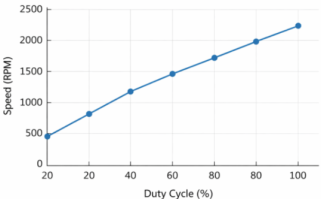
This study investigates the speed control of a DC motor using the Pulse Width Modulation (PWM) technique by analyzing the effect of different duty cycle variations on motor speed, efficiency, and overall system performance. Direct Current (DC) motors are extensively employed in industrial and automation systems because they provide superior speed control and operational flexibility. As modern industries increasingly demand higher efficiency and reduced energy consumption, effective motor speed regulation has become a critical requirement for improving overall system performance. In this context, this research explores the speed control of a DC motor through the implementation of the Pulse Width Modulation (PWM) technique, which is widely recognized for its accuracy and efficiency in power control applications. PWM operates by adjusting the duty cycle of a switching signal; consequently, the average voltage supplied to the motor can be regulated without significant power loss. By varying the duty cycle, the motor receives different effective voltage levels, and therefore its rotational speed can be controlled precisely. In this study, the behavior and performance of a DC motor are examined under multiple duty cycle conditions ranging from 20% to 100%, enabling a comprehensive evaluation of the relationship between duty cycle variation and motor speed. Both experimental observations and simulation results indicate that the motor speed increases proportionally with the duty cycle, while the system continues to maintain efficient power utilization and stable operation. Furthermore, the findings demonstrate that PWM-based control not only enhances speed regulation accuracy but also improves energy efficiency and system reliability. Consequently, PWM emerges as a highly effective and flexible technique for DC motor speed control, making it particularly suitable for modern industrial and automation applications.
| Published in | Science Journal of Circuits, Systems and Signal Processing (Volume 13, Issue 1) |
| DOI | 10.11648/j.cssp.20261301.12 |
| Page(s) | 14-19 |
| Creative Commons |
This is an Open Access article, distributed under the terms of the Creative Commons Attribution 4.0 International License (http://creativecommons.org/licenses/by/4.0/), which permits unrestricted use, distribution and reproduction in any medium or format, provided the original work is properly cited. |
| Copyright |
Copyright © The Author(s), 2026. Published by Science Publishing Group |
DC Motor, Speed Control, Pulse Width Modulation (PWM), Duty Cycle, Energy Efficiency
Duty Cycle (%) | Voltage (V) | Current (A) | Speed (RPM) |
|---|---|---|---|
20 | 2.4 | 0.25 | 520 |
40 | 4.8 | 0.38 | 980 |
60 | 7.2 | 0.52 | 1480 |
80 | 9.6 | 0.68 | 1980 |
100 | 12 | 0.85 | 2450 |
DC | Direct Current |
PWM | Pulse Width Modulation |
MOSFET | Metal-Oxide-Semiconductor Field-Effect Transistor |
RPM | Revolutions Per Minute |
V | Voltage |
| [1] | Y. H. El Naser, B. Demirsoy, K. Erin, and M. S. Demirsoy. “Chaotic Speed Control of a DC Motor Using the Sprott-A System for Robotic End-Effector Applications,” Black Sea Journal of Engineering and Science, 2025, 8(5), 1406–1414. |
| [2] | O. Jasim, “Design and Implementation of a Practical Board for Generating a PWM Signal to Control the Speed and Direction of a DC Motor,” Journal of Research in Engineering and Computer Sciences, 2024, 2(1), 1–8. |
| [3] | U. Goundaje, G. Dhulugade, A. Sontakke, and S. S. Manjare, “Soft Starter for DC Motor with Speed Control by PWM Method,” International Journal of Innovative Research in Electrical, Electronics, Instrumentation and Control Engineering, 2024, 12(4), 120–124. |
| [4] |
Pradeep, P., A. Ratnam, N. Saritha, I. G. Naidu, and G. Swapna. “Pulse Width Modulation Based DC Motor Closed Loop Speed Controller,” Journal of Propulsion Technology, 2024, 45(2), 1050–1057. Available:
https://www.propulsiontechjournal.com/index.php/journal/article/view/6587 |
| [5] | Y. Lee, A. Castellazzi, and S. Domae, “Digital Functional Blocks Implementation of PWM and Control for a High-Frequency Interleaved Y-Inverter Motor Drive,” Electronics, 2024, 13(13), 2501. |
| [6] | E. Margirahayu, J. Junaidi, G. A. Pauzi, and S. W. Suciyati, “DC Motor Speed Control System with PWM Technique Based on Arduino for Centrifugation Equipment Application,” Journal of Energy, Material, and Instrumentation Technology, 2022, 3(3), 137–142. |
| [7] | H. Ahmad and A. Zubair, “To Control the Speed of a DC Motor Using a Specially Designed PID Algorithm,” Pakistan Journal of Engineering and Technology, 2023, 6(3), 25–33. |
| [8] |
H. R. Hatem, “Control of Pulse Width Modulation on Direction and Speed of DC Motor Using Arduino,” Journal of Engineering and Applied Sciences, 2022, 17(9), 1493–1497.
https://makhillpublications.co/view-article/1816-949x/jeasci.2019.1493.1497 |
| [9] | K. Kroičs and A. Būmanis, “BLDC Motor Speed Control with Digital Adaptive PID-Fuzzy Controller and Reduced Harmonic Content,” Energies, 2024, 17(6), 1311. |
| [10] | N. N. H. Lwin, M. Aye, and T. T. Hla, “Development and Performance Analysis of a Human Detection Robot Using YOLOv8 and PWM-Based Speed Control,” Indonesian Journal of Computer Science, 2025, 14(3), 450–459. |
| [11] | D. S., P. J., R. B. B. R., R. Gowda, and M. K. M., “DC Motor Speed and Direction Control,” International Journal of Innovative Research in Electrical, Electronics, Instrumentation and Control Engineering, 2024, 12(7), 210–215. |
| [12] | J. Chiasson, “Modeling and High-Performance Control of Electric Machines,” IEEE Control Systems Magazine, 2020, 40(4), 30–48. |
| [13] |
R. Krishnan, “Electric Motor Drives: Modeling, Analysis, and Control,” Prentice Hall Electrical Engineering Series, 2019, 1(1), 1–45.
https://openlibrary.org/books/OL9288505M/Electric_Motor_Drives |
| [14] | M. H. Rashid, “Power Electronics: Circuits, Devices, and Applications,” Pearson Education, 2018, 4(1), 321–330. |
| [15] | Hughes and B. Drury, “Electric Motors and Drives: Fundamentals, Types and Applications,” Newnes, 2019, 5(1), 210–225. |
APA Style
Ali, Murshed, S. T., Hasan, A. S., Ali, S. (2026). Design and Implementation of an Intelligent PWM-Based Closed-Loop Speed Control System for DC Motor Performance Optimization. Science Journal of Circuits, Systems and Signal Processing, 13(1), 14-19. https://doi.org/10.11648/j.cssp.20261301.12
ACS Style
Ali; Murshed, S. T.; Hasan, A. S.; Ali, S. Design and Implementation of an Intelligent PWM-Based Closed-Loop Speed Control System for DC Motor Performance Optimization. Sci. J. Circuits Syst. Signal Process. 2026, 13(1), 14-19. doi: 10.11648/j.cssp.20261301.12
@article{10.11648/j.cssp.20261301.12,
  author = {Ali and Syed Tohabbul Murshed and Asm Shamim Hasan and Sumon Ali},
  title = {Design and Implementation of an Intelligent PWM-Based Closed-Loop Speed Control System for DC Motor Performance Optimization},
  journal = {Science Journal of Circuits, Systems and Signal Processing},
  volume = {13},
  number = {1},
  pages = {14-19},
  doi = {10.11648/j.cssp.20261301.12},
  url = {https://doi.org/10.11648/j.cssp.20261301.12},
  eprint = {https://article.sciencepublishinggroup.com/pdf/10.11648.j.cssp.20261301.12},
  abstract = {This study investigates the speed control of a DC motor using the Pulse Width Modulation (PWM) technique by analyzing the effect of different duty cycle variations on motor speed, efficiency, and overall system performance. Direct Current (DC) motors are extensively employed in industrial and automation systems because they provide superior speed control and operational flexibility. As modern industries increasingly demand higher efficiency and reduced energy consumption, effective motor speed regulation has become a critical requirement for improving overall system performance. In this context, this research explores the speed control of a DC motor through the implementation of the Pulse Width Modulation (PWM) technique, which is widely recognized for its accuracy and efficiency in power control applications. PWM operates by adjusting the duty cycle of a switching signal; consequently, the average voltage supplied to the motor can be regulated without significant power loss. By varying the duty cycle, the motor receives different effective voltage levels, and therefore its rotational speed can be controlled precisely. In this study, the behavior and performance of a DC motor are examined under multiple duty cycle conditions ranging from 20% to 100%, enabling a comprehensive evaluation of the relationship between duty cycle variation and motor speed. Both experimental observations and simulation results indicate that the motor speed increases proportionally with the duty cycle, while the system continues to maintain efficient power utilization and stable operation. Furthermore, the findings demonstrate that PWM-based control not only enhances speed regulation accuracy but also improves energy efficiency and system reliability. Consequently, PWM emerges as a highly effective and flexible technique for DC motor speed control, making it particularly suitable for modern industrial and automation applications.},
 year = {2026}
}
TY  - JOUR
T1  - Design and Implementation of an Intelligent PWM-Based Closed-Loop Speed Control System for DC Motor Performance Optimization
AU  - Ali
AU  - Syed Tohabbul Murshed
AU  - Asm Shamim Hasan
AU  - Sumon Ali
Y1  - 2026/07/22
PY  - 2026
N1  - https://doi.org/10.11648/j.cssp.20261301.12
DO  - 10.11648/j.cssp.20261301.12
T2  - Science Journal of Circuits, Systems and Signal Processing
JF  - Science Journal of Circuits, Systems and Signal Processing
JO  - Science Journal of Circuits, Systems and Signal Processing
SP  - 14
EP  - 19
PB  - Science Publishing Group
SN  - 2326-9073
UR  - https://doi.org/10.11648/j.cssp.20261301.12
AB  - This study investigates the speed control of a DC motor using the Pulse Width Modulation (PWM) technique by analyzing the effect of different duty cycle variations on motor speed, efficiency, and overall system performance. Direct Current (DC) motors are extensively employed in industrial and automation systems because they provide superior speed control and operational flexibility. As modern industries increasingly demand higher efficiency and reduced energy consumption, effective motor speed regulation has become a critical requirement for improving overall system performance. In this context, this research explores the speed control of a DC motor through the implementation of the Pulse Width Modulation (PWM) technique, which is widely recognized for its accuracy and efficiency in power control applications. PWM operates by adjusting the duty cycle of a switching signal; consequently, the average voltage supplied to the motor can be regulated without significant power loss. By varying the duty cycle, the motor receives different effective voltage levels, and therefore its rotational speed can be controlled precisely. In this study, the behavior and performance of a DC motor are examined under multiple duty cycle conditions ranging from 20% to 100%, enabling a comprehensive evaluation of the relationship between duty cycle variation and motor speed. Both experimental observations and simulation results indicate that the motor speed increases proportionally with the duty cycle, while the system continues to maintain efficient power utilization and stable operation. Furthermore, the findings demonstrate that PWM-based control not only enhances speed regulation accuracy but also improves energy efficiency and system reliability. Consequently, PWM emerges as a highly effective and flexible technique for DC motor speed control, making it particularly suitable for modern industrial and automation applications.
VL  - 13
IS  - 1
ER  -
Department of Electrical and Electronic Engineering, Rabindra Maitree University, Kushtia, Bangladesh
Department of Electrical and Electronic Engineering, Rabindra Maitree University, Kushtia, Bangladesh
Department of Electrical and Electronic Engineering, Rabindra Maitree University, Kushtia, Bangladesh
Department of Electrical and Electronic Engineering, Rabindra Maitree University, Kushtia, Bangladesh

Information



 Share This Article
 Twitter
 Linked In
 Facebook
 Copy
Copy Download