Research Article | | Peer-Reviewed

Revisiting the Absorptive Capacity–Firm Performance Nexus: An Integrative Review and Future Research Direction

Received: 6 May 2026     Accepted: 20 May 2026     Published: 30 May 2026
Views:       Downloads:
Abstract

Organizations increasingly operate within digitally interconnected, knowledge-intensive ecosystems characterized by technological disruption, institutional volatility, and intense competition. In such environments, sustainable firm performance depends less on the ownership of static resources and more on the ability to acquire, assimilate, transform, and exploit knowledge in real time. Absorptive capacity has therefore emerged as a critical dynamic capability enabling firms to identify valuable external knowledge, internalize it through organizational learning processes, and strategically deploy it to enhance competitiveness. Despite its prominence, empirical findings on the relationship between absorptive capacity and firm performance remain mixed and inconclusive. This study reviews existing conceptual, theoretical, and empirical literature to identify key knowledge gaps and inform future research. Specifically, it disentangles the dimensions of absorptive capacity—knowledge acquisition, assimilation, transformation, and exploitation—to examine how they individually and collectively influence firm performance. Drawing on organizational learning theory and balanced scorecard theory, the study synthesizes prior evidence to explain how firms convert external knowledge into sustained performance outcomes. The review indicates that absorptive capacity enhances performance through improved learning, innovation capability, strategic adaptation, and operational efficiency. Notably, realized absorptive capacity dimensions (transformation and exploitation) exhibit a more direct relationship with firm performance than potential absorptive capacity (acquisition and assimilation). The study proposes a conceptual model linking absorptive capacity dimensions to firm performance and outlines directions for future research. It contributes to the strategic management literature by advancing a capability–performance perspective that emphasizes knowledge utilization processes over resource possession, particularly in dynamic and turbulent environments.

Published in European Business & Management (Volume 12, Issue 3)
DOI 10.11648/j.ebm.20261203.11
Page(s) 38-49
Creative Commons

This is an Open Access article, distributed under the terms of the Creative Commons Attribution 4.0 International License (http://creativecommons.org/licenses/by/4.0/), which permits unrestricted use, distribution and reproduction in any medium or format, provided the original work is properly cited.

Copyright

Copyright © The Author(s), 2026. Published by Science Publishing Group

Keywords

Absorptive Capacity, Firm Performance, Knowledge Management, Organisational Learning

1. Introduction
Contemporary businesses operate in increasingly volatile, uncertain, and complex environments . Globalization has intensified cross-border competition, while digital platforms, artificial intelligence, and data analytics have shortened product life cycles and lowered barriers to entry. In this context, knowledge has become abundant, fluid, and widely distributed across interconnected ecosystems. As a result, the basis of competitive advantage has shifted from the ownership of tangible resources to the effective management and application of intangible assets, particularly knowledge.
Firms are therefore required to develop capabilities that enable continuous learning, adaptation, and innovation in response to environmental change. This shift has intensified scholarly interest in understanding how organizations achieve and sustain superior performance. Knowledge is now widely recognized as a strategically significant resource shaping innovation, strategic flexibility, and long-term performance outcomes . Consequently, organizational success increasingly depends on the ability to acquire, assimilate, and exploit external knowledge for commercial ends, a process conceptualized as absorptive capacity .
Absorptive capacity has emerged as a foundational construct explaining how firms leverage external knowledge to enhance organizational performance and sustain competitive advantage. It enables organizations to identify, assimilate, transform, and apply external knowledge effectively . Originally introduced by Cohen and Levinthal , the concept has evolved to encompass organizational structures, social integration mechanisms, and communication channels that facilitate knowledge sharing and interpretation . As such, absorptive capacity is widely regarded as a core dynamic capability embedded in organizational processes and routines .
Zahra and George further reconceptualized absorptive capacity as a multidimensional construct comprising potential absorptive capacity (knowledge acquisition and assimilation) and realized absorptive capacity (knowledge transformation and exploitation). This distinction clarifies how firms convert external knowledge into performance outcomes. Differences in firm performance therefore stem not only from access to knowledge, but from the ability to transform and apply it effectively. This process is shaped by prior knowledge bases, organizational routines, and shared interpretive frameworks that facilitate learning and reduce uncertainty . Accordingly, absorptive capacity is cumulative and path-dependent, developing through sustained investment in learning mechanisms such as training, research and development, inter-organizational collaboration, and knowledge-sharing practices .
As knowledge becomes increasingly distributed across global networks, innovation systems, and digital platforms, competitive advantage is derived from participation in knowledge ecosystems where valuable insights reside beyond firm boundaries. Under such conditions, firms with strong absorptive capacity demonstrate superior adaptive capabilities, as they can rapidly interpret environmental signals, recombine external knowledge with internal competencies, and reconfigure resources in response to change . In this regard, absorptive capacity functions as a critical micro-foundation of dynamic capabilities by enabling firms to sense opportunities, seize knowledge, and transform their resource base in turbulent environments .
Despite the growing body of literature on absorptive capacity, the relationship between absorptive capacity and firm performance remains conceptually fragmented and empirically inconclusive. Prior studies have produced mixed findings, partly due to inconsistent operationalization of absorptive capacity and limited differentiation between its constituent dimensions. There is insufficient explanation on how potential absorptive capacity (acquisition and assimilation) and realized absorptive capacity (transformation and exploitation) individually and collectively influence firm performance outcomes. This lack of clarity has constrained the development of a unified understanding of the absorptive capacity–performance nexus. Against this backdrop, this study reviews and synthesizes existing conceptual, theoretical, and empirical literature to address these gaps.
2. Statement of the Problem
Firm performance remains one of the most enduring and contested issues in strategic management research, as persistent performance heterogeneity among firms operating within similar industries continues to challenge established theoretical explanations . Firm performance in the absorptive capacity literature extends beyond traditional financial indicators to include innovation capability, operational efficiency, strategic responsiveness, customer outcomes, and competitive positioning. Contemporary studies increasingly adopt multidimensional performance frameworks because knowledge-based capabilities often generate indirect and long-term benefits that may not be immediately reflected in financial metrics alone. While early strategy research emphasized industry structure as the primary determinant of performance, subsequent capability-based perspectives have highlighted the importance of internal organizational processes, particularly learning and knowledge integration, in sustaining competitive advantage . Despite the growing recognition of knowledge as a critical strategic resource, many organizations continue to struggle to effectively leverage external knowledge for improved performance outcomes. Absorptive capacity has been widely proposed as a key capability enabling firms to acquire, assimilate, transform, and exploit external knowledge . However, the relationship between absorptive capacity and firm performance remains theoretically and empirically unsettled. Empirical findings are mixed: while some studies report strong positive effects on innovation, productivity, and financial performance , others identify weak, indirect, or context-dependent relationships shaped by environmental turbulence, organizational structure, or complementary capabilities . These inconsistencies suggest that the mechanisms through which absorptive capacity influences performance are not yet fully understood.
A key limitation in the existing literature is the tendency to treat absorptive capacity as a unidimensional construct, without adequately differentiating its core components—acquisition, assimilation, transformation, and exploitation. This has contributed to inconsistent empirical findings, particularly in identifying which dimensions most strongly drive firm performance. The problem is further amplified in dynamic and technology-intensive environments where firms increasingly depend on external knowledge sources rather than internally generated innovation . Although firms invest heavily in R&D collaborations, digital knowledge systems, and organizational learning initiatives, these investments do not always translate into improved performance outcomes. Evidence suggests that knowledge acquisition alone is insufficient; performance gains are realized only when knowledge is effectively assimilated, transformed, and exploited within organizational routines . Accordingly, there remains a need for further research that clarifies how the distinct dimensions of absorptive capacity influence firm performance and under what conditions these effects are most pronounced.
3. Review Methodology
This study adopted an integrative literature review methodology to synthesize conceptual, theoretical and empirical research on the relationship between absorptive capacity and firm performance. Literature for the review was systematically sourced from major academic databases including retrieved from Scopus, Web of Science, Google Scholar, Emerald Insight, and ScienceDirect. Search terms included combinations of the following keywords including ‘absorptive capacity,’ ‘firm performance,’ ‘dynamic capabilities’ and ‘organizational learning.’ Additional manual searches of reference lists from seminal and highly cited studies were conducted to ensure broader coverage of relevant literature.
The review primarily focused on peer-reviewed journal articles published between 1990 and 2025, beginning with the seminal work of Cohen and Levinthal , which introduced the absorptive capacity construct. To ensure relevance and scholarly rigor, only studies that conceptually or empirically examined absorptive capacity dimensions and their implications for organizational or firm performance were included. Conference papers, unpublished manuscripts and dissertations were excluded from the analysis. The final body of literature comprised studies from diverse sectors including manufacturing, hospitality, technology, construction, healthcare, and service industries, thereby enhancing the comprehensiveness and contextual richness of the review. The reviewed studies were subsequently analyzed using thematic synthesis techniques to identify dominant patterns, converging and diverging findings, methodological inconsistencies, theoretical debates and emerging research gaps.
4. Conceptual Literature
An integrative review of existing conceptual literature was undertaken to derive relevant insights into absorptive capacity and firm performance.
4.1. Concept of Firm Performance
Firm performance is a multidimensional construct that reflects how effectively an organization achieves its objectives, encompassing both financial and non-financial indicators. The success of any organization is therefore contingent upon its performance, which involves the efficient and effective execution of strategies aimed at achieving organizational goals . The concept is grounded in the broader notion of organizational effectiveness, where firms are considered effective if they achieve their stated objectives .
In strategic management literature, firm performance is widely recognized as a complex construct reflecting the degree to which an organization attains its strategic, financial, and operational objectives relative to competitors and stakeholder expectations . From a resource-based perspective, firm performance is determined by how effectively a firm acquires, develops, and deploys valuable, rare, inimitable, and non-substitutable resources and capabilities . In contrast, in turbulent environments, performance is increasingly explained through dynamic capabilities, learning processes, and organizational adaptability . Contemporary scholarship further emphasizes that firm performance is context-dependent and shaped by institutional, technological, and socio-cultural influences .
More recent research conceptualizes firm performance as the outcome of an interconnected system of capabilities rather than the effect of isolated resources. It is increasingly viewed as a dynamic and evolving result of a firm’s ability to sense opportunities, seize them through strategic action, and continuously transform its resource base over time . This perspective highlights firm performance as a process-oriented and multidimensional construct shaped by higher-order capabilities such as absorptive capacity, which enable firms to convert knowledge into sustained competitive advantage.
Measuring Firm Performance
Historically, firm performance measurement has been dominated by financial indicators such as profitability, return on assets (ROA), return on equity (ROE), and sales growth. While these metrics provide quantifiable and comparable benchmarks, they are limited in scope as they reflect past performance and fail to capture broader dimensions of organizational value creation . Drawing on the Balanced Scorecard framework, the literature emphasizes the need to integrate financial and non-financial indicators such as customer satisfaction, internal processes, and learning and innovation—to capture both current performance outcomes and future growth potential . From this perspective, firm performance is conceptualized as both an outcome and an indicator of strategic alignment across multiple organizational domains.
Firm performance is operationalized inconsistently across the literature, contributing to significant variation in empirical findings . Existing studies employ both financial and non-financial indicators, reflecting the multidimensional nature of organizational performance. Financially oriented studies commonly measure performance using profitability and market-based indicators such as return on assets, return on equity, earnings per share, cash flows, and Tobin’s Q . In contrast, other studies emphasize non-financial outcomes including customer satisfaction, quality improvement, customer retention, and market share . This variation in operationalization not only reflects differences in research contexts and objectives but also complicates cross-study comparability and contributes to inconsistencies in the absorptive capacity–performance literature.
To address the limitations associated with relying exclusively on either financial or non-financial indicators, several studies adopt a balanced scorecard perspective that integrates multiple dimensions of organizational performance. For instance, Ontita and Kinyua operationalized firm performance using a combination of market share, profitability, and stakeholder satisfaction in their study of commercial banks in Nairobi City County, Kenya. Similarly, Kela-Kahingo, Kinyua, and Muchemi assessed performance using indicators such as profitability, corporate reputation, brand loyalty, and stakeholder satisfaction to provide a broader evaluation of organizational outcomes. These multidimensional approaches reflect the growing recognition that firm performance extends beyond financial returns to include strategic, operational, and relational outcomes. Consequently, contemporary literature increasingly conceptualizes performance as a context-dependent construct shaped by a firm’s ability to deploy resources effectively, coordinate organizational activities, and adapt to changing environmental conditions. This perspective underscores the importance of integrating both financial and non-financial indicators in evaluating organizational effectiveness comprehensively. Accordingly, a robust performance measurement approach requires the integration of both financial and non-financial indicators to comprehensively capture the diverse objectives that firms pursue in complex business environments.
4.2. Concept of Absorptive Capacity
Absorptive capacity (ACAP) refers to a firm’s ability to recognize the value of new external information, assimilate it, and apply it for commercial purposes . It is conceptualized as a four-dimensional process comprising knowledge acquisition, assimilation, transformation, and exploitation. In their reconceptualization, Zahra and George refined this view by distinguishing between potential absorptive capacity (acquisition and assimilation) and realized absorptive capacity (transformation and exploitation). This distinction emphasizes that competitive advantage depends not only on acquiring external knowledge, but also on effectively integrating and converting it into strategic organizational actions that generate value.
Within the broader dynamic capabilities’ framework, absorptive capacity plays a vital role in fostering innovation, enhancing organizational learning, and enabling strategic adaptability in rapidly changing environments. It facilitates the recombination of internal and external knowledge resources, thereby contributing to sustained competitive advantage . As a result, absorptive capacity enables firms to systematically transform external information into usable organizational knowledge, particularly in contexts characterized by technological turbulence and competitive uncertainty. In such environments, firms must continuously update and reconfigure their competencies to remain competitive.
The effectiveness of absorptive capacity is reinforced by organizational routines that support communication, experimentation, and cross-functional collaboration. These routines enhance a firm’s ability to internalize new knowledge and translate it into productive outcomes. Firms that successfully integrate external knowledge into their internal processes are better positioned to innovate, adapt their strategies, and improve operational efficiency. Consequently, absorptive capacity serves as a critical mechanism through which firms achieve responsiveness and resilience in dynamic and uncertain environments.
4.2.1. Perspectives of Absorptive Capacity
Absorptive capacity reflects cumulative learning processes shaped by prior knowledge, experience, and organizational memory within the organizational learning perspective. Cohen and Levinthal emphasize that learning effectiveness depends on existing knowledge structures that enable firms to interpret new information meaningfully. Organizations with richer knowledge stocks are therefore better positioned to identify valuable external knowledge and integrate it into their cognitive frameworks. Learning is inherently iterative, reinforcing future learning capabilities and strengthening adaptive capacity over time. This underscores the path-dependent nature of absorptive capacity, where prior investments in skills, training, and research shape future innovation potential.
From a knowledge-based perspective, knowledge is regarded as the most strategically significant resource for achieving sustainable competitive advantage. Extending the resource-based view, the knowledge-based view (KBV) conceptualizes firms as institutions designed to integrate and coordinate specialized knowledge distributed among individuals and organizational units . In this sense, performance differences arise not merely from resource ownership but from superior knowledge integration capabilities. Absorptive capacity enables firms to identify relevant external knowledge and combine it with internal expertise to generate new organizational competencies.
Absorptive capacity is further embedded in organizational routines, decision-making processes, and learning mechanisms that enable continuous updating and reconfiguration of knowledge bases. From a process perspective, its effectiveness depends on temporal sequencing, coordination, and feedback loops that determine how external knowledge is transformed into innovation and performance outcomes. These internal mechanisms ensure that knowledge is not only acquired but also systematically embedded within organizational practices, thereby enhancing sustained adaptability and value creation.
From a network perspective, absorptive capacity is shaped by a firm’s position within interorganizational relationships such as alliances, partnerships, and broader knowledge ecosystems. Firms embedded in rich networks gain access to diverse external knowledge, which enhances their innovation potential . However, access to networks alone is insufficient; absorptive capacity determines the extent to which firms can internalize, interpret, and apply externally sourced knowledge. Relational factors such as trust, repeated interactions, and embeddedness further strengthen knowledge transfer and utilization .
4.2.2. Dimensions of Absorptive Capacity
Absorptive capacity is examined through four core dimensions—acquisition, assimilation, transformation, and exploitation—which collectively explain how firms develop and operationalize knowledge-based capabilities. Knowledge acquisition refers to a firm’s ability to identify and obtain valuable external knowledge. This capability is shaped by the firm’s prior knowledge base, which enhances its capacity to recognize relevant information in line with the cumulative and path-dependent nature of learning . It is typically reflected in human capital quality, R&D intensity, and knowledge search routines that expand the firm’s ability to scan and access relevant knowledge domains. In addition, external linkages such as alliances, partnerships, and network embeddedness serve as critical channels for accessing diverse and complementary knowledge . Accordingly, acquisition reflects the interaction between internal knowledge endowments and external knowledge exposure, positioning it as the entry point of absorptive capacity.
Knowledge assimilation focuses on the internal organizational processes through which externally acquired knowledge is analyzed, interpreted, and understood. It reflects a firm’s ability to process information and convert it into cognitively and operationally meaningful knowledge. This capability is supported by organizational structures and coordination mechanisms that enable systematic knowledge processing and collective sense-making. Information-sharing routines facilitate knowledge flow across functional boundaries, while knowledge management systems provide the infrastructure for storing, organizing, and retrieving knowledge. Formal organizational learning routines further institutionalize learning and strengthen the firm’s capacity to interpret complex and ambiguous external information .
Knowledge transformation extends assimilation by enabling firms to recombine newly acquired knowledge with existing knowledge bases to generate new insights and capabilities. It reflects the firm’s internal reconfiguration capability and is supported by cross-functional integration, which enables the synthesis of diverse knowledge across departments and reduces organizational silos. Knowledge recombination routines facilitate the systematic integration of new and existing knowledge, while reconfiguring routines allow firms to realign structures, processes, and resources in response to emerging insights and environmental changes . This dimension is further strengthened by organizational flexibility and adaptive routines, which ensure that knowledge integration remains dynamic and responsive to changing conditions. However, its effectiveness may be constrained by structural rigidities such as poor coordination, limited integration, and entrenched routines, which can hinder the conversion of assimilated knowledge into strategically valuable outcomes. Thus, transformation represents a dynamic capability-renewing process that links knowledge interpretation to application and supports sustained innovation and competitive advantage.
Knowledge exploitation represents the outcome-oriented stage of absorptive capacity, where transformed knowledge is applied to achieve commercial and strategic objectives such as innovation, process improvement, and enhanced firm performance. It constitutes the output stage of the process, linking absorptive mechanisms to observable outcomes including commercialization of ideas, operational improvements, and the development of new technological capabilities . This reflects the firm’s ability not only to generate knowledge-based insights but also to embed them into products, services, and operational systems that enhance competitiveness. Exploitation is operationalized through implementation capabilities, resource allocation decisions, and strategic alignment mechanisms that ensure effective deployment of knowledge across the organization. Importantly, its effectiveness depends on the successful functioning of the preceding dimensions—acquisition, assimilation, and transformation—thereby reinforcing the sequential, interdependent, and cumulative nature of absorptive capacity as an integrated capability system.
Zahra and George reconceptualized absorptive capacity by distinguishing between potential absorptive capacity (PACAP) and realized absorptive capacity (RACAP), thereby shifting attention from knowledge acquisition alone to the organizational processes through which knowledge is transformed into performance-enhancing outcomes. Their framework suggests that differences in firm performance arise not merely from access to external knowledge, but from a firm’s ability to effectively assimilate, transform, and exploit that knowledge within organizational routines and strategic processes. Empirical evidence further indicates that firms with strong realized absorptive capacity are more likely to achieve superior innovation and competitive performance because they possess mechanisms for converting knowledge into actionable organizational value . However, subsequent literature argues that absorptive capacity is more dynamic and context-dependent than implied in the PACAP–RACAP distinction.
Todorova and Durisin reintroduced the importance of recognizing the value of external knowledge and emphasized that transformation may function as an alternative rather than a sequential extension of assimilation. They further demonstrated that absorptive capacity effectiveness is shaped by organizational and environmental contingencies including social integration mechanisms, appropriability conditions, and power relations, all of which influence how knowledge is interpreted, shared, and utilized within firms. Collectively, these perspectives extend absorptive capacity beyond a linear capability model toward a more integrated understanding of how learning processes, organizational structures, and contextual conditions jointly influence firm performance outcomes.
4.2.3. Adoption and Outcomes of Absorptive Capacity in Strategic Management
Absorptive capacity functions as a dynamic capability that enables firms to sense, seize, and reconfigure opportunities within changing environments . As competition shifts from asset-based advantages to knowledge-driven performance, firms increasingly recognize that sustained competitive advantage depends not only on internal resources but also on their ability to continuously learn from external environments and integrate new knowledge into strategic decision-making processes . Accordingly, absorptive capacity is embedded in strategic organizational routines such as environmental scanning, alliance formation, research collaborations, and cross-functional coordination. These practices enable firms to systematically capture external insights and align them with internal competencies.
At the organizational level, absorptive capacity is institutionalized through structures and managerial systems that facilitate knowledge flows across boundaries, including interdepartmental teams, partnerships with universities and suppliers, and innovation-oriented cultures that encourage experimentation and knowledge sharing . This reflects a shift from reactive learning toward proactive capability development, where learning becomes an intentional strategic investment rather than an incidental outcome. Absorptive capacity is strongly associated with improved firm performance through enhanced innovation, operational effectiveness, and strategic adaptability. Firms with stronger learning capabilities tend to achieve higher innovation outputs, improved product development success rates, and greater responsiveness to environmental change. These capabilities reduce uncertainty in decision-making and enhance organizational agility, enabling firms to sustain competitive positioning even in conditions of technological turbulence . Importantly, performance gains do not arise from knowledge acquisition alone but from the firm’s ability to embed and operationalize knowledge within organizational routines and strategic actions.
The operationalization of absorptive capacity has evolved considerably in empirical research. Early studies proxied absorptive capacity using indicators such as R&D intensity, employee expertise, and prior knowledge base . More recent approaches conceptualize it as a multidimensional construct comprising acquisition, assimilation, transformation, and exploitation capabilities . Measurement instruments commonly assess organizational routines such as environmental scanning, knowledge-sharing practices, internal communication effectiveness, and innovation implementation processes. Survey-based scales capture managerial perceptions of learning effectiveness, while performance indicators reflect innovation outputs and productivity gains. The most widely used instrument is the multidimensional scale developed by Flatten et al , which improves empirical precision by distinguishing between potential absorptive capacity and realized absorptive capacity. This distinction helps explain why some firms successfully acquire knowledge but fail to translate it into performance improvements, reinforcing the view that knowledge application, rather than acquisition alone, drives organizational outcomes.
5. Literature Review
An extensive review of relevant theoretical and empirical literature was conducted, guided by the key constructs of this conceptual review. Accordingly, this section presents the theories underpinning absorptive capacity and firm performance, as well as a synthesis of related empirical literature.
5.1. Theoretical Review
This section presents the theoretical foundations of absorptive capacity and firm performance, drawing on key organizational theories that explain how firms learn, adapt, and convert knowledge into competitive advantage.
5.1.1. Organizational Learning Theory
Organizational Learning Theory posits that learning is not a discrete or episodic event but a continuous and iterative process through which organizations adapt, renew, and strategically reposition themselves over time . Early organizational theories emphasized formal structures and efficiency; however, contemporary perspectives recognize that organizational outcomes are shaped by internal learning processes, bounded rationality, and environmental adaptation . This evolution has led to knowledge-based and capability-based views of the firm, where organizations are conceptualized as repositories of knowledge and routines that drive competitive advantage. In this sense, the firm is not merely a production function but a learning system that continuously evolves through the development and reconfiguration of its capabilities.
Within this framework, organizational learning occurs through iterative cycles of exploration and exploitation. Exploration involves search, experimentation, variation, and innovation aimed at acquiring new knowledge beyond the firm’s existing competence base. Exploitation, in contrast, focuses on refinement, efficiency, and the application of existing knowledge . While exploitation enhances efficiency and short-term performance, overreliance on it may lead to rigidity, competency traps, and strategic inertia, particularly in dynamic environments . Consequently, sustainable performance depends on balancing exploration and exploitation, a condition referred to as organizational ambidexterity . Over time, these learning cycles become embedded in organizational routines, which serve as repositories of accumulated knowledge and experience .
The exploration–exploitation framework provides a useful lens for understanding absorptive capacity (ACAP). ACAP reflects a firm’s ability to recognise the value of external knowledge (exploration), assimilate and transform it within existing cognitive and structural systems (integration), and apply it to achieve commercial or strategic outcomes (exploitation)) . Accordingly, absorptive capacity can be viewed as a learning capability that operationalizes the exploration–exploitation cycle, enabling firms to continuously renew their knowledge base and adapt to environmental change.
Organizational Learning Theory further suggests that sustainable competitive advantage is derived not merely from resource possession but from the ability to organize, integrate, and deploy resources effectively. This aligns closely with the dynamic capabilities’ perspective, where absorptive capacity is conceptualized as a higher-order capability that enables firms to sense, seize, and reconfigure in response to environmental changes . Organizational structures and routines—such as cross-functional integration, knowledge recombination processes, and adaptive systems—therefore become critical enablers of innovation and strategic renewal. In this regard, absorptive capacity is not a standalone technical process, but a systemically embedded organizational capability shaped by structural, cultural, and strategic factors.
Empirical literature supports this view by showing that firms with strong learning infrastructures, knowledge-oriented cultures, and collaborative routines exhibit higher levels of absorptive capacity and improved performance outcomes . Studies further emphasize that absorptive capacity is deeply embedded in organizational design and managerial practices, including investments in human capital, R&D intensity, and knowledge management systems. Its effectiveness is also contingent upon the alignment between internal organizational structures and external knowledge environments, reinforcing the contingency logic of Organizational Learning Theory. Collectively, this theory provides a foundational explanation for how absorptive capacity develops and how it contributes to firm performance.
5.1.2. Balance Scorecard Framework
The Balanced Scorecard (BSC) framework reconceptualizes firm performance as a multidimensional and strategically integrated construct that extends beyond traditional financial measures . It emerged in response to the limitations of financial indicators such as return on investment, earnings per share, and profit margins, which primarily reflect historical performance and fail to capture intangible drivers of future value in knowledge-based economies. While financial metrics remain important, they are insufficient for assessing long-term organizational effectiveness) . The BSC introduces a strategic alignment logic in which intangible assets and organizational capabilities are translated into financial outcomes through a causal chain linking strategy and execution . This represents a shift from short-term accounting control systems to strategic performance frameworks that emphasize long-term value creation.
The BSC evaluates firm performance across four interrelated perspectives: financial, customer, internal business processes, and learning and growth. These dimensions capture both lagging indicators (financial outcomes) and leading indicators (innovation, process efficiency, and organizational learning), providing a more comprehensive and forward-looking assessment of performance . The framework is based on causal relationships among these perspectives, where improvements in learning and growth (e.g., employee capabilities and knowledge systems) enhance internal processes, which in turn improve customer outcomes and ultimately drive financial performance. Key principles include strategic alignment, integrated performance measurement, and the translation of strategy into operational objectives.
The Balanced Scorecard embeds performance measurement within a systemic framework that links capabilities, processes, and outcomes. It complements the dynamic capabilities perspective by providing a structured mechanism for assessing the outcomes of capability deployment. In knowledge-intensive environments, where competitive advantage is increasingly driven by intangible assets, the BSC offers a means of linking internal capabilities such as absorptive capacity to observable performance outcomes. Firms that adopt multidimensional performance measurement systems tend to achieve stronger alignment between strategy and operations, as well as improved performance across both financial and non-financial dimensions . Its effectiveness, however, depends on integration with organizational capabilities and strategic objectives, reinforcing its relevance alongside organizational learning theory in explaining firm performance.
5.2. Empirical Literature Review
Kim, Seo, and Kim provide evidence that the performance value of absorptive capacity becomes more pronounced under conditions of environmental dynamism. Their findings suggest that absorptive capacity enhances organizational ambidexterity and innovation performance by enabling firms to combine external knowledge with internal capabilities more effectively. The study therefore reinforces the argument that absorptive capacity contributes not only to knowledge acquisition but also to strategic renewal and adaptive capability in rapidly changing environments.
Adepoju and Fabunmi similarly demonstrate that absorptive capacity strengthens project performance within construction firms through improved learning and knowledge application processes. However, the mixed findings regarding realized absorptive capacity and financial performance indicate that the performance effects of absorptive capacity are not uniform across all outcomes. This suggests that contextual and managerial conditions may determine whether knowledge capabilities translate into measurable financial gains.
Evidence from the hospitality sector further highlights the operational value of absorptive capacity in service-oriented contexts. Espino-Rodríguez and Taha found that absorptive capacity improves service performance indirectly through enhanced supply chain integration. Their findings imply that the effectiveness of absorptive capacity lies less in knowledge possession itself and more in the firm’s ability to coordinate organizational processes and improve service delivery through knowledge integration mechanisms.
Studies focusing on specific absorptive capacity dimensions also reveal uneven performance effects across capability components. Kinyua, Muchemi, and Kiiru found that assimilation capacity enhances operational efficiency, customer satisfaction, and competitive positioning by strengthening internal communication, shared understanding, and organizational learning processes. These findings support the view that knowledge assimilation facilitates organizational alignment and improves the firm’s ability to respond strategically to market conditions.
The indirect nature of absorptive capacity effects is further demonstrated by Celik and Balta who found that acquisition capacity does not directly improve firm performance unless mediated by strategic agility. Their findings challenge linear assumptions within absorptive capacity research and suggest that acquired knowledge generates value only when firms possess adaptive strategic mechanisms capable of translating knowledge into responsive organizational action.
Research on realized absorptive capacity further emphasizes the interdependence between transformation and exploitation processes. Elkin Perez and Jaramillo found that these dimensions are strongly connected, reinforcing the argument that firms derive value from absorptive capacity through integrated knowledge application processes rather than isolated capability dimensions. Although the study did not directly assess objective performance indicators, the findings support the broader literature linking realized absorptive capacity to organizational effectiveness.
Similarly, Perdomo Charry, Lozada Barahona, and Zúñiga Collazos found that exploitation capacity significantly enhances profitability, market share, and innovation outcomes. Their findings strengthen the emerging consensus that realized absorptive capacity dimensions exert stronger performance effects because they enable firms to convert knowledge resources into improved products, services, and operational capabilities. Collectively, these studies suggest that the performance implications of absorptive capacity depend less on knowledge acquisition alone and more on the firm’s ability to integrate, transform, and strategically apply knowledge within organizational processes.
5.3. Proposed Conceptual Model
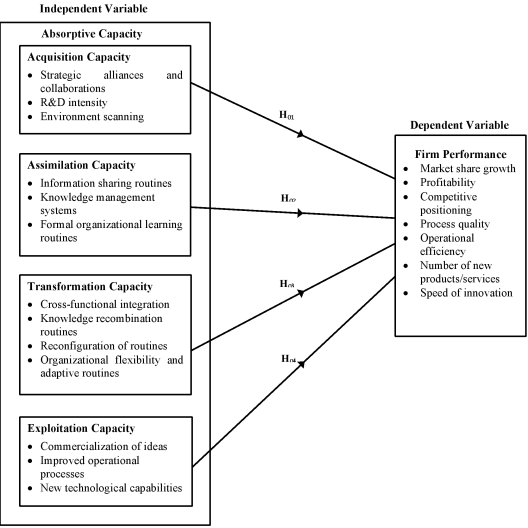
Conceptual models visually represent a system, process, or set of ideas by illustrating key variables, components, and their relationships. In this independent study, a conceptual model is proposed to depict the relationship between absorptive capacity and firm performance. This relationship is illustrated in Figure 1.
The proposed conceptual model illustrates the relationship between absorptive capacity, as the independent variable, and firm performance. Absorptive capacity is conceptualized as a four-dimensional construct comprising acquisition, assimilation, transformation, and exploitation, which together operate as a sequential and interdependent capability process. The model further demonstrates that absorptive capacity influences firm performance through a causal pathway that links internal knowledge processes to multidimensional performance outcomes. Key outputs of absorptive capacity, including innovation, improved operational processes, and enhanced technological capabilities, serve as mechanisms through which firms achieve superior performance.
The model also highlights the role of organizational enablers and routines such as knowledge management systems, information-sharing routines, formal organizational learning processes, and cross-functional integration mechanisms as foundational elements that support the development and effectiveness of absorptive capacity. These mechanisms ensure that knowledge flows are institutionalized and that learning is embedded within organizational structures and practices. Firm performance is operationalized as market share growth, profitability, competitive positioning, process quality, operational efficiency, the number of new products or services, and speed of innovation. These indicators capture outcomes across the financial, customer, internal business processes, and learning and growth perspectives, consistent with the Balanced Scorecard framework. Overall, the model links internal organizational capabilities to strategic performance outcomes and positions absorptive capacity as a key mechanism through which firms achieve sustained competitive advantage and improved performance.
Figure 1. Proposed Conceptual Model.
6. Conclusion
This independent study examined the relationship between absorptive capacity and firm performance, with the primary objective of proposing a conceptual model that explains how absorptive capacity influences firm performance outcomes. Through a review of relevant theoretical and empirical literature, the study analyzed the dimensions of absorptive capacity and their potential effects on firm performance. The analysis was guided by Organizational Learning Theory and the Balanced Scorecard framework, which collectively provided a foundation for understanding knowledge processes and performance measurement.
The study proposes a conceptual model that illustrates the relationship between absorptive capacity as the independent variable and firm performance as the dependent variable. This review advances the absorptive capacity literature in four important ways. First, it synthesizes fragmented empirical findings by differentiating the performance effects of potential absorptive capacity and realized absorptive capacity dimensions. Second, it integrates Organizational Learning Theory and Balanced Scorecard Theory to explain how knowledge processes translate into multidimensional firm performance outcomes. Third, the study proposes a sequential capability-performance framework linking acquisition, assimilation, transformation, and exploitation capabilities to operational and strategic performance outcomes. Finally, the review highlights the central role of knowledge utilization mechanisms in converting external knowledge into sustained competitive advantage across dynamic organizational environments.
The findings suggest that managers should shift focus from knowledge acquisition alone toward strengthening organizational mechanisms that facilitate knowledge transformation and exploitation. Investments in cross-functional coordination, digital knowledge systems, employee learning routines, and innovation-oriented cultures are critical for converting external knowledge into measurable performance outcomes. Firms operating in technologically dynamic environments should particularly emphasize realized absorptive capacity capabilities to improve adaptability and strategic responsiveness.
Despite its contributions, this study has several limitations. First, the review relies primarily on secondary literature and conceptual synthesis rather than empirical investigation, limiting direct causal verification of the proposed relationships. Second, the analysis focused on peer-reviewed English-language publications, which may have excluded relevant evidence from non-English and practitioner-oriented sources. Third, variations in measurement approaches, industry contexts, and methodological designs across reviewed studies may affect the comparability of findings. Finally, the proposed conceptual framework has not yet been empirically validated. Future research should therefore test the framework across industries, institutional environments, and longitudinal settings to establish the robustness and generalizability of the identified relationships.
Abbreviations

ACAP

Absorptive Capacity

KBV

Knowledge-Based View

PACAP

Potential Absorptive Capacity

RACAP

Realized Absorptive Capacity

ROA

Return on Assets

ROE

Return on Equity

Author Contributions
Peris Phylis Wagio Warui: Conceptualization, Data curation, Funding acquisition, Methodology, Visualization, Writing – original draft
Godfrey Muigai Kinyua: Supervision, Validation
Conflicts of Interest
The authors declare no conflicts of interest.
References
[1] Adepoju, A. O., & Fabunmi, D. O. (2024). Absorptive capacity and project-driven firm performance. European Project Management Journal, 14(1), 66–86.
[2] Argyris, C. (1999). On Organizational Learning (2nded.). Blackwell Business: Oxford, United Kingdom.
[3] Barney, J. (1991). Firm resources and sustained competitive advantage. Journal of Management, 17(1), 99–120.
[4] Barney, J. B., (1991). Firm Resources and Sustained Competitive Advantage. Journal of Management, 15: 175–190.
[5] Cameron, K. S., & Whetten, D. A. (1981). Perceptions of organizational effectiveness over organizational life cycles. Administrative Science Quarterly, 26(4), 525–544.
[6] Camisón, C., & Forés, B. (2010). Knowledge Absorptive Capacity: New Insights for its Conceptualization and Measurement. Journal of Business Research, 63: 707-715.
[7] Celik, A., & Balta, S. (2019). Strategic agility as a mediator between absorptive capacity and firm performance. Journal of Business Research, 101, 684–695.
[8] Cho, S. J., Chung, C. Y., & Young, J. (2019). Study on the relationship between CSR and financial performance. Sustainability, 11(2), Article 343.
[9] Cohen, W. M. & Levinthal, D. A. (1989). Innovation and Learning: The Two Faces of Research and Development. Economic Journal, 99(397): 569-596.
[10] Cohen, W. M. & Levinthal, D. A. (1990). Absorptive Capacity: A New Perspective on Learning and Innovation. Administrative Science Quarterly, 35(1): 128- 152.
[11] Cyert, R. M., & March, J. G. (1963). A behavioral theory of the firm. Prentice-Hall.
[12] Dyer, J. H., & Singh, H. (1998). The relational view: Cooperative strategy and sources of interorganizational competitive advantage. Academy of Management Review, 23(4), 660–679.
[13] Eisenhardt, K. M., & Martin, J. A. (2000). Dynamic capabilities: What are they? Strategic Management Journal, 21(10–11), 1105–1121.
[14] Elkin, G., Pérez, A., & Jaramillo, H. (2018). Realized absorptive capacity and innovation in manufacturing SMEs in Colombia and Brazil. Journal of Technology Management & Innovation, 13(3), 68–79.
[15] Espino-Rodríguez, T. F., & Taha, M. G. (2023). Absorptive capacity and supply chain integration and their impact on hotel service performance. Administrative Sciences, 13(12), Article 247.
[16] Fiol, C. M., & Lyles, M. A. (1985). Organizational learning. Academy of Management Review, 10(4), 803–813.
[17] Flatten, T. C.; Engelen, A.; Zahra, S. A. And Brettel, M. (2011). A Measure of Absorptive Capacity: Scale Development and Validation. European Management Journal, 29(2): 98-116.
[18] George, G., Zahra, S. A., & Wood, D. R. (2002). The effects of business–university alliances on innovative output and financial performance. Journal of Business Venturing, 17(6), 577–609.
[19] Grant, R. M. (1996). Toward a knowledge‐based theory of the firm. Strategic Management Journal, 17(S2), 109–122.
[20] Jansen, J. J. P., Van den Bosch, F. A. J., & Volberda, H. W. (2005). Managing potential and realized absorptive capacity. Academy of Management Journal, 48(6), 999–1015.
[21] Kaplan, R. S. & Norton, D. P. (1992). The Balanced Scorecard: Measures that Drive Performance, Harvard Business Review, 71-79.
[22] Kaplan, R. S. & Norton, D. P. (1996a). The Balanced Scorecard: Translating Strategy into Action. Harvard Business School Publishing: Boston, United State of America.
[23] Kaplan, R. S., & Norton, D. P. (2003). Strategy maps: Converting intangible assets into tangible outcomes. Harvard Business School Press, Boston, MA, United State of America.
[24] Kaplan, R. S. & Norton, D. P. (2004). Strategy Maps: Converting Intangible Assets into Tangible Outcomes. Harvard Business Press, Boston, MA, United State of America.
[25] Kaplan, R. S. & Norton, D. P. (2007). Using the Balanced Scorecard as a Strategic Management System. Harvard Business Review, July-August: 150–161.
[26] Kela-Kahingo, C. M., Kinyua, G. M. & Muchemi, A. (2024). Strategic Flexibility as a Predictor of Organisation Performance in Commercial Banks in Kenya: The Mediating Role of Organisational Competences. International Journal of Education and Research, 12(10). 153-174.
[27] Kim, K., Seo, E.-H., & Kim, C. Y. (2025). The relationships between environmental dynamism, absorptive capacity, organizational ambidexterity, and innovation performance from the dynamic capabilities perspective. Sustainability, 17(2), Article 449.
[28] Kinyua G. M. (2015). Relationship between Knowledge Management and Performance of Commercial Banks in Kenya. Doctoral Thesis, Kenyatta University; Nairobi, Kenya.
[29] Kinyua, J. K., Muchemi, A., & Kiiru, D. (2021). Antecedents of organization performance: Leveraging assimilation capacity in the context of insurance companies in Nairobi City County, Kenya. Journal of Business and Economic Development, 6(4), 202–211.
[30] Kogut, B., & Zander, U. (1992). Knowledge of the firm, combinative capabilities, and the replication of technology. Organization Science, 3(3), 383–397.
[31] Kotane, I., & Kuzmina-Merlino, I. (2015). Assessment of financial indicators for evaluation of business performance. European Integration Studies, 9, 216–224.
[32] Lane, P. J., & Lubatkin, M. (1998). Relative absorptive capacity and interorganizational learning. Strategic Management Journal, 19(5), 461–477.
[33] Lane, P. J., Koka, B. R., & Pathak, S. (2006). The reification of absorptive capacity: A critical review and rejuvenation of the construct. Academy of Management Review, 31(4), 833–863.
[34] Levitt, B. & March, J. G. (1988). Organizational Learning. Annual Review of Sociology, 14: 319–340.
[35] March, J. G. (1991). Exploration and exploitation in organizational learning. Organization Science, 2(1), 71–87.
[36] Mogaka, D. M., Kinyua, G. M. & Kimencu, L. (2025). The Nexus between Inter-Firm Networks and Firm Performance: Context-Specific Empirical Evidence of the Interceding Role of Competitive Advantage. The International Journal of Humanities & Social Studies, 13(7): 57 – 73.
[37] Muloko, K. T. & Kinyua G. M. (2026). Understanding the Nexus between Information Technology and Firm Performance: Insights from Food Processing Firms. The International Journal of Business & Management, 14(1): 66-75.
[38] Muthoni, C. M. & Kinyua, G. (2026). The Nexus Between Communication Competence and Firm Performance: Insights from Commercial Banks in the Kenya Context. International Journal of Economics, Commerce and Management, 14(2): 31-56.
[39] Nelson, R. R., & Winter, S. G. (1982). An evolutionary theory of economic change. Harvard University Press.
[40] Njoroge, J. G., Muathe, S. M., & Bula, H. (2015). Human capital resource and performance of mobile phone companies in Kenya. International Journal of Education and Research, 3(10), 409–420.
[41] Noblet, J. P., Simon, E. & Parent, R. (2011). Absorptive Capacity: A Proposed Operationalization. Knowledge Management Research & Practice, 9(4): 367- 377.
[42] Nonaka, I., & Takeuchi, H. (1995). The knowledge-creating company. Oxford University Press.
[43] Novak, A. (2017). Measuring value creation and firm performance beyond financial indicators. Studies in Business and Economics, 12(1), 79–84.
[44] O’Connor, G. C., Ravichandran, T., & Robeson, D. (2008). Risk management through learning: Management practices for radical innovation success. The Journal of High Technology Management Research, 19(1), 70–82.
[45] Obonyo, M. O., Kinyua, G. M. & Muchemi, A. W. (2026). Harnessing Knowledge Management Infrastructure Capability for Valuable Organizational Results: The Moderating Role of Regulatory Framework. Journal of Business and Economic Development, 11(1): 16-30.
[46] Oketch, J. O., Kilika, J. M. & Kinyua, G. M. (2021). TMT Characteristics and Organizational Performance in a Regulatory Setting in Kenya. Journal of Economics and Business, 4(1): 79-92.
[47] Ontita, J. & Kinyua, G. M. (2020). Role of Stakeholder Management on Firm Performance: An Empirical Analysis of Commercial Banks in Nairobi City County, Kenya. Journal of Business and Economic Development, 5(1): 26-35.
[48] Peng, C. W., & Yang, M. L. (2014). The Effect of Corporate Social Performance on Financial Performance: The Moderating Effect of Ownership Concentration. Journal of Business Ethics, 123: 171–182.
[49] Perdomo-Charry, G., Lozada-Barahona, E., & Zúñiga-Collazos, A. (2017). Exploitation capacity and firm performance: Evidence from Colombian firms. Espacios, 38(52), 24–35.
[50] Randeree, K., & Al Youha, H. A. (2009). Strategic management of performance: An examination of public sector organizations in the United Arab Emirates. International Journal of Knowledge, Culture and Change Management, 9(4), 123–134.
[51] Richard, P. J., Devinney, T. M., Yip, G. S., & Johnson, G. (2009). Measuring organizational performance: Towards methodological best practice. Journal of Management, 35(3), 718–804.
[52] Shadrack, M. & Kinyua, G. (2025). Leveraging Strategic Leadership for Enhanced Performance: Empirical Evidence from Technical and Vocational Education and Training Institutions in Nairobi City County, Kenya. International Academic Journal of Human Resource and Business Administration, 5(1): 346-367.
[53] Steers, R. M. (1975). Problems in the measurement of organizational effectiveness. Administrative Science Quarterly, 20(4), 546–558.
[54] Teece, D. J., Pisano, G., & Shuen, A. (1997). Dynamic Capabilities and Strategic Management. Strategic Management Journal, 18(7): 509-53.
[55] Teece, D. J. (2007). Explicating Dynamic Capabilities: The Nature and Micro- Foundations of (Sustainable) Enterprise Performance. Strategic Management Journal, 28(13): 1319-1350.
[56] Teece, D. J. (2012). Dynamic Capabilities: Routines versus Entrepreneurial Action. Journal of Management Studies, 49(8): 1395-1401.
[57] Todorova, G., & Durisin, B. (2007). Absorptive capacity: Valuing a reconceptualization. Academy of Management Review, 32(3), 774–786.
[58] Tsai, W. (2001). Knowledge Transfer in Intraorganizational Networks: Effects of Network Position and Absorptive Capacity on Business Unit Innovation and Performance. Academic Management Journal, 44: 996–1004.
[59] Tushman, M. L., & O’Reilly, C. A. (1996). Ambidextrous organizations: Managing evolutionary and revolutionary change. California Management Review, 38(4), 8–30.
[60] Van den Bosch, F. A. J., Volberda, H. W., & de Boer, M. (1999). Coevolution of firm absorptive capacity and knowledge environment: Organizational forms and combinative capabilities. Organization Science, 10(5), 551–568.
[61] Venkatraman, N., & Ramanujam, V. (1986). Measurement of business performance in strategy research: A comparison of approaches. Academy of Management Review, 11(4), 801–814.
[62] Volberda, H. W., Foss, N. J. & Lyles, M. A. (2009). Absorbing the Concept of Absorptive Capacity: How to Realize its Potential in the Organization Field. Organization Science, 21(4): 931-951.
[63] Volberda, H. W., Foss, N. J., & Lyles, M. A. (2010). Absorbing the concept of absorptive capacity. Academy of Management Perspectives, 24(4), 31–50.
[64] Zahra, S. A., & George, G. (2002). Absorptive capacity: Review and reconceptualization. Academy of Management Review, 27(2), 185–203.
Cite This Article
  • APA Style

    Warui, P. P. W., Kinyua, G. M. (2026). Revisiting the Absorptive Capacity–Firm Performance Nexus: An Integrative Review and Future Research Direction. European Business & Management, 12(3), 38-49. https://doi.org/10.11648/j.ebm.20261203.11

    Copy | Download

    ACS Style

    Warui, P. P. W.; Kinyua, G. M. Revisiting the Absorptive Capacity–Firm Performance Nexus: An Integrative Review and Future Research Direction. Eur. Bus. Manag. 2026, 12(3), 38-49. doi: 10.11648/j.ebm.20261203.11

    Copy | Download

    AMA Style

    Warui PPW, Kinyua GM. Revisiting the Absorptive Capacity–Firm Performance Nexus: An Integrative Review and Future Research Direction. Eur Bus Manag. 2026;12(3):38-49. doi: 10.11648/j.ebm.20261203.11

    Copy | Download

  • @article{10.11648/j.ebm.20261203.11,
      author = {Peris Phylis Wagio Warui and Godfrey Muigai Kinyua},
      title = {Revisiting the Absorptive Capacity–Firm Performance Nexus: An Integrative Review and Future Research Direction},
      journal = {European Business & Management},
      volume = {12},
      number = {3},
      pages = {38-49},
      doi = {10.11648/j.ebm.20261203.11},
      url = {https://doi.org/10.11648/j.ebm.20261203.11},
      eprint = {https://article.sciencepublishinggroup.com/pdf/10.11648.j.ebm.20261203.11},
      abstract = {Organizations increasingly operate within digitally interconnected, knowledge-intensive ecosystems characterized by technological disruption, institutional volatility, and intense competition. In such environments, sustainable firm performance depends less on the ownership of static resources and more on the ability to acquire, assimilate, transform, and exploit knowledge in real time. Absorptive capacity has therefore emerged as a critical dynamic capability enabling firms to identify valuable external knowledge, internalize it through organizational learning processes, and strategically deploy it to enhance competitiveness. Despite its prominence, empirical findings on the relationship between absorptive capacity and firm performance remain mixed and inconclusive. This study reviews existing conceptual, theoretical, and empirical literature to identify key knowledge gaps and inform future research. Specifically, it disentangles the dimensions of absorptive capacity—knowledge acquisition, assimilation, transformation, and exploitation—to examine how they individually and collectively influence firm performance. Drawing on organizational learning theory and balanced scorecard theory, the study synthesizes prior evidence to explain how firms convert external knowledge into sustained performance outcomes. The review indicates that absorptive capacity enhances performance through improved learning, innovation capability, strategic adaptation, and operational efficiency. Notably, realized absorptive capacity dimensions (transformation and exploitation) exhibit a more direct relationship with firm performance than potential absorptive capacity (acquisition and assimilation). The study proposes a conceptual model linking absorptive capacity dimensions to firm performance and outlines directions for future research. It contributes to the strategic management literature by advancing a capability–performance perspective that emphasizes knowledge utilization processes over resource possession, particularly in dynamic and turbulent environments.},
     year = {2026}
    }
    

    Copy | Download

  • TY  - JOUR
    T1  - Revisiting the Absorptive Capacity–Firm Performance Nexus: An Integrative Review and Future Research Direction
    AU  - Peris Phylis Wagio Warui
    AU  - Godfrey Muigai Kinyua
    Y1  - 2026/05/30
    PY  - 2026
    N1  - https://doi.org/10.11648/j.ebm.20261203.11
    DO  - 10.11648/j.ebm.20261203.11
    T2  - European Business & Management
    JF  - European Business & Management
    JO  - European Business & Management
    SP  - 38
    EP  - 49
    PB  - Science Publishing Group
    SN  - 2575-5811
    UR  - https://doi.org/10.11648/j.ebm.20261203.11
    AB  - Organizations increasingly operate within digitally interconnected, knowledge-intensive ecosystems characterized by technological disruption, institutional volatility, and intense competition. In such environments, sustainable firm performance depends less on the ownership of static resources and more on the ability to acquire, assimilate, transform, and exploit knowledge in real time. Absorptive capacity has therefore emerged as a critical dynamic capability enabling firms to identify valuable external knowledge, internalize it through organizational learning processes, and strategically deploy it to enhance competitiveness. Despite its prominence, empirical findings on the relationship between absorptive capacity and firm performance remain mixed and inconclusive. This study reviews existing conceptual, theoretical, and empirical literature to identify key knowledge gaps and inform future research. Specifically, it disentangles the dimensions of absorptive capacity—knowledge acquisition, assimilation, transformation, and exploitation—to examine how they individually and collectively influence firm performance. Drawing on organizational learning theory and balanced scorecard theory, the study synthesizes prior evidence to explain how firms convert external knowledge into sustained performance outcomes. The review indicates that absorptive capacity enhances performance through improved learning, innovation capability, strategic adaptation, and operational efficiency. Notably, realized absorptive capacity dimensions (transformation and exploitation) exhibit a more direct relationship with firm performance than potential absorptive capacity (acquisition and assimilation). The study proposes a conceptual model linking absorptive capacity dimensions to firm performance and outlines directions for future research. It contributes to the strategic management literature by advancing a capability–performance perspective that emphasizes knowledge utilization processes over resource possession, particularly in dynamic and turbulent environments.
    VL  - 12
    IS  - 3
    ER  - 

    Copy | Download

Author Information