Abstract
As the digital transformation of higher education accelerates, improving the digital level of traditional courses and the application capabilities of digital technology of teachers and students have become the core content of the current teaching and curriculum reform. The tourism management major is one of the most distinctive majors among management majors. Since its development in the 1980s, it has cultivated a large number of talents for the development of China's tourism industry. With the intelligent upgrade of the cultural tourism industry in recent years, common problems in the teaching of professional tourism management courses, such as the disconnect between theory and practice, rigid teaching models, and the lag in case updates, have become increasingly obvious. This issue fails to satisfy the talent demands of modern cultural tourism industry development. In this context, this paper adopts constructivist learning theory and the technology acceptance model to explore the integration path of AI technology from two dimensions: the major level and the curriculum level. Taking Tourism Economics, a core course for the tourism management major as an example, it puts forward concrete practical pathways. According to the research findings, the deep integration of AI technology can effectively address the core dilemma in traditional course teaching and bridge the gap between theory and industrial practice. Meanwhile, the two-dimensional system at the major and curriculum levels can facilitate the shift of teaching objectives from knowledge transmission to competency development. The findings offer practical pathways for AI-integrated courses, not only for the tourism management major, but also for other related majors.
|
Published in
|
Higher Education Research (Volume 11, Issue 6)
|
|
DOI
|
10.11648/j.her.20261106.11
|
|
Page(s)
|
227-236 |
|
Creative Commons
|

This is an Open Access article, distributed under the terms of the Creative Commons Attribution 4.0 International License (http://creativecommons.org/licenses/by/4.0/), which permits unrestricted use, distribution and reproduction in any medium or format, provided the original work is properly cited.
|
|
Copyright
|
Copyright © The Author(s), 2026. Published by Science Publishing Group
|
Keywords
Two-dimensional Framework, AI Integration, Tourism Management Curricula Reform
1. Introduction
With the development of modern artificial intelligence technology and higher education digital transformation, course teaching approaches have been reconstructed by generative AI and big data technologies. Course teaching has upgraded its orientation from one-dimensional knowledge transmission to the development of composite abilities. The integration of AI into the tourism management major is a necessary path for the digital transformation of talent cultivation. AI has inherent advantages such as task generation, scene simulation, and personalized feedback, and will play a significant role in promoting the transformation of the tourism management major.
From the perspective of cultural-tourism industry development, digital transformation is continuing to accelerate. New business formats such as smart tourism and digital cultural tourism are constantly emerging, and the talent demand in the cultural tourism industry has begun to shift from theoretical memorization to digital thinking and real problem solving capabilities. The development of the cultural-tourism industry demands reform on the supply-side of talent cultivation for tourism management major. The teaching content system and teaching organization approaches need to be updated in a timely manner to adapt to digital scenario of the cultural-tourism industry.
The core courses of the tourism management major mainly consist of theoretical courses and suffer from over-abstract theoretical content, outdated cases, insufficient practical scenarios, and lack of personalized guidance.
Tourism Economics, a core theoretical course for the major, involves numerous economic models and formula derivations
. The disconnection between learning and application is particularly prominent under the traditional teaching model. To advance the shift of course teaching from teacher-centered instruction to student-centered, ability-oriented practice. AI should be integrated into teaching to stimulate students' enthusiasm and boost the development of their professional ability
.
Compared with other management majors, the tourism management major is more practical and industry-oriented. However, there are currently few studies on its integration with AI from a holistic major-wide perspective. Most of the existing findings focus on individual courses, lacking systematic analysis and practical implications. Therefore, based on existing research, it is necessary to analyze pathways for the effective integration of AI technology into tourism management major teaching from both the major and curriculum perspectives, so as to improve students’ learning outcomes and foster their comprehensive competencies.
With the popularization and application of information technology, the digital level of education and teaching has gradually improved. How to promote the digital transformation of higher education and accelerate the in-depth integration of digital technology and education and teaching has become the core strategic direction of higher education teaching and curriculum reform. In recent years, with the iterative adoption of generative AI and big data technologies, the teaching environment of higher education is undergoing profound changes. Traditional course teaching approaches have been systematically reconstructed, and both sides of teaching are facing unprecedented challenges. Against this background, an in-depth exploration of the integration pathways between AI technology and tourism management major teaching is of great practical significance for addressing current teaching difficulties, remedying the drawbacks of traditional teaching, and improving the quality of talent cultivation.
In China, the tourism management major is an applied specialty within the management category and features strong industry connectivity. This major originated in the 1980s and forms a discipline system that has gradually developed and improved alongside the growth of China's tourism industry. With the development of China's tourism industry, the tourism management major has cultivated a large number of professional talents to support industrial development. As the digital transformation of the tourism industry accelerates, the industry’s talent demand has shifted, and requirements for students' digital literacy, real-world problem-solving ability, and practical application ability are getting higher and higher. In contrast, the teaching of tourism-management major still follows this traditional teaching model. There are obvious problems such as the disconnect between theory and practice, rigid teaching models, and lagging case updates. It struggles to meet the demands of the modern cultural-tourism industry for compound and digitally competent talents. Especially in core theoretical courses such as
Tourism Economics, abstract economic models and formula derivation often created difficulties in students' comprehension. The "cramming" teaching under the traditional teaching model fail to stimulate students' learning initiative and cannot effectively foster their ability to solve complex real-world problems. Therefore, in the teaching of tourism management major, there is an urgent need to adopt artificial intelligence technology to reconstruct the teaching process, realize the visual presentation of theoretical knowledge and the real-time introduction of dynamic cases via intelligent tools, strengthen the linkage between teaching and industry, and achieve an accurate match between teaching content and industry needs
.
At present, many studies have taken the integration of AI technology and professional teaching as the main research object. However, there are few findings on the integration of AI technology and the tourism-management major from a holistic major-wide perspective. Most of the existing findings focus on individual courses, lacking systematic analysis and practical implications. Therefore, based on existing research, this study analyzes the pathways for effectively integrating AI technology into the teaching of the tourism management major from both the major and curriculum perspectives, and develops a course-level AI integration plan by constructing a systematic AI integration framework at the major level.
This study aims to bridge this gap by proposing a systematic framework for AI integration in tourism management education, addressing both macro-level curriculum design and micro-level instructional strategies to provide a comprehensive roadmap for educators and institutions. Specifically, this research will identify key AI competencies required for tourism professionals, map these competencies to existing curriculum structures, and develop pedagogical approaches that leverage AI tools to enhance student engagement and learning outcomes in tourism management. Under this framework, this study will first illustrate the theoretical framework and then analyze the characteristics and dilemmas of teaching in the tourism management major. The AI-integrated pathways will be further explored, and conclusions and discussions will be presented in the final section.
2. Research Framework and Theoretical Foundation
This study builds a theoretical framework for integrating AI into tourism management major based on constructivist learning theory and the technology acceptance model (TAM).
2.1. Constructivist Learning Theory
The construct of constructivist learning theory was first articulated by Piaget
| [5] | Piaget, J. (1970). Genetic Epistemology. Columbia University Press. |
[5]
and Vygotsky
| [6] | Vygotsky, L. S. (1978). Mind in Society: The Development of Higher Psychological Processes. Harvard University Press. |
[6]
. The core points of this research are that knowledge is the result of active construction through the three major mechanisms of assimilation, accommodation, and equilibrium in the interaction between individuals and the environment; the theory also emphasizes that knowledge construction has social and cultural attributes, and social interaction and collaborative dialogue are the core driving forces of cognitive development. In research on applying constructivism to teaching, this theory holds that knowledge is not transmitted by teachers, but acquired through meaning construction by learners within a given context, that is, a social and cultural background, with assistance from others (including teachers and learning peers) and necessary learning materials. Grounded in constructivist learning theory, other research illustrates the inherent logic of alignment between AI technology and constructivist teaching philosophy. It points out that the application of AI tools can propel constructivist education to a higher level of development in three dimensions, which are deeper engagement, self-awareness, and conceptual clarity
| [7] | Grubaugh, S., Levitt, G., & Deever, D. (2023). Harnessing AI to power constructivist learning: An evolution in educational methodologies. Journal of Effective Teaching Methods, 1(3), 81–83. https://doi.org/10.59652/jetm.v1i3.43 |
[7].
In studies integrating AI technology with constructivism, three major characteristics of constructivism -- active construction, situational learning, and personalized development -- are highly consistent with generative AI’s capabilities of adaptive interaction, dynamic scene generation, and personalized feedback. Therefore, AI can be used as a cognitive tool to deepen inquiry-based learning and promote the development of metacognition, while maintaining a humanistic value orientation
| [8] | Lee, H., Atif, A., & Kang, K. (2026). Analysing AI utilisation in education through learner question types: A constructivist approach. Australasian Journal of Educational Technology, 42(1), 79-96. https://doi.org/10.14742/ajet.10657 |
[8]
. Other studies illustrate how AI empower teaching by adapting to individual meaning construction, supporting conversational knowledge co-construction, and lowering the threshold for practical teaching. The authors also pointed out that the core value of integrating AI into teaching is to lower the threshold for higher-order thinking, rather than to replace teacher guidance
| [9] | Lin, Z., Dai, Y., Ng, O. L. (2025). Constructionism in K-12 AI Literacy Education: A Systematic Review of Pedagogical Designs, Student Outcomes, and Learning Mechanisms. Journal of Educational Computing Research. 63(8), 1567-1598. https://doi.org/10.1177/07356331251360442 |
| [10] | Ramaila, P. (2026). Reframing Constructivist Pedagogy through Artificial Intelligence: A Framework for Vocational Education Contexts. International Journal of Learning, Teaching and Educational Research. 25(2), 412-438.
https://doi.org/10.26803/ijlter.25.3.18 |
| [11] | Dela Cruz, J. V. (2026). Bridging AI-Assisted Learning and Conceptual Mastery with the ASTRA Model. Journal of Research in Science, Mathematics and Technology Education. 9(2), 69-104. https://doi.org/10.31756/jrsmte.924 |
[9-11]
.
2.2. Technology Acceptance Model
The Technology Acceptance Model (TAM) was proposed by Davis, which is mainly used to explain and predict users' acceptance behavior of information technology
| [12] | Davis, F. D. (1989). Perceived usefulness, perceived ease of use, and user acceptance of information technology. MIS Quarterly, 13(3), 319–340.
https://doi.org/10.2307/249008 |
[12]
. Its core variables include perceived usefulness and perceived ease of use. In recent years, relative research has applied and extended TAM in the context of AI in education. One strand of research expands the TAM framework by incorporating learning motivation and agility to examine the educational adoption of generative AI and verifies that perceived usefulness and perceived ease of use exert significant positive effects on students’ intention to use such AI tools
| [13] | Şimşek, A. S., Cengiz, G. Ş. T., & Bal, M. (2025). Extending the TAM framework: Exploring learning motivation and agility in educational adoption of generative AI. Education and Information Technologies, 30(15), 20913-20942.
https://doi.org/10.1007/s10639-025-13591-9 |
[13]
. Another research applies TAM framework to examine teachers’ trust, technology acceptance and cognitive load, which revealed that AI explanations exert notable influences on teachers’ trust and technology acceptance while imposing cognitive load
| [14] | Wang, D., Bian, C., & Chen, G. (2024). Using explainable AI to unravel classroom dialogue analysis: Effects of explanations on teachers' trust, technology acceptance and cognitive load. British Journal of Educational Technology, 55(6), 2530-2556.
https://doi.org/10.1111/bjet.13466 |
[14]
. A third research integrates information quality into the TAM framework and pointed out that content quality could improve the acceptance of AI teaching by acting on perceived usefulness and perceived ease of use
| [15] | Sitompul, R. P. (2026). Determinants of students’ decision to adopt generative AI in higher education: An extended technology acceptance model with information quality. Decision Sciences in Human Learning and Development, 1(1), 117–134.
https://doi.org/10.64268/decision.v1i1.8 |
[15]
.
Constructivism emphasizes that learners construct knowledge actively through interaction in real situations, providing an epistemological foundation for AI-assisted contextualized teaching. TAM is used to explain teachers’ and students' willingness to use AI tools and their influencing factors, and to reveal the psychological mechanism of technology integration. The two jointly support the logic of educational reform from technological empowerment to capacity reshaping. On this basis, this study builds a two-dimensional integrated model including "major-level AI integration" and "course-level AI integration" based on these two theories. This model aims to clarify the role of AI technology in tourism management education, that is, to transform from an auxiliary tool to a cognitive partner, thereby reconstructing the relationship between teaching and learning. The dual-dimensional framework proposed in this study can fill two research gaps. First, in the past, most of the AI teaching research in the field of tourism management focused on the instrumental application of one course and rarely made systematic design from the perspective of the major. Problems commonly arise, such as disconnection between courses and lack of graded progression in AI ability cultivation. Second, TAM application in the field of educational AI mostly stayed at the level of empirical testing of individual acceptance in the past, and this set of logic was rarely used to guide system construction at the major level. There is a disconnect between theoretical research and practical countermeasures.
The specific connotations of this two-dimensional integration model are as follows: First, major-level AI integration covers data awareness, algorithmic thinking, and human-machine collaboration ethics, aiming to cultivate students' core competencies in an intelligent environment; second, course-level AI integration includes AI-based case simulations, personalized learning recommendations and virtual training scene construction to achieve the transformation from knowledge transfer to ability generation. This model not only provides a theoretical lens for subsequent analysis of the teaching dilemma of tourism-management major, but also lays a logical foundation for exploring AI-empowered teaching reform pathways.
3. Characteristics of Tourism-Management Major Courses and Difficulties Encountered
3.1. Characteristics of Tourism-Management Major Courses
As an early-developed and outward-oriented industry in China, tourism has long served as a showcase and windows for local development within tourist destinations. Given the open features of the tourism industry, the curriculum of tourism-management major is correspondingly comprehensive and practice-oriented. Based on the attributes of tourism and tourism-management major courses, the following problems currently exist in the integration of AI into the tourism management major courses:
3.1.1. Multi-Disciplinary Characteristics
Most courses in tourism management are cross-cutting courses, such as tourism economics, tourism psychology, tourism regulations, etc. One course often involves the core content of two or more management courses.
3.1.2. A Large Proportion of Practice-Oriented Courses
Practice-oriented courses account for a large proportion of the tourism management major curriculum. Such courses guide students to comprehensively apply acquired knowledge, integrate theory with practice, and foster students' ability to apply knowledge to analyze and solve problems. When taking practical and internship courses, students often struggle to bridge the gap between expectations and reality, and neglect the reflection and organization of professional knowledge during internships.
3.1.3. Course Ability Assessment and Evaluation
The goal of the tourism management major course is to improve students' professional quality. To achieve this goal, a step-by-step process is required, and the effect cannot be reflected in one course or a fixed period of time. Therefore, when assessing major courses, the effectiveness of the courses cannot be assessed quantitatively or deterministically. For tourism-management major courses, they involve a wider range of knowledge, and practice and internship courses account for a larger proportion, which also increases the difficulty of assessing the effectiveness of the courses.
3.2. Difficulties Encountered by Tourism Management Major Courses
3.2.1. Structural Mismatch Between Talent Supply and Industry Demand
Judging from the current development needs of the cultural-tourism industry, the development of digital intelligence is accelerating, and increasingly more new business formats are emerging, which puts forward higher requirements for the digital intelligence literacy of talents. However, the current talent cultivation programs for tourism management major still focus on traditional service skills and management theories, resulting in graduates having obvious shortcomings in digital thinking, data analysis, and AI tool application, making it difficult to meet the needs of the cultural-tourism industry. This mismatch between supply and demand manifests not only in the outdated knowledge structure, but also in students' inadequate ability to solve complex real-world problems.
3.2.2. AI Integration Exhibits Fragmented and Superficial Features
At present, the application of artificial intelligence technology in tourism management professional teaching is still in the exploratory stage, and there are still deficiencies in systematic top-level design and unified standards. The pathways and resources for AI integration are mostly voluntary attempts by individual teachers, and there is a lack of shared resources. Compared with early technology integration, such as online open courses, there are obvious deficiencies in standardization and depth of integration. In addition, AI integration mostly stays in superficial auxiliary links such as data retrieval and copywriting generation, and is insufficiently applied in teaching design, teaching tasks, and process evaluation, making it difficult to achieve deep integration of technology and major content.
3.2.3. The Teaching Model is Mismatched with the Ability Cultivation Orientation
The traditional teaching model of tourism management major remains teacher-centered, with teaching dominated by knowledge infusion and standardized skill training. It fails to adequately foster the critical thinking, innovative decision-making, and complex problem-solving abilities required in the digital intelligence era. The specific manifestations of this misalignment are: classroom teaching focuses on theoretical indoctrination, and students lack opportunities to apply AI tools to solve problems in real-world complex situations; the teaching effectiveness evaluation method is single, and it cannot fully reflect students' digital literacy and innovation potential.
3.2.4. Insufficient Support Capabilities of the Teaching Support System
At present, most teachers in tourism management major have traditional management and economics backgrounds. They lack sufficient mastery of digital intelligence technology and practical experience in AI application, making it difficult to effectively integrate AI into practice in teaching. Obvious shortcomings also exist in the supporting system, including hardware facilities and software platforms, which hinder the deep integration of AI technology and professional teaching. For example, although most colleges and universities have deployed teaching and training platforms, these platforms are poorly integrated with smart and AI-assisted technologies and thus fail to meet the demands of immersive and interactive teaching.
From the perspective of the essence of AI technology and the goals of digital education, these problems in the teaching of tourism management major mainly stem from the lack of connection with the needs of the industry from the major to the curriculum level, and the lack of systematic and systematic support for AI technology. The lack of support makes it difficult for AI technology to rise from the tool level to the educational paradigm level, which in turn restricts the overall improvement of talent cultivation. To enhance the effectiveness of AI applications, it is necessary to systematically reconstruct and optimize from the top-level design to the scene carrier of the course.
4. Construction of a Two-Dimensional Framework for AI Integration into Tourism Management Major Courses
4.1. Connotation of the Two-Dimensional Framework
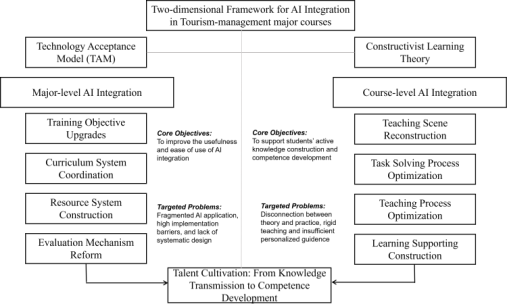
The two-dimensional framework refers to the two key elements of integrating AI technology into tourism management major: the macro top-level major design and the micro course scenario carrier. At the major level, the framework emphasizes systematic reconstruction from the dimensions of talent training positioning, training goals, and graduation requirements to ensure that AI literacy becomes the core competitiveness of professional talents; at the course level, the framework focuses on the construction of specific teaching scenarios and achieves the deep integration of AI technology and professional knowledge points through the optimization of course content, teaching methods, and evaluation systems. These two dimensions support each other and evolve together, forming a complete ecosystem of AI-empowered tourism management education. They aim to solve the current problems of fragmented and superficial technology applications and promote the transformation of the education paradigm from "tool-assisted" to "intelligent symbiosis".
Figure 1. Diagram of the two-dimensional framework for AI integration in tourism management education.
4.2. Construction of the AI Integration System
The effective implementation of AI integration not only includes course education in classroom teaching, but also involves professional training objectives, course structure system, course evaluation system and other aspects.
4.2.1. Construction of an AI Integration System at the Major Level of Tourism Management
The application of AI technology is not only reflected in the curriculum requirements at the single course level, but also as an intrinsic requirement for the training of professional talents. The integration of AI technology from the major level of tourism management is mainly carried out from the perspectives of talent training positioning, professional training goals, and professional graduation requirements, as shown in
Table 1 below.
Table 1. Integration Path of AI into Tourism Management Professional Courses.
| Main Tasks | Integration of AI technology |
Talent training position--ing | Application-oriented professionals with international vision, management capabilities, service awareness and innovative spirit | Digital thinking and digital literacy, AI tool application capabilities, intelligent innovation awareness, digital intelligence, international perspective |
Professional training goals | Able to engage in tourism-related operations, management, planning, consulting, training, education, etc. | Cultural tourism intelligent operation capabilities, AI-assisted planning capabilities, data-driven business analysis capabilities, and intelligent service scenario design capabilities |
Major graduation requirements | Quality requirements, knowledge requirements, professional abilities, innovation and entrepreneurship abilities | AI basic knowledge reserve, digital intelligence professional practical ability, data-driven analysis ability, AI-empowered innovation and entrepreneurship ability |
4.2.2. Construction of an AI Integration System at the Tourism Management Major Course Level
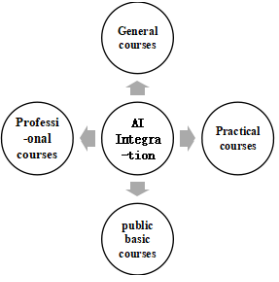
The subject setting at the major level centers on the core question of who to train, while curriculum design mainly addresses how to cultivate talents. Therefore, AI integration at the course level mainly involves course plan design, and its integration method is different from AI integration design at the major level. In the construction of the curriculum system, the categories and characteristics of college courses should be fully considered, with AI integration as the center, and public basic courses, general courses, professional courses, and practical courses should be organically connected in order to jointly play a role in improving the mathematical literacy of professional students. This system is illustrated in
Figure 2.
Figure 2. AI integration course system diagram.
4.2.3. Effect Evaluation System for AI Integration
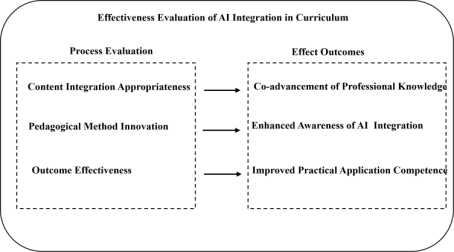
The evaluation of AI integration course effects is different from the assessment of basic or professional courses, and has different characteristics in teaching evaluation and learning effect evaluation. Combined with the characteristics of AI technology, the effect of AI integration can be evaluated from two aspects: teaching and learning. See
Figure 2 for details.
Figure 3. AI integration course system diagram.
The combination of AI technology and professional education requires a process, and its effect is affected by both teachers and students. At the same time, it is difficult to obtain accurate evaluation in a short time. Combined with the integration characteristics of AI technology, the evaluation elements can be divided into two parts: process evaluation and learning effect evaluation.
Process evaluation
The process evaluation is mainly carried out from three aspects: content integration, method innovation, and result effectiveness. Through the organic integration of content, the integration value of AI is highlighted. In the process of content integration, targeted innovative methods are also needed. For example, some knowledge points can be integrated through theory, text explanation, etc., while some knowledge points can be integrated through cases, videos, or student lectures. The integration of various methods can make the combination of AI technology more natural and the effect more obvious. In the assessment of AI integration results, due to its formal characteristics, it is suitable to use indirect assessment, including after-school assignments, case analysis, material analysis and other assessment methods. While assessing professional knowledge, it can not only reflect the connection between the knowledge learned and technology, but also effectively improve students' ability to apply what they have learned.
Effect output evaluation
The application of AI technology has a multi-faceted impact on students, and the evaluation can be carried out from three aspects. First of all, the effect of AI technology integration should be reflected in the dual progress of professional knowledge and capabilities assisted by AI technology. Secondly, effective AI integration should enable students to form a consensus on the correct application of AI, and be able to better think about professional knowledge through the integration of AI technology, and at the same time think in conjunction with corresponding scenarios. This positive integration attitude and effect is another manifestation of the direct effect of the integration of AI technology. Finally, the evaluation of the effects of AI technology integration should be carried out from the perspective of improving students' ability to apply what they have learned, and the learning effects should be evaluated through students' performance in solving professional case problems or professional practice.
5. Implementation Strategies for AI Integration into the Tourism Management Major
The construction of a two-dimensional system for AI integration into the tourism-management major relies on teaching and curriculum practice. The priority is to realize the linkage of the following four aspects:
5.1. Linkage Between Major Construction and Curriculum Practice
At the professional construction level, the cultivation of students' mathematical intelligence literacy is highlighted. Although technical literacy is reflected in the training objectives and training positioning of professional talents, it is generally stated in a scattered form. For example, the talent training goal emphasizes comprehensive and all-round development, but there is no effective connection with this goal in terms of curriculum positioning, graduation requirements, etc. Therefore, in the overall education design of tourism management major, the model of overall design-curriculum implementation-overall evaluation should be adopted to realize the integration of AI technology. First of all, set the training goals for digital intelligence talents in terms of professional training goals, graduation requirements, etc., such as "master digital intelligence technology, have the professional quality of tourism management, love the tourism management profession, and be willing to participate in the development of the tourism industry", etc. Secondly, in the course design, there must be specific content that connects to this goal. For example, in the teaching of "Tourism Economics", it should emphasize "analyzing and solving practical problems in the development of the tourism industry through digital intelligence technology". Finally, in the student graduation assessment, the assessment of digital intelligence skill elements in graduation goals and talent training goals should be implemented through various forms, such as the application of digital intelligence tools in graduation thesis, internship positions and technical relevance, etc.
5.2. Linkage Between Major Theoretical Courses and Major Practical Courses
Students majoring in tourism management are faced with environmental factors such as related knowledge fields, industrial fields, and diverse work contents during professional courses, internships, and employment. The current research on the integration of AI technology is mainly based on theoretical courses, and there is relatively insufficient research on practical courses. Due to the strong practical nature of the tourism management major, about one-third of the courses and credits received by students come from practical courses. Therefore, in the integration of AI technology, it is necessary to combine the goals of theoretical courses with practical courses, and the teachers who teach theoretical courses should be consistent with those who teach practical courses, especially off-campus practice instructors. Practical courses in the tourism management major are generally the practical application process of theoretical courses. Therefore, when setting the ideological and political goals of theoretical courses, it is necessary to consider the direction of AI technology integration in corresponding practical courses. Courses such as Introduction to Hotel Management and Tourism Destination Management should be combined with hotel-oriented courses and professional practice, scenic spots, and destination planning. This model is supported by the guidance of theoretical courses and the integration of actual technology in practical courses to complete the integration of AI technology into educational practice in the complete course.
5.3. Linkage of Online and Offline AI Technology for Building a Full-Space and Full-Time Learning Ecosystem
The realization of the integration effect of AI technology requires students to actively participate and recognize the technology application, so multiple modes need to be integrated into the teaching form. Combined with the current development trend of online and offline mixed teaching courses, the integration of AI technology should also simultaneously achieve a multi-angle integration model of online and offline courses. Online teaching focuses on knowledge transfer and basic skill training, using a task-oriented model, and uses an AI intelligent recommendation system to provide students with personalized learning resources and instant feedback; offline teaching focuses on in-depth discussions, situation simulations, and complex problem solving, and deepens the understanding of digital ethics, industry norms, and professional responsibilities through face-to-face interaction between teachers and students. This online and offline collaboration mechanism not only breaks the limitations of time and space, but also realizes the entire management of the learning process through data flow. The student behavior data recorded by the online platform can provide accurate academic analysis for offline teaching and help teachers adjust the focus of their discussions; while the in-depth thinking and emotional experience generated offline can feed back into the online resource library, enriching the content dimensions of personalized recommendations, thus building a comprehensive, full-process digital education environment.
5.4. Linkage Between Management Processes and Teaching Processes
The realization of the goal of cultivating mathematical intelligence skills cannot only rely on teachers' daily classroom teaching, but also requires management guarantee and support from the teachers' colleges and professional departments. The goal of mathematical intelligence skills is the key to achieving the entire professional development and talent training goals. Therefore, the management process and the teaching process should form a unified and mutually reinforcing relationship. On the one hand, the professional management department should design and manage the goals of AI integration in education from the perspectives of teacher teaching management and student management, appropriately foster teachers’ capabilities in applying AI technology, and provide relevant training when necessary. Students’ relevant assessments should also actively incorporate AI technology integration goals and serve as a link to achieve effective connection and expected outcomes within the AI-integrated teaching process. On the other hand, teachers should be able to grasp the orientation of professional AI technology in teaching, integrate the overall goal into the individual goals of the course, align the course construction with the direction of professional development and construction, and jointly promote the realization of the goal of training digital intelligence talents.
6. Discussions and Conclusions
The two-dimensional AI integration framework at the major level and curriculum level proposed in this study essentially aligns technology implementation with teaching reform. Rooted in TAM, jumping out of the micro perspective of whether individual teachers accept AI and turning to the system design level of the entire profession to respond to the two core questions in the AI integration process: is it useful? and is it troublesome to use? This echoes the research which identified perceived usefulness and information quality as the strongest factors affecting AI adoption decisions
| [15] | Sitompul, R. P. (2026). Determinants of students’ decision to adopt generative AI in higher education: An extended technology acceptance model with information quality. Decision Sciences in Human Learning and Development, 1(1), 117–134.
https://doi.org/10.64268/decision.v1i1.8 |
[15]
. Therefore, it can be seen that if the core value of AI is not clarified in the training goals and graduation requirements, and the quality of AI teaching content and adaptability to scenarios are not standardized and managed, and only teachers’ spontaneous and sporadic attempts are made, it will be difficult to truly promote and apply AI in professional construction.
Research at the curriculum level is mainly based on constructivist learning theory, and the core is to adjust the positioning of AI from a simple "efficiency tool" to a "cognitive scaffold and learning carrier." There have been many previous studies that have verified the role of AI in case generation, question answering and coaching, etc. but most of them have stayed at the shallow level of saving lesson preparation time and improving learning efficiency, and have not really involved the transformation of teaching models. This study maps AI to the core links of constructivism, including situation creation, inquiry guidance, and collaborative support, and clarifies that AI is not used to replace teacher teaching, but to make up for the long-standing shortcomings of traditional teaching—such as the lack of real industrial scenarios, the lack of personalized guidance, and the difficulty of implementing inquiry-based teaching. Ultimately, students can actively complete knowledge construction in real problems instead of passively receiving abstract theories.
The conclusion of this study is: In the context of the accelerated digital transformation of the cultural tourism industry, the systematic integration of AI into courses has become an inevitable direction for the reform of tourism management majors, and the two-dimensional architecture of "professional layering system and curriculum layer implementation" is a feasible path to promote AI from scattered applications to deep integration. By connecting the top-down design and teaching implementation from top to bottom, it can not only effectively solve the problem of traditional curriculum theory being divorced from practice and the teaching model being solidified, but also promote the transformation of the entire talent training from a knowledge transfer orientation to a capability cultivation orientation. Judging from the scenario-based case design of "Tourism Economics", this framework is practical and can also provide certain reference and reference for other applied majors of the same type.
The current research is still in the stage of theoretical framework construction and single-course case design, and has not been tested by large-scale teaching practice. The actual effect and adaptability of the framework still need to be gradually verified and optimized in more institutions and more courses. In the future, if empirical data can be combined to further refine differentiated integration strategies for different course types and academic situations, the practical guidance value of this system will be stronger.
Abbreviations
TAM | Technology Acceptance Model |
Author Contributions
Yanchun Jin: Conceptualization, Funding acquisition, Investigation, Methodology, Resources, Writing – original draft, Writing – review & editing
Bing Guan: Data curation, Formal Analysis, Investigation, Writing – original draft, Writing – review & editing
Funding
This work is supported by Guangdong Province Higher Education Teaching Research and Reform Project ( Research on TBL-based Curriculum Teaching Reform for Tourism Management Major in the Context of First-Class Major Construction; Exploration of Innovative Practical Model for Teaching Reform in the Course of HarmonyOS Mobile Programming Technology); Huizhou University’s Specialty-Innovation Integrated Characteristic Course Construction Project (Tourism Economics); Huizhou University “AI +” Curriculum Development Project (Tourism Management Information System).
Data Availability Statement
The data is available from the corresponding author upon reasonable request.
Conflicts of Interest
The authors declare no conflicts of interest.
References
| [1] |
Tribe, J. (1995). Tourism economics: life after death?. Tourism Economics, 1(4): 329-340.
https://doi.org/10.1177/135481669500100402
|
| [2] |
Zapalska, A., Rudd, D., & Flanegin, F. (2003). Teaching business issues in hospitality and tourism education. Journal of Hospitality & Tourism Education, 15(3), 13–22.
https://doi.org/10.1080/10963758.2003.10697025
|
| [3] |
Zhu, J. (Jason), & Yu, S. (2026). Generative AI for tourism and hospitality education. Current Issues in Tourism, 29(16), 3207–3215.
https://doi.org/10.1080/13683500.2025.2500730
|
| [4] |
Ivanov, S., & Soliman, M. (2023). Game of algorithms: ChatGPT implications for the future of tourism education and research. Journal of Tourism Futures. 9(2), 214-221.
https://doi.org/10.1108/JTF-02-2023-0038
|
| [5] |
Piaget, J. (1970). Genetic Epistemology. Columbia University Press.
|
| [6] |
Vygotsky, L. S. (1978). Mind in Society: The Development of Higher Psychological Processes. Harvard University Press.
|
| [7] |
Grubaugh, S., Levitt, G., & Deever, D. (2023). Harnessing AI to power constructivist learning: An evolution in educational methodologies. Journal of Effective Teaching Methods, 1(3), 81–83.
https://doi.org/10.59652/jetm.v1i3.43
|
| [8] |
Lee, H., Atif, A., & Kang, K. (2026). Analysing AI utilisation in education through learner question types: A constructivist approach. Australasian Journal of Educational Technology, 42(1), 79-96.
https://doi.org/10.14742/ajet.10657
|
| [9] |
Lin, Z., Dai, Y., Ng, O. L. (2025). Constructionism in K-12 AI Literacy Education: A Systematic Review of Pedagogical Designs, Student Outcomes, and Learning Mechanisms. Journal of Educational Computing Research. 63(8), 1567-1598.
https://doi.org/10.1177/07356331251360442
|
| [10] |
Ramaila, P. (2026). Reframing Constructivist Pedagogy through Artificial Intelligence: A Framework for Vocational Education Contexts. International Journal of Learning, Teaching and Educational Research. 25(2), 412-438.
https://doi.org/10.26803/ijlter.25.3.18
|
| [11] |
Dela Cruz, J. V. (2026). Bridging AI-Assisted Learning and Conceptual Mastery with the ASTRA Model. Journal of Research in Science, Mathematics and Technology Education. 9(2), 69-104.
https://doi.org/10.31756/jrsmte.924
|
| [12] |
Davis, F. D. (1989). Perceived usefulness, perceived ease of use, and user acceptance of information technology. MIS Quarterly, 13(3), 319–340.
https://doi.org/10.2307/249008
|
| [13] |
Şimşek, A. S., Cengiz, G. Ş. T., & Bal, M. (2025). Extending the TAM framework: Exploring learning motivation and agility in educational adoption of generative AI. Education and Information Technologies, 30(15), 20913-20942.
https://doi.org/10.1007/s10639-025-13591-9
|
| [14] |
Wang, D., Bian, C., & Chen, G. (2024). Using explainable AI to unravel classroom dialogue analysis: Effects of explanations on teachers' trust, technology acceptance and cognitive load. British Journal of Educational Technology, 55(6), 2530-2556.
https://doi.org/10.1111/bjet.13466
|
| [15] |
Sitompul, R. P. (2026). Determinants of students’ decision to adopt generative AI in higher education: An extended technology acceptance model with information quality. Decision Sciences in Human Learning and Development, 1(1), 117–134.
https://doi.org/10.64268/decision.v1i1.8
|
Cite This Article
-
APA Style
Jin, Y., Guan, B. (2026). A Two-Dimensional Framework for AI Integration in Tourism Management Curricula: Design and Practical Pathways. Higher Education Research, 11(6), 227-236. https://doi.org/10.11648/j.her.20261106.11
 Copy
|
 Download
ACS Style
Jin, Y.; Guan, B. A Two-Dimensional Framework for AI Integration in Tourism Management Curricula: Design and Practical Pathways. High. Educ. Res. 2026, 11(6), 227-236. doi: 10.11648/j.her.20261106.11
Copy
|
Download
AMA Style
Jin Y, Guan B. A Two-Dimensional Framework for AI Integration in Tourism Management Curricula: Design and Practical Pathways. High Educ Res. 2026;11(6):227-236. doi: 10.11648/j.her.20261106.11
Copy
|
Download
-
@article{10.11648/j.her.20261106.11,
  author = {Yanchun Jin and Bing Guan},
  title = {A Two-Dimensional Framework for AI Integration in Tourism Management Curricula: Design and Practical Pathways},
  journal = {Higher Education Research},
  volume = {11},
  number = {6},
  pages = {227-236},
  doi = {10.11648/j.her.20261106.11},
  url = {https://doi.org/10.11648/j.her.20261106.11},
  eprint = {https://article.sciencepublishinggroup.com/pdf/10.11648.j.her.20261106.11},
  abstract = {As the digital transformation of higher education accelerates, improving the digital level of traditional courses and the application capabilities of digital technology of teachers and students have become the core content of the current teaching and curriculum reform. The tourism management major is one of the most distinctive majors among management majors. Since its development in the 1980s, it has cultivated a large number of talents for the development of China's tourism industry. With the intelligent upgrade of the cultural tourism industry in recent years, common problems in the teaching of professional tourism management courses, such as the disconnect between theory and practice, rigid teaching models, and the lag in case updates, have become increasingly obvious. This issue fails to satisfy the talent demands of modern cultural tourism industry development. In this context, this paper adopts constructivist learning theory and the technology acceptance model to explore the integration path of AI technology from two dimensions: the major level and the curriculum level. Taking Tourism Economics, a core course for the tourism management major as an example, it puts forward concrete practical pathways. According to the research findings, the deep integration of AI technology can effectively address the core dilemma in traditional course teaching and bridge the gap between theory and industrial practice. Meanwhile, the two-dimensional system at the major and curriculum levels can facilitate the shift of teaching objectives from knowledge transmission to competency development. The findings offer practical pathways for AI-integrated courses, not only for the tourism management major, but also for other related majors.},
 year = {2026}
}
Copy
|
Download
-
TY  - JOUR
T1  - A Two-Dimensional Framework for AI Integration in Tourism Management Curricula: Design and Practical Pathways
AU  - Yanchun Jin
AU  - Bing Guan
Y1  - 2026/11/10
PY  - 2026
N1  - https://doi.org/10.11648/j.her.20261106.11
DO  - 10.11648/j.her.20261106.11
T2  - Higher Education Research
JF  - Higher Education Research
JO  - Higher Education Research
SP  - 227
EP  - 236
PB  - Science Publishing Group
SN  - 2578-935X
UR  - https://doi.org/10.11648/j.her.20261106.11
AB  - As the digital transformation of higher education accelerates, improving the digital level of traditional courses and the application capabilities of digital technology of teachers and students have become the core content of the current teaching and curriculum reform. The tourism management major is one of the most distinctive majors among management majors. Since its development in the 1980s, it has cultivated a large number of talents for the development of China's tourism industry. With the intelligent upgrade of the cultural tourism industry in recent years, common problems in the teaching of professional tourism management courses, such as the disconnect between theory and practice, rigid teaching models, and the lag in case updates, have become increasingly obvious. This issue fails to satisfy the talent demands of modern cultural tourism industry development. In this context, this paper adopts constructivist learning theory and the technology acceptance model to explore the integration path of AI technology from two dimensions: the major level and the curriculum level. Taking Tourism Economics, a core course for the tourism management major as an example, it puts forward concrete practical pathways. According to the research findings, the deep integration of AI technology can effectively address the core dilemma in traditional course teaching and bridge the gap between theory and industrial practice. Meanwhile, the two-dimensional system at the major and curriculum levels can facilitate the shift of teaching objectives from knowledge transmission to competency development. The findings offer practical pathways for AI-integrated courses, not only for the tourism management major, but also for other related majors.
VL  - 11
IS  - 6
ER  -
Copy
|
Download





 Share This Article
 Twitter
 Linked In
 Facebook