Abstract
This study examines the effect of digital financial services on the financial performance of private banks in Ethiopia from 2015 to 2024, analyzing internet banking, mobile banking, ATMs, POS terminals, bank size, and liquidity as independent variables. Using a quantitative explanatory design, secondary data were collected from six private banks via the National Bank of Ethiopia and bank websites, with financial performance measured by Return on Assets. Panel data analysis employing a random effects regression model in Stata 18 reveals that bank size and liquidity have a positive and significant impact on financial performance. However, internet banking shows a negative and significant effect, while mobile banking users and POS terminals exhibit negative but insignificant relationships, and ATM terminals demonstrate a positive but insignificant effect. These mixed findings indicate that although digital financial services are increasingly adopted, their contribution to bank profitability remains context-dependent. The study recommends that Ethiopian private banks strengthen liquidity management through high-quality liquid assets and pursue expansion via mergers, acquisitions, and geographic diversification into underserved areas. Policymakers, including the National Bank of Ethiopia and the Ministry of Finance, are encouraged to support strategic initiatives that foster innovation and sustainable growth within the banking sector.
|
Published in
|
Innovation Economics (Volume 1, Issue 1)
|
|
DOI
|
10.11648/j.iecon.20260101.15
|
|
Page(s)
|
45-55 |
|
Creative Commons
|

This is an Open Access article, distributed under the terms of the Creative Commons Attribution 4.0 International License (http://creativecommons.org/licenses/by/4.0/), which permits unrestricted use, distribution and reproduction in any medium or format, provided the original work is properly cited.
|
|
Copyright
|
Copyright © The Author(s), 2026. Published by Science Publishing Group
|
Keywords
Digital Financial Services, Financial Performance, Private Banks, Return on Assets, Ethiopia
1. Introduction
The global financial system has continually evolved, adapting to economic fluctuations and technological advancements. From the earliest use of metal coins as currency to the introduction of banknotes, lending practices, and ATM, innovation has driven the dynamic transformation of the banking sector. These milestones underscore the banking industry's ability to reinvent itself to meet changing societal needs, reshaping how individuals and businesses access and experience financial services In the modern era, digital financial services (DFS) such as internet banking, mobile banking, automated teller machines (ATM s), and Point of Sale (POS) systems have revolutionized traditional banking practices. These technological advancements have enabled banks to lower operational costs, expand their reach, and improve financial inclusion, particularly in developing economies like Ethiopia. By leveraging DFS, private banks globally have transitioned to customer-centrist models, offering faster, more accessible, and efficient services. Studies demonstrate the trans-formative impact of DFS, with banks reporting improved financial performance indicators such as Return on Assets (ROA) due to enhanced cost-efficiency and customer engagement
.
In Ethiopia, where the banking sector has traditionally relied on cash-based transactions and conventional banking practices, digital financial services (DFS) present a promising opportunity to enhance financial inclusion. A significant portion of the population, particularly in rural areas, remains unbanked due to limited infrastructure and low banking penetration
| [22] | Hailu, T. G. (2023). Digital financial inclusion in Ethiopia: Trends, challenges and prospects. Ethiopian Journal of Economics, 32(1), 1–28. |
[22]
. In response to these challenges, private banks in Ethiopia have increasingly adopted DFS to improve operational efficiency and meet the growing demand for accessible digital banking services. The National Bank of Ethiopia (NBE) has prioritized digital transformation as part of its economic reform agenda, focusing on expanding digital payment systems such as ATMs, POS, mobile banking, and internet banking platforms
| [34] | Odhiambo, O. S., & Ngaba, C. N. (2019). Mobile banking and financial performance of commercial banks in Kenya. International Journal of Business and Management, 14(8), 124–135. |
| [51] | Tura, S. (2023). Digital financial services adoption in Ethiopian banking sector: Challenges and opportunities. African Journal of Business Management, 17(1), 23–37. |
[34, 51]
. However, despite these developments, DFS in Ethiopian private banks is still in its early stages. The NBE's Financial Stability Report (2024) acknowledges progress in DFS expansion but also identifies key challenges, including limited interoperability between financial institutions, inadequate credit market infrastructure, and persistent gaps in financial inclusion. These obstacles have prevented the full realization of DFS's potential, especially in terms of enhancing financial performance and driving economic growth. While global research supports the positive impact of DFS on financial performance, this relationship has yet to be thoroughly explored in the Ethiopian private banking sector.
Globally, DFS has proven to be a powerful tool for enhancing financial inclusion and driving economic development. Approximately 1.7 billion adults, or 31% of the global adult population, remain excluded from formal financial services, according to
| [41] | Rogers, E. M. (2003). Diffusion of innovations (5th ed.). Free Press. |
[41]
. The proliferation of mobile networks and digital technologies has allowed under-served populations to access alternative financial systems, providing secure means to store, transfer, and accumulate money. Studies have shown that countries with advanced financial systems, supported by digital financial services, experience higher economic growth, reduced poverty, and lower income inequality
.
Ethiopia’s digital financial services (DFS) landscape, particularly within private banks, faces unique challenges such as limited internet penetration, low digital literacy, and underdeveloped regulatory frameworks. However, the growth of mobile banking and other DFS platforms offers an opportunity to revolutionize private banking operations. Internet and mobile banking reduce the need for physical branches, allowing private banks to lower operational costs while improving customer convenience. ATMs and POS terminals enhance transactional efficiency and customer engagement, which contribute to increased profitability and higher return on assets (ROA)
| [38] | Rahi, S. (2020). Impact of liquidity on financial performance: Evidence from banking sector. International Journal of Finance and Economics, 25(3), 1234–1245.
https://doi.org/10.1002/ijfe.1867 |
| [45] | Swarna, S., & Mallesha, S. (2020). Internet banking and customer satisfaction: A study on private sector banks. International Journal of Management, 11(2), 1234–1245. |
[38, 45]
. Overcoming the barriers to DFS adoption is crucial to unlocking these benefits for Ethiopia's private banking sector.
According to the United Nations Secretary-General's Special Advocate for Financial Inclusion
| [4] | Alalwan, A. A. (2017). Internet banking adoption in Jordan: A review of existing literature. Journal of Financial Services Marketing, 22(3), 123–137.
https://doi.org/10.1057/s41264-017-0028-5 |
| [54] | Vaske, J. J., Beaman, J., & Sponarski, C. C. (2017). Rethinking the risk perception paradox. Journal of Leisure Research, 49(1), 1–18. https://doi.org/10.1080/00222216.2016.1248939 |
[4, 54]
, the integration of DFS aligns with global goals, especially the Sustainable Development Goals (SDGs). By expanding financial inclusion and providing access to essential digital financial services such as mobile payments, digital remittances, and electronic wallets, DFS plays a vital role in poverty alleviation and economic development. Additionally, DFS supports environmental and social sustainability by aiding the transition to a green economy through sustainable financial products and services
| [3] | Ahiadorme, S. K. (2018). Electronic banking and financial performance of banks in Ghana. International Journal of Finance and Banking Research, 4(1), 1–10.
https://doi.org/10.11648/j.ijfbr.20180401.11 |
| [53] | United Nations Secretary-General's Special Advocate for Financial Inclusion (UNSGSA). (2018). Digital financial inclusion: Emerging policy approaches. United Nations. |
[3, 53]
. Despite progress in DFS implementation, the connection between digital financial services and financial performance, especially its impact on return on assets, remains underexplored in Ethiopia’s private banking sector
| [52] | Tuyon, J. (2023). Digital finance and green economy transition: Evidence from developing countries. Journal of Sustainable Finance & Investment, 13(2), 567–589. |
[52]
.
Digital Financial Services (DFS) have emerged as a game-changer in the banking sector, offering opportunities to boost financial inclusion, enhance operational efficiency, and increase profitability. Research by
| [26] | Jote, G. (2023). Impact of digital financial services on the profitability of commercial banks in Ethiopia. Journal of Banking and Finance Technology, 7(1), 1–15.
https://doi.org/10.1007/s42786-022-00045-3 |
| [32] | Mollah, S., & Quaddus, M. (2018). Internet banking adoption in Bangladesh: A review of existing literature. Journal of Financial Services Marketing, 23(1), 45–60.
https://doi.org/10.1057/s41264-017-0027-6 |
| [55] | Wadesango, N., & Magaya, T. (2020). Digital financial services and bank profitability: Evidence from Zimbabwe. Journal of African Business, 21(3), 334–348.
https://doi.org/10.1080/15228916.2019.1624567 |
[26, 32, 55]
highlights how technologies such as mobile banking, internet banking, ATMs, and POS systems have improved service delivery, lowered operational costs, and expanded customer reach. However, the impact of these services on financial performance, particularly Return on Assets (ROA), remains inconsistent. While studies like those by
| [2] | Afjal, M. (2023). Impact of digital banking on the financial performance of commercial banks: Evidence from Bangladesh. Journal of Financial Services Research, 63(2), 1–18.
https://doi.org/10.1007/s10693-022-00345-6 |
| [31] | Mekonnen, M. (2022). Effect of digitalization on financial performance of commercial banks in Ethiopia. Research Journal of Finance and Accounting, 13(5), 78–89. |
[2, 31]
generally show positive effects on profitability from mobile and internet banking, other research indicates a negative relationship with ATM usage and bank size
| [22] | Hailu, T. G. (2023). Digital financial inclusion in Ethiopia: Trends, challenges and prospects. Ethiopian Journal of Economics, 32(1), 1–28. |
| [48] | Thompson, P. (1997). The economics of banking. Macmillan Press. |
[22, 48]
.
The unique geographical and institutional contexts in emerging markets like Ethiopia complicate the results, as infrastructure, regulatory frameworks, and customer adoption rates vary significantly
| [25] | Jimoh, O. M. (2019). Digital financial services and bank performance: Evidence from selected banks in Nigeria. International Journal of Economics and Financial Issues, 9(2), 123–130. |
| [26] | Jote, G. (2023). Impact of digital financial services on the profitability of commercial banks in Ethiopia. Journal of Banking and Finance Technology, 7(1), 1–15.
https://doi.org/10.1007/s42786-022-00045-3 |
[25, 26]
. Despite these challenges, private banks in Ethiopia are leading the way in adopting DFS, using these technologies to overcome barriers such as geographical isolation and high costs to serve the large unbanked population
. This study aims to analyze the impact of mobile banking, internet banking, ATMs, and POS systems on the financial performance of six private Ethiopian banks from 2014 to 2023, specifically looking at Return on Assets (ROA).
Previous studies show mixed results: some suggest a positive impact of DFS on profitability and operational efficiency, while others report limited or negative effects. Tesfaw Altaseb (2020) found that ATM and POS services positively affected profitability, while debit cards negatively impacted ROA. Similarly,
| [1] | Adugna, B. M., Gadasandula, S., & Daravath, R. (2021). Effect of digital financial services on financial performance of commercial banks in Ethiopia. Journal of Banking and Financial Technology, 5(1), 1–16.
https://doi.org/10.1007/s42786-020-00022-0 |
| [8] | Cho, E., & Kim, S. (2015). Cronbach’s coefficient alpha: Well known but poorly understood. Organizational Research Methods, 18(2), 207–230.
https://doi.org/10.1177/1094428114555983 |
[1, 8]
reported a positive influence from mobile banking and ATMs, and
| [32] | Mollah, S., & Quaddus, M. (2018). Internet banking adoption in Bangladesh: A review of existing literature. Journal of Financial Services Marketing, 23(1), 45–60.
https://doi.org/10.1057/s41264-017-0027-6 |
[32]
demonstrated that digital services like ATMs, internet banking, and mobile banking improved service quality and profitability. However, other studies, such as those by
| [16] | Franke, G., & Sarstedt, M. (2019). Heuristics versus statistics in discriminant validity testing: A comparison of four procedures. Internet Research, 29(3), 430–447.
https://doi.org/10.1108/IntR-12-2017-0515 |
| [48] | Thompson, P. (1997). The economics of banking. Macmillan Press. |
[16, 48]
, point to negative correlations between mobile banking, ATM transactions, and ROA, raising questions about the consistency of DFS’s impact. This study aims to fill these gaps by systematically analyzing the effects of DFS on financial performance, while controlling for variables like bank liquidity and size. By considering challenges such as low internet penetration, digital literacy, and regulatory constraints in Ethiopia, this research seeks to provide valuable insights for private banks, policymakers, and researchers to optimize DFS strategies, drive financial inclusion, and support the sustainable growth of Ethiopia’s banking sector. Ultimately, the goal is to understand how the adoption of DFS, including mobile banking, internet banking, ATMs, and POS systems, influences profitability and operational efficiency in the Ethiopian banking industry.
2. Literatures Reviews
2.1. Theoretical and Empirical Literature
This section provides a comprehensive review of both theoretical and empirical literature on the impact of Digital Financial Services (DFS) on the profitability of private banks, establishing a foundation for the current research. The literature review aims to identify gaps in existing studies, address their limitations, and help form hypotheses for this study. It is divided into several sections, including theoretical and empirical reviews, identification of knowledge gaps, and the development of a conceptual framework based on the defined variables.
Two key theoretical frameworks are explored in this chapter: the Technology Acceptance Model (TAM) and the Diffusion of Innovation Theory (DIOT). The TAM, developed by Davis (1989), highlights that perceived usefulness and ease of use are essential factors influencing users' willingness to adopt technology, such as DFS in this study. The model suggests that users are more likely to adopt DFS when it is easy to use and offers tangible benefits. The DIOT, proposed by Rogers, describes the process through which innovations are adopted over time, classifying adopters into innovators, early adopters, early majority, late majority, and laggards. This theory is relevant here as it helps explain how DFS spreads in the banking sector and how its adoption can reduce transaction costs and potentially enhance overall performance.
In assessing financial performance, Return on Assets (ROA) is used as a comprehensive measure of a bank's profitability and operational efficiency. ROA, which is the ratio of net income to total assets, is favored in this study due to its reliability against external factors like market volatility. Higher ROA typically indicates better profitability in the banking sector
| [1] | Adugna, B. M., Gadasandula, S., & Daravath, R. (2021). Effect of digital financial services on financial performance of commercial banks in Ethiopia. Journal of Banking and Financial Technology, 5(1), 1–16.
https://doi.org/10.1007/s42786-020-00022-0 |
| [6] | Caron, E. (2022). Liquidity management and bank profitability: Evidence from European banks. Journal of Banking and Finance, 142, Article 106-589.
https://doi.org/10.1016/j.jbankfin.2022.106589 |
| [40] | Riley, C. (2020). Global financial inclusion: The unbanked and underbanked. World Bank Group. |
[1, 6, 40]
. This measure is particularly relevant for private banks in Ethiopia, where banks largely rely on deposit financing and external factors have less impact on ROA compared to other metrics like Return on Equity or Net Interest Margin. Previous studies, such as those by
| [12] | Derbali, A. (2021). Digital financial services and bank profitability: Evidence from MENA countries. Journal of Islamic Accounting and Business Research, 12(4), 567–582.
https://doi.org/10.1108/JIABR-09-2020-0218 |
| [31] | Mekonnen, M. (2022). Effect of digitalization on financial performance of commercial banks in Ethiopia. Research Journal of Finance and Accounting, 13(5), 78–89. |
[12, 31]
, have shown a positive relationship between ROA and improved financial performance. In this study, ROA is used to assess the financial performance of selected private banks in Ethiopia.
Digital Financial Services (DFS), including mobile banking, internet banking, ATMs, and POS systems, play a crucial role in enhancing financial performance. These services improve service delivery, reduce transaction costs, and increase financial inclusion, especially in underserved areas
| [20] | Goisis, G. (2009). Economies of scale and scope in banking: Evidence from Italy (Working Paper No. 2009-12). Bank of Italy. |
| [44] | Shrier, A. (2022). The impact of ATM and POS terminals on bank profitability. Journal of Banking Technology, 15(1), 45–60. |
[20, 44]
. DFS, which are accessible through mobile phones and digital platforms, allow individuals and businesses to access essential financial services, fostering broader economic participation and boosting customer satisfaction
| [19] | Gaya, S., Omoro, N., & Kinyua, J. (2022). Effect of ATM banking on financial performance of commercial banks in Kenya. International Journal of Finance and Banking Research, 8(1), 1–9. |
| [45] | Swarna, S., & Mallesha, S. (2020). Internet banking and customer satisfaction: A study on private sector banks. International Journal of Management, 11(2), 1234–1245. |
[19, 45]
. The integration of DFS into banking operations has become a key driver of profitability and financial inclusion, particularly in developing countries like Ethiopia.
Digital financial services (DFS) in Ethiopia began in 2001 when the state-owned Commercial Bank of Ethiopia (CBE) introduced ATMs, marking the country's first step into the digital banking world. While CBE was a pioneer, it was quickly outpaced by Dashen Bank, which led the charge in implementing E-payment systems. Over time, other banks such as Zemen Bank and United Bank introduced innovations like internet banking and telephone banking. Despite these advancements, the Ethiopian banking sector faced significant challenges in developing and adopting DFS, including infrastructure limitations, legal and regulatory hurdles, and low customer awareness
| [18] | Gardachew, W. (2010). Electronic banking in Ethiopia: Challenges and opportunities (Master’s thesis). Addis Ababa University. |
| [47] | Tesfaw, A. (2020). Effect of electronic banking on financial performance of commercial banks in Ethiopia. Journal of Accounting and Financial Management, 6(2), 34–45. |
[18, 47]
. DFS in Ethiopia includes services like mobile banking, internet banking, ATMs, and POS systems, all of which use technology to improve accessibility, efficiency, and financial inclusion. ATMs, for instance, allow customers to perform banking transactions without the need for human assistance, while internet banking enables individuals and businesses to manage accounts and make transactions through secure online platforms
| [14] | Federal Financial Institutions Examination Council (FFIEC). (2016). FFIEC IT examination handbook: Information security. FFIEC. https://ithandbook.ffiec.gov/ |
| [52] | Tuyon, J. (2023). Digital finance and green economy transition: Evidence from developing countries. Journal of Sustainable Finance & Investment, 13(2), 567–589. |
[14, 52]
. Mobile banking, especially important for the unbanked population, facilitates financial transactions via mobile devices, and POS systems allow for electronic payments in retail settings
| [33] | National Bank of Ethiopia (NBE). (2024). Financial stability report 2023/24. National Bank of Ethiopia. |
| [50] | Tsegaye, W., & Seyoum, A. (2020). Challenges of internet banking in Ethiopia. Ethiopian Journal of Business and Economics, 10(2), 78–95. |
[33, 50]
. These digital platforms have greatly enhanced the accessibility and efficiency of banking services, particularly in underserved areas, contributing to financial inclusion and improved customer satisfaction.
Several studies in Ethiopia have examined the impact of DFS on the financial performance of commercial banks, with mixed results.
. found that financial innovation, including DFS, positively impacts profitability, suggesting that banks should focus on increasing awareness and adoption of these services. Similarly,
highlighted the positive effects of mobile banking, online banking, and agency banking on financial performance, noting improvements in efficiency and profitability.
| [1] | Adugna, B. M., Gadasandula, S., & Daravath, R. (2021). Effect of digital financial services on financial performance of commercial banks in Ethiopia. Journal of Banking and Financial Technology, 5(1), 1–16.
https://doi.org/10.1007/s42786-020-00022-0 |
[1]
Also found a positive impact from ATMs and mobile banking on financial performance but observed a negative effect from POS systems.
| [32] | Mollah, S., & Quaddus, M. (2018). Internet banking adoption in Bangladesh: A review of existing literature. Journal of Financial Services Marketing, 23(1), 45–60.
https://doi.org/10.1057/s41264-017-0027-6 |
[32]
Emphasized that the integration of ATMs, internet banking, and mobile banking significantly enhanced operational performance and profitability, particularly through higher returns on equity.
| [1] | Adugna, B. M., Gadasandula, S., & Daravath, R. (2021). Effect of digital financial services on financial performance of commercial banks in Ethiopia. Journal of Banking and Financial Technology, 5(1), 1–16.
https://doi.org/10.1007/s42786-020-00022-0 |
| [21] | Greco, L., Minerba, F., & Rulli, E. (2018). Reliability and validity in structural equation modeling: A comparison of bootstrap and Bayesian approaches. Quality & Quantity, 52(3), 1163–1178. https://doi.org/10.1007/s11135-017-0525-1 |
| [42] | Sharma, S., & Bhatnagar, J. (2018). Internet banking adoption in India: A review of existing literature. Journal of Financial Services Marketing, 23(3), 89–104. |
[1, 21, 42]
Supported these findings, showing a positive correlation between mobile banking and return on assets (ROA), while noting a negative relationship between online banking and return on equity (ROE). However, some studies, such as
| [3] | Ahiadorme, S. K. (2018). Electronic banking and financial performance of banks in Ghana. International Journal of Finance and Banking Research, 4(1), 1–10.
https://doi.org/10.11648/j.ijfbr.20180401.11 |
| [36] | Omar, M. A., & Inaba, K. (2020). Financial inclusion and economic growth: Evidence from Sub-Saharan Africa. Journal of African Economies, 29(3), 234–256.
https://doi.org/10.1093/jae/ejz032 |
[3, 36]
, report that mobile banking had a negative impact on performance in certain contexts, leading to inconsistent results. This mixed evidence underscores the need for more focused research on DFS in Ethiopia. Specifically, there is a need to examine how ATMs, mobile banking, internet banking, and POS systems affect profitability in private banks while considering control variables like bank size and liquidity. This study aims to fill this gap, providing clearer insights into the relationship between DFS and financial performance in Ethiopia's banking sector.
2.2. Conceptual Framework
A research framework is a conceptual structure that underpins a study, providing a foundation for organizing and structuring the research. It helps outline the relationships and connections between key concepts or variables
| [24] | Jackson, S. L. (2009). Research methods and statistics: A critical thinking approach (3rd ed.). Wadsworth/Cengage Learning. |
[24]
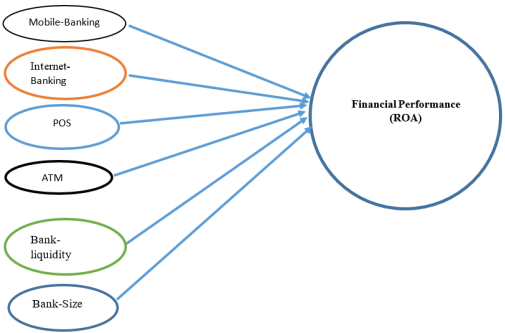
. In this study, the conceptual framework illustrates how the independent and dependent variables are related. Specifically, the independent variables are digital financial services (including ATMs, POS systems, agent banking, mobile banking, and internet banking), while the dependent variable is the financial performance, measured by Return on Assets (ROA), of six selected private banks in Ethiopia. This framework helps guide the exploration of how DFS influences the financial performance of these banks.
Independent Variables Dependent Variable
Digital Financial Services
Figure 1. Conceptual Framework.
3. Methodology
3.1. Method and Data
This study explores the impact of digital financial services (DFS) on the financial performance of private banks in Ethiopia, using a quantitative research approach with an explanatory design. The research focuses on six private banks Abay Bank, Awash Bank, Bank of Abyssinia, Dashen Bank, Enat Bank, Nib Bank, and United Bank which were selected for their comprehensive and consistent data on digital financial services, including mobile banking, internet banking, ATMs, and POS systems, from 2015 to 2024. A purposive sampling technique was used to ensure the inclusion of banks with reliable and complete data, enhancing the accuracy and relevance of the findings. Secondary data, primarily sourced from the National Bank of Ethiopia and the banks' annual reports, were analyzed. Panel data regression analysis was applied to the data collected over a ten-year period, allowing for the examination of cause-and-effect relationships between DFS adoption and Return on Assets (ROA). By combining cross-sectional and time-series data, the panel data analysis provides a more robust understanding of the banks’ dynamic behavior, while also reducing potential biases related to omitted variables. The study's findings aim to offer valuable insights into how the adoption of DFS influences bank profitability, contributing to a deeper understanding of the role of digital innovation in the Ethiopian banking sector.
3.2. Description of Variables
This study explores various factors that influence the financial performance of private banks in Ethiopia, with a particular focus on Return on Assets (ROA) as the dependent variable. ROA serves as a measure of a bank's ability to generate profit from its assets, reflecting how efficiently a bank uses its resources. The independent variables include Mobile Banking, which is measured by the natural log of the number of mobile banking users
| [9] | Dahlberg, T. (2008). Mobile banking: A summary of existing research. International Journal of Electronic Finance, 2(3), 245–258. https://doi.org/10.1504/IJEF.2008.018081 |
| [23] | Hussey, V., Greco, F., & Rulli, E. (2023). Measurement invariance in cross-cultural research: A comparison of confirmatory factor analysis methods. International Journal of Research Methodology, 26(2), 123–135. |
[9, 23]
; Internet Banking, measured by the natural log of internet banking users
| [46] | Taherdoost, H. (2016). Validity and reliability of the research instrument: How to test the validation of a questionnaire/survey in research. International Journal of Academic Research in Management, 5(4), 28–36. |
[46]
; Automated Teller Machines (ATMs), quantified by the natural log of ATM terminals installed; and Point of Sale (POS) terminals, measured by the natural log of POS terminals
| [1] | Adugna, B. M., Gadasandula, S., & Daravath, R. (2021). Effect of digital financial services on financial performance of commercial banks in Ethiopia. Journal of Banking and Financial Technology, 5(1), 1–16.
https://doi.org/10.1007/s42786-020-00022-0 |
| [20] | Goisis, G. (2009). Economies of scale and scope in banking: Evidence from Italy (Working Paper No. 2009-12). Bank of Italy. |
[1, 20]
. These digital financial services are essential for improving banking accessibility and efficiency, thereby boosting profitability. Additionally, the study includes Bank Liquidity, measured by the ratio of liquid assets to total deposits
, and Bank Size, measured by the natural log of total assets in Ethiopian Birr
| [30] | Mamo, S. (2021). Digital banking and financial performance of commercial banks in Ethiopia. International Journal of Finance and Banking Studies, 10(2), 45–58. |
[30]
. Liquidity is crucial for ensuring operational efficiency, while the size of a bank influences its ability to scale operations and attract more customers. By incorporating these variables, the study aims to offer a comprehensive view of the key factors affecting the financial performance of private banks in Ethiopia.
Table 1. Summary of variables description and their measurements.
Variables Definition | Symbol | Measurement |
Dependent Variable |
Financial Performance: Return on Assets (ROA) is a profitability measure that shows how efficiently a company uses its assets to generate profit. It reflects the bank's ability to maximize returns from its available resources. | ROA | ROA = (Net Income) / (Total Assets) |
Independent Variables | | |
Mobile Banking: The delivery of banking and financial services through mobile devices, enabling users to access and manage their accounts on the go. | lnnomank | The natural logarithm of the number of mobile banking users |
Automated Teller Machine (ATM): An electronic service that enables customers to perform basic banking transactions, such as withdrawals and deposits, without the need for a bank teller. | lnnoatm | The natural logarithm of the total number of ATM terminals installed by the banks. |
Point of Sale (POS) Terminal: An electronic device used by retailers to process card payments, allowing customers to make purchases using credit or debit cards. | lnnopos | The natural logarithm of the total number of POS terminals installed. |
Internet Banking: An online service that allows customers to carry out various financial transactions, such as transferring funds or checking balances, through a bank’s website. | lnnoibank | The natural logarithm of the total number of users accessing internet banking services. |
Bank Size: Calculated as the natural logarithm of the total value of a bank's assets, expressed in Ethiopian Birr. | lnbasz | The natural logarithm of the total value of assets, expressed in Ethiopian Birr. |
Bank Liquidity: The ability of a bank to quickly fulfill its financial obligations, especially to depositors, within a short period. | lnliqu | Cash to Customer Deposits Ratio |
3.3. Model Specification
The study used a random panel data regression model to analyze data from six private banks over a ten-year period, aiming to explore how digital financial services impact the financial performance of selected private banks in Ethiopia. The analysis focused on the effects of digital financial services such as mobile banking, internet banking, and POS systems along with control variables like bank liquidity and bank size, on financial performance (measured by Return on Assets, or ROA). A multiple linear regression approach was used to examine the relationships between these variables. In this study, the regression model includes two sets of variables: the dependent variable (financial performance) and independent variables (proxies for digital financial services, bank liquidity, and bank size).
The general notation for the basic panel data model is:
y= α + β1x1 + β2 x2 + β3 x3+ β4 x4+ β5x5 +ui +ϵit
The regression model employed in the study presented as follows;
ROAit =β0 +β1 lnnombankit +β2 lnnoibankit +β3 lnnoposit +β4 lnnoatmit +β5 lnbaszit +β6 lnlquiit +ui +ϵit
Where
This study investigates the determinants of bank profitability, measured by Return on Assets (ROA), using a panel data model for six private commercial banks (i = 1…6) over a ten-year period from 2015 to 2024 (t = 1…10). The model posits that ROA is a function of technological adoption and financial indicators, where β₀ is the constant term, and β₁ through β₆ are the coefficients to be estimated for the key explanatory variables: the number of mobile banking users (lnnombank), the number of internet banking users (lnnoibank), the number of ATM machines (lnnoatm), the number of point-of-sale terminals (lnnopos), bank liquidity (lnliqui), and bank size (lnbasz). By employing a panel data approach, the model incorporates a random effects component (uᵢ) to account for unobserved, bank-specific heterogeneity, alongside the idiosyncratic error term (ϵᵢt), to provide more robust and nuanced insights into the factors driving profitability across the banking sector.
3.4. Methods of Data Analysis
This study used ten years of panel data (2015-2024) from six private banks in Ethiopia to investigate the impact of digital financial services (DFS) on their financial performance. The data were analyzed using both descriptive and inferential statistics, with regression analysis conducted using STATA software version 18. Descriptive statistics, including minimum, mean, maximum, and standard deviation, were used to summarize the data, while Pearson correlation analysis assessed the relationships between the variables. A random effects model was chosen for the panel data regression analysis, after conducting the Hausman test to ensure the model's suitability. Several diagnostic tests were performed to validate the model, including checks for heteroscedasticity (Breusch-Pagan test), autocorrelation (Wooldridge test), multicollinearity, and normality (Jarque-Bera test). These tests confirmed the reliability of the data and the appropriateness of the model, ensuring that the results were robust and meaningful in understanding how digital financial services influence the profitability of private banks in Ethiopia.
4. Result and Discussion
4.1. Introduction
The first section presents a summary of the descriptive statistics for the dependent variable, Return on Assets (ROA), along with four independent variables and two control variables, based on data from six private banks spanning 2015 to 2024. This analysis includes a total of 60 observations, and the statistics reported include the average, minimum, maximum, and standard deviation values. The independent variables include the number of ATM terminals, the number of point-of-sale (POS) terminals, and the number of mobile banking users (lnnombank). The control variables are bank size (lnbasz) and bank liquidity (lnliqu). The second section provides a discussion of the econometric results, which were obtained using Stata 18 software. The analysis considers the natural logarithm of total assets as a measure of bank size (lnbasz) and the natural logarithm of bank liquidity (lnliqu) as key control variables in the regression models.
4.2. Overview of Descriptive Statistics
Descriptive Statistics refers to the section of a research study where key characteristics of the data are summarized to give an overview of its structure. This includes measures like the mean (average), minimum, maximum, and standard deviation, which help show the range and variability of the data. In your study, this section will present these statistics for the dependent variable, Return on Assets (ROA), as well as for independent variables such as ATM terminals, POS terminals, mobile banking users, bank size, and liquidity. These statistics provide a clear understanding of the data before conducting more detailed analyses.
Table 2. Descriptive Statistics Analysis.
Variables | Mean | Std. Dev. | Min | Max |
Lnroa | 2.991 | 2.0700 | 6.3486 | 1.1320 |
Lnnombank | 9.7075 | 2.8960 | 6.4646 | 13.127 |
Lnnoibank | 9.3998 | 1.2780 | 7.2893 | 12.138 |
Lnnopos | 5.4270 | 1.2780 | 3.2903 | 8.6128 |
Lnnoatm | 8.499 | 2.1157 | 5.2537 | 11.002 |
Lnbasz | 14.909 | 2.0696 | 11.815 | 19.401 |
Lnlqui | 3.0668 | 2.1137 | 6.5083 | 1.301 |
Source: STATA 18.0 Results, 2025
The descriptive analysis of the study provides valuable insights into the financial performance and the adoption of digital financial services (DFS) by private banks in Ethiopia. The average Return on Assets (ROA) stands at 2.99%, indicating moderate profitability, with a standard deviation of 2.07, suggesting considerable variation in how effectively the banks utilize their assets. The ROA values range from 1.13% to 6.35%, reflecting differing levels of profitability linked to asset management and the adoption of digital services. For mobile banking users, the mean is 9.71 with a standard deviation of 2.90, showing relatively high but varied adoption across the banks, with a range from 6.46 to 13.13. Internet banking users, on the other hand, have a mean of 9.40 and a lower standard deviation of 1.28, suggesting more consistent adoption, with values ranging from 7.29 to 12.14. The average number of POS terminals is 5.43, with a standard deviation of 1.28, indicating moderate consistency in their use, while the average number of ATM terminals is 8.50, with a higher standard deviation of 2.12, pointing to significant variation in infrastructure deployment. The mean of bank size was 14.91, indicating that the banks in this sample are relatively large, though with a substantial standard deviation of 2.07, reflecting size variability. Bank liquidity has a mean of 3.07 and a standard deviation of 2.11, highlighting differences in liquidity positions across the banks. These findings suggest that larger banks with better liquidity are more likely to invest in DFS, potentially leading to improved financial performance.
4.3. Econometrics Approach Results
A comparison between the Fixed Effects (FE) and Random Effects (RE) models was conducted to determine the most suitable approach for analyzing the panel data. The FE model focuses on variations within individual entities, accounting for unobserved factors that may correlate with the independent variables. In contrast, the RE model assumes no correlation between unobserved factors and the independent variables, treating them as random. The Hausman test, which helps in selecting between the two models, indicated that the RE model is more appropriate for this study. With a Hausman test statistic of 2.53 and a p-value of 0.8654, the null hypothesis that the RE model is appropriate cannot be rejected. This suggests that unobserved heterogeneity is not correlated with the independent variables, making the RE model more efficient and suitable for this analysis. The coefficients for key variables, such as mobile banking users, bank size, liquidity, internet banking users, POS terminals, and ATM terminals, showed noticeable differences between the FE and RE models. Overall, the RE model provided more efficient estimates. The Wald chi-squared statistic of 68.44 (with 6 degrees of freedom) further supports the model's significance, with a p-value of 0.0000, indicating that the independent variables (DFS) are significantly related to the dependent variable (ROA). This strongly suggests that variables like mobile and internet banking users, bank size, and liquidity have a meaningful impact on the financial performance (ROA) of private banks. In the random effects result table, the R-squared values offer useful insights into the model's explanatory power. The within-group R-squared value of 0.3768 means that about 37.94% of the variation in return on assets (lnroa) within individual banks is explained by the independent variables. The between-group R-squared value of 0.9001 shows that 90.01% of the variation in the dependent variable across different banks is explained by the model, indicating that the predictors are highly effective in explaining differences between banks. The overall R-squared value of 0.5636, which combines both within and between-group variations, shows that the model explains 56.36% of the total variance in return on assets, suggesting a good fit for the data.
Table 3. Random Effect Model Regression Results.
Variables | Lnroa Random Effect Result |
Lnnombank | -0.09735 |
(0.0758) |
Lnnoibank | 0.22336 |
(0.5301) |
Lnnopos | -0.12299 |
(0.35261) |
Lnnoatm | -0.46372*** |
(0.13005) |
Lnnoatm | 0.030993*** |
(0.0754) |
Lnnoatm | 0.6472*** |
(0.10043) |
Constant | -2.7091*** |
(1.8207) |
Observations | 60 |
Number of Banks | 6 |
R-squared | 0.5636 |
F | 68.44 |
Standard error in parentheses, *** p<0.01, ** p<0.05, * p<0.1
Source: STATA 18.0 Results, 2025
4.4. Discussion of the Regression Result
The results from the random-effects regression analysis, as shown in the table above, reveal mixed findings regarding the relationship between digital financial services (DFS) and financial performance, as measured by Return on Assets (ROA). Mobile banking usage (lnnombank) shows a negative but statistically insignificant effect on ROA, with a coefficient of -0.09736 and a p-value of 0.199. This suggests that while an increase in mobile banking users is associated with a slight decrease in ROA, the effect is not statistically significant.
Internet banking users (lnnoibank), however, exhibit a significant negative impact on ROA, with a coefficient of -0.4637 and a p-value of 0.000. This indicates that higher internet banking usage is linked to a substantial decrease in ROA. On the other hand, both ATMs (lnnoatm) and POS terminals (lnnpos) show positive but statistically insignificant relationships with ROA, with coefficients of 0.2233 and -0.1229, respectively. Regarding control variables, bank size (lnbsaz) and liquidity (lnliqu) both have a significant positive effect on ROA, with coefficients of 0.3099 and 0.6471, respectively, and p-values of 0.000. This suggests that larger banks and those with better liquidity are more likely to achieve higher financial performance. The regression results support the rejection of the null hypotheses for bank liquidity and bank size, indicating that these factors significantly contribute to financial performance. In contrast, the null hypotheses for mobile banking, POS terminals, and ATMs cannot be rejected, suggesting these variables do not have a significant impact on financial performance in this study. The findings for mobile banking align with previous studies by
| [32] | Mollah, S., & Quaddus, M. (2018). Internet banking adoption in Bangladesh: A review of existing literature. Journal of Financial Services Marketing, 23(1), 45–60.
https://doi.org/10.1057/s41264-017-0027-6 |
| [38] | Rahi, S. (2020). Impact of liquidity on financial performance: Evidence from banking sector. International Journal of Finance and Economics, 25(3), 1234–1245.
https://doi.org/10.1002/ijfe.1867 |
[32, 38]
, which point to the challenges of mobile banking in developing economies with underdeveloped infrastructure. However, research by
| [17] | Gambo, N. (2020). Effect of automated teller machines on the financial performance of deposit money banks in Nigeria. Journal of Finance and Accounting, 8(2), 45–52.
https://doi.org/10.11648/j.jfa.20200802.12 |
| [35] | Okoro, E. (2024). Digital financial services and bank profitability in emerging markets. Journal of Banking Regulation, 25(1), 56–72. |
[17, 35]
indicates that infrastructure development is key to realizing mobile banking’s benefits. Similarly, the negative and significant relationship between internet banking and ROA supports previous studies by
| [33] | National Bank of Ethiopia (NBE). (2024). Financial stability report 2023/24. National Bank of Ethiopia. |
| [43] | Shipalana, S. (2019). Digital financial services and economic growth in Africa. African Journal of Economic and Management Studies, 10(2), 156–172. |
[33, 43]
, which highlight the high initial costs of implementing internet banking systems, such as customer training and cybersecurity investments, which may outweigh the short-term benefits, especially in emerging economies like Ethiopia. For POS terminals, the study confirms the findings of
| [31] | Mekonnen, M. (2022). Effect of digitalization on financial performance of commercial banks in Ethiopia. Research Journal of Finance and Accounting, 13(5), 78–89. |
| [32] | Mollah, S., & Quaddus, M. (2018). Internet banking adoption in Bangladesh: A review of existing literature. Journal of Financial Services Marketing, 23(1), 45–60.
https://doi.org/10.1057/s41264-017-0027-6 |
[31, 32]
, which highlight the high initial setup costs as a barrier to profitability, although studies by
| [15] | Fentaw, E., & Thakkar, J. (2022). Financial innovation and profitability of commercial banks in Ethiopia. Cogent Economics & Finance, 10(1), 213-4567.
https://doi.org/10.1080/23322039.2022.2134567 |
| [5] | Ashiru, F. O., Balogun, O. A., & Paseda, O. T. (2023). Digital financial services and bank performance in Nigeria. Cogent Economics & Finance, 11(1), 2189456.
https://doi.org/10.1080/23322039.2023.2189456 |
[15, 5]
suggest that POS systems can still improve profitability, depending on user adoption and infrastructure. The positive but insignificant effect of ATM terminals on ROA is consistent with research by
| [27] | Kaoduili, U. C., & Ingida, D. M. (2023). Automated teller machines and financial performance of deposit money banks in Nigeria. International Journal of Business and Management Review, 11(2), 56–72. |
| [48] | Thompson, P. (1997). The economics of banking. Macmillan Press. |
[27, 48]
which suggest that the high setup and maintenance costs of ATMs often offset their potential benefits. In contrast, bank liquidity and bank size both show significant positive effects on ROA. These findings align with research by
| [7] | Chaudhary, S., & Sapkota, R. (2023). Impact of liquidity on financial performance of commercial banks: Evidence from Nepal. Journal of Business and Social Sciences, 4(1), 45–58.
https://doi.org/10.3126/jbss.v4i1.51234 |
| [21] | Greco, L., Minerba, F., & Rulli, E. (2018). Reliability and validity in structural equation modeling: A comparison of bootstrap and Bayesian approaches. Quality & Quantity, 52(3), 1163–1178. https://doi.org/10.1007/s11135-017-0525-1 |
[7, 21]
, which demonstrates that higher liquidity enhances profitability and financial stability, while larger banks benefit from economies of scale, greater resources, and better customer trust. This supports the Technology Acceptance Model
| [5] | Ashiru, F. O., Balogun, O. A., & Paseda, O. T. (2023). Digital financial services and bank performance in Nigeria. Cogent Economics & Finance, 11(1), 2189456.
https://doi.org/10.1080/23322039.2023.2189456 |
| [11] | Davis, F. D. (1989). Perceived usefulness, perceived ease of use, and user acceptance of information technology. MIS Quarterly, 13(3), 319–340. https://doi.org/10.2307/249008 |
| [13] | Dietrich, A., & Wanzenried, G. (2011). Determinants of bank profitability before and during the crisis: Evidence from Switzerland. Journal of International Financial Markets, Institutions and Money, 21(3), 307–327. https://doi.org/10.1016/j.intfin.2010.11.002 |
[5, 11, 13]
. However, studies by
| [10] | Dauda, L. A., & Haruna, H. A. (2021). Digital financial services and bank performance in Nigeria: A panel data analysis. African Journal of Economic and Management Studies, 12(3), 445–460. https://doi.org/10.1108/AJEMS-08-2020-0367 |
| [35] | Okoro, E. (2024). Digital financial services and bank profitability in emerging markets. Journal of Banking Regulation, 25(1), 56–72. |
[10, 35]
, suggest that strategic factors and innovation may be more influential than bank size alone. In conclusion, this study highlights that liquidity, bank size, and internet banking usage play significant roles in driving financial performance (ROA) in private banks in Ethiopia. While digital financial services like mobile banking, ATMs, and POS terminals had limited or no significant impact in this study, the findings underscore the importance of effective liquidity management and larger bank size for improving profitability.
5. Conclusion and Recommendation
This study examined the impact of digital financial services (DFS) on the financial performance of private banks in Ethiopia, specifically focusing on mobile banking, internet banking, POS terminals, and ATMs, along with control variables like bank liquidity and size. The results showed that mobile banking and POS terminals had an insignificant effect on Return on Assets (ROA), while internet banking had a negative and significant impact. This suggests that increased usage of internet banking could lower profitability, likely due to high initial costs and operational challenges. On the other hand, both bank liquidity and bank size were found to have a significant positive effect on financial performance, with larger banks and those maintaining higher liquidity showing better profitability. The study concludes that while digital financial services have the potential to improve banking efficiency, effective liquidity management and larger bank size remain the key drivers of financial success for private banks in Ethiopia.
Based on these findings, several recommendations are made: banks should focus on strengthening liquidity management, leverage economies of scale, promote digital financial literacy, and invest in technological innovation. Policymakers are encouraged to support better liquidity management practices and foster bank growth through strategies like mergers, acquisitions, and geographic expansion. Future research should explore additional factors, such as mobile money and agent banking, and use advanced econometric models to deepen our understanding of the variables affecting financial performance in the banking sector.
This study contributes to the understanding of how DFS affects the financial performance of private banks in Ethiopia, offering valuable insights into the relationship between mobile banking, internet banking, POS terminals, ATMs, and profitability (measured by ROA). The findings provide context-specific information that adds to the broader literature on DFS in emerging economies, highlighting the importance of bank liquidity and size in driving performance.
The study also emphasizes the challenges faced by Ethiopian banks, including infrastructure limitations and high operational costs, which hinder DFS adoption. However, the study has several limitations. It relies on secondary data from only six private banks, which may not fully represent the entire banking sector, and it focuses on a limited range of DFS. The ten-year study period may not capture long-term trends, and the panel data regression models used may not address all potential endogeneity concerns. Additionally, the study does not account for broader economic factors like GDP, inflation, and interest rates. Given these limitations, future research should incorporate a wider range of variables, consider a longer time frame, and use primary data collection to further explore the factors that influence the financial performance of Ethiopian banks.
Abbreviations
ATM | Automated Teller Machine |
CBE | Commercial Bank of Ethiopia |
DFS | Digital Financial Services |
DIOT | Diffusion of Innovation Theory |
FE | Fixed Effects |
GDP | Gross Domestic Product |
NBE | National Bank of Ethiopia |
POS | Point of Sale |
RE | Random Effects |
ROA | Return on Assets |
ROE | Return on Equity |
SDGs | Sustainable Development Goals |
TAM | Technology Acceptance Model |
UNSGSA | United Nations Secretary-General's Special Advocate for Financial Inclusion |
Author Contributions
Darara Anbesa Balami: Conceptualization, Data curation, Formal Analysis, Investigation, Methodology, Software, Writing – original draft
Dilgasa Bedada Gonfa: Resources, Supervision, Validation, Writing – review & editing
Conflicts of Interest
We declare that we have no competing interests.
References
| [1] |
Adugna, B. M., Gadasandula, S., & Daravath, R. (2021). Effect of digital financial services on financial performance of commercial banks in Ethiopia. Journal of Banking and Financial Technology, 5(1), 1–16.
https://doi.org/10.1007/s42786-020-00022-0
|
| [2] |
Afjal, M. (2023). Impact of digital banking on the financial performance of commercial banks: Evidence from Bangladesh. Journal of Financial Services Research, 63(2), 1–18.
https://doi.org/10.1007/s10693-022-00345-6
|
| [3] |
Ahiadorme, S. K. (2018). Electronic banking and financial performance of banks in Ghana. International Journal of Finance and Banking Research, 4(1), 1–10.
https://doi.org/10.11648/j.ijfbr.20180401.11
|
| [4] |
Alalwan, A. A. (2017). Internet banking adoption in Jordan: A review of existing literature. Journal of Financial Services Marketing, 22(3), 123–137.
https://doi.org/10.1057/s41264-017-0028-5
|
| [5] |
Ashiru, F. O., Balogun, O. A., & Paseda, O. T. (2023). Digital financial services and bank performance in Nigeria. Cogent Economics & Finance, 11(1), 2189456.
https://doi.org/10.1080/23322039.2023.2189456
|
| [6] |
Caron, E. (2022). Liquidity management and bank profitability: Evidence from European banks. Journal of Banking and Finance, 142, Article 106-589.
https://doi.org/10.1016/j.jbankfin.2022.106589
|
| [7] |
Chaudhary, S., & Sapkota, R. (2023). Impact of liquidity on financial performance of commercial banks: Evidence from Nepal. Journal of Business and Social Sciences, 4(1), 45–58.
https://doi.org/10.3126/jbss.v4i1.51234
|
| [8] |
Cho, E., & Kim, S. (2015). Cronbach’s coefficient alpha: Well known but poorly understood. Organizational Research Methods, 18(2), 207–230.
https://doi.org/10.1177/1094428114555983
|
| [9] |
Dahlberg, T. (2008). Mobile banking: A summary of existing research. International Journal of Electronic Finance, 2(3), 245–258.
https://doi.org/10.1504/IJEF.2008.018081
|
| [10] |
Dauda, L. A., & Haruna, H. A. (2021). Digital financial services and bank performance in Nigeria: A panel data analysis. African Journal of Economic and Management Studies, 12(3), 445–460.
https://doi.org/10.1108/AJEMS-08-2020-0367
|
| [11] |
Davis, F. D. (1989). Perceived usefulness, perceived ease of use, and user acceptance of information technology. MIS Quarterly, 13(3), 319–340.
https://doi.org/10.2307/249008
|
| [12] |
Derbali, A. (2021). Digital financial services and bank profitability: Evidence from MENA countries. Journal of Islamic Accounting and Business Research, 12(4), 567–582.
https://doi.org/10.1108/JIABR-09-2020-0218
|
| [13] |
Dietrich, A., & Wanzenried, G. (2011). Determinants of bank profitability before and during the crisis: Evidence from Switzerland. Journal of International Financial Markets, Institutions and Money, 21(3), 307–327.
https://doi.org/10.1016/j.intfin.2010.11.002
|
| [14] |
Federal Financial Institutions Examination Council (FFIEC). (2016). FFIEC IT examination handbook: Information security. FFIEC.
https://ithandbook.ffiec.gov/
|
| [15] |
Fentaw, E., & Thakkar, J. (2022). Financial innovation and profitability of commercial banks in Ethiopia. Cogent Economics & Finance, 10(1), 213-4567.
https://doi.org/10.1080/23322039.2022.2134567
|
| [16] |
Franke, G., & Sarstedt, M. (2019). Heuristics versus statistics in discriminant validity testing: A comparison of four procedures. Internet Research, 29(3), 430–447.
https://doi.org/10.1108/IntR-12-2017-0515
|
| [17] |
Gambo, N. (2020). Effect of automated teller machines on the financial performance of deposit money banks in Nigeria. Journal of Finance and Accounting, 8(2), 45–52.
https://doi.org/10.11648/j.jfa.20200802.12
|
| [18] |
Gardachew, W. (2010). Electronic banking in Ethiopia: Challenges and opportunities (Master’s thesis). Addis Ababa University.
|
| [19] |
Gaya, S., Omoro, N., & Kinyua, J. (2022). Effect of ATM banking on financial performance of commercial banks in Kenya. International Journal of Finance and Banking Research, 8(1), 1–9.
|
| [20] |
Goisis, G. (2009). Economies of scale and scope in banking: Evidence from Italy (Working Paper No. 2009-12). Bank of Italy.
|
| [21] |
Greco, L., Minerba, F., & Rulli, E. (2018). Reliability and validity in structural equation modeling: A comparison of bootstrap and Bayesian approaches. Quality & Quantity, 52(3), 1163–1178.
https://doi.org/10.1007/s11135-017-0525-1
|
| [22] |
Hailu, T. G. (2023). Digital financial inclusion in Ethiopia: Trends, challenges and prospects. Ethiopian Journal of Economics, 32(1), 1–28.
|
| [23] |
Hussey, V., Greco, F., & Rulli, E. (2023). Measurement invariance in cross-cultural research: A comparison of confirmatory factor analysis methods. International Journal of Research Methodology, 26(2), 123–135.
|
| [24] |
Jackson, S. L. (2009). Research methods and statistics: A critical thinking approach (3rd ed.). Wadsworth/Cengage Learning.
|
| [25] |
Jimoh, O. M. (2019). Digital financial services and bank performance: Evidence from selected banks in Nigeria. International Journal of Economics and Financial Issues, 9(2), 123–130.
|
| [26] |
Jote, G. (2023). Impact of digital financial services on the profitability of commercial banks in Ethiopia. Journal of Banking and Finance Technology, 7(1), 1–15.
https://doi.org/10.1007/s42786-022-00045-3
|
| [27] |
Kaoduili, U. C., & Ingida, D. M. (2023). Automated teller machines and financial performance of deposit money banks in Nigeria. International Journal of Business and Management Review, 11(2), 56–72.
|
| [28] |
Kolawole, O. D. (2023). Digital transformation and financial performance of banks in developing economies. Journal of African Business, 24(1), 89–104.
https://doi.org/10.1080/15228916.2022.2156789
|
| [29] |
Laeven, L. (2014). The impact of bank size on financial stability. World Bank Policy Research Working Paper No. 7430. World Bank.
https://doi.org/10.1596/1813-9450-7430
|
| [30] |
Mamo, S. (2021). Digital banking and financial performance of commercial banks in Ethiopia. International Journal of Finance and Banking Studies, 10(2), 45–58.
|
| [31] |
Mekonnen, M. (2022). Effect of digitalization on financial performance of commercial banks in Ethiopia. Research Journal of Finance and Accounting, 13(5), 78–89.
|
| [32] |
Mollah, S., & Quaddus, M. (2018). Internet banking adoption in Bangladesh: A review of existing literature. Journal of Financial Services Marketing, 23(1), 45–60.
https://doi.org/10.1057/s41264-017-0027-6
|
| [33] |
National Bank of Ethiopia (NBE). (2024). Financial stability report 2023/24. National Bank of Ethiopia.
|
| [34] |
Odhiambo, O. S., & Ngaba, C. N. (2019). Mobile banking and financial performance of commercial banks in Kenya. International Journal of Business and Management, 14(8), 124–135.
|
| [35] |
Okoro, E. (2024). Digital financial services and bank profitability in emerging markets. Journal of Banking Regulation, 25(1), 56–72.
|
| [36] |
Omar, M. A., & Inaba, K. (2020). Financial inclusion and economic growth: Evidence from Sub-Saharan Africa. Journal of African Economies, 29(3), 234–256.
https://doi.org/10.1093/jae/ejz032
|
| [37] |
Ozili, P. K. (2018). Impact of digital finance on financial inclusion in developing countries. Journal of Financial Regulation and Compliance, 26(2), 76–84.
https://doi.org/10.1108/JFRC-05-2017-0070
|
| [38] |
Rahi, S. (2020). Impact of liquidity on financial performance: Evidence from banking sector. International Journal of Finance and Economics, 25(3), 1234–1245.
https://doi.org/10.1002/ijfe.1867
|
| [39] |
Rahman, M. M. (2020). ROA as a performance measure: Evidence from banking industry. International Journal of Financial Studies, 8(2), 45–58.
https://doi.org/10.3390/ijfs8020045
|
| [40] |
Riley, C. (2020). Global financial inclusion: The unbanked and underbanked. World Bank Group.
|
| [41] |
Rogers, E. M. (2003). Diffusion of innovations (5th ed.). Free Press.
|
| [42] |
Sharma, S., & Bhatnagar, J. (2018). Internet banking adoption in India: A review of existing literature. Journal of Financial Services Marketing, 23(3), 89–104.
|
| [43] |
Shipalana, S. (2019). Digital financial services and economic growth in Africa. African Journal of Economic and Management Studies, 10(2), 156–172.
|
| [44] |
Shrier, A. (2022). The impact of ATM and POS terminals on bank profitability. Journal of Banking Technology, 15(1), 45–60.
|
| [45] |
Swarna, S., & Mallesha, S. (2020). Internet banking and customer satisfaction: A study on private sector banks. International Journal of Management, 11(2), 1234–1245.
|
| [46] |
Taherdoost, H. (2016). Validity and reliability of the research instrument: How to test the validation of a questionnaire/survey in research. International Journal of Academic Research in Management, 5(4), 28–36.
|
| [47] |
Tesfaw, A. (2020). Effect of electronic banking on financial performance of commercial banks in Ethiopia. Journal of Accounting and Financial Management, 6(2), 34–45.
|
| [48] |
Thompson, P. (1997). The economics of banking. Macmillan Press.
|
| [49] |
Triebs, T. P. (2016). Economies of scale and scope in banking: Evidence from Germany. Journal of Banking & Finance, 68, 180–192.
https://doi.org/10.1016/j.jbankfin.2016.04.001
|
| [50] |
Tsegaye, W., & Seyoum, A. (2020). Challenges of internet banking in Ethiopia. Ethiopian Journal of Business and Economics, 10(2), 78–95.
|
| [51] |
Tura, S. (2023). Digital financial services adoption in Ethiopian banking sector: Challenges and opportunities. African Journal of Business Management, 17(1), 23–37.
|
| [52] |
Tuyon, J. (2023). Digital finance and green economy transition: Evidence from developing countries. Journal of Sustainable Finance & Investment, 13(2), 567–589.
|
| [53] |
United Nations Secretary-General's Special Advocate for Financial Inclusion (UNSGSA). (2018). Digital financial inclusion: Emerging policy approaches. United Nations.
|
| [54] |
Vaske, J. J., Beaman, J., & Sponarski, C. C. (2017). Rethinking the risk perception paradox. Journal of Leisure Research, 49(1), 1–18.
https://doi.org/10.1080/00222216.2016.1248939
|
| [55] |
Wadesango, N., & Magaya, T. (2020). Digital financial services and bank profitability: Evidence from Zimbabwe. Journal of African Business, 21(3), 334–348.
https://doi.org/10.1080/15228916.2019.1624567
|
Cite This Article
-
APA Style
Balami, D. A., Gonfa, D. B. (2026). Digital Financial Services and Financial Performance: Empirical Evidence from Private Commercial Banks in Ethiopia. Innovation Economics, 1(1), 45-55. https://doi.org/10.11648/j.iecon.20260101.15
 Copy
|
Copy
|
 Download
ACS Style
Balami, D. A.; Gonfa, D. B. Digital Financial Services and Financial Performance: Empirical Evidence from Private Commercial Banks in Ethiopia. Innov. Econ. 2026, 1(1), 45-55. doi: 10.11648/j.iecon.20260101.15
Copy
|
Download
AMA Style
Balami DA, Gonfa DB. Digital Financial Services and Financial Performance: Empirical Evidence from Private Commercial Banks in Ethiopia. Innov Econ. 2026;1(1):45-55. doi: 10.11648/j.iecon.20260101.15
Copy
|
Download
-
@article{10.11648/j.iecon.20260101.15,
  author = {Darara Anbesa Balami and Dilgasa Bedada Gonfa},
  title = {Digital Financial Services and Financial Performance: Empirical Evidence from Private Commercial Banks in Ethiopia},
  journal = {Innovation Economics},
  volume = {1},
  number = {1},
  pages = {45-55},
  doi = {10.11648/j.iecon.20260101.15},
  url = {https://doi.org/10.11648/j.iecon.20260101.15},
  eprint = {https://article.sciencepublishinggroup.com/pdf/10.11648.j.iecon.20260101.15},
  abstract = {This study examines the effect of digital financial services on the financial performance of private banks in Ethiopia from 2015 to 2024, analyzing internet banking, mobile banking, ATMs, POS terminals, bank size, and liquidity as independent variables. Using a quantitative explanatory design, secondary data were collected from six private banks via the National Bank of Ethiopia and bank websites, with financial performance measured by Return on Assets. Panel data analysis employing a random effects regression model in Stata 18 reveals that bank size and liquidity have a positive and significant impact on financial performance. However, internet banking shows a negative and significant effect, while mobile banking users and POS terminals exhibit negative but insignificant relationships, and ATM terminals demonstrate a positive but insignificant effect. These mixed findings indicate that although digital financial services are increasingly adopted, their contribution to bank profitability remains context-dependent. The study recommends that Ethiopian private banks strengthen liquidity management through high-quality liquid assets and pursue expansion via mergers, acquisitions, and geographic diversification into underserved areas. Policymakers, including the National Bank of Ethiopia and the Ministry of Finance, are encouraged to support strategic initiatives that foster innovation and sustainable growth within the banking sector.},
 year = {2026}
}
Copy
|
Download
-
TY  - JOUR
T1  - Digital Financial Services and Financial Performance: Empirical Evidence from Private Commercial Banks in Ethiopia
AU  - Darara Anbesa Balami
AU  - Dilgasa Bedada Gonfa
Y1  - 2026/03/14
PY  - 2026
N1  - https://doi.org/10.11648/j.iecon.20260101.15
DO  - 10.11648/j.iecon.20260101.15
T2  - Innovation Economics
JF  - Innovation Economics
JO  - Innovation Economics
SP  - 45
EP  - 55
PB  - Science Publishing Group
UR  - https://doi.org/10.11648/j.iecon.20260101.15
AB  - This study examines the effect of digital financial services on the financial performance of private banks in Ethiopia from 2015 to 2024, analyzing internet banking, mobile banking, ATMs, POS terminals, bank size, and liquidity as independent variables. Using a quantitative explanatory design, secondary data were collected from six private banks via the National Bank of Ethiopia and bank websites, with financial performance measured by Return on Assets. Panel data analysis employing a random effects regression model in Stata 18 reveals that bank size and liquidity have a positive and significant impact on financial performance. However, internet banking shows a negative and significant effect, while mobile banking users and POS terminals exhibit negative but insignificant relationships, and ATM terminals demonstrate a positive but insignificant effect. These mixed findings indicate that although digital financial services are increasingly adopted, their contribution to bank profitability remains context-dependent. The study recommends that Ethiopian private banks strengthen liquidity management through high-quality liquid assets and pursue expansion via mergers, acquisitions, and geographic diversification into underserved areas. Policymakers, including the National Bank of Ethiopia and the Ministry of Finance, are encouraged to support strategic initiatives that foster innovation and sustainable growth within the banking sector.
VL  - 1
IS  - 1
ER  -
Copy
|
Download




 Share This Article
 Twitter
 Linked In
 Facebook