Abstract
Inflation is a significant macroeconomic challenge in South Asia, adversely affecting purchasing power, income distribution, and economic sustainability. This study investigates the macroeconomic determinants of consumer price index (CPI) inflation across eight selected South Asian countries over the period 2011–2024. Using annual panel data obtained from the World Bank’s World Development Indicators (WDI) and the IMF’s International Financial Statistics (IFS), the study employs Fixed Effects, panel unit root tests, Pedroni and Kao cointegration tests, Dumitrescu–Hurlin causality analysis, FMOLS, and PMG-ARDL models. The findings confirm the existence of a stable long-run relationship between inflation and its key determinants. Inflation is significantly driven upward by exchange rate depreciation, export growth, and growth in remittance inflows, while higher real GDP growth contributes to reducing inflationary pressures. Foreign direct investment (FDI), however, has no significant long-run effect on inflation. The error-correction mechanism indicates a relatively rapid adjustment of short-run deviations toward the long-run equilibrium. These findings provide important policy implications for South Asian economies, particularly regarding exchange rate management, sustainable economic growth, and effective macroeconomic policies to maintain price stability and support long-term economic sustainability.
Keywords
Inflation, Consumer Price Index, Exchange Rate, PMG-ARDL, FMOLS, South Asia
1. Introduction
Inflation is an important measure of the macroeconomic performance because it affects purchasing power, investment decisions, income distribution, resource allocation, and overall economic conditions. Low and stable inflation is essential for good monetary policy and is a key objective of monetary authorities, since high and persistent inflation creates uncertainty in the economy, can erode investor and consumer confidence, can undermine the effectiveness of monetary policy and can put economic growth at risk. Conversely, prolonged periods of low inflation or disinflation may slow down economic activity and increase the real debt burden, thus making it important to achieve an optimal level of price stability
| [11] | Chakrobortty, T., Karmakar, A., Rahman, A. K. M. A., Dobey, D. R., & Mim, M. R. T. (2025). Bank performance relation with green banking practices: A study on commercial bank in Bangladesh. Journal of Ekonomi, 7(2), 107–118.
https://doi.org/10.58251/ekonomi.1610026 |
| [13] | Chand, S. A., & Singh, B. (2025). Investigating the Relationship Between Remittances and Inflation in Developing and Emerging Economies: A Disaggregated Analysis Using the cross-Sectional Augmented Autoregressive Distributed Lag Approach. Emerging Markets Finance and Trade, 61(14), 4500-4511. https://doi.org/10.1080/1540496x.2025.2519406 |
[11, 13]
.
The most widely reported measure of inflation is the Consumer Price Index (CPI), which measures changes in the price of goods and services that consumers use. The CPI is also used to determine the cost of living, as a benchmark for wage negotiations, to adjust pensions and benefits, to formulate social welfare programs, to develop monetary policy and as a basis for overall economic policy. It is important to understand the macroeconomic factors that influence CPI inflation to be able to design appropriate stabilization policies, particularly in emerging economies where inflation is generally more volatile and more prone to shocks.
Inflation has re-emerged as a focal point worldwide after to the COVID-19 epidemic. Supply chain disruptions, alterations in consumer patterns, escalating energy and food prices, geopolitical crises, and constricting worldwide financial conditions together produced the greatest inflation rates recorded in decades. Despite inflation abating as a result of policy measures, many emerging market and developing countries continue to experience persistent inflationary pressures because of their dependence on imports, structural rigidities, and increased sensitivity to external shocks
| [16] | Doan Van, D. (2020). Money supply and inflation impact on economic growth. Journal of Financial Economic Policy, 12(1), 121-136. https://doi.org/10.1108/jfep-10-2018-0152 |
| [17] | Dumitrescu, E.-I., & Hurlin, C. (2012). Testing for Granger non-causality in heterogeneous panels. Economic Modelling, 29(4), 1450–1460.
https://doi.org/10.1016/j.econmod.2012.02.014 |
| [39] | Rahman, A. K. M. A., & Chakrobortty, T. (2026). Landscaping Theory and Lean Tourism: Evidence from the World’s Longest Natural Sea Beach. INTERNATIONAL JOURNAL OF MULTIDISCIPLINARY RESEARCH AND ANALYSIS, 09(07). https://doi.org/10.47191/ijmra/v9-i7-06 |
| [47] | World Bank. (2024). Global Economic Prospects. Washington, DC: World Bank. |
[16, 17, 39, 47]
. The trends highlight the fact that inflation is no longer only a monetary phenomenon or the consequence of monetary conditions, but rather the product of the interplay between monetary conditions, real economic activity and the external sector.
A wide range of empirical research has explored the determinants of inflation in developed and developing countries. Monetary variables, currency rates, economic growth, external capital inflows and trade-related factors are often considered as important variables affecting inflation, as found in prior studies
| [10] | Chakrobortty, T., Karmakar, G., Rahman, M., Rahman, Md. S., & Sabrina Chowdhury. (2026). THE NEXUS BETWEEN TOURISM, ENERGY CONSUMPTION AND SDG 7: A PANEL DATA ANALYSIS OF APEC ECONOMIES. In International Journal of Research and Analytical Reviews (Vol. 13, Issue 4, pp. 33–34). |
| [35] | Ndoricimpa, A. (2017). Threshold effects of inflation on economic growth: is Africa different?. International Economic Journal, 31(4), 599-620.
https://doi.org/10.1080/10168737.2017.1380679 |
| [43] | Taylor, J. B. (2000). Low Inflation, Pass-Through, and the Pricing Power of Firms. European Economic Review, 44(7), 1389–1408. https://doi.org/10.1016/s0014-2921(00)00037-4 |
[10, 35, 43]
. However, the evidence is mixed since the correlations differ across countries depending on the quality of the institutions, the economic structure, the policy environment and the estimation methods
| [2] | Barro, R. J. (1995). Inflation and Economic Growth. Bank of England Quarterly Bulletin, 35(2), 166–176. |
| [20] | Friedman, M. (1970). A theoretical framework for monetary analysis. Journal of Political Economy, 78(2), 193–238. https://doi.org/10.1086/259623 |
| [27] | Khan, M. S., & Senhadji, A. S. (2001). Threshold effects in the relationship between inflation and growth. IMF Staff Papers, 48(1), 1–21. https://www.jstor.org/stable/4621658 |
[2, 20, 27]
. Furthermore, the theory of inflation is challenged by recent global economic crises which seem to show that these theories do not fully explain the inflationary phenomena of the present day, particularly in developing countries with increased macroeconomic instability
.
Despite the considerable developments in the literature, there are still many gaps in research. Primarily, the majority of current research concentrates on singular nations, hence constraining the applicability of their conclusion’s other countries with varied structural attributes. Second, many studies only consider a limited cross-section of explanatory variables and do not consider the linkages between the broad monetary, real-sector and external variables that affect inflation. Third, results are often sensitive to the choice of the model and how it is estimated, highlighting the need for more robust econometric models that address endogeneity and unobserved heterogeneity
| [20] | Friedman, M. (1970). A theoretical framework for monetary analysis. Journal of Political Economy, 78(2), 193–238. https://doi.org/10.1086/259623 |
| [22] | Ha, J., Stocker, M. M., & Yilmazkuday, H. (2020). Inflation and exchange rate pass-through. journal of International Money and Finance, 105, 102187.
https://doi.org/10.1016/j.jimonfin.2020.102187 |
| [29] | Kremer, S., Bick, A., & Nautz, D. (2013). Inflation and growth: New evidence from a dynamic panel threshold analysis. Empirical Economics, 44(2), 861–878.
https://doi.org/10.1007/s00181-012-0553-9 |
[20, 22, 29]
. In the context of fast economic growth, exchange rate volatility, significant remittance inflows, high level of trade integration, and vulnerability to shocks from outside the South Asian region, these constraints are particularly relevant for South Asia.
This paper reviews the macroeconomic determinants of inflation in the South Asian countries, focusing on the effect of major macroeconomic variables on CPI inflation between 2011 and 2024. To produce accurate estimates whilst avoiding issues of endogeneity, omitted-variable bias, and unobserved heterogeneity, several panel econometric methods are used: Ordinary Least Squares (OLS); Panel Ordinary Least Squares (POLS); Two-Stage Least Squares (2SLS); and the Generalized Method of Moments (GMM). This study builds on the previous literature on the dynamics of inflation in South Asia, by providing a comprehensive set of macroeconomic factors in uniform panel. The outcomes are expected to help policymakers and central banks develop effective measures for stabilization that will ensure price stability and support sustainable economic growth. In the next sections of the paper the authors present the paper as follows. The relevant literature is reviewed in Section 2, the data and methodology are explained in Section 3, the empirical results are presented in Section 4, and policy implications and areas for further research are offered in Section 5.
2. Literature Review
Inflation has been studied as a macroeconomic phenomenon because of its impact on economic stability, investment, income distribution and sustainable growth. According to the theoretical models there are numerous external, real-sector and monetary factors that impact inflation. In the Quantity Theory of Money
, an increase in the money supply over time leads to higher prices if there is little growth in output. On the other hand, according to Keynesian theory, inflation is primarily due to an excess of aggregate demand, whereas according to the structuralist theory, it is due to supply-side constraints, institutional rigidities, and external shocks, particularly in emerging countries. Similarly, the expectations-augmented Phillips Curve highlights the importance of inflation expectations, labor market conditions and output gaps to the inflation process. All these theories essentially imply that inflation is a complex phenomenon brought about by the combined effect of monetary, external and real sector factors.
Among the several drivers, money supply is one of the most well studied factors affecting inflation. A major proposition of monetarist theory is that overproduction of money is the root cause of inflation. Empirical evidence supports this view in the main. According to
| [9] | Chakrobortty, T., Banu, M. L. A., Alam, S., & Dobey, D. R. (2026). Green ınvestment and financial efficiency as catalysts for SDG progress: Evidence from Bangladesh’s banking sector. Journal of Ekonomi, 8(1), 1-15.
https://doi.org/10.58251/ekonomi.1 |
[9]
a long-standing expansion of money supply has a significant impact on raising long-term inflation rates in Vietnam, while
| [33] | Mishchenko, V., Naumenkova, S., Mishchenko, S., & Ivanov, V. (2018). Inflation and economic growth: The search for a compromise for the Central Bank's monetary policy. Banks & bank systems, (13, Iss. 2), 153-163.
http://dx.doi.org/10.21511/bbs.13(2).2018.13 |
| [34] | Mishkin, F. S. (2019). The Economics of Money, Banking, and Financial Markets (12th ed.). Pearson. |
| [42] | Stylianou, T., Nasir, R., & Waqas, M. (2024). The relationship between money supply and inflation in Pakistan. Plos one, 19(3), e0301257.
https://doi.org/10.1371/journal.pone.0301257 |
[33, 34, 42]
found positive short and long-term relationship between money supply and inflation in Pakistan using ARDL method.
showed that after the outbreak of COVID-19, the expansionary monetary policy caused persistent inflation pressure in the USA, and
| [4] | Burkhanov, A. U., Kurbonbekova, M. T., & Usmonov, B. (2024). Impact of money supply on inflation in Uzbekistan—VAR approach. In Ecological footprint of the modern economy and the ways to reduce it: The role of leading technologies and responsible innovations (pp. 459-463).
https://doi.org/10.1007/978-3-031-49711-7_75 |
[4]
confirmed that money supply had a significant impact on the inflation process in Uzbekistan. There is indeed cross-country evidence indicating that monetary expansion has a greater inflationary impact in heavily indebted developing countries, but it is also possible that the sensitivity of inflation to money supply depends on the degree of economic development and monetization in countries as suggested by
| [24] | International Monetary Fund. (2023). World Economic Outlook: Navigating Global Divergences. Washington, DC: International Monetary Fund. |
[24]
. The literature is quite consistent in suggesting that inflationary effects of money supply depend on quality of institutions, fiscal conditions and credibility of monetary policy.
The exchange rate fluctuations are a very important source of inflation particularly for any emerging economy that relies on imports. When currency prices depreciate, home prices of imported commodities, intermediate goods and energy products increase, which, through the exchange rate pass-through effect, leads to inflation on imported goods.
found that movements in exchange rates have significant long-term impacts on inflation in open economies, while
| [1] | Abdurehman, A. A., & Hacilar, S. (2016). The relationship between exchange rate and inflation: An empirical study of Turkey. International Journal of Economics and Financial Issues, 6(4), 1454-1459. |
[1]
found that, despite deviations from Purchasing Power Parity, exchange rate volatility has lasting effects on inflation.
| [5] | Carranza, L., Galdon-Sanchez, J. E., & Gomez-Biscarri, J. (2009). Exchange rate and inflation dynamics in dollarized economies. Journal of Development Economics, 89(1), 98-108. https://doi.org/10.1016/j.jdeveco.2008.06.007 |
[5]
showed that exchange rate depreciation generally increases the level of inflation, as evidenced by more than 100 countries, but the pass-through varies depending on exchange rate regimes and the degree of dollarization. Likewise,
| [7] | Chakrobortty, T., Alam, S., Karmakar, G., Proteek, M. S. M., Rahman, M. S., & Rahman, A. K. M. A. (2026). The Confluence of Policy and practice: Marine Fisheries of Bangladesh as a catalyst for SDG achievement. International Journal of Innovative Science and Research Technology (IJISRT), 1982. https://doi.org/10.38124/ijisrt/26apr931 |
[7]
found that the stability of the exchange rate is correlated with lower inflation in times of high inflation. Recent studies by
| [6] | Chakrobortty, T. (2023). Determining Factors of Share Prices in Bangladesh: An Empirical study on cash dividends and retained Earnings. International Journal of Research Publication and Reviews, 04(02), 1400–1415.
https://doi.org/10.55248/gengpi.2023.4230 |
| [15] | Dilanchiev, A., Aghayev, A., Rahman, M. H., Ferdaus, J., & Baghirli, A. (2021). Dynamic analysis for measuring the impact of remittance inflows on inflation: evidence from Georgia. International Journal of Financial Research, 12(1), 339-347. https://doi.org/10.5430/ijfr.v12n1p339 |
| [38] | Petkovski, M., Kjosevski, J., & Simeonovski, K. (2024). Testing for causality between remittances and inflation: Evidence from Central and Eastern Europe. Panoeconomicus, 71(2), 191-213. https://doi.org/10.2298/PAN210322019P |
| [44] | Valogo, M. K., Duodu, E., Yusif, H., & Baidoo, S. T. (2023). Effect of exchange rate on inflation in the inflation targeting framework: Is the threshold level relevant?. Research in Globalization, 6, 100119.
https://doi.org/10.1016/j.resglo.2023.100119 |
[6, 15, 38, 44]
further show that the pass-through of exchange rate changes depends on the source of the economic shocks, the credibility of monetary policy, and the depreciation thresholds. The above results confirm together the significance of exchange rate movements as a key determinant of inflation in developing countries.
The relationship between economic expansion and inflation is somewhat complicated. There is no objection to moderate inflation when the economy is growing, however, if inflation stays high for long periods of time, investment tends to be reduced and long-term growth is lowered. On the other hand, if growth is maintained continuously, it can improve the productive capacity, and at the same time, reduce the inflationary pressure by expanding production and improving efficiency. Empirical studies usually show a non-linear relationship between inflation and economic growth. To establish country-specific inflation thresholds,
calculated the countries examined in Africa to establish where inflation becomes significant and has a negative impact on economic growth. Inflation rates exceedingly approximately 6% have a negative effect on the performance of the economy, and it is recommended to have a balanced monetary policy to support sustainable growth, according to
.
argued that the relationship between inflation and growth is dependent on the quality of institutions, and
| [9] | Chakrobortty, T., Banu, M. L. A., Alam, S., & Dobey, D. R. (2026). Green ınvestment and financial efficiency as catalysts for SDG progress: Evidence from Bangladesh’s banking sector. Journal of Ekonomi, 8(1), 1-15.
https://doi.org/10.58251/ekonomi.1 |
[9]
highlighted the indirect link between monetary growth and inflation and economic growth. The effect of inflation on growth varies by country, as revealed by the positive relationship found by
| [23] | International Monetary Fund. (2023). World Economic Outlook: Inflation and Disinflation. |
| [30] | Kryeziu, N., & Durguti, E. (2019). The impact of inflation on economic growth: The case of Eurozone. International Journal of Finance & Banking Studies (2147-4486), 8(1), 01–09. https://doi.org/10.20525/ijfbs.v8i1.297 |
[23, 30]
between moderate inflation and GDP growth in Eurozone countries.
Remittance inflows are also a major macroeconomic determinant, and are very important for many developing countries, particularly in South Asia. There are theoretical arguments that remittances can raise inflation by boosting aggregate demand and household consumption, and can lower inflationary pressures by increasing productive capacity through investment remittances. The results from these two experiments are inconclusive.
found that high levels of remittance inflows increase the degree of inflation in emerging Asian and Pacific countries, while
| [8] | Chakrobortty, T., Alam, S., Rahman, A. K. M. A., Proteek, M. S. M., & Karmakar, G. (2025). Bangladesh and the Blue Economy: Harnessing Marine Resources for Sustainable growth. International Journal of Innovative Science and Research Technology (IJISRT), 2415.
https://doi.org/10.38124/ijisrt/25nov1498 |
[8]
showed that there is a positive long-term relationship between remittances and inflation in Georgia.
| [3] | Basnet, H. C., Donou-Adonsou, F., & Upadhyaya, K. (2022). Remittances-inflation nexus in South Asia: an empirical examination. Journal of Financial Economic Policy, 14(2), 152-161. https://doi.org/10.1108/jfep-02-2021-0053 |
[3]
found that remittances reduce inflation in the short term and increase it in the long term in South Asia. Additionally,
| [7] | Chakrobortty, T., Alam, S., Karmakar, G., Proteek, M. S. M., Rahman, M. S., & Rahman, A. K. M. A. (2026). The Confluence of Policy and practice: Marine Fisheries of Bangladesh as a catalyst for SDG achievement. International Journal of Innovative Science and Research Technology (IJISRT), 1982. https://doi.org/10.38124/ijisrt/26apr931 |
| [31] | Kwon, G., McFarlane, L., & Robinson, W. (2009). Public debt, money supply, and inflation: a cross-country study. IMF Staff Papers, 56(3), 476-515. https://doi.org/10.1057/imfsp.2008.26 |
[7, 31]
demonstrated that remittances have different inflationary effect in different institutional environments and different socioeconomic groups. On the other hand,
| [32] | Le Thanh, T. U. N. G., Ly, P. T. M., Nhu, P. T. Q., Thanh, P. T., Le Tuan, A. N. H., & Phung, T. T. P. (2015). The impact of remittance inflows on inflation: Evidence in Asian and the Pacific developing countries. Journal of Applied Economic Sciences, 10(7), 37-51. |
| [40] | Rivera, J. P. R., & Tullao Jr, T. S. (2020). Investigating the link between remittances and inflation: evidence from the Philippines. South East Asia Research, 28(3), 301-326.
https://doi.org/10.1080/0967828X.2020.1793685 |
[32, 40]
found that remittance inflows rise when inflation is rising, thus suggesting that the causal effect could work in the opposite direction.
The existing literature suggests that the inflation process has been influenced by the combination of monetary expansion, exchange rate changes, economic growth and remittance inflows. While many studies have found valuable information, there are still a number of areas of research that remain. Primarily, the majority of current research concentrates on singular nations, so constraining the applicability of their conclusions to the South Asian context. Secondly, many studies study only one or two factors of inflation, ignoring the simultaneous effects of the monetary, external and real sector variables. Third, a small number of studies employ some of the more sophisticated panel econometric approaches to analyze the interactions between long-run and short-run behavior and to capture the effects of heterogeneity and endogeneity. Although there has been substantial change in the inflation structure, there is still limited empirical evidence from the post-COVID-19 era. This study fills in this gap, and uses a comprehensive panel data set and a number of econometric techniques to study the determinants of inflation in South Asian economies, providing a stronger body of evidence about the joint effects of macroeconomic variables on South Asian inflation dynamics.
2.1. Theoretical Background
Inflation is a complex macroeconomic phenomenon influenced by monetary, real-sector, and external factors. This study draws on the Quantity Theory of Money, Keynesian theory, Structuralist theory, and the open-economy approach to explain the determinants of CPI inflation in South Asia.
The Quantity Theory of Money suggests that an increase in money supply, when not matched by corresponding growth in real output, increases aggregate purchasing power and ultimately raises the general price level. Therefore, money supply growth (MSG) is expected to have a positive relationship with inflation.
The Keynesian theory explains inflation through excess aggregate demand relative to productive capacity. While rapid economic expansion may initially create demand-pull inflation, sustained real GDP growth can expand productive capacity and reduce inflationary pressure. Thus, GDP growth (GDPG) may have a negative relationship with inflation when growth is productivity-driven.
The Structuralist theory emphasizes supply-side constraints, structural rigidities, import dependence, and external shocks as important sources of inflation in developing economies. These factors are particularly relevant to South Asian economies, where supply disruptions and external price shocks can significantly affect domestic prices.
The open-economy approach highlights the role of exchange rates and international economic flows. Exchange-rate depreciation increases the domestic cost of imported goods and inputs through exchange-rate pass-through, thereby increasing inflation. Export growth (EXPG) may increase domestic demand and price pressures, while remittance inflows (REM) can raise household consumption and aggregate demand. FDI may either increase inflation through higher demand or reduce inflation by expanding productive capacity; therefore, its theoretical effect is ambiguous.
Overall, these theories indicate that CPI inflation in South Asia results from the interaction of monetary, domestic, and external factors, providing the theoretical foundation for examining MSG, EXR, GDPG, REM, FDI, and EXPG in this study.
2.2. Research Hypothesis
To assess the relationship between macroeconomic volatility and price stability in South Asia, this study formulates testable hypotheses grounded in established economic theory and regional structural characteristics. These hypotheses are designed to evaluate three critical dimensions: the existence of long-term equilibrium (cointegration), the magnitude and sign of specific determinants, and the directional flow of causality. By examining these propositions, the study aims to distinguish whether inflationary pressures in the South Asian panel are primarily driven by domestic monetary expansion, external sector shocks, or supply-side constraints.
H1: The Consumer Price Index (CPI) in South Asia has a long-term equilibrium link with macroeconomic factors.
H2: Inflation is significantly positively impacted by changes in exchange rates and the expansion of the money supply.
H3: The price level is significantly impacted negatively by real GDP growth, which also serves as an inflation stabilizer.
H4: Long-term equilibrium is maintained by quickly correcting short-term price level aberrations.
H5: The external sector variables (EXR, EXPG) and CPI exhibit either unidirectional or bidirectional Granger causality.
H6: South Asian domestic pricing levels are significantly positively impacted by external capital inflows, particularly remittances (REM) and foreign direct investment (FDI).
3. Methods
3.1. Sample Selection and Data Sources
Eight South Asian economies—Afghanistan, Bangladesh, Bhutan, India, the Maldives, Nepal, Pakistan, and Sri Lanka—are included in the balanced panel data set used in this analysis. The study's temporal scope is 2011–2024, yielding 104 observations (N × T). This time frame was chosen to reflect recent macroeconomic changes, such as the post-pandemic recovery phase and notable changes in global commodity prices, which are essential to comprehending the region's current inflationary dynamics.
The secondary data was carefully collected from the World Bank's World Development Indicators (WDI) database
| [46] | World Bank. (2023). Migration and Development Brief. |
[46]
and the International Monetary Fund's (IMF) International Financial Statistics (IFS). Every variable was sourced according to its annual periodicity in order to guarantee consistency and dependability. The main domestic and external determinants are represented by the independent variables Money Supply (MSG), Exchange Rate (EXR), GDP Growth (GDPG), Remittances (REM), Foreign Direct Investment (FDI), and Export Growth (EXPG), while the dependent variable, Consumer Price Index (CPI), acts as a stand-in for inflation. In order to minimize heteroscedasticity and guarantee a normalized distribution for the next panel ARDL and causality estimations, variables reported in high absolute values were transformed into logarithms or growth rates as needed for empirical rigor.
3.2. Variable Specification and Model Equation
This paper describes a multivariate model in which the Consumer Price Index (CPI) is a function of supply-side, monetary, and external factors in order to examine the factors that influence inflation in South Asia. The long-run functional relationship is represented as follows using the Pooled Mean Group (PMG) estimator framework:
CPIit= β0+ β1MSGit+ β2EXRit+ β3GDPGit+ β4REMit+ β5FDIit+ β6EXPGit+ εit
where:
1) i represents the cross-sectional units (8 South Asian countries);
2) t denotes the time period (2011–2024);
3) β1 to β6 are the long-run coefficients to be estimated;
4) εit is the idiosyncratic error term.
Within the ARDL framework, the model is re-specified as an Error Correction Model (ECM) to capture the short-run dynamics and the rate of adjustment toward long-run equilibrium:
ΔCPIit= ɸi(CPIit-1- θ'iXit) +ijΔCPIit-j+'ijΔXit-j+ μi+ εit
Δ stands for the first-difference operator in this specification. The Error Correction Coefficient (COINTEQ), which gauges how quickly the system recovers to equilibrium after a brief shock, is represented by the word ɸi. The set of independent variables (MSG, EXR, GDPG, REM, FDI, and EXPG) is represented by the vector Xit. To ensure that the estimated coefficients may be read as elasticities and reduce the impact of outliers and variance variation within the panel, all variables are either log-transformed or handled as growth rates.
3.3. Econometric Methods
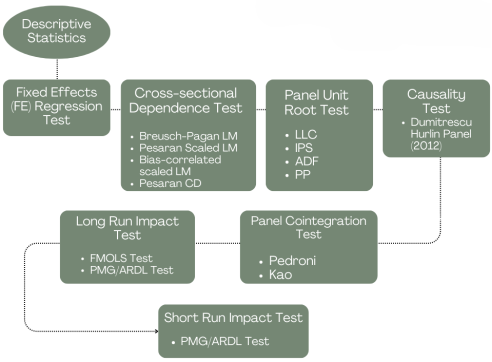
This section describes the sequential process used to look into the causes of inflation in order to give a strict roadmap of the empirical journey. The framework of the research design progresses from simple data diagnostics to intricate long-term estimations and directed testing. The study confirms that the ensuing FMOLS and PMG (ARDL) results are free from bias and spurious correlations by starting with descriptive and diagnostic tests (Fixed Effects and Cross-sectional Dependence) before moving on to stationarity and cointegration analysis. As seen in the flowchart below (
Figure 1), this thorough procedural structure provides a strong econometric strategy for managing the intricacies of a diverse South Asian panel.
Figure 1. Econometric Model Flow Chart.
4. Results and Discussion
4.1. Descriptive Statistics
Table 1. Descriptive Statistics.
| CPI | MSG | EXR | GDPG | REM | FDI | EXPG |
Mean | 6.456177 | 60.86366 | 93.27226 | 4.234213 | 7.633262 | 2.062265 | 24.35915 |
Median | 5.615627 | 55.31770 | 81.15010 | 5.031172 | 4.523832 | 0.706980 | 18.70000 |
Maximum | 49.72110 | 126.1671 | 327.5065 | 37.50787 | 66.12434 | 16.78347 | 96.60000 |
Minimum | -6.601186 | 27.60000 | 14.60201 | -32.90883 | 0.077343 | -0.638806 | 5.119171 |
Std. Dev. | 6.112190 | 21.23582 | 61.28817 | 6.476325 | 11.08012 | 3.615509 | 21.30833 |
Skewness | 3.703534 | 0.937764 | 1.768567 | -1.191274 | 3.329617 | 2.456036 | 1.925832 |
Kurtosis | 25.85823 | 3.717403 | 7.160466 | 18.78870 | 15.71921 | 7.834516 | 5.732647 |
Jarque-Bera | 2694.362 | 18.81728 | 139.1637 | 1189.811 | 961.9102 | 221.6713 | 104.0791 |
Probability | 0.000000 | 0.000082 | 0.000000 | 0.000000 | 0.000000 | 0.000000 | 0.000000 |
Sum | 723.0918 | 6816.730 | 10446.49 | 474.2319 | 854.9253 | 230.9737 | 2728.224 |
Sum Sq. Dev. | 4146.834 | 50056.55 | 416942.6 | 4655.649 | 13627.36 | 1450.982 | 50398.97 |
Observations | 112 | 112 | 112 | 112 | 112 | 112 | 112 |
Descriptive statistics for the dependent variable, the Consumer Price Index (CPI), along with the six macroeconomic explanatory variables measured for eight countries in South Asia for the period of 2011 to 2024 (N = 112) are provided in
Table 1. The results show that there is a great economic variance and volatility in the region. The CPI is 6.46% on average with a wide range of -6.60% to 49.72%, meaning some countries experienced deflation or price stability whilst others faced high inflationary pressures. The Money Supply Growth (MSG) showed the highest mean value (60.86%), while the Exchange Rate (EXR) showed the highest (93.27%) of the explanatory variables. The sizeable EXR standard deviation of 61.29 shows a high level of exchange rate volatility in South Asian economies. The GDP Growth (GDPG) was on average 4.23%, with a minimum value of -32.91%, reflecting significant economic disruptions. The average values of Remittance Growth (REM) and Export Growth (EXPG) stood at 7.63% and 24.36% respectively, and the highest values were extraordinary and represented the best achievements of the external sector development.
Skewness, kurtosis, and Jarque–Bera test were used to determine the distribution characteristics. Most of the variables have positive skewnesses, specifically CPI (3.70) and REM (3.33) indicating that there were some major inflationary and remittance shocks that were sporadic. GDPG, on the other hand, is highly negative skewed (-1.19) which means there have been significant economic declines, although they are rare. All the variables are highly kurtosed with values well above the benchmark of 3, with CPI (25.88) and GDPG (18.79) showing leptokurtic distributions, which are characterised by fat tails and high probability of extreme observations. The Jarque–Bera statistics for all variables are significant at the 1% level (p < 0.01), which means that the null hypothesis of normality is rejected. To address the non-normality, the use of robust panel estimation techniques, including the Generalised Method of Moments (GMM) is warranted to reduce the effects of heteroscedasticity and ensure the credible results of the empirical analysis.
4.2. Fixed Effects (FE) Regression Test
Table 2: Impact of Monetary and External Variables on CPI (Fixed Effects Model).
Dependent Variable: CPI
Number of obs. = 112
R-squared (Within): 0.3679
F-value (Prob.): 0.0000
Table 2. Fixed Effects Model.
Variables | Coefficient | Std. Error | t-stat | [95% conf. interval] |
MSG | -.09462* | .0540385 | -1.75 | -.2018576 | .0126175 |
EXR | .0786311*** | .01324 | 5.94 | .0523568 | .1049055 |
GDPG | -.1900331** | .0803229 | -2.37 | -.3494312 | -.030635 |
REM | -.0225199 | .0954502 | -0.24 | -.2119377 | .1668978 |
FDI | .3400653 | .4848003 | 0.70 | -.6220051 | 1.302136 |
EXPG | .3222589*** | .1012872 | 3.18 | .1212578 | .5232601 |
Constant | -2.693721 | 4.486019 | -0.60 | -11.59608 | 6.208637 |
The Fixed Effects (FE) regression model, which was used to account for time-invariant country-specific factors within the South Asian panel, is shown in
Table 2. An F-value probability of 0.0000 indicates that the model has a strong overall fit, supporting the independent variables' joint relevance. The model explains about 37% of the variation in the Consumer Price Index (CPI) within the sampled nations, according to the Within R-squared of 0.3679. At the 1% level (p < 0.01), the Exchange Rate (EXR) and Export Growth (EXPG) are the most important external factors. Currency depreciation is a major contributor to inflationary pressures, most likely through the channel of imported inflation, according to the positive coefficient for EXR (0.0786). The CPI is positively impacted by EXPG (0.3222), suggesting that more export demand may raise domestic price levels. However, at the 5% level, GDP Growth (GDPG) has a statistically significant negative impact (-0.1900, p < 0.05), indicating that economic growth in these countries is linked to better supply-side efficiency that help control inflation. Money Supply Growth (MSG), which has a marginal negative correlation with CPI (-0.0946), is only relevant at the 10% level when it comes to monetary and financial flows. Remittance Growth (REM) and Foreign Direct Investment (FDI), on the other hand, did not reach statistical significance in this particular model, as shown by their large confidence intervals that cross zero and low t-statistics. These findings demonstrate that real output growth and exchange rate stability are more important factors in determining price stability for South Asian nations than foreign capital inflows.
4.3. Cross-sectional Dependence Test
Table 3. Cross-sectional Dependence Test.
Variables | Breusch-Pagan LM | Pesaran Scaled LM | Bias-correlated scaled LM | Pesaran CD |
CPI | 75.49054*** | 6.346191*** | 6.038498*** | 6.833963*** |
MSG | 116.8798*** | 11.87707*** | 11.56938*** | 3.494951*** |
EXR | 242.9333*** | 28.72167*** | 28.41398*** | 15.02679*** |
GDPG | 99.11409*** | 9.503020*** | 9.195328*** | 7.582278*** |
REM | 96.41016*** | 9.141693*** | 8.834000*** | -0.399904 |
FDI | 32.99821* | 0.667914 | 0.360221 | -0.102352 |
EXPG | 107.0767*** | 10.56707*** | 10.25938*** | 8.186805*** |
The study looks for Cross-sectional Dependency (CD), which happens when shocks in one South Asian nation spread to another, in order to guarantee the accuracy of the panel data estimations. The Breusch-Pagan LM, Pesaran Scaled LM, Bias-corrected Scaled LM, and Pesaran CD tests are the four diagnostic tests whose findings are shown in
Table 3. At the 1% significance level (p < 0.01) for all four test parameters, the null hypothesis of cross-sectional independence is rejected for almost all variables, including CPI, MSG, EXR, GDPG, and EXPG. This suggests that these macroeconomic factors are linked among the eight nations, either as a result of similar trade regulations, shared regional economic shocks, or close proximity. Although the Pesaran CD test does not reject the null, Remittance Growth (REM) notably exhibits significant reliance in the LM-based tests, indicating a more intricate or localized correlation structure for migration-based inflows. The least strong indication of dependency is shown in FDI Growth, which is barely significant at the 10% level in the Breusch-Pagan LM test. All things considered, the widespread existence of cross-sectional dependence among the main variables attests to the fact that the nations in the panel do not develop independently.
4.4. Unit Root Test
Table 4. Panel unit root test.
Series: CPI |
Sample: 2011 2024 |
Exogenous variables: Individual effects |
User-specified lags: 1 |
Newey-West automatic bandwidth selection and Bartlett kernel |
Balanced observations for each test |
| | | Cross- | |
Method | Statistic | Prob.** | sections | Obs |
Null: Unit root (assumes common unit root process) |
Levin, Lin & Chu t* | -3.98515 | 0.0000 | 8 | 96 |
Null: Unit root (assumes individual unit root process) |
Im, Pesaran and Shin W-stat | -1.95194 | 0.0255 | 8 | 96 |
ADF - Fisher Chi-square | 30.9375 | 0.0137 | 8 | 96 |
PP - Fisher Chi-square | 25.2175 | 0.0661 | 8 | 104 |
A number of Panel Unit Root Tests were performed on the dependent variable, CPI, for the years 2011–2024 in order to guarantee the data's stationarity and reduce the possibility of erroneous regression. Results from first-generation tests assuming individual processes and those assuming a shared unit root process are shown in
Table 4. The null hypothesis of a common unit root is rejected because the Levin, Lin, and Chu (LLC) test statistic of -3.985 is highly significant (p < 0.01). This implies that, assuming a common autoregressive value, the series is stationary throughout the panel. Tests that allow for individual unit root processes, such as the Im, Pesaran and Shin (IPS) W-stat, ADF-Fisher Chi-square, and PP-Fisher Chi-square, were used to further validate these results
| [37] | Pesaran, M. H. (2007). A simple panel unit root test in the presence of cross-section dependence. Journal of Applied Econometrics, 22(2), 265–312. https://doi.org/10.1002/jae.951 |
| [41] | Shin, Y., Smith, R. P., & Pesaran, M. H. (1999). Pooled Mean Group estimation of dynamic heterogeneous panels. Journal of the American Statistical Association, 94(446), 621–634.
https://doi.org/10.2307/2670182 |
[37, 41]
. The PP-Fisher test is significant at the 10% level (p = 0.0661), whereas the IPS and ADF-Fisher tests are statistically significant at the 5% level (p = 0.0255 and p = 0.0137, respectively). When taken as a whole, these findings offer compelling proof that the CPI series is stationary at levels, or I(0), for the sample's South Asian nations. The use of standard panel estimating methodologies is justified by this stationarity at level, which also demonstrates that inflation shocks in these economies are often temporary rather than permanent.
4.5. Causality Tests
Table 5. Causality Tests (Dumitrescu Hurlin Panel).
Dependent Variable: CPI |
Independent Variables | W-bar | Z-bar |
MSG | 1.8863 | 1.7725* |
EXR | 5.3644 | 8.7288*** |
GDPG | 4.0349 | 2.8778*** |
REM | 2.0419 | 2.0839** |
FDI | 1.2772 | 0.5544 |
EXPG | 4.3850 | 3.3729*** |
Significant directional flows are found using the
Dumitrescu-Hurlin Panel Causality Test (Variable-specific Lag). The findings show that while Money Supply (MSG) and Remittances (REM) exhibit significance at the 10% and 5% levels, respectively, Exchange Rate (EXR), GDP Growth (GDPG), and Export Growth (EXPG) substantially Granger-cause CPI (p < 0.01). This demonstrates that these macroeconomic metrics are excellent indicators of inflationary trends in South Asia.
4.6. Panel Cointegration Test
Table 6. Panel Cointegration Test.
Test Type | Statistic | Individual Intercept | Intercept & Trend |
Weighted Statistic | p-value | Weighted Statistic | p-value |
Pedroni (Within-Dimension) | Panel v-Statistic | -2.014024 | 0.9780 | -2.691219 | 0.9964 |
Panel rho-Statistic | 3.612389 | 0.9998 | 4.337251 | 1.0000 |
Panel PP-Statistic | -5.812006 | 0.0000 | -2.826869 | 0.0024 |
Panel ADF-Statistic | -0.047162 | 0.4812 | 0.257585 | 0.6016 |
Pedroni (Between-Dimension) | Group rho-Statistic | 4.047385 | 1.0000 | 4.507895 | 1.0000 |
Group PP-Statistic | -6.162379 | 0.0000 | -7.087075 | 0.0000 |
Group ADF-Statistic | -0.672131 | 0.2508 | 0.469756 | 0.6807 |
The study uses the
| [36] | Pedroni, P. (2004). Panel cointegration. Econometric Theory, 20(3), 597–625. |
[36]
Pedroni (Residual-Based) Panel Cointegration Test to investigate the long-run equilibrium relationship between CPI and the chosen macroeconomic variables. The results for both within-dimension (Panel) and between-dimension (Group) statistics are shown in
Table 6, which takes into account both intercept and trend models as well as models with a single intercept. The empirical findings provide conflicting evidence; the Panel PP-Statistic and Group PP-Statistic are highly significant at the 1% level (p = 0.0000) across both model specifications, while the Panel v, rho, and ADF statistics typically fail to reject the null hypothesis of no cointegration. The PP and ADF statistics in Pedroni's framework frequently yield more trustworthy results in small-to-medium panels. Despite short-term oscillations, a long-term stable link between the variables is shown by the substantial statistical significance of the PP-statistics (Weighted Statistics of -5.81 and -6.16 for individual intercepts). This demonstrates that over time, the Consumer Price Index (CPI), GDP growth, and external monetary factors all move in tandem throughout the eight South Asian nations.
Table 7. Kao Residual Cointegration Test.
Kao Residual Cointegration Test |
Series: CPI MSG EXR GDPG REM FDI EXPG |
Sample: 2011 2024 |
Included observations: 112 |
Null Hypothesis: No cointegration |
Trend assumption: No deterministic trend |
User-specified lag length: 1 |
Newey-West automatic bandwidth selection and Bartlett kernel |
| t-Statistic | Prob. |
ADF | -6.138520 | 0.0000 |
Residual variance | 25.33613 | |
HAC variance | 21.49716 | |
The Kao Residual Cointegration Test was used to support the results of the Pedroni test and guarantee the stability of the long-term relationship between the variables. The Kao test imposes homogenous coefficients on the first-stage regressors while taking individual-specific intercepts into account, in contrast to the Pedroni test, which permits heterogeneous structural dynamics
. The Augmented Dickey-Fuller (ADF) t-statistic of -6.1385 is statistically significant at the 1% level (p = 0.0000), as shown in
Table 7. The null hypothesis of no cointegration is strongly rejected as a consequence, offering conclusive empirical proof that there is a long-term stable link between CPI and its macroeconomic drivers (MSG, EXR, GDPG, REM, FDI, and EXPG) throughout the South Asian panel. Concerns about spurious regression are allayed by the convergence of the Pedroni and Kao test results, which verify that the variables are cointegrated. As a result, the study is in a good position to proceed with estimating the long-run coefficients in order to ascertain the precise elasticities and effects of various external and monetary determinants on domestic price levels.
4.7. FMOLS Test
Table 8. FMOLS Test.
Dependent Variable: CPI |
Method: Panel Fully Modified Least Squares (FMOLS) |
Variable | Coefficient | Std. Error | t-Statistic | Prob. |
MSG | 0.178439 | 0.070110 | 2.545113 | 0.0128 |
EXR | 0.183415 | 0.022866 | 8.021380 | 0.0000 |
GDPG | -0.207074 | 0.061953 | -3.342424 | 0.0013 |
REM | 0.035978 | 0.079239 | 0.454039 | 0.6510 |
FDI | 0.676737 | 0.437243 | 1.547736 | 0.1255 |
EXPG | 0.391001 | 0.091120 | 4.291038 | 0.0000 |
R-squared | 0.620075 | Mean dependent var | 6.182667 |
Adjusted R-squared | 0.522778 | S.D. dependent var | 6.242306 |
S.E. of regression | 4.312264 | Sum squared resid | 1524.841 |
Long-run variance | 7.522706 | |
After cointegration was confirmed, the long-term connections were estimated using the Panel Fully Modified Least Squares (FMOLS) approach, which efficiently accounts for endogeneity and serial correlation that are frequently found in panel data. With an R-squared of 0.6201, as shown in
Table 8, the model exhibits excellent explanatory power, meaning that the macroeconomic variables included account for almost 62% of the long-run variation in CPI.
The empirical findings show that at the 5% and 1% levels, Money Supply Growth (MSG), Exchange Rate (EXR), and Export Growth (EXPG) all have a statistically significant positive effect on inflation. In particular, a 1% increase in MSG and EXR causes the CPI to rise by 0.178% and 0.183%, respectively, supporting the monetarist perspective and the notion of imported inflation in the context of South Asia. On the other hand, GDP Growth (GDPG) exhibits a substantial negative coefficient (-0.2071, p < 0.01), indicating that real economic expansion acts as a buffer against price increases. Despite having positive coefficients, FDI and Remittance Growth (REM) do not approach statistical significance, suggesting that domestic monetary policy and trade-related factors have a greater long-term inflationary impact.
4.8. Long Run Impact Test_PMG (ARDL)
Table 9. Long Run Impact Test_PMG (ARDL).
Dependent Variable: D(CPI) |
Method: ARDL |
Sample: 2012 2024 |
Included observations: 104 |
Variable | Coefficient | Std. Error | t-Statistic | Prob. |
| Long-run (Pooled) Coefficients |
MSG | 0.029452 | 0.029876 | 0.985812 | 0.3267 |
EXR | 0.160113 | 0.012393 | 12.91988 | 0.0000 |
GDPG | -0.108318 | 0.047902 | -2.261250 | 0.0260 |
REM | 0.062806 | 0.022645 | 2.773586 | 0.0066 |
FDI | -0.136537 | 0.317821 | -0.429605 | 0.6684 |
EXPG | 0.219870 | 0.050034 | 4.394420 | 0.0000 |
| Short-run (Mean-Group) Coefficients |
COINTEQ | -1.139170 | 0.196536 | -5.796230 | 0.0000 |
C | -11.68405 | 2.708735 | -4.313472 | 0.0000 |
@TREND | -1.082813 | 0.373788 | -2.896860 | 0.0046 |
Log-Likelihood: | -199.8355 |
The study defines the long-run equilibrium and short-run adjustment dynamics of the variables using an ARDL framework and the Pooled Mean Group (PMG) estimator. The Error Correction Term (COINTEQ), which is shown to be negative (-1.139) and highly significant at the 1% level (p = 0.0000), is a crucial part of this calculation. This conclusion indicates that any short-term deviations from the equilibrium price level are adjusted within the next year, confirming the presence of a stable long-run cointegrating relationship where the pace of adjustment is extraordinarily fast.
4.8.1. Long-Run Impact Analysis
Over time, the findings show that Export Growth (EXPG), Remittance Growth (REM), and Exchange Rate (EXR) are statistically significant and positive drivers of inflation. The prevalence of imported inflation in South Asia is highlighted by the fact that a 1% increase in EXR causes a 0.16% increase in CPI (p < 0.01). It's interesting to note that Remittance Growth is significant in this model (0.0628, p < 0.01), indicating that strong remittance inflows may drive up local prices by increasing aggregate demand. On the other hand, GDP Growth (GDPG) continues to have a significant negative impact (-0.108, p = 0.026), confirming that real economic growth reduces inflationary pressures. Furthermore, FDI and Money Supply Growth (MSG) do not achieve statistical significance in this long-run specification, suggesting that their influence on price stability may be indirect or absorbed by other PMG framework factors.
4.8.2. Short-Run Dynamics
The system's instant response is the main focus of the short-run coefficients (Mean-Group). An oscillatory convergence, in which the system overcorrects significantly before reaching equilibrium, is indicated by the high absolute value of the Error Correction Term (beyond 1.0). When all other factors are held constant, the Constant and Trend terms are both statistically significant and negative, indicating an independent downward pressure on inflation levels over time. This dual-level analysis demonstrates that the South Asian region has a strong corrective mechanism to return to equilibrium after macroeconomic shocks, even though trade-related factors (EXR and EXPG) and capital inflows (REM) determine the long-term price trend.
5. Empirical Findings and Panel Discussion
The Consumer Price Index (CPI) averaged 6.46%, with a standard deviation of 6.11 indicating substantial volatility, according to the descriptive statistics. For every variable, the Jarque-Bera test rejects the null hypothesis of normality (p < 0.01). The majority of variables showed cross-sectional dependence (p < 0.01), and Panel Unit Root tests proved that the CPI is stationary at level I(0). Additionally, a long-term cointegrating link between the macroeconomic factors and CPI is confirmed by both the Pedroni and Kao tests (p < 0.01). The structural causes of inflation are consistently supported by the Panel ARDL (PMG) and FMOLS estimates. The CPI is significantly positively impacted over time by the Exchange Rate (EXR) and Export Growth (EXPG) (p < 0.01), indicating that both currency devaluation and external demand are inflationary. GDP Growth (GDPG) has a noteworthy negative coefficient (-0.108), suggesting that economic growth contributes to price stabilisation. FDI is still statistically negligible in the PMG model, despite Remittance Growth (REM) being considerable. After a shock, the Error Correction Term (COINTEQ) is negative and significant (-1.139, p < 0.01), suggesting an extraordinarily fast rate of adjustment toward equilibrium.
Most of the research hypotheses developed for this study are strongly supported by the empirical results. The Pedroni and Kao cointegration results, which demonstrate that the Consumer Price Index (CPI) and its determinants move together over time, provide significant support for Hypothesis 1 (H1), which proposed the presence of a long-run equilibrium connection. As for the individual drivers, both the Exchange Rate (EXR) and Export Growth (EXPG) showed positive and statistically significant coefficients across the FMOLS and PMG (ARDL) models, supporting Hypotheses 2 (H2) and 4 (H4). This implies that currency depreciation and shocks to the external economy are the main causes of inflation in South Asia. In a similar vein, the substantial negative correlation between GDP growth and CPI supports Hypothesis 3 (H3), which holds that real economic activity acts as a stabilizer against regional price volatility. Additionally, the study shows conflicting results for Hypothesis 6 (H6) about capital inflows; FDI remained minor but Remittances (REM) became substantial in the long-run ARDL framework, resulting in only partial support for this hypothesis. Lastly, the Dumitrescu-Hurlin Causality test at Variable Specific Lag fully supports Hypothesis 5 (H5) regarding directional impact. The fact that the null hypothesis for EXR, EXPG, and GDPG was rejected (p < 0.01) indicates that these variables serve as causal predecessors rather than only being linked with inflation. When taken as a whole, these findings offer a thorough confirmation of the suggested theoretical framework, highlighting the importance of both domestic production and foreign trade in determining South Asia's inflationary environment.
6. Conclusion
The present study used a broad-based panel econometric approach to examine macroeconomic determinants of inflation in eight South Asian economies during 2011–2024. The Consumer Price Index (CPI) was used to proxy the inflation rate, while key macroeconomic data such as money supply growth, exchange rate, GDP growth, remittances, foreign direct investment (FDI), and export growth were included in the analysis. For robust empirical evidence, several complementary estimation techniques were used, such as the Fixed Effects (FE) technique and the panel unit root tests, the Pedroni and Kao panel cointegration tests, the Dumitrescu–Hurlin panel causality tests, the Fully Modified Ordinary Least Squares (FMOLS) technique, and the Pooled Mean Group Autoregressive Distributed Lag (PMG-ARDL) estimator.
The empirical results show that domestic macroeconomic conditions and external sector conditions affect inflation in South Asia. The panel cointegration analysis results show that there exists a long-run stable relationship between inflation and its determinants, meaning that over the short-run and medium-run, macroeconomic variables move together, but not necessarily in the same direction. Exchange rate depreciation is consistently the most important determinant of inflation in the region, irrespective of the estimation technique used, reflecting the importance of imported inflation for the region. An increase in export demand also has a very positive effect on inflation, indicating that increased external demand can raise domestic prices because it results in higher demand for scarce resources.
On the other hand, real GDP growth has a substantial negative correlation with inflation, which suggests that periods of economic growth are associated with price stability through an enhancement of productive capacity and efficiency on the supply side. Remittances show positive and statistically significant impact in the long run in the PMG-ARDL system, but it is not as strong as the impact of exchange rates. Foreign direct investment, on the other hand, does not have a statistically significant effect on inflation, suggesting that it is likely to have an indirect effect or act as a mediator via other macroeconomic mechanisms.
The large error correction coefficient indicates that the economies of the South Asian countries are quite resilient in adjusting to macroeconomic shocks in a relatively short period of time. In addition, the panel causality analysis shows that the exchange rate, GDP growth, export growth, and (to a lesser degree) money supply and remittances have predictive power for future movements in inflation.
Overall, the results indicate that inflation in South Asia is a multi-dimensional phenomenon which is related to the interplay of monetary conditions, external sector performance and real economic activity. The study advances the literature by supporting the existing empirical evidence on cross-country variation in inflation with multiple estimation methods for panel data and by including new observations since the pandemic that reflect changing inflationary trends. The results are significant for policy makers who want to draw up coordinated policies, both monetary and exchange-rate and growth oriented to keep the region's prices stable in the long term.
7. Policy Implication
These empirical results suggest a number of important policy implications for the South Asian economies. Firstly, to counteract the inflationary effects of exchange rate depreciation, maintaining exchange rate stability should be a primary macroeconomic objective. This calls for careful exchange-rate policies and building foreign exchange reserves. Secondly, an improvement in GDP growth will help achieve long-term price stability, so investments in infrastructure and technology are needed to increase domestic production. Third, export growth has a positive effect on inflation, but policies to support domestic supply need to go hand in hand. Fourthly, remittances should be channeled towards productive investments to reduce the demand-pull inflation. Fifth, though there is no direct correlation between foreign direct investment (FDI) and inflation, the improvement of the investment climate is important in order to attract high quality FDI and therefore promote long-term economic growth. Finally, enhanced policy coordination within the South Asian region can help increase their ability to respond to external economic shocks. All these factors point to the importance of a unified approach to the management of monetary policy, economic growth and regional cooperation to control inflation in South Asia.
Abbreviations
FDI | Foreign Direct Investment |
WDI | World Development Indicators |
IFS | International Financial Statistics |
CPI | Consumer Price Index |
Author Contributions
Tamal Chakrobortty: Conceptualization, Formal Analysis, Methodology
Gopal Karmakar: Data curation, Project administration, Writing – original draft, Writing – review & editing
Sabrina Chowdhury: Data curation, Writing – review & editing
Md. Fahim Muntasim Rafi: Data curation, Writing – review & editingn
Julkar Nain: Data curation, Investigation, Writing – review & editing
Data Availability Statement
The World Bank Indicators databases are used in this study's empirical research and findings.
Conflicts of Interest
The authors declare no conflicts of interest.
References
| [1] |
Abdurehman, A. A., & Hacilar, S. (2016). The relationship between exchange rate and inflation: An empirical study of Turkey. International Journal of Economics and Financial Issues, 6(4), 1454-1459.
|
| [2] |
Barro, R. J. (1995). Inflation and Economic Growth. Bank of England Quarterly Bulletin, 35(2), 166–176.
|
| [3] |
Basnet, H. C., Donou-Adonsou, F., & Upadhyaya, K. (2022). Remittances-inflation nexus in South Asia: an empirical examination. Journal of Financial Economic Policy, 14(2), 152-161.
https://doi.org/10.1108/jfep-02-2021-0053
|
| [4] |
Burkhanov, A. U., Kurbonbekova, M. T., & Usmonov, B. (2024). Impact of money supply on inflation in Uzbekistan—VAR approach. In Ecological footprint of the modern economy and the ways to reduce it: The role of leading technologies and responsible innovations (pp. 459-463).
https://doi.org/10.1007/978-3-031-49711-7_75
|
| [5] |
Carranza, L., Galdon-Sanchez, J. E., & Gomez-Biscarri, J. (2009). Exchange rate and inflation dynamics in dollarized economies. Journal of Development Economics, 89(1), 98-108.
https://doi.org/10.1016/j.jdeveco.2008.06.007
|
| [6] |
Chakrobortty, T. (2023). Determining Factors of Share Prices in Bangladesh: An Empirical study on cash dividends and retained Earnings. International Journal of Research Publication and Reviews, 04(02), 1400–1415.
https://doi.org/10.55248/gengpi.2023.4230
|
| [7] |
Chakrobortty, T., Alam, S., Karmakar, G., Proteek, M. S. M., Rahman, M. S., & Rahman, A. K. M. A. (2026). The Confluence of Policy and practice: Marine Fisheries of Bangladesh as a catalyst for SDG achievement. International Journal of Innovative Science and Research Technology (IJISRT), 1982.
https://doi.org/10.38124/ijisrt/26apr931
|
| [8] |
Chakrobortty, T., Alam, S., Rahman, A. K. M. A., Proteek, M. S. M., & Karmakar, G. (2025). Bangladesh and the Blue Economy: Harnessing Marine Resources for Sustainable growth. International Journal of Innovative Science and Research Technology (IJISRT), 2415.
https://doi.org/10.38124/ijisrt/25nov1498
|
| [9] |
Chakrobortty, T., Banu, M. L. A., Alam, S., & Dobey, D. R. (2026). Green ınvestment and financial efficiency as catalysts for SDG progress: Evidence from Bangladesh’s banking sector. Journal of Ekonomi, 8(1), 1-15.
https://doi.org/10.58251/ekonomi.1
|
| [10] |
Chakrobortty, T., Karmakar, G., Rahman, M., Rahman, Md. S., & Sabrina Chowdhury. (2026). THE NEXUS BETWEEN TOURISM, ENERGY CONSUMPTION AND SDG 7: A PANEL DATA ANALYSIS OF APEC ECONOMIES. In International Journal of Research and Analytical Reviews (Vol. 13, Issue 4, pp. 33–34).
|
| [11] |
Chakrobortty, T., Karmakar, A., Rahman, A. K. M. A., Dobey, D. R., & Mim, M. R. T. (2025). Bank performance relation with green banking practices: A study on commercial bank in Bangladesh. Journal of Ekonomi, 7(2), 107–118.
https://doi.org/10.58251/ekonomi.1610026
|
| [12] |
Chakrobortty, T., & Sultana, M. (2023). Financial Inclusion for Rural Community in Bangladesh through Agent Banking. International Journal for Multidisciplinary Research, 5(3).
https://doi.org/10.36948/ijfmr.2023.v05i03.2747
|
| [13] |
Chand, S. A., & Singh, B. (2025). Investigating the Relationship Between Remittances and Inflation in Developing and Emerging Economies: A Disaggregated Analysis Using the cross-Sectional Augmented Autoregressive Distributed Lag Approach. Emerging Markets Finance and Trade, 61(14), 4500-4511.
https://doi.org/10.1080/1540496x.2025.2519406
|
| [14] |
De Grauwe, P., & Schnabl, G. (2008). Exchange rate stability, inflation, and growth in (South) Eastern and Central Europe. Review of Development Economics, 12(3), 530-549.
https://doi.org/10.1111/j.1467-9361.2008.00470.x
|
| [15] |
Dilanchiev, A., Aghayev, A., Rahman, M. H., Ferdaus, J., & Baghirli, A. (2021). Dynamic analysis for measuring the impact of remittance inflows on inflation: evidence from Georgia. International Journal of Financial Research, 12(1), 339-347.
https://doi.org/10.5430/ijfr.v12n1p339
|
| [16] |
Doan Van, D. (2020). Money supply and inflation impact on economic growth. Journal of Financial Economic Policy, 12(1), 121-136.
https://doi.org/10.1108/jfep-10-2018-0152
|
| [17] |
Dumitrescu, E.-I., & Hurlin, C. (2012). Testing for Granger non-causality in heterogeneous panels. Economic Modelling, 29(4), 1450–1460.
https://doi.org/10.1016/j.econmod.2012.02.014
|
| [18] |
Fischer, S. (1993). The role of macroeconomic factors in growth. Journal of Monetary Economics, 32(3), 485–512.
https://doi.org/10.1016/0304-3932(93)90027-D
|
| [19] |
Friedman, M. (1968). The Role of Monetary Policy. American Economic Review, 58(1), 1–17.
https://doi.org/10.20955/r.50.9-24.lcj
|
| [20] |
Friedman, M. (1970). A theoretical framework for monetary analysis. Journal of Political Economy, 78(2), 193–238.
https://doi.org/10.1086/259623
|
| [21] |
Gharehgozli, O., & Lee, S. (2022). Money supply and inflation after COVID-19. Economies, 10(5), 101.
https://doi.org/10.3390/economies10050101
|
| [22] |
Ha, J., Stocker, M. M., & Yilmazkuday, H. (2020). Inflation and exchange rate pass-through. journal of International Money and Finance, 105, 102187.
https://doi.org/10.1016/j.jimonfin.2020.102187
|
| [23] |
International Monetary Fund. (2023). World Economic Outlook: Inflation and Disinflation.
|
| [24] |
International Monetary Fund. (2023). World Economic Outlook: Navigating Global Divergences. Washington, DC: International Monetary Fund.
|
| [25] |
Kao, C. (1999). Spurious regression and residual-based tests for cointegration in panel data. Journal of Econometrics, 90(1), 1–44.
https://doi.org/10.1016/s0304-4076(98)00023-2
|
| [26] |
Kara, A., & Nelson, E. (2003). The exchange rate and inflation in the UK. Scottish Journal of Political Economy, 50(5), 585-608.
https://doi.org/10.1111/j.0036-9292.2003.05005003.x
|
| [27] |
Khan, M. S., & Senhadji, A. S. (2001). Threshold effects in the relationship between inflation and growth. IMF Staff Papers, 48(1), 1–21.
https://www.jstor.org/stable/4621658
|
| [28] |
Khan, M., & Waqas, H. (2020). Institutional quality and the relationship between inflation and economic growth. Empirical economics, 58(2), 627-649.
https://doi.org/10.1007/s00181-018-1479-7
|
| [29] |
Kremer, S., Bick, A., & Nautz, D. (2013). Inflation and growth: New evidence from a dynamic panel threshold analysis. Empirical Economics, 44(2), 861–878.
https://doi.org/10.1007/s00181-012-0553-9
|
| [30] |
Kryeziu, N., & Durguti, E. (2019). The impact of inflation on economic growth: The case of Eurozone. International Journal of Finance & Banking Studies (2147-4486), 8(1), 01–09.
https://doi.org/10.20525/ijfbs.v8i1.297
|
| [31] |
Kwon, G., McFarlane, L., & Robinson, W. (2009). Public debt, money supply, and inflation: a cross-country study. IMF Staff Papers, 56(3), 476-515.
https://doi.org/10.1057/imfsp.2008.26
|
| [32] |
Le Thanh, T. U. N. G., Ly, P. T. M., Nhu, P. T. Q., Thanh, P. T., Le Tuan, A. N. H., & Phung, T. T. P. (2015). The impact of remittance inflows on inflation: Evidence in Asian and the Pacific developing countries. Journal of Applied Economic Sciences, 10(7), 37-51.
|
| [33] |
Mishchenko, V., Naumenkova, S., Mishchenko, S., & Ivanov, V. (2018). Inflation and economic growth: The search for a compromise for the Central Bank's monetary policy. Banks & bank systems, (13, Iss. 2), 153-163.
http://dx.doi.org/10.21511/bbs.13(2).2018.13
|
| [34] |
Mishkin, F. S. (2019). The Economics of Money, Banking, and Financial Markets (12th ed.). Pearson.
|
| [35] |
Ndoricimpa, A. (2017). Threshold effects of inflation on economic growth: is Africa different?. International Economic Journal, 31(4), 599-620.
https://doi.org/10.1080/10168737.2017.1380679
|
| [36] |
Pedroni, P. (2004). Panel cointegration. Econometric Theory, 20(3), 597–625.
|
| [37] |
Pesaran, M. H. (2007). A simple panel unit root test in the presence of cross-section dependence. Journal of Applied Econometrics, 22(2), 265–312.
https://doi.org/10.1002/jae.951
|
| [38] |
Petkovski, M., Kjosevski, J., & Simeonovski, K. (2024). Testing for causality between remittances and inflation: Evidence from Central and Eastern Europe. Panoeconomicus, 71(2), 191-213.
https://doi.org/10.2298/PAN210322019P
|
| [39] |
Rahman, A. K. M. A., & Chakrobortty, T. (2026). Landscaping Theory and Lean Tourism: Evidence from the World’s Longest Natural Sea Beach. INTERNATIONAL JOURNAL OF MULTIDISCIPLINARY RESEARCH AND ANALYSIS, 09(07).
https://doi.org/10.47191/ijmra/v9-i7-06
|
| [40] |
Rivera, J. P. R., & Tullao Jr, T. S. (2020). Investigating the link between remittances and inflation: evidence from the Philippines. South East Asia Research, 28(3), 301-326.
https://doi.org/10.1080/0967828X.2020.1793685
|
| [41] |
Shin, Y., Smith, R. P., & Pesaran, M. H. (1999). Pooled Mean Group estimation of dynamic heterogeneous panels. Journal of the American Statistical Association, 94(446), 621–634.
https://doi.org/10.2307/2670182
|
| [42] |
Stylianou, T., Nasir, R., & Waqas, M. (2024). The relationship between money supply and inflation in Pakistan. Plos one, 19(3), e0301257.
https://doi.org/10.1371/journal.pone.0301257
|
| [43] |
Taylor, J. B. (2000). Low Inflation, Pass-Through, and the Pricing Power of Firms. European Economic Review, 44(7), 1389–1408.
https://doi.org/10.1016/s0014-2921(00)00037-4
|
| [44] |
Valogo, M. K., Duodu, E., Yusif, H., & Baidoo, S. T. (2023). Effect of exchange rate on inflation in the inflation targeting framework: Is the threshold level relevant?. Research in Globalization, 6, 100119.
https://doi.org/10.1016/j.resglo.2023.100119
|
| [45] |
Whelan, K. (2021). Central banks and inflation: Where do we stand and how did we get here? European Journal of Economics and Economic Policies: Intervention, 18(3), 310–330.
https://doi.org/10.4337/ejeep.2021.03.06
|
| [46] |
World Bank. (2023). Migration and Development Brief.
|
| [47] |
World Bank. (2024). Global Economic Prospects. Washington, DC: World Bank.
|
Cite This Article
-
APA Style
Chakrobortty, T., Karmakar, G., Chowdhury, S., Rafi, M. F. M., Nain, J. (2026). Macroeconomic Determinants of Inflation: An Empirical Analysis Using CPI and Key Economic Indicators. International Journal of Business and Economics Research, 15(5), 164-178. https://doi.org/10.11648/j.ijber.20261505.15
 Copy
|
 Download
ACS Style
Chakrobortty, T.; Karmakar, G.; Chowdhury, S.; Rafi, M. F. M.; Nain, J. Macroeconomic Determinants of Inflation: An Empirical Analysis Using CPI and Key Economic Indicators. Int. J. Bus. Econ. Res. 2026, 15(5), 164-178. doi: 10.11648/j.ijber.20261505.15
Copy
|
Download
AMA Style
Chakrobortty T, Karmakar G, Chowdhury S, Rafi MFM, Nain J. Macroeconomic Determinants of Inflation: An Empirical Analysis Using CPI and Key Economic Indicators. Int J Bus Econ Res. 2026;15(5):164-178. doi: 10.11648/j.ijber.20261505.15
Copy
|
Download
-
@article{10.11648/j.ijber.20261505.15,
  author = {Tamal Chakrobortty and Gopal Karmakar and Sabrina Chowdhury and Md. Fahim Muntasim Rafi and Julkar Nain},
  title = {Macroeconomic Determinants of Inflation: An Empirical Analysis Using CPI and Key Economic Indicators},
  journal = {International Journal of Business and Economics Research},
  volume = {15},
  number = {5},
  pages = {164-178},
  doi = {10.11648/j.ijber.20261505.15},
  url = {https://doi.org/10.11648/j.ijber.20261505.15},
  eprint = {https://article.sciencepublishinggroup.com/pdf/10.11648.j.ijber.20261505.15},
  abstract = {Inflation is a significant macroeconomic challenge in South Asia, adversely affecting purchasing power, income distribution, and economic sustainability. This study investigates the macroeconomic determinants of consumer price index (CPI) inflation across eight selected South Asian countries over the period 2011–2024. Using annual panel data obtained from the World Bank’s World Development Indicators (WDI) and the IMF’s International Financial Statistics (IFS), the study employs Fixed Effects, panel unit root tests, Pedroni and Kao cointegration tests, Dumitrescu–Hurlin causality analysis, FMOLS, and PMG-ARDL models. The findings confirm the existence of a stable long-run relationship between inflation and its key determinants. Inflation is significantly driven upward by exchange rate depreciation, export growth, and growth in remittance inflows, while higher real GDP growth contributes to reducing inflationary pressures. Foreign direct investment (FDI), however, has no significant long-run effect on inflation. The error-correction mechanism indicates a relatively rapid adjustment of short-run deviations toward the long-run equilibrium. These findings provide important policy implications for South Asian economies, particularly regarding exchange rate management, sustainable economic growth, and effective macroeconomic policies to maintain price stability and support long-term economic sustainability.},
 year = {2026}
}
Copy
|
Download
-
TY  - JOUR
T1  - Macroeconomic Determinants of Inflation: An Empirical Analysis Using CPI and Key Economic Indicators
AU  - Tamal Chakrobortty
AU  - Gopal Karmakar
AU  - Sabrina Chowdhury
AU  - Md. Fahim Muntasim Rafi
AU  - Julkar Nain
Y1  - 2026/10/31
PY  - 2026
N1  - https://doi.org/10.11648/j.ijber.20261505.15
DO  - 10.11648/j.ijber.20261505.15
T2  - International Journal of Business and Economics Research
JF  - International Journal of Business and Economics Research
JO  - International Journal of Business and Economics Research
SP  - 164
EP  - 178
PB  - Science Publishing Group
SN  - 2328-756X
UR  - https://doi.org/10.11648/j.ijber.20261505.15
AB  - Inflation is a significant macroeconomic challenge in South Asia, adversely affecting purchasing power, income distribution, and economic sustainability. This study investigates the macroeconomic determinants of consumer price index (CPI) inflation across eight selected South Asian countries over the period 2011–2024. Using annual panel data obtained from the World Bank’s World Development Indicators (WDI) and the IMF’s International Financial Statistics (IFS), the study employs Fixed Effects, panel unit root tests, Pedroni and Kao cointegration tests, Dumitrescu–Hurlin causality analysis, FMOLS, and PMG-ARDL models. The findings confirm the existence of a stable long-run relationship between inflation and its key determinants. Inflation is significantly driven upward by exchange rate depreciation, export growth, and growth in remittance inflows, while higher real GDP growth contributes to reducing inflationary pressures. Foreign direct investment (FDI), however, has no significant long-run effect on inflation. The error-correction mechanism indicates a relatively rapid adjustment of short-run deviations toward the long-run equilibrium. These findings provide important policy implications for South Asian economies, particularly regarding exchange rate management, sustainable economic growth, and effective macroeconomic policies to maintain price stability and support long-term economic sustainability.
VL  - 15
IS  - 5
ER  -
Copy
|
Download





 Share This Article
 Twitter
 Linked In
 Facebook