
 ,
Goulai Bi You Bazago Etienne,
Diessongo Nodouma Safiatou,
Coulibaly Quidana Desiree,
Azonbakin Simon,
Laleye Anatole
,
Goulai Bi You Bazago Etienne,
Diessongo Nodouma Safiatou,
Coulibaly Quidana Desiree,
Azonbakin Simon,
Laleye Anatole
Background: Fertility disorders have been a significant issue affecting populations for decades. According to the World Health Organization (WHO), this issue affects approximately 17.5% of the adult population roughly one in six people worldwide. Method: This was a descriptive cross-sectional study conducted over a seven-year period at the Cotonou cytogenetics laboratory. The study aimed to highlight the impact of chromosomal translocations on couple fertility. Participants included patients found to have a chromosomal translocation via karyotyping during an infertility workup. Patients whose karyotypes revealed abnormalities other than chromosomal translocations were excluded from the study. Conventional cytogenetic techniques were employed; specifically, G-banded metaphase karyotyping was performed using lymphocyte cultures incubated at 37°C for 72 hours. Results: A total of 36 cases of chromosomal translocations were identified. The genotypes involved 31 cases of Robertsonian translocations (88.9%) and 5 cases of reciprocal translocations (11.1%). Balanced Robertsonian translocations were found in 22 female patients during investigations into reproductive disorders. One case of a balanced homologous Robertsonian translocation was recorded in a patient with a history of recurrent miscarriages. Discussion: Chromosomal translocations whether balanced or unbalanced significantly impact couple fertility due to associated gamete and embryonic development abnormalities. Given this, would it not be beneficial to include karyotyping in prenuptial health screenings?
| Published in | International Journal of Genetics and Genomics (Volume 14, Issue 3) |
| DOI | 10.11648/j.ijgg.20261403.12 |
| Page(s) | 113-116 |
| Creative Commons |
This is an Open Access article, distributed under the terms of the Creative Commons Attribution 4.0 International License (http://creativecommons.org/licenses/by/4.0/), which permits unrestricted use, distribution and reproduction in any medium or format, provided the original work is properly cited. |
| Copyright |
Copyright © The Author(s), 2026. Published by Science Publishing Group |
Karyotype, Chromosome, Couple Infertility, Chromosomal Translocations, Chromosomal Abnormality, Cytogenetic Analysis
FISH | Fluorescence in Situ Hybridization |
WHO | World Health Organization |
KCl | Potassium Chloride |
der | Derivative Chromosome |
rob | Robertsonian Translocation |
| [1] | Dimassi S, Tilla M, Sanlaville D. Anomalies chromosomiques ଝ. J Pediatr Pueric. Epub ahead of print 2017. |
| [2] | Sajiro MAKING, Akira TONOMURA, Ei MATSUNA. Chromosome studies in ten cases of mongolism. (Preliminary report), Y. TANAKA, M.J. 1960, 36(10), 670-4. |
| [3] | Benchikh S, Bousfiha A, Razoki L, et al. Chromosome Abnormalities Related to Reproductive and Sexual Development Disorders: A 5-Year Retrospective Study. Biomed Res Int; 2021. Epub ahead of print 2021. |
| [4] | McGowan-Jordan J, Hastings RJ, Moore S. An International System for Human Cytogenomic Nomenclature (2020). Karger 2020; 170. |
| [5] | Tuna M, Amos CI, Mills GB. Whole-chromosome arm acquired uniparental disomy in cancer development is a consequence of isochromosome formation. Neoplasia (United States) 2022; 25: 9–17. |
| [6] | Liu D, Chen C, Zhang X, et al. Successful birth after preimplantation genetic testing for a couple with two different reciprocal translocations and review of the literature. Reprod Biol Endocrinol 2021; 19: 1–9. |
| [7] | Chen SY, Schenkel FS, Melo ALP, et al. Identifying pleiotropic variants and candidate genes for fertility and reproduction traits in Holstein cattle via association studies based on imputed whole-genome sequence genotypes. BMC Genomics 2022; 23: 1–22. |
| [8] | Gardner R, Sutherland S, Shaffer L. Variant chromosomes and abnormalities of no phenotypic consequence. Chromosome abnormalities and genetic counselling. Oxford Univ Press 2012; 12: 2012. |
| [9] | Hervé b, Molina-Gomes D, Picone O, et al. Trisomy 21: A french discovery with major diagnostic implications. Feuill Biol Sept 2014; 55: 320–329. |
| [10] | Caloone J, Sanlaville D, Fichez A, et al. Trisomie 21 par isochromosome: À Propos d’un cas rare de discordance fœto-placentaire complète. Gynecol Obstet Fertil 2011; 39: e77–e80. |
| [11] | Morin SJ, Eccles J, Iturriaga A, et al. Translocations, inversions and other chromosome rearrangements. Fertil Steril 2017; 107: 19–26. |
APA Style
Alice, T. W., Etienne, G. B. Y. B., Safiatou, D. N., Desiree, C. Q., Simon, A., et al. (2026). Chromosomal Translocations and Couple Infertility in Cotonou. International Journal of Genetics and Genomics, 14(3), 113-116. https://doi.org/10.11648/j.ijgg.20261403.12
ACS Style
Alice, T. W.; Etienne, G. B. Y. B.; Safiatou, D. N.; Desiree, C. Q.; Simon, A., et al. Chromosomal Translocations and Couple Infertility in Cotonou. Int. J. Genet. Genomics 2026, 14(3), 113-116. doi: 10.11648/j.ijgg.20261403.12
@article{10.11648/j.ijgg.20261403.12,
  author = {Tuo-Benie Wako-Tianwa Alice and Goulai Bi You Bazago Etienne and Diessongo Nodouma Safiatou and Coulibaly Quidana Desiree and Azonbakin Simon and Laleye Anatole},
  title = {Chromosomal Translocations and Couple Infertility in Cotonou},
  journal = {International Journal of Genetics and Genomics},
  volume = {14},
  number = {3},
  pages = {113-116},
  doi = {10.11648/j.ijgg.20261403.12},
  url = {https://doi.org/10.11648/j.ijgg.20261403.12},
  eprint = {https://article.sciencepublishinggroup.com/pdf/10.11648.j.ijgg.20261403.12},
  abstract = {Background: Fertility disorders have been a significant issue affecting populations for decades. According to the World Health Organization (WHO), this issue affects approximately 17.5% of the adult population roughly one in six people worldwide. Method: This was a descriptive cross-sectional study conducted over a seven-year period at the Cotonou cytogenetics laboratory. The study aimed to highlight the impact of chromosomal translocations on couple fertility. Participants included patients found to have a chromosomal translocation via karyotyping during an infertility workup. Patients whose karyotypes revealed abnormalities other than chromosomal translocations were excluded from the study. Conventional cytogenetic techniques were employed; specifically, G-banded metaphase karyotyping was performed using lymphocyte cultures incubated at 37°C for 72 hours. Results: A total of 36 cases of chromosomal translocations were identified. The genotypes involved 31 cases of Robertsonian translocations (88.9%) and 5 cases of reciprocal translocations (11.1%). Balanced Robertsonian translocations were found in 22 female patients during investigations into reproductive disorders. One case of a balanced homologous Robertsonian translocation was recorded in a patient with a history of recurrent miscarriages. Discussion: Chromosomal translocations whether balanced or unbalanced significantly impact couple fertility due to associated gamete and embryonic development abnormalities. Given this, would it not be beneficial to include karyotyping in prenuptial health screenings?},
 year = {2026}
}
TY  - JOUR
T1  - Chromosomal Translocations and Couple Infertility in Cotonou
AU  - Tuo-Benie Wako-Tianwa Alice
AU  - Goulai Bi You Bazago Etienne
AU  - Diessongo Nodouma Safiatou
AU  - Coulibaly Quidana Desiree
AU  - Azonbakin Simon
AU  - Laleye Anatole
Y1  - 2026/07/28
PY  - 2026
N1  - https://doi.org/10.11648/j.ijgg.20261403.12
DO  - 10.11648/j.ijgg.20261403.12
T2  - International Journal of Genetics and Genomics
JF  - International Journal of Genetics and Genomics
JO  - International Journal of Genetics and Genomics
SP  - 113
EP  - 116
PB  - Science Publishing Group
SN  - 2376-7359
UR  - https://doi.org/10.11648/j.ijgg.20261403.12
AB  - Background: Fertility disorders have been a significant issue affecting populations for decades. According to the World Health Organization (WHO), this issue affects approximately 17.5% of the adult population roughly one in six people worldwide. Method: This was a descriptive cross-sectional study conducted over a seven-year period at the Cotonou cytogenetics laboratory. The study aimed to highlight the impact of chromosomal translocations on couple fertility. Participants included patients found to have a chromosomal translocation via karyotyping during an infertility workup. Patients whose karyotypes revealed abnormalities other than chromosomal translocations were excluded from the study. Conventional cytogenetic techniques were employed; specifically, G-banded metaphase karyotyping was performed using lymphocyte cultures incubated at 37°C for 72 hours. Results: A total of 36 cases of chromosomal translocations were identified. The genotypes involved 31 cases of Robertsonian translocations (88.9%) and 5 cases of reciprocal translocations (11.1%). Balanced Robertsonian translocations were found in 22 female patients during investigations into reproductive disorders. One case of a balanced homologous Robertsonian translocation was recorded in a patient with a history of recurrent miscarriages. Discussion: Chromosomal translocations whether balanced or unbalanced significantly impact couple fertility due to associated gamete and embryonic development abnormalities. Given this, would it not be beneficial to include karyotyping in prenuptial health screenings?
VL  - 14
IS  - 3
ER  -
Department of Medical Biology, Basic and Biological Sciences, University of Abomey-Calavi, Cotonou, Benin; Laboratory of Histology, Embryology, and Cytogenetics, Alassane Ouattara University, Bouake, Ivory Coast
Department of Medical Biology, Basic and Biological Sciences, University of Abomey-Calavi, Cotonou, Benin; Abidjan Faculty of Medical Sciences, Felix Houphouët-Boigny University (UFHB), Abidjan, Ivory Coast
Department of Medical Biology, Basic and Biological Sciences, University of Abomey-Calavi, Cotonou, Benin
Department of Medical Biology, Basic and Biological Sciences, University of Abomey-Calavi, Cotonou, Benin; Abidjan Faculty of Medical Sciences, Felix Houphouët-Boigny University (UFHB), Abidjan, Ivory Coast
Department of Medical Biology, Basic and Biological Sciences, University of Abomey-Calavi, Cotonou, Benin
Department of Medical Biology, Basic and Biological Sciences, University of Abomey-Calavi, Cotonou, Benin
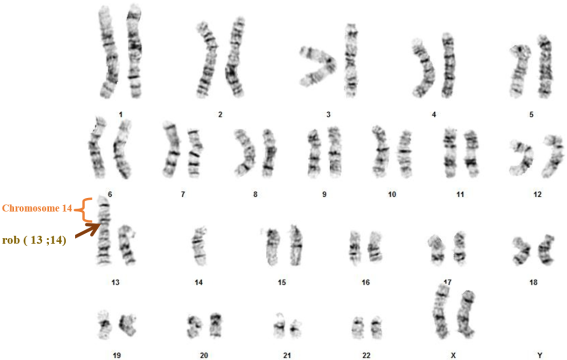
Figure 1. Female chromosomal complement showing a structural anomaly: 45,XX,der(13;14)(p13;p13). Cytogenetics Laboratory, Faculty of Health Sciences, Cotonou, Benin.
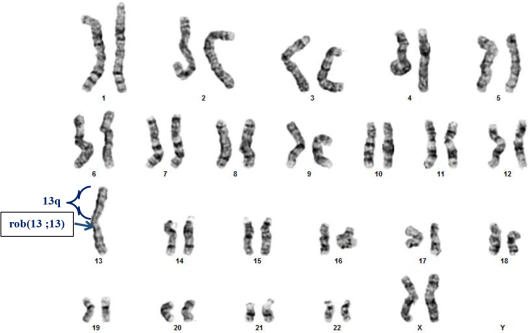
Figure 2. Female chromosomal complement showing a structural anomaly: 45, XX, der (13;13) (q11.2; q11.2). Cytogenetics Laboratory, Faculty of Health Sciences, Cotonou, Benin.

Information


 Share This Article
 Twitter
 Linked In
 Facebook
 Copy
Copy Download