
Manual loading and unloading of raw materials and semi-finished products remains one of the most injury-intensive operations in manufacturing and logistics, and it continues to drive a disproportionate share of work-related musculoskeletal disorders. Established assessment tools — RULA, REBA, OWAS, and the NIOSH lifting equation — each capture a single facet of exposure, and recent attempts to combine them through multi-criteria decision-making have concentrated almost exclusively on the biomechanical domain, leaving physiological strain, cognitive workload, and environmental stressors outside the analytic frame. This fragmentation prevents safety practitioners from ranking heterogeneous hazards on a common scale and from targeting interventions where composite risk is highest. This article develops the Integrated Human-factor and Ergonomic-load assessment Framework (IHEF), a five-layer architecture that normalises biomechanical, physiological, cognitive, and environmental sub-scores and fuses them into a single Composite Risk Index through Analytic Hierarchy Process weighting, before linking the index to a hierarchy-of-controls decision layer and a continual-improvement feedback loop. The framework further triangulates the three classical load-limit criteria and specifies a reproducible task-decomposition and data-reduction procedure for multi-task jobs. A matched-plant validation protocol, complete with an a-priori statistical-power justification, is presented to demonstrate feasibility in industrial practice. The framework offers safety managers a transparent, auditable basis for prioritising ergonomic interventions across competing hazard domains. Its originality lies in extending multi-criteria ergonomic assessment beyond posture to a genuinely multi-domain composite index tailored to loading and unloading work. No empirical results are reported; all numerical values are planning parameters awaiting validation.
| Published in | International Journal of Industrial and Manufacturing Systems Engineering (Volume 11, Issue 2) |
| DOI | 10.11648/j.ijimse.20261102.12 |
| Page(s) | 35-45 |
| Creative Commons |
This is an Open Access article, distributed under the terms of the Creative Commons Attribution 4.0 International License (http://creativecommons.org/licenses/by/4.0/), which permits unrestricted use, distribution and reproduction in any medium or format, provided the original work is properly cited. |
| Copyright |
Copyright © The Author(s), 2026. Published by Science Publishing Group |
Manual Materials Handling, Ergonomic Risk Assessment, Composite Risk Index, Analytic Hierarchy Process, Human Factors, Occupational Safety, Musculoskeletal Disorders, Work-system Design
Assessment paradigm | Representative tools | Exposure domain captured | Principal limitation for loading/unloading |
|---|---|---|---|
Postural / biomechanical | RULA [3] , REBA [4] , OWAS | Working posture; segmental load | Single-task; no cognitive or physiological load; observer subjectivity [15] |
Load-limit / biomechanical | NIOSH RLE [5] | Spinal compressive load per lift | Symmetric single-lift focus; weak at high frequency |
Psychophysical | Snook-Ciriello tables [6] | Worker-accepted maximum weight/force | Unreliable above ~6 lifts/min; may exceed physiological limit |
Physiological | %HRmax; energy expenditure [7] | Whole-body metabolic strain | Costly field measurement; large inter-individual variance |
Cognitive | NASA-TLX [8] | Mental workload | Rarely integrated with physical exposure |
MCDM-integrated | AHP / fuzzy-AHP [9, 11-14] | Weighted combination of criteria | To date dominated by biomechanical criteria only |
Layer | Function | Instruments / inputs | Output |
|---|---|---|---|
L1 Data acquisition | Capture exposure in four domains | RULA, REBA, NIOSH LI [3-5] ; %HRmax [7] ; NASA-TLX [8] ; lux, WBGT, noise | Domain sub-scores (0-1) |
L2 Aggregation | Fuse domains into one index | AHP-weighted sum of normalised sub-scores [10] | Composite Risk Index K (0-10) |
L3 Classification | Map K to action level | Five thresholds (Acceptable → Critical) | Risk level 1-5 |
L4 Control selection | Match control to dominant domain | Hierarchy of controls [37] | Prioritised control plan |
L5 Outcome monitoring | Track KPIs and re-trigger | LTI rate, WMSD prevalence, RULA/LI re-score, productivity | Feedback to L1 (PDCA) |
Domain | Sub-indicator | Normalisation reference | Direction |
|---|---|---|---|
Biomechanical | RULA/REBA grand score; NIOSH LI | Action-level thresholds [3 -5] | Higher = worse |
Physiological | Mean%HRmax over shift | 45% sustainable-work limit [7] | Higher = worse |
Cognitive | End-of-shift NASA-TLX | 0-100 scale [8] | Higher = worse |
Environmental | Composite of lux, WBGT, noise | ISO/EN threshold limit values | Deviation = worse |
Parameter | Planned value | Basis |
|---|---|---|
Design | Prospective matched-plant quasi-experiment | Plant-level engineering controls preclude individual randomisation |
Plants / arms | 4 plants, 2 matched pairs | Matched on scale, workforce, baseline injury rate |
Target sample | ≈ 180 workers per arm | Power analysis (see text) |
Primary outcome | Lost-time injury rate / 1,000 worker-months | Person-time denominator from payroll |
Follow-up | 12-month baseline + 24-month follow-up | Difference-in-differences estimation |
Reliability targets | Cohen’s κ ≥ 0.75; ICC ≥ 0.80 | Pre-specified acceptance thresholds |
Primary validation | Predictive validity of Composite Risk Index K | Cox model; c-statistic vs single-domain models |
AHP | Analytic Hierarchy Process |
ICC | Intraclass Correlation Coefficient |
IHEF | Integrated Human-factor and Ergonomic-load assessment Framework |
KPI | Key Performance Indicator |
LI | Lifting Index |
LTI | Lost-Time Injury |
MCDM | Multi-Criteria Decision-Making |
NASA-TLX | National Aeronautics and Space Administration Task Load Index |
NIOSH | National Institute for Occupational Safety and Health |
PDCA | Plan-Do-Check-Act |
REBA | Rapid Entire Body Assessment |
RLE | Revised Lifting Equation |
RULA | Rapid Upper Limb Assessment |
WBGT | Wet-Bulb Globe Temperature |
WMSD | Work-related Musculoskeletal Disorder |
| [1] | L. Punnett and D. H. Wegman, "Work-related musculoskeletal disorders: the epidemiologic evidence and the debate," J. Electromyogr. Kinesiol., vol. 14, no. 1, pp. 13-23, 2004, |
| [2] | U. S. Government Accountability Office, "Wearable Technologies: Potential Opportunities and Deployment Challenges in Manufacturing and Warehousing," Rep. GAO-25-107213, Washington, DC, 2024. |
| [3] | L. McAtamney and E. N. Corlett, "RULA: a survey method for the investigation of work-related upper limb disorders," Appl. Ergon., vol. 24, no. 2, pp. 91-99, 1993, |
| [4] | S. Hignett and L. McAtamney, "Rapid Entire Body Assessment (REBA)," Appl. Ergon., vol. 31, no. 2, pp. 201-205, 2000, |
| [5] | T. R. Waters, V. Putz-Anderson, A. Garg, and L. J. Fine, "Revised NIOSH equation for the design and evaluation of manual lifting tasks," Ergonomics, vol. 36, no. 7, pp. 749-776, 1993, |
| [6] | S. H. Snook and V. M. Ciriello, "The design of manual handling tasks: revised tables of maximum acceptable weights and forces," Ergonomics, vol. 34, no. 9, pp. 1197-1213, 1991, |
| [7] | A. Garg and M. M. Ayoub, "What criteria exist for determining how much load can be lifted safely? ", Hum. Factors, vol. 22, no. 4, pp. 475-486, 1980, |
| [8] | S. G. Hart and L. E. Staveland, "Development of NASA-TLX (Task Load Index)," in Human Mental Workload, P. A. Hancock and N. Meshkati, Eds. Amsterdam: Elsevier, 1988, pp. 139, |
| [9] | A. Cimino, M. G. Gnoni, F. Longo, and L. Nicoletti, "A risk assessment framework based on ergonomic methods and AHP for prioritizing interventions to prevent container terminal operator’s musculoskeletal disorders," Saf. Sci., vol. 159, art. 106017, 2023, |
| [10] | T. L. Saaty, The Analytic Hierarchy Process. New York: McGraw-Hill, 1980. |
| [11] | M. Rezvanizadeh, M. Mohammad-Ghasemi, A. Soltanzadeh, and M. Sadeghi-Yarandi, "Development of a novel ergonomic index assessment in the workplace based on physical, cognitive, and environmental components," Work, vol. 76, no. 3, pp. 1075-1090, 2023, |
| [12] | V. Tatar, B. Ayvaz, and D. Pamucar, "A quantitative ergonomic risk assessment model of maritime port operations: an integrated spherical fuzzy-FUCOM-ARTASI approach," Ocean Coast. Manag., vol. 267, art. 107710, 2025, |
| [13] | W. F. Senjaya, B. N. Yahya, and S.-L. Lee, "Ergonomic risk level prediction framework for multiclass imbalanced data," Comput. Ind. Eng., vol. 184, art. 109556, 2023, |
| [14] | B. S. de Almeida Calixto et al., "Assessment of occupational risk using multi-criteria fuzzy AHP methodology in a university laboratory," Sustainability, vol. 17, no. 6, art. 2715, 2025, |
| [15] | "Comparing risk assessment methods for work-related musculoskeletal disorders with in vivo joint loads during manual materials handling," Sci. Rep., vol. 14, art. 5880, 2024, |
| [16] | "Online ergonomic evaluation in realistic manual material handling task: proof of concept," Bioengineering, vol. 11, no. 1, art. 14, 2024, |
| [17] | Z. Jiao, K. Huang, Q. Wang, G. Jia, Z. Zhong, and Y. Cai, "Improved REBA: deep learning based rapid entire body risk assessment for prevention of musculoskeletal disorders," Ergonomics, vol. 67, no. 10, pp. 1356-1370, 2024, |
| [18] | I. Sabino, M. Carmo Fernandes, C. Cepeda, C. Quaresma, H. Gamboa, I. L. Nunes, and A. T. Gabriel, "Application of wearable technology for the ergonomic risk assessment of healthcare professionals: a systematic literature review," Int. J. Ind. Ergon., vol. 100, art. 103570, 2024, |
| [19] | F. Lolli, A. M. Coruzzolo, C. Forgione, M. Peron, and F. Sgarbossa, "Auto-AzKNIOSH: an automatic NIOSH evaluation with Azure Kinect coupled with task recognition," Ergonomics, pp. 1-17, 2024, |
| [20] | D. Mourtzis, J. Angelopoulos, and N. Panopoulos, "Operator 5.0: a survey on enabling technologies and a framework for digital manufacturing based on extended reality," J. Manuf. Syst., vol. 65, pp. 1-19, 2022, |
| [21] | D. Romero, J. Stahre, and M. Taisch, "The Operator 4.0: towards socially sustainable factories of the future," Comput. Ind. Eng., vol. 139, art. 106128, 2020, |
| [22] | Z. Arkouli, G. Michalos, G. Kokotinis, and S. Makris, "Worker-centered evaluation and redesign of manufacturing tasks for ergonomics improvement using axiomatic design principles," CIRP J. Manuf. Sci. Technol., vol. 55, pp. 188-209, 2024, |
| [23] | S. De Bock et al., "Benchmarking occupational exoskeletons: an evidence mapping systematic review," Appl. Ergon., vol. 98, art. 103582, 2022, |
| [24] | D. J. Schwerha, N. McNamara, M. A. Nussbaum, and S. Kim, "Adoption potential of occupational exoskeletons in diverse enterprises engaged in manufacturing tasks," Int. J. Ind. Ergon., vol. 82, art. 103103, 2021, |
| [25] | N. Gonsalves, A. Akanmu, A. Shojaei, and P. Agee, "Factors influencing the adoption of passive exoskeletons in the construction industry: industry perspectives," Int. J. Ind. Ergon., vol. 100, art. 103549, 2024, |
| [26] | C. Di Natali et al., "Equivalent weight: connecting exoskeleton effectiveness with ergonomic risk during manual material handling," Int. J. Environ. Res. Public Health, vol. 18, no. 5, art. 2677, 2021, |
| [27] | F. Davoudi Kakhki and A. Moghadam, "Evaluating impact of occupational exoskeletons on physical fatigue using wearable sensors and deep learning," Int. J. Adv. Manuf. Technol., 2026, |
| [28] | S. Taori and S. Lim, "Use of a wearable electromyography armband to detect lift-lower tasks and classify hand loads," Appl. Ergon., vol. 119, art. 104285, 2024, |
| [29] | "Empowering Industry 5.0: automated sensor-based ergonomic risk assessment," Int. J. Interact. Des. Manuf., 2025, |
| [30] | A. Mital, "The psychophysical approach in manual lifting: a verification study," Hum. Factors, vol. 25, no. 5, pp. 485-491, 1983, |
| [31] | A. Mital, A. S. Nicholson, and M. M. Ayoub, A Guide to Manual Materials Handling, 2nd ed. London: Taylor & Francis, 1997. |
| [32] | R. Gilgen-Ammann, T. Schweizer, and T. Wyss, "RR interval signal quality of a heart rate monitor and an ECG Holter at rest and during exercise," Eur. J. Appl. Physiol., vol. 119, no. 7, pp. 1525-1532, 2019, |
| [33] | D. B. Chaffin, G. B. J. Andersson, and B. J. Martin, Occupational Biomechanics, 4th ed. Hoboken, NJ: Wiley, 2006. |
| [34] | W. S. Marras, "Occupational low back disorder causation and control," Ergonomics, vol. 43, no. 7, pp. 880-902, 2000, |
| [35] | W. Karwowski, "Ergonomics and human factors: the paradigms for science, engineering, design, technology and management of human-compatible systems," Ergonomics, vol. 48, no. 5, pp. 436-463, 2005, |
| [36] | E. Hollnagel, D. D. Woods, and N. Leveson, Resilience Engineering: Concepts and Precepts. Aldershot, UK: Ashgate, 2006. |
| [37] | International Organization for Standardization, ISO 45001:2018 — Occupational Health and Safety Management Systems — Requirements with Guidance for Use. Geneva: ISO, 2018. |
| [38] | International Organization for Standardization, ISO 11228-1:2021 — Ergonomics — Manual Handling — Part 1: Lifting, Lowering and Carrying. Geneva: ISO, 2021. |
| [39] | A.-W. Chan et al., "SPIRIT 2013 statement: defining standard protocol items for clinical trials," Ann. Intern. Med., vol. 158, no. 3, pp. 200-207, 2013, |
| [40] | E. von Elm et al., "The Strengthening the Reporting of Observational Studies in Epidemiology (STROBE) statement," Lancet, vol. 370, no. 9596, pp. 1453-1457, 2007, |
| [41] | T. R. Waters, V. Putz-Anderson, and A. Garg, Applications Manual for the Revised NIOSH Lifting Equation, DHHS (NIOSH) Publ. No. 94-110. Cincinnati, OH: NIOSH, 1994. |
| [42] | M. Hassani and N. Karanikas, "Scoping review of studies on work-related musculoskeletal disorders: quality of evidence, coverage of risk factors and types of risk assessment tools used," Work, 2026, |
| [43] | "The challenges of ergonomics in handling loads in Industry 4.0 and 5.0," Rev. Gest. Soc. Ambient., vol. 19, no. 5, art. e012238, 2025, |
APA Style
Jalilov, A., Murtozaevich, N. S. (2026). Toward a Unified Ergonomic Risk Index for Manual Loading and Unloading: An Integrated Multi-Domain Framework. International Journal of Industrial and Manufacturing Systems Engineering, 11(2), 35-45. https://doi.org/10.11648/j.ijimse.20261102.12
ACS Style
Jalilov, A.; Murtozaevich, N. S. Toward a Unified Ergonomic Risk Index for Manual Loading and Unloading: An Integrated Multi-Domain Framework. Int. J. Ind. Manuf. Syst. Eng. 2026, 11(2), 35-45. doi: 10.11648/j.ijimse.20261102.12
@article{10.11648/j.ijimse.20261102.12,
  author = {Akhmadbek Jalilov and Narziev Shovkiddin Murtozaevich},
  title = {Toward a Unified Ergonomic Risk Index for Manual Loading and Unloading: An Integrated Multi-Domain Framework},
  journal = {International Journal of Industrial and Manufacturing Systems Engineering},
  volume = {11},
  number = {2},
  pages = {35-45},
  doi = {10.11648/j.ijimse.20261102.12},
  url = {https://doi.org/10.11648/j.ijimse.20261102.12},
  eprint = {https://article.sciencepublishinggroup.com/pdf/10.11648.j.ijimse.20261102.12},
  abstract = {Manual loading and unloading of raw materials and semi-finished products remains one of the most injury-intensive operations in manufacturing and logistics, and it continues to drive a disproportionate share of work-related musculoskeletal disorders. Established assessment tools — RULA, REBA, OWAS, and the NIOSH lifting equation — each capture a single facet of exposure, and recent attempts to combine them through multi-criteria decision-making have concentrated almost exclusively on the biomechanical domain, leaving physiological strain, cognitive workload, and environmental stressors outside the analytic frame. This fragmentation prevents safety practitioners from ranking heterogeneous hazards on a common scale and from targeting interventions where composite risk is highest. This article develops the Integrated Human-factor and Ergonomic-load assessment Framework (IHEF), a five-layer architecture that normalises biomechanical, physiological, cognitive, and environmental sub-scores and fuses them into a single Composite Risk Index through Analytic Hierarchy Process weighting, before linking the index to a hierarchy-of-controls decision layer and a continual-improvement feedback loop. The framework further triangulates the three classical load-limit criteria and specifies a reproducible task-decomposition and data-reduction procedure for multi-task jobs. A matched-plant validation protocol, complete with an a-priori statistical-power justification, is presented to demonstrate feasibility in industrial practice. The framework offers safety managers a transparent, auditable basis for prioritising ergonomic interventions across competing hazard domains. Its originality lies in extending multi-criteria ergonomic assessment beyond posture to a genuinely multi-domain composite index tailored to loading and unloading work. No empirical results are reported; all numerical values are planning parameters awaiting validation.},
 year = {2026}
}
TY  - JOUR
T1  - Toward a Unified Ergonomic Risk Index for Manual Loading and Unloading: An Integrated Multi-Domain Framework
AU  - Akhmadbek Jalilov
AU  - Narziev Shovkiddin Murtozaevich
Y1  - 2026/11/23
PY  - 2026
N1  - https://doi.org/10.11648/j.ijimse.20261102.12
DO  - 10.11648/j.ijimse.20261102.12
T2  - International Journal of Industrial and Manufacturing Systems Engineering
JF  - International Journal of Industrial and Manufacturing Systems Engineering
JO  - International Journal of Industrial and Manufacturing Systems Engineering
SP  - 35
EP  - 45
PB  - Science Publishing Group
SN  - 2575-3142
UR  - https://doi.org/10.11648/j.ijimse.20261102.12
AB  - Manual loading and unloading of raw materials and semi-finished products remains one of the most injury-intensive operations in manufacturing and logistics, and it continues to drive a disproportionate share of work-related musculoskeletal disorders. Established assessment tools — RULA, REBA, OWAS, and the NIOSH lifting equation — each capture a single facet of exposure, and recent attempts to combine them through multi-criteria decision-making have concentrated almost exclusively on the biomechanical domain, leaving physiological strain, cognitive workload, and environmental stressors outside the analytic frame. This fragmentation prevents safety practitioners from ranking heterogeneous hazards on a common scale and from targeting interventions where composite risk is highest. This article develops the Integrated Human-factor and Ergonomic-load assessment Framework (IHEF), a five-layer architecture that normalises biomechanical, physiological, cognitive, and environmental sub-scores and fuses them into a single Composite Risk Index through Analytic Hierarchy Process weighting, before linking the index to a hierarchy-of-controls decision layer and a continual-improvement feedback loop. The framework further triangulates the three classical load-limit criteria and specifies a reproducible task-decomposition and data-reduction procedure for multi-task jobs. A matched-plant validation protocol, complete with an a-priori statistical-power justification, is presented to demonstrate feasibility in industrial practice. The framework offers safety managers a transparent, auditable basis for prioritising ergonomic interventions across competing hazard domains. Its originality lies in extending multi-criteria ergonomic assessment beyond posture to a genuinely multi-domain composite index tailored to loading and unloading work. No empirical results are reported; all numerical values are planning parameters awaiting validation.
VL  - 11
IS  - 2
ER  -
Department of Labour Safety Research, Institute for Poverty Reduction and Labour Market Research, Tashkent, Uzbekistan
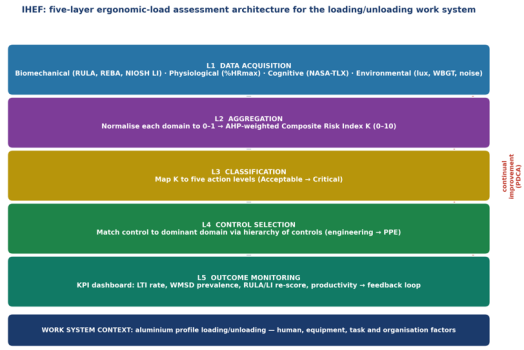
Figure 1. The IHEF five-layer architecture embedded in the loading/unloading work system, with a continual-improvement (PDCA) feedback loop. Figure prepared by the authors.
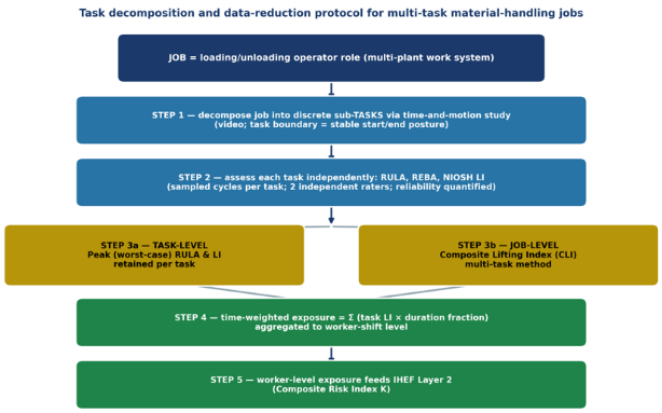
Figure 2. Task-decomposition and data-reduction protocol feeding the IHEF Composite Risk Index. Figure prepared by the authors.
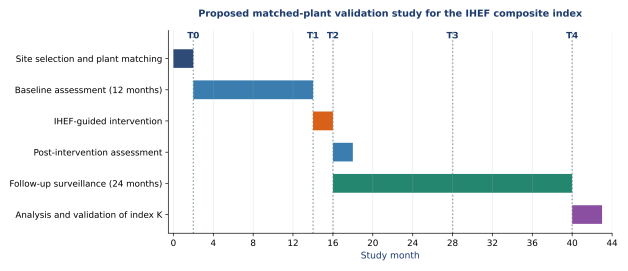
Figure 3. Proposed matched-plant validation study schedule in SPIRIT format; T0-T4 denote assessment timepoints. Figure prepared by the authors.

Information



 Share This Article
 Twitter
 Linked In
 Facebook

 Copy
 Download