Abstract
Restorative justice, together with community policing and community corrections, is widely regarded as one of the three pillars of “proactive criminal justice.” In the past, however, restorative justice and policing developed with limited overlap, leaving “restorative policing” largely underexplored. Nevertheless, international practical experience shows that police can be empowered to refer cases for restorative justice, represent the community in restorative processes, enforce resolutions formed through restorative procedures, and even serve as facilitators in restorative conferences. As the most fundamental local peacebuilders, police can, through restorative justice approaches, help achieve mutually beneficial outcomes for offenders, victims, and the community. Given the close connection between restorative policing and community relations, this study employs a four-point bipolar Likert scale questionnaire to empirically examine whether police can appropriately participate in restorative justice processes. Specifically, it explores whether police officers are better positioned to serve as facilitators in restorative justice processes or as community representatives within such frameworks. Research findings indicate that in Taiwan, despite police lacking legal authority to make restorative justice referrals, survey results from the northern region demonstrate strong community support for police involvement in restorative processes, with a satisfaction rate averaging 56%. At the same time, items measuring the suitability of police as “restoration promoters of restorative justice” (5 items) show stronger relevance than those assessing whether police are suitable as “community representatives of restorative justice” (2 items). In addition, multiple regression analysis revealed that police are perceived as suitable facilitators in restorative justice processes. However, the communities interviewed also expressed concerns that police involvement in the restoration process may introduce risks of failure, miscalculation, misjudgment, or perceptions of differential treatment. In response to these concerns, this article suggests that restorative justice should integrate mediation and adopt restorative policing as its starting point. Accordingly, a two-stage restorative justice model is proposed, with restorative policing serving as both the initial phase and a continuing process. This approach involves empowering police to implement restorative policing through comprehensive legal authorization and emphasizing police-led restorative procedures to prioritize issue resolution. Through strengthening police-community relations, this model aims to establish a foundation for localized restorative policing and the practical application of restorative justice.
|
Published in
|
International Journal of Law and Society (Volume 9, Issue 1)
|
|
DOI
|
10.11648/j.ijls.20260901.18
|
|
Page(s)
|
83-98 |
|
Creative Commons
|

This is an Open Access article, distributed under the terms of the Creative Commons Attribution 4.0 International License (http://creativecommons.org/licenses/by/4.0/), which permits unrestricted use, distribution and reproduction in any medium or format, provided the original work is properly cited.
|
|
Copyright
|
Copyright © The Author(s), 2026. Published by Science Publishing Group
|
Keywords
Police, Restorative Policing, Restorative Justice, Participation, Community
1. Introduction
In recent years, restorative justice (RJ) has been widely applied in Taiwan's criminal justice system, shaping its operations and providing a legal basis for criminal enforcement. However, it was not until the 2023 amendment to the Crime Victim Rights Protection Act, which added a dedicated chapter titled “Chapter Four: Restorative Justice” (Articles 44 to 49), that Taiwan's restorative mechanism was formally established as RJ. Together with community policing and community corrections, RJ is considered one of the three pillars of proactive criminal justice
| [16] | Hsu, Chun-Chin (2010). Humanistic Criminology. Taipei: Sanmin. |
[16]
. Despite this institutional development, RJ and policing have historically rarely intersected, leaving restorative policing (RP) largely underdeveloped
. Particularly in Taiwan, it is therefore worth considering whether the police may assume an additional role in referring cases to RJ. At the same time, whether police can become central actors in presiding over, participating in, or implementing RJ remains both possible and contested.
RP is a policing model centered on repairing harm and rebuilding relationships
| [34] | Sun, Yi-Shyong. (2023). The Evolution of Strategic Thinking in Policing. Journal of Central Police University, 60, 1–22. |
[34]
. Unlike traditional punitive enforcement, RP emphasizes resolving crime through dialogue, negotiation, and community involvement rather than relying on arrests and pursuits. The concept of RP originated in New Zealand's 1989 Children, Young Persons, and Their Families Act, which institutionalized the Māori tradition of Family Group Conferencing. Under this system, juvenile delinquency cases are addressed primarily through dialogue and negotiation among families, communities, and victims, rather than through direct entry into the judicial process. This approach is widely regarded as a model of RP, in which police officers shift from enforcers to meeting coordinators who facilitate reconciliation between perpetrators and victims
.
In the 1990s, several police departments in the UK began piloting “Restorative Caution,” which required perpetrators of minor offenses to meet with victims and apologize in order to reduce the likelihood of legal proceedings
. This development marked the emergence of community policing-based RP
and emphasized the role of police as “restorative facilitators,” rather than solely as law enforcement officers
| [18] | Hsu, Fu-Sheng (2018). A Study of Restorative Justice and Practice in Taiwan. Central Police University Law Review, 35, 1-44. |
[18]
. Around the same time, Canada introduced provisions in the Youth Criminal Justice Act that allow police to participate fully in the restoration processes following an offense or to lead such processes themselves, positioning the police as fundamental peace-building actors at the local level
| [16] | Hsu, Chun-Chin (2010). Humanistic Criminology. Taipei: Sanmin. |
[16]
. Police officers operate on the front lines of public affairs. According to Article 2 of Taiwan's Police Act, “The mission of the police is obligated to maintain public order, protect social security, prevent all hazards, and promote public welfare according to applicable laws,” underscoring their central role in maintaining social order and security. Furthermore, the “2024 Annual Survey of Public Satisfaction with Police's Work in Maintaining Public Order in Taiwan,” published by the Center for Criminological Research at National Chung Cheng University in January 2025, shows high levels of public satisfaction across various policies, particularly in the area of “providing convenient services to the public,” where effective police–community cooperation is evident. This plays a crucial role in promoting community safety and increasing public satisfaction. When the relationship between the police and the public is positive, and the police understand the public’s needs and formulate corresponding policies, it not only contributes to improved community safety but also enhances the public’s image of the police, thereby increasing satisfaction with police services. Accordingly, public satisfaction with police services remained high in 2024, at 91.01%, compared to 90.39% in 2023
. This indicates that the public supports police actions and maintains a high level of satisfaction
. Furthermore, from a community policing perspective, the police maintain close interaction with the community. The community, as one of the key players in RJ, is both the object of RJ restoration and the subject of RJ participation, and may even be understood as the arena of RJ
| [16] | Hsu, Chun-Chin (2010). Humanistic Criminology. Taipei: Sanmin. |
[16]
. Therefore, from an RP perspective, this overlap raises an important question: Can the police in Taiwan function as community representatives within RJ procedures? More specifically, can police chair restorative meetings, participate in restorative processes, or implement restorative decisions in ways that advance RJ's objective of achieving mutually beneficial outcomes for perpetrators, victims, and the community? This study addresses these questions through a combination of literature review and questionnaire survey methods.
2. The Practice of RP
2.1. The Regret of RP's Lack of Legal Basis
Across countries with experience in RP practices, some systems use police as coordinators of restorative meetings, some empower police to adjudicate or mediate minor offenses, and others involve police as facilitators of RJ or as community representatives throughout the RJ process. Among these models, police-referral RJ is the most common (details below). In Taiwan, academic journals and master's and doctoral dissertations bearing the designation “RP” remain extremely scarce as of 2025. Moreover, interactions between police and RJ are not specifically addressed in current legal practice.
At present, Taiwan has enacted multiple laws governing judicially led RJ, including Article 29 of the Juvenile Justice Act, Articles 13 and 29 of the Regulations Governing the Adjudication of Juvenile Protection Cases, Article 42 of the Prison Act, Article 33 of the Enforcement Rules of the Prison Act, Article 5 of the Regulations Governing the Prison’s Imposing Punishment on the Prisoner, Article 37 of the Detention Act, Article 28 of the Enforcement Rules of the Detention Act, Article 5 of the Regulations Governing the Detention Center’s Imposing Punishment on the Defendant, Articles 4, 8, and 28 to 29 of the Guidelines for the Prevention of School Bullying, Articles 125 and 319 of the Enforcement Rules of Citizen Judges Act, Chapter 4 (Articles 44 to 49) of the Crime Victim Rights Protection Act, Article 26 of the Gender Equity Education Act, and Article 4 of the Regulations on the Implementation of Remorse Programs. An examination of these provisions reveals no explicit legal basis authorizing police to conduct restorative justice (RJ).
Article 248-2 of Taiwan's Code of Criminal Procedure states that, “During the investigation stage, when a victim is examined or interviewed, his statutory agent, spouse, lineal blood relative, collateral blood relative within the third degree of kinship, family head, family member, physician, psychologist, counselor, social worker, or other person the victim trusts, with the consent of the victim, may be present and state their own opinions” (Section 1). However, this provision does not apply if the person present is the accused, or if, in the opinion of the public prosecutor, prosecutor investigator, judicial police officer, or judicial policeman, such presence would hinder the investigation. (Section 2).” Therefore, during the investigation stage, only prosecutors may, upon the request of the defendant and the victim, refer cases to appropriate agencies, institutions, or groups for remediation, leaving no formal role for police involvement in RJ.
Similarly, Article 271-4 of the Code of Criminal Procedure states that, “The court may order the case to undergo mediation any time before the conclusion of oral argument. Alternatively, the court may, upon petition of the accused or the victim and after taking into account the opinion expressed by the public prosecutor, the agent, the defense attorney, and the assistant, refer the case to an appropriate organization, institution, or association to undergo a restorative justice program (Section 1). Where the victim is without legal capacity, of limited legal capacity, or is deceased, the petition for a restorative justice program referred to in the preceding paragraph may be made by the statutory agent, lineal blood relative, or spouse of the victim. (Section 2).” Police have no authority over restorative referrals or petitions during the trial process. In Taiwan, police are not authorized or legally permitted to refer restorative cases. This differs significantly from the original RJ theory, which allows for such referrals at any stage of the criminal justice process, including the pre-indictment police stage, the pre-trial prosecution stage, the pre-sentencing trial stage, and the rehabilitation stage
| [16] | Hsu, Chun-Chin (2010). Humanistic Criminology. Taipei: Sanmin. |
[16]
. Currently, Taiwan has relevant laws and regulations governing the pre-trial prosecution stage, the pre-sentencing trial stage, and the rehabilitation stage. However, the pre-trial police stage remains a shortcoming, indicating that RP still has significant limitations in terms of localized RJ reform.
2.2. The Relationship Between Community and RP
Both community policing and RP are inextricably linked to RJ. Community policing aims to build partnerships between the police and the community, fostering collaboration to address community problems and improve overall quality of life
| [37] | Yeh, Yu-Lan (1996). New Orientations of Policing: The Theories and Practices of Community Policing. Police Science Quarterly, 7(3), 1-17. |
[37]
. According to Mon (2006)
| [27] | Mon, Wei-Teh (2006). An Empirical Analysis on Public Opinion of Policing: In Cases of Citizen Complaint. Law Enforcement Review, 2(2), 1-34. |
[27]
, in areas with more developed communitarianism, residents are more actively involved in community activities and affairs; as a result, community policing can be effectively implemented, community security improves, and overall quality of life gradually increases
| [6] | Chen, Kuo-En (2006). A Working Model of Community Policing System--A Case Study of the Advancement of Community Peace in Chaiyi City. Police Science Quarterly, 36(6) Month 5-6, 1-27. |
[6]
. Accordingly, community policing has evolved from a narrow role of “law enforcer” to broader roles such as “solver of social problems,” “mobilizer of social resources,” and even “social worker”
| [5] | Chen, Fei-Lin (2015). The Evolution of Localization of Community Policing in Taiwan. Journal of Police Management, 11, 139-155. |
[5]
. In this sense, community policing can be regarded as the social foundation of RJ.
RP may be understood as a front-end extension of RJ. Both approaches are closely connected to the element of “community” and share the value of “cooperative governance,” focusing on “harm recovery” rather than solely on crime prevention
| [11] | Cordner, Gary. (2014). Community Policing. Oxford University Press. |
[11]
. In discussing the relationship between community and RP, it is essential that RP be rooted in the community. Community members are most familiar with local issues, such as crime hotspots and social conflicts, and can therefore provide timely, context-specific solutions. Furthermore, traditional policing often relies on policies such as zero tolerance, which may generate potential antagonism between the police and the community. In contrast, RP seeks to reduce hostility through dialogue, mutual trust, and integration, thereby rebuilding police-community relations and facilitating restorative processes. This shift allows the police to move from the role of “enforcers” to that of “conflict resolvers,” identifying and addressing social problems.
Empirical research supports this perspective. A five-year study in Baltimore, Maryland, found that RP combined with community dialogue reduced juvenile violent crime recidivism by 25%
| [32] | Sherman, Larry., & Strang, Heather. (2007). Restorative Justice: The Evidence. The Smith Institute. |
[32]
. The interaction between the community and RP thus reflects a broader paradigm of shift from state-controlled authority to more inclusive forms of social governance. Its significance lies not only in the institutional design of RJ systems but also in the cultivation of a more resilient civil society. This collaborative effort between the police and the community to complete the restoration highlights the indispensable role of the community in RJ. The following discussion continues by examining the relevance, importance, and necessity of the “community” within RJ programs.
3. The Relationship Between the Community and the Restoration Process
3.1. The Importance of Community Participation in Restoration
3.1.1. The Trend of the Community
Almost every country in the world today has developed a reliance on retribution, and this tendency often becomes a driving force in the formulation of criminal policy. While imposing severe punishments, such approaches deepen expectations for incarceration, catalyze moral panic and public fear, and increase the demand for punishment and sanction mechanisms, particularly in utilitarian systems such as that of the United States
| [28] | Newman, Graeme. (1978). The Punishment Response. Philadelphia: Lippincott. |
[28]
. As societies pursue so-called justice and security, justice remains unfulfilled, and communities remain wounded as long as calls for revenge continue to dominate public discourse
| [23] | Mackey, V. (1990). Restorative Justice: Toward Nonviolence. Louisville, KY: Presbyterian Criminal Justice Program, Presbyterian Church (USA). |
[23]
.
Ultimately, the most significant difference between RJ and traditional criminal justice in the conflict resolution “process” lies in community involvement, while the most important difference in the handling of “outcomes” lies in community restoration. However, during the emergence and development of RJ across countries, it has often been uncritically promoted as superior in achieving multiple objectives, resulting in limited capacity to evaluate pilot programs and yielding largely inconclusive outcomes
| [21] | Karmen, A. (1990). Crime Victims: An Introduction to Victimology. 2nd Ed. Belmont, California: Wadsworth Publishing Company. |
[21]
. Even now, it remains difficult to accurately assess the RJ’s adaptation across countries or to determine its effectiveness, particularly with respect to community participation and community recovery. In this sense, RJ may be understood as occupying the least explored leg of the three-legged stool
| [14] | Harris, M. K. (1989). Alternative visions in the context of contemporary realities. In P. Arthur (ed.) Justice: The Restorative Vision. New Perspectives on Crime and Justice February (#7) Akron, PA: Mennonite Central Committee. |
[14]
.
Inevitably, Taiwan's practice of RJ has also fallen into similar misconceptions. The advantages of RJ have been overstated, with mediation conflated with restoration and presented as an “improvement.” Community involvement has been consistently neglected, and in practice, little consideration has been given to how communities themselves might be restored. Furthermore, the rise of “community-based criminal policy” has been overlooked, quietly replacing the balanced approach of “tough and soft criminal policy”
| [22] | Liu, Yu-Wei (2023). Examining the Influence of Restorative Model on Criminal Policy: Discussing the Community-based Criminal Policy Concurrently. The Military Law Journal, 69(4), 67-91. |
[22]
.
One of the fundamental principles of RJ is that the harm caused by crime encompasses the perpetrator, the victim, and the local community, and that the power to control crime must shift from the state toward individual citizens and local communities
| [35] | Umbreit, Mark S. (1994). Victim Meets Offender: The Impact of Restorative Justice and Mediation. Monsey, New York: Willow Tree Press, Inc. |
[35]
. This implies that crime control must be “communized.” Addressing and preventing crime requires active community engagement and shared responsibility. Yet, this responsibility is frequently evaded at two levels: first, when communities delegate crime handling entirely to legally mandated public institutions; and second, when community responsibility is considered fulfilled once the offender is convicted and punished
| [25] | Marshall, Tony F. (1992). Restorative Justice on Trial in Britain. In H. Messmer & H.-U. Otto (eds.), Restorative Justice on Trial. Netherlands: Kluwer Academic Publishers.
https://doi.org/10.1007/978-94-015-8064-9_2 |
[25]
.
Throughout this process, it has been difficult to identify the responsibilities actually fulfilled by the community in the restoration process. This suggests that, despite the broader trend toward community-based RJ, there remains an unfortunate lack of follow-up evaluation of community functions, both domestically and internationally. In this context, the police are at the forefront of community involvement. The frequency and extent of police-community interaction significantly influence community capacity. If communities are to fulfill the functions expected of RJ, the maintenance and effectiveness of their operation should be considered in light of the high potential of the RP model.
3.1.2. The Cohesion of Community Consciousness
Most crimes involve problems between perpetrators and victims within the same community, and many violent crimes likewise stem from interpersonal conflicts within the same community. These problems must therefore be faced and addressed collectively by participating community members, rather than being entrusted solely to groups of “professional outsiders”
. Problems originate within the community, and the community must resolve its own internal issues. In the long run, reliance on third-party institutions such as courts, prosecutors, and mediators is fundamentally inconsistent with the original intent of RJ.
Communities are microcosms of society. For RJ to function effectively, the local community in which the parties reside exerts a profound influence and should receive greater procedural consideration, with particular emphasis on interpersonal relationships. Socially integrative strategies should gradually incorporate local communities into the compensation process. Especially in an era of advanced AI technology, existing social or community networks can be leveraged to offer more innovative ways to address various antisocial behaviors. If conflicts are legally resolved through the active participation of local communities, deviant behavior becomes a socially relevant issue, and the causal relationships of events become clearer
| [26] | Messmer, H., & Otto, Hans-Uwe. (1992). Restorative Justice: Steps on the way toward a good idea. In H. Messmer & H.-U. Otto (eds.), Restorative Justice on Trial. Netherlands: Kluwer Academic Publishers. |
[26]
.
However, similar to the United States, which is one of the earliest promoters of RJ, Taiwan also lacks a strong sense of “community”
. Both societies have experienced the obliteration of neighborhood and local community functions
. Therefore, strengthening community “awareness” is the first step in building community consciousness. However, it remains both fundamental and challenging. Questions concerning how this awareness is stimulated, by whom, and through what methods are central to the development of mutual trust in the process of building community cohesion of mutual trust in the process of building community cohesion.
Considering one of RJ’s functions in criminology, namely crime prevention, the best approach is to bring the community together and, through community cohesion, mobilize the collective effectiveness of the community
| [31] | Rukus, Joseph., Mildred E. Warner., & Zhang, Xue. (2018). Community Policing: Least Effective Where Need Is Greatest. Crime & Delinquency, 64(14), 1858-1881.
https://doi.org/10.1177/0011128716686339 |
[31]
. Given the limited size of the police force but the substantial potential of public participation, this approach involves integrating community resources and combining public strength. This partnership between the police, the community, and the public emphasizes building community consensus and mobilizing public capacity to jointly address community security issues
| [13] | Fattah, E. A. (1979). Some Recent Theoretical developments in victimology. Victimology. 4(2).198-213. |
| [19] | Huang, Frank F. Y (2003). Community policing and crime prevention. Journal of Crime Prevention, Central Police University, 4, 55-74. |
[13, 19]
. Assuming that the existing community policing system serves as the foundation and that RP is re-emphasized, it is reasonable to expect that police can develop implementation strategies within RJ, such as “understanding community dynamics and carrying out investigations,” “proactively caring for the community and cultivating police-community mutual trust,” “stimulating public participation and strengthening self-defense capabilities,” and “actively integrating into the community and creating police-community harmony”
| [7] | Chen, Sun-Yun (2024). Practical Discussion on the Implementation of Community Policing through Police Beat Visits. Journal of Police Management, 20, 139-166. |
[7]
.
3.2. Community Needs and Responsibilities in the Restoration Process
Within the framework of RJ, perpetrators, victims, society, and communities each have their own injuries, needs, and responsibilities. These elements are interconnected and sequential: the “harm” caused by crime generates the “need” to repair that harm, and the need to repair, in turn, generates the “responsibility” to take positive action to meet these needs
| [23] | Mackey, V. (1990). Restorative Justice: Toward Nonviolence. Louisville, KY: Presbyterian Criminal Justice Program, Presbyterian Church (USA). |
[23]
. With regard to perpetrators and victims, these dimensions are relatively straightforward. However, what are the “needs” and “responsibilities” of the community within RJ?
The community’s primary “needs” may be understood as a sense of justice. With respect to responsibility, like victims, local communities experience a loss of security following crime and therefore require reassurance that measures are being taken to prevent its recurrence
| [39] | Zehr, Howard. (1990). Changing Lenses: A New Focus for Crime and Justice. Scottsdale, PA: Herald Press. |
[39]
. Regardless of their effectiveness, preventative measures are preferable to inaction, which may generate moral panic or heightened fear of crime. Whenever a crime occurs, communities need to know there is a clear stance toward crime and that responses will be timely. In short, from the community's perspective, safety is the primary concern
| [23] | Mackey, V. (1990). Restorative Justice: Toward Nonviolence. Louisville, KY: Presbyterian Criminal Justice Program, Presbyterian Church (USA). |
[23]
.
In terms of community responsibility, community empowerment is a central element of RJ. This involves encouraging communities to assume responsibility for their daily routines, thereby increasing public trust and strengthening overall community cohesion
. Empowering local communities with the capacity to resolve conflicts allows them to heal from crime-related harm and fosters a sense of shared responsibility and local governance. Furthermore, when responding to crime, communities must connect the harm suffered by victims with the needs and responsibilities of perpetrators, rather than treating crime as an exclusively individual matter. This requires building channels for dialogue and recovery between victims and perpetrators, as well as between perpetrators and the community.
If communities fail to rebuild trust with perpetrators, offenders may become further alienated, creating a cycle that contributes to recidivism
| [10] | Cordella, J. P. (1991). Reconciliation and the Mutualist Model of Community. In R. Quinney & H. Pepinsky (eds.), Criminology as Peacemaking. Bloomington: Indiana University Press, p. 30-46. |
[10]
. Therefore, both perpetrators and communities share responsibility for the harm caused by crime. If perpetrators are held accountable for their actions, communities must likewise assume responsibility for addressing harm and supporting healing. Accordingly, communities require not only comprehensive crime prevention strategies but also a perspective that recognizes each conflict as a potential community resource
| [30] | Prothrow-Stith, Deborah. (1991). Deadly Consequences. New York: Harper Collins Publishers. |
[30]
. Every conflict presents an opportunity to reaffirm the value of each community member to the overall well-being of the community. Similarly, every consultative meeting serves as a practical demonstration of effective conflict resolution and reinforces community members' right to personal safety and freedom from crime.
In summary, under the premise that the community is responsible for establishing peace, the needs of local communities arising from criminal conflicts include: 1. a sense of justice; 2. community empowerment; 3. rebuilding peaceful relationships between individuals and vital social connections, and reintegrating victims and perpetrators into a supporting community; 4. a sense of safety and hope; and 5. taking concrete action to prevent similar conflicts from recurring. The community's responsibilities include: 1. taking immediate action to protect victims and perpetrators; 2. examining the perpetrator's responsibility and requiring relevant parties to actively participate in the conflict resolution process; 3. providing local resources and seeking healing for victims and perpetrators; 4. providing public education and establishing a process for peaceful conflict resolution; and 5. identifying patterns of recurring conflicts and addressing their root causes
| [36] | Van Ness, Daniel W. (1989). Pursuing a restorative vision of justice. In P. Arthur (ed.) Justice: The Restorative Vision. New Perspectives on Crime and Justice February (#7) Akron, PA: Mennonite Central Committee. |
[36]
. If these needs and responsibilities are met through police involvement in RJ and implemented through a RP model, it is believed that substantial and timely improvements in effectiveness can be achieved.
4. The Role of Police in RJ
Following the above discussion, while the community has both needs and responsibilities, it remains an abstract concept. How can this be made more concrete? And what role does it represent after participating in RJ? Drawing on comparative experience, the following provides a brief overview of the methods and roles of police participation in RJ in various countries:
4.1. Australia
The Australian model of “Community Action Conferences” is coordinated by a police officer, whose role is to encourage all participants to reach a collective agreement on how to best minimize the ongoing harm caused by crime. Community police coordinate the process but do not control the outcome. In other Australian states, there is also police-run victim/offender conferencing, primarily targeting juvenile offenders or those involved in minor offenses. Section 4 of the Young Offenders Act 1997 in New South Wales allows police officers to act as specialist youth officers and refer juvenile delinquency cases to juvenile justice conferences. Police officers may also be appointed as chairpersons and are authorized to preside over RJ consultations. Even in Canberra, the police force can lead the implementation of RJ through “Diversionary Conferencing”
| [17] | Hsu, Chun-Chin, & Chen, Yu-Shu. (2004). A Study on the Role of Police Agencies within Restorative Justice Theory. Commissioned Research Report (No. PG9308-0326 / 093-301010200C1-007). Taipei: Criminal Investigation Bureau, National Police Agency, Ministry of the Interior. |
[17]
.
4.2. New Zealand
In New Zealand's RJ, in cases involving the protection of children and adolescents, the police, in addition to acting as referral agencies, have a legal obligation to abide by and implement the decisions, recommendations, and implementation plans made by caregiver family groups. In juvenile justice, the police may issue cautions and warnings. With respect to juvenile justice family groups, the police are authorized to participate in meetings and are required to abide by and implement the decisions, recommendations, and implementation plans adopted at those meetings. Regardless of the form of the restorative meeting, the police may attend but may not chair the meeting or assume an active deliberative role. Some police chiefs argue that, as law enforcement officers primarily responsible for crime prevention, chairing restorative meetings may limit their ability to support victims and raise concerns about impartiality due to consideration of the perpetrator's perspective; therefore, they strongly oppose police-chaired restorative meetings
| [17] | Hsu, Chun-Chin, & Chen, Yu-Shu. (2004). A Study on the Role of Police Agencies within Restorative Justice Theory. Commissioned Research Report (No. PG9308-0326 / 093-301010200C1-007). Taipei: Criminal Investigation Bureau, National Police Agency, Ministry of the Interior. |
[17]
.
4.3. The United States of America
While police officers also act as referral agents for RJ, the biggest difference between them and those in New Zealand and Australia lies in their far deeper involvement in RJ. In addition to chairing RJ meetings, they implement the agreements and plans decided upon at those meetings, playing a highly proactive role in the restoration process while simultaneously acting as leaders and supervisors of RJ meetings
| [17] | Hsu, Chun-Chin, & Chen, Yu-Shu. (2004). A Study on the Role of Police Agencies within Restorative Justice Theory. Commissioned Research Report (No. PG9308-0326 / 093-301010200C1-007). Taipei: Criminal Investigation Bureau, National Police Agency, Ministry of the Interior. |
[17]
. Empirical research indicates that RJ led by US police agencies is quite effective when its application is limited to juvenile offenders
| [24] | Mark S. Umbreit., Claudia Fercello, M. S. W. (1997). Woodbury Police Department’s Restorative Justice Community Conferencing Program. An Initial Assessment of Client Satisfaction. Center for Restorative Justice & Mediation. University of Minnesota. https://hdl.handle.net/11299/205698 |
[24]
.
4.4. Canada
In 2002, Canada enacted Section 6 of the Youth Criminal Justice Act, which granted police officers the power to refer cases to the community. Based on this legal basis, the Royal Canadian Mounted Police (RCMP) developed “Community Justice Forums.” These forums primarily target young offenders and are widely accepted by the Canadian community
| [17] | Hsu, Chun-Chin, & Chen, Yu-Shu. (2004). A Study on the Role of Police Agencies within Restorative Justice Theory. Commissioned Research Report (No. PG9308-0326 / 093-301010200C1-007). Taipei: Criminal Investigation Bureau, National Police Agency, Ministry of the Interior. |
[17]
.
4.5. Opinions in This Article
In summary, the roles played by police agencies in implementing RJ include: presiding over RJ-related conferences (such as in Australia, New Zealand, and Canada); transferring cases to relevant agencies or referring them to RJ conferences (such as in Australia, New Zealand, the United States, and Canada); participating in RJ-related conferences (such as in Australia, New Zealand, the United States, and Canada); and implementing relevant resolutions of RJ-related conferences (such as in the United States and New Zealand). These roles are generally accepted and positively affirmed by the communities in these countries. In contrast, Taiwan lacks a legal basis for the police's role in RJ, and there is no clear design for it.
Given the current legal basis in Taiwan, “transferring” or “referring” the case to relevant agencies may still be feasible. As for “implementing” the resolutions of RJ conferences, this depends on the nature of the conference itself and its resolutions. If it involves public power, transferring implementation to the police appears indisputable. However, it is particularly noteworthy that if the design of RJ itself remains a matter of public power, it becomes difficult to distinguish how it differs from the formal judicial system or government agencies dedicated to resolving conflicts. This clearly defeats the original purpose of RJ. Conversely, if it involves private power, and the police implement resolutions formed through private means, the distinction between the police and hired thugs becomes unclear. This blurs the boundary between public and private interests and is therefore highly inappropriate.
Furthermore, expecting the police to preside over or participate in the practice of RJ remains highly problematic. However, it is puzzling that police officers, in their “public service” activities, occasionally preside over or participate in mediation between parties. Yet, under Article 9 of the Taiwan Police Act and the Police Power Exercise Act, mediation is not a legally mandated police function. A research report commissioned by the Criminal Investigation Bureau (CIB, Taiwan) and conducted by criminal justice scholars Hsu et al. (2004) likewise mentioned that police presiding over or participating in mediation lacks both legal basis and institutional incentives
| [17] | Hsu, Chun-Chin, & Chen, Yu-Shu. (2004). A Study on the Role of Police Agencies within Restorative Justice Theory. Commissioned Research Report (No. PG9308-0326 / 093-301010200C1-007). Taipei: Criminal Investigation Bureau, National Police Agency, Ministry of the Interior. |
[17]
. Moreover, such practices may give rise to civil disputes derived from criminal cases, effectively drawing police officers into the role of parties to the dispute.
In cases involving serious misconduct or severe infringement of legal interests, this could also affect the police's willingness to mediate. In addition, mediation often involves conflicts of interest. Therefore, police officers, primarily acting as law enforcement officers, are prone to role confusion and face criticism
| [17] | Hsu, Chun-Chin, & Chen, Yu-Shu. (2004). A Study on the Role of Police Agencies within Restorative Justice Theory. Commissioned Research Report (No. PG9308-0326 / 093-301010200C1-007). Taipei: Criminal Investigation Bureau, National Police Agency, Ministry of the Interior. |
[17]
. Therefore, the involvement of police in mediation is highly controversial, highlighting the difficulties police face in presiding over or participating in RJ.
Furthermore, Criminal Judgment of the Supreme Court No. 343 of 2020 (Taiwan) states that “mediation” is based on the principle of private autonomy, resolving disputes non-litigiously through mutual consent, concessions by the parties, or mediation by the court or specific institutions. While both mediation and RJ involve parties negotiating and discussing solutions to their cases independently or with the assistance of a neutral third party, the primary purpose of mediation is to reduce litigation, lessen the burden on the courts, allow parties to reintegrate into society without criminal punishment or rehabilitation, and spare them the suffering of litigation. Typically, the dialogue between the parties focuses on “solving the problem.” Monetary compensation is often the primary focus, and it should not depend solely on whether a civil settlement has been reached with the victim (see the Supreme Court's Judgments No. 4116 and No. 54 of 2013 in Taiwan).
Since mediation prioritizes reducing litigation and ensuring compensation, it emphasizes expedient resolution, naturally neglecting the parties' forgiveness and empathy, and failing to promote reconciliation. In contrast, the ideal of RJ seeks to facilitate dialogue between perpetrators and victims at an appropriate time through restorative facilitators, enabling them to understand each other, restore their “relationships and emotional bonds,” and make the perpetrator aware of the harm caused, thereby reducing the likelihood of recidivism. Ultimately, it aims to restore the victim's well-being through apology, acceptance of responsibility, and compensation.
Therefore, the Supreme Court's judgment (Taiwan) identifies the central distinction between “mediation” and “restorative justice”: the former focuses on “solving problems,” while the latter tends to “relationship restoration.” Although mediation may be an important “process” for promoting RJ, the two cannot be equated. Moreover, modern criminal procedure policy has shifted from protecting the rights of defendants to recognizing the necessity of upholding and restoring victims’ dignity (see the Supreme Court's Judgment No. 343 of 2020 and the Taichung Branch Court's Judgment No. 246 of 2020 in Taiwan). This further demonstrates that RJ is more complex and challenging than mediation. The questions and controversies that arise from mediation, whether the police preside over it or participate in it, are likely to re-emerge within RJ practices.
5. Research Design
5.1. Research Framework
To examine the suitability of police officers to lead or participate in RJ operations, this study conducted an online questionnaire survey targeting adults aged 18 and above in Taiwan. The questionnaire was created using Google Forms and randomly distributed across social media platforms in Taipei, New Taipei City, Taoyuan, and Hsinchu (northern Taiwan). To ensure that respondents were familiar with the meaning of RJ, the operation and definition of RJ were explained before the questionnaire was completed. A standardized questionnaire was used to gather information from selected respondents, employing a research method of asking questions to collect data. In accordance with academic ethics, the survey primarily used random sampling and voluntary participation.
5.2. Questionnaire Structure
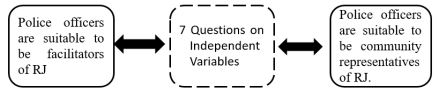
The overall questionnaire structure was based on the dependent variables: “Police officers are suitable to be facilitators of RJ “and “Police officers are suitable to be community representatives of RJ.” Meanwhile, seven questions related to police and community recovery were compiled as independent variables, including: “Do you think the police's professional competence in RJ is sufficient?,” “Does police participation in RJ have credibility?,” “Can police participation in RJ meet the needs of the parties involved?,” “Is police participation in RJ efficient?,” “Is there a possibility of failure, miscalculation, or misjudgment in police participation in RJ?,” “After RJ is popularized in the community, is the police's position in the community important?,” “Will the results of police participation in RJ vary depending on the socioeconomic status and cultural differences of the parties involved?”). These seven questions were intended to assess whether police are suitable to serve as facilitators of RJ or as community representatives of RJ. The causal relationships and relevant features among these variables, as illustrated in
Figure 1, were analyzed based on the four response options (8:28) derived from the two dependent variables and the seven independent variables.
Figure 1. Research framework.
6. Research Methods
To enhance the reliability and validity of the study, this questionnaire adopted a four-point Likert scale. A four-point scale was chosen because if an odd-point scale were used, the proportion of “no opinion” in the middle option would likely be greater than that for the affirmative and negative options, which may obscure respondents' actual attitudes and reduce interpretive clarity. This choice also supports the appropriateness of the measurement method used in this study.
Following a pre-test, valid questionnaires were administered from September 2023 to February 2025, yielding 2,041 responses. Frequency distribution analysis was used to analyze the proportion of each item, and the Pearson Correlation Coefficient was used to compare the coefficients and values between two continuous variables. A t-test was also conducted to determine whether each item showed a statistically significant association with the dependent variables. Furthermore, multiple regression analysis was employed to examine whether the seven independent variables related to attitudes towards RJ could simultaneously explain variation in opinions regarding the suitability of police officers for their respective roles, thereby providing an integrated assessment of the research findings.
7. Research Findings
This paper examines 2,041 valid questionnaires using frequency distributions, Pearson correlation coefficients, t-tests, and multiple regression analysis. The empirical findings are summarized below.
7.1. Frequency Distribution
This questionnaire consists of nine questions. In the 2,041 valid questionnaires, regarding the question “Police officers are suitable to be facilitators of RJ” (Question A), the highest percentage of respondents (63%) agreed, followed by 27% strongly agreed, 9% disagreed, and 1% strongly disagreed. This demonstrates strong support for police officers as facilitators of RJ. For the item “Police officers are suitable to be community representatives of RJ” (Question B), 56% agreed, 23% disagreed, 17% strongly agreed, and 4% strongly disagreed, likewise indicating considerable support for this role.
Furthermore, with respect to perceived professional competence, “Is the police's professional competence in RJ sufficient?” (Question C), 58% agreed, while 31% strongly agreed. Regarding the question “Does police participation in RJ have credibility?” (Question D), 55% agreed, while 29% strongly agreed. For the item “Can police participation in RJ meet the needs of the parties involved?” (Question E), 58% agreed, while 21% disagreed. For the question “Is police participation in RJ efficient?” (Question F), the highest percentage of respondents (54%) agreed, followed by (24%) disagreed. With respect to the question “Is there a possibility of failure, miscalculation, or misjudgment in police participation in RJ?” (Question G), 57% agreed, while 33% strongly agreed. For the question “After RJ is popularized in the community, is the police's position in the community important?” (Question H), 45% agreed, while 35% disagreed. Finally, for the item “Will the results of police participation in RJ vary depending on the socioeconomic status and cultural differences of the parties involved?” (Question I), 59% agreed, and 31% strongly agreed. Taken together, the nine items indicate that the majority of opinions regarding police involvement in RJ are generally positive. However, most respondents also believe that police participation may fail, lead to miscalculation, or result in misjudgment, and that outcomes may vary based on the socioeconomic status and cultural background of the parties involved. The data distribution of the remaining related items is summarized in
Table 1.
Table 1. Perceptions of Police Involvement in Restorative Justice.
Topic Options | A | B | C | D | E | F | G | H | I |
Strongly agree | 27% | 17% | 31% | 29% | 19% | 17% | 33% | 14% | 31% |
Agree | 63% | 56% | 58% | 55% | 58% | 54% | 57% | 45% | 59% |
Disagree | 9% | 23% | 9% | 15% | 21% | 24% | 7% | 35% | 9% |
Strongly disagree | 1% | 4% | 2% | 2% | 1% | 6% | 3% | 7% | 1% |
Source: Self-drawn
7.2. Pearson Correlation Coefficient
7.2.1. Question C: “Is the Police's Professional Competence in RJ Sufficient”
As shown in
Table 2, the correlation coefficients between Question C and Questions A and B are significant (
r = .51 and .37) and are positive, indicating that the more one agrees with Question C, the more one also agrees with questions A and B. As shown in
Table 2, the t-test of the difference between the two correlation coefficients is statistically significant (
t(2038) = 6.01,
p <.05), indicating that the correlation between A and C is significantly higher than that between B and C.
Table 2. Question C vs. Police as suitable actors in RJ.
| Question A (a) | Question B (b) | Difference (a-b) | t-value |
Question C | .51* | .37* | .14 | 6.01* |
N = 2041; *p <.05 |
Source: Self-drawn
7.2.2. Question D: “Does Police Participation in RJ Have Credibility”
Table 3 shows that the correlation coefficients between Question D and Questions A and B are significant (
r = .44 and .30) and positive. This indicates that respondents who agree more with question D are also more likely to agree with Questions A and B.
Table 3 further shows that the difference between the two correlation coefficients is statistically significant (
t(2038) = 6.18,
p <.05), indicating that the correlation between the degree of agreement of Question A and Question D is significantly higher than that between the degree of agreement with Question B and Question D.
Table 3. Question D vs. Police as suitable actors in RJ.
| Question A (a) | Question B (b) | Difference (a-b) | t-value |
Question D | .44* | .30* | .15 | 6.18* |
N = 2041; *p <.05 |
Source: Self-drawn
7.2.3. Question E: “Can Police Participation in RJ Meet the Needs of the Parties Involved”
Table 4 shows that Question E is significantly correlated with both Question A and Question B (
r =.43 and .12, respectively), with positive correlation coefficients, indicating that respondents who agree more strongly with Question E are also more likely to agree with Question A and Question B. The t-test results for the difference between the two correlation coefficients are statistically significant (
t(2038) = 12.69,
p <.05), indicating that the correlation between agreeing with Question A and Question E is significantly higher than that between agreeing with Question B and Question E.
Table 4. Question E vs. Police as suitable actors in RJ.
| Question A (a) | Question B (b) | Difference (a-b) | t-value |
Question E | .43* | .12* | .31 | 12.69* |
N = 2041; *p <.05 |
Source: Self-drawn
7.2.4. Question F: “Is Police Participation in RJ Efficient”
As shown in
Table 5, the correlation coefficients between Question F and both Question A and Question B are statistically significant (
r =.19,.45), and the coefficients are positive. The t-test further indicates that the difference between the two correlation coefficients is statistically significant (
t(2038) = -11.12,
p <.05); however, a negative t-value indicates that the correlation between Question B and Question F is significantly higher than that between Question A and Question F.
Table 5. Question F vs. Police as suitable actors in RJ.
| Question A (a) | Question B (b) | Difference (a-b) | t-value |
Question F | .19* | .45* | -.27 | -11.12* |
N = 2041; *p <.05 |
Source: Self-drawn
7.2.5. Question G: “Is There a Possibility of Failure, Miscalculation, or Misjudgment in Police Participation in RJ”
As shown in
Table 6, the correlation coefficients between Question G and Questions A and B are statistically significant (
r =.49 and .21), and all are positive. The t-test results for the difference between the two correlation coefficients are statistically significant (
t(2038) = 12.13,
p <.05), indicating that the correlation between Question A and Question G is significantly higher than that between Question B and Question G.
Table 6. Question G vs. Police as suitable actors in RJ.
| Question A (a) | Question B (b) | Difference (a-b) | t-value |
Question G | .49* | .21* | .29 | 12.13* |
N = 2041; *p <.05 |
Source: Self-drawn.
7.2.6. Question H: “After RJ Is Popularized in the Community, Is the Police's Position in the Community Important”
As shown in
Table 7, the correlation coefficients between the participants' agreement with this item and their agreement with questions A and B were both statistically significant (
r =.21 and .40), and the correlation coefficients were positive, indicating that those who agreed more with this item were also more likely to agree with questions A and B, respectively. The t-test results for the difference between these two correlation coefficients were statistically significant (
t(2038) = -7.88,
p <.05). However, the negative t-value indicates that those who agreed more with this item were more likely to agree with question B.
Table 7. Question H vs. Police as suitable actors in RJ.
| Question A (a) | Question B (b) | Difference (a-b) | t-value |
Question H | .21* | .40* | -.19 | -7.88* |
N = 2041; *p <.05 |
Source: Self-drawn
7.2.7. Question I: “Socioeconomic and Cultural Variations in the Outcomes of Police Participation in RJ”
Question I: “Will the Results of Police Participation in RJ Vary Depending on the Socioeconomic Status and Cultural Differences of the Parties Involved?”As shown in
Table 8, the correlation coefficients between the degree of agreement for this item and the degree of agreement for both Question A and Question B were statistically significant (r =.49 and .40), and both coefficients were positive. The t-test results for the difference between the two correlation coefficients are statistically significant (t(2038) = 4.06, p <.05), indicating that respondents who agree more with this item are more likely to agree with Question A than with Question B.
Table 8. Question I vs. Police as suitable actors in RJ.
| Question A (a) | Question B (b) | Difference (a-b) | t-value |
Question I | .49* | .40* | .09 | 4.06* |
N = 2041; *p <.05 | | | | |
Source: Self-drawn.
Based on the above analysis,
Table 9 summarizes the correlation between the police role suitability (RJ facilitator or community representative) and the seven questions. First, the questions with a high degree of correlation with Question A are Questions C, D, E, G, and I. Second, the items with a high degree of correlation with Question B are Questions F and H.
Table 9. Summary of the differences in the suitability of police officers for restorative justice roles and their relevance to various questions.
Questions that are highly relevant to Question A | Question C |
Question D |
Question E |
Question G |
Question I |
Questions that are highly relevant to Question B | Question F |
Question H |
Source: Self-drawn
7.3. Multiple Regression Analysis
Multiple regression analysis was used to examine the attitudes reflected in the seven RJ-related items and to assess the extent to which the police are perceived as suitable for their roles as RJ facilitators or community representatives.
7.3.1. Multiple Regression Analysis of Police Officers' Suitability to Become RJ Facilitators
Table 10. Multiple Regression Analysis of RJ Attitude Questions Regarding Police Suitability as RJ Facilitators.
| Unstandardized coefficient | Standard error | Standardized coefficient | t-value |
(constant) | 0.73 | 0.07 | | |
Question C | 0.17 | 0.04 | 0.18 | |
Question D | 0.12 | 0.02 | 0.14 | |
Question E | 0.16 | 0.02 | 0.18 | |
Question F | 0.00 | 0.02 | -0.01 | |
Question G | 0.18 | 0.02 | 0.21 | |
Question H | 0.10 | 0.02 | 0.13 | |
Question I | 0.07 | 0.04 | 0.08 | |
*p <.05; Overall model F(7,2031) = 190.71, R2 =.40 |
Source: Self-drawn
As shown in
Table 10, this regression model reached statistical significance (
F(7,2031) = 190.71,
p <.05). When standardized coefficients are applied, the dependent variable equals 0 when all independent variables are at their mean values, indicating that the regression model is statistically significant. The seven independent variables collectively explain 40% of the variance in perceptions of police officers’ suitability as RJ facilitators (
R2 =.40). Among these variables, six items, Questions C, D, E, G, H, and I, exhibited statistically significant effects.
7.3.2. Multiple Regression Analysis on the Suitability of Police Officers as Community Representatives in Restorative Justice
Table 11. Multiple Regression Analysis of Attitudes Towards RJ on the Suitability of Police Officers as Community Representatives for RJ.
| Unstandardized coefficient | Standard error | Standardized coefficient | t-value |
(constant) | 0.51 | 0.09 | | 5.62* |
Question C | 0.00 | 0.05 | 0.00 | 0.03 |
Question D | 0.08 | 0.03 | 0.08 | 3.35* |
Question E | -0.03 | 0.02 | -0.02 | -1.09 |
Question F | 0.25 | 0.02 | 0.27 | 10.77* |
Question G | 0.04 | 0.03 | 0.04 | 1.48 |
Question H | 0.16 | 0.02 | 0.17 | 7.08* |
Question I | 0.29 | 0.05 | 0.25 | 6.21* |
*p <.05; Overall model F(7,2031) = 135.04, R2 =.32 |
Source: Self-drawn
As shown in
Table 11, this regression model also reached statistical significance (
F(7,2031) = 135.04,
p <.05). When using the raw, unstandardized coefficients, the dependent variable equals the constant term when all independent variables are 0. When using standardized coefficients, the dependent variable equals 0 when all independent variables are at their mean values, indicating that the regression model is statistically valid. The seven questions collectively explain 32% of the variance in police officers’ suitability for RJ (
R2 =.32). Four items, Questions D, F, H, and I, demonstrated statistically significant effects.
Based on the regression analysis presented above, it is evident that among the seven items, the degree of association with “Police officers are suitable to be facilitators of RJ” (Question A) is greater than that with “Police officers are suitable to be community representatives of RJ” (Question B). Therefore, objective quantitative analysis indicates that police officers are better suited to serve as facilitators of RJ, that is, to preside over RJ procedures.
8. Suggestions and Conclusions
8.1. Suggestions
8.1.1. Integrating Mediation into RJ, Starting with RP
Criminal Judgment of the Supreme Court No. 343 of 2020 (Taiwan) distinguishes mediation from RJ. The former addresses “concrete” problem-solving, while the latter aims at “abstract” relationship restoration. This often leads to the public's inability to objectively differentiate between the two. Even when cases appear resolved through mediation or reconciliation, neither party is truly satisfied, let alone the restoration of community harmony (Judgment No. 61 of 2019, Kaohsiung Branch, Taiwan High Court).
According to judicial practice in Taiwan, regardless of whether mediation or RJ has been applied, the determination of the sentence is a matter in which the courts are entitled to exercise discretion under substantive law. Even if mediation or RJ has been practiced, it does not prevent the changes in sentencing factors (Supreme Court Judgment No. 4339 of 2014 in Taiwan), nor is it intended to promote the sentencing interests of the defendant (Supreme Court Judgment No. 266 of 2012 in Taiwan). In other words, the practice of RJ does not absolve the defendant of responsibility.
The high degree of similarity between mediation and RJ may hinder the development of localized RJ. From the perspective of RJ, the problem-solving achieved through mediation constitutes only “one” part of the broader restoration process. The restoration process also “incidentally” achieves the goals that mediation can accomplish. This raises questions regarding the independent function and continued significance of mediation within the criminal justice system.
This study suggests that mediation should be integrated into RJ, starting with RP. Leveraging the police's advantageous position in the community, it is crucial to enhance public awareness of RJ procedures and facilitate the practical implementation of restorative processes, avoiding misunderstandings and confusion within the community and preventing what Durkheim described as “anomie,” which leads to disorder due to a lack of clear norms.
8.1.2. Constructing a Two-stage RJ Model, Starting with and Continuing RP
Problem-solving constitutes an essential part of the healing process and also serves as a prerequisite. Once concrete problems are resolved, the restoration of emotions/relationships should continue over time, especially in terms of community and society recovery, which may not follow a fixed timetable. Therefore, given the potential for RP in Taiwan, this study proposes a “two-stage RJ model.” The first stage prioritizes problem-solving, while the second stage focuses on restoration, particularly for community/society recovery. This model begins with RP in the first stage, employing police-led restoration procedures to facilitate timely resolution, ensuring perpetrators are held accountable for their actions and victims receive prompt compensation and have their needs met. After the first phase of conflict resolution is completed, it becomes even more important to complete the second phase of community recovery through RP, so that the community accepts the restorative process and society recognizes the results. Only after a win-win situation for both parties has been achieved can there be long-term follow-up and evaluation of the third win—the community. This represents the actual contribution of RP to RJ. However, this outcome is also closely linked to the principle that RP must maintain good interaction and deep engagement with the community and establish a mechanism of mutual trust. Only in this way can a real practice of localized RJ be formed.
8.1.3. Empowering Police to Practice Restorative Policing and Providing a Comprehensive Legal Basis
Empowerment is an indispensable element in promoting RP. RP has emerged as an international trend in recent years, particularly emphasizing the provision of greater discretion to police officers
| [40] | Zhang, Yan. (2020). Police Discretion and Restorative Justice in China: Stories from the Street-level Police. International Journal of Offender Therapy and Comparative Criminology, 65(4), 498-520.
https://doi.org/10.1177/0306624X20944686 (Original work published 2021). |
[40]
. Under current Taiwanese law, police officers are classified into several categories: First-level judicial “police officers” (Article 2 of the Judicial Police Dispatching Act and Article 229 of the Code of Criminal Procedure) are authorized to “assist” prosecutors in performing their duties and investigating crimes. Second-level judicial “police officers” (Article 3 of the Judicial Police Dispatching Act and Article 230 of the Code of Criminal Procedure) are “subject to the command” of prosecutors in performing their duties and investigating crimes. Finally, judicial “police” (Article 4 of the Judicial Police Dispatching Act and Article 231 of the Code of Criminal Procedure) are “subject to the orders” of prosecutors and judicial “police officers” in performing their duties and investigating crimes. Therefore, it is evident from Taiwanese law that the powers of first-level and second-level judicial “police officers” and judicial “police” differ, and the powers they are granted should also differ in degree or scope to avoid losing legal protection due to a lack of authority.
While Taiwanese police do not possess the same authority as Japanese police to handle minor criminal cases through prosecutors, this renders them more susceptible to criticism over potential punishments or accusations of favoritism
| [20] | Jeng, Shann-Yinn (1999). Japanese Code of Criminal Procedure: Police Handling of Minor Crimes. Taipei Bar Journal, 234, 50-64. |
| [38] | Yu, Chen-Hua. (2004). An Examination of the Authority of Judicial Police to Dispose of Minor Offenses. The Taiwan Law Review, 108, 78–93. |
[20, 38]
.
Despite these constraints, RP represents an important pathway for modern policing reform. Its core objective lies in moving beyond a traditional authoritarian law enforcement framework and incorporating restorative principles of criminal justice into police practice. This transformation involves a change in the nature of public power, necessitating a redefinition of the police's role in crime prevention. Perhaps Taiwan's Police Power Exercise Act or Code of Criminal Procedure could include provisions authorizing restorative treatment, thereby reducing systemic practical obstacles arising from case-by-case discretion.
From the perspective of legal sociology, the demand for the legalization of RP may stem from three sources of tension: (i) a value conflict between traditional punitive thinking and the philosophy of relationship restoration; (ii) a structural contradiction between the participatory demands of community policing and the monopolistic nature of public authority; and (iii) a normative gap between flexible law enforcement measures and the principle of legal certainty. In response, this study proposes the establishment of a police officer’s “duty to facilitate restoration” within Taiwan’s police law framework.
Through a gradual and phased authorization structure, reform could begin with differentiated regulatory tracks, namely one governing community mediation procedures for minor offenses, and another providing judicial referral mechanisms for serious crimes, while simultaneously instituting a bidirectional oversight mechanism to prevent abuses of power. In the medium term, police officers could be institutionally designed to participate in restorative processes as community representatives, enabling them to gain familiarity with restorative procedures and practices. In the long term, police officers may assume the role of restorative facilitators, with legal authorization conferring both a formal legal basis and legal effects. Such an institutional design not only preserves the principles of the rule of law but also creates a more flexible space for crime governance within police institutions, constituting an important practical manifestation of restorative justice at the front end of the criminal justice system.
8.1.4. Strengthening Police-community Relations to Lay the Foundation for RP and RJ Practices
The relationship between the police and the community is gradually shifting from confrontation toward co-creation, positioning RP as a practical pathway for rebuilding trust between the police and the public. Tensions between traditional authoritarian law enforcement and rising public awareness of rights have become increasingly evident. At its core, RP seeks to move beyond the binary opposition of “law enforcer vs managed population” by fostering mutual trust through dialogical governance.
The Ministry of the Interior in Taiwan previously promoted a community safety implementation plan that emphasized a jointly constructed safety network involving both police officers and the community. Through two-way communication, this approach can effectively transform the nature of police-community relations. In practice, police agencies may need to design and implement a multi-dimensional transformation framework.
First, this study proposes that police agencies could promote “empathy-based duty training,” using scenario simulations or AI tools such as AR (Augmented Reality)/VR (Virtual Reality) to cultivate officers' ability to identify diverse community needs, thereby making RP a component of future AI-driven policing trends. Second, this study further suggests building a “police-community collaboration platform” that incorporates citizen participation mechanisms to enable community members to jointly shape community-level restorative consensus. The third dimension involves developing a police-led community restoration mechanism, creating dialogue spaces for minor offenses, or designing modified restoration models such as “direct referral” or “empowered referral” based on the degree of intent or negligence, which could also contribute to the allocation of social resources. This transformation of the policing model requires institutional support, government resources, legal authorization, and the design of a third-party oversight mechanism to safeguard procedural justice. Fundamentally, the reconstruction of police–community relations constitutes a reconstruction of social trust. When the police role shifts from that of order managers to collaborators in resolving community conflicts, and when communities shift from passive recipients of protection to active participants, this partnership can activate social capital and contribute to broader ESG objectives. However, only when law enforcement officers lower their stance and engage in dialogue will the public become willing to open themselves to communication and participation. As Hsu, an advocate of RJ in Taiwan
| [16] | Hsu, Chun-Chin (2010). Humanistic Criminology. Taipei: Sanmin. |
[16]
, stated when discussing the future path of RJ: “We must allow ourselves to transcend the limits of the existing criminal justice framework and move towards infinite possibilities; systemic reconstruction is perhaps inevitable.”
| [15] | Hsu, Chun-Chin (2003). Elements and Practicing Models to Restorative Justice. Crime and Criminal Justice International, 1, 37-66. |
[15]
Therefore, beginning with RP represents an effective pathway for enabling localized RJ to take root and flourish within communities.
8.2. Conclusions
Both the literature review and the empirical findings indicate that police officers can participate in RJ procedures and have the potential to contribute to the development of RP. Furthermore, international experience indicates that police officers can also serve as community representatives and participants, and in some contexts, as facilitators who chair RJ meetings. However, in Taiwan, police lack even the legal authority to refer cases to RJ. Nevertheless, a survey conducted in northern Taiwan found that the community had a positive expectation of police involvement in RJ, with an average satisfaction rate of 56%. Furthermore, the items most strongly correlated with “Police officers are suitable to be facilitators of restorative justice” (Question A) (5 items corresponding to Questions C, D, E, G, and I) showed a higher degree of association than “Police officers are suitable to be community representatives of restorative justice” (Question B) (2 items). This study, through multiple regression analysis, concludes that police officers are more suitable facilitators of RJ. However, concerns remain about the possibility of failure, misjudgment, or unfair treatment when police participate in RJ procedures. Furthermore, this study recognizes the value of RP within the community, given that it is based on community policing. Currently, the community element of RJ is still in a state of “missing one out of three.” The public cannot distinguish between RJ and mediation, and the persistent misconception that equates the two continues to hinder the realization of “community restoration.” This leads to situations in which, although problems or conflicts are ultimately resolved, resentment remains high, and society fails to return to a harmonious state before the problems or conflicts occurred. As a result, RJ becomes shrouded in distrust, questioning, and even rejection, which constitutes one of the reasons why RJ has not developed effectively in Taiwan. The perceived effectiveness of RJ obscures the substantive goal of achieving “justice” and fails to highlight the true meaning of “restoring the original state,” which is regrettable. Therefore, it may be possible to initiate gradual reform by leveraging the opportunities presented by RP.
Abbreviations
RJ | Restorative Justice |
RP | Restorative Policing |
Author Contributions
Yu-Wei Liu: Conceptualization, Data curation, Formal Analysis, Methodology, Resources, Writing – original draft
Conflicts of Interest
The author declares no conflicts of interest.
References
| [1] |
Bazemore, Gordon., & Griffiths, Curt. (2003). Police reform, restorative justice and restorative policing. Police Practice and Research, 4(4), 335–346.
https://doi.org/10.1080/15614260310001631244
|
| [2] |
Carr, Nicola. (2002). Restorative Cautioning. Probation Journal, 49(3), 238-240.
https://doi.org/10.1177/026455050204900309
|
| [3] |
Center for Criminological Research, National Chung Cheng University. (2024). A Survey Study on Taiwanese Public Satisfaction with the Justice System and Crime Prevention in 2023. Retrieved April 25, 2025, from
https://deptcrc.ccu.edu.tw/index.php?option=module&lang=cht&task=pageinfo&id=1995&index=2
|
| [4] |
Center for Criminological Research, National Chung Cheng University. (2025). A Survey of Taiwanese Public Satisfaction with Police Crime Control and Public Order Maintenance in 2024. Retrieved April 25, 2025, from
https://deptcrc.ccu.edu.tw/index.php?option=module&lang=cht&task=pageinfo&id=2139&index=1
|
| [5] |
Chen, Fei-Lin (2015). The Evolution of Localization of Community Policing in Taiwan. Journal of Police Management, 11, 139-155.
|
| [6] |
Chen, Kuo-En (2006). A Working Model of Community Policing System--A Case Study of the Advancement of Community Peace in Chaiyi City. Police Science Quarterly, 36(6) Month 5-6, 1-27.
|
| [7] |
Chen, Sun-Yun (2024). Practical Discussion on the Implementation of Community Policing through Police Beat Visits. Journal of Police Management, 20, 139-166.
|
| [8] |
Christie, Nils. (1977). Conflict as property. The British Journal of Criminology 17(1), p. 1-15.
https://doi.org/10.1093/oxfordjournals.bjc.a046783
|
| [9] |
Clamp, Kerry & Paterson, Craig. (2016). Restorative policing: Concepts, theory and practice. London: Routledge.
https://doi.org/10.4324/9781315660837
|
| [10] |
Cordella, J. P. (1991). Reconciliation and the Mutualist Model of Community. In R. Quinney & H. Pepinsky (eds.), Criminology as Peacemaking. Bloomington: Indiana University Press, p. 30-46.
|
| [11] |
Cordner, Gary. (2014). Community Policing. Oxford University Press.
|
| [12] |
Fang, Hua-Siang. (2019). A Legal Analysis of the Introduction of Restorative Justice. Legislative Yuan Issue Analysis (No. R00701). Taipei: Legislative Yuan. Retrieved March 28, 2025, from
https://www.ly.gov.tw/Pages/Detail.aspx?nodeid=6590&pid=183141
|
| [13] |
Fattah, E. A. (1979). Some Recent Theoretical developments in victimology. Victimology. 4(2).198-213.
|
| [14] |
Harris, M. K. (1989). Alternative visions in the context of contemporary realities. In P. Arthur (ed.) Justice: The Restorative Vision. New Perspectives on Crime and Justice February (#7) Akron, PA: Mennonite Central Committee.
|
| [15] |
Hsu, Chun-Chin (2003). Elements and Practicing Models to Restorative Justice. Crime and Criminal Justice International, 1, 37-66.
|
| [16] |
Hsu, Chun-Chin (2010). Humanistic Criminology. Taipei: Sanmin.
|
| [17] |
Hsu, Chun-Chin, & Chen, Yu-Shu. (2004). A Study on the Role of Police Agencies within Restorative Justice Theory. Commissioned Research Report (No. PG9308-0326 / 093-301010200C1-007). Taipei: Criminal Investigation Bureau, National Police Agency, Ministry of the Interior.
|
| [18] |
Hsu, Fu-Sheng (2018). A Study of Restorative Justice and Practice in Taiwan. Central Police University Law Review, 35, 1-44.
|
| [19] |
Huang, Frank F. Y (2003). Community policing and crime prevention. Journal of Crime Prevention, Central Police University, 4, 55-74.
|
| [20] |
Jeng, Shann-Yinn (1999). Japanese Code of Criminal Procedure: Police Handling of Minor Crimes. Taipei Bar Journal, 234, 50-64.
|
| [21] |
Karmen, A. (1990). Crime Victims: An Introduction to Victimology. 2nd Ed. Belmont, California: Wadsworth Publishing Company.
|
| [22] |
Liu, Yu-Wei (2023). Examining the Influence of Restorative Model on Criminal Policy: Discussing the Community-based Criminal Policy Concurrently. The Military Law Journal, 69(4), 67-91.
|
| [23] |
Mackey, V. (1990). Restorative Justice: Toward Nonviolence. Louisville, KY: Presbyterian Criminal Justice Program, Presbyterian Church (USA).
|
| [24] |
Mark S. Umbreit., Claudia Fercello, M. S. W. (1997). Woodbury Police Department’s Restorative Justice Community Conferencing Program. An Initial Assessment of Client Satisfaction. Center for Restorative Justice & Mediation. University of Minnesota.
https://hdl.handle.net/11299/205698
|
| [25] |
Marshall, Tony F. (1992). Restorative Justice on Trial in Britain. In H. Messmer & H.-U. Otto (eds.), Restorative Justice on Trial. Netherlands: Kluwer Academic Publishers.
https://doi.org/10.1007/978-94-015-8064-9_2
|
| [26] |
Messmer, H., & Otto, Hans-Uwe. (1992). Restorative Justice: Steps on the way toward a good idea. In H. Messmer & H.-U. Otto (eds.), Restorative Justice on Trial. Netherlands: Kluwer Academic Publishers.
|
| [27] |
Mon, Wei-Teh (2006). An Empirical Analysis on Public Opinion of Policing: In Cases of Citizen Complaint. Law Enforcement Review, 2(2), 1-34.
|
| [28] |
Newman, Graeme. (1978). The Punishment Response. Philadelphia: Lippincott.
|
| [29] |
Paul McCold. (1995). Restorative Justice: The Role of the Community. Academy of Criminal Justice Sciences Annual Conference, Boston, available at:
https://www.iirp.edu/news/restorative-justice-the-role-of-the-community
visited on Mar. 8, 2025.
|
| [30] |
Prothrow-Stith, Deborah. (1991). Deadly Consequences. New York: Harper Collins Publishers.
|
| [31] |
Rukus, Joseph., Mildred E. Warner., & Zhang, Xue. (2018). Community Policing: Least Effective Where Need Is Greatest. Crime & Delinquency, 64(14), 1858-1881.
https://doi.org/10.1177/0011128716686339
|
| [32] |
Sherman, Larry., & Strang, Heather. (2007). Restorative Justice: The Evidence. The Smith Institute.
|
| [33] |
Stark, Rodney. (1987). Deviant places: a theory of the ecology of crime. Criminology 25 (November), p. 893-909.
https://doi.org/10.1111/j.1745-9125.1987.tb00824.x
|
| [34] |
Sun, Yi-Shyong. (2023). The Evolution of Strategic Thinking in Policing. Journal of Central Police University, 60, 1–22.
|
| [35] |
Umbreit, Mark S. (1994). Victim Meets Offender: The Impact of Restorative Justice and Mediation. Monsey, New York: Willow Tree Press, Inc.
|
| [36] |
Van Ness, Daniel W. (1989). Pursuing a restorative vision of justice. In P. Arthur (ed.) Justice: The Restorative Vision. New Perspectives on Crime and Justice February (#7) Akron, PA: Mennonite Central Committee.
|
| [37] |
Yeh, Yu-Lan (1996). New Orientations of Policing: The Theories and Practices of Community Policing. Police Science Quarterly, 7(3), 1-17.
|
| [38] |
Yu, Chen-Hua. (2004). An Examination of the Authority of Judicial Police to Dispose of Minor Offenses. The Taiwan Law Review, 108, 78–93.
|
| [39] |
Zehr, Howard. (1990). Changing Lenses: A New Focus for Crime and Justice. Scottsdale, PA: Herald Press.
|
| [40] |
Zhang, Yan. (2020). Police Discretion and Restorative Justice in China: Stories from the Street-level Police. International Journal of Offender Therapy and Comparative Criminology, 65(4), 498-520.
https://doi.org/10.1177/0306624X20944686
(Original work published 2021).
|
Cite This Article
-
APA Style
Liu, Y. (2026). Assessing the Feasibility of Police Participation in Restorative Justice in Taiwan: A Restorative Policing Perspective. International Journal of Law and Society, 9(1), 83-98. https://doi.org/10.11648/j.ijls.20260901.18
 Copy
|
Copy
|
 Download
ACS Style
Liu, Y. Assessing the Feasibility of Police Participation in Restorative Justice in Taiwan: A Restorative Policing Perspective. Int. J. Law Soc. 2026, 9(1), 83-98. doi: 10.11648/j.ijls.20260901.18
Copy
|
Download
AMA Style
Liu Y. Assessing the Feasibility of Police Participation in Restorative Justice in Taiwan: A Restorative Policing Perspective. Int J Law Soc. 2026;9(1):83-98. doi: 10.11648/j.ijls.20260901.18
Copy
|
Download
-
@article{10.11648/j.ijls.20260901.18,
  author = {Yu-Wei Liu},
  title = {Assessing the Feasibility of Police Participation in Restorative Justice in Taiwan: A Restorative Policing Perspective},
  journal = {International Journal of Law and Society},
  volume = {9},
  number = {1},
  pages = {83-98},
  doi = {10.11648/j.ijls.20260901.18},
  url = {https://doi.org/10.11648/j.ijls.20260901.18},
  eprint = {https://article.sciencepublishinggroup.com/pdf/10.11648.j.ijls.20260901.18},
  abstract = {Restorative justice, together with community policing and community corrections, is widely regarded as one of the three pillars of “proactive criminal justice.” In the past, however, restorative justice and policing developed with limited overlap, leaving “restorative policing” largely underexplored. Nevertheless, international practical experience shows that police can be empowered to refer cases for restorative justice, represent the community in restorative processes, enforce resolutions formed through restorative procedures, and even serve as facilitators in restorative conferences. As the most fundamental local peacebuilders, police can, through restorative justice approaches, help achieve mutually beneficial outcomes for offenders, victims, and the community. Given the close connection between restorative policing and community relations, this study employs a four-point bipolar Likert scale questionnaire to empirically examine whether police can appropriately participate in restorative justice processes. Specifically, it explores whether police officers are better positioned to serve as facilitators in restorative justice processes or as community representatives within such frameworks. Research findings indicate that in Taiwan, despite police lacking legal authority to make restorative justice referrals, survey results from the northern region demonstrate strong community support for police involvement in restorative processes, with a satisfaction rate averaging 56%. At the same time, items measuring the suitability of police as “restoration promoters of restorative justice” (5 items) show stronger relevance than those assessing whether police are suitable as “community representatives of restorative justice” (2 items). In addition, multiple regression analysis revealed that police are perceived as suitable facilitators in restorative justice processes. However, the communities interviewed also expressed concerns that police involvement in the restoration process may introduce risks of failure, miscalculation, misjudgment, or perceptions of differential treatment. In response to these concerns, this article suggests that restorative justice should integrate mediation and adopt restorative policing as its starting point. Accordingly, a two-stage restorative justice model is proposed, with restorative policing serving as both the initial phase and a continuing process. This approach involves empowering police to implement restorative policing through comprehensive legal authorization and emphasizing police-led restorative procedures to prioritize issue resolution. Through strengthening police-community relations, this model aims to establish a foundation for localized restorative policing and the practical application of restorative justice.},
 year = {2026}
}
Copy
|
Download
-
TY  - JOUR
T1  - Assessing the Feasibility of Police Participation in Restorative Justice in Taiwan: A Restorative Policing Perspective
AU  - Yu-Wei Liu
Y1  - 2026/02/14
PY  - 2026
N1  - https://doi.org/10.11648/j.ijls.20260901.18
DO  - 10.11648/j.ijls.20260901.18
T2  - International Journal of Law and Society
JF  - International Journal of Law and Society
JO  - International Journal of Law and Society
SP  - 83
EP  - 98
PB  - Science Publishing Group
SN  - 2640-1908
UR  - https://doi.org/10.11648/j.ijls.20260901.18
AB  - Restorative justice, together with community policing and community corrections, is widely regarded as one of the three pillars of “proactive criminal justice.” In the past, however, restorative justice and policing developed with limited overlap, leaving “restorative policing” largely underexplored. Nevertheless, international practical experience shows that police can be empowered to refer cases for restorative justice, represent the community in restorative processes, enforce resolutions formed through restorative procedures, and even serve as facilitators in restorative conferences. As the most fundamental local peacebuilders, police can, through restorative justice approaches, help achieve mutually beneficial outcomes for offenders, victims, and the community. Given the close connection between restorative policing and community relations, this study employs a four-point bipolar Likert scale questionnaire to empirically examine whether police can appropriately participate in restorative justice processes. Specifically, it explores whether police officers are better positioned to serve as facilitators in restorative justice processes or as community representatives within such frameworks. Research findings indicate that in Taiwan, despite police lacking legal authority to make restorative justice referrals, survey results from the northern region demonstrate strong community support for police involvement in restorative processes, with a satisfaction rate averaging 56%. At the same time, items measuring the suitability of police as “restoration promoters of restorative justice” (5 items) show stronger relevance than those assessing whether police are suitable as “community representatives of restorative justice” (2 items). In addition, multiple regression analysis revealed that police are perceived as suitable facilitators in restorative justice processes. However, the communities interviewed also expressed concerns that police involvement in the restoration process may introduce risks of failure, miscalculation, misjudgment, or perceptions of differential treatment. In response to these concerns, this article suggests that restorative justice should integrate mediation and adopt restorative policing as its starting point. Accordingly, a two-stage restorative justice model is proposed, with restorative policing serving as both the initial phase and a continuing process. This approach involves empowering police to implement restorative policing through comprehensive legal authorization and emphasizing police-led restorative procedures to prioritize issue resolution. Through strengthening police-community relations, this model aims to establish a foundation for localized restorative policing and the practical application of restorative justice.
VL  - 9
IS  - 1
ER  -
Copy
|
Download





 Share This Article
 Twitter
 Linked In
 Facebook