Abstract
Policing in the modern era is evolving at an unprecedented pace, driven by complex security challenges influenced by high technology, an ever-changing landscape of crime, coupled with emerging threats of cybercrime, terrorism, organized criminal networks, and natural disasters. This calls for a proactive and adaptive police approach and professionalism. The study aims to examine high-stakes incidents as well as what strategies the Malawi police leadership uses to handle them: A Case of Cyclone Freddy. Utilized mixed methods embedded design, pragmatics paradigm, and four theories: High Reliability Organization Theory, Naturalistic Decision Making Theory, Shared Leadership Theory, and Sense-making Theory. Data was collected using a semi-structured questionnaire that was administered on a purposefully selected online platform to 40 respondents, and an interview guide was administered to a purposefully selected focus group discussion of 10. Data analysis followed descriptive statistics and thematic analysis. Findings reveal that Malawi police leaders experienced natural disasters of Cyclone Freddy in 2023, as well as other incidents of major public disorders, riots, demonstrations, and mob violence, Cyclone Ana and Cyclone Gombe in 2022, armed robberies/ ongoing violent crimes, and active shooter high-stakes incidents. During Cyclone Freddy, Police leaders used strategic thinking and decision-making, effective communication, operational readiness and adaptability, and ethical leadership and accountability. Police leaders used the model of Intelligence → Reconnaissance → Mission → Administration → Command (IRMAC) → reassessment. The findings contribute to the conclusion that knowledge is power. Leaders must be aware that the IRMAC model cycle is ongoing until the incident is cleared. Operational tactics and strategy will continue to change following updates to the intelligence. Agile and versatile intelligence collection is especially valuable in high-stakes incidents because it helps leaders move quickly from uncertainty to informed action while continuously adapting as the situation changes. The cycle goes on and off in phases, starting with the first responders, follow-ups, and complete response. Theoretically, Naturalistic Decision-Making theory gives leaders access to previous experiences, supports the recognition of patterns, documents expert knowledge, and helps retain tacit knowledge from experienced officers. Shared Leadership improves communication by facilitating information sharing, reducing knowledge silos, and strengthening collaboration across units. High Reliability Organizations promote organizational learning, supporting after-action reviews, institutionalizing best practices, and improving resilience through continuous learning. Recommendation is that there is a need for strengthening intelligence collection to fill gaps of uncertainty, time pressure, and lack of information of any high-stakes incident to improve future responses.
Keywords
High-stakes Incidents, Strategic Thinking and Decision Models, Operational Readiness, Natural Disasters, Policing Evolution
1. Introduction
The Malawi Police Service is mandated by section 153 of the Malawi Constitution to maintain law and order, preserve public peace, and protect people’s rights. Furthermore, section 4 of the Police Act stipulates that the Malawi Police Service has been tasked with the objectives of protecting life and property, detecting crime, preventing crime, and bringing suspects to court. However, reports by Beck and Eyoh & Uzonwanne
| [2] | Beck, A. A. (2022). Decision-making in crisis: A case study of frontline police commander decision-making in critical incidents. Doctoral Study Project (DSP) Presented to the Glenn R. Jones College of Business of Trident University International, a Member of the American Intercontinental University System, in Partial Fulfillment of the Requirements for the Degree of Doctor of Business Administration.
https://www.researchgate.net.publication.397999624 |
| [6] | Eyoh, A. A. & Uzonwanne, M. C. (2025). Introduction to tactical leadership and operational strategy (Pages 1-7). Police operational strategy and tactical leadership for enhanced professionalism and economic impact. Okpuno Awka, Anambra State, Nigeria. Fab Educational Books.
https://www.researchgate.net.publication.398466687 |
[2, 6]
reveal the reality of police operations, which may start with a normal, simple chase against law violators and end in a reaction that may escalate into further incidents that rapidly unfold, turning into dynamic situations that deteriorate, requiring immediate police action. To respond to such circumstances, police officers are challenged by compressed timetables, ambiguous or incomplete information, and the potential for life-and-death consequences
| [6] | Eyoh, A. A. & Uzonwanne, M. C. (2025). Introduction to tactical leadership and operational strategy (Pages 1-7). Police operational strategy and tactical leadership for enhanced professionalism and economic impact. Okpuno Awka, Anambra State, Nigeria. Fab Educational Books.
https://www.researchgate.net.publication.398466687 |
[6]
. Lack of professional handling of volatile evolving incidents, as well as emerging natural disasters, can lead to a loss of life or serious bodily injury, property damage, increased liability, and ultimately eroding of public trust
| [6] | Eyoh, A. A. & Uzonwanne, M. C. (2025). Introduction to tactical leadership and operational strategy (Pages 1-7). Police operational strategy and tactical leadership for enhanced professionalism and economic impact. Okpuno Awka, Anambra State, Nigeria. Fab Educational Books.
https://www.researchgate.net.publication.398466687 |
[6]
. To maintain law and order amidst these high-stakes incidents, the Malawi police service leadership has to be at the forefront of policing leadership and must be involved in decision-making strategies in high-stakes scenarios.
1.1. Empirical Evidence
Policing in the modern era is evolving at an unprecedented pace, driven by complex security challenges, technological advancements, and the growing need for professionalism among law enforcement personnel
| [6] | Eyoh, A. A. & Uzonwanne, M. C. (2025). Introduction to tactical leadership and operational strategy (Pages 1-7). Police operational strategy and tactical leadership for enhanced professionalism and economic impact. Okpuno Awka, Anambra State, Nigeria. Fab Educational Books.
https://www.researchgate.net.publication.398466687 |
[6]
. A nation's economic development and stability are directly tied to the efficiency and effectiveness of its security forces
| [6] | Eyoh, A. A. & Uzonwanne, M. C. (2025). Introduction to tactical leadership and operational strategy (Pages 1-7). Police operational strategy and tactical leadership for enhanced professionalism and economic impact. Okpuno Awka, Anambra State, Nigeria. Fab Educational Books.
https://www.researchgate.net.publication.398466687 |
[6]
. Without strategic leadership, disciplined policing, and operational excellence, law enforcement agencies cannot foster the safety and security necessary for economic development
| [6] | Eyoh, A. A. & Uzonwanne, M. C. (2025). Introduction to tactical leadership and operational strategy (Pages 1-7). Police operational strategy and tactical leadership for enhanced professionalism and economic impact. Okpuno Awka, Anambra State, Nigeria. Fab Educational Books.
https://www.researchgate.net.publication.398466687 |
[6]
. The ever-changing landscape of crime, coupled with emerging threats such as cybercrime, terrorism, organized criminal networks, and natural disasters, demands a proactive and adaptive approach from police forces
| [6] | Eyoh, A. A. & Uzonwanne, M. C. (2025). Introduction to tactical leadership and operational strategy (Pages 1-7). Police operational strategy and tactical leadership for enhanced professionalism and economic impact. Okpuno Awka, Anambra State, Nigeria. Fab Educational Books.
https://www.researchgate.net.publication.398466687 |
[6]
.
1.2. High-Stakes Incidents: Police Leadership Experience
Research indicates that, in the quest to maintain law and order within national territories, police forces worldwide handle numerous high-stakes incidents. In the USA, amongst high-stakes incidents, the police handled Shootings
| [7] | Justice, J. M. (2013). Active shooters: Is law enforcement ready for a Mumbai-style attack? Thesis submitted in partial fulfillment of the requirements for the degree of Master of Arts in Security Studies (Homeland Security and Defense) from Naval Post-graduate School.
https://calhoun.nps.edu.api.bitstreams.content |
[7]
and Terrorism
| [8] | Kierstead, R. L. (2015). Recommendation for a national standard for tactical emergency casualty care and Israeli Hospital trauma protocol in the United States. Thesis submitted in partial fulfillment of the requirements for the degree of Master of Arts in Security Studies (Homeland Security and Defense) from the Naval Post-Graduate School, June 2015.
https://www.hsdl.org/c/abstract/?docid=768622 |
[8]
. In the United Kingdom, police officers handled the COVID-19 surge
| [1] | Bang, H. N. and Muir, C. G. (2025) Local authority major incident management in the United Kingdom: Are local services adequately equipped to enhance resilience to pandemic-induced crowd risks? International Journal of Mass Emergencies & Disasters 2025, Vol. 43 (1-2) 16-31.
https://doi.org/10.1177/02807270251380227 |
[1]
. In the Austrian Police,
| [17] | Renner, R.; Cvetkovi´c, V. M.; Lieftenegger, N. (2025) Dealing with High-Risk Police Activities and Enhancing Safety and Resilience: Qualitative Insights into Austrian Police Operations from a Risk and Group Dynamic Perspective. Safety 2025, 11, 68. https://doi.org/10.3390/safety11030068 |
[17]
indicate that police have handled incidents of terrorism and hostage crises. In Nigeria, the Nigerian police have always handled Special Operations as high-stakes incidents to bring social order
| [6] | Eyoh, A. A. & Uzonwanne, M. C. (2025). Introduction to tactical leadership and operational strategy (Pages 1-7). Police operational strategy and tactical leadership for enhanced professionalism and economic impact. Okpuno Awka, Anambra State, Nigeria. Fab Educational Books.
https://www.researchgate.net.publication.398466687 |
[6]
.
1.2.1. Natural Disasters: Floods, Earthquakes, Cyclones
The police leadership must prioritize life-saving operations, allocate scarce resources, and coordinate with emergency management agencies despite uncertain information about the scale of damage
| [6] | Eyoh, A. A. & Uzonwanne, M. C. (2025). Introduction to tactical leadership and operational strategy (Pages 1-7). Police operational strategy and tactical leadership for enhanced professionalism and economic impact. Okpuno Awka, Anambra State, Nigeria. Fab Educational Books.
https://www.researchgate.net.publication.398466687 |
[6]
. The research by Bang & Muir
| [1] | Bang, H. N. and Muir, C. G. (2025) Local authority major incident management in the United Kingdom: Are local services adequately equipped to enhance resilience to pandemic-induced crowd risks? International Journal of Mass Emergencies & Disasters 2025, Vol. 43 (1-2) 16-31.
https://doi.org/10.1177/02807270251380227 |
[1]
in the United Kingdom examined how police officers handled the COVID-19 upsurge using a qualitative case study to explore local-level major incident management during the COVID-19 pandemic. In 2020, specifically on 25 June, thousands of citizens flocked to Bournemouth’s beaches in Southeast England, taking advantage of a brief relief from COVID-19 lockdown measures. The crowd's emotions intensified, resulting in unruly and anti-social behavior, leading to unprecedented social disorder in the city’s town and beaches. The local authorities lacked the capacity to contain the crowd; therefore, a major incident was declared to seek assistance in managing the crowd
| [1] | Bang, H. N. and Muir, C. G. (2025) Local authority major incident management in the United Kingdom: Are local services adequately equipped to enhance resilience to pandemic-induced crowd risks? International Journal of Mass Emergencies & Disasters 2025, Vol. 43 (1-2) 16-31.
https://doi.org/10.1177/02807270251380227 |
[1]
. The research by Bang & Muir
| [1] | Bang, H. N. and Muir, C. G. (2025) Local authority major incident management in the United Kingdom: Are local services adequately equipped to enhance resilience to pandemic-induced crowd risks? International Journal of Mass Emergencies & Disasters 2025, Vol. 43 (1-2) 16-31.
https://doi.org/10.1177/02807270251380227 |
[1]
is a testament to the fact that police leadership handled the public health emergency of the COVID-19 pandemic as a high-stakes incident in the United Kingdom.
While Bang & Muir
| [1] | Bang, H. N. and Muir, C. G. (2025) Local authority major incident management in the United Kingdom: Are local services adequately equipped to enhance resilience to pandemic-induced crowd risks? International Journal of Mass Emergencies & Disasters 2025, Vol. 43 (1-2) 16-31.
https://doi.org/10.1177/02807270251380227 |
[1]
study examines how police handled crowd management during the COVID-19 pandemic, the current study analyzes strategies that influenced police leadership in handling the high-stakes Cyclone Freddy incident in Southern Malawi.
1.2.2. Strategic Thinking and Decision-Making Models
This paper defines Strategic thinking in high-stakes incidents as the ability to understand a complex, rapidly changing situation, anticipate possible consequences, identify priorities, and develop actions that achieve the most important objectives while managing risk. Decision-making is the process of selecting and implementing the most appropriate course of action from available alternatives, often when information is incomplete, time is limited, and the consequences of error can be serious.
In Nigeria, scholars such
| [6] | Eyoh, A. A. & Uzonwanne, M. C. (2025). Introduction to tactical leadership and operational strategy (Pages 1-7). Police operational strategy and tactical leadership for enhanced professionalism and economic impact. Okpuno Awka, Anambra State, Nigeria. Fab Educational Books.
https://www.researchgate.net.publication.398466687 |
[6]
claim that without strategic leadership, disciplined policing, and operational excellence, law enforcement agencies cannot foster the safety and security necessary for economic development. Scholars have reported that, globally, police forces have handled various high-stakes incidents using a range of strategies.
Bang & Muir
| [1] | Bang, H. N. and Muir, C. G. (2025) Local authority major incident management in the United Kingdom: Are local services adequately equipped to enhance resilience to pandemic-induced crowd risks? International Journal of Mass Emergencies & Disasters 2025, Vol. 43 (1-2) 16-31.
https://doi.org/10.1177/02807270251380227 |
[1]
, in the United Kingdom, reveal how important it is to use strategic thinking to address a high-stakes incident by declaring the state of affairs and enabling collaboration and coordination among multi-agency stakeholders to deal with it in a professional manner. This multi-agency approach improves the preparation stages, information sharing to manage issues, situational awareness, coordination, and early warning for response. This study exposes the vulnerability of a single entity handling high-stakes incidents that are characterized by uncertain, residual, or unanticipated risks.
In the study report of Boulton
| [3] | Boulton, L. (2025). Guiding police decisions or falling short? A critical theoretical review of the national decision model. The Police Journal: Theory, Practice and Principles 2026, Vol. 99(2) 202–216. https://doi.org/10.1177/0032258X251352756 |
[3]
in the United Kingdom, results indicate that the College of policing in the UK developed the National Decision Model (NDM) that was aimed at guiding officers in high-stakes incidents with risk, uncertainty, and time pressure. The critical theoretical review reveals that there were limitations that need attention for further research to determine real-world efficacy
| [3] | Boulton, L. (2025). Guiding police decisions or falling short? A critical theoretical review of the national decision model. The Police Journal: Theory, Practice and Principles 2026, Vol. 99(2) 202–216. https://doi.org/10.1177/0032258X251352756 |
[3]
. The National Decision Model ethical framework has received some academic attention, but its effectiveness in supporting decision-making across varied policing roles has not been largely examined
| [3] | Boulton, L. (2025). Guiding police decisions or falling short? A critical theoretical review of the national decision model. The Police Journal: Theory, Practice and Principles 2026, Vol. 99(2) 202–216. https://doi.org/10.1177/0032258X251352756 |
[3]
. The study recommends robust empirical validation of the National Decision Model to help guide officers through the demanding realities of modern policing.
In another study by Beck
| [2] | Beck, A. A. (2022). Decision-making in crisis: A case study of frontline police commander decision-making in critical incidents. Doctoral Study Project (DSP) Presented to the Glenn R. Jones College of Business of Trident University International, a Member of the American Intercontinental University System, in Partial Fulfillment of the Requirements for the Degree of Doctor of Business Administration.
https://www.researchgate.net.publication.397999624 |
[2]
, interviews were used to collect data from 18 respondents across three data sources, including secondary document analysis, questionnaires, and interviews, to examine frontline commander decision-making at the Golden Police Department in Golden City, Colorado. The study results pointed out that the process frontline commanders use when making decisions in critical incidents was influenced by perception, assessment, prediction, and evaluation, prioritizing and deciding, and acting (PAPPA)
| [2] | Beck, A. A. (2022). Decision-making in crisis: A case study of frontline police commander decision-making in critical incidents. Doctoral Study Project (DSP) Presented to the Glenn R. Jones College of Business of Trident University International, a Member of the American Intercontinental University System, in Partial Fulfillment of the Requirements for the Degree of Doctor of Business Administration.
https://www.researchgate.net.publication.397999624 |
[2]
. The study contributed to the development of a prescriptive decision-making model. Therefore, the PAPP model can be applied to guidance, teaching, and evaluation of decisions to enhance ethical decision-making by frontline commanders.
1.2.3. Effective Communication
Communication is a critical component of high-stakes incident management because it connects information, people, and decisions. Effective communication can help coordinate responses, reduce confusion, protect lives, and support recovery.
In the Mitchell
| [13] | Mitchell, K. M. (2025). Leadership Practices for High-Performance Teams: Insights From Senior Military General Officers and Flag Officers. A Dissertation by Kimberly M. Mitchell University of Massachusetts Global, A Private Nonprofit Affiliate of the University of Massachusetts, Irvine, California School of Education Submitted in partial fulfillment of the requirements for the degree of Doctor of Education in Organizational Leadership.
https://digitalcommons.umassglobal.edu.edd.dissertations |
[13]
study, which aimed to identify and describe how senior military general officers and flag officers (GOFOs), and determine the degree of importance that senior military (GOFOs) perceived the three high-performance team effect (HPTE) core competencies impacted their leadership for creating HPTs. Using a mixed-methods approach, the study identified and described nine senior military officers’ perceptions of strategies for leading HPTs, focusing on the three core competencies: clarity, connection, and communication
| [13] | Mitchell, K. M. (2025). Leadership Practices for High-Performance Teams: Insights From Senior Military General Officers and Flag Officers. A Dissertation by Kimberly M. Mitchell University of Massachusetts Global, A Private Nonprofit Affiliate of the University of Massachusetts, Irvine, California School of Education Submitted in partial fulfillment of the requirements for the degree of Doctor of Education in Organizational Leadership.
https://digitalcommons.umassglobal.edu.edd.dissertations |
[13]
. The study participants were purposively and conveniently chosen based on specific criteria and recommendations from expert military personnel. The study used purposive and convenience sampling based on specific criteria and recommendations from expert military personnel
| [13] | Mitchell, K. M. (2025). Leadership Practices for High-Performance Teams: Insights From Senior Military General Officers and Flag Officers. A Dissertation by Kimberly M. Mitchell University of Massachusetts Global, A Private Nonprofit Affiliate of the University of Massachusetts, Irvine, California School of Education Submitted in partial fulfillment of the requirements for the degree of Doctor of Education in Organizational Leadership.
https://digitalcommons.umassglobal.edu.edd.dissertations |
[13]
. The results of interactions with nine senior military GOFOs reveal that clarity, connection, and communication are critical for cultivating and sustaining HPTs in military contexts. Clarity, foundational to alignment, goes beyond removing ambiguity to ensure shared goals, roles, and visions
| [13] | Mitchell, K. M. (2025). Leadership Practices for High-Performance Teams: Insights From Senior Military General Officers and Flag Officers. A Dissertation by Kimberly M. Mitchell University of Massachusetts Global, A Private Nonprofit Affiliate of the University of Massachusetts, Irvine, California School of Education Submitted in partial fulfillment of the requirements for the degree of Doctor of Education in Organizational Leadership.
https://digitalcommons.umassglobal.edu.edd.dissertations |
[13]
. Connection fosters cohesion and innovation through cognitive diversity, trust, and shared purpose, with the human aspects of leadership intentionality, care, and rapport emphasized as vital to resilience. Communication, the linchpin, requires tailored, candid dialogue, repetition, shared language, and decisiveness to enhance cohesion and efficiency
| [13] | Mitchell, K. M. (2025). Leadership Practices for High-Performance Teams: Insights From Senior Military General Officers and Flag Officers. A Dissertation by Kimberly M. Mitchell University of Massachusetts Global, A Private Nonprofit Affiliate of the University of Massachusetts, Irvine, California School of Education Submitted in partial fulfillment of the requirements for the degree of Doctor of Education in Organizational Leadership.
https://digitalcommons.umassglobal.edu.edd.dissertations |
[13]
. The dynamic interplay of these competencies shifts with situational demands, and the absence of one undermines success, though compensatory strategies can mitigate gaps. These insights offer actionable strategies for leaders in complex environments.
The study’s findings underscore the critical independence of clarity, connection, and communication in fostering HPTs within complex, high-stakes environments. Leaders who strategically cultivate these core competencies, balancing accountability, interpersonal connection, and transparent communication, lay the foundation for cohesive, adaptable, and resilient teams, ensuring organizational success despite challenges
| [13] | Mitchell, K. M. (2025). Leadership Practices for High-Performance Teams: Insights From Senior Military General Officers and Flag Officers. A Dissertation by Kimberly M. Mitchell University of Massachusetts Global, A Private Nonprofit Affiliate of the University of Massachusetts, Irvine, California School of Education Submitted in partial fulfillment of the requirements for the degree of Doctor of Education in Organizational Leadership.
https://digitalcommons.umassglobal.edu.edd.dissertations |
[13]
. The study recommends that leaders prioritize leadership accountability, collaborative engagement, and tailored communication strategies to foster clarity and connection within HPTs
| [13] | Mitchell, K. M. (2025). Leadership Practices for High-Performance Teams: Insights From Senior Military General Officers and Flag Officers. A Dissertation by Kimberly M. Mitchell University of Massachusetts Global, A Private Nonprofit Affiliate of the University of Massachusetts, Irvine, California School of Education Submitted in partial fulfillment of the requirements for the degree of Doctor of Education in Organizational Leadership.
https://digitalcommons.umassglobal.edu.edd.dissertations |
[13]
. By emphasizing diversity, interpersonal connection, situational awareness, and role flexibility, leaders can adapt to dynamic environments, mitigate challenges, and sustain resilient, cohesive, and effective HPTs
| [13] | Mitchell, K. M. (2025). Leadership Practices for High-Performance Teams: Insights From Senior Military General Officers and Flag Officers. A Dissertation by Kimberly M. Mitchell University of Massachusetts Global, A Private Nonprofit Affiliate of the University of Massachusetts, Irvine, California School of Education Submitted in partial fulfillment of the requirements for the degree of Doctor of Education in Organizational Leadership.
https://digitalcommons.umassglobal.edu.edd.dissertations |
[13]
.
1.2.4. Operational Readiness and Adaptability
This paper defines Operational readiness as the state of being adequately prepared to respond effectively to a high-stakes incident at short notice. It means having the people, plans, equipment, information, communication systems, and procedures necessary to act safely and efficiently. Adaptability in high-stakes incidents is the ability of individuals, teams, and organizations to adjust their actions, decisions, and strategies as circumstances change during an emergency or crisis. High-stakes incidents are often unpredictable. Information may be incomplete, resources may become unavailable, and the situation can change rapidly. Adaptability, therefore, helps responders remain effective despite uncertainty.
Another study by Renner
| [17] | Renner, R.; Cvetkovi´c, V. M.; Lieftenegger, N. (2025) Dealing with High-Risk Police Activities and Enhancing Safety and Resilience: Qualitative Insights into Austrian Police Operations from a Risk and Group Dynamic Perspective. Safety 2025, 11, 68. https://doi.org/10.3390/safety11030068 |
[17]
in the Austrian Police examines risk categorization in ad hoc operations and the interplay between risk perception and training, proposing actionable strategies to enhance safety and preparedness through tailored training programs. The study applied the framework of dynamic theory and applied a semi-inductive, semi-deductive qualitative methodology. Findings reveal the transformative impact of intensive scenario-based and high-stress training, which enhances situational awareness and reinforces team-based responses through cohesion and effective communication
| [17] | Renner, R.; Cvetkovi´c, V. M.; Lieftenegger, N. (2025) Dealing with High-Risk Police Activities and Enhancing Safety and Resilience: Qualitative Insights into Austrian Police Operations from a Risk and Group Dynamic Perspective. Safety 2025, 11, 68. https://doi.org/10.3390/safety11030068 |
[17]
. Operational resilience and success in high-stakes incidents depend on factors such as group dynamics and cohesive, effective communication
| [17] | Renner, R.; Cvetkovi´c, V. M.; Lieftenegger, N. (2025) Dealing with High-Risk Police Activities and Enhancing Safety and Resilience: Qualitative Insights into Austrian Police Operations from a Risk and Group Dynamic Perspective. Safety 2025, 11, 68. https://doi.org/10.3390/safety11030068 |
[17]
. The study recommends sustainable, continuous, adaptive, and specialized training to handle evolving challenges. The training must focus on both the theory and the practical aspects of police operations in high-stakes incidents.
In another study by Okon
| [15] | Okon, R., Zouo, S. J. C., and Sobowale, A. (2024). Operational oversight in high-stakes turnarounds: Key insights for C-suite leaders. World Journal of Advanced Research and Reviews, 2024, 24(02), 2391–2408.
https://doi.org/10.30574/wjarr.2024.24.2.3591 |
[15]
that analyzed case studies and comprehensive current literature review with a purpose to investigate the foundational components of oversight including accountability, resource allocation, and performance monitoring that underpin effective turnaround efforts
| [15] | Okon, R., Zouo, S. J. C., and Sobowale, A. (2024). Operational oversight in high-stakes turnarounds: Key insights for C-suite leaders. World Journal of Advanced Research and Reviews, 2024, 24(02), 2391–2408.
https://doi.org/10.30574/wjarr.2024.24.2.3591 |
[15]
. The focus is on the C-suite leadership’s strategic. Financial and operational responses to critical organizational challenges
| [15] | Okon, R., Zouo, S. J. C., and Sobowale, A. (2024). Operational oversight in high-stakes turnarounds: Key insights for C-suite leaders. World Journal of Advanced Research and Reviews, 2024, 24(02), 2391–2408.
https://doi.org/10.30574/wjarr.2024.24.2.3591 |
[15]
. Results indicate that operational resilience and success depend on adaptive oversight structures that allow leaders to respond agilely to fluctuating market demands and operational complexities, aimed at aligning with long-term recovery goals et al.
| [15] | Okon, R., Zouo, S. J. C., and Sobowale, A. (2024). Operational oversight in high-stakes turnarounds: Key insights for C-suite leaders. World Journal of Advanced Research and Reviews, 2024, 24(02), 2391–2408.
https://doi.org/10.30574/wjarr.2024.24.2.3591 |
[15]
. Oversight capabilities can be enhanced by advanced technologies such as predictive analytics and AI risk management tools, enabling C-suite leaders to implement data-driven decision-making processes and real-time monitoring
| [15] | Okon, R., Zouo, S. J. C., and Sobowale, A. (2024). Operational oversight in high-stakes turnarounds: Key insights for C-suite leaders. World Journal of Advanced Research and Reviews, 2024, 24(02), 2391–2408.
https://doi.org/10.30574/wjarr.2024.24.2.3591 |
[15]
. The study recommends robust governance frameworks and transparent communication channels to foster stakeholders' trust to boost morale and secure resources during recovery
| [15] | Okon, R., Zouo, S. J. C., and Sobowale, A. (2024). Operational oversight in high-stakes turnarounds: Key insights for C-suite leaders. World Journal of Advanced Research and Reviews, 2024, 24(02), 2391–2408.
https://doi.org/10.30574/wjarr.2024.24.2.3591 |
[15]
.
Okon
| [15] | Okon, R., Zouo, S. J. C., and Sobowale, A. (2024). Operational oversight in high-stakes turnarounds: Key insights for C-suite leaders. World Journal of Advanced Research and Reviews, 2024, 24(02), 2391–2408.
https://doi.org/10.30574/wjarr.2024.24.2.3591 |
[15]
findings show that a multidimensional approach integrating technological, strategic, and governance-driven oversight enhances resilience in turnaround situations, positioning organizations for sustainable growth. The study recommends the adoption of agile oversight frameworks, the prioritization of environmental, social, and governance (ESG) principles, and the fostering of a culture of continuous improvement and adaptability within the organization
| [15] | Okon, R., Zouo, S. J. C., and Sobowale, A. (2024). Operational oversight in high-stakes turnarounds: Key insights for C-suite leaders. World Journal of Advanced Research and Reviews, 2024, 24(02), 2391–2408.
https://doi.org/10.30574/wjarr.2024.24.2.3591 |
[15]
. These strategies equip leaders with the tools and insights needed to navigate the complexities of high-stakes turnarounds effectively, thereby contributing to organizational stability and future success.
1.2.5. Ethical Leadership and Accountability
This paper defines the concept of ethical leadership and accountability as a means that people making or implementing decisions during high-stakes incidents remain responsible for ensuring that their actions are lawful, fair, proportionate, transparent, and respectful of human dignity.
Waring's study claims that previous accountability research has often failed to balance experimental control with naturalistic context, thereby preventing the development of an integrated socio-cognitive model. Waring also observes that despite an increase in police accountability, there has been a gap in systematic focus on the influence of the socio-cognitive model on policing
| [18] | Waring, S. (2011). An examination of the impact of accountability and blame culture on police judgments and decisions in critical incident contexts. Thesis submitted in accordance with the requirements of the University of Liverpool for the degree of Doctor of Philosophy.
https://livrepository.liverpool.ac.uk/id/eprint/5275 |
[18]
. Given the level of risk to public safety in high-stakes incidents and the potential for police actions to address such risks, there is a need to identify and understand the factors that influence police judgments and decisions
| [18] | Waring, S. (2011). An examination of the impact of accountability and blame culture on police judgments and decisions in critical incident contexts. Thesis submitted in accordance with the requirements of the University of Liverpool for the degree of Doctor of Philosophy.
https://livrepository.liverpool.ac.uk/id/eprint/5275 |
[18]
. Therefore, the research examines the impact of accountability on police judgments and decisions within high-stakes incident contexts. The study uses a mixed-methods design, and qualitative data consist of transcripts from electronic focus groups, debriefs, and questionnaires, which are analyzed through coding, grouping codes into subthemes, and grouping subthemes into themes
| [18] | Waring, S. (2011). An examination of the impact of accountability and blame culture on police judgments and decisions in critical incident contexts. Thesis submitted in accordance with the requirements of the University of Liverpool for the degree of Doctor of Philosophy.
https://livrepository.liverpool.ac.uk/id/eprint/5275 |
[18]
. The quantitative data is collected from police officers through a vignette and a simulation.
Waring's study results reveal that accountability may influence police judgments and decisions by altering emotions, motivational goals, and attentional focus. The influence of this social mechanism may depend on police perceptions of the organizational culture driving the form accountability takes
| [18] | Waring, S. (2011). An examination of the impact of accountability and blame culture on police judgments and decisions in critical incident contexts. Thesis submitted in accordance with the requirements of the University of Liverpool for the degree of Doctor of Philosophy.
https://livrepository.liverpool.ac.uk/id/eprint/5275 |
[18]
. Research findings will highlight that accountability is most likely to encourage optimal performance when police view the organization as providing a supportive environment with legitimate and fair appraisal mechanisms. This contrasts with an unfair, illegitimate environment driven by a culture of blame. Within a supportive environment, police are more likely to be motivated by accuracy than self-preservation
| [18] | Waring, S. (2011). An examination of the impact of accountability and blame culture on police judgments and decisions in critical incident contexts. Thesis submitted in accordance with the requirements of the University of Liverpool for the degree of Doctor of Philosophy.
https://livrepository.liverpool.ac.uk/id/eprint/5275 |
[18]
. A supportive environment also encourages attention to remain focused on making judgments and decisions appropriate to the situation, rather than becoming distracted by anxiety about the risk of being blamed and punished.
1.3. Statement of the Problem
Modern policing has evolved at an unprecedented pace, driven by complex security challenges, technology advancements, and the growing need for professionalism among law enforcement personnel. As Police routinely respond to operations, they spontaneously encounter critical incidents characterized by a lack of information and dynamic, rapidly unfolding situations that deteriorate, calling for a professional response. To manage such high-stakes incidents, Police leadership is stressed by compressed timetables, ambiguous or incomplete information, and the potential for life-and-death consequences, and, if mishandled, ultimately leads to the erosion of public trust. They handle Shootings, terrorism, the upsurge of COVID-19, terrorism hostage crises, and high-stakes incidents to bring social order. They use strategic leadership, strategic thinking and decision-making models, effective communication, operational readiness and adaptability, ethical leadership & accountability, and collaborative leadership strategies. However, local studies claim that in Malawi, national state actors handled Natural disasters such as Cyclone Freddy
| [11] | Manda, S. and Mumbo Thindwa, T. T., (2025) ‘‘This one caught us unaware’: Disaster politics and institutions during Cyclone Freddy in Malawi. International Journal of Disaster Risk Reduction 117 (2025) 105144. Journal homepage:
https://www.researchgate.net.publication.38763962 |
[11]
. The gap is that there is little documented empirical evidence on how the Malawi Police leadership handled high-stakes incidents such as Cyclone Freddy. This is the main reason this study seeks to explore high-stakes incidents and the strategies that police leadership put in place to manage them: A case of Cyclone Freddy. Study results will help police officers adopt the most effective strategies to improve decision-making and integrate legal knowledge, ethical judgment, leadership, and structured analytical processes. The study is equally important in helping Police leadership make empirically based decisions to handle emerging threats in high-stakes incidents.
2. Methodology
2.1. Theories Guiding the Study
The study spans leadership and decision-making, hence needs some relevant complementary theories as explained below:
2.1.1. High Reliability Organization (HRO) Theory
Research findings by Cantu
| [4] | Cantu, J., Tolk, J. N., Fritts, S., & Gharehyakheh, A. (2020). High Reliability Organization (HRO) systematic literature review: Discovery of culture as a foundational hallmark. Journal of Contingencies and Crisis Management. https://www.researchgate.net.publication.34149903 |
[4]
reveal that the High Reliability Organization theory in the published literature has not significantly evolved beyond its original characteristics and hallmarks. The research conclusion reveals that the findings emphasize that a culture of reliability is the sixth hallmark that works synergistically with certain foundational organizational characteristics and allows mindfulness, which is the distinctive hallmark of High Reliability Organizations, to thrive and grow
| [4] | Cantu, J., Tolk, J. N., Fritts, S., & Gharehyakheh, A. (2020). High Reliability Organization (HRO) systematic literature review: Discovery of culture as a foundational hallmark. Journal of Contingencies and Crisis Management. https://www.researchgate.net.publication.34149903 |
[4]
. This is the fundamental difference between “reliable” and “highly reliable” operations, differentiating High Reliability Organizations from well-run organizations that are not High Reliability Organizations. This theory is extremely relevant because police leadership operates in environments where mistakes can have severe consequences
| [4] | Cantu, J., Tolk, J. N., Fritts, S., & Gharehyakheh, A. (2020). High Reliability Organization (HRO) systematic literature review: Discovery of culture as a foundational hallmark. Journal of Contingencies and Crisis Management. https://www.researchgate.net.publication.34149903 |
[4]
. High Reliability Organization theory explains how organizations manage dangerous situations while minimizing failures. Its principles include: Preoccupation with failure, reluctance to simplify, sensitivity to operations, commitment to resilience, and deference to expertise
| [4] | Cantu, J., Tolk, J. N., Fritts, S., & Gharehyakheh, A. (2020). High Reliability Organization (HRO) systematic literature review: Discovery of culture as a foundational hallmark. Journal of Contingencies and Crisis Management. https://www.researchgate.net.publication.34149903 |
[4]
. These principles apply to terrorism, riots, hostage situations, major disasters,, and armed confrontations.
2.1.2. Naturalistic Decision Making (NDM) Theory
Klein
, in his research paper, pointed out that the Naturalistic Decision Making Theory framework emphasizes the role of experience in enabling people to categorize situations to make effective decisions rapidly. The NDM Theory focuses on field settings, and its interest in complex conditions provides insights for human factors practitioners on ways to improve performance
. The Naturalistic Decision Making Theory approach has been used to improve performance through revisions to military doctrine, training focused on decision requirements, and the development of information technologies to support decision-making and related cognitive functions
. The application of the theory to this research is that Police leaders often make decisions under Uncertainty, stress, limited information, and time pressure. Naturalistic Decision Making Theory explains how experienced leaders make effective decisions in real-world environments. The theory emphasizes: Experience, situational awareness, intuition, and recognition of patterns
. This is highly applicable to police leadership.
2.1.3. Shared Leadership Theory
According to Xu
, the findings reveal that Shared Leadership Theory is a contemporary leadership theory; it emphasizes collective responsibility among team members, which enhances collaboration, innovation, and organizational effectiveness through the decentralization of authority and responsibility
With these achievements, the paper also discusses future research directions for shared leadership to promote theoretical development and practical application. Applying the theory to police leadership in high-stakes incidents, this research finds that modern policing increasingly emphasizes collaborative leadership rather than purely hierarchical leadership
. Therefore, Shared Leadership Theory explains interagency coordination, shared decision-making, collaboration, and communication. Useful where police leadership coordinates with: Fire services, military, emergency medical services, and disaster management agencies.
2.1.4. Sense-making Theory
According to Czarniawska
| [5] | Czarniawska, B. (1997). Book Reviews. Sensemaking in Organizations, by Karl E. Weick (Thousand Oaks, CA: Sage Publications, 1995), 231 pp. Scand. J. Mgmt, Vol. 13, No. 1. pp. I 13-120, 1997. Published by Elsevier Science Ltd. Printed in Great Britain.
https://www.researchgate.net.publication.257397559 |
[5]
, there are seven properties of organizational sense-making, which are explored: "identity, retrospect, enactment, social contact, ongoing events, cues, and plausibility". Sense-making Theory explains how leaders interpret ambiguous, rapidly changing situations before deciding on a course of action
| [5] | Czarniawska, B. (1997). Book Reviews. Sensemaking in Organizations, by Karl E. Weick (Thousand Oaks, CA: Sage Publications, 1995), 231 pp. Scand. J. Mgmt, Vol. 13, No. 1. pp. I 13-120, 1997. Published by Elsevier Science Ltd. Printed in Great Britain.
https://www.researchgate.net.publication.257397559 |
[5]
. High-stakes incidents are often characterized by: Incomplete information, conflicting reports, rapidly changing conditions, and uncertainty
| [5] | Czarniawska, B. (1997). Book Reviews. Sensemaking in Organizations, by Karl E. Weick (Thousand Oaks, CA: Sage Publications, 1995), 231 pp. Scand. J. Mgmt, Vol. 13, No. 1. pp. I 13-120, 1997. Published by Elsevier Science Ltd. Printed in Great Britain.
https://www.researchgate.net.publication.257397559 |
[5]
. This theory complements Naturalistic Decision Making Theory by focusing on how police leadership constructs a shared understanding of evolving events.
2.1.5. Interconnectedness of the Four Theories
The Highly Reliable Organization Theory emphasizes the need for police leadership to use the sixth principle of mindfulness when handling any high-stakes incident to perform well. The Naturalistic Decision Making theory calls for the role of experience of police leadership when handling high-stakes incidents. Experience helps police leaders rapidly categorize situations to make effective decisions, especially by analyzing past doctrines, providing operational and theoretical training, and adapting the use of information and communication technology (ICT) to support predictive analysis aimed at improving performance
| [3] | Boulton, L. (2025). Guiding police decisions or falling short? A critical theoretical review of the national decision model. The Police Journal: Theory, Practice and Principles 2026, Vol. 99(2) 202–216. https://doi.org/10.1177/0032258X251352756 |
[3]
. Shared Leadership Theory emphasizes collective responsibility among team members at the organizational or inter-agency level, which enhances collaboration, innovation, and organizational effectiveness through the decentralization of authority and responsibility
. Shared Leadership Theory insists on collaborative rather than hierarchical leadership
. Sense-Making Theory calls for police leadership to apply seven principles of organizational Identity, retrospect (
career), enactment (
authority), social contact (
relationship), ongoing event, cues, and plausibility (
integrity)
| [4] | Cantu, J., Tolk, J. N., Fritts, S., & Gharehyakheh, A. (2020). High Reliability Organization (HRO) systematic literature review: Discovery of culture as a foundational hallmark. Journal of Contingencies and Crisis Management. https://www.researchgate.net.publication.34149903 |
[4].
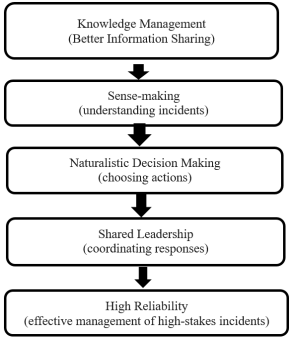
The theoretical argument guiding this study assumes that high-stakes policing requires leaders first to make sense of complex and rapidly evolving situations (Sensemaking Theory), then make timely decisions under conditions of uncertainty using experience and professional judgment (Naturalistic Decision Making Theory). Effective incident management depends on leadership being distributed across individuals and teams who collaborate, communicate, and coordinate their expertise (Shared Leadership Theory). When these individual and team processes are consistently supported by organizational learning, resilience, and reliable operating practices, the police organization is better positioned to function as a High Reliability Organization. Knowledge management serves as the integrating mechanism across these processes by capturing, sharing, and applying knowledge to strengthen situational understanding, decision quality, collaboration, and organizational learning, thereby enhancing the Malawi Police leadership capacity to manage high-stakes incidents effectively.
This integrated perspective is well-suited to current research because it connects the micro level (individual leader cognition), the team level (shared leadership and interpersonal relationships), and the organizational level (high reliability), with knowledge management acting as the cross-cutting mechanism that links these levels into a coherent framework for improving police leadership during high-stakes incidents. The interplay and interdependency of the four theories above guiding the study will help bridge the gap in police leadership competencies and knowledge management,, building the capacity to enable police leadership to apply principles of knowledge management. The combination of the four theories brings a comprehensive, holistic police leadership that is able to react to high-stakes incidents by managing challenges through the use of agile and versatile intelligence collection that pushes for collaborative leadership through consultation, coordination, and collaboration. Agile and versatile intelligence collection builds resilience through sense-making theory.
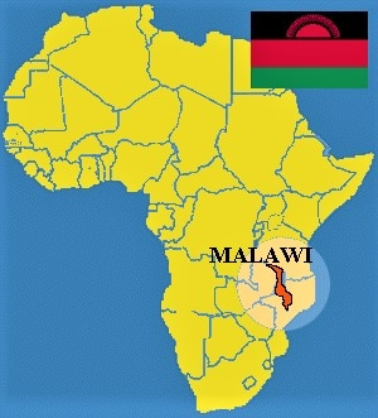
Figure 1. Shows Malawi in Africa.
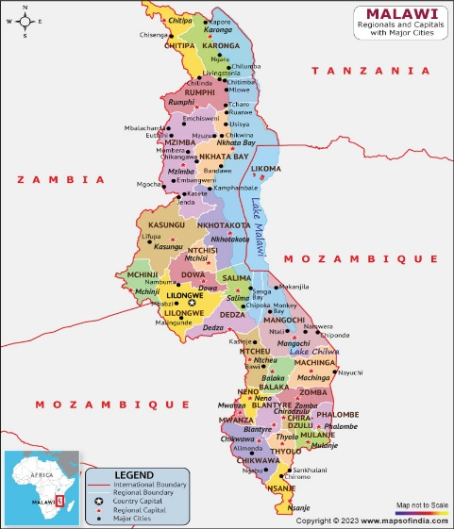
Figure 2. Showing a map of Malawi.
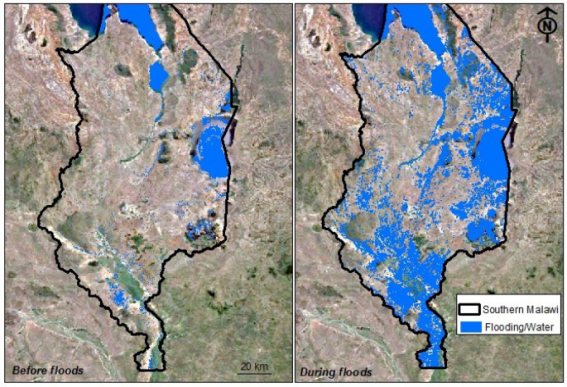
Figure 3. Showing Southern Malawi.
Figures 1-3 show the map of the study area. This is the southern part of Malawi, which includes the districts of Blantyre, Phalombe, Chiradzulo, Mulanje, Thyolo, Chikwawa, Nsanje, and Mwanza. The Cyclone Freddy had a big impact on Chikwawa District on transportation because bridges were washed away and some roads were cut off, making transportation and vehicle movements impossible due to flooding. The power supply was interrupted because ESCOM poles and wires transmitting power were damaged by continuous rains, causing trees to fall onto them. People needed communication, which was interrupted by internet challenges and limited movements. People needed food due to a limited food supply caused by limited movements. Some people were trapped in the highlands, surrounded by floods, and needed rescue teams. Blantyre District, Phalombe District, and Mulanje District experienced landslides, and rescue teams were urgently needed to recover victims and their property. Houses, crops, and livestock were submerged in floods, calling for immediate humanitarian assistance from concerned authorities. The socio-demographic characteristics of the victims' population include chiefs, faith leaders, pupils, students, local communities, public servants, and business persons.
2.2. Methods of Data Collection
Table 1. Explore high-stakes incidents and strategies that police leadership put in place to manage them: A case of Cyclone Freddy.
Variables | Methods of collecting data | Data analysis |
Cyclone Freddy, Active shooter incidents, Terrorist attacks, Major public disorder or riots, Natural disasters, Armed robberies or ongoing violent crimes, Strategic thinking & decision making, effective communication, operation readiness & adaptability, ethical leadership & accountability Dependent variable: High-stakes incidents | Quantitative Survey Semi-structured questionnaire (online Google form) Qualitative interviews Embedded open-ended questionnaires on the Survey semi-structured questionnaire Focus group discussion interview guide | Quantitative Survey Descriptive statistics Qualitative Interviews Transcript, coding, grouping into sub-themes, and themes. |
2.3. Data Analysis
2.3.1. Quantitative Survey
The online Google form was completed by 40 participants on a purposively targeted online platform that had police officers who experienced the phenomenon—the researcher sought consent from the institution to collect data from respondents. When the Institution accepted the researcher to collect data from respondents, the researcher administered a consent form to respondents, informing them of their rights to participate or withdraw during the process. The respondents were also informed about the confidentiality of their participation identity. The questions in the semi-structured questionnaire were analyzed individually based on descriptive statistics. The analysis produced frequency tables, which are the basis for competing results. There have not been statistical tests in the study because the survey has just tried to generalize the results due to time constraints, as well as the nature of the phenomena.
2.3.2. Qualitative Interviews
The interviews were conducted as part of a focus group discussion with 10 police officers who were commanders during the phenomenon—the researcher sought consent from respondents before administering the interviews. The respondents were also informed that pseudonyms would be used to protect their identities. The recorded interviews were transcribed manually. The transcript was coded manually. The codes were grouped into sub-themes. The sub-themes were grouped into themes that responded to the research objectives. The transcripts were in two stages. The first stage was the transcript embedded with open-ended questions in the survey semi-structured questionnaire to accommodate qualitative interviews. The second stage was the transcript of the 10 respondents' responses during the follow-up focus group discussion, which aimed to clarify matters in the semi-structured questionnaire.
2.4. Data Management
Due to the sensitive nature of policing and security operations, the data underlying this study cannot be shared publicly. Access may be granted upon request to the corresponding author, subject to ethical and security clearance.
2.5. Limitations
The study faced a number of limitations. (1) Costs of conducting a survey and interviews forced the researcher to use an online data collection strategy. (2) Sensitiveness of the topic hindered the researcher from doing more probing from other key informants’ interviews. (3) This study needed more funds to go and triangulate responses from police leadership with community members, but resources did not permit it.
3. Results
Table 2. Experience of a high-stakes incident.
Base: all respondents who answered this question
Response category | N | % | Base (N) |
Yes | 36 | 92.3% | 40 |
No | 3 | 7.7% | 40 |
Total | 39 | 100.0% | |
Table 3. High-stakes incidents that have been experienced (select all that apply): A case of Cyclone Freddy.
Base: respondents who selected at least one option; percentages may sum to more than 100% (multiple responses permitted)
Response category | N | % | Base (N) |
Active shooter incidents | 3 | 8.1% | 40 |
Armed robberies or ongoing violent crimes | 4 | 10.8% | 40 |
Critical infrastructure attacks | 3 | 8.1% | 40 |
Kidnappings and child abductions | 1 | 2.7% | 40 |
Large-scale traffic collisions or transport disasters | 4 | 10.8% | 40 |
Major public disorder or riots | 23 | 62.2% | 40 |
Mass casualty incidents | 2 | 5.4% | 40 |
Natural disasters (Cyclone Freddy) | 14 | 37.8% | 40 |
Did you encounter Cyclone Freddy and other high-stakes incidents as police leadership, and what strategies did you use to manage them?
3.1. High-stakes Incidents
Through a survey, the study wanted to find out if respondents have ever experienced Cyclone Freddy and other High-stakes incidents. In response to the question.
Table 4. Strategies that police leadership use to handle Cyclone Freddy and other high-stakes incidents (select all that apply).
Base: respondents who selected at least one option; multiple responses permitted
Response category | N | % | Base (N) |
effective communication | 18 | 47.4% | 40 |
ethical leadership & accountability | 6 | 15.8% | 40 |
operation readiness & adaptability | 17 | 44.7% | 40 |
Strategic thinking & decision making | 23 | 60.5% | 40 |
3.2. Strategies for Managing Cyclone Freddy and Other High-Stakes Incidents
When the study conducted a survey to know
“What strategies did police leadership use to handle Cyclone Freddy and other high-stakes incidents?” Respondents were allowed to provide multiple responses.
Table 4. Reveal that respondents pointed out that incident commanders used various strategies to manage Cyclone Freddy and other high-stakes incidents mentioned above, as revealed; 60% strategic thinking and decision making, 47.4% effective communication, 44.7% operation readiness and adaptability, and lastly, ethical leadership and accountability. In this question, two respondents did not respond for reasons known to themselves. The study wanted to know the
“Most effective strategy overall for Cyclone Freddy and other high-stakes incidents?” Interviews revealed that strategic thinking and decision-making, effective communication, operational readiness and adaptability, and ethical leadership and accountability were the most effective strategies for applying agile and versatile intelligence collection.
3.3. How did the Malawi Police Leadership Use IRMAC as a Cycle
Interviews conducted through focus group discussions revealed that the Malawi Police leadership applied agile and versatile intelligence collection through the IRMAC model. Through continuous analysis of the shared information, which was processed into intelligence from first respondents to follow-up respondents, the Malawi Police leadership did not treat IRMAC as five separate steps; they used it as a continuous decision cycle:
Intelligence → Reconnaissance → Mission → Administration → Command → reassessment
Table 5. Various questions were to be asked throughout the phenomenon.
Intelligence: | Establish what is known—location, occupants, cyclone development, hazardous conditions, casualties, and resources already responding. |
Reconnaissance: | Obtain reliable information from personnel at or near the scene about conditions, access, hazards, and changes. |
Mission: | Set immediate objectives such as protecting life, controlling people by providing information about the incident,, and preventing escalation. |
Administration: | Ensure sufficient responders, rescuing apparatus, medical resources, transport, communications, and relief personnel. |
Command: | Establish sectors/teams, allocate responsibilities, communicate priorities, and create a system for receiving updates. |
Reassess: | New intelligence changes the operational picture, so the commander repeats the cycle and modifies the plan. |
Through probing and triangulation utilizing focus group discussion on how police leadership used the IRMAC model to handle Cyclone Freddy and other High-stakes incidents, respondents revealed some Key strategies that Malawi Police leadership used to handle them through the following recorded statement.
An explanation from Focus Group Discussion respondent A pointed out:
Another Focus Group Discussion respondent B said:
Furthermore, Focus Group Discussion respondent C revealed:
“Inter-agency collaboration:
Another Focus Group Discussion respondent D mentioned that:
“Public safety and law enforcement: During the emergency, police leadership ensured: protection of evacuation centers, prevention of looting, safeguarding humanitarian supplies, maintenance of law and order, crowd management around relief distribution points.”
In addition, Focus Group Discussion respondent E revealed that:
“Communication and public information: Police spokespersons regularly updated the public on casualty figures, road accessibility, rescue operations, safety advice, and areas requiring evacuation. Effective communication helped reduce panic and supported informed decision-making.”
Additionally, Focus Group Discussion respondent F pointed out that:
“Resource mobilization: Recognizing that many police officers and their families were also victims, MPS leadership mobilized internal welfare support by collecting donations of food, cash, and essential supplies for affected officers. This demonstrated compassionate leadership while maintaining operational readiness.”
Furthermore, Focus Group Discussion respondent G explained that:
“Personnel welfare and morale: Senior leaders, including the Deputy Inspector General, visited affected officers and encouraged resilience while providing material and emotional support. Maintaining staff morale was essential because police officers continued working despite personal losses.”
In addition, Focus Group Discussion respondent H had this to say:
“Adaptive crisis leadership: Cyclone Freddy created unprecedented challenges, including landslides, destroyed infrastructure, and communication failures. Police leadership adapted by: reallocating officers to priority areas, adjusting patrol patterns, working with local communities to reach inaccessible locations, and prioritizing life-saving operations before routine policing.”
4. Discussion
The study reveals that respondents agree that they experienced Cyclone Freddy and other high-stakes incidents. In addition to Cyclone Freddy, respondents also experienced major public disorders, riots, demonstrations, and mob violence, natural disasters of Cyclone Ana and Cyclone Gombe in 2022, armed robberies/ ongoing violent crimes, and landslides. Findings are similar to results from studies conducted by scholars worldwide. In the USA, police leadership experienced Shootings
| [7] | Justice, J. M. (2013). Active shooters: Is law enforcement ready for a Mumbai-style attack? Thesis submitted in partial fulfillment of the requirements for the degree of Master of Arts in Security Studies (Homeland Security and Defense) from Naval Post-graduate School.
https://calhoun.nps.edu.api.bitstreams.content |
[7]
and Terrorism
| [8] | Kierstead, R. L. (2015). Recommendation for a national standard for tactical emergency casualty care and Israeli Hospital trauma protocol in the United States. Thesis submitted in partial fulfillment of the requirements for the degree of Master of Arts in Security Studies (Homeland Security and Defense) from the Naval Post-Graduate School, June 2015.
https://www.hsdl.org/c/abstract/?docid=768622 |
[8]
. In the United Kingdom, police officers experienced an upsurge in COVID-19
| [1] | Bang, H. N. and Muir, C. G. (2025) Local authority major incident management in the United Kingdom: Are local services adequately equipped to enhance resilience to pandemic-induced crowd risks? International Journal of Mass Emergencies & Disasters 2025, Vol. 43 (1-2) 16-31.
https://doi.org/10.1177/02807270251380227 |
[1]
. In the Austrian Police, they experienced terrorism hostage crises
| [17] | Renner, R.; Cvetkovi´c, V. M.; Lieftenegger, N. (2025) Dealing with High-Risk Police Activities and Enhancing Safety and Resilience: Qualitative Insights into Austrian Police Operations from a Risk and Group Dynamic Perspective. Safety 2025, 11, 68. https://doi.org/10.3390/safety11030068 |
[17]
. In Nigeria, the Nigerian police have always handled Special Operations to bring social order
| [6] | Eyoh, A. A. & Uzonwanne, M. C. (2025). Introduction to tactical leadership and operational strategy (Pages 1-7). Police operational strategy and tactical leadership for enhanced professionalism and economic impact. Okpuno Awka, Anambra State, Nigeria. Fab Educational Books.
https://www.researchgate.net.publication.398466687 |
[6]
. The findings are contrary to results by May
| [12] | May, B. (2024). Understanding Decision Inertia: An exploratory examination of the manifestation of decision inertia in high-stakes events. This thesis is submitted in partial fulfillment of the requirements for the award of the degree of Doctor of Philosophy at The University of Portsmouth. https://researchportal.port.ac.uk.studentTheses.under |
[12]
where some police leadership exhibit decision inertia in times of crisis. The implication is that results indicate that Malawi police leadership has experienced Cyclone Freddy and almost all other categories of high-stakes incidents.
Study respondents reveal police leadership used the IRMAC model of decision making so that processed information (Intelligence) allowed deployment of various strategies to manage Cyclone Freddy's high-stakes incident, such as strategic thinking and decision making, effective communication, operational readiness and adaptability, ethical leadership, and accountability. According to the respondents, the study reveals that the most effective strategies are: strategic thinking and decision-making, effective communication, operational readiness and adaptability, and ethical leadership and accountability. Focus group discussions reveal that the Malawi Police leadership played a significant role in the response to Tropical Cyclone Freddy (March 2023), working alongside other stakeholders such as the Department of Disaster Management Affairs (DoDMA), the Malawi Defense Force, humanitarian organizations, and local communities. Their leadership strategies reflected principles of emergency management, crisis leadership, and inter-agency coordination.
Leadership Implications: The findings reveal that the Malawi Police leadership response illustrates several important crisis leadership principles. These crisis leadership principles include the following: Collaboration: Working effectively with multiple agencies. Decisiveness: Rapid deployment and prioritization of life-saving operations. Communication: Providing timely and accurate information to the public. Resilience: Continuing operations despite officers themselves being affected. Service-oriented leadership: Protecting lives while supporting both communities and police personnel. Flexibility: Adapting operational plans as conditions changed.
In brief, the Malawi Police leadership managed the Cyclone Freddy incident primarily through unified command, rapid operational deployment, inter-agency coordination, effective communication, maintenance of public security, resource mobilization, and attention to personnel welfare. These strategies aligned with internationally recognized disaster management practices and contributed to the broader national emergency response coordinated by the Government of Malawi and DoDMA.
The results are similar to revelations by other scholars, such as In Nigeria, where the police used strategic leadership, disciplined policing, and operational excellence
| [6] | Eyoh, A. A. & Uzonwanne, M. C. (2025). Introduction to tactical leadership and operational strategy (Pages 1-7). Police operational strategy and tactical leadership for enhanced professionalism and economic impact. Okpuno Awka, Anambra State, Nigeria. Fab Educational Books.
https://www.researchgate.net.publication.398466687 |
[6]
. In the United Kingdom, police forces have used decision models
| [3] | Boulton, L. (2025). Guiding police decisions or falling short? A critical theoretical review of the national decision model. The Police Journal: Theory, Practice and Principles 2026, Vol. 99(2) 202–216. https://doi.org/10.1177/0032258X251352756 |
[3]
. Beck
| [2] | Beck, A. A. (2022). Decision-making in crisis: A case study of frontline police commander decision-making in critical incidents. Doctoral Study Project (DSP) Presented to the Glenn R. Jones College of Business of Trident University International, a Member of the American Intercontinental University System, in Partial Fulfillment of the Requirements for the Degree of Doctor of Business Administration.
https://www.researchgate.net.publication.397999624 |
[2]
reports that police in the United States have applied decision-making models. Mitchell
| [13] | Mitchell, K. M. (2025). Leadership Practices for High-Performance Teams: Insights From Senior Military General Officers and Flag Officers. A Dissertation by Kimberly M. Mitchell University of Massachusetts Global, A Private Nonprofit Affiliate of the University of Massachusetts, Irvine, California School of Education Submitted in partial fulfillment of the requirements for the degree of Doctor of Education in Organizational Leadership.
https://digitalcommons.umassglobal.edu.edd.dissertations |
[13]
shows clarity, connection, and communication strategies. Okon et al.
| [15] | Okon, R., Zouo, S. J. C., and Sobowale, A. (2024). Operational oversight in high-stakes turnarounds: Key insights for C-suite leaders. World Journal of Advanced Research and Reviews, 2024, 24(02), 2391–2408.
https://doi.org/10.30574/wjarr.2024.24.2.3591 |
[15]
recommend the adoption of agile oversight frameworks, prioritizing environmental, social, and governance principles, and fostering a culture of continuous improvement and adaptability within the organization. A study in the Austrian Police recommends the strategy of the transformative impact of intensive scenario-based and high-stress training
| [17] | Renner, R.; Cvetkovi´c, V. M.; Lieftenegger, N. (2025) Dealing with High-Risk Police Activities and Enhancing Safety and Resilience: Qualitative Insights into Austrian Police Operations from a Risk and Group Dynamic Perspective. Safety 2025, 11, 68. https://doi.org/10.3390/safety11030068 |
[17]
. Waring emphasizes the strategy of procedural decision-making and lawful decisions
| [18] | Waring, S. (2011). An examination of the impact of accountability and blame culture on police judgments and decisions in critical incident contexts. Thesis submitted in accordance with the requirements of the University of Liverpool for the degree of Doctor of Philosophy.
https://livrepository.liverpool.ac.uk/id/eprint/5275 |
[18]
. Study
| [11] | Manda, S. and Mumbo Thindwa, T. T., (2025) ‘‘This one caught us unaware’: Disaster politics and institutions during Cyclone Freddy in Malawi. International Journal of Disaster Risk Reduction 117 (2025) 105144. Journal homepage:
https://www.researchgate.net.publication.38763962 |
[11]
reveals that disaster actors are not a homogeneous category and deploy different tools during emergencies. Various entities bring a substantial amount of expertise that may help ease the pressure on victims' tactics and resources
| [11] | Manda, S. and Mumbo Thindwa, T. T., (2025) ‘‘This one caught us unaware’: Disaster politics and institutions during Cyclone Freddy in Malawi. International Journal of Disaster Risk Reduction 117 (2025) 105144. Journal homepage:
https://www.researchgate.net.publication.38763962 |
[11]
. The best possible way forward is to promote collaborative leadership through the sharing of information to manage swift and effective consultations, coordination, and collaboration towards the common mission.
Table 6. A useful way to think about research objectives’ results and guiding theories explains a different knowledge contribution of leadership in complex policing environments.
Research Objective | Theoretical Contribution | Contribution to Empirical Knowledge |
Investigate high-stakes incidents and strategies police leadership uses to manage them. | HRO theory explains organizational reliability strategies such as preoccupation with failure, resilience, deference to expertise, and operational sensitivity. NDM theory explains how experienced police leaders make rapid decisions under uncertainty. Sense-making theory explains how leaders interpret ambiguous information during evolving incidents. | Empirical findings have identified strategic thinking and decision making, effective communication, operational readiness and adaptability, ethical leadership, and accountability leadership strategies used during high-stakes incidents, in resource-constrained environments. Revealing that Malawi Police leadership strategies reflected principles of emergency management, crisis leadership, and inter-agency coordination. In brief, the Malawi Police Service leadership managed the high-stakes Cyclone Freddy incident primarily through unified command, rapid operational deployment, inter-agency coordination, effective communication, maintenance of public security, resource mobilization, and attention to personnel welfare. These strategies aligned with internationally recognized disaster management practices and contributed to the broader national emergency response coordinated by the Government of Malawi and DoDMA. |
4.1. A Useful Commander's Question set During Cyclone Freddy Management
At the start of an incident, the commander had to work through rapidly:
Intelligence: What happened? What is happening now? What could happen next? What information is reliable? What critical information is missing?
Reconnaissance: What are the actual conditions? What are the hazards? Where are affected or vulnerable people? What routes and resources are available? What has changed since the initial information?
Mission: What is the immediate priority? What outcomes must be achieved? What tasks are necessary to achieve those outcomes? What risks are acceptable or unacceptable?
Administration: Do we have enough personnel and equipment? What specialist capabilities are required? How will communications, medical support, transport, and logistics be maintained? How will responders be relieved and supported?
Command: Who has overall command? Who is responsible for each function? How will information reach the commander? What decisions require escalation? When will the situation be reassessed?
The key value of IRMAC is that it prevents the commander from jumping straight from “something serious has happened” to “send people in.” It encourages a disciplined process of understanding the situation, establishing objectives, ensuring the response can be sustained, and maintaining effective command as circumstances change.
The study probed more from the focus group discussion interview on the genesis and more insights on the IRMAC model that came out during the focus group discussion session. In summary, the respondents explained that IRMAC requires agility and versatile intelligence collection capabilities. Agile and versatile intelligence collection is especially valuable in high-stakes incidents because it helps management move quickly from uncertainty to informed action while continuously adapting as the situation changes.
Similarly, the findings are consistent with the results of
| [16] | Ngui, T. K. (2025). Artificial Intelligence and Leadership Agility: Concepts and Their Application. International Journal of Research and Innovation in Social Science (IJRISS). Volume IX, Issue XIV, February 2025. Special Issue on Management.
https://ideas.repec.org/a/bcp/journl/v9y2025i14p464-476.html |
[16]
, who concluded that agility is the capability and understanding to respond quickly to disruption, capitalize on new opportunities, and address threats. Kucharska et al.
| [10] | Kucharska, W., Balcerowski, T., Kucharski, M., & Jussila, J. (2024, June). How does the relationship between the acceptance of mistakes, the component of learning culture, and tacit knowledge-sharing drive organizational agility? Risk as a moderator. In Proceedings of the 25th European Conference on Knowledge Management (Vol. 25, No. 1, pp. 397-404). Academic Conferences and Publishing Limited.
https://www.researchgate.net.publication.383779510 |
[10]
emphasized that agility must be understood as the ability to respond to contextual changes, requires being charged by new, contextual, tacit knowledge obtained through trial-and-error actions (learning by doing), and is achievable by breaking conventions and experimenting. Moreover, risk management skills have been proven to be a critical characteristic of agile organizations today. Naseer et al.
| [14] | Naseer, A., Naseer, H., Ahmad, A., Maynard, S. B., Siddiqui, A. M. (2023). Moving towards agile cybersecurity incident response: A case study exploring the enabling role of big data analytics-embedded dynamic capabilities, Computers & Security, Volume 135, 2023, 103525, "
https://doi.org/10.1016/j.cose.2023.103525 |
[14]
emphasize the need for flexibility, speed, and continuous learning to achieve agility in intelligence collection.
The implication is that the IRMAC model may be taken as a policing doctrine that promotes continuous intelligence collection, allowing operational commanders to keep adapting to the evolving high-stakes incident. In brief, the study results reveal that (i) agility enables faster decision-making: High-stakes incidents such as Cyclone Freddy evolve rapidly. An agile intelligence function can change its collection priorities as new information emerges, rather than waiting for a fixed reporting cycle. The intelligence cycle is designed to be iterative: requirements, collection, analysis, dissemination, and feedback continually influence one another. (ii) Versatile collection creates a fuller picture: Using multiple complementary sources reduces dependence on a single information stream. Depending on the incident, this might include: Reports from personnel on the ground, internal operational data, Public/open-source information, Partner or government reporting, Sensors, imagery or technical data, Social and media reporting, Specialist or subject-matter expertise. The value is not simply more information, but the ability to compare different sources and identify corroboration, contradictions, and gaps. The research results and implications in this study reveal that the IRMAC model is significant to the handling of Cyclone Freddy and other high-stakes incidents because (i) it improves situational awareness, (ii) it helps managers prioritize scarce resources, (iii) it supports risk anticipation, not just reaction, and (iv) it reduces the danger of acting on unreliable information.
4.2. Addressing the Research Gap
The study results indicate that police leadership indeed experiences high-stakes incidents. These incidents are handled using various strategies depending on their nature and characteristics. Police leadership uses various strategies, which are determined by the characteristics of particular incidents. The varying characteristics pose distinct challenges that require police leadership to draw on the interpersonal competencies they possess. The possession of interpersonal competencies is determined by the knowledge the police leadership has. Therefore, knowledge management mechanisms through agile and versatile intelligence collection have the potential to influence the handling of high-stakes incidents.
The knowledge gap and theoretical contribution that this research addresses are through the four theories used to interpret the study. Through HRO Theory, Malawi police leadership “mindfulness comes on top of the five principles of 'preoccupation with failure, reluctance to simplify, sensitivity to operations, commitment to resilience, and deference to expertise” The mindfulness hallmark influenced the police leadership to establish a national Command Center that received feedback from regional command centers. The police leadership used all available sources to continue collecting intelligence for sustainable adaptation to evolving high-stakes incidents.
Complemented by the Naturalistic Decision-Making theory, which calls for the role of experience of police leadership when handling high-stakes incidents. Experience helps police leaders rapidly categorize situations to make effective decisions, especially by analyzing past doctrines, providing operational and theoretical training, and adapting the use of Information and Communication Technology (ICT) to support predictive analysis aimed at improving performance. This was greatly influenced by the IRMAC model, which allowed first respondents to share information and enabled continuous follow-up by other teams on assessments made by the first respondents.
In addition, Shared Leadership Theory emphasizes collective responsibility among team members at the organization level or inter-agency level, which enhances collaboration, innovation, and organizational effectiveness through decentralization of authority and responsibility. Shared Leadership Theory insists on collaborative rather than hierarchical leadership. Malawi police leadership allowed various stakeholders to use their expertise on the gathered and shared intelligence to achieve a common national goal in addressing the high-stakes incident.
Furthermore, Sense-Making Theory calls for police leadership to apply seven principles of organizational identity, retrospect (career), enactment (authority), social contact (relationship), ongoing event, cues, and plausibility (integrity).
Based on
Figure 4 below, knowledge management supports sense-making by enabling the sharing of intelligence, preserving lessons learned, improving situational awareness, and making previous incident reports accessible. Naturalistic Decision-Making gives leaders access to previous experiences, supports the recognition of patterns, documents expert knowledge, and retains tacit knowledge from experienced officers. Shared Leadership improves communication by facilitating information sharing, reducing knowledge silos, and strengthening collaboration across units. High Reliability Organizations promote organizational learning, supporting after-action reviews, institutionalizing best practices, and improving resilience through continuous learning.
The study findings reveal that the Malawi police leadership used knowledge management through agile and versatile intelligence collection by utilizing the decision model of IRMAC for high-stakes incident management, as illustrated in
Table 7 below:
Table 7. The IRMAC model shows leadership's continuous learning during an incident.
IRMAC element | Key question | What the incident commander does |
I — Intelligence | What do we know, and what don't we know? | Collect and verify information about the incident, threats/hazards, people affected, resources, environment, and likely developments—separate confirmed facts from assumptions. |
R — Reconnaissance | What is actually happening on the ground? | Obtain direct or reliable observations of the scene. Identify hazards, access/egress routes, affected areas, critical infrastructure, available resources, and changes in conditions. |
M — Mission | What must we achieve? | Establish clear objectives, normally prioritizing life safety, incident stabilization, and protection of property/environment. Convert broad objectives into specific tasks and priorities. |
A — Administration | What support is required to sustain the response? | Organize personnel, equipment, transport, communications, medical support, supplies, welfare, documentation, and relief/rotation arrangements. |
C — Command | Who is responsible for what, and how will decisions be made? | Establish command structure, assign responsibilities, maintain communications, set decision points, coordinate agencies, and continuously reassess the plan. |
A simple conceptual sequence is:
Figure 4. Knowledge management conceptual sequence.
5. Conclusion
This study has shown that the Malawi Police Service leadership managed Cyclone Freddy as a high-stakes incident requiring rapid, strategic, and ethically grounded decision-making. The implementation of the IRMAC operational decision-making model allowed police leadership to use the most effective strategies: strategic thinking, effective communication, operational readiness and adaptability, and ethical leadership with accountability. Agile and versatile intelligence collection enhanced situational awareness, preserved lessons learned, and facilitated interagency collaboration.
The integration of High Reliability Organization Theory, Naturalistic Decision-Making Theory, Shared Leadership Theory, and Sense-making Theory provides a robust framework for understanding police leadership responses. Together, these theories highlight that knowledge management through sustainable, continuous, agile, and versatile intelligence collection is the critical enabler that transforms fragmented actions into coherent, adaptive, and reliable policing during crises. Also, by filling the gap in empirical evidence on Malawi Police leadership during Cyclone Freddy, this study contributes to both academic scholarship and practical disaster-response strategies, concluding that police operations rely on sustained intelligence collection.
6. Recommendations
To strengthen preparedness and resilience in future high-stakes incidents, the Malawi Police Service should:
1) Institutionalize After-Action Reviews. Ensure systematic reflection and documentation after every major incident to capture lessons learned.
2) Establish a Centralized Knowledge Hub. Create a national incident-reporting and intelligence-sharing system accessible across police units and partner agencies.
3) Expand Scenario-Based Training. Implement regular disaster-response simulations focusing on natural disasters, crowd control, and multi-agency coordination.
4) Integrate ICT and Predictive Analytics. Use technology-driven tools for early warning, risk assessment, and real-time decision support during crises.
5) Strengthen Interagency Collaboration. Formalize joint protocols with emergency services, military, and disaster management agencies to improve coordination.
6) Embed Ethical Leadership Practices. Reinforce accountability mechanisms that promote lawful, fair, and transparent decision-making under pressure.
Abbreviations
COVID 19 | Corona Virus Disease 2019 |
DoDMA | Department of Disaster Management Affairs |
FGD | Focus Group Discussion |
HRO | Highly Reliability Organization Theory |
IRMAC | Intelligence Reconnaissance Mission Administration Command |
LPDP Consultancy | Lilian Precious Dorah and Phelemero Consultancy |
NDM | National Decision-Making Theory |
NDM | National Decision Model |
NGO | Non-Governmental Organizations |
Acknowledgments
The author thanks all co-authors for their time in contributing to the article and all cited authors for their contributions to the body of knowledge in the field.
Acknowledgement is further directed to all respondents for their willingness and commitment to participate in the study and their value contribution.
Furthermore, appreciations are directed to the management of Malawi Police Service and the Royal Malaysia Police College Kuala Lumpur for their organizing the forum 50th ISPOCC that became genesis for this research.
Author Contributions
David Kumwenda: Conceptualization, Data curation, Formal Analysis, Funding acquisition, Investigation, Methodology, Project administration, Resources, Software, Supervision, Validation, Visualization, Writing – original draft, Writing – review & editing
Thokozani Andrew Chazema: Funding acquisition, Investigation, Methodology, Software, Supervision, Validation, Visualization, Writing – review & editing
Dumbo Kacholola: Validation, Visualization, Writing – review & editing
References
| [1] |
Bang, H. N. and Muir, C. G. (2025) Local authority major incident management in the United Kingdom: Are local services adequately equipped to enhance resilience to pandemic-induced crowd risks? International Journal of Mass Emergencies & Disasters 2025, Vol. 43 (1-2) 16-31.
https://doi.org/10.1177/02807270251380227
|
| [2] |
Beck, A. A. (2022). Decision-making in crisis: A case study of frontline police commander decision-making in critical incidents. Doctoral Study Project (DSP) Presented to the Glenn R. Jones College of Business of Trident University International, a Member of the American Intercontinental University System, in Partial Fulfillment of the Requirements for the Degree of Doctor of Business Administration.
https://www.researchgate.net.publication.397999624
|
| [3] |
Boulton, L. (2025). Guiding police decisions or falling short? A critical theoretical review of the national decision model. The Police Journal: Theory, Practice and Principles 2026, Vol. 99(2) 202–216.
https://doi.org/10.1177/0032258X251352756
|
| [4] |
Cantu, J., Tolk, J. N., Fritts, S., & Gharehyakheh, A. (2020). High Reliability Organization (HRO) systematic literature review: Discovery of culture as a foundational hallmark. Journal of Contingencies and Crisis Management.
https://www.researchgate.net.publication.34149903
|
| [5] |
Czarniawska, B. (1997). Book Reviews. Sensemaking in Organizations, by Karl E. Weick (Thousand Oaks, CA: Sage Publications, 1995), 231 pp. Scand. J. Mgmt, Vol. 13, No. 1. pp. I 13-120, 1997. Published by Elsevier Science Ltd. Printed in Great Britain.
https://www.researchgate.net.publication.257397559
|
| [6] |
Eyoh, A. A. & Uzonwanne, M. C. (2025). Introduction to tactical leadership and operational strategy (Pages 1-7). Police operational strategy and tactical leadership for enhanced professionalism and economic impact. Okpuno Awka, Anambra State, Nigeria. Fab Educational Books.
https://www.researchgate.net.publication.398466687
|
| [7] |
Justice, J. M. (2013). Active shooters: Is law enforcement ready for a Mumbai-style attack? Thesis submitted in partial fulfillment of the requirements for the degree of Master of Arts in Security Studies (Homeland Security and Defense) from Naval Post-graduate School.
https://calhoun.nps.edu.api.bitstreams.content
|
| [8] |
Kierstead, R. L. (2015). Recommendation for a national standard for tactical emergency casualty care and Israeli Hospital trauma protocol in the United States. Thesis submitted in partial fulfillment of the requirements for the degree of Master of Arts in Security Studies (Homeland Security and Defense) from the Naval Post-Graduate School, June 2015.
https://www.hsdl.org/c/abstract/?docid=768622
|
| [9] |
Klein, G. (2008). Naturalistic Decision Making. Golden Anniversary Special Issue June 2008 – Human Factors 456-460.
https://www.researchgate.net.publication.319770380
|
| [10] |
Kucharska, W., Balcerowski, T., Kucharski, M., & Jussila, J. (2024, June). How does the relationship between the acceptance of mistakes, the component of learning culture, and tacit knowledge-sharing drive organizational agility? Risk as a moderator. In Proceedings of the 25th European Conference on Knowledge Management (Vol. 25, No. 1, pp. 397-404). Academic Conferences and Publishing Limited.
https://www.researchgate.net.publication.383779510
|
| [11] |
Manda, S. and Mumbo Thindwa, T. T., (2025) ‘‘This one caught us unaware’: Disaster politics and institutions during Cyclone Freddy in Malawi. International Journal of Disaster Risk Reduction 117 (2025) 105144. Journal homepage:
https://www.researchgate.net.publication.38763962
|
| [12] |
May, B. (2024). Understanding Decision Inertia: An exploratory examination of the manifestation of decision inertia in high-stakes events. This thesis is submitted in partial fulfillment of the requirements for the award of the degree of Doctor of Philosophy at The University of Portsmouth.
https://researchportal.port.ac.uk.studentTheses.under
|
| [13] |
Mitchell, K. M. (2025). Leadership Practices for High-Performance Teams: Insights From Senior Military General Officers and Flag Officers. A Dissertation by Kimberly M. Mitchell University of Massachusetts Global, A Private Nonprofit Affiliate of the University of Massachusetts, Irvine, California School of Education Submitted in partial fulfillment of the requirements for the degree of Doctor of Education in Organizational Leadership.
https://digitalcommons.umassglobal.edu.edd.dissertations
|
| [14] |
Naseer, A., Naseer, H., Ahmad, A., Maynard, S. B., Siddiqui, A. M. (2023). Moving towards agile cybersecurity incident response: A case study exploring the enabling role of big data analytics-embedded dynamic capabilities, Computers & Security, Volume 135, 2023, 103525, "
https://doi.org/10.1016/j.cose.2023.103525
|
| [15] |
Okon, R., Zouo, S. J. C., and Sobowale, A. (2024). Operational oversight in high-stakes turnarounds: Key insights for C-suite leaders. World Journal of Advanced Research and Reviews, 2024, 24(02), 2391–2408.
https://doi.org/10.30574/wjarr.2024.24.2.3591
|
| [16] |
Ngui, T. K. (2025). Artificial Intelligence and Leadership Agility: Concepts and Their Application. International Journal of Research and Innovation in Social Science (IJRISS). Volume IX, Issue XIV, February 2025. Special Issue on Management.
https://ideas.repec.org/a/bcp/journl/v9y2025i14p464-476.html
|
| [17] |
Renner, R.; Cvetkovi´c, V. M.; Lieftenegger, N. (2025) Dealing with High-Risk Police Activities and Enhancing Safety and Resilience: Qualitative Insights into Austrian Police Operations from a Risk and Group Dynamic Perspective. Safety 2025, 11, 68.
https://doi.org/10.3390/safety11030068
|
| [18] |
Waring, S. (2011). An examination of the impact of accountability and blame culture on police judgments and decisions in critical incident contexts. Thesis submitted in accordance with the requirements of the University of Liverpool for the degree of Doctor of Philosophy.
https://livrepository.liverpool.ac.uk/id/eprint/5275
|
| [19] |
Xu, Y. (2025). The Review of Shared Leadership. Academic Journal of Management and Social Sciences, Vol. 13, No. 2, 2025.
https://www.researchgate.net.publication.398229371
|
Cite This Article
-
APA Style
Kumwenda, D., Chazema, T. A., Ahmad, Z., Kacholola, D. (2026). Intelligence-led Strategic Thinking & Decision Making by the Malawi Police Service Leadership During the High-Stakes Incident of Cyclone Freddy. International Journal of Law and Society, 9(4), 537-552. https://doi.org/10.11648/j.ijls.20260904.20
 Copy
|
 Download
ACS Style
Kumwenda, D.; Chazema, T. A.; Ahmad, Z.; Kacholola, D. Intelligence-led Strategic Thinking & Decision Making by the Malawi Police Service Leadership During the High-Stakes Incident of Cyclone Freddy. Int. J. Law Soc. 2026, 9(4), 537-552. doi: 10.11648/j.ijls.20260904.20
Copy
|
Download
AMA Style
Kumwenda D, Chazema TA, Ahmad Z, Kacholola D. Intelligence-led Strategic Thinking & Decision Making by the Malawi Police Service Leadership During the High-Stakes Incident of Cyclone Freddy. Int J Law Soc. 2026;9(4):537-552. doi: 10.11648/j.ijls.20260904.20
Copy
|
Download
-
@article{10.11648/j.ijls.20260904.20,
  author = {David Kumwenda and Thokozani Andrew Chazema and Zubair Ahmad and Dumbo Kacholola},
  title = {Intelligence-led Strategic Thinking & Decision Making by the Malawi Police Service Leadership During the High-Stakes Incident of Cyclone Freddy},
  journal = {International Journal of Law and Society},
  volume = {9},
  number = {4},
  pages = {537-552},
  doi = {10.11648/j.ijls.20260904.20},
  url = {https://doi.org/10.11648/j.ijls.20260904.20},
  eprint = {https://article.sciencepublishinggroup.com/pdf/10.11648.j.ijls.20260904.20},
  abstract = {Policing in the modern era is evolving at an unprecedented pace, driven by complex security challenges influenced by high technology, an ever-changing landscape of crime, coupled with emerging threats of cybercrime, terrorism, organized criminal networks, and natural disasters. This calls for a proactive and adaptive police approach and professionalism. The study aims to examine high-stakes incidents as well as what strategies the Malawi police leadership uses to handle them: A Case of Cyclone Freddy. Utilized mixed methods embedded design, pragmatics paradigm, and four theories: High Reliability Organization Theory, Naturalistic Decision Making Theory, Shared Leadership Theory, and Sense-making Theory. Data was collected using a semi-structured questionnaire that was administered on a purposefully selected online platform to 40 respondents, and an interview guide was administered to a purposefully selected focus group discussion of 10. Data analysis followed descriptive statistics and thematic analysis. Findings reveal that Malawi police leaders experienced natural disasters of Cyclone Freddy in 2023, as well as other incidents of major public disorders, riots, demonstrations, and mob violence, Cyclone Ana and Cyclone Gombe in 2022, armed robberies/ ongoing violent crimes, and active shooter high-stakes incidents. During Cyclone Freddy, Police leaders used strategic thinking and decision-making, effective communication, operational readiness and adaptability, and ethical leadership and accountability. Police leaders used the model of Intelligence → Reconnaissance → Mission → Administration → Command (IRMAC) → reassessment. The findings contribute to the conclusion that knowledge is power. Leaders must be aware that the IRMAC model cycle is ongoing until the incident is cleared. Operational tactics and strategy will continue to change following updates to the intelligence. Agile and versatile intelligence collection is especially valuable in high-stakes incidents because it helps leaders move quickly from uncertainty to informed action while continuously adapting as the situation changes. The cycle goes on and off in phases, starting with the first responders, follow-ups, and complete response. Theoretically, Naturalistic Decision-Making theory gives leaders access to previous experiences, supports the recognition of patterns, documents expert knowledge, and helps retain tacit knowledge from experienced officers. Shared Leadership improves communication by facilitating information sharing, reducing knowledge silos, and strengthening collaboration across units. High Reliability Organizations promote organizational learning, supporting after-action reviews, institutionalizing best practices, and improving resilience through continuous learning. Recommendation is that there is a need for strengthening intelligence collection to fill gaps of uncertainty, time pressure, and lack of information of any high-stakes incident to improve future responses.},
 year = {2026}
}
Copy
|
Download
-
TY  - JOUR
T1  - Intelligence-led Strategic Thinking & Decision Making by the Malawi Police Service Leadership During the High-Stakes Incident of Cyclone Freddy
AU  - David Kumwenda
AU  - Thokozani Andrew Chazema
AU  - Zubair Ahmad
AU  - Dumbo Kacholola
Y1  - 2026/11/27
PY  - 2026
N1  - https://doi.org/10.11648/j.ijls.20260904.20
DO  - 10.11648/j.ijls.20260904.20
T2  - International Journal of Law and Society
JF  - International Journal of Law and Society
JO  - International Journal of Law and Society
SP  - 537
EP  - 552
PB  - Science Publishing Group
SN  - 2640-1908
UR  - https://doi.org/10.11648/j.ijls.20260904.20
AB  - Policing in the modern era is evolving at an unprecedented pace, driven by complex security challenges influenced by high technology, an ever-changing landscape of crime, coupled with emerging threats of cybercrime, terrorism, organized criminal networks, and natural disasters. This calls for a proactive and adaptive police approach and professionalism. The study aims to examine high-stakes incidents as well as what strategies the Malawi police leadership uses to handle them: A Case of Cyclone Freddy. Utilized mixed methods embedded design, pragmatics paradigm, and four theories: High Reliability Organization Theory, Naturalistic Decision Making Theory, Shared Leadership Theory, and Sense-making Theory. Data was collected using a semi-structured questionnaire that was administered on a purposefully selected online platform to 40 respondents, and an interview guide was administered to a purposefully selected focus group discussion of 10. Data analysis followed descriptive statistics and thematic analysis. Findings reveal that Malawi police leaders experienced natural disasters of Cyclone Freddy in 2023, as well as other incidents of major public disorders, riots, demonstrations, and mob violence, Cyclone Ana and Cyclone Gombe in 2022, armed robberies/ ongoing violent crimes, and active shooter high-stakes incidents. During Cyclone Freddy, Police leaders used strategic thinking and decision-making, effective communication, operational readiness and adaptability, and ethical leadership and accountability. Police leaders used the model of Intelligence → Reconnaissance → Mission → Administration → Command (IRMAC) → reassessment. The findings contribute to the conclusion that knowledge is power. Leaders must be aware that the IRMAC model cycle is ongoing until the incident is cleared. Operational tactics and strategy will continue to change following updates to the intelligence. Agile and versatile intelligence collection is especially valuable in high-stakes incidents because it helps leaders move quickly from uncertainty to informed action while continuously adapting as the situation changes. The cycle goes on and off in phases, starting with the first responders, follow-ups, and complete response. Theoretically, Naturalistic Decision-Making theory gives leaders access to previous experiences, supports the recognition of patterns, documents expert knowledge, and helps retain tacit knowledge from experienced officers. Shared Leadership improves communication by facilitating information sharing, reducing knowledge silos, and strengthening collaboration across units. High Reliability Organizations promote organizational learning, supporting after-action reviews, institutionalizing best practices, and improving resilience through continuous learning. Recommendation is that there is a need for strengthening intelligence collection to fill gaps of uncertainty, time pressure, and lack of information of any high-stakes incident to improve future responses.
VL  - 9
IS  - 4
ER  -
Copy
|
Download







 Share This Article
 Twitter
 Linked In
 Facebook