Abstract
Molybdenum, a rare metal of exceptional strategic importance, is widely utilized in critical sectors such as the nuclear industry, aerospace, and electronics due to its outstanding properties. In recent years, growing global demand for molybdenum and its derivative materials has led to a persistent supply-demand gap in the industry, prompting domestic manufacturers to transition toward developing advanced molybdenum-based new materials. (Delete this sentence) This review systematically examines the types and properties of common molybdenum alloys, the fundamental characteristics of molybdenum disulfide, and the principles of mainstream preparation methods including powder metallurgy and additive manufacturing, while highlighting the applications of molybdenum derivatives across various fields. Additionally, it explores strategies for high-quality development in the molybdenum-based materials sector from three perspectives—material composition, integrated innovation in advanced fabrication processes, and industrialization of two-dimensional molybdenum-based materials—and outlines future trends. The study aims to provide theoretical foundations for fundamental research, technological advancement, and practical applications of molybdenum-based materials. (Molybdenum, a strategically important rare metal, occupies an irreplaceable position in high-end fields such as nuclear industry, aerospace, and electronics, owing to its high melting point, excellent high-temperature strength, good thermal and electrical conductivity, and corrosion resistance. With the global energy transition and upgrading of advanced manufacturing, the supply-demand gap for molybdenum materials has become increasingly prominent, and China’s molybdenum industry is shifting from resource export to high-end material manufacturing. This review systematically summarizes the research progress of molybdenum-based materials from traditional alloys to two-dimensional functional systems. First, the compositions, properties, and limitations of five commonly used molybdenum alloys—TZM, Mo-Re, Mo-W, Mo-Cu, and Mo-La2O3—are outlined. Second, the principles, advantages, and existing challenges of mainstream fabrication routes are elaborated, including powder metallurgy (mechanical alloying, isostatic pressing, powder injection molding, spark plasma sintering, and liquid-phase sintering) and additive manufacturing (electron beam selective melting and laser powder bed fusion). Third, taking molybdenum disulfide as a representative, the layered crystal structure of molybdenum-based ceramic materials and their application potential and challenges in electronic devices, optoelectronic sensing, and biomedical detection are analyzed. Furthermore, this review proposes development strategies for the high-quality advancement of the molybdenum-based materials industry from three perspectives—precise alloy composition design, integrated innovation of advanced preparation processes, and industrialization of two-dimensional molybdenum-based materials—and provides an outlook on future trends. This review aims to offer systematic theoretical references for fundamental research, technological development, and engineering applications of molybdenum-based materials, thereby promoting the high-value-added utilization of molybdenum resources and the self-reliance of the industrial chain in China).
1. Introduction
Molybdenum is a rare, refractory, and precious metal, as well as a key mineral resource with extremely high strategic value globally. It possesses fundamental properties such as a high melting point, great strength, high hardness, and a large elastic modulus, along with excellent wear resistance, electrical conductivity, and thermal conductivity. Additionally, this material exhibits a low coefficient of thermal expansion, strong resistance to acid and alkali corrosion, robust protection against liquid metal erosion, and outstanding overall chemical structural stability
| [1] | Li Honggui. Metallurgy of Rare Metals [M]. Beijing: Metallurgical Industry Press, 1990. |
[1]
. Due to its superior comprehensive performance, molybdenum and molybdenum alloys have become indispensable core materials in the production of advanced electronic components, wear-resistant parts, and high-temperature structural components, finding widespread applications in various industrial sectors including aerospace, defense, nuclear industry, power electronics, steel metallurgy, machinery manufacturing, energy chemistry, medical devices, lighting equipment, and glass fibers
| [2] | Ren Wuxin, Lu Yan Wang, Kaiping Du, et al. Research progress of molybdenum-rhenium alloys in nuclear reactors [J]. Nonferrous Metals, 2025, 15(1): 46-55. |
| [3] | Perepezko J H. The hotter the engine, the better [J]. Science, 2009, 326(5956): 1068-1069.
https://doi.org/10.1126/science.1179327 |
| [4] | El-genk M S, Tournier J M. A review of refractory metal alloys and mechanically alloyed-oxide dispersion strengthened steels for space nuclear power systems [J]. Journal of Nuclear Materials, 2005, 340(1): 93-112.
https://doi.org/10.1016/j.jnucmat.2004.10.118 |
[2-4]
. In recent years, the growing demand for molybdenum materials from traditional downstream industries as well as emerging sectors such as new energy and semiconductors has continuously widened the supply-demand gap in the molybdenum industry, driving sustained price increases that reached historic highs by 2026. As the world's largest producer of molybdenum resources, China has accelerated the transformation of its domestic molybdenum industry, shifting from a development model focused on raw ore exports to a transition toward high-end molybdenum-based new materials such as high-purity molybdenum targets, molybdenum-rhenium alloys, and molybdenum disulfide. Against the backdrop of global energy transition and the upgrading of high-end manufacturing, the strategic importance of molybdenum resources has become increasingly prominent. Understanding the fundamental properties and current status of molybdenum alloys and two-dimensional molybdenum-based materials is essential for effectively advancing the transformation of the molybdenum industry toward high-end molybdenum-based new materials.
Molybdenum (Mo) is a scarce, refractory, and rare metal that serves as a strategically vital mineral resource. It exhibits exceptional mechanical properties—including high melting point, hardness, strength, and elastic modulus—along with outstanding wear resistance, excellent electrical and thermal conductivity, low thermal expansion coefficient, acid/alkali corrosion resistance, strong resistance to liquid metal erosion, and superior chemical stability
| [1] | Li Honggui. Metallurgy of Rare Metals [M]. Beijing: Metallurgical Industry Press, 1990. |
[1]
. Leveraging these comprehensive advantages, molybdenum and its alloys have become indispensable core materials for developing high-end electronic components, wear-resistant parts, and high-temperature structural components. Currently, molybdenum products are widely used in various industries such as aerospace, defense, nuclear energy, power electronics, steel metallurgy, machinery manufacturing, energy chemistry, medical equipment, light sources, and glass fibers
| [2] | Ren Wuxin, Lu Yan Wang, Kaiping Du, et al. Research progress of molybdenum-rhenium alloys in nuclear reactors [J]. Nonferrous Metals, 2025, 15(1): 46-55. |
| [3] | Perepezko J H. The hotter the engine, the better [J]. Science, 2009, 326(5956): 1068-1069.
https://doi.org/10.1126/science.1179327 |
| [4] | El-genk M S, Tournier J M. A review of refractory metal alloys and mechanically alloyed-oxide dispersion strengthened steels for space nuclear power systems [J]. Journal of Nuclear Materials, 2005, 340(1): 93-112.
https://doi.org/10.1016/j.jnucmat.2004.10.118 |
[2-4]
. In recent years, driven by steady growth in traditional downstream sectors and rapid development of emerging industries like new energy and semiconductors, market demand for molybdenum-based materials has surged, widening the supply-demand gap and driving prices to historic highs by 2026. As the world's largest molybdenum producer, China has accelerated its industrial upgrading, moving away from a resource-intensive model focused on primary raw material exports like molybdenum concentrates toward advanced applications such as high-purity molybdenum targets, molybdenum-rhenium alloys, and molybdenum disulfide. Amid global energy transition and rapid advancements in high-end manufacturing, the strategic importance of molybdenum minerals continues to grow. A comprehensive analysis of the physicochemical properties and research progress of molybdenum alloys and two-dimensional molybdenum-based materials will provide robust support for China's molybdenum industry chain to advance into the high-end materials sector.
2. Molybdenum Alloy
2.1. Types of Molybdenum Alloys
Currently, the most commonly used molybdenum alloys in industry fall into five major categories: TZM titanium-zirconium-molybdenum alloy, molybdenum-rhenium alloy, molybdenum-tungsten alloy, molybdenum-copper alloy, and molybdenum-lanthanum alloy, as shown in
Table 1.
Table 1. Types and Properties of Molybdenum Alloys.
Alloy Series | alloying component | function | shortcoming | References |
TZM titanium-zirconium-molybdenum alloy | Mo-0.4~0.55Ti-0.06~0.12%Zr-0.01~0.04C | High melting point, high strength, excellent elastic modulus, low linear expansion coefficient, low vapor pressure, good electrical and thermal conductivity, and strong corrosion resistance. | It exhibits poor high-temperature oxidation resistance, requires complex preparation processes, and involves high costs. | | [5] | Wang Jinshu, Hu Yancao, Zhou Meiling, et al. Study on the emission mechanism of Mo-Y2O3 cathodes [J]. Rare Metals, 2001, 25(3): 170-173. | | [6] | Shi Qishuang. The effect of solid solution-quenching heat treatment on the microstructure and mechanical properties of low-oxygen titanium-zirconium-molybdenum alloys [D]. Xi'an University of Architecture and Technology, 2024. | | [7] | Kaserer L, Braun J, Stajkovic J, Kaserer L, Braun J, Stajkovic J, et al. Molybdenum alloy Mo-Ti-Zr-C adapted for laser powder bed fusion with refined isotropic microstructure and excellent high temperature strength [J]. International Journal of Refractory Metals and Hard Materials, 2023, 113: 106174.
https://doi.org/10.1016/j.ijrmhm.2023.106174 |
[5-7] |
Molybdenum-alloy | Mo-Re | High strength, extremely low plastic-to-brittle transition temperature, and high resistivity | High cost, high density, poor oxidation resistance at high temperatures | |
Molybdenum-tungsten alloy | Mo-W | Exhibits excellent high-temperature mechanical properties, superior resistance to corrosion by molten metals, and good thermal and electrical conductivity. | Cold working is highly challenging, and its oxidation resistance at high temperatures is poor. | | [10] | Tongay S, Zhou J, Ataca C, et al. Two-dimensional molybdenum tungsten diselenide alloys: photoluminescence, Raman scattering, and electrical transport [J]. ACS Nano, 2014, 8(7): 7130-7137. https://doi.org/10.1021/nn5020566 |
[10] |
molybdenum-copper | Mo-Cu | Characterized by high electrical and thermal conductivity, non-magnetism, and excellent machinability | Low heat resistance at high temperatures, poor oxidation resistance under high temperatures, and complex preparation process | | [11] | Cao Weicheng, Fu Xiaojun. Recovery of molybdenum and copper from Mo-Cu alloy waste [J]. Rare Metals Express, 2006, 25(7): 31-34. | | [12] | Rosalie J M, Guo J, Pippan R, et al. On nanostructured molybdenum-copper composites produced by high-pressure torsion [J]. Journal of Materials Science, 2017, 52: 9872-9883. https://doi.org/10.1007/s10853-017-1142-2 |
[11, 12] |
Molybdenum-alloyed molybdenum | Mo-1%~2%La2O3 | High recrystallization temperature, excellent high-temperature creep resistance, and good toughness. | Poor high-temperature oxidation resistance and stringent preparation requirements | | [13] | Zhang J X, Zhou M L, Liu L, et al. Effect of La2O3 on the recrystallization of molybdenum wires [J]. Acta Metallurgica Sinica (English Letters), 1996, 9(2): 94-98. | | [14] | Li W H, Ai T T, Dong H F, et al. Microstructure and mechanical properties improvement of Mo-12Si-8.5B alloy by adding lanthanum oxide [J]. Rare Metals, 2019, 38(9): 821-828. https://doi.org/10.1007/s12598-019-01273-7 |
[13, 14] |
2.2. Preparation Process of Molybdenum Alloys
Molybdenum and molybdenum alloys are refractory alloy materials that require multiple critical factors during their preparation. Currently, the mainstream preparation methods for molybdenum alloys primarily fall into two categories: powder metallurgy and additive manufacturing.
2.2.1. Powder Metallurgy Method
The powder metallurgy process primarily encompasses steps such as powder preparation, pressing, sintering, and subsequent processing. Among these, atomization and mechanical alloying are the most widely employed methods for powder preparation
| [15] | Sun H X, Chen C G, Zhang Z W, et al. PM High speed steel with high-performance manufactured by super-fine powder with low oxygen content [J]. Rare Metals Materials and Engineering, 2019, 48(10): 3246-3252.
https://doi.org/10.12442/j.issn.1002-185X.20190049 |
| [16] | Guo Hui, Li Xikun, Song Yuanyuan, et al. Preparation of Ti4AlN3 via powder metallurgy and study on its properties [J]. Steel Vanadium Titanium, 2021, 42(5): 47-53.
https://doi.org/10.7513/j.issn.1004-7638.2021.05.008 |
[15, 16]
. Mechanical alloying, often referred to as high-energy ball milling, is a technique that involves mixing various pure metal powders in specified ratios and achieving uniform powder homogenization through high-energy mechanical grinding, enabling the production of ultrafine metallic micropowders
| [17] | Liu Z Y, Loh N H, Khor K A, et al. Mechanical alloying of TiC/M2 high speed steel composite powders and sintering investigation [J]. Materials Science and Engineering A, 2001, 311(1-2): 13-21.
https://doi.org/10.1016/S0921-5093(01)00929-7 |
[17]
. Based on this method, Hu Baoquan et al. utilized high-energy ball milling to facilitate continuous cold welding, fragmentation, and recombination between molybdenum and copper powders, ultimately obtaining nanoscale composite powders with uniform composition
| [18] | Hu Baoquan, Wang Yanzhong. Effect of surfactants on the morphological characteristics of high-energy ball-milled Mo-Cu composite powders [J]. Casting Equipment and Technology, 2021(1): 17-18, 39. |
| [19] | Hu Baoquan, Bai Peikang, Cheng Jun. Preparation of low-mass fraction Mo-Cu alloys by mechanical alloying [J]. Functional Materials, 2010, 41(5): 837-839, 843. |
[18, 19]
. This preparation process offers significant advantages, including a simple operational workflow, high powder homogeneity, and excellent alloying performance.
Powder consolidation forming represents the second critical step in the preparation process of molybdenum alloy powders. The density and uniformity of distribution of the formed green body directly determine the final microstructure and overall performance of the finished product. Current mainstream powder forming techniques for molybdenum alloys include isostatic pressing, dry pressing, and powder injection molding, each with distinct technical characteristics and application scenarios
| [20] | Yang F, Li Y L, Shen C X, et al. Research progress on preparation and forming of titanium and titanium alloy powders [J]. Powder Metallurgy Technology, 2023, 41(4): 330-342.
https://doi.org/10.19591/j.cnki.cn11-1974/tf.2021030037 |
| [21] | Kearns M A, Murray K, Davies P A, et al. Sintering and properties of MIM M2 high speed steel produced by prealloy and master alloy routes [J]. Metal Powder Report, 2016, 71(3): 200-206. https://doi.org/10.1016/j.mprp.2016.04.005 |
[20, 21]
. Among these, hot isostatic pressing integrates green body formation with sintering processes, achieving energy efficiency gains while requiring complex equipment and higher initial investment costs; its key advantages lie in high product yield rates and exceptional comprehensive performance
| [22] | Shen Q M, Yang J, Shan X Y, et al. Development and application of HIP technology [J]. Rare Metals and Cemented Carbides, 2003(2): 33-39. |
[22]
. Powder injection molding is a novel technique combining powder metallurgy and precision injection molding technologies, with its standard process flow illustrated in
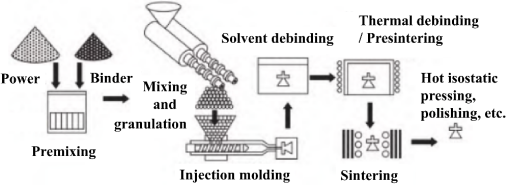
Figure 1 [23]. This method enables near-net-shape formation of components in a single operation, producing parts that meet precise dimensional and geometric requirements without requiring additional machining steps, thereby reducing material waste and production costs—making it particularly suitable for large-scale manufacturing of complex molybdenum alloy products. However, specific requirements for molybdenum alloy powders significantly increase the production costs associated with this forming method.
Powder consolidation forming represents the second critical step in the preparation process of molybdenum alloy powders, as the density and uniformity of distribution within the formed green body directly determine the final microstructure and overall performance of the product. Current mainstream powder forming techniques for molybdenum alloys include isostatic pressing, dry pressing, and powder injection molding, each with distinct technical characteristics and application scenarios
| [20] | Yang F, Li Y L, Shen C X, et al. Research progress on preparation and forming of titanium and titanium alloy powders [J]. Powder Metallurgy Technology, 2023, 41(4): 330-342.
https://doi.org/10.19591/j.cnki.cn11-1974/tf.2021030037 |
| [21] | Kearns M A, Murray K, Davies P A, et al. Sintering and properties of MIM M2 high speed steel produced by prealloy and master alloy routes [J]. Metal Powder Report, 2016, 71(3): 200-206. https://doi.org/10.1016/j.mprp.2016.04.005 |
[20, 21]
. Among these, hot isostatic pressing integrates green body formation with sintering processes, offering significant energy efficiency advantages while delivering high product yield rates and excellent comprehensive performance, albeit at the cost of complex procedures and high equipment investment
| [22] | Shen Q M, Yang J, Shan X Y, et al. Development and application of HIP technology [J]. Rare Metals and Cemented Carbides, 2003(2): 33-39. |
[22]
. Powder injection molding, a novel technique combining powder metallurgy and precision injection molding, follows a standard process flow illustrated in
Figure 1 [23]. This method enables near-net-shape formation of components in a single operation, producing parts that meet precise dimensional and geometric requirements without requiring secondary processing, thereby reducing material waste and production costs. It also facilitates large-scale production of complex-shaped molybdenum alloy products. However, this technique imposes specific requirements on molybdenum alloy powders, substantially increasing manufacturing costs.
Figure 1. Process flowchart of powder injection molding.
Figure 1 Schematic of metal injection molding (MIM) fabrication procedure.
Sintering is the critical process for achieving density enhancement of powder metallurgy green bodies after forming, playing a decisive role in determining the density, microstructural composition, and overall mechanical properties of molybdenum alloys. Currently, two mainstream sintering techniques are employed in alloy preparation: plasma sintering and liquid-phase sintering. Plasma sintering utilizes plasma to activate powders, enabling rapid densification at low temperatures and significantly improving the comprehensive performance of molybdenum alloys
| [24] | Minasyan T, Kirakosyan H, Aydinyan S, et al. Mo-Cu pseudoalloys by combustion synthesis and spark plasma sintering [J]. Journal of Materials Science, 2018, 53(24): 16598-16608. https://doi.org/10.1007/s10853-018-2787-1 |
[24]
. Reddy et al.
| [25] | Reddy M V, Sahoo P K, Krishnaiah A, et al. Densification and microstructure studies of Mo-30-40 wt% Cu nanocomposites prepared through chemical route [J]. Journal of Alloys and Compounds, 2023, 941: 168740.
https://doi.org/10.1016/j.jallcom.2023.168740 |
[25]
conducted discharge plasma sintering experiments using nano-sized Mo-Cu composite powders at 1000°C, successfully producing molybdenum-copper alloys with fine grains and uniform microstructure, achieving a density exceeding 98% and a microhardness surpassing 587 HV. Studies demonstrate that plasma sintering rapidly densifies alloy green bodies, refines grain structure, and enhances performance; however, challenges remain including suboptimal process parameters, unclear sintering mechanisms, and limited industrial applicability. Liquid-phase sintering involves heating molybdenum alloy powders above the melting point or eutectic temperature of at least one component to achieve densification under coexistence of solid and liquid phases. Current research focuses on enhancing sintering efficiency through doping with trace activators or using ultrafine powder materials to optimize this process
| [26] | Benavides P A, Soto B, Palma R H. Liquid phase sintering of mechanically alloyed Mo-Cu powders [J]. Materials Science and Engineering: A, 2017, 701: 237-244.
https://doi.org/10.1016/j.msea.2017.06.090 |
| [27] | Zhang H. Influence of Ti addition on the microstructure and comprehensive properties of Mo-Cu alloy [J]. Journal of Materials Research and Technology, 2024, 30: 2833-2847.
https://doi.org/10.1016/j.jmrt.2024.05.016 |
[26, 27]
. Scholars including Guo
| [28] | Guo S B, Kang Q, Cai C B, et al. Mechanical properties and expansion coefficient of Mo-Cu composites with different Ni contents [J]. Rare Metals, 2012, 31(4): 368-371.
https://doi.org/10.1007/s12598-012-0312-6 |
[28]
conducted experimental studies on the effects of trace amounts of the active element Ni on the sintering properties of Mo-18Cu composites. The results demonstrated that Ni addition significantly enhances the wettability of the copper liquid phase on the molybdenum matrix surface. After sintering at 1250°C for 2 hours, the samples exhibited optimal overall performance, with a density of 99.2%, hardness of 72.5 HRA, and flexural strength of 1058 MPa. Additionally, the study revealed that physical properties such as resistivity and thermal conductivity of the molybdenum-copper alloy decline to some extent with increasing Ni doping content.
Sintering is the critical process for achieving density enhancement of powder metallurgy green bodies after forming, directly determining the density, microstructural morphology, and comprehensive mechanical properties of molybdenum alloys, making it a pivotal step in their preparation. Currently, mainstream sintering techniques in this field fall into two major categories: discharge plasma sintering and liquid-phase sintering. These methods exhibit distinct advantages and limitations depending on their respective sintering mechanisms during alloy modification. Discharge plasma sintering utilizes plasma to activate metal powders, enabling rapid densification of green bodies at low temperatures while effectively optimizing the microstructure and enhancing material performance
| [24] | Minasyan T, Kirakosyan H, Aydinyan S, et al. Mo-Cu pseudoalloys by combustion synthesis and spark plasma sintering [J]. Journal of Materials Science, 2018, 53(24): 16598-16608. https://doi.org/10.1007/s10853-018-2787-1 |
[24]
. Reddy et al.
| [25] | Reddy M V, Sahoo P K, Krishnaiah A, et al. Densification and microstructure studies of Mo-30-40 wt% Cu nanocomposites prepared through chemical route [J]. Journal of Alloys and Compounds, 2023, 941: 168740.
https://doi.org/10.1016/j.jallcom.2023.168740 |
[25]
successfully synthesized fine-grained, uniformly structured molybdenum-copper alloys using nano-sized Mo-Cu composite powders through discharge plasma sintering at 1000°C. Experimental results demonstrated that the resulting alloys achieved over 98% density with microhardness exceeding 587 HV. Studies confirm that this technique accelerates green body densification, refines grain size, and significantly improves mechanical properties. However, notable challenges remain—including poor parameter compatibility, incomplete understanding of sintering mechanisms, and limited scalability—hindering its widespread industrial application. Liquid-phase sintering is a manufacturing process that involves heating a molybdenum alloy powder green body to temperatures above the melting point or eutectic temperature of at least one component, achieving sintering densification under coexistence of solid and liquid phases. Current industry practices primarily enhance sintering efficiency through doping with trace activators and using ultrafine powder materials to optimize the liquid-phase sintering system and improve sintering performance
| [26] | Benavides P A, Soto B, Palma R H. Liquid phase sintering of mechanically alloyed Mo-Cu powders [J]. Materials Science and Engineering: A, 2017, 701: 237-244.
https://doi.org/10.1016/j.msea.2017.06.090 |
| [27] | Zhang H. Influence of Ti addition on the microstructure and comprehensive properties of Mo-Cu alloy [J]. Journal of Materials Research and Technology, 2024, 30: 2833-2847.
https://doi.org/10.1016/j.jmrt.2024.05.016 |
[26, 27]
. Researchers including Guo
| [28] | Guo S B, Kang Q, Cai C B, et al. Mechanical properties and expansion coefficient of Mo-Cu composites with different Ni contents [J]. Rare Metals, 2012, 31(4): 368-371.
https://doi.org/10.1007/s12598-012-0312-6 |
[28]
conducted systematic experiments investigating the effects of Ni as a trace activator on the sintering characteristics of Mo-18Cu composites. Results demonstrated that Ni doping significantly improves the wettability of molten copper on the molybdenum substrate surface, substantially enhancing sintering density. After 2 hours of sintering at 1250°C, the composite achieved optimal mechanical properties: a density of 99.2%, hardness of 72.5 HRA, and flexural strength of 1058 MPa. However, experiments revealed that Ni doping adversely affects the physical properties of the molybdenum-copper alloy, with key parameters such as resistivity and thermal conductivity showing progressive deterioration as Ni content increases.
2.2.2. Additive Manufacturing Method
Additive manufacturing technology, also known as 3D printing technology, is one of the most advanced precision forming techniques today
| [29] | Lu Bingheng, Li Dichen. Development of Additive Manufacturing (3D Printing) Technology [J]. Mechanical Manufacturing and Automation, 2013, 42(4): 1-4. |
[29]
. It operates on the principle of discrete material deposition, building up layers sequentially in a "bottom-up" manner to precisely create solid components with specified geometric structures
. Current additive manufacturing methods for molybdenum alloys primarily include Electron Beam Selective Melting (EBSM), Laser Powder Bed Fusion (LPBF), and Directional Energy Deposition (DED).
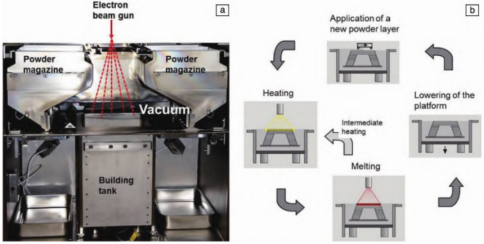
Electron beam selective melting (EBSM) technology employs high-power electron beams as an energy source to achieve the melting, forming, and processing of molybdenum alloys, as illustrated in
Figure 2 [31]. During EBSM forming, the microstructure of the sample is primarily governed by both the beam current and scanning speed, with current intensity exerting a significantly greater influence on microstructural morphology than acceleration voltage; components fabricated via this process exhibit superior mechanical properties
| [32] | Yan Kan, Gao Zhijie, Gao Lei, et al. Research Progress on Metal Materials Fabrication via Electron Beam Selective Melting Additive Manufacturing [J]. Thermal Processing Technology, 2024, 53(11): 7-13.
https://doi.org/10.14158/j.cnki.1001-3814.20241250 |
[32]
. However, molybdenum alloy and superalloy parts produced using electron beam additive manufacturing often suffer from surface quality defects, with surface finish failing to meet operational standards; the surface roughness and hardness of some components even exceed those of conventional forged specimens, rendering them unsuitable for direct assembly or service application, necessitating subsequent mechanical finishing to optimize surface quality and satisfy engineering requirements
.
Electron beam selective melting (EBSM) technology employs high-power electron beams as an energy source to achieve the melting, forming, and processing of molybdenum alloys, as illustrated in
Figure 2 [31]. During EBSM forming, the microstructure of the sample is primarily governed by both the beam current and scanning speed. The impact of current intensity on microstructural morphology is significantly more pronounced than that of acceleration voltage. Molybdenum alloy components fabricated via this process exhibit excellent mechanical properties
| [32] | Yan Kan, Gao Zhijie, Gao Lei, et al. Research Progress on Metal Materials Fabrication via Electron Beam Selective Melting Additive Manufacturing [J]. Thermal Processing Technology, 2024, 53(11): 7-13.
https://doi.org/10.14158/j.cnki.1001-3814.20241250 |
[32]
. However, molybdenum alloys and superalloys produced by EBSM often suffer from surface quality defects, with the surface finish of finished products failing to meet operational requirements. Moreover, the surface roughness and hardness of some components exceed those of conventional forged specimens, rendering them unsuitable for direct assembly or service application. These parts must undergo subsequent mechanical finishing to optimize surface quality and satisfy engineering demands
.
Figure 2. Schematic diagram of the working principle of electron beam melting (EBM): (a) Processing chamber; (b) Four processing steps per material layer.
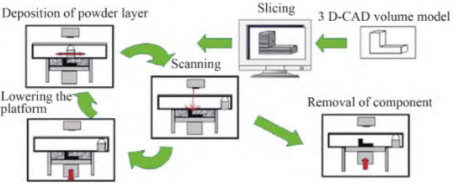
Laser Powder Bed Fusion (LPBF) is a representative additive manufacturing technology. As illustrated in
Figure 3, it employs high-energy laser beams to selectively melt metal powders, achieving near-net-shape component fabrication through a cyclic process of layer-by-layer melting, cooling, and solidification
| [34] | Ng C C, Savalani M M, Man H C, et al. Layer manufacturing of magnesium and its alloy structures for future applications [J]. Virtual and Physical Prototyping, 2010, 5(1): 13-19.
https://doi.org/10.1080/17452751003718629 |
[34]
. Compared to traditional metal processing methods such as machining and casting, this technique requires no custom molds and enables direct integrated formation of complex structural components, offering significant technical advantages in overall part fabrication and the production of intricate geometries
| [35] | Olakanmi E O, Cochrane R F, Dalgarno K W. A review on selective laser sintering/melting (SLS/SLM) of aluminium alloy powders: Processing, microstructure, and properties [J]. Progress in Materials Science, 2015, 74: 401-477.
https://doi.org/10.1016/j.pmatsci.2015.03.002 |
[35]
. The fundamental principles and workflow of LPBF are demonstrated in
Figure 3 [36], involving multiple steps: First, a three-dimensional CAD model is sliced into layers, with the resulting cross-sectional geometry data imported into the laser melting system; then, a powder deposition unit evenly deposits metal powder (10-45 μm in particle size) onto the substrate surface, forming uniform-thickness layers; subsequently, under a protective atmosphere of high-purity inert gas, high-energy lasers scan the powder bed according to each layer's contour, causing complete powder fusion and rapid solidification to form single-layer structures; after each layer is completed, the substrate automatically descends by one layer thickness, repeating the powder deposition and scanning processes until the final component is fully fabricated through cumulative layering. LPBF technology uses conventional fusible metal powders as raw materials, achieving a component density approaching 100% and mechanical properties comparable to those of traditionally manufactured parts, with some performance indicators even surpassing conventional products. For highly chemically reactive molybdenum alloy powders, creating vacuum or high-purity inert gas environments during processing effectively prevents oxidation defects associated with high-temperature operations, making LPBF the preferred technique for precision forming of molybdenum-based composites
| [37] | He Bowen, Wu Qianye, Wu Lianmei, et al. Research Status and Development Trends of Laser Powder Bed Melting Magnesium-Based Composites [J]. China Journal of Rare Earth Sciences, 2026, 44(5): 513-531. |
[37]
. However, this technology still faces certain challenges in practical applications: the powder forming process is prone to defects such as spheroidization, deformation, and cracking; additionally, the layer-by-layer deposition method results in low overall processing efficiency, while the limited processing chamber volume restricts part dimensions, hindering large-scale production of large molybdenum alloy components.
Laser Powder Bed Fusion (LPBF) is a mainstream metal additive manufacturing process. Its working principle involves using high-energy laser beams to selectively melt metal powder, achieving near-net-shape fabrication of metal components through a cyclic process of layer-by-layer melting and subsequent cooling solidification
| [34] | Ng C C, Savalani M M, Man H C, et al. Layer manufacturing of magnesium and its alloy structures for future applications [J]. Virtual and Physical Prototyping, 2010, 5(1): 13-19.
https://doi.org/10.1080/17452751003718629 |
[34]
. Compared to traditional processing methods such as casting and mechanical machining, LPBF eliminates the need for specialized molds and enables one-step integration of complex structural parts, offering significant advantages in manufacturing both monolithic structures and intricate components with irregular shapes
| [35] | Olakanmi E O, Cochrane R F, Dalgarno K W. A review on selective laser sintering/melting (SLS/SLM) of aluminium alloy powders: Processing, microstructure, and properties [J]. Progress in Materials Science, 2015, 74: 401-477.
https://doi.org/10.1016/j.pmatsci.2015.03.002 |
[35]
. The complete LPBF workflow is illustrated in
Figure 3 [36], comprising the following steps: First, a three-dimensional CAD model is sliced into layers, with each cross-sectional profile data imported into the manufacturing equipment; then, a powder deposition system evenly spreads metal powder with particle sizes ranging from 10 to 45 μm onto the substrate to form thin layers; under a high-purity inert gas atmosphere, a laser beam selectively scans the powder bed along predetermined trajectories, rapidly melting and solidifying the powder to create single-layer structures. Upon completion of each layer, the substrate automatically descends by the corresponding thickness, repeating the powder deposition and laser melting cycles until the entire part is printed. Utilizing conventional metal powders, LPBF produces components with nearly 100% density and mechanical properties that match or exceed those of traditional forged or cast parts. For highly chemically active molybdenum alloy powders, isolating them from oxygen using vacuum or a high-purity inert atmosphere effectively suppresses high-temperature oxidation; consequently, LPBF has become the preferred method for precision forming of molybdenum-based composites
| [37] | He Bowen, Wu Qianye, Wu Lianmei, et al. Research Status and Development Trends of Laser Powder Bed Melting Magnesium-Based Composites [J]. China Journal of Rare Earth Sciences, 2026, 44(5): 513-531. |
[37]
. However, this process still has limitations: it is prone to metallurgical defects such as spheroidization, warping, and thermal cracking during printing; the layer-by-layer powder deposition approach offers low production efficiency; additionally, the limited space within the forming cavity imposes strict constraints on part dimensions, making large-scale manufacturing of large-sized molybdenum alloy components challenging.
Figure 3. Principle 1of the LPBF process.
Figure 3 Schematic illustration of the layer-by-layer fabrication procedure for laser powder bed fusion (LPBF) additive manufacturing, including model slicing, powder spreading, laser scanning and part removal.
2.3. Applications of Molybdenum Alloys
In the nuclear industry, molybdenum and its alloys have become the preferred structural materials for nuclear reactors due to their exceptional comprehensive properties. These materials exhibit outstanding strength, toughness, corrosion resistance, and radiation-induced brittleness resistance, making them widely applicable in manufacturing critical reactor components such as core structures, fuel rod cladding, reactor pressure vessels, and drive mechanisms
| [38] | Hasegawa A, Ueda K, Satou M, et al. Neutron irradiation embrittlement of molybdenum rhenium alloys and their improvement by heat treatment [J]. Journal of Nuclear Materials, 1998, 258-263(PART 1 A): 902-906.
https://doi.org/10.1016/S0022-3115(98)00254-7 |
[38]
. In 2012, the U.S. Department of Energy launched a dedicated program to develop accident-tolerant fuels in collaboration with national laboratories and nuclear fuel manufacturers, aiming to create fuels with superior performance characteristics. Molybdenum alloys, leveraging their unique refractory metal properties, emerged as a key candidate system for next-generation fuel cladding materials
| [39] | Cheng B, Chou P, Kim Y J. Evaluations of Mo-alloy for light water reactor fuel cladding to enhance accident tolerance [J]. EPJ Nuclear Sciences & Technologies, 2016, 2: 1-6.
https://doi.org/10.1051/epjn/e2015-50060-7 |
[39]
. As new nuclear reactors increasingly adopt high-enriched uranium systems, U-Mo alloy fuels have become a focal research area. The U-10Mo alloy demonstrates high uranium density, low thermal expansion coefficient, excellent radiation stability, and robust interface stability between U-Mo and zirconium, offering significant overall service performance advantages that establish it as a highly promising advanced nuclear fuel material system for engineering applications
| [40] | Jue J F, Keiser D D, Miller B D, et al. Effects of irradiation on the interface between U-Mo and zirconium diffusion barrier [J]. Journal of Nuclear Materials, 2018, 499: 567-581.
https://doi.org/10.1016/j.jnucmat.2017.11.032 |
| [41] | Ajantiwalay T, Smith C, Keiser D D, et al. A critical review of the microstructure of U-Mo fuels [J]. Journal of Nuclear Materials, 2020, 540: 152386.
https://doi.org/10.1016/j.jnucmat.2020.152386 |
[40, 41]
.
In the aerospace sector, molybdenum alloys have become a critical structural material for key hot-end components such as turbine blades and combustion chamber nozzles in China's aviation engines, owing to their excellent high-temperature mechanical properties and comprehensive performance characteristics. In recent years, the design and optimization of novel alloy systems have been a primary focus of research on molybdenum alloys for aerospace applications. Through component regulation and process improvements, the overall performance of these alloys has been significantly enhanced to meet the demands of next-generation aerospace equipment. For instance, the domestically developed Mo-Cr-W-Ni molybdenum-based alloy exhibits outstanding high-temperature strength and sustained creep resistance, and is now widely used in core aerospace components including aviation engines
| [42] | Cui Chaopeng, Li Qiang, Fan Mengyu, et al. Current Status and Prospects of Mo Alloy Development [J]. Chemical Industry Management, 2024, (14): 54-58. |
[42]
.
In the aerospace sector, molybdenum alloys exhibit exceptional high-temperature mechanical properties and comprehensive mechanical performance, making them widely used in manufacturing critical hot-end components such as aircraft engine turbine blades and combustion chamber nozzles. In recent years, the design and modification of novel alloy systems have become a primary research focus for molybdenum alloys in aerospace applications. Through precise control of alloy composition and optimization of preparation processes, researchers have continuously enhanced the overall performance of these alloys to meet the stringent requirements of next-generation aerospace equipment. Taking China's independently developed Mo-Cr-W-Ni molybdenum alloy as an example, this material demonstrates high high-temperature strength and outstanding creep resistance, and has been widely adopted in advanced aerospace core components including aircraft engines
| [42] | Cui Chaopeng, Li Qiang, Fan Mengyu, et al. Current Status and Prospects of Mo Alloy Development [J]. Chemical Industry Management, 2024, (14): 54-58. |
[42]
.
In the electronics industry, molybdenum alloys are widely used in manufacturing components for core semiconductor devices such as transistors and diodes due to their high melting point, low thermal expansion coefficient, and excellent chemical stability. With advancements in optoelectronics and semiconductor device technologies, the electronics sector has imposed new requirements on the overall performance of molybdenum alloys: these materials must not only maintain their low thermal expansion properties but also further enhance electrical and thermal conductivity along with high-temperature operational stability to meet the demands of next-generation electronic information technology. The domestically developed novel molybdenum-tungsten alloy system has achieved an optimal balance between low thermal expansion characteristics and high electrical conductivity, and has now been successfully commercialized and deployed at scale
| [42] | Cui Chaopeng, Li Qiang, Fan Mengyu, et al. Current Status and Prospects of Mo Alloy Development [J]. Chemical Industry Management, 2024, (14): 54-58. |
[42]
.
In the electronics industry, molybdenum alloys are widely used in manufacturing core semiconductor components such as transistors and diodes due to their high melting point, low linear expansion coefficient, and excellent chemical stability. With continuous advancements in optoelectronic technology and semiconductor devices, the electronics sector has set higher requirements for the overall performance of molybdenum alloys. Currently, these alloys must not only retain their inherent advantage of low thermal expansion but also enhance electrical and thermal conductivity as well as operational stability under high-temperature conditions to meet the demands of next-generation electronic information technologies. The domestically developed novel molybdenum-tungsten alloy system has successfully achieved synergistic optimization of low thermal expansion and high electrical conductivity, and has now been commercialized for mass production and large-scale engineering applications
| [42] | Cui Chaopeng, Li Qiang, Fan Mengyu, et al. Current Status and Prospects of Mo Alloy Development [J]. Chemical Industry Management, 2024, (14): 54-58. |
[42]
.
3. Molybdenum-based Ceramic Materials
Molybdenum-based ceramic materials represent a class of high-performance composite materials, primarily prepared either using refractory compounds such as molybdenum carbides, borides, and sulfides as the matrix phase, or by combining metallic molybdenum as a reinforcing phase with ceramic phases. These materials exhibit multiple outstanding properties, including high melting points and hardness, excellent high-temperature oxidation resistance and wear resistance, and some systems even possess metallic conductivity, demonstrating remarkable overall performance advantages.
Molybdenum-based ceramics are high-performance composite materials typically fabricated by incorporating refractory ceramic phases such as molybdenum carbides, borides, or sulfides as the matrix, or using metallic molybdenum as a reinforcing phase combined with ceramic components. These materials combine the advantages of both metals and ceramics, featuring high melting points, exceptional hardness, outstanding high-temperature oxidation resistance, and excellent wear resistance, while certain formulations also maintain good electrical conductivity, resulting in remarkable overall performance.
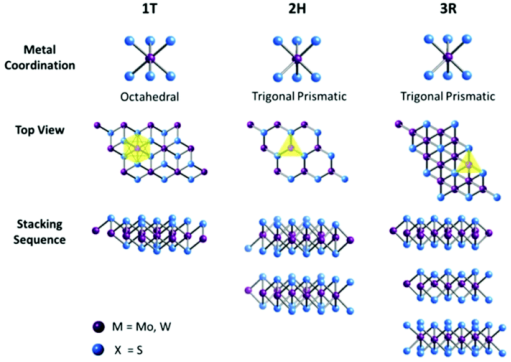
A representative example of molybdenum-based ceramic materials is molybdenum disulfide (MoS
2). As shown in
Figure 4 [43], MoS
2 exhibits a sandwich-layered crystal structure where molybdenum and sulfur atoms within each layer are tightly bonded via strong covalent bonds, while interlayer connections rely solely on weak van der Waals forces. This unique bonding architecture not only endows MoS
2 with distinctive physicochemical properties and excellent mechanical performance but also grants its single-layer form high strength and superior elasticity. Additionally, the fabrication process for MoS
2-based devices is straightforward, meeting the demands of high-volume, low-cost industrial production
| [44] | Toh R J, Sofer Z, Luxa J, et al. 3R phase of MoS2 and WS2 outperforms the corresponding 2H phase for hydrogen evolution [J]. Chemical Communications, 2017, 53(20): 3054-3057. https://doi.org/10.1039/C6CC09952A |
[44]
. Thanks to its outstanding comprehensive performance, MoS
2 has been widely adopted across various fields. In electronics and integrated circuits, MoS
2-based field-effect transistors achieve subthreshold swing values approaching the ideal Boltzmann limit, with switching ratios reaching up to 10
6, effectively mitigating the short-channel effect prevalent in conventional silicon-based devices at nanoscale scales. Meanwhile, this material exhibits excellent compatibility with flexible substrates and can be used to fabricate high-performance operational amplifiers, demonstrating unique technical advantages in analog circuit applications such as flexible electronics and wearable devices
| [45] | Esmaeili-rad M R, Salahuddin S. 2013. High performance molybdenum disulfide amorphous silicon heterojunction photodetector [J]. Scientific Reports, 3: 2345.
https://doi.org/10.1038/srep02345 |
[45]
. In the fields of optoelectronics and sensing, various devices developed based on MoS
2 achieve ultra-high external quantum efficiency and detection sensitivity, making them suitable for diverse applications including biomedical imaging, ultraviolet detection, and low-power visual sensing in robotics. In biomedical detection and diagnosis, MoS
2 has been successfully applied in the development of microfluidic devices and immunoensors, providing innovative technological solutions for early screening and precise diagnosis of major diseases such as cancer
| [46] | Singh C, Ali M A, Kumar V, et al. Functionalized MoS2 nanosheets assembled microfluidic immunosensor for highly sensitive detection of food pathogen [J]. Sensors and Actuators B: Chemical, 2018, 259: 1090-1098.
https://doi.org/10.1016/j.snb.2017.11.152 |
[46]
.
Molybdenum disulfide (MoS
2) is the most representative material among molybdenum-based ceramic materials. It exhibits a typical sandwich-layered crystal structure as shown in
Figure 4 [43], where Mo atoms and S atoms within each layer are tightly bonded via strong covalent bonds, while adjacent layers are connected solely by weak van der Waals forces. This unique crystalline bonding mechanism endows MoS
2 with a range of distinctive physicochemical properties and mechanical characteristics; single-layer MoS
2, in particular, combines ultra-high strength with excellent elasticity. Additionally, the fabrication process for MoS
2 devices is simple, enabling large-scale, low-cost industrial production
| [44] | Toh R J, Sofer Z, Luxa J, et al. 3R phase of MoS2 and WS2 outperforms the corresponding 2H phase for hydrogen evolution [J]. Chemical Communications, 2017, 53(20): 3054-3057. https://doi.org/10.1039/C6CC09952A |
[44]
. Due to its outstanding comprehensive performance, MoS
2 has been widely adopted across various industries. In microelectronics and integrated circuits, MoS
2-based field-effect transistors achieve subthreshold voltage swings approaching the Boltzmann limit and exhibit switching ratios as high as 10
6, effectively suppressing short-channel effects associated with silicon-based devices at miniaturized scales. Moreover, the material demonstrates excellent compatibility with flexible substrates, making it suitable for fabricating high-performance operational amplifiers and offering significant advantages in analog circuits for flexible electronics and wearable devices
| [45] | Esmaeili-rad M R, Salahuddin S. 2013. High performance molybdenum disulfide amorphous silicon heterojunction photodetector [J]. Scientific Reports, 3: 2345.
https://doi.org/10.1038/srep02345 |
[45]
. In optoelectronic devices and sensing applications, MoS
2-based components demonstrate exceptional external quantum efficiency and detection sensitivity, making them ideal for biomedical imaging, ultraviolet sensing, and low-power visual perception in robotics. In biological detection applications, MoS
2 has been utilized in the development of microfluidic chips and immunoassays, paving new avenues for early screening and precise diagnosis of major diseases such as cancer
| [46] | Singh C, Ali M A, Kumar V, et al. Functionalized MoS2 nanosheets assembled microfluidic immunosensor for highly sensitive detection of food pathogen [J]. Sensors and Actuators B: Chemical, 2018, 259: 1090-1098.
https://doi.org/10.1016/j.snb.2017.11.152 |
[46]
.
Figure 4. Three distinct coordination and stacking sequence structures of MoS2: 1T, 2H, and 3R.
Figure 4. Three typical crystal polytypes of transition metal dichalcogenides (MoS
2, WS
2), including the metal coordination environment, top-plane atomic arrangement and interlayer stacking sequence for 1T octahedral phase, 2H trigonal prismatic phase and 3R trigonal prismatic phase. M represents transition metals (Mo, W), and X denotes chalcogen element (S).
Molybdenum disulfide (MoS
2) exhibits outstanding chemical, photoelectric, and electronic properties, along with excellent mechanical flexibility and structural strength, laying a solid foundation for its applications in fields such as strain engineering. However, its intrinsic electronic characteristics still suffer from significant limitations: field-effect transistors fabricated from MoS
2 commonly exhibit reduced carrier mobility and impaired electrostatic control performance, while the overall device fabrication remains challenging; these technical issues require further in-depth research and optimization
| [47] | Kumar P, Horwath J P, Foucher A C, et al. Direct visualization of out-of-equilibrium structural transformations in atomically thin chalcogenides [J]. npj 2D Materials and Applications, 2020, 4(1): 16.
https://doi.org/10.1038/s41699-020-0150-2 |
| [48] | Wang H M, Li C H, Fang P F, et al. Synthesis, properties, and optoelectronic applications of two-dimensional MoS2 and MoS2-based heterostructures [J]. Chemical Society Reviews, 2018, 47(16): 6101-6127.
https://doi.org/10.1039/C8CS00218A |
[47, 48]
.
Molybdenum disulfide (MoS
2) exhibits outstanding chemical stability, photoelectric properties, electronic performance, as well as excellent mechanical flexibility and structural strength, providing a solid performance foundation for its application in cutting-edge fields such as strain engineering. However, its intrinsic electronic characteristics still suffer from significant limitations that hinder its device-based applications. Currently, MoS
2-based field-effect transistors commonly face issues such as carrier mobility degradation and failure of electrostatic modulation performance, while the overall fabrication process remains challenging; these technical bottlenecks require further optimization and breakthroughs through in-depth research
| [47] | Kumar P, Horwath J P, Foucher A C, et al. Direct visualization of out-of-equilibrium structural transformations in atomically thin chalcogenides [J]. npj 2D Materials and Applications, 2020, 4(1): 16.
https://doi.org/10.1038/s41699-020-0150-2 |
| [48] | Wang H M, Li C H, Fang P F, et al. Synthesis, properties, and optoelectronic applications of two-dimensional MoS2 and MoS2-based heterostructures [J]. Chemical Society Reviews, 2018, 47(16): 6101-6127.
https://doi.org/10.1039/C8CS00218A |
[47, 48]
.
4. Future Outlook
The precise control of alloy compositions combined with advanced preparation techniques represents a key research focus in molybdenum alloys. These materials exhibit significant low-temperature brittleness, high plastic-to-brittle transition temperatures, high production costs, and challenges in fabricating large-scale or complex structural components. Relying solely on composition adjustments or single-process optimization often fails to overcome existing performance limitations or enhance overall material properties. Future research should integrate machine learning and deep learning technologies to enable precision design of novel alloy systems. Incorporating nanoscale second-phase particles such as refractory carbides can significantly improve molybdenum alloy performance. Regarding manufacturing processes, further refinement of core techniques like discharge plasma sintering and liquid-phase activation sintering in powder metallurgy is essential to address issues such as nanoparticle agglomeration and insufficient sintering density, thereby meeting practical engineering demands for extreme applications including hot-end components in next-generation aero-engines and nuclear reactor core structures.
The precise control of component composition coupled with advanced preparation techniques represents the core research focus in current molybdenum alloy development. Molybdenum and its alloys inherently suffer from technical limitations including pronounced low-temperature brittleness, elevated plastic-to-brittle transition temperatures, high production costs, and significant challenges in fabricating large-scale or complex structural components. Relying solely on single-component regulation or process optimization alone fails to overcome existing performance constraints and achieve substantial improvements in overall material properties. Future research should integrate intelligent technologies such as machine learning and deep learning to enable precise and efficient design of novel molybdenum alloy systems. Incorporation of refractory carbide nanoscale second-phase particles can refine microstructures and enhance matrix strength, comprehensively optimizing mechanical performance. At the preparation level, core powder metallurgy techniques like discharge plasma sintering and liquid-phase activation sintering require further refinement to address critical issues such as ultra-fine powder agglomeration and insufficient sintering density. Through synergistic optimization of material design and manufacturing processes, these alloys can effectively meet engineering demands for extreme service conditions, including thermal-end components in next-generation aero-engines and nuclear reactor core structures.
Fundamental research and industrialization of two-dimensional molybdenum-based ceramic materials can drive innovative applications of these materials in the electronics field. Currently, such materials face challenges including complex preparation processes, high costs, difficulties in precise phase structure control, as well as poor stability and rate performance. Future efforts should focus on optimizing the synthesis process of molybdenum disulfide to achieve stable production of high-performance molybdenum disulfide films that meet large-scale manufacturing demands. Additionally, improving material properties through matrix alloying and microstructural modification can better satisfy practical application requirements. Furthermore, expanding the application scope of molybdenum disulfide—such as in flexible wearable devices and highly sensitive biosensors—is essential for advancing its transition from laboratory research to commercialization and practical implementation.
Beyond research on the modification and process optimization of traditional bulk molybdenum alloys, the development and technological advancement of low-dimensional molybdenum-based ceramic composites represent a crucial pathway for expanding the application scope of molybdenum-based materials and unlocking their multifunctional potential. The fundamental research and industrial application of two-dimensional molybdenum-based ceramic materials can drive technological innovation in their utilization within the electronics sector. Currently, these materials still face significant technical challenges: complex preparation processes, high production costs, difficulties in precise phase structure control, as well as issues like insufficient stability and poor rate performance, all of which severely hinder their large-scale adoption. To address these issues, optimizing the preparation process of molybdenum disulfide will enable stable and controllable production of high-performance films suitable for industrial mass manufacturing. Additionally, modification techniques such as matrix alloying and microstructural regulation can further enhance the overall performance of molybdenum-based materials, overcoming practical application bottlenecks. Furthermore, expanding the application scope of molybdenum disulfide by exploring its potential in emerging fields like flexible wearable devices and highly sensitive biosensors is essential. Through multidimensional approaches encompassing process optimization, performance enhancement, and scenario diversification, we can steadily advance two-dimensional molybdenum-based materials from laboratory research to commercialization and practical implementation.
5. Conclusion
In summary, molybdenum alloys and two-dimensional molybdenum-based functional materials are indispensable key raw materials for high-end industries such as the nuclear industry, aerospace, and electronic information. Commonly used molybdenum alloys exhibit excellent comprehensive mechanical and thermal properties; with continuous advancements in preparation techniques like powder metallurgy and additive manufacturing, molybdenum alloy components have been progressively upgraded toward higher precision and performance to meet future industry demands. Two-dimensional molybdenum-based materials, exemplified by molybdenum disulfide, possess unique physicochemical characteristics and overall performance, endowing them with significant application value and industrial potential in sectors such as novel optoelectronic devices and flexible electronic equipment.
In summary, molybdenum alloys and two-dimensional molybdenum-based functional materials have become indispensable core raw materials in high-end manufacturing sectors such as the nuclear industry, aerospace, and electronics. Traditional molybdenum alloys exhibit excellent mechanical properties and thermal stability; driven by continuous advancements in preparation technologies like powder metallurgy and additive manufacturing, molybdenum alloy components are evolving toward higher precision, greater reliability, and superior overall performance, thereby consistently meeting the future demands of advanced industries. Two-dimensional molybdenum-based materials, with molybdenum disulfide (MoS2) as a prime example, possess unique physicochemical properties and demonstrate significant application potential and industrialization prospects in cutting-edge fields such as next-generation optoelectronic devices and flexible electronic devices.
While molybdenum alloys and two-dimensional molybdenum-based materials demonstrate excellent performance and promising application prospects, they face significant technical challenges: weak high-temperature oxidation resistance, high production costs, and difficulties in manufacturing large-scale complex components. Similarly, two-dimensional molybdenum-based materials encounter obstacles such as high barriers to mass production and insufficient device stability during operation. These issues have become major constraints on the high-quality development of the molybdenum-based materials industry. Future research and industrial advancement should focus on three key priorities: precise composition design, integration of advanced fabrication techniques, and achieving industrial-scale production of two-dimensional molybdenum-based materials. By leveraging interdisciplinary collaboration for technological innovation, we can accelerate the high-end development and domestication of these materials. China can fully leverage its abundant domestic molybdenum reserves to establish a comprehensive innovation ecosystem spanning fundamental research, technological development, and practical applications, thereby enhancing self-reliance across the entire molybdenum industry chain and providing robust support for national strategic material security and sustainable growth of high-end manufacturing.
Although molybdenum alloys and two-dimensional molybdenum-based functional materials exhibit excellent comprehensive performance and broad application prospects, several critical challenges remain: molybdenum alloys generally suffer from inadequate high-temperature oxidation resistance, persistently high production costs, and significant difficulties in fabricating large-scale complex components; two-dimensional molybdenum-based materials represented by MoS2 face limitations such as challenges in large-scale production and poor long-term device stability. These issues have become key barriers hindering the high-quality development of the molybdenum-based materials industry. Future research efforts and industrialization strategies should focus on three core areas: precise alloy composition control, integrated development of advanced manufacturing processes, and breakthroughs in mass-production technologies for two-dimensional molybdenum-based materials. By leveraging interdisciplinary collaboration to drive technological innovation, we can accelerate the advancement of molybdenum-based materials toward higher-end applications and address domestic shortages in critical materials. With abundant molybdenum mineral reserves, China can fully leverage its resource advantages to establish a comprehensive innovation ecosystem encompassing fundamental theoretical research, new process development, and engineering applications. This will significantly enhance self-reliance across the entire molybdenum industry chain and strengthen material foundations for national strategic material security and sustainable development of high-end equipment manufacturing.





 Share This Article
 Twitter
 Linked In
 Facebook
 Copy
Copy Download