
 ,
Khakimova Dilafruz Yuldashboy Qizi,
Ibragimov Izzatilla Sulaymonovich,
Abdusamiyeva Lobarkhon Nomonjon Qizi
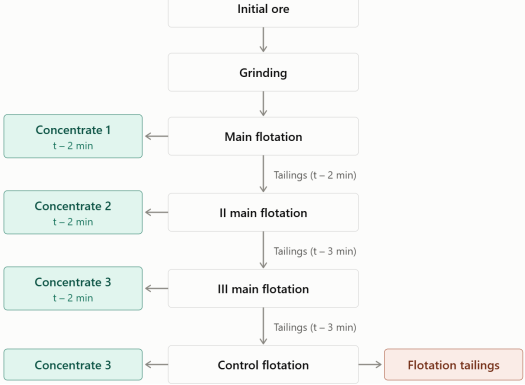
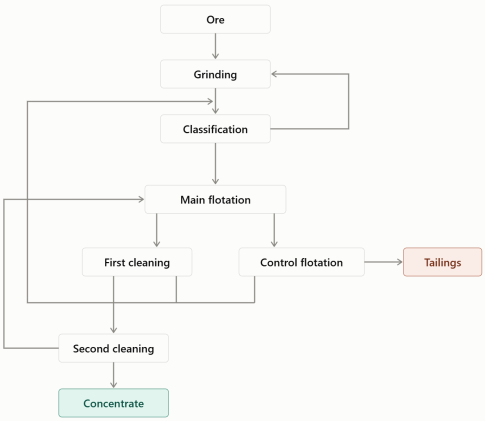
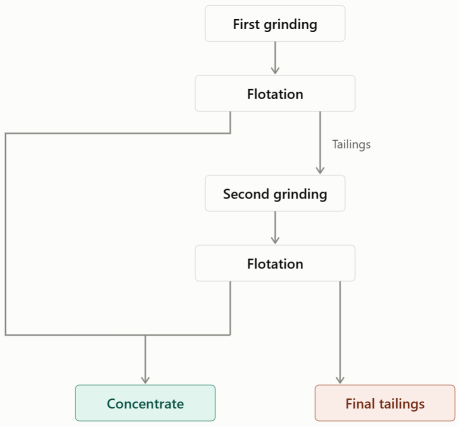
This study examines the influence of grinding fineness on concentrate grade, product yield, and copper, molybdenum, and gold recovery during flotation beneficiation of copper-molybdenum ore from the Kalmakyr deposit. Five grinding conditions were compared, corresponding to 57%, 60%, 65%, 70%, and 80% by mass passing 0.074 mm. The evaluation was based on the reported assays, yields, and recoveries of flotation products under the investigated flowsheet. Increasing the proportion of material passing 0.074 mm from 57% to 70% raised copper recovery from 83.79% to 88.73%. At 70% passing 0.074 mm, the combined concentrate yield was 7.76%, with grades of 3.82% Cu, 0.039% Mo, and 5.02 g/t Au; corresponding recoveries were 88.73% Cu, 82.61% Mo, and 77.80% Au. At 80% passing 0.074 mm, copper, molybdenum, and gold recoveries increased further to 89.01%, 83.14%, and 79.67%, respectively, while the combined concentrate yield was 7.72%. Thus, the finer grinding condition delivered the highest reported recoveries, whereas the 70% condition provided a slightly coarser alternative with recoveries close to those obtained at 80%. Without grinding-energy or operating-cost measurements, an economic optimum cannot be demonstrated from these data alone. The manuscript also discusses staged addition of spindle oil, regrinding, and the possible inclusion of centrifugal gravity concentration. These process modifications are distinguished from the grinding-fineness comparison and should not be interpreted as verified improvements without matched experimental controls. The findings provide an experimental basis for comparing practical grinding targets for the investigated ore and identify the additional measurements required before final process optimization.
| Published in | International Journal of Mineral Processing and Extractive Metallurgy (Volume 11, Issue 4) |
| DOI | 10.11648/j.ijmpem.20261104.12 |
| Page(s) | 85-92 |
| Creative Commons |
This is an Open Access article, distributed under the terms of the Creative Commons Attribution 4.0 International License (http://creativecommons.org/licenses/by/4.0/), which permits unrestricted use, distribution and reproduction in any medium or format, provided the original work is properly cited. |
| Copyright |
Copyright © The Author(s), 2026. Published by Science Publishing Group |
Copper-molybdenum Ore, Kalmakyr Deposit, Grinding Fineness, Flotation, Copper Recovery, Molybdenum Recovery, Gold Recovery, Gravity-flotation
Grinding fineness | Product | Yield,% | Grade,% | Recovery,% | ||||
|---|---|---|---|---|---|---|---|---|
Au, g/t | Cu | Mo | Au | Cu | Mo | |||
57% -0,074 мм | Rougher flotation concentrate I | 0.88 | 17.06 | 18.56 | 0.085 | 31.28 | 52.68 | 22.01 |
Rougher flotation concentrate II | 4.45 | 2.9 | 1.40 | 0.029 | 26.90 | 20.03 | 37.84 | |
Rougher flotation concentrate III | 1.60 | 2.38 | 1.32 | 0.027 | 7.93 | 6.80 | 12.70 | |
Scavenger flotation concentrate | 1.00 | 2.9 | 1.33 | 0.014 | 6.05 | 4.28 | 3.97 | |
Combined flotation concentrate | 7.93 | 4.37 | 3.28 | 0.033 | 72.17 | 83.79 | 76.51 | |
Flotation tailings | 92.07 | 0.15 | 0.075 | 0.0009 | 27.83 | 16.21 | 23.49 | |
Feed ore | 100.00 | 0.48 | 0.32 | 0.0034 | 100.0 | 100.0 | 100.0 | |
60% -0,074 мм | Rougher flotation concentrate I | 1.23 | 17.09 | 16.27 | 0.104 | 42.30 | 62.55 | 32.09 |
Rougher flotation concentrate II | 4.90 | 2.43 | 1.10 | 0.025 | 23.99 | 16.81 | 30.31 | |
Rougher flotation concentrate III | 1.25 | 2.20 | 1.11 | 0,033 | 5.54 | 4,32 | 10.42 | |
Scavenger flotation concentrate | 0.70 | 1.74 | 0.91 | 0.014 | 2.45 | 2.00 | 2.45 | |
Combined flotation concentrate | 8.08 | 4.57 | 3.39 | 0.037 | 74.28 | 85.67 | 75.28 | |
Flotation tailings | 91.92 | 0.14 | 0.05 | 0.001 | 25.72 | 14.33 | 24.72 | |
Feed ore | 100.00 | 0.497 | 0.335 | 0.004 | 100.0 | 100.0 | 100.0 | |
65% -0,074 мм | Rougher flotation concentrate I | 1.19 | 18.41 | 18.39 | 0.118 | 43.29 | 64.55 | 35.91 |
Rougher flotation concentrate II | 4.65 | 2.52 | 1.15 | 0.022 | 23.20 | 15.71 | 25.72 | |
Rougher flotation concentrate III | 1.55 | 2.34 | 1.24 | 0.031 | 7.17 | 5.66 | 12.47 | |
Scavenger flotation concentrate | 0.65 | 2.22 | 1.08 | 0.017 | 2.85 | 2.07 | 2.78 | |
Combined flotation concentrate | 8.04 | 4.81 | 3.71 | 0.037 | 76.50 | 87.98 | 76.28 | |
Flotation tailings | 91.96 | 0.13 | 0.04 | 0.001 | 23.50 | 12.02 | 23.12 | |
Feed ore | 100.00 | 0.506 | 0.339 | 0.0039 | 100.0 | 100.0 | 100.0 | |
70% -0,074 мм | Rougher flotation concentrate I | 1.31 | 16.76 | 17.76 | 0.128 | 43.82 | 69.65 | 45.27 |
Rougher flotation concentrate II | 4.75 | 2.89 | 0.94 | 0.022 | 27.43 | 13.31 | 28.14 | |
Rougher flotation concentrate III | 1.10 | 1.93 | 1.24 | 0.024 | 4.24 | 4.08 | 7.11 | |
Scavenger flotation concentrate | 0.60 | 1.93 | 0.95 | 0.013 | 2.31 | 1.70 | 2.10 | |
Combined flotation concentrate | 7.76 | 5.02 | 3.82 | 0.039 | 77.80 | 88.73 | 81.79 | |
Flotation tailings | 92.24 | 0.12 | 0.04 | 0.0007 | 22.20 | 11.27 | 17.39 | |
Feed ore | 100.00 | 0.501 | 0.334 | 0.0037 | 100.0 | 100.0 | 100.0 | |
80% -0,074 мм | Rougher flotation concentrate I | 1.33 | 17.19 | 17.9 | 0.139 | 45.44 | 70.66 | 47.52 |
Rougher flotation concentrate II | 4.79 | 2.90 | 0.89 | 0.022 | 27.57 | 12.67 | 27.44 | |
Rougher flotation concentrate III | 1.00 | 2.16 | 1.33 | 0.022 | 4.29 | 3.95 | 5.73 | |
Scavenger flotation concentrate | 0.60 | 1.99 | 0.97 | 0.016 | 2.37 | 1.73 | 2.45 | |
Combined flotation concentrate | 7.72 | 5.19 | 3.89 | 0.042 | 79.67 | 89.01 | 83.14 | |
Flotation tailings | 92.28 | 0.11 | 0.04 | 0.0007 | 20.33 | 10.99 | 16.86 | |
Feed ore | 100.00 | 0.503 | 0.337 | 0.00388 | 100.0 | 100.0 | 100.0 | |
Product | Yield (%) | Grade | Recovery,% | ||||
|---|---|---|---|---|---|---|---|
Cu | Mo | Au | Cu | Mo | Au | ||
Feed ore | 100.00 | 0.33 | 0.0037 | 0.5 | 100.00 | 100.00 | 100.00 |
Combined Cu-Mo concentrate | 1.69 | 15.87 | 0.1507 | 18.4 | 81.27 | 68.85 | 62.19 |
Final tailings | 98.31 | 0.063 | 0.00117 | 0.192 | 18.73 | 31.15 | 37.81 |
Product | Yield (%) | Cu (%) | Mo (%) | Au (g/t) | Cu recovery (%) | Mo recovery (%) | Au recovery (%) |
|---|---|---|---|---|---|---|---|
Feed ore | 100.00 | 0.33 | 0.0037 | 0.5 | 100 | 100 | 100 |
Concentrate | 5.0 | 5.28 | 0.0562 | 4.5 | 80 | 76 | 45 |
Tailings | 95.0 | 0.070 | 0.00094 | 0.289 | 20 | 24 | 55 |
Cu | Copper |
Mo | Molybdenum |
Au | Gold |
| [1] | Wills, B. A., & Finch, J. A. (2016). Wills’ mineral processing technology: An introduction to the practical aspects of ore treatment and mineral recovery (8th ed.). Butterworth-Heinemann. |
| [2] | Makhmarejabov, D., Tojiyev, R., Khakimova, D., Tillyaev, A., Rajapov, K., Abduvaliyeva, K., Mamatqulov, M., Kayumov, O., Atayeva, F., Mirzayev, O., Karimov, Y., Ibodullayevich, F. N., & Faraji, M. (2026). High-Performance V2CTₓ MXene/Ni-V LDH Aerogel for Au(III) Recovery: Redox-Exchange Synergy for Enhanced Performance. Solid State Sciences, Article 108411. |
| [3] |
Ibragimov, I. S. (2025). Technological and mineralogical properties of chalcopyrite and molybdenite in ores of the Yoshliq I deposit [in Russian]. European Journal of Interdisciplinary Research and Development, 40, 156-162.
http://www.ejird.journalspark.org/index.php/ejird/article/view/1493 |
| [4] | Park, I., Hong, S., Jeon, S., Ito, M., & Hiroyoshi, N. (2020). A review of recent advances in depression techniques for flotation separation of Cu-Mo sulfides in porphyry copper deposits. Metals, 10(9), 1269. |
| [5] | Abdollahi, M., Bahrami, A., Mirmohammadi, M. S., Kazemi, F., Danesh, A., & Ghorbani, Y. (2020). A process mineralogy approach to optimize molybdenite flotation in copper-molybdenum processing plants. Minerals Engineering, 157, 106557. |
| [6] | Samadov, A. U., & Abdusamiyeva, L. N. (2026). Qalmoqir koni mis-molibden rudasining granulometrik tarkibi va metallarning yiriklik sinflari bo‘yicha taqsimlanishini tahlil qilish. Muhandislik va iqtisodiyot, 8(Part I), 78-82. |
| [7] | Samadov, A. U., & Abdusamiyeva, L. N. (2026). Qalmoqqir mis-molibden rudalari minerallarining ochilish darajasini baholash va boyitish texnologiyasini asoslash. Muhandislik va iqtisodiyot, 8(Part I), 174-178. |
| [8] | Kawatra, S. K., & Young, C. A. (Eds.). (2019). SME mineral processing and extractive metallurgy handbook. Society for Mining, Metallurgy & Exploration. |
| [9] | Haldar, S. K. (2018). Mineral exploration: Principles and applications (2nd ed.). Elsevier. |
| [10] |
Park, I., et al. (2026). Selective flotation of chalcopyrite and molybdenite: A review of depressant applications. Green and Smart Mining Engineering, 3(1), 27-40.
https://doi.org/10.1016/j.gsme.2025.07.003 [Full author list to be verified against publisher metadata.]. |
| [11] | Jiang, F., He, S., Sun, W., Luo, Y., & Tang, H. (2025). Efficient and green flotation separation of molybdenite from chalcopyrite using 1-thioglycerol as depressant. Metals, 15(3), 299. |
| [12] | Lv, X., Luo, A., Tong, X., Chen, J., & Jian, S. (2025). Experimental and mechanistic study on flotation separation of chalcopyrite and molybdenite using the novel depressant 2-mercapto-6-methylpyrimidin-4-ol. Molecules, 30(6), 1396. |
| [13] | Zhang, H.-T., Song, X.-Y., Huang, Y.-H., Zhang, Z., Wang, W., & Xu, L.-F. (2024). Selective flotation separation of molybdenite and chalcopyrite using O3 oxidation method. Transactions of Nonferrous Metals Society of China, 34(1), 298-308. |
| [14] | Berdakh, D., Miki, H., Hirajima, T., Sasaki, K., Ulmaszoda, A., Nakao, R., Ochi, D., Aoki, Y., & Suyantara, G. P. W. (2024). Effect of oxidation treatment on the selective separation of molybdenite from chalcocite using flotation. Powder Technology, 431, 119078. |
| [15] | Pestryak, I. V., Morozov, V. V., Ochir, E., & Erdenezul, J. (2024). Experimental substantiation of the requirements for the composition of circulating water used in grinding and flotation of copper-molybdenum ores. Obogashchenie Rud. |
APA Style
Usmanovich, S. A., Qizi, K. D. Y., Sulaymonovich, I. I., Qizi, A. L. N. (2026). Effect of Grinding Fineness on Concentrate Grade and Metal Recovery in Copper-molybdenum Ore Beneficiation. International Journal of Mineral Processing and Extractive Metallurgy, 11(4), 85-92. https://doi.org/10.11648/j.ijmpem.20261104.12
ACS Style
Usmanovich, S. A.; Qizi, K. D. Y.; Sulaymonovich, I. I.; Qizi, A. L. N. Effect of Grinding Fineness on Concentrate Grade and Metal Recovery in Copper-molybdenum Ore Beneficiation. Int. J. Miner. Process. Extr. Metall. 2026, 11(4), 85-92. doi: 10.11648/j.ijmpem.20261104.12
AMA Style
Usmanovich SA, Qizi KDY, Sulaymonovich II, Qizi ALN. Effect of Grinding Fineness on Concentrate Grade and Metal Recovery in Copper-molybdenum Ore Beneficiation. Int J Miner Process Extr Metall. 2026;11(4):85-92. doi: 10.11648/j.ijmpem.20261104.12
@article{10.11648/j.ijmpem.20261104.12,
  author = {Samadov Alisher Usmanovich and Khakimova Dilafruz Yuldashboy Qizi and Ibragimov Izzatilla Sulaymonovich and Abdusamiyeva Lobarkhon Nomonjon Qizi},
  title = {Effect of Grinding Fineness on Concentrate Grade and Metal Recovery in Copper-molybdenum Ore Beneficiation},
  journal = {International Journal of Mineral Processing and Extractive Metallurgy},
  volume = {11},
  number = {4},
  pages = {85-92},
  doi = {10.11648/j.ijmpem.20261104.12},
  url = {https://doi.org/10.11648/j.ijmpem.20261104.12},
  eprint = {https://article.sciencepublishinggroup.com/pdf/10.11648.j.ijmpem.20261104.12},
  abstract = {This study examines the influence of grinding fineness on concentrate grade, product yield, and copper, molybdenum, and gold recovery during flotation beneficiation of copper-molybdenum ore from the Kalmakyr deposit. Five grinding conditions were compared, corresponding to 57%, 60%, 65%, 70%, and 80% by mass passing 0.074 mm. The evaluation was based on the reported assays, yields, and recoveries of flotation products under the investigated flowsheet. Increasing the proportion of material passing 0.074 mm from 57% to 70% raised copper recovery from 83.79% to 88.73%. At 70% passing 0.074 mm, the combined concentrate yield was 7.76%, with grades of 3.82% Cu, 0.039% Mo, and 5.02 g/t Au; corresponding recoveries were 88.73% Cu, 82.61% Mo, and 77.80% Au. At 80% passing 0.074 mm, copper, molybdenum, and gold recoveries increased further to 89.01%, 83.14%, and 79.67%, respectively, while the combined concentrate yield was 7.72%. Thus, the finer grinding condition delivered the highest reported recoveries, whereas the 70% condition provided a slightly coarser alternative with recoveries close to those obtained at 80%. Without grinding-energy or operating-cost measurements, an economic optimum cannot be demonstrated from these data alone. The manuscript also discusses staged addition of spindle oil, regrinding, and the possible inclusion of centrifugal gravity concentration. These process modifications are distinguished from the grinding-fineness comparison and should not be interpreted as verified improvements without matched experimental controls. The findings provide an experimental basis for comparing practical grinding targets for the investigated ore and identify the additional measurements required before final process optimization.},
 year = {2026}
}
TY  - JOUR
T1  - Effect of Grinding Fineness on Concentrate Grade and Metal Recovery in Copper-molybdenum Ore Beneficiation
AU  - Samadov Alisher Usmanovich
AU  - Khakimova Dilafruz Yuldashboy Qizi
AU  - Ibragimov Izzatilla Sulaymonovich
AU  - Abdusamiyeva Lobarkhon Nomonjon Qizi
Y1  - 2026/10/26
PY  - 2026
N1  - https://doi.org/10.11648/j.ijmpem.20261104.12
DO  - 10.11648/j.ijmpem.20261104.12
T2  - International Journal of Mineral Processing and Extractive Metallurgy
JF  - International Journal of Mineral Processing and Extractive Metallurgy
JO  - International Journal of Mineral Processing and Extractive Metallurgy
SP  - 85
EP  - 92
PB  - Science Publishing Group
SN  - 2575-1859
UR  - https://doi.org/10.11648/j.ijmpem.20261104.12
AB  - This study examines the influence of grinding fineness on concentrate grade, product yield, and copper, molybdenum, and gold recovery during flotation beneficiation of copper-molybdenum ore from the Kalmakyr deposit. Five grinding conditions were compared, corresponding to 57%, 60%, 65%, 70%, and 80% by mass passing 0.074 mm. The evaluation was based on the reported assays, yields, and recoveries of flotation products under the investigated flowsheet. Increasing the proportion of material passing 0.074 mm from 57% to 70% raised copper recovery from 83.79% to 88.73%. At 70% passing 0.074 mm, the combined concentrate yield was 7.76%, with grades of 3.82% Cu, 0.039% Mo, and 5.02 g/t Au; corresponding recoveries were 88.73% Cu, 82.61% Mo, and 77.80% Au. At 80% passing 0.074 mm, copper, molybdenum, and gold recoveries increased further to 89.01%, 83.14%, and 79.67%, respectively, while the combined concentrate yield was 7.72%. Thus, the finer grinding condition delivered the highest reported recoveries, whereas the 70% condition provided a slightly coarser alternative with recoveries close to those obtained at 80%. Without grinding-energy or operating-cost measurements, an economic optimum cannot be demonstrated from these data alone. The manuscript also discusses staged addition of spindle oil, regrinding, and the possible inclusion of centrifugal gravity concentration. These process modifications are distinguished from the grinding-fineness comparison and should not be interpreted as verified improvements without matched experimental controls. The findings provide an experimental basis for comparing practical grinding targets for the investigated ore and identify the additional measurements required before final process optimization.
VL  - 11
IS  - 4
ER  -
Department of Engineering Communication, Tashkent University of Architecture and Civil Engineering, Tashkent, Uzbekistan
Biography: Samadov Alisher Usmanovich is a prominent Uzbek scientist, Doctor of Technical Sciences, and Professor. His scientific research focuses mainly on mineral processing, the beneficiation of copper and copper-molybdenum ores, and the I mprovement of technological processes and regimes in mineral beneficiation. He currently serves as a Professor at the Department of Engineering Communication, Tashkent University of Architecture and Civil Engineering, Tashkent, Uzbekistan. He has made significant contributions to scientific research in the field of mineral processing and continues to contribute to the development of scientific research and the training of young researchers.
Research Fields: Metallurgy, Mineral Processing Technologies, Beneficiation of Non-Ferrous and Precious Metals, Flowsheet Optimization

Department of Mining, Almalyk State Technical Institute, Almalyk, Uzbekistan
Biography: Khakimova Dilafruz Yuldashboy Qizi is an Uzbek researcher and Associate Professor in the field of mineral processing. She works at the Department of Mining, Almalyk State Technical Institute, Almalyk, Uzbekistan. Her scientific research focuses on ore preparation, optimization of grinding fineness, flotation performance, and enhancing the extraction of copper, molybdenum, and precious metals.
Research Fields: Mineral Processing, Beneficiation Technologies, Ore Preparation, Grinding Fineness Optimization, Flotation Reagent Regimes
Department of Mining, Almalyk State Technical Institute, Almalyk, Uzbekistan
Biography: Ibragimov Izzatilla Sulaymonovich is an Uzbek researcher and Senior Lecturer in the field of mineral processing. He works at the Department of Mining, Almalyk State Technical Institute, Almalyk, Uzbekistan. His scientific research focuses on ore beneficiation technologies and complex mineral processing.
Research Fields: Mineral Processing, Ore Beneficiation, Complex Processing of Polymetallic Ores, Flotation Circuits, Gravity Concentration
Department of Mining, Almalyk State Technical Institute, Almalyk, Uzbekistan
Biography: Abdusamiyeva Lobarkhon Nomonjon Qizi is a PhD researcher in mineral processing at the Department of Mining, Almalyk State Technical Institute, Almalyk, Uzbekistan. Her research focuses on ore beneficiation technologies, optimization of flotation regimes, and mineral liberation.
Research Fields: Mineral Processing, Ore Beneficiation, Optimization of Flotation Regimes, Mineral Liberation, Recovery of Valuable Components


Information


 Share This Article
 Twitter
 Linked In
 Facebook

 Copy
 Download