Objective: To study cases of thyroidectomy in war situations at the Timbuktu hospital. Methodology: This is a prospective cross-sectional descriptive study carried out in the ENT-CCF department of Timbuktu hospital over a one-year period from August 2024 to July 2025. All total or partial thyroidectomy with a medical file with an operating report, regularly updated, were included. Results: Between August 1 and July 31, 2025, we collected 32 cases of thyroidectomies in the department, which represents 20.12% of all surgeries (n=159) performed in the department during this period. The female sex was in the majority, i.e., 96.87%, with a ratio of 1 man to 31 women. Age range of [40-60[ represented 56.25% with a mean of 41.87 years with a standard deviation: 10.89 years. The reason for consultation was anterocervical swelling 90.60%, signs of compression 3 cases. 59.36% of our patients were classified in the TIRADS on thyroid ultrasound. Multinodular goiter was the majority surgical indication 37.5%The types of thyroidectomy performed are: Lobo-isthmectomy 47%, Total thyroidectomy 31%, lobectomy: 13% and subtotal thyroidectomy: 9%Surgical complications: Surgical wound infection 1 case, Trauma to the digestive tract 1 case. The histological types are vesicular adenoma 87.5% and papillary carcinoma 12%. Conclusion: thyroidectomy is a surgical procedure that requires perfect control of the anatomy of the neck to minimize complications in conflict areas where the technical platform is limited.
This is an Open Access article, distributed under the terms of the Creative Commons Attribution 4.0 International License (http://creativecommons.org/licenses/by/4.0/), which permits unrestricted use, distribution and reproduction in any medium or format, provided the original work is properly cited.
Thyroidectomy is a surgical procedure consisting of the partial or total removal of the thyroid gland
[1]
Barry, M., Diallo, M., Fofana, H., Kpossou, V., Barry, B., Touré, A. and Diallo, A. (2024) Thyroidectomy: frequency and indications in the general surgery department of the Ignace Deen National Hospital/University Hospital of Conakry. International Journal of Otolaryngology and Head & Neck Surgery, 13, 157-167.
N'Gouan J M et al. Thyroid surgery in ENT in Abidjan. The Rev. Col. Odonto-Stomatol. Afr. Chir. Maxillo-Fac., vol. 18, n° 1, 2011, pp. 45-49.
[2, 3]
. Its practice requires a perfect knowledge of the anatomy of the neck
[3]
N'Gouan J M et al. Thyroid surgery in ENT in Abidjan. The Rev. Col. Odonto-Stomatol. Afr. Chir. Maxillo-Fac., vol. 18, n° 1, 2011, pp. 45-49.
[3]
. Its incidence in France was 71 cases per 100,000 inhabitants in 2014 (4). Its indications are dominated by thyroid nodules, uncontrolled hyperthyroidism, thyroid cancer and aesthetics
[1]
Barry, M., Diallo, M., Fofana, H., Kpossou, V., Barry, B., Touré, A. and Diallo, A. (2024) Thyroidectomy: frequency and indications in the general surgery department of the Ignace Deen National Hospital/University Hospital of Conakry. International Journal of Otolaryngology and Head & Neck Surgery, 13, 157-167.
F. Poumale et al. Thyroid Surgery in Bangui: Indications and Follow-up Operatives About 135 Cases. Health Sci. Dis: Vol 18 (4) October - November - December 2017 available on
The Timbuktu hospital has been covering areas of persistent insecurity since 2012; with periods of exacerbation marked by armed clashes; which is a factor influencing the movement of patients to the hospital as well as the presence of qualified personnel for the management of certain pathologies, this is how we initiated this study in order to know data on thyroidectomy in an armed conflict zone. Our objective was to study cases of thyroidectomies in a zone and conflict.
2. Methodology
This is a prospective descriptive observational study carried out in the Ear Nose throat and Head and Neck Surgery (ENT-HNS) department of Timbuktu Hospital over a period of one (1) year from August 2024 to July 2025. All patients who had undergone total or partial thyroidectomy were included in the study, who had a medical file with an operative report and the result of the histopathology of the available operative specimen. The variables studied were age, sex, surgical indication, surgical procedures, intra- and post-operative complications, treatment of complications and evolution. Patient consent was obtained in advance and the study sheets were anonymous in order to respect the confidentiality of patients.
3. Results
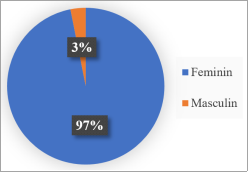
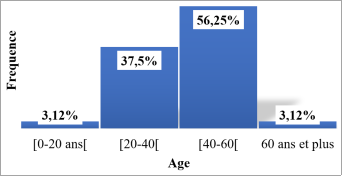
Between August 1 and July 31, 2025, we collected 32 cases of thyroidectomies in the department, which represents 20.12% of all surgeries (n=159) performed in the department during this period. The female sex was in the majority, i.e. 96.87%, with a ratio of 1 man to 31 woman (Figure 1). Age range of [40-60[ represented 56.25% with a mean of 41.87 years with a standard deviation: 10.89 years (Figure 2). The majority of our patients came from rural areas of the region, 75%. A notion of familial goiter was found in 22%.
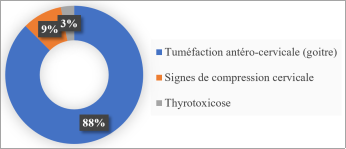
Laterocervical swelling was the most frequent reason for consultation (87.75%). All our patients have had cervical ultrasound. Our patients were classified as Eu-TIRADS 3 in 59,36. Multinodular goiter was the most common surgical indication, accounting for 40.5% (Table 1). The most commonly performed surgical technique was lobo-isthmectomy (in 47% (Table 2). Complications were 1 case of esophageal injury and one case of surgical wound infection (Table 3). The histology of the operative specimens concluded that vesicular adenoma was present in 87.5% and papillary carcinoma in 12.5% (Table 3).
Table 1. Distribution of patients according to thyroidectomy indications.
Indications for thyroidectomy
Workforce
Percentage%
Plunging goiter
2
6,25
Homogeneous goiter
7
22
Multi nodular goiter
13
40,5
Suspected thyroid cancer
2
6,25
Hyperthyroid goiter/Graves' disease
1
3
Thyroid nodule
7
22
Total
32
100
Table 2. Distribution of patients by type of surgery.
Type of surgery
Workforce
Percentage%
Partial thyroidectomy
Subtotal thyroidectomy
3
9
Lobo-isthmectomy
15
47
Lobectomy
4
13
Total thyroidectomy
10
31
Total
32
100
Table 3. Distribution of patients by type of surgical complications.
Surgical complications
Workforce
Percentage%
Singles
30
94
Surgical site infection
1
3
Involvement of the digestive tract
1
3
Total
32
100
Table 4. Distribution of patients according to the histological result of the thyroidectomy specimen.
Histological types of the surgical specimen
Workforce
Percentage%
Carcinonomic papillary
4
12,5
Vesicular adenoma
28
87,5
Total
32
100
4. Discussion
4.1. Epidemiological Aspects
1) Frequency
We collected 32 cases of thyroidectomies in the ENT and Head and Neck Surgery department of Timbuktu Hospital during one year of study, which represents 20.12% of all surgeries performed (n=159) in the department during this period. Sissoko T et al. had almost the same result: 31.6 cases per year for five years
[6]
Sissoko T. Thyroidectomy: assessment of 5 years of activities in the ent and ccf department of the Gabriel Toure university hospital [thesis]. USTTB, Bamako 2019.
[6]
. Tea Z. B and Tanon have significantly lower levels than those found in our study with 1.83% respectively
[3]
N'Gouan J M et al. Thyroid surgery in ENT in Abidjan. The Rev. Col. Odonto-Stomatol. Afr. Chir. Maxillo-Fac., vol. 18, n° 1, 2011, pp. 45-49.
[7]
TANON-A. M. J. et al., Surgery of benign thyroid paìthology in ENT and Head and neck surgery at the University Hospital of Yopougon (Côte d'Ivoire). Rev. Odonto-stomatol neck after chir maxillo-fac 2004; 11(1): 11-15.
[3, 7]
. Jihad R. and Ouedraogo P. B. had rates of 150 cases per year over two years and 72.8 cases per year over five years, respectively, which are clearly in line with ours
[8]
Ouédraogo B. P et al. Goiters in ENT: epidemiological, diagnostic and therapeutic aspects. The African Journal of ENT and Head and Neck Surgery 2016; (16): 1-5.
[9]
Jihad R., Surgical goiters (about 300 cases). [Thesis]. Morocco: Sidi Mohammed Ben Abdellah University, Faculty of Medicine and Pharmacy FES. 2016 ; n°145/16, p146.
[8, 9]
. Our low rate could be explained on the one hand by difficulties in getting to the hospital in Timbuktu due to insecurity and on the other hand, a very limited human resource and technical platform.
2) Gender
The female sex was in the majority 96.87% and 3.13% with a sex ratio of 1H/31F (0.032). We share the same observations with those found in the literature as well as Sissoko T in Mali, Maryam C in Morocco and Tea Z. B in Côte d'Ivoire were predominantly female, with 88.4%, 74% and 92,9%
[3]
N'Gouan J M et al. Thyroid surgery in ENT in Abidjan. The Rev. Col. Odonto-Stomatol. Afr. Chir. Maxillo-Fac., vol. 18, n° 1, 2011, pp. 45-49.
[6]
Sissoko T. Thyroidectomy: assessment of 5 years of activities in the ent and ccf department of the Gabriel Toure university hospital [thesis]. USTTB, Bamako 2019.
[10]
Chkairi Maryam. Complications and follow-up of thyroid surgery about 101 cases in the ENT department of the Moulay Ismail Military Hospital Meknes. [Thesis] Sidi Mohamed Ben Abdallah University, Fez, 2021.
[3, 6, 10]
. The female predominance is explained by the high frequency of thyroid pathologies in women due to risk factors such as multiparity. Indeed, in men, thyroid pathology is generally rarer, but the risk of thyroid cancer is higher in men than in women
[11]
Illé S. et al. Results of 5 years of thyroidectomy at the ENT and Head and Neck Surgery Department of the National Hospital of Niamey (Niger). European Scientific Journal, July 2017 edition, Vol. 13, n°21 ISSN: 1857 - 7881 (Print) and - ISSN 1857-7431.
[11]
.
3) Age
The average age of our patients was 41.87 years with the extremes ranging from 20 years to 80 years of age, of which the age group of 40 and 60 years represented 56.25%.
The average age in the series of Maryam was 50 years old with extremes of 21 and 85 years old; and the most affected age group is between 41 and 60 years old with a percentage of 65.34%
[10]
Chkairi Maryam. Complications and follow-up of thyroid surgery about 101 cases in the ENT department of the Moulay Ismail Military Hospital Meknes. [Thesis] Sidi Mohamed Ben Abdallah University, Fez, 2021.
[10]
. Sissoko T Relates to EU as an average age of 46.89 years
[6]
Sissoko T. Thyroidectomy: assessment of 5 years of activities in the ent and ccf department of the Gabriel Toure university hospital [thesis]. USTTB, Bamako 2019.
[6]
. We note in these studies that the average ages are slightly higher than those of our series. This could be due to insecurity in the region. Indeed, young people have the ability to go to the hospital more easily to be taken care of in this situation.
4) History of familial goiter:
The notion of familial goitre must be sought in each case of goitre, because genetic factors are involved in the genesis of this pathology
[9]
Jihad R., Surgical goiters (about 300 cases). [Thesis]. Morocco: Sidi Mohammed Ben Abdellah University, Faculty of Medicine and Pharmacy FES. 2016 ; n°145/16, p146.
[9]
. Agreement in homozygous twins exceeds 40%
[12]
Wémeau J. L. Therapeutic management of goiters. Press med 2011; (40): 1-5.
[12]
. We found that 22% of our patients had a notion of familial goiter; which is slightly higher than that of Sissoko T
[6]
Sissoko T. Thyroidectomy: assessment of 5 years of activities in the ent and ccf department of the Gabriel Toure university hospital [thesis]. USTTB, Bamako 2019.
[6]
reported that 14.39% had a history of familial goiter, Jihad R and Ouedraogo P. B had the notion of familial goitre in 9.67% and 9.34
[8]
Ouédraogo B. P et al. Goiters in ENT: epidemiological, diagnostic and therapeutic aspects. The African Journal of ENT and Head and Neck Surgery 2016; (16): 1-5.
[9]
Jihad R., Surgical goiters (about 300 cases). [Thesis]. Morocco: Sidi Mohammed Ben Abdellah University, Faculty of Medicine and Pharmacy FES. 2016 ; n°145/16, p146.
[8, 9]
.
4.2. Clinical Aspects
Reason for consultation:
In our study, laterocervical swelling was the most frequent reason for consultation (87.75%). Our results corroborate those of Keïta M and Barry M. S who had cervical swelling as the most frequent reason for consultation with 79.4% and 86% respectively
[1]
Barry, M., Diallo, M., Fofana, H., Kpossou, V., Barry, B., Touré, A. and Diallo, A. (2024) Thyroidectomy: frequency and indications in the general surgery department of the Ignace Deen National Hospital/University Hospital of Conakry. International Journal of Otolaryngology and Head & Neck Surgery, 13, 157-167.
Keita M, coll. Benign Goiters in ENT, Epidemiological and Anatomical Aspects: Study of 97 cases. J. TUN - N018 June 2007: 16-19.
[1, 13]
.
All our patients have had cervical ultrasound. Our patients were classified as Eu-TIRADS 3 and 4b in 87.54 and 12.46%. In the literature, stage 4B corresponds to a risk of malignancy of 10 to 80%, the nodules have central hypervascularization and/or irregular boundaries and/or microcalcifications
[14]
Hartl D. Tumors of the thyroid body. EMC - Otorhinolaryngology 2015; 10(2): 1-12 [Rule 20-875-A-10].
[14]
. CT allows a detailed morphological study of the intrathoracic portion of the goiter that is inaccessible to ultrasound. It will specify the lower and posterior limits of the goitre; its relationship with the large cervicothoracic vessels and with the oesotracheal axis
[6]
Sissoko T. Thyroidectomy: assessment of 5 years of activities in the ent and ccf department of the Gabriel Toure university hospital [thesis]. USTTB, Bamako 2019.
[6]
.
Multinodular goitre was the most represented surgical indication (40.5%), followed by thyroid nodule and homogeneous goiter with 22% each. We share the same observations with the literature, in particular Barry, Zakaria and Tiguida who have 50%, 77% and 77.6% respectively. Poumale et al. have simple goiter as the most frequent indication with 34.7% as Balde disc has had Graves' disease mainly with 34%. This high frequency in our study is explained by the predominance of the female sex, which is a risk factor for this anatomical clinical form
[1]
Barry, M., Diallo, M., Fofana, H., Kpossou, V., Barry, B., Touré, A. and Diallo, A. (2024) Thyroidectomy: frequency and indications in the general surgery department of the Ignace Deen National Hospital/University Hospital of Conakry. International Journal of Otolaryngology and Head & Neck Surgery, 13, 157-167.
F. Poumale et al. Thyroid Surgery in Bangui: Indications and Follow-up Operatives About 135 Cases. Health Sci. Dis: Vol 18 (4) October - November - December 2017 available on
ELBARKAOUI Zakaria. Post-operative Complications of Thyroidectomy: About 188 cases [thesis], Mohamed V University, Rabat, 2022.
[1, 2, 5, 15]
.
The most common types of thyroidectomy performed were lobo-isthmectomy and total thyroidectomy, with 47% and 31% respectively. Tiguida and Poumale made the same observation that they had lobo-isthmectomy as the type of surgery frequents it with 56.11 and 55.5% respectively
[5]
F. Poumale et al. Thyroid Surgery in Bangui: Indications and Follow-up Operatives About 135 Cases. Health Sci. Dis: Vol 18 (4) October - November - December 2017 available on
Sissoko T. Thyroidectomy: assessment of 5 years of activities in the ent and ccf department of the Gabriel Toure university hospital [thesis]. USTTB, Bamako 2019.
[5, 6]
. Balde had the total thyroidectomy as the most performed with 66.92%
[2]
Baldé et al Thyroid Surgery in Rural Senegal: 60 Month Assessment. Health Sci. Dis: Vol 22 (4) June 2020 pp 30-34 Available free of charge on
. The type of thyroidectomy is usually placed preoperatively by the surgical indication but may vary intraoperatively in some cases. In cases of total thyroidectomies, patients were supplemented with thyroid hormones.
In our studies, the histological types found were vesicular adenoma 87.5% and papillary carcinoma 12.5%. Sissoko T and Balde had a malignancy rate of 2.16% and 14.52%. This rate increases with the presence of certain factors such as the notion of cervical irradiation and the genetic predisposition to thyroid tumors
[6]
Sissoko T. Thyroidectomy: assessment of 5 years of activities in the ent and ccf department of the Gabriel Toure university hospital [thesis]. USTTB, Bamako 2019.
[14]
Hartl D. Tumors of the thyroid body. EMC - Otorhinolaryngology 2015; 10(2): 1-12 [Rule 20-875-A-10].
[6, 14]
.
In our study, the complications were 1 case of esophageal lesion and one case of infection of the operative wound, i.e. 2 cases. In the literature, the most frequently encountered complications are hemorrhagic complications, neurological complications, thyroid insufficiency and hypoparathyroidism. The control of cervical anatomy and the consideration of thyroid deficits make it possible to reduce these orbits after thyroid surgery
[16]
P. Tran Ba, Huy, R. Kania. Thyroidectomy. Medical-Surgical Cyclopedia 46-460 (2004).
[16]
.
5. Conclusion
Thyroidectomy is a surgical procedure that requires perfect control of the anatomy of the neck to minimize complications. The indications and techniques do not change in conflict zones even with a limited technical platform.
Abbreviations
ENT-HNS
Ear Noose Throat and Head and Neck Surgery
EU-TIRADS
European Thyroid Imaging Reporting and Data System
HU
Hospital University
Author Contributions
Idrissa Konate: Conceptualization, Data curation, Formal Analysis, Funding acquisition, Investigation, Methodology, Writing – original draft
Barry, M., Diallo, M., Fofana, H., Kpossou, V., Barry, B., Touré, A. and Diallo, A. (2024) Thyroidectomy: frequency and indications in the general surgery department of the Ignace Deen National Hospital/University Hospital of Conakry. International Journal of Otolaryngology and Head & Neck Surgery, 13, 157-167.
F. Poumale et al. Thyroid Surgery in Bangui: Indications and Follow-up Operatives About 135 Cases. Health Sci. Dis: Vol 18 (4) October - November - December 2017 available on
Sissoko T. Thyroidectomy: assessment of 5 years of activities in the ent and ccf department of the Gabriel Toure university hospital [thesis]. USTTB, Bamako 2019.
[7]
TANON-A. M. J. et al., Surgery of benign thyroid paìthology in ENT and Head and neck surgery at the University Hospital of Yopougon (Côte d'Ivoire). Rev. Odonto-stomatol neck after chir maxillo-fac 2004; 11(1): 11-15.
[8]
Ouédraogo B. P et al. Goiters in ENT: epidemiological, diagnostic and therapeutic aspects. The African Journal of ENT and Head and Neck Surgery 2016; (16): 1-5.
[9]
Jihad R., Surgical goiters (about 300 cases). [Thesis]. Morocco: Sidi Mohammed Ben Abdellah University, Faculty of Medicine and Pharmacy FES. 2016 ; n°145/16, p146.
[10]
Chkairi Maryam. Complications and follow-up of thyroid surgery about 101 cases in the ENT department of the Moulay Ismail Military Hospital Meknes. [Thesis] Sidi Mohamed Ben Abdallah University, Fez, 2021.
[11]
Illé S. et al. Results of 5 years of thyroidectomy at the ENT and Head and Neck Surgery Department of the National Hospital of Niamey (Niger). European Scientific Journal, July 2017 edition, Vol. 13, n°21 ISSN: 1857 - 7881 (Print) and - ISSN 1857-7431.
[12]
Wémeau J. L. Therapeutic management of goiters. Press med 2011; (40): 1-5.
[13]
Keita M, coll. Benign Goiters in ENT, Epidemiological and Anatomical Aspects: Study of 97 cases. J. TUN - N018 June 2007: 16-19.
[14]
Hartl D. Tumors of the thyroid body. EMC - Otorhinolaryngology 2015; 10(2): 1-12 [Rule 20-875-A-10].
[15]
ELBARKAOUI Zakaria. Post-operative Complications of Thyroidectomy: About 188 cases [thesis], Mohamed V University, Rabat, 2022.
[16]
P. Tran Ba, Huy, R. Kania. Thyroidectomy. Medical-Surgical Cyclopedia 46-460 (2004).
Konate, I., Konate, O., Diamoutene, B. S., Wangara, A., Djibril, K., et al. (2026). Thyroid Surgery in a Conflict Zone: A Year-long Review at the Timbuktu Regional Hospital. International Journal of Otorhinolaryngology, 12(2), 40-44. https://doi.org/10.11648/j.ijo.20261202.11
Konate, I.; Konate, O.; Diamoutene, B. S.; Wangara, A.; Djibril, K., et al. Thyroid Surgery in a Conflict Zone: A Year-long Review at the Timbuktu Regional Hospital. Int. J. Otorhinolaryngol.2026, 12(2), 40-44. doi: 10.11648/j.ijo.20261202.11
Konate I, Konate O, Diamoutene BS, Wangara A, Djibril K, et al. Thyroid Surgery in a Conflict Zone: A Year-long Review at the Timbuktu Regional Hospital. Int J Otorhinolaryngol. 2026;12(2):40-44. doi: 10.11648/j.ijo.20261202.11
@article{10.11648/j.ijo.20261202.11,
  author = {Idrissa Konate and Oumar Konate and Boubacar Sidiki Diamoutene and Aboubacrine Wangara and Kassogue Djibril and Boubacar Sanogo and Abdoulaye Oumar Bakayoko and Tata Toure and Zacharia Traore and Fatogoma Issa Kone and Mohamed Amadou Keita},
  title = {Thyroid Surgery in a Conflict Zone: A Year-long Review at the Timbuktu Regional Hospital},
  journal = {International Journal of Otorhinolaryngology},
  volume = {12},
  number = {2},
  pages = {40-44},
  doi = {10.11648/j.ijo.20261202.11},
  url = {https://doi.org/10.11648/j.ijo.20261202.11},
  eprint = {https://article.sciencepublishinggroup.com/pdf/10.11648.j.ijo.20261202.11},
  abstract = {Objective: To study cases of thyroidectomy in war situations at the Timbuktu hospital. Methodology: This is a prospective cross-sectional descriptive study carried out in the ENT-CCF department of Timbuktu hospital over a one-year period from August 2024 to July 2025. All total or partial thyroidectomy with a medical file with an operating report, regularly updated, were included. Results: Between August 1 and July 31, 2025, we collected 32 cases of thyroidectomies in the department, which represents 20.12% of all surgeries (n=159) performed in the department during this period. The female sex was in the majority, i.e., 96.87%, with a ratio of 1 man to 31 women. Age range of [40-60[ represented 56.25% with a mean of 41.87 years with a standard deviation: 10.89 years. The reason for consultation was anterocervical swelling 90.60%, signs of compression 3 cases. 59.36% of our patients were classified in the TIRADS on thyroid ultrasound. Multinodular goiter was the majority surgical indication 37.5%The types of thyroidectomy performed are: Lobo-isthmectomy 47%, Total thyroidectomy 31%, lobectomy: 13% and subtotal thyroidectomy: 9%Surgical complications: Surgical wound infection 1 case, Trauma to the digestive tract 1 case. The histological types are vesicular adenoma 87.5% and papillary carcinoma 12%. Conclusion: thyroidectomy is a surgical procedure that requires perfect control of the anatomy of the neck to minimize complications in conflict areas where the technical platform is limited.},
 year = {2026}
}
TY  - JOUR
T1  - Thyroid Surgery in a Conflict Zone: A Year-long Review at the Timbuktu Regional Hospital
AU  - Idrissa Konate
AU  - Oumar Konate
AU  - Boubacar Sidiki Diamoutene
AU  - Aboubacrine Wangara
AU  - Kassogue Djibril
AU  - Boubacar Sanogo
AU  - Abdoulaye Oumar Bakayoko
AU  - Tata Toure
AU  - Zacharia Traore
AU  - Fatogoma Issa Kone
AU  - Mohamed Amadou Keita
Y1  - 2026/08/10
PY  - 2026
N1  - https://doi.org/10.11648/j.ijo.20261202.11
DO  - 10.11648/j.ijo.20261202.11
T2  - International Journal of Otorhinolaryngology
JF  - International Journal of Otorhinolaryngology
JO  - International Journal of Otorhinolaryngology
SP  - 40
EP  - 44
PB  - Science Publishing Group
SN  - 2472-2413
UR  - https://doi.org/10.11648/j.ijo.20261202.11
AB  - Objective: To study cases of thyroidectomy in war situations at the Timbuktu hospital. Methodology: This is a prospective cross-sectional descriptive study carried out in the ENT-CCF department of Timbuktu hospital over a one-year period from August 2024 to July 2025. All total or partial thyroidectomy with a medical file with an operating report, regularly updated, were included. Results: Between August 1 and July 31, 2025, we collected 32 cases of thyroidectomies in the department, which represents 20.12% of all surgeries (n=159) performed in the department during this period. The female sex was in the majority, i.e., 96.87%, with a ratio of 1 man to 31 women. Age range of [40-60[ represented 56.25% with a mean of 41.87 years with a standard deviation: 10.89 years. The reason for consultation was anterocervical swelling 90.60%, signs of compression 3 cases. 59.36% of our patients were classified in the TIRADS on thyroid ultrasound. Multinodular goiter was the majority surgical indication 37.5%The types of thyroidectomy performed are: Lobo-isthmectomy 47%, Total thyroidectomy 31%, lobectomy: 13% and subtotal thyroidectomy: 9%Surgical complications: Surgical wound infection 1 case, Trauma to the digestive tract 1 case. The histological types are vesicular adenoma 87.5% and papillary carcinoma 12%. Conclusion: thyroidectomy is a surgical procedure that requires perfect control of the anatomy of the neck to minimize complications in conflict areas where the technical platform is limited.
VL  - 12
IS  - 2
ER  -
Konate, I., Konate, O., Diamoutene, B. S., Wangara, A., Djibril, K., et al. (2026). Thyroid Surgery in a Conflict Zone: A Year-long Review at the Timbuktu Regional Hospital. International Journal of Otorhinolaryngology, 12(2), 40-44. https://doi.org/10.11648/j.ijo.20261202.11
Konate, I.; Konate, O.; Diamoutene, B. S.; Wangara, A.; Djibril, K., et al. Thyroid Surgery in a Conflict Zone: A Year-long Review at the Timbuktu Regional Hospital. Int. J. Otorhinolaryngol.2026, 12(2), 40-44. doi: 10.11648/j.ijo.20261202.11
Konate I, Konate O, Diamoutene BS, Wangara A, Djibril K, et al. Thyroid Surgery in a Conflict Zone: A Year-long Review at the Timbuktu Regional Hospital. Int J Otorhinolaryngol. 2026;12(2):40-44. doi: 10.11648/j.ijo.20261202.11
@article{10.11648/j.ijo.20261202.11,
  author = {Idrissa Konate and Oumar Konate and Boubacar Sidiki Diamoutene and Aboubacrine Wangara and Kassogue Djibril and Boubacar Sanogo and Abdoulaye Oumar Bakayoko and Tata Toure and Zacharia Traore and Fatogoma Issa Kone and Mohamed Amadou Keita},
  title = {Thyroid Surgery in a Conflict Zone: A Year-long Review at the Timbuktu Regional Hospital},
  journal = {International Journal of Otorhinolaryngology},
  volume = {12},
  number = {2},
  pages = {40-44},
  doi = {10.11648/j.ijo.20261202.11},
  url = {https://doi.org/10.11648/j.ijo.20261202.11},
  eprint = {https://article.sciencepublishinggroup.com/pdf/10.11648.j.ijo.20261202.11},
  abstract = {Objective: To study cases of thyroidectomy in war situations at the Timbuktu hospital. Methodology: This is a prospective cross-sectional descriptive study carried out in the ENT-CCF department of Timbuktu hospital over a one-year period from August 2024 to July 2025. All total or partial thyroidectomy with a medical file with an operating report, regularly updated, were included. Results: Between August 1 and July 31, 2025, we collected 32 cases of thyroidectomies in the department, which represents 20.12% of all surgeries (n=159) performed in the department during this period. The female sex was in the majority, i.e., 96.87%, with a ratio of 1 man to 31 women. Age range of [40-60[ represented 56.25% with a mean of 41.87 years with a standard deviation: 10.89 years. The reason for consultation was anterocervical swelling 90.60%, signs of compression 3 cases. 59.36% of our patients were classified in the TIRADS on thyroid ultrasound. Multinodular goiter was the majority surgical indication 37.5%The types of thyroidectomy performed are: Lobo-isthmectomy 47%, Total thyroidectomy 31%, lobectomy: 13% and subtotal thyroidectomy: 9%Surgical complications: Surgical wound infection 1 case, Trauma to the digestive tract 1 case. The histological types are vesicular adenoma 87.5% and papillary carcinoma 12%. Conclusion: thyroidectomy is a surgical procedure that requires perfect control of the anatomy of the neck to minimize complications in conflict areas where the technical platform is limited.},
 year = {2026}
}
TY  - JOUR
T1  - Thyroid Surgery in a Conflict Zone: A Year-long Review at the Timbuktu Regional Hospital
AU  - Idrissa Konate
AU  - Oumar Konate
AU  - Boubacar Sidiki Diamoutene
AU  - Aboubacrine Wangara
AU  - Kassogue Djibril
AU  - Boubacar Sanogo
AU  - Abdoulaye Oumar Bakayoko
AU  - Tata Toure
AU  - Zacharia Traore
AU  - Fatogoma Issa Kone
AU  - Mohamed Amadou Keita
Y1  - 2026/08/10
PY  - 2026
N1  - https://doi.org/10.11648/j.ijo.20261202.11
DO  - 10.11648/j.ijo.20261202.11
T2  - International Journal of Otorhinolaryngology
JF  - International Journal of Otorhinolaryngology
JO  - International Journal of Otorhinolaryngology
SP  - 40
EP  - 44
PB  - Science Publishing Group
SN  - 2472-2413
UR  - https://doi.org/10.11648/j.ijo.20261202.11
AB  - Objective: To study cases of thyroidectomy in war situations at the Timbuktu hospital. Methodology: This is a prospective cross-sectional descriptive study carried out in the ENT-CCF department of Timbuktu hospital over a one-year period from August 2024 to July 2025. All total or partial thyroidectomy with a medical file with an operating report, regularly updated, were included. Results: Between August 1 and July 31, 2025, we collected 32 cases of thyroidectomies in the department, which represents 20.12% of all surgeries (n=159) performed in the department during this period. The female sex was in the majority, i.e., 96.87%, with a ratio of 1 man to 31 women. Age range of [40-60[ represented 56.25% with a mean of 41.87 years with a standard deviation: 10.89 years. The reason for consultation was anterocervical swelling 90.60%, signs of compression 3 cases. 59.36% of our patients were classified in the TIRADS on thyroid ultrasound. Multinodular goiter was the majority surgical indication 37.5%The types of thyroidectomy performed are: Lobo-isthmectomy 47%, Total thyroidectomy 31%, lobectomy: 13% and subtotal thyroidectomy: 9%Surgical complications: Surgical wound infection 1 case, Trauma to the digestive tract 1 case. The histological types are vesicular adenoma 87.5% and papillary carcinoma 12%. Conclusion: thyroidectomy is a surgical procedure that requires perfect control of the anatomy of the neck to minimize complications in conflict areas where the technical platform is limited.
VL  - 12
IS  - 2
ER  -





 Share This Article
 Twitter
 Linked In
 Facebook
 Copy
Copy Download