1. Introduction and Background
Access to safe and reliable domestic water remains a cornerstone of human survival, health, and dignity. Yet, despite decades of global investment, significant disparities persist in how households access, use, and sustain water for domestic purposes. For many low- and middle-income countries, community-managed water supply systems (CMWS) have emerged as the dominant model of service delivery, particularly where government utilities and private operators have limited reach
| [21] | Kativhu, T., Mazvimavi, D., Tevera, D., & Nhapi, I. (2016). Implementation of Community Based Management (CBM) in Zimbabwe: The dichotomy of theory and practice and its influence on sustainability factors. Physics and Chemistry of the Earth, 94, 102–115. https://doi.org/10.1016/j.pce.2016.09.004 |
| [29] | Merrey, D. J. (2015). Water scarcity, livelihoods and food security: Research and innovation for development. International Journal of Water Resources Development, 31(4), 1–5.
https://doi.org/10.1080/07900627.2015.1010195 |
| [42] | Whaley, L., & Cleaver, F. (2017). Can “functionality” save the community management model of rural water supply? Water Resources and Rural Development, 9, 56–66.
https://doi.org/10.1016/j.wrr.2017.04.001 |
| [44] | Whittington D., Davis J., Prokopy L., Komives K., Thorsten R., Lukacs H., Bakalian A. & Wakeman W. (2008) BWPI working paper 22: how well is the demand-driven, community management model for rural water supply systems doing? evidence from olivia, Peru, and Ghana. Brooks World Poverty Institute 22, 1–26.
https://www.bwpi.manchester.ac.uk/media/learning-and-teaching/documents/workingpapers/bwpi/bwpi-wp-2208.pdf |
| [46] | World Bank. (2017). Sustaining rural water supply services: Lessons from global practice. Washington, DC: World Bank.
https://openknowledge.worldbank.org/handle/10986/27988 |
[21, 29, 42, 44, 46]
. These systems, typically managed by user committees or local associations, play a critical role in bridging the service gap in both urban informal settlements and rural areas, contexts where the majority of underserved populations reside. Globally, the scale of reliance on CMWS is substantial. In urban informal settlements, where more than 1 billion people currently live
, piped utility connections are often unreliable or non-existent. In these environments, community-managed water points, neighbourhood kiosks, and boreholes provide the primary source of water for domestic use
| [16] | Hope, R., & Rouse, M. (2013). Rural water service sustainability: Evidence from Kenya. World Development, 52, 56–70.
https://doi.org/10.1016/j.worlddev.2013.05.015 |
| [30] | Moriarty P., Smits S., Butterworth J. & Franceys R. (2013) Trend in rural water supply: towardsa service delivery approach. Water Alternatives 6 (3), 329–34.
https://www.water-alternatives.org/index.php/volume6/v6issue3/220-a6-3-1/file |
| [37] | Solo, T. M. (2018). Independent water entrepreneurs in African cities: Full-time providers or gap fillers? World Development, 110, 120–134. https://doi.org/10.1016/j.worlddev.2018.05.004 |
[16, 30, 37]
. For instance, in informal settlements across Nairobi, Accra, and Mumbai, CMWS function as lifelines by supplying water for drinking, cooking, sanitation, and personal hygiene. These systems, while small in scale compared to formal utilities, collectively serve hundreds of millions of urban poor households worldwide
.
In rural areas, the reliance on CMWS is even more pronounced. An estimated 2 billion rural residents globally continue to depend on small, community-operated systems such as boreholes, handpumps, protected springs, and gravity-fed schemes
| [29] | Merrey, D. J. (2015). Water scarcity, livelihoods and food security: Research and innovation for development. International Journal of Water Resources Development, 31(4), 1–5.
https://doi.org/10.1080/07900627.2015.1010195 |
| [44] | Whittington D., Davis J., Prokopy L., Komives K., Thorsten R., Lukacs H., Bakalian A. & Wakeman W. (2008) BWPI working paper 22: how well is the demand-driven, community management model for rural water supply systems doing? evidence from olivia, Peru, and Ghana. Brooks World Poverty Institute 22, 1–26.
https://www.bwpi.manchester.ac.uk/media/learning-and-teaching/documents/workingpapers/bwpi/bwpi-wp-2208.pdf |
| [47] | World Health Organization & United Nations Children’s Fund. (2021). Progress on household drinking water, sanitation and hygiene 2000–2020: Five years into the SDGs. WHO & UNICEF. https://www.who.int/publications/i/item/9789240030848 |
[29, 44, 47]
. This reflects the long-standing “community management” paradigm adopted since the 1980s, which places responsibility for operation and maintenance directly on local user groups. Although critiques have highlighted persistent challenges of this model including sustainability gaps and inequitable access, community management remains central to global rural water provision, especially in Africa and South Asia
| [10] | Foster, T., & Hope, R. (2017). Evaluating water point sustainability and user satisfaction in rural Africa. Water Resources Research, 53(2), 1475–1489.
https://doi.org/10.1002/2016WR019429 |
| [11] | Foster, T., Willetts, J., Lane, M., Thomson, P., & Katuva, J. (2019). Risk factors associated with rural water supply failure: A systematic review. Water, 11(3), 437.
https://doi.org/10.3390/w11030437 |
| [21] | Kativhu, T., Mazvimavi, D., Tevera, D., & Nhapi, I. (2016). Implementation of Community Based Management (CBM) in Zimbabwe: The dichotomy of theory and practice and its influence on sustainability factors. Physics and Chemistry of the Earth, 94, 102–115. https://doi.org/10.1016/j.pce.2016.09.004 |
| [46] | World Bank. (2017). Sustaining rural water supply services: Lessons from global practice. Washington, DC: World Bank.
https://openknowledge.worldbank.org/handle/10986/27988 |
[10, 11, 21, 46]
. Sustained household access to domestic water from CMWS, however, is not determined by infrastructure alone. Rather, it is strongly shaped by household-level assets and capacities. Financial resources are among the most critical determinants: households with the ability to pay user fees or contribute to repair costs are more likely to enjoy uninterrupted service, whereas poorer households often face disconnection or exclusion
| [21] | Kativhu, T., Mazvimavi, D., Tevera, D., & Nhapi, I. (2016). Implementation of Community Based Management (CBM) in Zimbabwe: The dichotomy of theory and practice and its influence on sustainability factors. Physics and Chemistry of the Earth, 94, 102–115. https://doi.org/10.1016/j.pce.2016.09.004 |
| [24] | Komives, K., Whittington, D., & Wu, X. (2005). Infrastructure coverage and the poor: A global perspective. World Bank Research Observer, 20(1), 15-40.
https://doi.org/10.1093/wbro/lki008 |
[21, 24]
. Physical assets, such as proximity to a water point or possession of water storage tanks, also enhance reliability by reducing time burdens and buffering against supply interruptions
. In addition, human capital influences how effectively households manage water use and their willingness to invest in collective systems
| [25] | Krejcie, R. V., & Morgan, D. W. (1970). Determining sample size for research activities. Educational and Psychological Measurement, 30(3), 607-610.
https://doi.org/10.1177/001316447003000308 |
| [27] | Marks, S. J., Komives, K., & Davis, J. (2014). Community participation and water supply sustainability: Evidence from handpump projects in rural Kenya. Journal of Planning Education and Research, 34(3), 276–290.
https://doi.org/10.1177/0739456X14527637 |
[25, 27]
. Social capital is equally essential; households with stronger ties to community associations or decision-making structures often secure more equitable and reliable access
| [15] | Harvey, P. A., & Reed, R. A. (2007). Community-managed water supplies in Africa: Sustainable or dispensable? Community Development Journal, 42(3), 365–378.
https://doi.org/10.1093/cdj/bsl001 |
[15]
. Beyond assets, sociodemographic characteristics of households have been consistently linked to sustained access outcomes. Family size plays a dual role: larger households typically have greater water demand, which can motivate consistent payment and engagement with CMWS, yet they also face financial strain in covering recurring water costs
| [13] | Giné-Garriga, R., Jiménez-Fdez de Palencia, A., Pérez-Foguet, A., Martín-Alonso, J., & Molina, J. L. (2017). Water, sanitation, hygiene and rural poverty: Issues of sector capacity and governance. Water Policy, 19(4), 685-703.
https://doi.org/10.2166/wp.2017.026 |
[13]
. Gender of the household head has also emerged as an influential factor. Female-headed households, often disproportionately represented among the poor, may face barriers to sustaining access due to limited income or exclusion from governance processes
| [31] | Ndiritu, A. W., Mburung’a, S. M., & Ndiritu, C. N. (2018). Pay as You Drink for Sustainability of Community Water Projects. European Scientific Journal, ESJ, 14(11), 137–152.
https://doi.org/10.19044/esj.2018.v14n11p137 |
[31]
. Paradoxically, when women lead or participate in water management committees, evidence suggests service sustainability improves because of women’s prioritization of domestic water security
.
Educational attainment of the household head is consistently associated with sustained access. Households headed by individuals with higher education levels are more likely to appreciate the importance of water quality, prioritize fee payments, and participate in management structures (19). Marital status also plays a role: married households often enjoy greater economic and social stability, enhancing their ability to maintain access, whereas widowed or single-headed households are more vulnerable to service disruption
. Among all factors, however, socioeconomic status (SES) stands out as the most powerful determinant. Wealthier households are more likely to afford user fees, purchase storage or treatment equipment, and sustain consistent access, while poorer households remain at risk of exclusion, rationing, or dependence on unsafe alternatives
.
Across sub-Saharan Africa (SSA), access to safe and reliable domestic water continues to be one of the most pressing development challenges. The region has the lowest water service coverage in the world, with rural populations and urban informal settlements disproportionately dependent on community-managed water services (CMWS). The reliance on these systems is shaped not only by infrastructural gaps but also by household-level socioeconomic and sociodemographic factors that determine whether access is sustained over time
| [11] | Foster, T., Willetts, J., Lane, M., Thomson, P., & Katuva, J. (2019). Risk factors associated with rural water supply failure: A systematic review. Water, 11(3), 437.
https://doi.org/10.3390/w11030437 |
| [15] | Harvey, P. A., & Reed, R. A. (2007). Community-managed water supplies in Africa: Sustainable or dispensable? Community Development Journal, 42(3), 365–378.
https://doi.org/10.1093/cdj/bsl001 |
[11, 15]
. Rapid urbanization in SSA has led to the proliferation of informal settlements, now home to over 230 million people
| [38] | Tacoli, C., McGranahan, G., & Satterthwaite, D. (2015). Urbanisation, rural–urban migration and urban poverty. International Institute for Environment and Development (IIED). Retrieved from https://www.iied.org/10725iied |
| [40] | UN-Habitat. (2022). World cities report 2022: Envisaging the future of cities. United Nations Human Settlements Programme. https://unhabitat.org/world-cities-report-2022 |
[38, 40]
. In these densely populated environments, piped utilities rarely extend their services, and where they do, affordability barriers prevent equitable access. Consequently, residents rely heavily on communal water kiosks, boreholes, or small neighborhood-managed schemes
| [1] | Adams, E. A., & Smiley, S. L. (2018). Urban water supply in Sub-Saharan Africa: Historical and emerging policies and institutional arrangements. International Journal of Water Resources Development, 34(4), 600–618
https://doi.org/10.1080/07900627.2017.1362917 |
[1]
. For example, in Kampala, Uganda, and Darsalaam, Tanzania, water kiosks operated by community groups are the main sources of water for informal settlements dwellers, supplying between 30–60% of households in certain settlements
| [22] | Kayaga, S., Franceys, R., & Sansom, K. (2019). Urban water services in informal settlements: A guide for policy makers. International Water Association. |
[22]
. This reliance underscores the indispensable role of CMWS in safeguarding domestic water access for urban poor populations across the region.
The situation in rural SSA is even more striking. More than 400 million rural Africans depend on CMWS, primarily in the form of boreholes fitted with handpumps, protected springs, and small-scale gravity-fed schemes
| [45] | WHO/UNICEF Joint Monitoring Programme. (2022). Progress on household drinking water, sanitation and hygiene 2000‑2022: Special focus on equity. https://washdata.org |
[45]
. Community-based management has long been the dominant model, particularly after international donors promoted it during the 1980s and 1990s. Despite critiques of its sustainability, this approach remains pervasive, with local committees tasked with collecting user fees, managing repairs, and ensuring equitable distribution
| [42] | Whaley, L., & Cleaver, F. (2017). Can “functionality” save the community management model of rural water supply? Water Resources and Rural Development, 9, 56–66.
https://doi.org/10.1016/j.wrr.2017.04.001 |
[42]
. In countries such as Ethiopia, Malawi, and Ghana, more than 60% of rural water points are under community management
| [11] | Foster, T., Willetts, J., Lane, M., Thomson, P., & Katuva, J. (2019). Risk factors associated with rural water supply failure: A systematic review. Water, 11(3), 437.
https://doi.org/10.3390/w11030437 |
[11]
. Research across SSA highlights several household-level factors that determine sustained access to domestic water from CMWS. Financial capacity is central; households that can consistently pay tariffs or contribute to maintenance funds are more likely to enjoy reliable service, while the poorest households often face exclusion or disconnection
. Proximity to water sources and the ability to invest in storage containers reduce vulnerability to service interruptions
. Additionally, human capital, such as education levels and awareness of hygiene practices, enhances household willingness to engage in community governance and pay for water services
| [27] | Marks, S. J., Komives, K., & Davis, J. (2014). Community participation and water supply sustainability: Evidence from handpump projects in rural Kenya. Journal of Planning Education and Research, 34(3), 276–290.
https://doi.org/10.1177/0739456X14527637 |
[27]
. Social factors, including membership in community associations and trust in management committees, further strengthen households’ ability to maintain sustained access
| [42] | Whaley, L., & Cleaver, F. (2017). Can “functionality” save the community management model of rural water supply? Water Resources and Rural Development, 9, 56–66.
https://doi.org/10.1016/j.wrr.2017.04.001 |
[42]
. Household sociodemographic characteristics significantly influence patterns of water access in SSA. Family size affects demand: larger households require more water, making them more likely to prioritize sustained access, but they also face higher financial burdens that may jeopardize their ability to consistently pay for services
| [13] | Giné-Garriga, R., Jiménez-Fdez de Palencia, A., Pérez-Foguet, A., Martín-Alonso, J., & Molina, J. L. (2017). Water, sanitation, hygiene and rural poverty: Issues of sector capacity and governance. Water Policy, 19(4), 685-703.
https://doi.org/10.2166/wp.2017.026 |
[13]
. The gender of the household head is another critical factor. Female-headed households, which are common in many SSA countries due to migration, widowhood, or divorce, often face compounded vulnerabilities, including lower income and exclusion from decision-making
. Yet, where women are actively involved in water committees, service reliability often improves, reflecting the importance of gender-inclusive governance
| [27] | Marks, S. J., Komives, K., & Davis, J. (2014). Community participation and water supply sustainability: Evidence from handpump projects in rural Kenya. Journal of Planning Education and Research, 34(3), 276–290.
https://doi.org/10.1177/0739456X14527637 |
[27]
.
Educational attainment also plays a key role. Studies in Ethiopia and Malawi demonstrate that households headed by individuals with secondary education or higher are more willing to pay for water and more proactive in sustaining services
| [19] | Jambo, K., Chidya, R. C. G., & Mwakalila, S. (2021). Socioeconomic determinants of household access to safe water and sanitation services in sub-Saharan Africa. Water Policy, 23(4), 945–960. https://doi.org/10.2166/wp.2021.031 |
[19]
. Marital status further influences access; married household heads tend to pool resources and labor, strengthening their ability to sustain water services, whereas single or widowed heads often face higher vulnerability to disconnection
| [18] | Hope, R., Thomson, P., Koehler, J., & Foster, T. (2020). Rethinking the sustainability of rural water services: Governance, accountability, and payment compliance. World Development, 125, 104–664.
https://doi.org/10.1016/j.worlddev.2019.104664 |
[18]
. Finally, socioeconomic status (SES) remains a dominant determinant. Wealthier households in SSA are more likely to afford user fees, invest in water storage, and connect to improved water points, while poorer households remain at risk of exclusion and reliance on unsafe alternatives
.
Kenya presents a unique case in understanding the dynamics of household access to water through community-managed systems. The country has made notable progress in expanding water supply infrastructure, yet significant inequalities remain between urban and rural populations. According to the
| [45] | WHO/UNICEF Joint Monitoring Programme. (2022). Progress on household drinking water, sanitation and hygiene 2000‑2022: Special focus on equity. https://washdata.org |
[45]
, about 68% of Kenyans have access to at least basic drinking water services, but coverage is highly uneven with 91% in urban areas compared to only 56% in rural areas. This disparity underscores the heavy reliance on community-managed water services (CMWS) among both rural households and those living in urban informal settlements. Kenya’s urban population has grown rapidly, leading to the expansion of informal settlements in Nairobi, Mombasa, Kisumu, Nakuru, and other towns
| [38] | Tacoli, C., McGranahan, G., & Satterthwaite, D. (2015). Urbanisation, rural–urban migration and urban poverty. International Institute for Environment and Development (IIED). Retrieved from https://www.iied.org/10725iied |
[38]
. An estimated 35–40% of the urban population lives in informal settlements where utility-provided piped water is scarce or prohibitively expensive
. In these contexts, CMWS including kiosks, communal taps, and boreholes are often the main sources of domestic water since rapid urban growth has outpaced formal water infrastructure investment
| [1] | Adams, E. A., & Smiley, S. L. (2018). Urban water supply in Sub-Saharan Africa: Historical and emerging policies and institutional arrangements. International Journal of Water Resources Development, 34(4), 600–618
https://doi.org/10.1080/07900627.2017.1362917 |
| [38] | Tacoli, C., McGranahan, G., & Satterthwaite, D. (2015). Urbanisation, rural–urban migration and urban poverty. International Institute for Environment and Development (IIED). Retrieved from https://www.iied.org/10725iied |
[1, 38]
. In Nairobi’s Kibera and Mathare settlements, for instance, water kiosks managed by local groups supply tens of thousands of residents daily. While these systems play a critical role, their sustainability is often fragile, depending heavily on household ability to pay and community-level governance
| [23] | Koehler, J., Thomson, P., & Hope, R. (2015). Understanding the impact of household demographics on rural water supply management in Kenya. Water Policy, 17(4), 715–730.
https://doi.org/10.2166/wp.2015.164 |
[23]
.
In rural Kenya, households depend on community boreholes, protected springs, and small-scale piped schemes managed by local associations. In Nakuru County alone, the county government has documented more than 240 community-based water projects, most of which provide domestic water through kiosks or household connections
. These schemes are indispensable for rural households, especially in semi-arid zones, where domestic water is needed not only for drinking and hygiene but also for sustaining daily household routines and childcare
. The ability of Kenyan households to sustain access to CMWS is closely tied to socioeconomic and sociodemographic characteristics. Financial capacity is perhaps the most decisive factor: households with reliable income streams are better positioned to pay regular tariffs, contribute to repair funds, and avoid disconnection, whereas poorer households may face chronic arrears or exclusion
| [24] | Komives, K., Whittington, D., & Wu, X. (2005). Infrastructure coverage and the poor: A global perspective. World Bank Research Observer, 20(1), 15-40.
https://doi.org/10.1093/wbro/lki008 |
[24]
. Physical proximity to water points also influences sustainability, as households farther from kiosks or taps face higher costs and time burdens, reducing regular use
.
Sociodemographic factors further shape access patterns in Kenya. Family size strongly influences demand: larger households require greater volumes of water, which can incentivize regular engagement with CMWS, but may also stretch household budgets, especially when water is sold per container
| [13] | Giné-Garriga, R., Jiménez-Fdez de Palencia, A., Pérez-Foguet, A., Martín-Alonso, J., & Molina, J. L. (2017). Water, sanitation, hygiene and rural poverty: Issues of sector capacity and governance. Water Policy, 19(4), 685-703.
https://doi.org/10.2166/wp.2017.026 |
[13]
The gender of the household head has notable implications. Female-headed households, which constitute a significant proportion of households in urban informal settlements and rural areas due to male migration, widowhood, or divorce, often face economic vulnerability. These households may struggle to sustain payments for domestic water, though research also suggests that women prioritize domestic water needs more consistently than men, often reallocating scarce resources to ensure continued access
. Educational attainment of the household head is another important determinant. Households headed by individuals with higher education levels are more likely to understand the health risks of unsafe water, prioritize sustained use of CMWS, and actively participate in management structures
| [19] | Jambo, K., Chidya, R. C. G., & Mwakalila, S. (2021). Socioeconomic determinants of household access to safe water and sanitation services in sub-Saharan Africa. Water Policy, 23(4), 945–960. https://doi.org/10.2166/wp.2021.031 |
[19]
. Marital status also influences access: married households often combine resources and share responsibilities, strengthening their capacity to pay for and maintain access, while single, widowed, or divorced household heads may lack sufficient income and support networks
. Socioeconomic status (SES) remains the overarching determinant; wealthier households can afford regular payments, invest in private connections or storage facilities, and sustain continuous access, whereas low-income families frequently face exclusion or intermittent access
.
1.1. Statement of Research Problem
Despite the critical role of CMWS, global evidence highlights significant challenges of sustainability. In urban informal settlements, systems often fail due to households’ inability to afford tariffs, vandalism, or mismanagement of kiosks. Research in Nairobi and Dhaka illustrates that water kiosks frequently break down, leaving residents no option but to fetch water from unsafe streams and rivers
| [1] | Adams, E. A., & Smiley, S. L. (2018). Urban water supply in Sub-Saharan Africa: Historical and emerging policies and institutional arrangements. International Journal of Water Resources Development, 34(4), 600–618
https://doi.org/10.1080/07900627.2017.1362917 |
[1]
. In rural contexts, failures are even more widespread. Approximately 30–40% of rural handpumps in sub-Saharan Africa are non-functional at any given time, reflecting similar patterns in other parts of the developing world
| [11] | Foster, T., Willetts, J., Lane, M., Thomson, P., & Katuva, J. (2019). Risk factors associated with rural water supply failure: A systematic review. Water, 11(3), 437.
https://doi.org/10.3390/w11030437 |
[11]
. Globally, thousands of community-managed systems collapse annually because of low household contributions, limited technical skills, or governance disputes
| [42] | Whaley, L., & Cleaver, F. (2017). Can “functionality” save the community management model of rural water supply? Water Resources and Rural Development, 9, 56–66.
https://doi.org/10.1016/j.wrr.2017.04.001 |
[42]
. Each of these failures directly undermines household water security, exacerbating inequalities and hindering progress toward Sustainable Development Goal 6 on universal access to safe water
| [44] | Whittington D., Davis J., Prokopy L., Komives K., Thorsten R., Lukacs H., Bakalian A. & Wakeman W. (2008) BWPI working paper 22: how well is the demand-driven, community management model for rural water supply systems doing? evidence from olivia, Peru, and Ghana. Brooks World Poverty Institute 22, 1–26.
https://www.bwpi.manchester.ac.uk/media/learning-and-teaching/documents/workingpapers/bwpi/bwpi-wp-2208.pdf |
[44]
. The global picture demonstrates both the potential and the fragility of community-managed water services. On one hand, they are indispensable in ensuring access for billions of people who would otherwise remain unserved. On the other hand, their sustainability is tightly bound to households’ socioeconomic and sociodemographic profiles, which influence whether access can be reliably maintained. This complexity sets the stage for examining how these dynamics unfold in specific regions such as sub-Saharan Africa, where reliance on CMWS remains exceptionally high. CMWS in SSA face alarmingly high failure rates. In urban informal settlements, failures are often linked to affordability constraints, illegal connections, and poor governance. For example, in Lusaka, Zambia, community kiosks frequently shut down due to mismanagement and inability to recover costs, leaving households to rely on unsafe shallow wells
| [7] | Chilufya, A., Banda, J., & Mwamba, L. (2020). Factors influencing community water kiosk failures in Lusaka informal settlements. Journal of Water and Sanitation Studies, 12(3), 45–59. |
[7]
. In rural areas, sustainability challenges are even more acute. Approximately 30–40% of handpumps in SSA are non-functional at any given time
| [11] | Foster, T., Willetts, J., Lane, M., Thomson, P., & Katuva, J. (2019). Risk factors associated with rural water supply failure: A systematic review. Water, 11(3), 437.
https://doi.org/10.3390/w11030437 |
[11]
. This means that millions of rural households are left without sustained domestic water access, undermining both health and livelihoods. Failures are commonly attributed to insufficient household contributions, weak accountability mechanisms, and lack of technical skills for repair
| [42] | Whaley, L., & Cleaver, F. (2017). Can “functionality” save the community management model of rural water supply? Water Resources and Rural Development, 9, 56–66.
https://doi.org/10.1016/j.wrr.2017.04.001 |
[42]
. These systemic weaknesses highlight the need for hybrid models of support, combining community management with professionalized backstopping to ensure long-term functionality
| [23] | Koehler, J., Thomson, P., & Hope, R. (2015). Understanding the impact of household demographics on rural water supply management in Kenya. Water Policy, 17(4), 715–730.
https://doi.org/10.2166/wp.2015.164 |
[23]
. CMWS in Kenya face significant sustainability challenges. In urban informal settlements, failures are often linked to affordability constraints, illegal connections, and weak community governance. In Nairobi’s Mathare settlement, for instance, water kiosks frequently shut down due to inability to recover costs, forcing households to rely on unsafe alternatives
| [1] | Adams, E. A., & Smiley, S. L. (2018). Urban water supply in Sub-Saharan Africa: Historical and emerging policies and institutional arrangements. International Journal of Water Resources Development, 34(4), 600–618
https://doi.org/10.1080/07900627.2017.1362917 |
[1]
. In rural areas, failure rates are also high. Studies indicate that about 15% of rural water points in Kenya fail within the first year of operation, and 25% are non-functional by the fourth year
| [12] | Foster, T., Furey, S., Banks, B., & Willetts, J. (2019). Functionality of handpumps: A review of data from sub-Saharan Africa. Rural Water Supply Network (RWSN). |
[12]
. These breakdowns are often linked to household-level challenges such as inability to pay tariffs, limited technical capacity within communities, and governance disputes in water user associations
| [42] | Whaley, L., & Cleaver, F. (2017). Can “functionality” save the community management model of rural water supply? Water Resources and Rural Development, 9, 56–66.
https://doi.org/10.1016/j.wrr.2017.04.001 |
[42]
. In Nakuru County, household disconnections due to unpaid fees remain a common problem, undermining sustained access and threatening the viability of schemes
.
1.2. Research Objectives
To analyse the influence household socioeconomic factors and governance perceptions on sustained access to water from community-managed water supply.
2. Literature Review
2.1. Influence of Household Socio-Economic Status on Sustained Access to Water from Community-Managed Water Supply
Households’ socio-economic factors, such as status and education, source of income, marital status as well as the family size and age are critical predictors of household sustainable access to service to community-managed water supply. These characteristics fundamentally influence the households’ capacity to contribute to community water system maintenance especially on how they equally participate in governance structures as well as adapt to water saving technologies. Household income and livelihood for instance, affects affordability and desire to pay for services, while education influences understanding of hygiene and the need of using safe water
| [4] | Arias-Granados, F., Flores, A. A., & Martinez, D. P. (2022). Determinants of rural water sustainability: Socio-economic factors. dimensions in Latin America. Water International, 47(5), 678695. https://doi.org/10.1080/02508060.2022.2078444 |
[4]
. Further, Evidence from Ethiopia demonstrate that community-based water supply systems serving multiple domestic and productive uses boosts household income generation as well as promoting sustainability of rural water services
. In general, households with high education and steady incomes are better equipped to contribute significantly to the sustainability and operation of CMWS initiatives. On the other hand, a lower socioeconomic position could lead to delayed water payments and inadequate decision-making participation, which could lead to system collapse
| [5] | Burt, Z., Ercumen, A., & Nelson, K. L. (2019). Household socio-economic factors. factors and community-level dynamics influencing rural water sustainability in South Asia. World Development, 113, 138–150.
https://doi.org/10.1016/j.worlddev.2018.09.010 |
[5]
. Additionally, coping mechanisms and water use during service outages are influenced by family size and age distribution
| [5] | Burt, Z., Ercumen, A., & Nelson, K. L. (2019). Household socio-economic factors. factors and community-level dynamics influencing rural water sustainability in South Asia. World Development, 113, 138–150.
https://doi.org/10.1016/j.worlddev.2018.09.010 |
[5]
. The community-managed natural resource management (CBNRM) concept, which contends that the capacity and incentives of individual families as well as institutional design are crucial for the sustainable use of shared resources, continues to place a strong emphasis on the socioeconomic factor. In a similar vein, Amartya Sen's Capability approach emphasizes the significance of creating favourable circumstances that empower households to make decisions that result in sustainable resource usage.
Identifying the influence of socio-economic factors on the relationship between the water service model and household sustained benefits of water service access may assist the policy makers in deciding the appropriate alternative water service. How people perceive and experience community-managed water supply can differ by socio-demographic characteristics such as age, size of the family, wealth, sex and education, marital status, employment among others. The characteristics are expected to influence the effect of livelihood, technical, water service model type and the governance effects on households’ sustainable access to water services among the rural households.
| [4] | Arias-Granados, F., Flores, A. A., & Martinez, D. P. (2022). Determinants of rural water sustainability: Socio-economic factors. dimensions in Latin America. Water International, 47(5), 678695. https://doi.org/10.1080/02508060.2022.2078444 |
[4]
carried out a survey on determinants of rural water sustainability across Peru and Bolivia. They employed household surveys and logistic regression to explore the economic predictors of sustained CMWS usage. Key findings showed that long-term use and financial contributions to water systems were positively correlated with the household head's educational attainment and a variety of income sources. Service interruptions resulted from poorer households' difficulties making monthly payments. While the study effectively isolated the education and income effects, it however did not address the family size and age, which greatly signify the culture of the people of Kenya, therefore creating a gap for the current study.
Burt et al. studied household socio-economic factors and community-level dynamics influencing rural water sustainability in South Asia. This study used a multilevel logistic regression framework to analyze more than 1,000 rural families in Bangladesh and India. The results showed that higher education levels, smaller household sizes and dual-income households were associated with greater user fee compliance and better reporting of water faults
| [5] | Burt, Z., Ercumen, A., & Nelson, K. L. (2019). Household socio-economic factors. factors and community-level dynamics influencing rural water sustainability in South Asia. World Development, 113, 138–150.
https://doi.org/10.1016/j.worlddev.2018.09.010 |
[5]
. The study emphasized how education contributed to stronger community participation. Despite providing regional insight, the study lacked African contextual data and overlooked the role of marital status and household leadership structure For this reason, the current study sought to integrate these variables in a Kenyan context of Nakuru County.
A study by
on rethinking sustainability in rural water systems, particularly on the role of socio-economic factors. The study employed longitudinal methods in data collection and analysis of the results on smart meters and household surveys in Kenya, Zambia and Uganda. The findings were that income volatility was a key reason for service breakdowns. Additionally, it was found that households with stable income with fewer dependents were more likely to sustain the use than others. Education levels as well played a critical role in the prediction of household water service sustainability especially when the water governances were weak. Though insightful, this study focused more on water quantity and payment consistency, not on the full socio-economic factors. The current study incorporated a broader lens and tested associations more comprehensively in a Kenyan context at a county level.
The community/agency's ability to contribute to the initial project cost does not associate with the knowledge or the willingness to continue sustaining the water services. The community’s willingness to pay, the ability to pay and the quantity demanded for water services through the piped-to-household water supply are hypothesized to be associated with the household socioeconomic characteristics
| [31] | Ndiritu, A. W., Mburung’a, S. M., & Ndiritu, C. N. (2018). Pay as You Drink for Sustainability of Community Water Projects. European Scientific Journal, ESJ, 14(11), 137–152.
https://doi.org/10.19044/esj.2018.v14n11p137 |
[31]
. The study in application of capital structure and the sustainable access to service models engaged beneficiaries and the project chairpersons as well as bank managers. The structured questionnaires, interviews and observations yielded quantitative results where the amount of the user fee had relatively low but positive relationship with water system sustainable access to service. However, the author was not categorical on the water service model understudy, and the context was different from Nakuru since Kieni is considered semiarid than Nakuru. The methodology employed by the researcher was distinctively quantitative therefore limiting the expression of people’s opinions and perceptions. The limitations therefore leave an opportunity for the current proposed study.
Even though there has been a lot of discussion about the cost of sustaining rural water systems benefits to households, very little literature exists on how household income levels associate with household sustainable access to service of benefits of water services. Household economic considerations are expected to influence recipients' ability to pay water rates as well as the operations and maintenance for water systems.
suggest households preferring fetching water at kiosks based on the expected household budget.
| [14] | Gondo, R., Dare, K. O., Mbaiwa, J. E., & Motsholapheko, M. R. (2020). Demographic and socio-economic factors influencing water governance in the Okavango Delta, Botswana. Water Resources and Rural Development, 23, 100137.
https://doi.org/10.1016/j.wrr.2020.100137 |
[14]
, employing purposive research methodology, studied the demographic and socio-economic factors. Factors influencing water governance. A sample size of 455 water users as well 9 key informants were selected as observation units. Via descriptive and qualitative analysis, gender inequalities in water purveying were realized. In addition, relatively higher water consumption was seen in small households than in large ones. Income levels among the respondents were identified as a key determinant of water services sustainable access to service. The results agree with
| [31] | Ndiritu, A. W., Mburung’a, S. M., & Ndiritu, C. N. (2018). Pay as You Drink for Sustainability of Community Water Projects. European Scientific Journal, ESJ, 14(11), 137–152.
https://doi.org/10.19044/esj.2018.v14n11p137 |
[31]
on the water user fee and the household ability. The study demonstrated contradictory results especially on water consumption. The authors also did not categorically identify the water service model under study. The study then opened an opportunity for the study on household factors associated with sustainable access to service of community-managed water service in Nakuru County.
| [20] | Jonah, C., Maitho, T., & Omware, Q. (2015b). Water access and sustainable rural livelihoods: A case of Elementaita Division in Nakuru County, Kenya. International Journal of Science, Technology and Society, 3(1), 9–23.
https://doi.org/10.11648/j.ijsts.20150301.12 |
[20]
notes that though overpricing of water services affects the household budget, users' unwillingness to pay, and under-pricing favour the household expenditure on water, leading to the users' unwillingness to pay. Public water services are expected to enhance affordable and accessible water services to those who lack domestic or yard taps.
| [8] | Coulson, A. B., Rivett, M. O., Kalin, R. M., Fernández, S. M. P., Truslove, J. P., Nhlema, M., & Maygoya, J. (2021). The Cost of a Sustainable Water Supply at Network Kiosks in Peri-Urban Blantyre, Malawi. Sustainable access to service, 13(9), 4685. https://doi.org/10.3390/su13094685 |
[8]
conducted a study on the cost of sustainable water supply at a networked kiosk in peri-urban centres. The rationale behind the search was to establish how much it cost the water users associations who operate the public kiosks and the water tariffs enforced on the water users.
| [34] | Olela, E. S. (2018). Factors influencing sustainability of water supply projects for rural communities in Garbatula Sub-County, Isiolo County, Kenya. Published in the International Academic Journal of Innovative Research (IAJIR) / International Academic Journal of Innovative Studies in Project Management, Volume 3(2), pp. 516–537.
http://iajournals.org/articles/iajispm_v3_i2_516_537.pdf |
[34]
dictates that should any water tariff be considered, the sustainable access to service of the services yield only when the community's economic status is consulted.
| [8] | Coulson, A. B., Rivett, M. O., Kalin, R. M., Fernández, S. M. P., Truslove, J. P., Nhlema, M., & Maygoya, J. (2021). The Cost of a Sustainable Water Supply at Network Kiosks in Peri-Urban Blantyre, Malawi. Sustainable access to service, 13(9), 4685. https://doi.org/10.3390/su13094685 |
[8]
argue that the cost of operating a sustainable public service among the rural communities cannot be solely borne by the water users alone. If the household could afford a one-off payment for connectivity, they would pay fewer water tariffs than those who benefit from the public water service.
2.2. Conceptual Framework
Figure 1. Conceptual framework.
The conceptual framework presents the interactions between the independent variables, the moderating variables as well as the dependent variables. It diagrammatically relays the information on the investigated associations between the households’ and governance factors and the sustainable access to water services from a community-managed supply in Nakuru County Kenya. It illustrates the relationships between household-level factors and the sustainability of community-managed water supply (CMWS). At its core is the understanding that sustainability of CMWS is a multidimensional construct composed of technical reliability, financial stability, and social equity each measured though indicators such as service interruptions, frequencies, revenue collection approach, tariff fairness, access equity, as well as household continued use. It is informed by five key domains of household-level variables: The socio-economic factors that encompass education level, marital status, income source, family size and age of the household head. These factors affect the household's capacity to engage with and support community water initiatives. Secondly, household experiences with CMWS governance practices. governance was conceptualized as moderating variable with 2 distinct indicators that is, Trust in participatory decision making and confidence in water governance. Crucially, to strengthen the analytical rigor, the framework incorporates household perception on governance as a moderating variable, with a specific focus on trust in participatory decision-making processes and confidence in water governance systems. Trust in participatory decision-making was defined as a household’s perception that governance of community water systems is fair, transparent and inclusive. While, confidence in water governance was conceptualized as residents’ belief in the reliability, affordability and integrity of the water service and the organizations that manage it, moderating variables were posited to influence the strength and direction of the relationships between the independent household-level variables and the sustainability of CMWS. In other words, even where household factors may be favorable or unfavorable; their effect on sustainable access to service was significantly shaped by the community's level of trust in governance mechanisms and the degree to which households believe in the legitimacy and functionality of participatory structures. For instance, high trust in participatory decision-making, amplifies the positive effects of household engagement, while low confidence in governance dampen the willingness of households to support or invest in local water systems, regardless of other enabling factors.
The conceptual framework therefore highlights the complex interplay between household-level determinants and broader governance contexts in shaping the sustainability outcomes of community-managed water supply. It aligns with the principles of participatory development, systems thinking and decentralization, all of which emphasize the necessity of institutional trust and community engagement in achieving long-term water service delivery outcomes. By explicitly integrating governance and institutional trust as moderating variables, the framework offers a more nuanced and realistic depiction of sustainability in a rural water system.
3. Methods
3.1. Study Design and the Overview of the Study Site
The study used a mixed research design method employing both quantitative and qualitative approaches in data collection and analysis. The design was appropriate as it allowed cross-sectional examination of household Socioeconomic characteristics influence on sustainable water service access from community-managed water supply. The study focused on Njoro and Murindat Wards, rural and peri-urban areas in Njoro and Gilgil Sub-Counties, respectively. This was based on the premise that water governance in Nakuru County is significantly influenced by the population growth rate as well as institutional flaws, considering that annual rainfall ranges at 669mm annually
. As a result, many households depend on rainwater collecting systems, boreholes, protected springs, and small-scale piped networks, mostly managed by local user associations and community-managed organizations. As of the 2023 Nakuru County review, 66% water supply coverage shared connections and community sources, while 40% relied on unimproved sources. Piped water was available to 36.8% of houses. The county's water supply is primarily reliant on subterranean water with high fluoride levels. Rainwater collection is another primary source of water in the county, with about 80% of families relying on it
. The County government of Nakuru, through institutional arrangements, has established 248 community-managed water projects. Among the community-managed water projects, approximately 17 serve through the piped-to-household and public water services models, while the rest (231) serve distinctively through the public water services. The community-managed water organizations source water from various sources, including boreholes, rivers, dams, pans, roof catch and springs, with boreholes being the most predominant source. In contrast, pan and roof catch are the least practiced
.
The two types of communities differ significantly in terms of household income, access to infrastructure and population density. The selection of both peri-urban and rural areas in Nakuru County was intentional to capture various socio-economic factors that influence households' sustained access to community-managed water services. Rural areas are predominantly agrarian, with low physical infrastructure. At the same time, peri-urban districts function as transitional zones between urban and rural environments, with more diverse livelihoods, higher population density and rising service expectations
. By combining both environments, the study provides a more thorough understanding and makes its conclusions more relevant across Kenya's many community situations. In rural areas, Nakuru County's water service delivery involves a hybrid strategy that comprises private vendors, community-managed water systems and public utilities such as NAWASSCO. The latter operate under the Ministry of Water's community project model, which gives local water user organizations (WUAs) management for the water supply, often with little external assistance. Although these programs are essential for rural water access, they suffer several sustainability risks, such as inadequate institutional capacity, inconsistent maintenance and low accountability.
The study was conducted in specific wards (Njoro and Murindat), which enhanced the inclusion of both the peri-urban and rural context that reflects Kenya's broader socio-economic factors as well as cultural diversities within Nakuru County. By incorporating multiple contexts (per-urban and rural) that are densely and sparsely populated, the researcher aimed at ensuring variability in source of income, education level, service accessibility water access and user practices. Nakuru County, particularly Murindat and Njoro Wards, was selected as the research location due to the use and outcomes of CMWS, the variety of water governance models, persistent service dependability issues, and the presence of multiple community-managed systems that have functioned over time with varying degrees of success. The researcher selected Nakuru County particularly Gilgil and Njoro wards as the study area. This was due to their heavy reliance on community-managed water services featuring diverse governance approaches and their service reliability challenges. Furthermore, these wards constitute multiple CMWS that have operated over varying durations while at different levels of success. The exclusion of other wards was due to their predominant reliance on the centralized (public utility) and sufficient limitation on governance and performance history. These reasons made them unsuitable for examining the factors that influence sustained access to CMWS
. The county offers a pertinent microcosm for investigating how household-level elements, such as the convenience of water services, socio-economic factors, governance, households' experiences with CMWS quality, experiences with livelihood, and views of governance, influence CMWS's long-term viability.
3.2. Operationalization of Study Variables
The dependent variable of the study was sustainable water access to service from community-managed supply, which is a binary variable Y (0 or 1). It was anchored on two separate concepts: piped-to-household water services sustainable access to service and the unsustainable access to service of piped-to household community-managed water services. To create the binary variable, sustainable access to water service from community-managed supply, Principal Component Analysis (PCA) on 3 questions was applied. The questions were, “If your household has piped water, is the water running NOW”; “If your household has piped water, has the water been running for the last 1 month”; and “If your household has piped water, has the water been running for the last three months” to create a single indicator Y (coded as 0 or 1). First, before performing PCA, a reliability test of the 3 questions was conducted, and the 3 questions were found reliable based on Cronbach’s alpha (α = 0.905) as shown below.
Table 1. Reliability Statistics of Water Service Sustainable access to service.
Reliability Statistics of Water Service Sustainable access to service |
Cronbach's Alpha | N of Items |
0.905 | 3 |
The researcher then proceeded to create a composite variable using PCA. He selected the first PCA, which explained 84% of total variations in the original data (See Table below).
Table 2. Total Variance Explained.
Component | Initial Eigenvalues | Extraction Sums of Squared Loadings |
Total | % of Variance | Cumulative% | Total | % of Variance | Cumulative% |
1 | 2.523 | 84.087 | 84.087 | 2.523 | 84.087 | 84.087 |
2 | .461 | 15.373 | 99.460 | | | |
3 | .016 | .540 | 100.000 | | | |
Extraction Method: Principal Component Analysis.
By extracting the first principal component, values above 0 were indicators of sustainable access to service water services (Y = 1) while values below 0 were indicators of unstained use water services (Y = 0). It was found that 80 (61.5%) of users were found to have sustained the service while 55 (38.5%) of users found to have been unable to sustain the service.
Governance measures namely trust in participatory decision-making and confidence in water governance were the moderating variables in all regression models. Trust in participatory decision-making was defined as a household’s perception that governance of community water systems is fair, transparent and inclusive. Trust in participatory decision-making was conceptualized as a household’s perceived fairness, transparency and inclusiveness in the governance of community water systems. A five-item Likert scale was used to in the household questionnaire, higher scores indicating greater trust in participatory decision-making. Negatively phrased items were reverse coded before a mean composite score was computed, then standardized using z-scores for analysis. Z-score values were used to create a binary variable such that values below 0 were used as reference category (Low).
Table 3. Shows internal consistency of the scale used.
Table 3. Reliability Statistics of trust in participatory decision-making.
Reliability Statistics of trust in participatory decision-making |
Cronbach's Alpha | N of Items |
0.82 | 5 |
Confidence in water governance referred to residents’ belief in the reliability, affordability and integrity of the water service and its managing structures. To measure this construct, a seven-item Likert scale was included in the household questionnaire with responses raging form 1 (
strongly disagree to strongly agree). Higher scores indicated greater confidence. Negatively phrased items were reverse coded before a mean composite score was computed, then standardized using z-scores for analysis. Z-score values were used to create a binary variable such that values below 0 were used as reference category (Low).
Table 4 shows internal consistency of the scale used.
Table 4. Reliability Statistics of confidence in water governance.
Reliability Statistics of confidence in water governance |
Cronbach's Alpha | N of Items |
0.88 | 7 |
Each of the variables above were created as composite variables through simple average method and converting the raw scores into standard scores using z-scores and later converting them into binary forms with zero as a reference. Standard scores below zero are considered worse while values above zero as considered better with appropriate labels.
3.3. Quantitative Data Analysis
Results were presented following the objectives of the study. For each objective, descriptive results were first presented in a univariate style focusing on individual variables. This was followed by cross-tabulation analysis, which presented association analysis between each variable and the water service sustainable access to service. Each association was accompanied by a corresponding chi-square test of association with p-value at 95% confidence level.
Since the dependent variable (sustainable water service access from a community-managed water supply), was dichotomous, binary logistic regression modelling was used to assess factors influencing the household sustainable access to service from community-managed water supply for each of the study objectives. In developing the binary logistic regression model, Y (0 or 1) for sustainable access to water service, the research transformed the outcome variable (Y) into a dichotomy variable representing the presence or absence of the sustainable water service access simply because logistics regression requires a binary outcome. That was done to describe a probable presence of variables of interest in improved community-managed water service use and sustainable access to the service. . is an event where log (p)=in(p/1-p). It is a log of the odds for success and βi Xi described a linear combination of a set of household social-economic factors, rural-urban gradient factors, perception of water quality, service conveniences of water services factors, livelihood factors, and the governance factors as drivers of households proved sustainable access to service from community-managed water service.
Analysis was performed using SPSS prior to model estimation and data were checked for logistic regression assumptions. A sequential modeling approach, the logistic regression model, was used in the analysis of objectives in determining the influence of community-managed water service in Nakuru County Kenya. In the assessment, a question was posed; on whether households’ socioeconomic characteristic, governance practices, conveniences of water services, perception on water quality, and livelihood perception influenced sustainable access to service from community-managed water service amongst connected-and-non-connected members. The researcher employed the most fit cut-off of P=0.005
| [23] | Koehler, J., Thomson, P., & Hope, R. (2015). Understanding the impact of household demographics on rural water supply management in Kenya. Water Policy, 17(4), 715–730.
https://doi.org/10.2166/wp.2015.164 |
[23]
. The study also noted that advances in the statistical methodological and practices emerged to report the p-values as either p=0.10, p=0.05, p=0.001 with a categorical respect to p=0.005 benchmark for example p=.05. The logistic regression coefficients were evaluated at a standard 95% confidence level (p=0.05) however for association approaching significance (for example, p-value 0.05 and 0.10) results were interpreted with caution and noted as marginally significance at the 90%confidence level. Additionally, a positive
dy/dx in the marginal effects model portrays the predictor variable increases the community-managed water service sustainable access to service while the negative driver shows that the predictor variable never increased the household community-managed water sustainable access to service.
The logistics regression was done through sequential approach where model 1 presented summary results of the relationship between the respective indicators among the study predictors and the sustainable access to services from community-managed water supply. This was then followed by a sequential addition of variables to model 2 (marital status,) and model 3 (family size and age) variables were included with relevance to the specific study objective under examination. Model 4 was built by adding two governance factors as moderating variables, which were the same across all study objectives as trust in participatory decision-making and confidence in water governance. Regression coefficients (odds ratios) and p-values determined the likelihood of sustained water service use, with Root Mean Square Error (RMSE) evaluating model fit.
3.4. Research Participant, Selection and Enrolment
A sample size of 135 households were selected using multistage sampling as guided by the Krejce and Morgan sampling table
, which is most appropriate when the population size is known. Consequently, two stage stratified sampling strategy was employed to enhance representatives across both services access and geographical dimensions. In the first stage, the three water projects’ areas (Erithia, Karunga and Ngewacho) served as primary strata that allowed the research to capture most potential context differences in the community-managed water services implementation. In the second stage, the households within each project area were further stratified according to their piped-water connections status. The study population was stratified into three distinct yet mutually exclusive groups based on their community-managed water system connection history. The researcher created separate list for each connection status stratum. The first stratum comprised of households that had never been disconnected from the main pipe since the initial connection. The second stratum included the household who experienced disconnection at least ones but they were later reconnected and continued with access to water services. The third stratum comprised of household that were disconnected and never connected, which means thy no longer receive water services from a community-managed water supply. The approach ensured that all households including the disconnected or never reconnected households were included in the study. The researcher ensured that each household fell into only one category since the strata were fully distinct and not overlapping. The approach ensured geographical context and service continuity were categorically represented in the sample while ensuring mutually exclusivity of the strata and non-overlapping. The researcher employed the random selection of respondents from each stratum in order to reduce choice and coverage biases, and thereafter, random number tables to select participants from the water projects list of water users, therefore giving every participant an equal chance in the study.
Purposive sampling was used to select participants who participated in the FGDs. Recruitment criteria included participants with diverse experiences with community-managed services such as participation during installation of pipes, source of materials, experiences with water service provision, experiences with different kinds of disruption of services from community-managed supply including disconnection and reconnection. 60 participants were recruited to participate in the FGDs. There were three FGDs for each of the two community-managed water supply projects, namely, women who had never experienced disconnection, women from housheolds that had experienced a disconnection of services but reconnected, and women from households that had never been disconnected.
3.5. Data Collection Method and Data Analysis
Structured household questionnaires were used to collect quantitative data, while the qualitative data were obtained through focus group discussions (FGDs). The discussions were conducted in the Kikuyu language and later translated into English for analysis. A pilot test was conducted in the Subukia constituency to enhance the reliability and validity of the instrument. The quantitative data were analyzed using thematic for qualitative method while quantitative data through descriptive, cross-tabulation, and chi-square test at a 95% confidence level. Binary logistic regression was used to assess the factors influencing a household's sustainable access to services from a community-managed water supply. Trust in participatory decision making and water users' confidence in water governance (moderating variables) was measured through interaction terms in multivariate logistic models. The Root Mean Square Error (RMSE) was employed to evaluate model fitness.
3.6. Ethics Statement
Data was collected in strict compliance with the principles of the National Commission of Science and Technology (NACOSTI) and the St Paul's University Ethical Review Board (SPU-ERB). Consequently, the process of enhancing the confidentiality of the data provided by the respondents, either through the questionnaire or interview recording, was strictly observed. Participation was voluntary, and written informed consent was obtained from all the research participants; they received no compensation for participation.
4. Research Findings
4.1. Descriptive Analysis on Socio-Economic Status (SES) on the Sustained Use of Community-Based Water Services
The objective of this study was to examine the influence of household socio-economic status (SES) on the sustained use of community-based water services amongst connected and non-connected members. The SES considered in this study includes education level, employment status (source of income information), marital status, family size, and age.
Table 5. Descriptive analysis.
Variable | Frequency/Statistic | Percent |
Education Level | | |
No formal schooling | 7 | 5.4 |
Primary | 40 | 30.8 |
Secondary | 64 | 49.2 |
Greater than secondary | 19 | 14.6 |
Source of Income | | |
Farming | 65 | 50 |
Business | 13 | 10 |
Employed by the government/Govt Agencies | 10 | 7.7 |
Employed in non-government Agencies | 14 | 10.8 |
Daily labour (casuals paid on a daily wages) | 7 | 5.4 |
Self-employed | 18 | 13.8 |
Remittances | 3 | 2.3 |
Marital status | | |
Single | 18 | 13.8 |
Married | 79 | 60.8 |
Separated | 8 | 6.2 |
Divorced | 2 | 1.5 |
Widowed | 23 | 17.7 |
Family Size | | |
Mean | 4.6 | |
SE. Mean | 0.2 | |
Minimum | 1 | |
Maximum | 12 | |
Age (Years) | | |
Mean | 52.1 | |
SE. Mean | 1.3 | |
Minimum | 28 | |
Maximum | 88 | |
The survey reveals that most respondents have achieved at least secondary education. Specifically, 49.2% of respondents have completed secondary education, while 30.8% have attained primary education. A smaller proportion, 14.6%, has education beyond the secondary level, and a minimal 5.4% have no formal schooling. This distribution indicates a relatively educated population, which could influence the understanding and utilization of community-managed water supply. The higher education levels assumed to correlate with better knowledge and practices regarding water usage and conservation, which might affect the sustainable access to community-managed water supply. The findings of this study are consistent with
| [1] | Adams, E. A., & Smiley, S. L. (2018). Urban water supply in Sub-Saharan Africa: Historical and emerging policies and institutional arrangements. International Journal of Water Resources Development, 34(4), 600–618
https://doi.org/10.1080/07900627.2017.1362917 |
| [23] | Koehler, J., Thomson, P., & Hope, R. (2015). Understanding the impact of household demographics on rural water supply management in Kenya. Water Policy, 17(4), 715–730.
https://doi.org/10.2166/wp.2015.164 |
[1, 23]
who reported relatively educated population influence water users’ engagement in the community-managed water systems.
Income sources among the surveyed households show a predominance of agricultural activities, with 50.0% of respondents relying on farming. Other notable sources of income include self-employment (13.8%) and business activities (10.0%). Employment in government (7.7%) and non-government (10.8%) agencies also contributes significantly. A smaller percentage of households depend on daily labour (5.4%) and remittances (2. 3%).
The study hypothesizes that diversity in income sources suggests varying economic stability and resource availability among households, which can influence their ability to sustain payments for community-managed water supply. Availability and affordability of water was one of the strongest pillars of livelihood coping mechanisms. Evidence from FGDs suggests that households maximise use of water as a contributing source of income by either growing vegetables for sale and at some point the water is helpful since its availability and affordability determines the household capacity to rear animals and later sell them at a profit.
One of the participants observed,
“One is able to plant onions, kales and when it is supplied, you are able to water them and have something to eat. You can also sell the kales” (FGD2)
Another one noted that:
“I can say that water is good. It really helps us in farming, giving water to cows and to plant kales and onions things like that. The challenges come in when they disconnect the water. You see you even lack drinking water and also the money making is reduced” (FGD2)
The findings are consistent with the findings of
| [16] | Hope, R., & Rouse, M. (2013). Rural water service sustainability: Evidence from Kenya. World Development, 52, 56–70.
https://doi.org/10.1016/j.worlddev.2013.05.015 |
| [42] | Whaley, L., & Cleaver, F. (2017). Can “functionality” save the community management model of rural water supply? Water Resources and Rural Development, 9, 56–66.
https://doi.org/10.1016/j.wrr.2017.04.001 |
[16, 42]
whose study confirmed that among the various livelihoods, agriculture remains the backbone for the rural households.
As regards marital status, data indicates that 60.8% of respondents are married while 17.7% of respondents are widowed, which could affect household dynamics and economic status. Smaller proportions of the population are single (13.8%), separated (6.2%), or divorced (1.5%). The findings of this study especially on the married respondents and smaller proportions of single, widowed or divorced respondents is consistent with the findings of
| [23] | Koehler, J., Thomson, P., & Hope, R. (2015). Understanding the impact of household demographics on rural water supply management in Kenya. Water Policy, 17(4), 715–730.
https://doi.org/10.2166/wp.2015.164 |
[23]
, who revealed that, being married contributes in the household water management and engagement with the community based water systems. The average family size among surveyed households is 4.6 members, with the range extending from single-member households to those with up to 12 members. The standard error of the mean is 0.2, indicating a moderate variability in family sizes. Typically, larger households may have higher water needs, which can influence the demand and usage patterns of community-managed water supply compared to smaller households. The study hypothesizes that these variations in family structure may present unique challenges or advantages in terms of household water management. This finding are consistent with
| [42] | Whaley, L., & Cleaver, F. (2017). Can “functionality” save the community management model of rural water supply? Water Resources and Rural Development, 9, 56–66.
https://doi.org/10.1016/j.wrr.2017.04.001 |
[42]
, who revealed that larger households have higher water needs and therefore may face challenges in water management.
Respondents' ages ranged from 28 to 88 years, with a mean age of 52.1 years and a standard error of the mean of 1.3 years. This indicates a mature population, with a broad age distribution encompassing both younger and older adults. The age of respondents can significantly influence their perceptions and use of community-managed water supply. Older individuals might prioritize reliability and ease of access, while younger respondents could be more adaptable to changes and new technologies in water management. Understanding the age demographics is crucial for tailoring water service policies and interventions to meet the needs of all age groups effectively
| [23] | Koehler, J., Thomson, P., & Hope, R. (2015). Understanding the impact of household demographics on rural water supply management in Kenya. Water Policy, 17(4), 715–730.
https://doi.org/10.2166/wp.2015.164 |
[23]
. These findings are consistent with the findings of
| [23] | Koehler, J., Thomson, P., & Hope, R. (2015). Understanding the impact of household demographics on rural water supply management in Kenya. Water Policy, 17(4), 715–730.
https://doi.org/10.2166/wp.2015.164 |
[23]
who revealed that age demographics matter in design interventions for sustainable water service access.
The study found that 80 (61.5%) of users found water services sustainable while 50 (38.5%) of users found water services unsustainable. The table below presents a cross-tabulation between sustainable water access to community-managed supply and different educational levels, sources of income and marital status alongside with chi-squares’ test of association (p-value). The purpose of this analysis was to examine whether there is any significant association between these individual social-economic statuses with sustainable access to water service. The percentage of each sustainable access to service category is distributed across each level of education, sources of income and marital status to establish the bulk in each category.
4.1.1. Cross Tabulation Analysis
The table below presents a cross-tabulation between sustainable water access to community-managed supply and different educational levels, sources of income and marital status alongside with chi-squares’ test of association (p-value). The purpose of this analysis was to examine whether there is any significant association between these individual social-economic statuses with sustainable access to water service. The percentage of each sustainable access to service category is distributed across each level of education, sources of income and marital status to establish the bulk in each category.
Table 6. Summary of Cross tabulation analysis for SES.
Variable | Sustainable access to service | Unsustainable access to service | P-value |
Education Level | | | 0.006 |
No formal schooling | 1 (14.3%) | 6 (85.7%) | |
Primary | 25 (62.5%) | 15 (37.5%) | |
Secondary | 46 (71.9%) | 18 (28.1%) | |
Greater than secondary | 8 (42.1%) | 11 (57.9%) | |
Sources of Income | | | 0.002 |
Farming | 32 (49.2%) | 33 (50.8%) | |
Business | 9 (69.2%) | 4 (30.8%) | |
Employed by Govt | 6 (60%) | 4 (40%) | |
Employed in non-govt. | 13 (92.9%) | 1 (7.1%) | |
Daily Casual Labour | 7 (100%) | 0 (0%) | |
Self-employed | 13 (72.2%) | 5 (27.8%) | |
Remittances | 0 (0%) | 3 (100%) | |
Marital status | | | 0.005 |
Single | 14 (77.8%) | 4 (22.2%) | |
Married | 50 (63.3%) | 29 (36.7%) | |
Separated | 7 (87.5%) | 1 (12.5%) | |
Divorced | 2 (100%) | 0 (0%) | |
Widowed | 7 (30.4%) | 16 (69.6%) | |
Source: Field Data (2025)
Among respondents with no formal schooling, a large majority (85.7%) reported unsustainable access, with only 14.3% indicating sustainable service. For those with primary education, 62.5% reported sustainable access compared to 37.5% who reported unsustainable access. A similar pattern is observed among respondents with secondary education, where 71.9% reported sustainable access and 28.1% reported unsustainable access. However, respondents with education beyond secondary school showed a reversal of this trend, with 57.9% reporting unsustainable access compared to 42.1% reporting sustainable access. These findings suggest that basic and secondary education are associated with more positive perceptions of water service sustainability, while higher education may be linked to more critical evaluation of service performance. These findings suggest that basic and secondary education are associated with more positive perceptions of water service sustainability, while higher education may be linked to more critical evaluation of service performance. Thus, these results suggest that higher education levels are generally associated with a more positive reporting of water service sustainable access to service. Thus, these results suggest that higher education levels are generally associated with a more positive reporting of water service sustainable access to service. These findings are consistent with
| [1] | Adams, E. A., & Smiley, S. L. (2018). Urban water supply in Sub-Saharan Africa: Historical and emerging policies and institutional arrangements. International Journal of Water Resources Development, 34(4), 600–618
https://doi.org/10.1080/07900627.2017.1362917 |
| [23] | Koehler, J., Thomson, P., & Hope, R. (2015). Understanding the impact of household demographics on rural water supply management in Kenya. Water Policy, 17(4), 715–730.
https://doi.org/10.2166/wp.2015.164 |
| [42] | Whaley, L., & Cleaver, F. (2017). Can “functionality” save the community management model of rural water supply? Water Resources and Rural Development, 9, 56–66.
https://doi.org/10.1016/j.wrr.2017.04.001 |
[1, 23, 42]
whose studies concluded that education improves water knowledge and users participation and management process adherence therefore leading to better sustainable water services access.
The source of household income also demonstrates a statistically significant relationship between sources of income and the reported sustainable access to water services (p = 0.002). Households engaged in farming reported nearly equal outcomes, with 49.2% indicating sustainable access and 50.8% indicating unsustainable access, suggesting mixed experiences. Business owners showed more favourable outcomes, with 69.2% reporting sustainable access compared to 30.8% reporting unsustainable access. Among government employees, 60% reported sustainable access and 40% unsustainable access. Notably, respondents employed in non-governmental organizations reported very high levels of sustainable access (92.9%) with only 7.1% reporting unsustainable access. Daily casual labourers uniformly reported sustainable access (100%). Similarly, self-employed respondents showed strong positive outcomes, with 72.2% reporting sustainable access compared to 27.8% unsustainable access. In contrast, all respondents relying on remittances reported unsustainable access (100%). This pattern may imply that more diversified or regularized income streams improve a household’s ability to meet user fees, connection charges, and maintenance contributions, thereby supporting more reliable access. Heavy dependence on farming, which is often seasonal and vulnerable to climatic and market fluctuations, may undermine service continuity. This pattern may imply that more diversified or regularized income streams improve a household’s ability to meet user fees, connection charges, and maintenance contributions, thereby supporting more reliable access. Heavy dependence on farming, which is often seasonal and vulnerable to climatic and market fluctuations, may undermine service continuity. These findings suggest that more stable and diversified income sources, particularly non-governmental employment and self-employment, are associated with higher likelihood of sustainable water service access, while reliance on remittances is linked to poorer outcomes. These findings agree with the findings of
| [23] | Koehler, J., Thomson, P., & Hope, R. (2015). Understanding the impact of household demographics on rural water supply management in Kenya. Water Policy, 17(4), 715–730.
https://doi.org/10.2166/wp.2015.164 |
| [42] | Whaley, L., & Cleaver, F. (2017). Can “functionality” save the community management model of rural water supply? Water Resources and Rural Development, 9, 56–66.
https://doi.org/10.1016/j.wrr.2017.04.001 |
[23, 42]
whose findings support the idea that households’ livelihood affects water services access sustainability perception.
Similarly, marital status shows a significant association with the perceived sustainable access to service of water services (p = 0.005 Marital status similarly reveals significant differences. Although married respondents formed the majority in both categories, unsustained access was especially pronounced among widowed households (32% compared to 8.8% among sustained access households). This may reflect heightened socio-economic vulnerability among widowed household heads, including reduced labour capacity, lower income security, and weaker social support systems. Overall, the findings confirm that household socio-economic characteristics are significantly associated with sustained access to community-managed piped water services, and they underscore the importance of addressing social and economic inequalities in efforts to improve long-term water service sustainability. These results suggest that marital status, particularly being married or in a stable household structure, is associated with better access to sustainable water services, while widowed individuals may face greater vulnerability and challenges in maintaining consistent water access. These findings concur with
| [31] | Ndiritu, A. W., Mburung’a, S. M., & Ndiritu, C. N. (2018). Pay as You Drink for Sustainability of Community Water Projects. European Scientific Journal, ESJ, 14(11), 137–152.
https://doi.org/10.19044/esj.2018.v14n11p137 |
[31]
, who reported that sustained access to community-managed water services is closely associated with household socio-economic characteristics, particularly stability within the household structure.
While cross-tabulations provide useful information regarding the association between sustainable access to water service and individual categorical independent variable, multivariate analyses that account for more than single variable may be more desirable to examine marginal contributions of each variable simultaneously.
4.1.2. Binary Logistic Regression Model Results
Table 7 below presents logistic regression model showing odds ratio for each variable with standard deviation in parenthesis. The significance of each odds ratio is shown by the number of stars associated with p-value (
+ p < 0.1, * p < 0.05, ** p < 0.01, *** p < 0.001), while the values in parenthesis represent standard deviations (SD). Model one shows results for predicting water service sustainable access to service based on education level and sources of income. Marital status is in Model two while in Model 3, both family size and age feature simultaneously. The Root Mean Square Error (RMSE) is displayed below each model. To avoid inflation of coefficients for categorical variables, dummy variables were created. Only smaller categories in each variable were classified as “Other”. Thus, the results compare the odds ration of the most prevalent category relative to other categories combined.
Table 7. Summary of Binary logistic regression model on households’ socio-economic factors.
Variable | Beta | Std. Error | Wald | Odds Ratio | P value |
(Intercept) | 0.417 | 0.421 | 0.980 | 1.517 | 0.322 |
Education (Ref: Secondary) | | | | | |
No formal schooling | -1.883 | 1.194 | 2.497 | 0.152 | 0.115 |
Primary | -0.312 | 0.411 | 0.576 | 0.732 | 0.448 |
Greater than secondary | -0.947 | 0.554 | 2.921 | 0.388 | 0.087 |
Main Source of income (Ref: Farming) | | | | | |
Business | 0.668 | 0.670 | 0.994 | 1.950 | 0.319 |
Employed by Govt | 0.293 | 0.682 | 0.185 | 1.340 | 0.667 |
Employed in non-govt | 1.692 | 0.974 | 3.017 | 5.430 | 0.082 |
Daily casual labour | 1.413 | 1.099 | 1.654 | 4.108 | 0.198 |
Self-employed | 0.699 | 0.549 | 1.621 | 2.012 | 0.203 |
Remittances | -1.560 | 1.640 | 0.904 | 0.210 | 0.342 |
Marital status (Ref: Married) | | | | | |
Single | 0.512 | 0.557 | 0.845 | 1.669 | 0.358 |
Separated | 1.002 | 0.981 | 1.042 | 2.724 | 0.307 |
Divorced | 1.223 | 1.489 | 0.674 | 3.397 | 0.412 |
Widowed | -1.032 | 0.548 | 3.546 | 0.356 | 0.060 |
Family size | 0.099 | 0.211 | 0.220 | 1.104 | 0.639 |
Age | -0.677 | 0.225 | 9.054 | 0.508 | 0.003 |
Source: Field Data (2025)
Results show that education was not a statistically significant predictor of sustained access to service from community-managed water supply. Compared with respondents who attained secondary education, those with no formal schooling (OR = 0.152, p = 0.115), primary education (OR = 0.732, p = 0.448), and greater than secondary education (OR = 0.388, p = 0.087) showed lower odds of reporting sustained access. Although these effects were not statistically significant in the fully adjusted regression model, education was significant in when considered in isolation in cross tabulation analysis. This suggests that its influence is partly mediated by demographic factors such as age and family size. The argument indicates that while education enhances awareness, its independent effect diminishes when broader socio-demographic conditions are accounted for. These findings align with studies by
| [1] | Adams, E. A., & Smiley, S. L. (2018). Urban water supply in Sub-Saharan Africa: Historical and emerging policies and institutional arrangements. International Journal of Water Resources Development, 34(4), 600–618
https://doi.org/10.1080/07900627.2017.1362917 |
| [23] | Koehler, J., Thomson, P., & Hope, R. (2015). Understanding the impact of household demographics on rural water supply management in Kenya. Water Policy, 17(4), 715–730.
https://doi.org/10.2166/wp.2015.164 |
| [43] | Whittington, D., Davis, J., Prokopy, L., et al. (2002). How well is the demand-driven, community management model for rural water supply systems doing? Evidence from Bolivia, Peru and Ghana. https://doi.org/10.2166/wp.2009.310 |
[1, 23, 43]
who revealed that literacy and secondary education are significantly associated with household participation in water committees and timely water tariff payment.
Using farming as the reference category, source of income was not statistically significant in the final model, although the direction of effects remained substantively meaningful. Households employed in the non-government sector had higher odds of reporting sustained access (OR = 5.432, p = 0.082), while those engaged in business (OR = 1.950, p = 0.319) and self-employment (OR = 2.012, p = 0.203) also demonstrated positive associations. These relationships were statistically significant in earlier models but weakened after controlling for age and family size. In simple terms, households with more stable or diversified incomes are more likely to maintain reliable water services than those dependent on farming. This pattern reflects the vulnerability of agricultural livelihoods to seasonal income fluctuations, which can limit households’ ability to pay tariffs or participate in water governance. The findings are consistent with
| [1] | Adams, E. A., & Smiley, S. L. (2018). Urban water supply in Sub-Saharan Africa: Historical and emerging policies and institutional arrangements. International Journal of Water Resources Development, 34(4), 600–618
https://doi.org/10.1080/07900627.2017.1362917 |
| [23] | Koehler, J., Thomson, P., & Hope, R. (2015). Understanding the impact of household demographics on rural water supply management in Kenya. Water Policy, 17(4), 715–730.
https://doi.org/10.2166/wp.2015.164 |
| [42] | Whaley, L., & Cleaver, F. (2017). Can “functionality” save the community management model of rural water supply? Water Resources and Rural Development, 9, 56–66.
https://doi.org/10.1016/j.wrr.2017.04.001 |
[1, 23, 42]
. whose studies concluded that education improves water knowledge and user participation, thereby influencing perceptions and management of sustainable water services.
Marital status did not significantly influence sustained access in the final model. Compared with married respondents, single (OR = 1.669, p = 0.358), separated (OR = 2.724, p = 0.307), and divorced individuals (OR = 3.397, p = 0.412) showed higher but non-significant odds, while widowed respondents exhibited lower odds (OR = 0.356, p = 0.060). These findings suggest that marital status alone does not independently determine perceptions of water service sustainability. Although marital status showed modest effects in earlier models, its influence appears to be indirect, mediated through economic stability and household structure. Similar observations have been reported by
| [1] | Adams, E. A., & Smiley, S. L. (2018). Urban water supply in Sub-Saharan Africa: Historical and emerging policies and institutional arrangements. International Journal of Water Resources Development, 34(4), 600–618
https://doi.org/10.1080/07900627.2017.1362917 |
| [42] | Whaley, L., & Cleaver, F. (2017). Can “functionality” save the community management model of rural water supply? Water Resources and Rural Development, 9, 56–66.
https://doi.org/10.1016/j.wrr.2017.04.001 |
[1, 42]
which notes that being married influences household participation in decision-making and water payment. However, there are other household characteristics such as income, family size, and age, which influence sustainable access.
Both family size and age feature in Model 3. Family size has an odds ratio of 1.104 (SD = 0.233), indicating a slight, non-significant increase in the likelihood of perceiving water services as sustainable with larger family sizes. Age, however, shows a significant negative association with sustainable access to service perception, with an odds ratio of 0.508 (SD = 0.114), indicating that older respondents are less likely to find water services sustainable. This effect is statistically significant at the p˂0.01 level. family size was not significantly associated with sustained access (OR = 1.104, p = 0.639). This indicates that larger households were neither more nor less likely to perceive water services as sustainable. While larger families may benefit from pooled labour and resources, they also face increased water demand and expenditure. The absence of statistical significance suggests that household size alone does not determine perceptions of sustainability and that economic and institutional factors play a more decisive role. These findings align with previous findings by
| [1] | Adams, E. A., & Smiley, S. L. (2018). Urban water supply in Sub-Saharan Africa: Historical and emerging policies and institutional arrangements. International Journal of Water Resources Development, 34(4), 600–618
https://doi.org/10.1080/07900627.2017.1362917 |
| [23] | Koehler, J., Thomson, P., & Hope, R. (2015). Understanding the impact of household demographics on rural water supply management in Kenya. Water Policy, 17(4), 715–730.
https://doi.org/10.2166/wp.2015.164 |
[1, 23]
which highlight that household heads may have developed less adaptability to service changes. Additionally, they may less likely want to participate in the management of water services or be more sensitive to water service disruptions where the family size alone does not determine perceptions sustainable access to water services.
The findings demonstrated that sustained access to community-managed water services is shaped by a complex interplay of socio-economic and demographic factors. In accessible terms, households with higher education, stable income sources, and younger household heads are more likely to maintain reliable water service access, while those dependent on subsistence livelihoods or characterized by older demographic profiles face greater challenges. From the perspective of Capability theory, the results demonstrate that education, income, and demographic characteristics influence households’ capabilities to access and sustain essential services. Investments in human capital and livelihood diversification enhance households’ freedom to secure reliable water access.
Similarly, Socio-Technical Systems Theory emphasizes that water service sustainability is not merely a technical issue but a product of interactions between infrastructure, institutions, and social conditions. The attenuation of socio-economic effects after controlling for demographic variables highlights the interconnected nature of these systems. Sustainable water management therefore requires integrated interventions that address both technical efficiency and socio-economic inequalities. These findings reinforce existing literature demonstrating that socio-economic status, participation in governance, and livelihood stability are central to the sustainability of community-managed water systems
| [1] | Adams, E. A., & Smiley, S. L. (2018). Urban water supply in Sub-Saharan Africa: Historical and emerging policies and institutional arrangements. International Journal of Water Resources Development, 34(4), 600–618
https://doi.org/10.1080/07900627.2017.1362917 |
| [23] | Koehler, J., Thomson, P., & Hope, R. (2015). Understanding the impact of household demographics on rural water supply management in Kenya. Water Policy, 17(4), 715–730.
https://doi.org/10.2166/wp.2015.164 |
| [42] | Whaley, L., & Cleaver, F. (2017). Can “functionality” save the community management model of rural water supply? Water Resources and Rural Development, 9, 56–66.
https://doi.org/10.1016/j.wrr.2017.04.001 |
[1, 23, 42]
. The findings of this study demonstrate that sustained access to piped water from community-managed water supply depends not only on infrastructure alone, but also on household socioeconomic capacity, and the border governance environment plays a critical role. Although socio-economic factors (education, income source, and marital status) revealed significant associations in the cross-tabulation analysis, only age remained statistically significant in the full adjusted logistic regression model. This suggests that socio-economic characteristics interact in complex ways rather than operating independently.
The Root Mean Square Error (RMSE) values provide a measure of the models' predictive accuracy. Model 1 and Model 2 have an RMSE of 0.46, indicating moderate prediction error. Model 3 has family size and age, in which the RMSE decreases slightly to 0.44, suggesting a marginal improvement in the model's fit. This reduction in RMSE indicates that including additional variables like family size and age enhances the model's ability to predict the perceived sustainable access to water services, albeit slightly.
4.2. Moderating Effect of Community-Based Water Governance on Sustained Access to Community-Managed Water Supply
In addition to the above regression models, the influence of the moderating variable which is on the governance characteristics of the water supply model, trust in participatory decision making, and confidence in water governance were analysed for each of the above 4 independent variables. The analysis of the variables facilitated an understanding of the influence of the governance factors on sustainable access to service with each water service model.
Table 8. Moderating Effect on Household Socio-Economic Factors and Sustained Access.
Variable | (Governance Moderation) |
Education Level | |
Secondary (Ref: Other) | 1.58 (0.79) |
Source of Income | |
Farming (Ref: Other) | 0.60 (0.28) |
Marital Status | |
Married (Ref: Other) | 1.14 (0.54) |
Family Size | 1.07 (0.25) |
Age | 0.47** (0.13) |
Governance (Main Effects) | |
Trust in Participatory Decision-Making | 1.96** (0.64) |
Confidence in Water Governance | 2.21** (0.69) |
Interaction Terms | |
Education × Trust | 1.51* (0.63) |
Education × Confidence | 1.44* (0.61) |
Income × Trust | 1.39* (0.59) |
Income × Confidence | 1.67* (0.71) |
The analysis presented in
Table 8 extends the earlier regression models by incorporating governance variables and their interaction with household socio-economic characteristics. After introducing trust in participatory decision-making and confidence in water governance as moderating variables, the main effects of education level and source of income remain positive but are diminished relative to Model 3. Both governance variables display strong and statistically significant positive effects on sustained access (
p < 0.01). The interaction terms between education and governance variables are statistically significant (
p < 0.01) while the marital status and family size were found to be insignificant.
These results indicate that a household’s socio-economic advantages alone are not sufficient to guarantee sustained access to community-managed water services. Instead, the effectiveness of education and income in supporting sustained use depends on the quality of governance arrangements. Households with higher education levels are significantly more likely to sustain access when they perceive water governance processes as participatory and transparent. Similarly, income-generating households demonstrate higher sustained access when they have confidence in the institutions managing water services. The study findings are consistent with the findings of
| [19] | Jambo, K., Chidya, R. C. G., & Mwakalila, S. (2021). Socioeconomic determinants of household access to safe water and sanitation services in sub-Saharan Africa. Water Policy, 23(4), 945–960. https://doi.org/10.2166/wp.2021.031 |
| [28] | Meinzen-Dick, R. (2014). Property rights and sustainable irrigation: A developing country perspective. Agricultural Water Management, 145, 23–31.
https://doi.org/10.1016/j.agwat.2014.06.017 |
| [32] | Nagel, C., Beach, E., Iribarren, D., & Chenoweth, J. (2022). Governance quality and rural water service sustainability: Evidence from Sub-Saharan Africa. Water Policy, 24(2), 145–162. https://doi.org/10.2166/wp.2022.114 |
[19, 28, 32]
who revealed an interaction effect between education and governance quality, thereby confirming that governance conditions how socio-economic characteristics translate into sustained water services access.
The moderation effects suggest that governance acts as an enabling mechanism that allows the conversion of socio-economic resources into sustained service use. In poorly governed contexts, even relatively well-resourced households exhibit weaker commitment to continued participation, while in well-governed systems; socio-economic differences translate more effectively into long-term engagement. These findings align with the capability theory, which emphasizes that resources require the support of favourable conversion factors to yield meaningful outcomes.
In this study, governance quality functions as a social conversion factor that enables households to translate education and income into sustained water access. Without trust and institutional confidence, household capabilities remain constrained, regardless of resource endowment. The results demonstrate that social organization and institutional trust are critical to system sustainability. Technical access and household capacity are insufficient when governance structures fail to foster legitimacy and accountability.
4.3. Conclusions
This study investigated the household-level determinants that influence the households’ sustained use of community-managed water services (CMWS) in Nakuru County, Kenya. Utilizing a mixed-methods research design, the study integrated quantitative data drawn from 130 household surveys with qualitative insights obtained through focus group discussions from 60 participants. The findings converged to emphasize that the sustained use of CMWS is not solely dependent on infrastructure and technical efficiency but is significantly mediated by a complex interplay of socio-economic, spatial, perceptual, and livelihood-based household factors. A critical determinant of sustained engagement with community-managed water services was household socio-economic status (SES). The study found that households with higher SES—characterized by stable income, higher educational attainment, and ownership of key assets—were more likely to maintain continuous access to water services. These households were better equipped to make timely user fee payments, engage meaningfully in water governance, and demand accountability from management committees. On the contrary, lower-income households, particularly those earning less than KES 10,000 monthly, often struggled to keep up with payments, leading to disconnections and a shift to unsafe, alternative water sources. Education played a pivotal role: households led by individuals with post-secondary education reported service continuity rates exceeding 80%, while those with primary education or less fell significantly below this threshold. These findings highlight the need for equity-sensitive policy frameworks, including subsidized tariffs and inclusive representation, to ensure that socio-economic vulnerability does not exclude households from essential water services. The proximity of households to water points emerged as another decisive factor in determining sustained usage. Households situated within 500 meters of a water point were significantly more likely to continue using the service consistently, as close proximity reduced the time, effort, and physical burden associated with water collection. This was especially important for women, the elderly, and households with young children. The data indicated a statistically significant negative correlation between distance and system usage, affirming that sustained use strategies must incorporate community-driven siting and topographical considerations in system design. Distant households were not only less frequent users but also less involved in governance processes, suggesting that physical distance translated into psychological and social disengagement from the water project.
4.4. Policy Recommendations
The findings of this study demonstrate the need for policy frameworks that move beyond a narrow focus on water infrastructure development and explicitly address the socioeconomic conditions that influence households’ ability to sustain access to community-managed water services. National and county water policies should incorporate socioeconomic vulnerability assessments into water service planning, implementation, and monitoring processes. Such an approach would enable policymakers to identify households at greater risk of service exclusion, particularly widowed households, low-income households, and those dependent on unstable livelihoods. Policy interventions such as targeted subsidies, flexible payment arrangements, and social support mechanisms would enhance equity and help ensure that vulnerable households maintain continuous access to safe and reliable water services.
4.5. Recommendations for Further Research
The present study established that household socioeconomic characteristics influence sustained access to community-managed water services, but the effects of most variables diminished when governance factors were introduced into the analysis. This finding suggests that governance may play a more complex role than simple moderation. Future research should therefore examine the pathways through which governance practices influence the relationship between household characteristics and water service sustainability. In particular, studies should investigate whether governance functions as a mediating mechanism through which education, income stability, and household vulnerability are translated into sustained water access.





 Share This Article
 Twitter
 Linked In
 Facebook
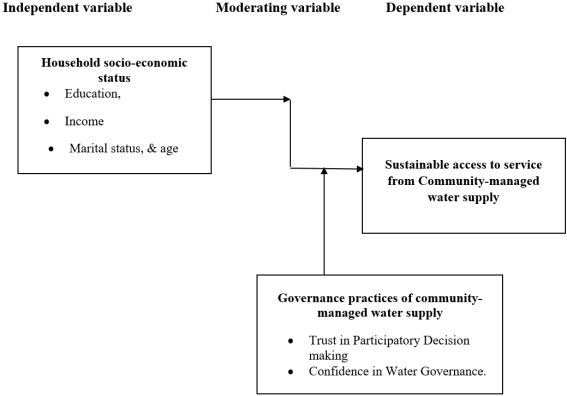
 Copy
Copy Download