Abstract
Every Eid in Bangladesh, millions of people travel from cities back to their villages to celebrate with their families, making it one of the biggest human migrations in the world; cities like Dhaka, Chittagong, and Sylhet empty out as factory workers, students, and day laborers all rush to reach home before the holiday, and for most of these people, particularly middle-class or lower-class individuals, the train is the only affordable means of travel. Because trains are cheaper than buses, many people choose Bangladesh Railway (BR); however, BR simply does not have enough trains to carry everyone safely, as normal coaches are built for around 90 to 110 seated passengers, yet during Eid these same coaches end up carrying three or four times that number, and when there is no more room inside, people climb to the top of the roof or hang from the sides, resulting in deaths and serious injuries every year. This paper studies the main problems of Eid train travel in Bangladesh, including overcrowding, safety risks, problems faced by women passengers, and ticket fraud, and it proposes a practical solution: a high-capacity standing coach for Eid travel that is not a separate train but rather an extra coach added to trains that already run, labelled something like Extra 1 or Extra 2. The coach removes fixed seats and replaces them with grab poles, hand loops, and a smart door layout consisting of one wide central door for entry and narrower end doors for exit, enabling it to carry about 280 to 320 passengers safely, which is almost three times as many as a regular coach. The paper also addresses the ticket fraud problem and poor station management that make everything worse, and it proposes a step-by-step plan for how Bangladesh Railway can put this proposal into practice.
|
Published in
|
International Journal of Safety Research (Volume 1, Issue 2)
|
|
DOI
|
10.11648/j.ijsr.20260102.13
|
|
Page(s)
|
96-102 |
|
Creative Commons
|

This is an Open Access article, distributed under the terms of the Creative Commons Attribution 4.0 International License (http://creativecommons.org/licenses/by/4.0/), which permits unrestricted use, distribution and reproduction in any medium or format, provided the original work is properly cited.
|
|
Copyright
|
Copyright © The Author(s), 2026. Published by Science Publishing Group
|
Keywords
Bangladesh Railway (BR), Eid Travel, High-capacity Standing Coach, Rooftop Travel, Rail Safety, Overcrowding,
Ticket Fraud, Eid-ul-Fitr
1. Introduction
During Eid, almost every working person in Bangladesh wants to go home. It does not matter if they are a rickshaw puller, a garment worker, a student, or an office employee — everyone tries to reach their village within the same few days. According to rough estimates, somewhere between 85 and 100 million people travel during the Eid window, which is usually only about seven days long
.
Trains are the most popular choice because they are cheaper than buses and reach places that roads sometimes do not
. But Bangladesh Railway (BR) was not built to handle this kind of crowd
| [9] | Bangladesh Railway, Annual Report, Ministry of Railways, Government of Bangladesh, 2024-2025. |
[9]
. On a normal day, the network works fine.
During Eid, the gap between how many seats are available and how many people need them becomes truly huge.
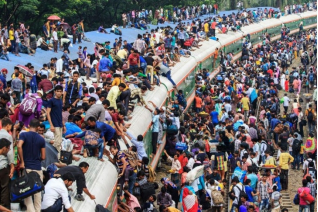
Figure 1. Overcrowded Bangladesh Railway trains during the Eid travel season, showing passengers on rooftops and hanging from doorframes — a recurring and dangerous phenomenon.
When coaches fill up, people start sitting on the roof. Others hang from doorframes or squeeze into the tiny gaps between carriages
. None of these spots have any safety rails, handholds, or protection. If the train brakes suddenly, or passes under a low bridge, or hits an electrical line, the people on top have no chance
.
This is not a small or rare problem. The Nil Sagar Express derailment in March 2026 injured more than a hundred passengers, many of them on the roof
. Deaths and serious injuries during Eid train travel happen every single year. And every year, the official response is the same: send more police to chase people off the rooftops. But when someone has no other option, telling them to get off the roof does not help.
The solution has to come from giving people a safe place to be inside the train, not just threatening them for going on top. This paper argues that the core problem is not discipline or willpower — it is engineering. The current coaches are built for comfortable long-distance sitting, which is the wrong design for Eid’s short, dense, high-pressure travel. A coach built specifically for these conditions, with standing room and wide doors, would change the picture entirely. That is what this paper proposes.
2. Methodology
This research is mainly based on reviewing information that is already publicly available. The sources used include official reports and annual data from Bangladesh Railway and the Ministry of Railways, news coverage from Bangladeshi media outlets like Dhaka Tribune, TBS News, and The Financial Express, and observations from the Dhaka Mass Rapid Transit (MRT) Line 6, which already uses a standing-focused design in a similar tropical climate
| [8] | Dhaka Mass Transit Company, “Dhaka MRT Line 6 Operations Report,” 2023-2024. |
[8]
.
The technical design of the proposed coach was worked out by starting from Bangladesh Railway’s own standard measurements, so that any new coach would fit on existing tracks and platforms without needing any major changes. The capacity numbers were calculated by comparing the floor area used by fixed seats in a standard coach versus the open-floor area in the proposed design and applying standard standing-passenger density Figures used by transit systems in similar countries.
No direct field surveys or interviews were conducted for this paper due to time and resource limitations, which is one of the limitations discussed later. However, the key findings in this paper are based on documented real events and official data, not guesswork.
3. Problem Statement
3.1. Why Trains Are the Main Option
For a large part of Bangladesh’s population, especially poorer families and people from rural areas, the train is the only realistic way to travel during Eid. Bus fares are higher and bus journeys during Eid can take twice as long due to traffic jams. Ferries do not serve all routes. Trains are subsidized, predictable, and connect to rural districts that other transport sometimes cannot reach
.
This is why so much demand concentrates on Bangladesh Railway during Eid. The system carries roughly 60 to 70 million passengers in a normal year
| [9] | Bangladesh Railway, Annual Report, Ministry of Railways, Government of Bangladesh, 2024-2025. |
[9]
. During Eid, a huge portion of that yearly total gets crammed into just one week. The network was never designed for this and has not been properly expanded to handle it.
3.2. The Capacity Gap
A regular Bangladesh Railway passenger coach has fixed seats for between 90 and 110 people
| [9] | Bangladesh Railway, Annual Report, Ministry of Railways, Government of Bangladesh, 2024-2025. |
[9]
. During Eid, actual demand on some routes can be four or five times that number. This is not a small mismatch that can be fixed by adding a few extra trains. It is a deep structural problem.
When there is no room inside, people make do with what is available outside. Rooftops fill up first. Then doorsteps, side handles, and the gaps between carriages. None of these areas have any safety equipment. People sitting on the roof have nothing to hold onto when the train brakes. They cannot see low bridges coming. In rainy weather the surface becomes slippery. Every one of these passengers is one bad moment away from a serious accident.
3.3. Problems with Women Passengers
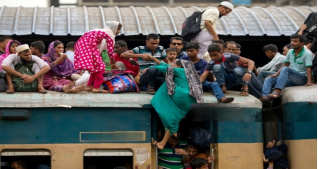
Women face extra difficulties during Eid travel. When trains are overcrowded and chaos breaks out at stations, women are often pushed aside or unable to reach the doors. In some cases, women have had to be lifted in through windows because the doors were completely blocked by the crowd. This is unsafe, undignified, and completely unacceptable.
Figure 2. Additional documentation of the Eid railway overcrowding crisis: women forced onto rooftops and clinging to the exterior of coaches during peak travel days.
Without a dedicated and enforced space for women, they remain exposed to these risks every single Eid season. A separate women’s compartment with proper crowd control is not just a comfort issue — it is a basic safety requirement.
3.4. The Ticket Fraud Problem
The overcrowding problem gets even worse because of organized ticket fraud
. Syndicates operating around major stations photocopy real tickets multiple times. One valid ticket might be copied five or six times and used by different people to enter the station or board the train
. When a legitimate passenger with a real ticket gets to their compartment, they often find it already full of people holding fake copies.
People pushed out of their own seats have nowhere to go except the roof or the doorsteps. The fraud does not just cost money — it directly creates the dangerous overcrowding that leads to deaths. Without fixing the ticketing system, adding more capacity will only partially solve the problem because fraudulent passengers will fill whatever new space is created. Unauthorized passengers also block train access by closing windows and doors from inside, preventing ticket holders from boarding. This adds another layer of chaos at already overwhelmed stations.
3.5. The Human Cost
Between 50 and 80 people die from rooftop travel accidents every year during the Eid travel period
. That Figure does not include the much larger number of people who are injured but survive. Behind every one of these statistics is a family that lost someone who was simply trying to go home for a holiday. This should be the starting point for any serious conversation about Eid railway safety
| [15] | R. Khatun, M. T. Aditya, S. M. Rifaat, and R. Mahmud, “A quantitative analysis of assessing passengers’ satisfaction level of inter-city train services in Bangladesh,” Case Studies on Transport Policy, vol. 21, no. 2, Art. 101477, 2025.
https://doi.org/10.1016/j.cstp.2025.101477 |
[15]
.
4. Proposed Solution
4.1. The Main Idea
The solution this paper proposes is to attach 2 to 3 dedicated high-capacity standing coaches to every major Eid train. These are not new services — they are just extra coaches tagged on to trains that already run, something like Extra 1 or Extra 2 at the end of the normal coach lineup. The inside has no fixed seats. Instead it has standing support equipment: vertical grab poles, overhead hand loops, and side lean rails.
Table 1 shows the key design specifications.
Table 1. Coach Design Specifications (Based on Bangladesh Railway Standard).
Specification | Measurement |
Length over body | 22.3 M (73 Ft) |
Width | 3.1 M |
Height from rail | 4.0 M |
Floor height from rail | 1.25 M |
Bogie centres | 14.8 M |
Wheel arrangement | Bo-Bo |
Empty weight | 36-40 Tons |
Max passenger load | 280-320 Standing Passengers |
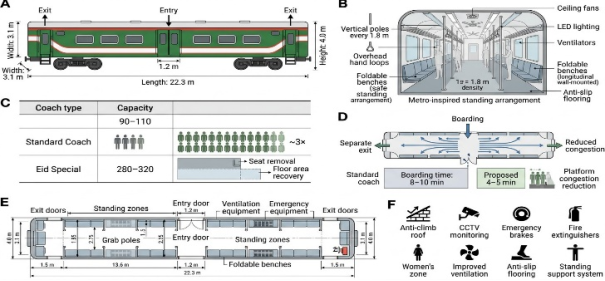
Passengers enter through one wide central door on each side, and exit through the narrower doors at both ends of the coach. The goal is to carry 280 to 320 passengers safely per coach, which is nearly three times the capacity of a regular seated coach.
This is not a complicated or untested idea. Metro systems around the world, including Dhaka’s own MRT Line 6 which opened in 2023, use exactly this kind of standing-first design in hot, humid conditions
| [11] | R. Ahmed, S. Akter, and M. N. Kabir, “Operational performance of urban mass rapid transit in tropical climates: Lessons from Dhaka MRT Line 6,” Urban Rail Transit, vol. 10, no. 2, pp. 88-103, 2024.
https://doi.org/10.1007/s40864-024-00210-x |
[11]
. The same principles can be applied to the specific conditions of Eid rail travel.
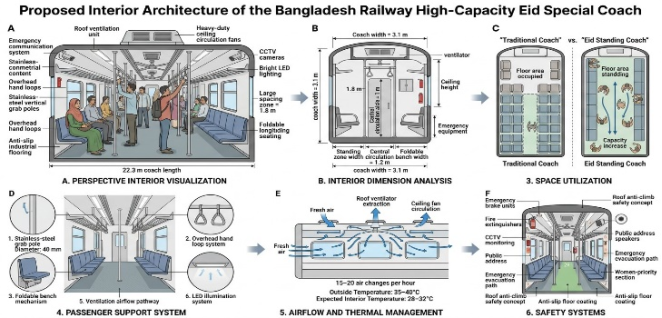
Figure 3. Interior of the Bangladesh Railway Eid Special Coach — grab poles, overhead hand loops, bench seating along the walls, wide central aisle, LED lighting, Bangladesh Railway green livery.
4.2. Interior Design
The inside of the proposed coach is very different from anything currently used on Bangladesh Railway. There are no passenger seats at all. The entire floor space, from one end to the other, is open standing room. This one change is what produces the big jump in capacity: in a normal coach, around 40% of the usable floor area is taken up by seat structures and the legroom they need. Getting rid of seats turns all of that into space people can actually stand in.
The floor is reinforced steel with an anti-slip surface coating, important because passengers will be standing in humid conditions and the floor will see very heavy use. A 1.2-metre-wide walkway runs down the full length of the coach so people can move between the entry points and so that emergency exit is always possible.
Vertical stainless steel grab poles, 40 mm across, are placed every 1.8 m down both sides. Overhead hand loops hang every 0.9 m along ceiling rails that go the full length of the coach. Horizontal lean rails along both walls give extra support, especially for elderly passengers.
4.3. Door Design
One of the biggest problems with current Eid train boarding is how long it takes. Standard coaches have two doors, each about 0.8 m wide. When hundreds of passengers need to get on or off in a few minutes, those two small doors create a dangerous bottleneck on the platform.
The suggested design uses a different approach to doors. There is one wide double-sliding door on each side of the coach, placed right in the middle of the entry door. Getting off the coach happens through the narrower doors at both ends. Keeping entry and exit separate means the crowd does not push against itself at the same doorway, which is one of the main things that makes platforms dangerous during Eid
. The wide central door, suggested at around 1.2 m, allows roughly 60 to 80 passengers per minute to board, compared to 30 to 40 in a standard coach. Boarding a full coach could drop to around 4 to 5 minutes instead of 8 to 10. Less time stuck at the door means less time for a dangerous crush to build up on the platform.
Table 2 provides a direct comparison.
Table 2. Boarding Efficiency Comparison.
Parameter | Standard Coach | Standing Coach |
Doors per coach | 2 | 1 wide entry (centre) |
+ 2 narrow exit (ends) |
Door width | 0.8 m | 1.2 m |
Total boarding time | 8-10 min | 4-5 min |
Platform congestion | 10 min per train | 5 min per train |
4.4. Ventilation and Heat
Bangladesh is hot and humid. During Eid-ul-Fitr, tempera-tures often reach 35 to 40 degrees Celsius and humidity stays above 80%. A coach packed with 300 passengers generates a huge amount of body heat. Without proper ventilation, the temperature inside could become dangerous within a short time.
The proposed design handles this through multiple layers of ventilation. Large mesh-protected windows, about 1.2 by 1.0 m each, run along both sides and have adjustable shutters. Two roof-mounted ventilators, each moving 500 cubic metres of air per hour, pull hot air out. Four heavy-duty ceiling fans of 600 mm diameter each circulate air throughout the coach.
Together, these systems are designed to produce 15 to 20 full air changes per hour, keeping the interior within 4 to 7 degrees of the outside temperature even when the coach is full.
The target interior temperature when it is 35 degrees outside is between 28 and 32 degrees Celsius. This is not air conditioning, but it is within a tolerable range for a 2 to 6 hour journey for passengers who regularly experience these conditions in their daily lives.
4.5. Safety Features
The most important safety feature is the anti-climb roof. The roof surface is curved, smooth, and made from welded stainless steel panels with no flat areas, no external ladders, and nothing to grip onto. This makes it physically very difficult to sit on the roof at speed. Combined with Closed-Circuit Television (CCTV) cameras at both ends of the coach, this design effectively stops rooftop travel without needing any ongoing police presence on board. Inside, two emergency brake units are placed at both ends at an accessible height. Two fire extinguishers per compartment zone are fixed at regular points. A public address (PA) system with four speakers per coach lets crew and station staff give clear instructions even above the noise of a full, busy carriage
.
A dedicated women’s compartment section should be main-tained within each train, clearly marked, with assigned female railway attendants and police at the door during boarding. This gives women a safe, controlled space to board without being pushed aside by the general crowd
.
Table 3 shows clearly that one standing coach equals almost three times the capacity of a regular seated coach. If just 50 of these coaches were distributed across 20 additional Eid trains, each train could carry roughly 15,000 more passengers per journey. Across the busiest days of the Eid period, that translates to about 300,000 additional safe passenger journeys per day. A full fleet of 200 coaches would, in theory, cover the entire structural shortfall that currently pushes people onto rooftops.
Coach Type | Capacity | Use Case |
Standard Seated Coach | 90-110 passengers | Regular daily service |
Proposed Eid Standing Coach | 280-320 passengers | Peak Eid travel days |
5. Station Management and Ticket Fraud Fixes
The standing coach proposal solves the capacity problem. But it will not fully work if the ticketing and station management problems are left untreated. The most important fix here is moving to verifiable digital ticketing. Paper tickets that can be photocopied are inherently insecure. A digital ticket tied to a specific person’s name and National Identity Document (NID) number, with a Quick Response (QR) code scanned at the station gate, cannot be copied. Bangladesh already has the mobile payment infrastructure to make this happen. What is needed is a firm decision to roll out digital tickets across all major Eid routes before the next season
.
Figure 4. Bangladesh Railway Eid Special Coach — Proposed Design Blueprint. The wide central door on each side is for entry only. Exit is through the narrower doors at both ends. Foldable bench seating runs along both walls with a clear standing zone in the middle.
At station entrances, each compartment boarding point should have assigned railway police officers and trained attendants whose only job is to check tickets and direct passengers. Passengers without seats or standard tickets should be directed to the standing coaches rather than being left to push their way anywhere they can find room. This is not complicated crowd management — it is basic organization applied consistently.
6. Limitations
This paper is honest about what it cannot claim. The most significant limitation is comfort. Standing for four to six hours is harder than sitting, especially for elderly passengers, people with disabilities, and families traveling with small children. The standing coach is not suitable for these groups, and any deployment must always maintain sufficient seated coaches on every Eid train. The standing coaches are an addition, not a replacement for seated travel.
There is also the question of whether passengers will accept this new design. Many Bangladeshi rail travelers may initially feel that a standing coach represents a reduction in service. Communication needs to be clear and honest: the standing coach offers guaranteed safe indoor space, compared to the reality of current Eid travel where even seated-ticket holders may end up on the roof due to fraud and overcrowding.
The paper also lacks original field data. No direct passenger surveys, platform observation studies, or engineering stress tests were conducted. The technical Figures are drawn from Comparable systems and standard transit design practice, which is reasonable, but real-world prototyping would be needed to confirm them
.
Finally, the standing coach does not solve the deeper reason why the Eid travel crisis exists in the first place. The root cause is that millions of Bangladeshis live and work far away from their families because economic opportunities are concentrated in a few big cities. Fixing transportation is important and urgent, but the long-term answer also involves more balanced regional development. Railway policy alone cannot address that.
7. Conclusion
People should not have to risk their lives to go home for Eid. That is the simple truth at the heart of this paper. Every year, dozens of Bangladeshis die in accidents that were completely preventable, because the railway system cannot safely carry everyone who needs to use it during the Eid period. And every year, the same response follows: more police, more warnings, more announcements. Then the rooftops fill up again anyway because there is nowhere else to go.
The Eid Special Coach proposed here is not a radical or experimental idea. It is a practical, tested approach applied to a specific local problem. Metro systems worldwide carry standing passengers safely every day. Dhaka’s own MRT does it in tropical heat right now. The design principles are well established, the technology exists and is not expensive, and the economics make strong sense.
What this paper recommends in practical terms is the following:
1) Attach 2 to 3 dedicated high-capacity standing coaches to every major Eid train, designed to the specifications described in this paper.
2) Reserve one dedicated, enforced compartment per train for women passengers, with female attendants and police stationed at the entrance during boarding.
3) Strengthen station entry control by requiring verifiable dig-ital tickets and deploying attendants at every compartment door.
4) Take firm action against ticket syndicates and unauthorized passenger occupation of compartments.
5) Begin with 5 prototype coaches on high-demand routes for the next Eid, scale to 25 coaches over the following two years, and work toward a long-term fleet of 200.
If these steps are taken seriously and implemented con-sistently, the number of rooftop-travel deaths during Eid can be dramatically reduced. Bangladesh Railway would also generate significantly more revenue from the increased legitimate passenger capacity. Both outcomes are achievable. The question is whether there is the political will to actually do it.
Bangladesh Railway has the mandate to move people safely. The people who ride on rooftops during Eid are not doing it by choice — they are doing it because there is no better option available to them. This paper offers a clear, actionable path toward making a better option available.
8. Recommendations
Bangladesh Railway should prioritize the following measures for the immediate and medium-term Eid travel seasons:
1) Commission the design and prototyping of dedicated high-capacity standing coaches aligned with the specifications presented in
Table 1.
2) Mandate full digital-ticket rollout on all major intercity routes before the next Eid season, tied to NID verification.
3) Establish a dedicated women’s compartment policy backed by enforced attendant and police presence at boarding points.
4) Conduct a post-season audit after the first pilot deployment to measure boarding times, passenger volume, and incident rates, and use findings to refine the design for wider rollout.
5) Pursue longer-term route expansion and rolling stock investment so that Eid travel demand can be met with seated capacity as well.
Abbreviations
BR | Bangladesh Railway |
CCTV | Closed-Circuit Television |
MRT | Mass Rapid Transit |
NID | National Identity Document |
PA | Public Address (System) |
QR | Quick Response (Code) |
Acknowledgments
The author thanks Bangladesh Railway and the Ministry of Railways for their publicly available operational data. The author also acknowledges the journalists and editors at Dhaka Tribune, TBS News, The Financial Express Bangladesh, and BSS News whose on-the-ground coverage of the March 2026 Nil Sagar Express derailment and the broader Eid travel situation provided the factual grounding this paper relies on. The passengers who are injured or killed during Eid train travel every year are the real reason this research matters.
Author Contributions
Anuj Kumar Gupta: Conceptualization, Investigation, Methodology, Resources, Visualization, Writing – original draft, Writing – review & editing
Conflicts of Interest
The authors declare no conflicts of interest.
References
| [1] |
Bangladesh Telegraph, “Rail secretary outlines Eid train travel safety, anti-rooftop measures,” May 22, 2026. Available:
https://www.bssnews.net/news/389648
|
| [2] |
Dhaka Tribune, “Eid exodus begins as Dhaka empties amid travel rush,” May 25, 2026. Available:
https://www.dhakatribune.com/amp/bangladesh/411132
|
| [3] |
BSS News / Yunnan Gateway, “Bangladesh train accident results from chronic rail problem,” Mar. 18, 2026. Available:
http://www.yunnangateway.com/html/2026/opinion2023_0319/125930.html
|
| [4] |
Dhaka Tribune, “Why unrest persists in Eid travel despite extended holiday,” Mar. 27, 2026. Available:
https://www.dhakatribune.com/bangladesh/406325
|
| [5] |
TBS News, “Rail secretary outlines Eid train travel safety, anti-rooftop measures,” May 22, 2026. Available:
https://www.tbsnews.net/bangladesh/rail-secretary-1446426
|
| [6] |
The Financial Express Bangladesh, “Making Eid travels safer,” May 23, 2026. Available:
https://thefinancialexpress.com.bd/views/columns/making-eid-travels-safer
|
| [7] |
Bangladesh Railway, “BR takes various initiatives to make Eid journey safe, comfortable,” Mar. 18, 2025. Available:
https://www.dhakatribune.com/bangladesh/376697
|
| [8] |
Dhaka Mass Transit Company, “Dhaka MRT Line 6 Operations Report,” 2023-2024.
|
| [9] |
Bangladesh Railway, Annual Report, Ministry of Railways, Government of Bangladesh, 2024-2025.
|
| [10] |
Bangladesh Pratidin, “Advance Eid train ticket sale begins,” Bangladesh Pratidin, Mar. 3, 2026. Available:
https://en.bd-pratidin.com/national/2026/03/03/58130
|
| [11] |
R. Ahmed, S. Akter, and M. N. Kabir, “Operational performance of urban mass rapid transit in tropical climates: Lessons from Dhaka MRT Line 6,” Urban Rail Transit, vol. 10, no. 2, pp. 88-103, 2024.
https://doi.org/10.1007/s40864-024-00210-x
|
| [12] |
BSS News, “Eid special train services to begin tomorrow,” BSS News, May 23, 2026. Available:
https://www.bssnews.net/news/389896
|
| [13] |
TBS News, “Rail secretary outlines Eid train travel safety, anti-rooftop measures,” The Business Standard, May 23, 2026. Available:
https://www.tbsnews.net/bangladesh/
|
| [14] |
TBS News, “Rail secretary outlines Eid train travel safety, anti-rooftop measures,” The Business Standard, Dhaka, Bangladesh, May 23, 2026. Available:
https://www.tbsnews.net/bangladesh/rail-secretary-outlines-eid-train-travel-safety-anti-rooftop-measures-1446426
|
| [15] |
R. Khatun, M. T. Aditya, S. M. Rifaat, and R. Mahmud, “A quantitative analysis of assessing passengers’ satisfaction level of inter-city train services in Bangladesh,” Case Studies on Transport Policy, vol. 21, no. 2, Art. 101477, 2025.
https://doi.org/10.1016/j.cstp.2025.101477
|
| [16] |
S. A. Ibtihal and S. M. Rifaat, “Accident prediction model for railway level crossings (RLCs) in Bangladesh,” KSCE Journal of Civil Engi-neering, Art. 100296, 2025.
https://doi.org/10.1016/j.kscej.2025.100296
|
Cite This Article
-
APA Style
Gupta, A. K. (2026). Eid Homecoming Travel Crisis in Bangladesh: Overcrowding, Safety Risks, and a High-Capacity Standing Coach Solution for Bangladesh Railway. International Journal of Safety Research, 1(2), 96-102. https://doi.org/10.11648/j.ijsr.20260102.13
 Copy
|
Copy
|
 Download
ACS Style
Gupta, A. K. Eid Homecoming Travel Crisis in Bangladesh: Overcrowding, Safety Risks, and a High-Capacity Standing Coach Solution for Bangladesh Railway. Int. J. Saf. Res. 2026, 1(2), 96-102. doi: 10.11648/j.ijsr.20260102.13
Copy
|
Download
AMA Style
Gupta AK. Eid Homecoming Travel Crisis in Bangladesh: Overcrowding, Safety Risks, and a High-Capacity Standing Coach Solution for Bangladesh Railway. Int J Saf Res. 2026;1(2):96-102. doi: 10.11648/j.ijsr.20260102.13
Copy
|
Download
-
@article{10.11648/j.ijsr.20260102.13,
  author = {Anuj Kumar Gupta},
  title = {Eid Homecoming Travel Crisis in Bangladesh: Overcrowding, Safety Risks, and a High-Capacity Standing Coach Solution for Bangladesh Railway},
  journal = {International Journal of Safety Research},
  volume = {1},
  number = {2},
  pages = {96-102},
  doi = {10.11648/j.ijsr.20260102.13},
  url = {https://doi.org/10.11648/j.ijsr.20260102.13},
  eprint = {https://article.sciencepublishinggroup.com/pdf/10.11648.j.ijsr.20260102.13},
  abstract = {Every Eid in Bangladesh, millions of people travel from cities back to their villages to celebrate with their families, making it one of the biggest human migrations in the world; cities like Dhaka, Chittagong, and Sylhet empty out as factory workers, students, and day laborers all rush to reach home before the holiday, and for most of these people, particularly middle-class or lower-class individuals, the train is the only affordable means of travel. Because trains are cheaper than buses, many people choose Bangladesh Railway (BR); however, BR simply does not have enough trains to carry everyone safely, as normal coaches are built for around 90 to 110 seated passengers, yet during Eid these same coaches end up carrying three or four times that number, and when there is no more room inside, people climb to the top of the roof or hang from the sides, resulting in deaths and serious injuries every year. This paper studies the main problems of Eid train travel in Bangladesh, including overcrowding, safety risks, problems faced by women passengers, and ticket fraud, and it proposes a practical solution: a high-capacity standing coach for Eid travel that is not a separate train but rather an extra coach added to trains that already run, labelled something like Extra 1 or Extra 2. The coach removes fixed seats and replaces them with grab poles, hand loops, and a smart door layout consisting of one wide central door for entry and narrower end doors for exit, enabling it to carry about 280 to 320 passengers safely, which is almost three times as many as a regular coach. The paper also addresses the ticket fraud problem and poor station management that make everything worse, and it proposes a step-by-step plan for how Bangladesh Railway can put this proposal into practice.},
 year = {2026}
}
Copy
|
Download
-
TY  - JOUR
T1  - Eid Homecoming Travel Crisis in Bangladesh: Overcrowding, Safety Risks, and a High-Capacity Standing Coach Solution for Bangladesh Railway
AU  - Anuj Kumar Gupta
Y1  - 2026/06/30
PY  - 2026
N1  - https://doi.org/10.11648/j.ijsr.20260102.13
DO  - 10.11648/j.ijsr.20260102.13
T2  - International Journal of Safety Research
JF  - International Journal of Safety Research
JO  - International Journal of Safety Research
SP  - 96
EP  - 102
PB  - Science Publishing Group
SN  - 3071-4974
UR  - https://doi.org/10.11648/j.ijsr.20260102.13
AB  - Every Eid in Bangladesh, millions of people travel from cities back to their villages to celebrate with their families, making it one of the biggest human migrations in the world; cities like Dhaka, Chittagong, and Sylhet empty out as factory workers, students, and day laborers all rush to reach home before the holiday, and for most of these people, particularly middle-class or lower-class individuals, the train is the only affordable means of travel. Because trains are cheaper than buses, many people choose Bangladesh Railway (BR); however, BR simply does not have enough trains to carry everyone safely, as normal coaches are built for around 90 to 110 seated passengers, yet during Eid these same coaches end up carrying three or four times that number, and when there is no more room inside, people climb to the top of the roof or hang from the sides, resulting in deaths and serious injuries every year. This paper studies the main problems of Eid train travel in Bangladesh, including overcrowding, safety risks, problems faced by women passengers, and ticket fraud, and it proposes a practical solution: a high-capacity standing coach for Eid travel that is not a separate train but rather an extra coach added to trains that already run, labelled something like Extra 1 or Extra 2. The coach removes fixed seats and replaces them with grab poles, hand loops, and a smart door layout consisting of one wide central door for entry and narrower end doors for exit, enabling it to carry about 280 to 320 passengers safely, which is almost three times as many as a regular coach. The paper also addresses the ticket fraud problem and poor station management that make everything worse, and it proposes a step-by-step plan for how Bangladesh Railway can put this proposal into practice.
VL  - 1
IS  - 2
ER  -
Copy
|
Download





 Share This Article
 Twitter
 Linked In
 Facebook