
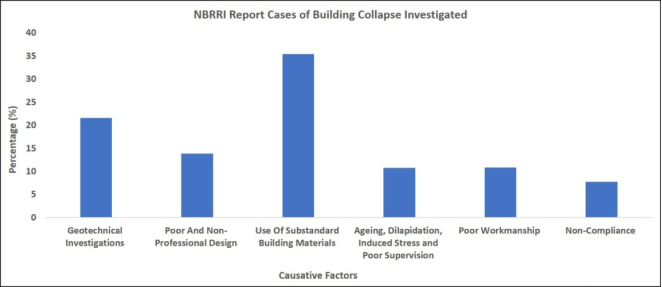
The persistent incidence of building collapse in Nigeria has emerged as a critical concern for researchers and stakeholders in the built environment. Despite the frequency of these events, many have not been systematically analyzed to determine their underlying causes. This study investigates a selection of collapsed buildings across various locations in Nigeria, examining parameters such as building type, structural condition at the time of collapse, number of casualties, prevailing weather conditions, and both causative and contributory factors expressed in percentages. Findings reveal that the predominant cause of building collapse is the use of substandard construction materials, accounting for 35.38% of cases. Geotechnical investigation failures follow as the second leading cause at 21.54%, while poor or non-professional design contributes 13.85%. Other significant factors include ageing infrastructure, dilapidation, induced stress, and inadequate supervision (10.76%), poor workmanship (10.78%), and non-compliance with building regulations (7.69%). The study concludes that mitigating building collapse in Nigeria requires a multifaceted approach involving proactive planning, stringent enforcement of building codes, and heightened public awareness. These measures are essential to safeguard lives and property and to ensure the integrity of the built environment.
| Published in | Journal of Civil, Construction and Environmental Engineering (Volume 11, Issue 1) |
| DOI | 10.11648/j.jccee.20261101.11 |
| Page(s) | 1-13 |
| Creative Commons |
This is an Open Access article, distributed under the terms of the Creative Commons Attribution 4.0 International License (http://creativecommons.org/licenses/by/4.0/), which permits unrestricted use, distribution and reproduction in any medium or format, provided the original work is properly cited. |
| Copyright |
Copyright © The Author(s), 2026. Published by Science Publishing Group |
Building Industry, Building Collapse, Substandard Materials, Geotechnical Investigations
S/N | Building Location | Building Type/Nature of collapse | Date | Result of Preliminary Investigation | No. of Casualties |
|---|---|---|---|---|---|
1. | Yar’Adua Drive, Oweri, Imo | Eight storey building under construction | April, 30 2020 | Not adhering to design provided | 15 dead |
2. | No. 6, Olonode Street, Ebute Meta, Lagos | Three storey building – Partial collapse | May, 25 2020 | Preliminary report by LASEMA- Severely distressed | No casualty |
3. | Shanuaje Street, Iju, Lagos | Two storey building – Partial collapse | June 14 2020 | Lack of maintenance | No casualty |
4. | 46, Gafari Balogun Street, Ogudu, Lagos | One storey building | June 17, 2020 | Mud slide | 2 children trapped and died |
5. | 86, Nkwere Street, Umuahia, Abia | Three storey building | June 24, 2020 | Sub-standard building materials. | No casualty |
6. | 16 and 17 Freeman Street, Lagos Island, Lagos | Three storey building collapsed on nearby bungalow | July 11, 2020 | Defective structure | 3 confirmed dead – A policewoman and two children. |
7. | Nkaliki Road, opposite Abakaliki L. G. A. Ebonyi State | Three storey building under construction | July 22, 2020 | Sub-standard materials | No casualty |
8. | 95, Abeokuta Street, Ebute-Meta, Lagos | Three storey building | July 24 2020 | Lack of geotechnical investigation | One woman wounded and hospitalized |
9. | Behind Dawaki Market, Galadima Area, FCT, Abuja | Two storey building under construction | July 25 2020 | Faulty design | Ten people trapped. |
S/N | Building Location | Type/Nature of Building | Date | Result of Preliminary Investigation | No. of Casualties |
|---|---|---|---|---|---|
1. | Federal Medical Centre (FMC), Umuahia, Abia State | Two storey building under construction | 20th May 2021 | Lack of geotechnical investigation before construction | No casualty. |
2. | Amikwo village, Akwa, Anambra State | Two storey building under construction. | July 6th 2021 | Substandard Materials | 20 persons escaped death |
3. | Oko, Orumba North Local Govt., Anambra, State | Two storey building | July 6th 2021 | Poor supervision | Four persons trapped and rescued |
4. | No. 19, Church Street, Lagos Island, Lagos State | Partial collapse of a three-storey building | 8th July, 2021 | Already earmarked for integrity tests by LASEMA due to visible cracks found on walls and columns. | One five years old boy found dead |
5. | 77, Tapa Road, Oke-Ojo, Isawo, Ikorodu, Lagos State | Two storey building (Attachment to the main building) under construction | 20th July, 2021 | - | One dead |
6. | Nweke Awkuzu Street, Ugbene Area of Abakpa Nike, Enugu State | Three storey building | 20th August 2021- | Lack of geotechnical investigation before construction | No casualty |
7. | Holy Ghost Church Building, Abeda Pave Community, Chachangi Ward, Takum Local Council, Taraba State | Church Building | 11th September 2021 | Substandard Materials | Two worshipers dead. |
8. | Nazareth High School, Imeko – Afon, Ogun State | School building | 26th September 2021 | Substandard Materials | One student died while two sustained injuries. |
9. | 97, Lagos Road, Haruna Axis of Ikorodu, Lagos State | Two storey building | 18th October, 2021 | Failed integrity test earlier conducted by LASBCA* | One dead, two rescued from debris. |
S/N | Building Location | Type/Nature of Building | Date | Result of Preliminary Investigation | No. of Casualties |
|---|---|---|---|---|---|
1. | Salvation Ministry, Okpanam, Oshimili North Local, Delta State | One storey building | 11th Jan. 2022 | Lack of geotechnical investigation before construction | 4 dead and several injured. |
2. | 16, Akanbi Crescent, Off Adeshina Street, Harvey, Yaba, Lagos State | Three storey building under construction | 12th February 2022 | Substandard Materials | 5 dead, 2 rescued. |
3. | Along Audu Bako Way, Kano, Kano State | One storey building under renovation | 16th March 2022 | Poor supervision | No casualty |
4. | The heart of Oba, Idemili North LGA, Anambra State. | Five storey building | 31st March 2022 | Already earmarked for integrity tests. | Many trapped as at time of reporting |
5. | Hotoro Unguwar Gabas, behind Chula Filling Station, Kano State | Uncompleted one storey building | 9th April 2022 | Earmarked for integrity tests. | 2 dead, 3 critically injured |
6. | Bende Street, Old Port Harcourt Township., River State | Old three storey building. Already evacuated | 29th June 2022 | Earmarked for integrity tests. | No casualty |
7. | Kubwa Area, FCT Abuja | Three storey mall building under construction. | 26th August 2022 | Substandard Materials | 2 dead and many injured |
8. | Oba Idowu Oniru Street close to Sand Field Bus Stop, Lekki, Lagos State | Seven storey building under construction | 4th September 2022 | Substandard Materials | 6 dead |
9. | Ibolo, Oraifite, Ekwusigo Local Government Area | Two storey building under construction | 23rd September 2022 | Substandard Materials | 2 persons died |
S/N | Building Location | Type/Nature of Building | Date | Result of Preliminary Investigation | No. of Casualties |
|---|---|---|---|---|---|
1. | 7th Avenue, Gwarimpa, FCT Abuja | Two storey building under construction | 2nd February 2023 | Lack of geotechnical investigation before construction | 3 dead, over 40 trapped |
2. | Aluu Community, Ikwerre LGA, River State | Two storey building under construction | 4th February 2023 | Substandard Materials | 3 persons died |
3. | 1st Avenue, Banana Island, Ikoyi. Lagos State | Seven storey building under construction | 12th April 2023 | Poor supervision | 1 dead, several injured. |
4. | Muri Nta Eke Street, off Ikot Eyo, Cross River State | Two storey building under construction. | 29th April 2023 | Substandard Materials | 13 escaped death. |
5. | Ifo Layout Abakpa Nike Area, Enugu State | Two storey building | 18th June 2023 | - | 1 woman trapped |
6. | Ada George Area, Obio/Akpor Local Government Area of Port- Harcourt, River State | Two storey building under construction | 29th June 2023 | Lack of geotechnical investigation | No casualty |
7. | Dape, Life Camp Abuja | Four storey hotel building under construction | 3rd July 2023 | Substandard Materials | Undisclosed numbers of labourers trapped |
8. | High Court of Justice, Ado-Ekiti, Ekiti State | A section of High Court Complex | 12th July 2023 | Substandard Materials | Chief Justice of the State injured. |
9. | Inalende Area, Mokola, Ibadan, Oyo State, | Three storey building | 24th July 2023 | Collapsed due to settlement after heavy rainfall. | 8 people rescued. |
10. | Itedo Eledumare Street, Obale, Akure North LGA, Ondo State | Section of the building wall collapsed. | 1st August 2023 | Following over 24 hrs rainfall | 1 dead and another sustained injury |
S/N | Building Location | Type/Nature of Building | Date | Result of Preliminary Investigation | No. of Casualties |
|---|---|---|---|---|---|
1. | Ochanja Market, Onisha, Anambra State | Two storey building under construction | 26th February, 2024 | Substandard Materials | Many trapped and number of dead yet to be ascertained then. |
2. | Umumbi Autonomous Community, Ukwa West LGA, Abia State | Three storey building under construction | 7th June 2024 | Substandard Materials | Five people trapped. |
3. | Dennis Memorial Grammar School Onisha., Anambra State | Five storey building under construction | 12th June 2024 | Poor supervision | One dead, three people feared trapped |
4. | Nicholas Ukachukwu’s Praco Limited Estate, Plot 458 Guzape, FCT Abuja | Unnamed multi-storey building under construction | 28th June 2024 | Poor supervision | Unidentified number of workers trapped |
5. | Close 10, Drive 5, Second Gate of Prince and Princess Estate Gudu, FCT, Abuja | Duplex under construction | 28th June 2024 | - | Two trapped persons rescued |
6. | 12, Cameroun Street, off Ewenla, Mushin, Lagos State | Two storey building | 3rd July 2024 | Lack of geotechnical investigation before construction | Seven persons rescued |
7. | Ifite-Akwa, Near Nnamdi Azikiwe University, Anambra State | Three storey building under construction | 12th July 2024 | Substandard Materials | No casualty |
8. | Cupid Road (Sultan Dasuki Way) Kubwa, FCT, Abuja | A section of two storey residential building | 13th July 2024 | Substandard Materials | Unspecified numbers of residents trapped |
9. | Okpanam Community, Oshimili North Local Govt Area, Delta State | Two storey building under construction | 14th September 2024 | Failed integrity test | Unspecified number of workers trapped. |
10. | Egbelu Mgbaraja Area of Ogbogoro Community, Obio Akpo LGA, River State. | Two storey building under construction | 4th November 2024 | Not adhering to design provided | One person died |
S/N | Building Location | Type/Nature of Building | Date | Result of Preliminary Investigation | No. of Casualties |
|---|---|---|---|---|---|
1. | Aboaga Along Igwuruta-Etche Road, Ikwerre Local Govt Area, Rivers State. | Three storey building under construction. | 4th January 2025 | Lack of geotechnical investigation before construction | Seven workers injured and rescued |
2. | Norther Vulture Estate, Chevron Dirive, Ikota Lekki, Lagos State. | Two storey building under construction. | 29th January 2025 | Substandard Materials | Three people died, six injured |
3. | Mayigi Community Comprehensive High School, Ilase, Ipokia Local Government, Ogun State | Mud school building due to rainstorm | 19th March 2025 | Aged building | One student died while five others and two teachers were seriously injured |
4. | 10, Oremeta Street, Ojodu-Berger, Lagos State. | Three storey building housed a restaurant | 19th April 2025 | Substandard Materials | Five people died 12 rescued as at the time of compiling this report |
5. | Opposite Mobil Filling Station (formerly Bugon Filling Station), Ota – Ona, Ikorodu, Lagos | Two storey building undergoing construction. | 26th May 2025 | - | Three persons dead, others rescued. |
6. | No. 5, Craig Street, Off Apata Road, Shomolu | Two storey building under construction collapsed on RCCG, Liberty Parish | 15th June 2025 | Lack of geotechnical investigation before construction | No casualty |
7. | Abedi Area of Sabon Gari, Fagge Local Govt. Area, Kano State | Three storey building under construction. | 13th July 2025 | Substandard Materials | Four dead, Seven injured. |
8. | Pentagon Lodge, Ekwueme Federal University, Ndufu-Alike, Ikwo, Eboyi State | Three Storey hostel building | 25th July 2025 | Lack of geotechnical investigation | No casualty. |
9. | Olokoro Road, Federal Low-Cost Housing Estate, Umuahia | Three storey building under construction | 26th July 2025 | Substandard Materials | Seven people sustained injuries |
S/N | Location | Building Type | State as at Collapse | No. of Injured/ No. of deaths | Weather Condition at time of Collapse | Causative Factor | Contributory factor in Percentage | Remark /Source of Evidence |
|---|---|---|---|---|---|---|---|---|
`1 | Lagos | 5 storey building Residential | Under construction | 35/10 | Rainy season | Materials Design Workmanship Geotechnical failure Compliance | 7% 1% 2% 5% 85% | Primary Cause of Failure Is Violation of Approved Design |
2 | Ogun | Residential | Dilapidated mud house | 5/2 | Rainy season | Materials Design Workmanship Geotechnical failure Compliance | 100% NIL NIL NIL NIL | Primary Cause of Failure Is Material |
3 | Anambra | 3 storey building Residential | Under construction | 13/7 | Rainy season | Materials Design Workmanship Geotechnical failure Compliance | 94% 2% 3% 2% NIL | Primary Cause of Failure Is the Use of Sub-Standard Material |
4 | Abuja | 4 storey building Residential | Under construction | 6/2 | Rainy season | Materials Design Workmanship Geotechnical failure Compliance | 90% 1% 4% 5% NIL | Primary Cause of Failure Is the Use of Sub-Standard Material |
5 | Abuja | 1 storey building Residential | Under construction | 7/0 | Rainy season | Materials Design Workmanship Geotechnical failure Compliance | 92% NIL 8% NIL NIL | Primary Cause of Failure Is the Use of Sub-Standard Material |
6 | Akwa Ibom | Religious Building | In Use | 29/3 | Dry season | Materials Design Workmanship Geotechnical failure Compliance | 3% 95% 2% NIL NIL | Primary Cause of Failure Is Poor and Non-Professional Design |
7 | Lagos | 2 storey building Residential | In Use | 13/2 | Dry season | Materials Design Workmanship Geotechnical failure Compliance | 34% 1% 2% NIL NIL | Material And Other Factors Are Responsible; Prolong Exposed to Adverse Weather Conditions |
8 | Owerri | 4 storey building Residential | Under construction | 15/4 | Rainy season | Materials Design Workmanship Geotechnical failure Compliance | 90% 1% 4% 5% NIL | Primary Cause of Failure Is the Use of Sub-Standard Material |
9 | Owerri | 4 storey building Residential | Under construction | 15/4 | Rainy season | Materials Design Workmanship Geotechnical failure Compliance | 4% 94% 2% NIL NIL | Primary Cause of Failure Is Poor and Non-Professional Design |
10 | Lagos | Bungalow Building Residential | Under construction | 4/2 | Rainy season | Materials Design Workmanship Geotechnical failure Compliance | NIL NIL 2% 98% NIL | Primary Cause of Failure Is Soil Settlement Due to Heavy Downpour |
11 | Lagos | 4 storey building plus Penthouse Residential | In Use | 16/8 | Rainy season | Materials Design Workmanship Geotechnical failure Compliance | 95% 3% 1% 1% NIL | Other Factors Are Responsible; Prolong Exposed to Adverse Weather Conditions |
12 | Owerri | 3 storey building Residential | Under construction | 7/0 | Rainy season | Materials Design Workmanship Geotechnical failure Compliance | 90% 1% 4% 5% NIL | Primary Cause of Failure Is Poor and Non-Professional Design |
13 | Lagos | 3 storey building Residential | In Use | 8/0 | Rainy season | Materials Design Workmanship Geotechnical failure Compliance | 24% 9% 2% NIL NIL | The Factor Responsible Is Ageing and Dilapidated Nature of The Structure |
14 | Anambra | 2 storey building Residential | Under construction | 6/0 | Dry season | Materials Design Workmanship Geotechnical failure Compliance | 92% 5% 2% 1% NIL | Primary Cause of Failure Is the Use of Sub-Standard Material |
15 | Abuja | 4 storey building Residential | Under construction | 12/3 | Rainy season | Materials Design Workmanship Geotechnical failure Compliance | 2% 2% 87% 4% NIL | Lack Of Supervision and Poor Workmanship Are the Factors Responsible |
16 | Anambra | 3 storey building Residential | In Use | 7/1 | Rainy season | Materials Design Workmanship Geotechnical failure Compliance | 8% 88% 4% NIL NIL | Primary Cause of Failure Is Poor and Non-Professional Design |
17 | Abia | 3 storey building Residential | In Use | 13/2 | Rainy season | Materials Design Workmanship Geotechnical failure Compliance | 94% 3% 2% 1% NIL | Primary Cause of Failure Is the Use of Sub-Standard Material |
18 | Ebonyi | 3 storey building Residential | In Use | 7/1 | Rainy season | Materials Design Workmanship Geotechnical failure Compliance | 91% 4% 2% 3% NIL | Primary Cause of Failure Is the Use of Sub-Standard Material |
AEC | Architectural, Engineering, and Construction |
BIM | Building Information Modeling |
NBRRI | Nigeria Building and Road Research Institute |
NDT | Non-Destructive Testing |
SIA | Structural Integrity Assessments |
| [1] | Ajayi, T. O., Adhuze, O. O., & Nwako, B. A. (2023), “Examining causes and solutions for building collapse in Nigeria: A review”. International Research and Engineering Journal. Retrieved from |
| [2] | Ayedun, C. A., Oloyede, S. A., Durodola, D. O., Adedoyin, A. A., & Ogunde, A. O. (2018), “Building failure and collapse: A framework for tackling its scourge in Nigeria”. International Journal of Mechanical Engineering and Technology, 9(9), pp 395–404. |
| [3] | Orikpete, O. F., & Ewim, D. R. E. (2023), “Investigating the root causes of recurring building collapse in Nigeria: A systematic review and meta-analysis”. Journal of Earth & Environment Science, pp 61–70. |
| [4] |
Ekundayo, O. O. (2023), “Building failure crisis in Nigeria: Addressing causes, prevalence and solutions”. World Journal of Engineering Research and Technology, 9(12), pp 82–93. Retrieved from
https://www.wjert.org/download/article/72112023/1701852067.pdf |
| [5] | Ekponyoh, U. D., George, W. K., Etuk, E. R., Elijah, E. S., & Kabari, A. D. (2025), “Building collapse in Abuja and Lagos between 1984 and 2023: Assessing structural vulnerabilities to prevent reoccurrence”. World Journal of Innovative Management and Technology, 9(2), pp 1–27. |
| [6] | Qurix, W. B., & Doshu, R. G. (2020), “Mitigating building collapse in Nigeria”. ARTEKS Journal, 5(3). |
| [7] | Olagunju R. E., Aremu S. C. and Ogundele J. (2013), “Incessant Collapse of Buildings in Nigeria: An Architect’s View”. Civil and Environmental Research 3(4), pp 49 –54. |
| [8] | Ede, A. N. (2010), “Building Collapse in Nigeria: The trend of casualties in the last decades (2000-2010)”. International Journal of Civil and Environmental Engineering IJCEE-IJENS, 10(6), pp 32–42. |
| [9] | Ayininuola, A. J., & Olalusi, O. O. (2004), “Assessment of Building failures in Nigeria: Lagos and Ibadan case study”. African Journal of Science and Technology, 5, pp 73–78. |
| [10] | Adebowale, P. A., Gambo, M. D., Ankeli, I. A., & Daniel, I. D. (2016), “Building Collapse in Nigeria: Issues and Challenges”. In Proceeding of the International Journals of Art and Sciences (pp 99–108). |
| [11] | Oloyode, S. A Omogun, C. B and Akinjare, O. A (2010), “Tracking Causes of Building Collapse in Nigeria”. Journal of sustainable Development 3 (3), PP 127-132. |
| [12] | Oseghale, G. E., Ikpo, I. J., & Ajayi, O. D. (2015), “Causes and Effects of Building Collapse in Lagos State, Nigeria”. Civil and Environmental Research, 7(4), pp 34–43. |
| [13] | Folagbade, S. O. (2002), “Case Study of Building collapse in Nigeria”. In Proceedings on building collapse: Causes, Prevention and Remedies, Ondo State, Nigeria: The Nigerian Institute of Building (pp 110–121). |
| [14] | Youdeowei, P. O. and Rowland-Lato, E. O (2019), “Geotechnical Investigation of a collapsed building site in Port Harcourt, Rivers State”. International Journal of Engineering Research Technology, 8 (4), pp 125-136. |
| [15] | Chinwokwu, G. (2000), “The role of professionals in averting building collapse”. Proceedings of a workshop on Building collapse: Causes, prevention and remedies (pp 12-28). The Nigerian Institute of Building, Lagos State. |
| [16] | Olagunju, R. E. (2011), “Development of Mathematical Models for the Maintenance of Residential Buildings in Niger State, Nigeria”, Ph.D (Architecture) Thesis, Department of Architecture, Federal University of Technology, Minna, Nigeria. |
| [17] | Fagbenle O. I. and Oluwunmi A. O. (2010), “Building Failure and Collapse in Nigeria: The Influence of the Informal Sector”. Journal of Sustainable Development 3(4), pp. 268–276. |
| [18] | Babalola H. I. (2015), “Building Collapse: Causes and Policy Direction in Nigeria”. International Journal of Scientific Research and Innovative Technology 2(8), pp 1-8 |
| [19] | Chendo, I. G. and Obi, N. I. (2015) “Building Collapse in Nigeria: The Causes, Effects, Consequences and Remedies” International Journal of Civil Engineering, Construction and Estate Management, Vol. 3, No. 4, pp 41-49. |
| [20] | Windapo, A. O., & Rotimi, J. O. (2012), “Contemporary Issues in Building Collapse and Its Implications for Sustainable Development”. pp 283–299. |
APA Style
Sule, J., Augustine, E. O., Abdulmumin, M., Halidu, A. (2026). Framework for Building Collapse Investigation and Proffered Mitigation Measures for Nigeria; the NBRRI Approach. Journal of Civil, Construction and Environmental Engineering, 11(1), 1-13. https://doi.org/10.11648/j.jccee.20261101.11
ACS Style
Sule, J.; Augustine, E. O.; Abdulmumin, M.; Halidu, A. Framework for Building Collapse Investigation and Proffered Mitigation Measures for Nigeria; the NBRRI Approach. J. Civ. Constr. Environ. Eng. 2026, 11(1), 1-13. doi: 10.11648/j.jccee.20261101.11
AMA Style
Sule J, Augustine EO, Abdulmumin M, Halidu A. Framework for Building Collapse Investigation and Proffered Mitigation Measures for Nigeria; the NBRRI Approach. J Civ Constr Environ Eng. 2026;11(1):1-13. doi: 10.11648/j.jccee.20261101.11
@article{10.11648/j.jccee.20261101.11,
  author = {Jibrin Sule and Ejembi Oche Augustine and Miiraj Abdulmumin and Abubakar Halidu},
  title = {Framework for Building Collapse Investigation and Proffered Mitigation Measures for Nigeria; the NBRRI Approach},
  journal = {Journal of Civil, Construction and Environmental Engineering},
  volume = {11},
  number = {1},
  pages = {1-13},
  doi = {10.11648/j.jccee.20261101.11},
  url = {https://doi.org/10.11648/j.jccee.20261101.11},
  eprint = {https://article.sciencepublishinggroup.com/pdf/10.11648.j.jccee.20261101.11},
  abstract = {The persistent incidence of building collapse in Nigeria has emerged as a critical concern for researchers and stakeholders in the built environment. Despite the frequency of these events, many have not been systematically analyzed to determine their underlying causes. This study investigates a selection of collapsed buildings across various locations in Nigeria, examining parameters such as building type, structural condition at the time of collapse, number of casualties, prevailing weather conditions, and both causative and contributory factors expressed in percentages. Findings reveal that the predominant cause of building collapse is the use of substandard construction materials, accounting for 35.38% of cases. Geotechnical investigation failures follow as the second leading cause at 21.54%, while poor or non-professional design contributes 13.85%. Other significant factors include ageing infrastructure, dilapidation, induced stress, and inadequate supervision (10.76%), poor workmanship (10.78%), and non-compliance with building regulations (7.69%). The study concludes that mitigating building collapse in Nigeria requires a multifaceted approach involving proactive planning, stringent enforcement of building codes, and heightened public awareness. These measures are essential to safeguard lives and property and to ensure the integrity of the built environment.},
 year = {2026}
}
TY  - JOUR
T1  - Framework for Building Collapse Investigation and Proffered Mitigation Measures for Nigeria; the NBRRI Approach
AU  - Jibrin Sule
AU  - Ejembi Oche Augustine
AU  - Miiraj Abdulmumin
AU  - Abubakar Halidu
Y1  - 2026/01/19
PY  - 2026
N1  - https://doi.org/10.11648/j.jccee.20261101.11
DO  - 10.11648/j.jccee.20261101.11
T2  - Journal of Civil, Construction and Environmental Engineering
JF  - Journal of Civil, Construction and Environmental Engineering
JO  - Journal of Civil, Construction and Environmental Engineering
SP  - 1
EP  - 13
PB  - Science Publishing Group
SN  - 2637-3890
UR  - https://doi.org/10.11648/j.jccee.20261101.11
AB  - The persistent incidence of building collapse in Nigeria has emerged as a critical concern for researchers and stakeholders in the built environment. Despite the frequency of these events, many have not been systematically analyzed to determine their underlying causes. This study investigates a selection of collapsed buildings across various locations in Nigeria, examining parameters such as building type, structural condition at the time of collapse, number of casualties, prevailing weather conditions, and both causative and contributory factors expressed in percentages. Findings reveal that the predominant cause of building collapse is the use of substandard construction materials, accounting for 35.38% of cases. Geotechnical investigation failures follow as the second leading cause at 21.54%, while poor or non-professional design contributes 13.85%. Other significant factors include ageing infrastructure, dilapidation, induced stress, and inadequate supervision (10.76%), poor workmanship (10.78%), and non-compliance with building regulations (7.69%). The study concludes that mitigating building collapse in Nigeria requires a multifaceted approach involving proactive planning, stringent enforcement of building codes, and heightened public awareness. These measures are essential to safeguard lives and property and to ensure the integrity of the built environment.
VL  - 11
IS  - 1
ER  -
Building Research Department, Nigerian Building and Road Research Institute, Abuja, Nigeria
Building Research Department, Nigerian Building and Road Research Institute, Abuja, Nigeria
Civil Engineering Department, University of Ilorin, Ilorin, Nigeria
Civil Engineering Technology Department, Federal Polytechnic Nasarawa, Nasarawa, Nigeria

Information



 Share This Article
 Twitter
 Linked In
 Facebook
 Copy
Copy Download