Case Report | | Peer-Reviewed

Study on Implementation and Effectiveness of Base Isolation System Using Lead Rubber Bearing in a Residential Building at Bharuch, India

Received: 17 May 2026     Accepted: 30 May 2026     Published: 18 June 2026
Views:       Downloads:
Abstract

The research presented herein investigates the ability of an adaptive seismic isolation system to protect the structure built in Bharuch, Gujarat, India subjected to earthquake ground motion. As Seismic hazards remain a challenge to engineers, to reduce loss of life and damage to property due to earthquake, Seismic Isolation technique has been adopted which causes reduction in earthquake forces by lengthening period of vibration of the structure. Seismic isolation for the structure was done using Lead Rubber Bearings (LRB) with four basic requirements, i.e. effective stiffness, damping, acceleration response and shear. This technical paper discusses performance evaluation of the Elastomeric isolators (LRB), based on tests carried out both on rubber compound and full-scale devices to simulate and evaluate actual performance of Isolators. The building is of 4-storeyed residential apartment was base isolated using LRBs. This study discusses the theoretical method or numerical analysis in ETABS for selection of dimension of LRB as well as the laboratory tests to verify the properties. The isolator system performs three functions: horizontal flexibility, energy dissipation and rigidity against normal lateral loads. The important isolator property; effective stiffness, damping, displacements were evaluated as per both theoretical and experimental investigations. Several trials have been conducted with respect to selection of dimensions, rubber hardness, shear modulus which is suitable to match the target design base shear and displacement of structure during design basis and maximum credible earthquake. Finally the selected LRB was found suitable to achieve the targeted base shear and displacement as per both numerical analysis and experimental investigation.

Published in Journal of Civil, Construction and Environmental Engineering (Volume 11, Issue 3)
DOI 10.11648/j.jccee.20261103.14
Page(s) 93-104
Creative Commons

This is an Open Access article, distributed under the terms of the Creative Commons Attribution 4.0 International License (http://creativecommons.org/licenses/by/4.0/), which permits unrestricted use, distribution and reproduction in any medium or format, provided the original work is properly cited.

Copyright

Copyright © The Author(s), 2026. Published by Science Publishing Group

Keywords

Lead Rubber Bearing, Base Isolation, Damping, Time Period, Energy Dissipation, Base Shear

1. Introduction
The idea of base-isolation was to confine the seismic energy in a limited region of the structure as Conventional seismic design was not acceptable because the structure must remain fully functional during a major earthquake. Basically, protection of the structure was guided by the installation of special seismic protection systems that ensure essentially elastic behavior of the structure during a major earthquake. A seismic isolation system can also decouple the structure response from the ground motion with additional damping property for absorption of energy into the structure. The isolated structure moves like a quasi-rigid body where no significant coupling exists between the vertical and horizontal motions which enables a substantial simplification of the design. Isolation requirement permits vertical seismic forces to be transmitted through the structure without attenuation or amplification. It makes the structure flexible allowing vertical and horizontal movements during major earthquake in both DBE (Design Basis Earthquake) and MCE (Maximum Credible Earthquake) conditions. So, the general properties of an isolator are:
a) Performance under all service loads, vertical and horizontal, shall be as effective as conventional structural bearings.
b) Providing enough horizontal flexibility in order to reach the target natural period for the isolated structure.
c) Re-centering capabilities even after a severe earthquake so that no residual displacements could disrupt the serviceability of the structure.
d) Providing an adequate level of energy dissipation: in order to control the displacements that otherwise could damage other structural elements.
Mendez et. al. evaluates Elastomeric Isolators through tests on rubber compounds and full‑scale devices, assessing how well these tests represent actual isolator performance and help estimate device durability and service life. Mahdi and Behzad showed that base‑isolated RC buildings exhibit response factors largely independent of member seismic detailing, with far fewer plastic hinges than fixed‑base counterparts. Afraa et al. investigates the effect of ground motion duration on the seismic response of base-isolated bridges. Donato et al. two base isolation systems are analyzed and their seismic behavior is compared with reference to a multi-storey reinforced concrete building. Yi et al. showed that internal resonance in hysteretically isolated frames drives strong mode‑to‑mode energy transfer, shaping deformation and acceleration demands. Sharma et al. found that the performance of high damping, low damping isolators varies with near and far‑field motions, highlighting the need for appropriate damping selection or hybrid systems. Jara et al. showed that the effectiveness of passive control systems in RC buildings varies with height and distance from the Middle America Trench. Kumar and Singh highlighted key performance factors of friction‑based isolators and emphasized the need for adaptive multi‑surface systems. Lin et al. proposed an EEW‑activated smart base‑isolation system that unlocks upon warning to maximize isolation efficiency, with shake‑table tests confirming significant reductions in seismic response. Das et. al highlighted that the force-displacement relationship varies significantly depending on earthquake intensity, seismic zone, and local soil properties, provides valuable insights into how lead rubber bearings influence seismic performance by reducing base shear and enhancing structural safety and how varying damper properties can effectively control seismic responses in both regular and irregular building configurations. The study shows that LRB base isolation markedly reduces seismic forces and improves flexibility in mid‑rise RC buildings compared with fixed‑base designs. Demir et al. showed that fluid viscous dampers, LRB, friction isolators, and their combinations greatly reduce drift, acceleration, and torsional irregularity in a mid‑rise RC building. Rahman and Patel showed that adding U‑shaped dampers to natural rubber bearings greatly boosts damping and energy dissipation, offering an effective adjustable isolation option.
2. General Properties of the Building
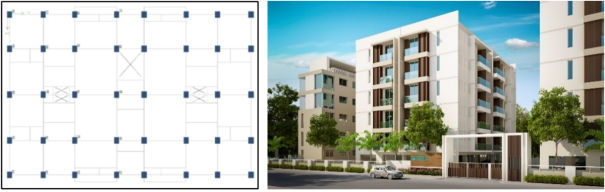
Figure 1. Ground Floor Plan and Isolator IDs.
The structure is a 4-story residential apartment building (Figure 1) which needed to be base isolated for seismic loads. Isolation bearings (LRB) were placed in the open ground story (isolation story) over concrete pedestals. The work includes engineering design of base isolation systems to achieve the design target of base shear, displacements at Design Basis Earthquake (DBE) and Maximum Credible Earthquake (MCE).
1) 40 no s columns in one building and two such type buildings have been base-isolated.
2) Soil type at the site location is black cotton soil Up to 6' depth and after 6' it is yellow soil and after excavation of the site and foundation casting, the backfill soil is yellow soil.
3) Built up area=355 sq. m on each floor. Height of building=24.1m.
4) Isolation level height=2.5m
Table 1. Dimensions of the residential building.

Parameter

Measurement

Unit

Length of Building

X (L)

15.86

m

Width of Building

Y (B)

23.72

m

Height of Building

(H)

24.1

m

Floor name

Height (m)

No. Floor

Total height (m)

Typ. Floor

3.00

4

12

Terrace

3.00

1

3

Stair Cabin

3.00

1

3

Parking

3.60

1

3.6

Plinth Beam

2.50

1

2.5

Section

Size In mm

Storey level (conc. Grade)

Slab

130

M25

Beam

230 X 450

M25

Column (GF)

300 X 600

M25

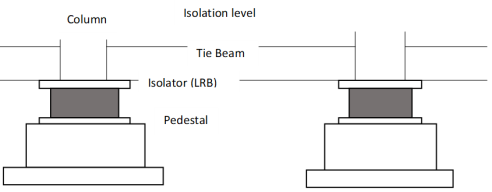
The isolation level has been identified at plinth beam level at 2.5 m above ground level (Figure 2).
Figure 2. Isolation level defined at plinth beam level.
Site specification:
1) Seismic zone –III as per standard division of earthquake hazard zones in India (IS 1893 part 1).
2) Soil characteristics- Medium type.
3) Type of superstructure-Special Moment resisting Frame (SMRF).
4) Importance factor of building-1.
3. Design Loads of Members of Building
The structure was analyzed without isolation system using ETABS software. The following load combinations were used to design the whole structure.
1) P1= Avg. loads under gravity condition (DL + 0.5LL)
2) P2=Max. loads under gravity condition (DL + LL)
3) P3=Max. loads under seismic conditions (1.2DL + LL + EQMCE)
4) P4=Min. loads under seismic conditions (0.8DL –EQMCE)
5) P5=Avg. loads under seismic conditions (1.2DL + 0.5LL + EQMCE)
Where DL=Dead load, LL=Live load, EQMCE=Earthquake load at Maximum credible earthquake condition.
From the analysis, following results have been obtained:
1) Max vertical reaction on column= 1798 kN
2) Min vertical reaction on column= 120 kN
3) Total seismic weight of building, W= DL+0.5LL= 36354 kN
4. Target Properties of the Base Isolation System
Lead Rubber Bearings (LRB) were used as isolator with additional damping property (Table 2). It fulfilled the targeted effective stiffness which is directly related to the time period of vibration as well target reduction of base shear of the building by additional damping property of the LRB.
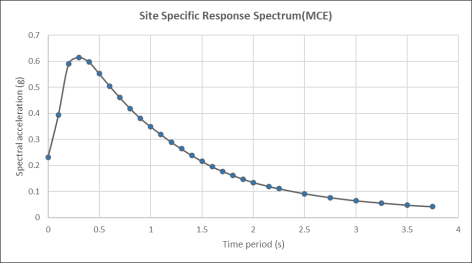
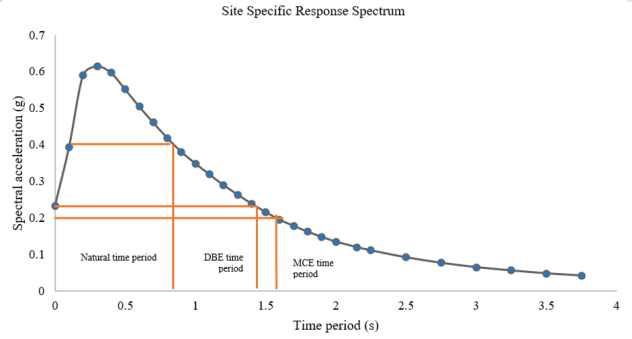
For analysis of the structure at DBE as well as MCE condition, site specific Response Spectrum has been used with respect to the site characteristics mentioned in Figure 3. Spectral acceleration value for DBE has been considered as half of MCE.
Figure 3. Site specific response spectrum for Bharuch.
Table 2. Target properties of base isolated structure.

Property of LRB

Recommended Value

Max Do for 1.5WL

6 mm

Max DD at DBE

45 mm

Max DM at MCE

110 mm

Max DTM at MCE

1.36 DM but not exceeding 200 mm

Max TD

2.50 sec

Max TM

3.00 sec

Max. lateral force transmitted to superstructure

0.039 W

(i.e. members above isolation level)

Equivalent Viscous Damping of LRB at DBE

Between 15% to 30% of Critical

Base shear at DBE

3.9% of W

Base shear at MCE

8.0% of W

Max displacement under 1.5 times of Wind load

6 mm

Vertical load capacity (static)

3 times of P2

Max tensile stress due to uplift

1 MPa

Min load capacity at DTM

1798 kN

Lateral force at DTM & 0.5DTM

2.5% of W

1) DD= Design displacement at DBE
2) DM=Max displacement at MCE
3) DTM=Total max displacement at MCE
4) TD= Time period at DBE
5) TM=Time period at MCE
5. Properties of Base Isolator Used; LRB 460-125
Lead Rubber Bearings consist of alternate layers of rubber and vulcanized reinforcement steel plates of limited thickness and a central lead core. The rubber/steel laminated bearing is designed to carry the weight of the structure and make the post-yield elasticity available. The rubber provides the isolation and the re-centering. The lead core deforms plastically under shear deformations, while dissipating energy through heat. LRB acts as horizontal spring and altogether as parallel combination of springs. It shares total seismic vertical load and horizontal load through equal shear displacement.
F=F1+F2+……Fn
F=K x d, F1=K1xd, Fn=Knx d as K=K1+K2+……Kn
K1, K2 are effective stiffness of individual LRB and K is the equivalent stiffness of the system.
Additional top and bottom plates were used for connection with Lead rubber bearings block with structure.
The dimensions & properties of LRB used in this project are as follows:
1) Diameter of isolator= 460 mm
2) Diameter of Lead core=70 mm
3) Total thickness of Rubber=125 mm
4) Total thickness of Rubber block= 229mm
5) Shear modulus of rubber= 0.9 MPa
Formula used for calculation of properties of LRB:
1) Total Effective stiffness, Keff = ∑Kn
2) Characteristic strength of lead, Qd= Area of lead x Yield stress of lead
3) Yield force of isolator, fy = Qd +Hy (Force on elastomer for a displacement up to yield point)
4) Horizontal force on isolator at DBE, Vbd = Qd+ Hd (Force on elastomer at DBE displacement)
5) Horizontal force on isolator at MCE, VEd= Qd+ Hm (Force on elastomer at MCE displacement)
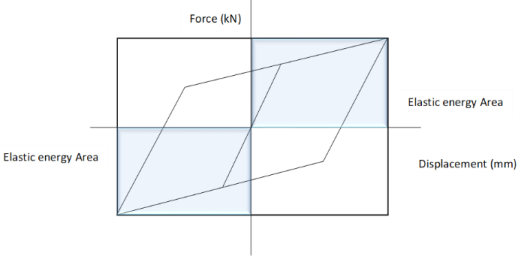
6) Damping at DBE, ξbd = (Energy dissipated per cycle/Total elastic energy)
7) Energy dissipated per cycle, EDC = Area of hysteresis loop
The hysteresis graph for Leab Rubber Bearings represents the force-displacement interaction as shown in Figure 4.
Figure 4. Force-deformation interaction or hysteresis graph of LRB.
6. Analysis of System with Base Isolation
Total seismic weight was shared by all 40 isolators through parallel spring combinations.
After doing trial and error, calculated design displacement of LRBs at DBE is DD=36 mm.
Where DD = (g x Spectral acceleration ratio x TD2)/ (damping factor x 4π2), [Reference: UBC 1997 edition 1658.3.2]
[Spectral acceleration value taken from Site specific Response spectrum for corresponding Time period]
System Time period, TD= (2π x sqrt (Seismic wt./ (Keff x g)))
Max displacement at MCE, DTM = 76 mm
Total system was analyzed following same procedure at MCE also.
1) Total horizontal force of 40 isolators to be transferred to structure is 1360 kN at DBE which is only 3.7% of total seismic weight of the building.
2) Total horizontal force of 40 isolators to be transferred to structure is 2690 kN at DBE which is only 7.4% of total seismic weight of the building.
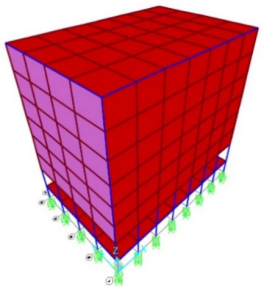
Figure 5. System analysis is done considering all LRBs as horizontal springs placed parallelly.
Analysis has been done in ETABS design & analysis software using following methods (Figure 6):
1) Response spectrum (RS) using site specific data
2) Non-linear time history (NLTHA) using Bhuj accelerogram data matched to target site specific response spectrum
Figure 6. Analysis model (isolated using LRB) in ETABS.
The LRBs have been modelled as “Link” system at each column and the linear and non-linear properties including initial stiffness, yield force, post-yield stiffness ratio have been provided for analysis with RS and NLTHA method.
The fixed support base shear is 20% on seismic weight as per RS and 17% as per NLTHA analysis.
After several trial designs using different dimensions (plan of bearing, rubber height), shear modulus of rubber, area of lead core, the dimensions, properties of LRBs have been defined. The properties of elastomer and lead core are derived based on the dimensions, shear modulus, height etc.
As per analysis, the properties of LRB 460-125 to fulfil the design base shear are mentioned in Table 3.
Table 3. Results from the analysis of the isolated building.

Property

Value

Effective stiffness at DBE

1.87 kN/mm

Effective stiffness at MCE

1.77 kN/mm

Characteristic strength of lead

40.4 kN

Yield force

48 kN

Initial stiffness

4.75 kN/mm

Damping at DBE

28%

Max vertical load capacity at MCE

2364 kN

Base shear at DBE

3.7% of W

Base shear at MCE

7.4% of W

Max displacement under 1.5 times of Wind load

5.74mm

Vertical load capacity (static)

7 times of P2

Max tensile stress due to uplift

0.75 MPa

Lateral force at DTM & 0.5DTM

6.13% of W

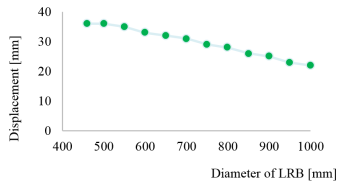
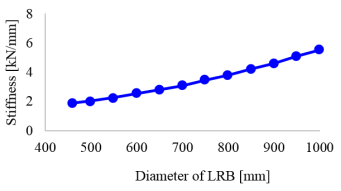
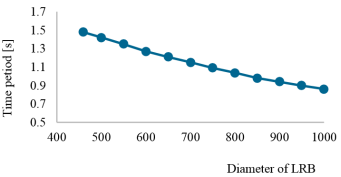
Through a lot of trial & error processes, finally LRB with 460mm diameter and 125 mm of total rubber thickness has been chosen. The following graphs represent the change in stiffness, time period and displacement of LRB with change in diameter (Figure 7-9).
Figure 7. Displacement variation with change in diameter.
Figure 8. Stiffness variation with change in diameter.
Figure 9. Time period variation with change in diameter.
From above graphs, it has been observed that increment of diameter causes increment of effective stiffness as well as decrement of Design displacement for the same structure and time period. As the purpose of base isolation was to lengthen the time period, diameter cannot be increased here.
If diameter is reduced even up to 400 mm, the max vertical load criteria at max displacement will not be satisfied.
The total thickness of rubber cannot be increased due to limitation in available height in structure.
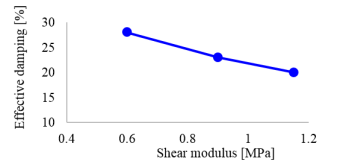
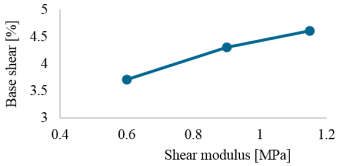
If shear modulus of rubber is increased without changing all other parameters, design base shear percentage will increase as at the same displacement, elastomer will require more force to recenter for higher shear modulus value and will result in larger base shear (Figure 10, 11). Again, the other purpose of base isolation is also to reduce horizontal force which will be transferred to structure during earthquake\. So, shear modulus which was considered for this structure was rightly chosen.
Figure 10. Damping variation with change in shear modulus.
Figure 11. Base shear variation with change in shear modulus.
Figure 12. Period shifting with change in time period of the structure.
Finally, the purpose of using LRBs as base isolation system has been achieved. Acceleration response was reduced by period shifting.
Natural period of structure= (0.075 x 240.75) =0.81s [Ref. Cl. NO. 7.6 of IS 1893: 2002]
Lengthened period of structure = 1.48s. at DBE.
Lengthened period of structure = 1.51s. at MCE.
Total horizontal force at both DBE and MCE level was significantly reduced by using LRBs. Max horizontal force transferred to structure is 7% of total seismic weight of the building.
Actual Horizontal force without using LRBs,
(g x Spectral acceleration ratio x TD)/ (damping factor x 4π2) = 4264 kN [as per soil and site specification based on UBC 1997-vol-2]
7. Testing of Lrbs
Testing was done for both Prototype and production bearings. The following tests were conducted at Sismalab, Italy (prototype) and mageba factory at Howrah (Production control). Testing was done according to Project specification, UBC 1997-vol 2 and EN 15129.
1) Raw material Test
2) Compression stiffness
3) Combined compression-shear
4) Shear performance test with ramp loading
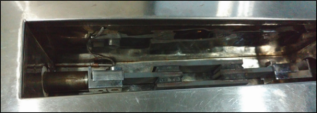
Quad Core Test: 3 quad core samples were tested at various temperatures from 0°C to 40°C and various shear strains ranging from 2% to 300%. Sample was prepared as per ASTM D4014 standard. Dynamic shear modulus and damping were measured for 3rd Cycle.
Figure 13. Quad core testing machine.
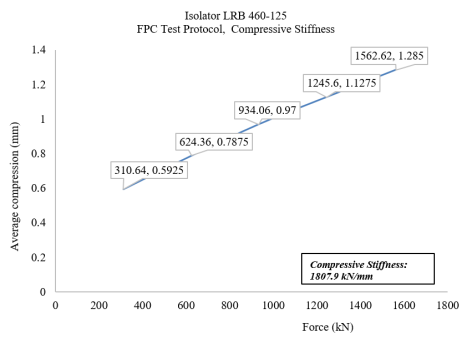
Compression Test: Compression test was done with a max compressive stress of 14 MPa maintaining for a period of 10 min and 1 hr. Compression stiffness was measured with each load increment of 2 MPa.
Figure 14. Compressive stiffness test for full scale LRB.
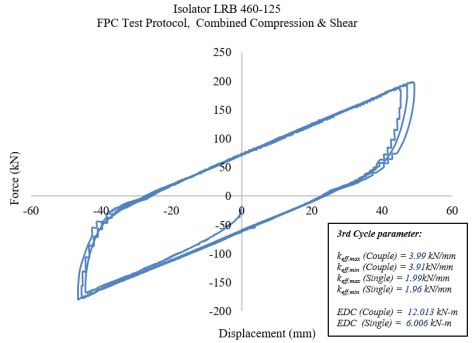
Combined compression and shear test: Combined compression-shear test was done with a vertical load of 8.55 MPa and a displacement up to design displacement (3 cycles).
Figure 15. Force-Displacement Plot of LRB (Prototype).
For isolators, combined compression-shear test was carried out with a max load of 11.6 MPa and a displacement of Max displacement as per project specification.
The horizontal characteristics were measured and plotted for each test of compression-shear for each bearing. The value of effective stiffness and damping for each bearings was within the range of ±20% of average value which was the criteria as per UBC-1997-vol 2 and project specification.
Isolator was working fine and there was no sign of failure even after extreme displacement tested for 3 cycles for both sinusoidal input and Ramp loading.
The above hysteresis loop area clearly shows and proves the performance of the isolators with respect to damping value. It achieved 25-28% damping at 45mm displacement (DBE) which clearly matches the target values in the design.
8. Comparison Between Analytical and Experimental Results
The comparison has been made on two primary properties; effective stiffness and effective damping at DBE displacement (dbd) as per both analytical and theoretical results. These two major properties will have significant contributions in calculation of base shear using LRBs.
Table 4. Comparison between analytical and experimental results.

Property

Analytical value

Experimental value

Difference

Allowable difference as per standard

Effective stiffness, Keff

1.87 kN/mm

1.96 kN/mm

5%

20%

Effective damping, ξbd

28%

25%

10%

20%

The difference between analytical and experimental is well within the limit, hence the LRB system proposed as base isolators are validated to achieve the desired reduced base shear in seismic.
9. Conclusion
The structural design presented confirms base isolation as effective seismic disaster mitigation technique in enhancing the performance of residential apartment building, and that its use reduces total construction cost by reduction of structural acceleration response in case of earthquake. By providing an alternative to conventional earthquake resistance design measures, it saves the major strengthening works which would otherwise be required, if the benefits of energy dissipation and damping were not incorporated in the design. The application of Base isolation system as Seismic protection technique significantly reduces seismic risk without compromising structural safety, reliability and economy. Above all, the effectiveness of use of LRB as isolation system has been proved satisfactorily. Further investigation can be executed for full scale testing of building model along with isolators using real time earthquake ground acceleration.
Abbreviations

DL

Dead Load

LL

Live Load

EQMCE

Earthquake Load at MCE

P1

Avg. Loads Under Gravity Condition

P2

Max. Loads Under Gravity Condition

P3

Max. Loads Under Seismic Conditions

P4

Min. Loads Under Seismic Conditions

P5

Avg. Loads Under Seismic Conditions

DD

Design Displacement at DBE

DM

Max Displacement at MCE

DTM

Total Max Displacement at MCE

TD

Time Period at DBE

TM

Time Period at MCE

DD

Design Displacement at DBE

F

Total Horizontal Force of Isolators

F1

Horizontal Force of Individual Isolators

Kn

Effective Stiffness of Individual Isolators

Keff

Equivalent Stiffness of All Isolators

Qd

Yield Force of Lead Core

fy

Yield Force of Isolator

Hy

Force on Elastomer for a Displacement up to Yield Point

Hd

Force on Elastomer at DBE Displacement

Hm

Force on Elastomer at MCE Displacement

Vbd

Seismic Shear Force at Dd

VEd

Seismic Shear Force at Dm

ζbd

Effective Damping at Dd

EDC

Energy Dissipated per Cycle

Acknowledgments
I would like to take this opportunity to express my deepest gratitude to our reverent Professor Dr. Debasish Bandyopadhyay, for his resourceful guidance, active supervision, continued support and constant encouragement to help me bring this paper to its present shape. I would also like to take this opportunity to thank all my colleagues and seniors in office and university who encourage me continuously for studies and research.
Author Contributions
Agamoni Das: Conceptualization, Data curation, Formal Analysis, Investigation, Methodology, Resources, Software, Validation, Visualization, Writing – original draft, Writing – review & editing
Debasish Bandyopadhyay: Conceptualization, Resources, Visualization, Writing – review & editing
Data Availability Statement
The data is available from the corresponding author upon reasonable request.
Conflicts of Interest
The authors declare no conflicts of interest.
References
[1] Mendez Galindo C, Majumdar S, Das A (2015), “Advances in elastomeric isolators”, Journal of Structural Engineering, 141(8): 04015008, Pages 1-15.
[2] Mahdi G, Sayed Behzad T (2020),” On the effect of seismic base isolation on seismic design requirements of RC structures”, Engineering Structures, 215: 110657, Pages 1-10,
[3] Afraa Labiba H, AHM Muntasir B (2020), “Influence of ground motion duration and isolation bearings on the seismic response of base-isolated bridges”, Journal of Vibration and Control, 26(13-14): 772-787, Pages 772-787.
[4] Donato C, Fabio De A (2016), “Assessment and dynamic nonlinear analysis of different base isolation systems for a multi-storey RC building irregular in plan”, Soil Dynamics and Earthquake Engineering, 87: 177-191, Pages 177-191.
[5] Yi H, Siu-Seong L, Weidong Z, Qi W (2020), “Internal resonance of structure with hysteretic base-isolation and its application for seismic mitigation”, Soil Dynamics and Earthquake Engineering, 137: 106288, Pages 1-15.
[6] Bilal LK, Muhammad A, Muhammad U, Syed HF, Asad H, Muhammad F (2019), “Effect of near and far Field Earthquakes on the performance of various base isolation systems”, Engineering Structures, 182: 616-629, Pages 616-629.
[7] Jara JM, Hernández EJ, Olmos BA (2020), “Effect of epicentral distance on the applicability of base isolation and energy dissipation systems to improve seismic behavior of RC buildings”, Bulletin of Earthquake Engineering, 18(12): 5501-5520, Pages 5501-5520.
[8] Chunwei Z, Amir A (2021), “The advancement of seismic isolation and energy dissipation mechanisms based on friction”, Engineering Structures, 228: 111366, Pages 1-12.
[9] Yan-Shing L, Ricky WK C, Hiroshi (2020), “Earthquake early warning-enabled smart base isolation system”, Engineering Structures, 204: 109864, Pages 1-10.
[10] Das A, Dr Bandyopadhyay D (2023), “Force-displacement trade off of RCC building located at various seismic zones and site condition adopting time history analysis”, Journal of Structural Engineering and Management, 2023; 10(1).
[11] Das A, Dr Bandyopadhyay D, A (2024), “parametric study of base shear- deformation for isolated structures using lead rubber bearings”, Journal of Transportation System Engineering and Information Technology, 2024; 12(3).
[12] Das, A., & Bandyopadhyay, D. (2025), Study on seismic base shear and deformation of regular and irregular buildings using different properties of fluid viscous dampers. Structures, 76.
[13] Sahoo, D. N. & Parhi, P. K. (2018), “Base isolation of residential building using lead rubber bearing technique”, International Journal of Engineering Research and Technology, 7(5), 125–131.
[14] Ozer Esra, & Inel Mehmet. (2025). “The effect of single and combined use of base isolator and fluid viscous damper on seismic performance in a conventional RC building with torsional irregularity”, Journal of Building Engineering, 101.
[15] Nguyen, X. D.; Guizani, L. (2021), “Analytical and numerical investigation of natural rubber bearings incorporating U-shaped dampers behaviour for seismic isolation”, Engineering Structures, 243.
Cite This Article
  • APA Style

    Das, A., Bandyopadhyay, D. (2026). Study on Implementation and Effectiveness of Base Isolation System Using Lead Rubber Bearing in a Residential Building at Bharuch, India. Journal of Civil, Construction and Environmental Engineering, 11(3), 93-104. https://doi.org/10.11648/j.jccee.20261103.14

    Copy | Download

    ACS Style

    Das, A.; Bandyopadhyay, D. Study on Implementation and Effectiveness of Base Isolation System Using Lead Rubber Bearing in a Residential Building at Bharuch, India. J. Civ. Constr. Environ. Eng. 2026, 11(3), 93-104. doi: 10.11648/j.jccee.20261103.14

    Copy | Download

    AMA Style

    Das A, Bandyopadhyay D. Study on Implementation and Effectiveness of Base Isolation System Using Lead Rubber Bearing in a Residential Building at Bharuch, India. J Civ Constr Environ Eng. 2026;11(3):93-104. doi: 10.11648/j.jccee.20261103.14

    Copy | Download

  • @article{10.11648/j.jccee.20261103.14,
      author = {Agamoni Das and Debasish Bandyopadhyay},
      title = {Study on Implementation and Effectiveness of Base Isolation System Using Lead Rubber Bearing in a Residential Building at Bharuch, India},
      journal = {Journal of Civil, Construction and Environmental Engineering},
      volume = {11},
      number = {3},
      pages = {93-104},
      doi = {10.11648/j.jccee.20261103.14},
      url = {https://doi.org/10.11648/j.jccee.20261103.14},
      eprint = {https://article.sciencepublishinggroup.com/pdf/10.11648.j.jccee.20261103.14},
      abstract = {The research presented herein investigates the ability of an adaptive seismic isolation system to protect the structure built in Bharuch, Gujarat, India subjected to earthquake ground motion. As Seismic hazards remain a challenge to engineers, to reduce loss of life and damage to property due to earthquake, Seismic Isolation technique has been adopted which causes reduction in earthquake forces by lengthening period of vibration of the structure. Seismic isolation for the structure was done using Lead Rubber Bearings (LRB) with four basic requirements, i.e. effective stiffness, damping, acceleration response and shear. This technical paper discusses performance evaluation of the Elastomeric isolators (LRB), based on tests carried out both on rubber compound and full-scale devices to simulate and evaluate actual performance of Isolators. The building is of 4-storeyed residential apartment was base isolated using LRBs. This study discusses the theoretical method or numerical analysis in ETABS for selection of dimension of LRB as well as the laboratory tests to verify the properties. The isolator system performs three functions: horizontal flexibility, energy dissipation and rigidity against normal lateral loads. The important isolator property; effective stiffness, damping, displacements were evaluated as per both theoretical and experimental investigations. Several trials have been conducted with respect to selection of dimensions, rubber hardness, shear modulus which is suitable to match the target design base shear and displacement of structure during design basis and maximum credible earthquake. Finally the selected LRB was found suitable to achieve the targeted base shear and displacement as per both numerical analysis and experimental investigation.},
     year = {2026}
    }
    

    Copy | Download

  • TY  - JOUR
    T1  - Study on Implementation and Effectiveness of Base Isolation System Using Lead Rubber Bearing in a Residential Building at Bharuch, India
    AU  - Agamoni Das
    AU  - Debasish Bandyopadhyay
    Y1  - 2026/06/18
    PY  - 2026
    N1  - https://doi.org/10.11648/j.jccee.20261103.14
    DO  - 10.11648/j.jccee.20261103.14
    T2  - Journal of Civil, Construction and Environmental Engineering
    JF  - Journal of Civil, Construction and Environmental Engineering
    JO  - Journal of Civil, Construction and Environmental Engineering
    SP  - 93
    EP  - 104
    PB  - Science Publishing Group
    SN  - 2637-3890
    UR  - https://doi.org/10.11648/j.jccee.20261103.14
    AB  - The research presented herein investigates the ability of an adaptive seismic isolation system to protect the structure built in Bharuch, Gujarat, India subjected to earthquake ground motion. As Seismic hazards remain a challenge to engineers, to reduce loss of life and damage to property due to earthquake, Seismic Isolation technique has been adopted which causes reduction in earthquake forces by lengthening period of vibration of the structure. Seismic isolation for the structure was done using Lead Rubber Bearings (LRB) with four basic requirements, i.e. effective stiffness, damping, acceleration response and shear. This technical paper discusses performance evaluation of the Elastomeric isolators (LRB), based on tests carried out both on rubber compound and full-scale devices to simulate and evaluate actual performance of Isolators. The building is of 4-storeyed residential apartment was base isolated using LRBs. This study discusses the theoretical method or numerical analysis in ETABS for selection of dimension of LRB as well as the laboratory tests to verify the properties. The isolator system performs three functions: horizontal flexibility, energy dissipation and rigidity against normal lateral loads. The important isolator property; effective stiffness, damping, displacements were evaluated as per both theoretical and experimental investigations. Several trials have been conducted with respect to selection of dimensions, rubber hardness, shear modulus which is suitable to match the target design base shear and displacement of structure during design basis and maximum credible earthquake. Finally the selected LRB was found suitable to achieve the targeted base shear and displacement as per both numerical analysis and experimental investigation.
    VL  - 11
    IS  - 3
    ER  - 

    Copy | Download

Author Information
  • Department of Construction Engineering, Jadavpur University, Kolkata, India

    Biography: Agamoni Das is a PhD scholar at Jadavpur University. She has 10+ years’ experience in industry with seismic mitigation topics including isolation and damping system. She is currently working in Hilti Group as Head-Codes & Approvals (Fastening). In her role, she leads the development and management of codes and approvals of products and solutions for structural designers and engineering teams, ensuring that Hilti’s solutions are grounded in both cutting-edge research and practical application. She authors and co-authors several peer-reviewed publications on seismic disaster mitigation using isolation and damping systems.

    Research Fields: Seismic Base isolation, Damping systems, Earthquake engineering, Optimum isolation design, Retrofitting and Strengthening of structures

  • Department of Construction Engineering, Jadavpur University, Kolkata, India

    Biography: Debasish Bandyopadhyay is a senior faculty member in the Department of Construction Engineering at Jadavpur University, India, specializing in Structural Engineering, Structural Health Monitoring, Earthquake Engineering, and Disaster Mitigation. He completed his Ph.D. in 2009 from IIT Kharagpur, following an M. Tech. in Structural Engineering and a B. E. in Civil Engineering. His academic and research work focuses on condition assessment, repair and retrofitting of structures, seismic‑resistant design, and non‑destructive testing. Before joining academia, he served as an Executive Engineer at the Damodar Valley Corporation, contributing to major thermal power and bridge construction projects.

    Research Fields: Earthquake engineering, Disaster Mitigation, Advanced materials and practices in structural design, Designing and retrofitting buildings to withstand seismic activities, Structural Engineering & Health Monitoring