Research Article | | Peer-Reviewed

Investigation of the Effect of Labour Productivity Factors on Schedule Overruns in Building Construction Projects: Case Study in Uganda

Received: 12 June 2026     Accepted: 3 July 2026     Published: 24 July 2026
Views:       Downloads:
Abstract

Productivity in the building construction industry in Uganda significantly contributes to economic development and the creation of employment opportunities for individuals. However, building construction projects in the country persistently face challenges of schedule overruns, delays and, in some cases, incompletion and abandonment. These challenges are largely attributed to labour productivity factors, which are dynamic and difficult to predict. There is, therefore, need for a better understanding of the major factors contributing to these challenges, in order to facilitate improvements in project schedules. The purpose of this study was to investigate the labour productivity factors that contribute to project schedule overruns and their effects on the completion of construction projects across cities in four regions of Uganda. The research employed a quantitative approach to collect data from 262 randomly selected respondents. The study concentrated on two categories of labour productivity factors that contribute to project schedule overruns. These were: technological and management labour productivity related factors. Data analysis was conducted using SPSS and R-studio. The study assessed significant factors contributing to project schedule overruns using relative importance index (RII), while their effect on schedule was examined through correlation and regression analysis. Findings revealed that the most significant factors contributing to schedule overruns were technological (RII= 0.770), followed by management with (RII =0.769) labour productivity factors. Correlation results indicated a very strong positive relationship between project schedule and labour productivity factors, technological related (r =+0.939) and management related (r = + 0.947). Regression model results indicate that adjusted= 0.87, further confirmed that these technological and management labour productivity factors were statistically significant contributors of project schedule overruns. It is recommended that contractors and construction professionals prioritize the identified significant factors and strengthen management practices through implementation of productivity monitoring and reward of hardworking workers in order to meet project time lines.

Published in Journal of Civil, Construction and Environmental Engineering (Volume 11, Issue 4)
DOI 10.11648/j.jccee.20261104.15
Page(s) 203-213
Creative Commons

This is an Open Access article, distributed under the terms of the Creative Commons Attribution 4.0 International License (http://creativecommons.org/licenses/by/4.0/), which permits unrestricted use, distribution and reproduction in any medium or format, provided the original work is properly cited.

Copyright

Copyright © The Author(s), 2026. Published by Science Publishing Group

Keywords

Labour, Productivity, Factors, Project, Schedule, Overruns, Technological, Management, Building, Construction

1. Introduction
The construction industry plays a significant role in the economic development of any country. In Uganda, the construction industry is of paramount importance as it creates employment opportunities for individuals and generates revenue for the government, thereby supporting economic growth. However, the industry in Uganda has been facing a challenge of low levels of project completion, despite the high demand for building and housing services from the public. This demand is reflected in an annual population growth rate of 2.9 percent . Given the growing population, there is a need to improve building methods and labour skills to ensure that construction projects are completed on schedule. This will enable the industry to effectively meet the rising demand for housing services.
Schedule Overruns
Project schedule overrun is a global concern, particularly in developing countries. It is a situation in which the contractual completion date for a construction project is extended . Similarly, Yusuf , refer to it as the lapse of time between the agreed-upon completion date and the actual date of project completion. Meanwhile, Zadeh et al. , characterize it as the period during which any part of a construction project extends beyond the scheduled completion date, subsequently affecting overall project completion. A study by Albtoush et al. , conducted a survey on 130 public projects in Jordan and found that project schedule overruns occurred in 106 projects (82 percent). Similarly, Muhwezi et al. , conducted a survey on 23 running public construction projects in Kampala, Uganda and found that 92 percent were behind schedule. Moreover, reports, from BMAU and BMAU , reveal that 80 percent of building construction projects in Uganda have been affected by time delays, a trend attributed to various labour productivity factors.
2. LP Factors that Influence Project Schedule Overrun
Alinaitwe et al. , revealed that labour productivity factors are a primary driver of project schedule overruns in building construction projects. Momade et al. , referred to labour productivity as the units of work produced per man-hour, further indicating that productivity is the measurement of how an individual utilizes available resources to produce outputs from given inputs. Thus, construction productivity depends on workforce effort and individual performance.
Over several years, a considerable number of studies have investigated the labour productivity factors that contribute to project schedule overruns in the construction industry. These factors are never constant and are difficult to predict, resulting in a continuous decline in project schedules. Such overruns lead to significant financial losses.
Scholars have advanced a range of specific factors and broader categories of causes that collectively drive these delays and subsequently result in low building project completion in developing countries. The available literature indicates categorization of the various labour productivity group factors in up to ten (10) categories. These are manpower, technological, supervision, material, leadership, external, project, management, motivation and work condition related factors . This study however, re-categorized these factors into five (5) broad categories: technological, managerial, contractual, psychophysical and worksite condition. Of these, the study focused on technological and management labour productivity factors as they were identified as the most significant contributors to project schedule overruns.
2.1. Technological Labour Productivity (LP) Related Factors
Various studies have consistently highlighted that technological LP related factors are significant contributors to project schedule overruns. Studies by Soham and Rajiv , from India and Agu et al. , from Nigeria, for instance, assert that the inability of contractors’ teams to understand drawing details, which is attributed to lack of technical expertise; the lack of attention to drawing details; inconsistency in final drawings; and individual levels of education greatly affect project schedules. According to Mahamid , from Saudi Arabia indicates that technological skills are the main cause of rework. This is attributed to factors such as competence of supervisor(s), non-compliance with specifications, frequent change orders, and material shortage. These subsequently lead to a decline in labour productivity and ultimately result in project schedule overruns. Studies by Soham and Rajiv and Gurgun et al. , identified technological factors, particularly the inappropriate use of modern construction methods, as the main contributor to project construction schedule overrun. This issue is attributed to high initial investment costs, lack of skilled labour, insufficient awareness among the construction team and lack regulatory framework, all of which lead to low productivity, subsequently contributing to schedule overruns in the construction projects. However, most evidence on technological LP factors and schedule overruns comes from non-Ugandan countries. Therefore, a research gap exists in understanding which specific technological LP factors are the most critical in contributing to project schedule overruns in Uganda.
2.2. Management Labour Productivity (LP) Related Factors
The available literature indicates that management LP related factors significantly contribute to project schedule overruns. In particular, the slow progress of building construction projects and inappropriate use of building materials are critical factors that affect the completion of projects on schedule. A number of studies have been conducted on key variables in order to assess their relative contribution to schedule overruns. Negesa , in a study from Ethiopia, identified the delayed delivery of materials to site; the availability of the consultant team on the project site; and the availability of equipment and tools as the main contributors within this category. Studies by Alaghbari et al. , in Malaysia and Khursheed et al. , in India observed that the level of technical skills and experience among contractors’ teams; deficiencies in contract documents; insufficient instructions provided to contractors; and the skills of supervisors on the project site are critical contributing factors to the slow progress of construction projects. According to Faremi et al. , in Nigeria and Khursheed , argued that quality control of materials, non-compliance with material specifications, the client’s financial status, material availability and the integrity of the contractor’s team are major factors that contribute to the inappropriate use of building materials on the construction project, ultimately resulting in schedule delays. Although studies have repeatedly shown that management LP factors, such as poor supervision, ineffective communication and inadequate planning, significantly contribute to project schedule overruns, limited research has been conducted to validate these findings within the construction industry in Uganda.
2.3. Objectives of the Study
The main objective of the study was to investigate labour productivity factors that contribute to project schedule overruns in building construction projects across four regional cities in Uganda.
The study was guided by the following specific objectives:
1) To determine the influence of technological labour productivity factors on project schedule overruns.
2) To determine the effect of management labour productivity factors on project.
schedule overruns in the building construction industry in Uganda.
Research Hypotheses
1) Ho: Technological labour productivity factors do not significantly influence project schedule overruns in the building construction industry.
2) Ha: Technological labour productivity factors significantly influence project schedule overruns in the building construction industry.
3) Ho: Management labour productivity factors do not significantly influence project schedule overruns in the building construction industry.
4) Ha: Management labour productivity factors significantly influence project schedule overruns in the building construction industry.
3. Methodologies
3.1. Research Approach and Design
A cross-sectional study design employing a quantative approach was used. Data was collected through questionnaires focused on ongoing building construction projects managed by local construction firms.
3.2. Study Population and Sample
These firms are registered with the Uganda National Association of Builders, Suppliers and Engineering Contractors (UNABSEC) and categorized from A-1 to A-5 in descending order, based on their annual financial contractual capacity. A list of local construction firms, along with contractors’ contact details, was obtained from UNABSEC. This allowed the identification of five categories of local firms under UNABSEC. Category A-1 comprised of 28 firms, A-2 had 15 firms, A-3 had 16 firms, whereas A-4 had 90 firms and the last category, A-5, consisted of 59 local firms, bringing the total to 208. Of these, 7.7 percent were located in northern Uganda (Gulu city); 81 percent in the central region (Kampala metropolitan); 8.3 percent in the western region (Mbarara city); and 3 percent in the eastern region (Mbale city). In order to limit researcher bias and increase equal participation opportunities, the researcher contacted contractors within each category to identify ongoing building construction projects. A total of 284 active projects were identified, as shown in the Table 1. The study population from each ongoing project included a construction manager, architect, site engineer, health and safety manager, quantity surveyor and general foreman. This resulted in a population of 1,704 individuals (284 projects x6 participants per project). The Krejcie and Morgan (1970) sample size estimation table was used to determine a sample of 324 respondents from a targeted population of 1,704.
Table 1. Study population.

UNABSEC local companies’ categorization

No. of companies

Running projects

Population sample (running proj.x 6 no. of respondents per project)

Sample size (using Stratified sampling)

No. project sampled

Sampling criteria

A-1

28

48

288

54

9

Stratified & Simple random sampling

A-2

15

26

156

30

5

A-3

16

26

156

30

5

A-4

90

110

660

126

21

A-5

59

74

444

84

14

Total

208

284

1704

324

54

3.3. Study Location
The study was carried out in four regional cities of Uganda. The choice of these locations was triggered by two factors. First, these cities host a high number of construction projects undertaken by local construction companies for both government and private developers. Secondly, construction projects run by local construction companies, particularly in these cities, frequently face challenges of project schedule overruns and abandonment .
3.4. Sample Selection Criterion
Simple random sampling was used to select the number of local construction companies with ongoing projects, as this technique helps generalize findings and reduce bias . Stratified sampling was then used to draw respondents from different strata of local construction companies grouped as A-1 to A-5.
3.5. Pilot of the Tools for Validity and Reliability
A pilot study of the research instrument, the questionnaire, was conducted using a small sample of respondents drawn from the target population who never participated in the main survey. The purpose was to assess the clarity and relevance of the questions. To establish content validity, the content validity index (CVI) was calculated by dividing the number of questionnaire items declared valid by the experts by the total number of items on the questionnaire. An overall CVI of 0.88 was obtained, which exceeded the recommended threshold of 0.70 . To ensure reliability of the instrument, Cronbach’s Alpha coefficient was computed using SPSS to assess the internal consistency of responses across items. The instrument achieved an overall internal consistency reliability coefficient of 0.872 which was above the acceptable threshold of 0.7 .
3.6. Data Management and Analysis
The effect of labour productivity factors on project schedule in building construction projects were established through the following steps:
A literature review was conducted on labour productivity factors affecting the schedule of building construction projects. The following LP factors were identified: technological, and management group factors. These factors were validated prior to data collection through questionnaires administered to various experts in the study area. Appropriate modifications were made based on their feedback. Thereafter, the questionnaire, constructed on a five-point Likert scale, was administered to respondents. The respondents were requested to assess each labour productivity factor according to its degree of importance in causing project schedule delays, using the following scale: 5-strongly agree, 4-agree, 3-neutral, 2-disagree and 1-strongly disagree. Additionally, the impact of Labour Productivity factors on project schedule was assessed using a separate questionnaire scale: 5- has very severe impact on schedule, 4-severe impact, 3-moderate impact, 2-minor impact and 1-insignificant impact.
3.7. Data Analysis
All collected data were analyzed using SPSS. The relative importance index (RII) and weighted mean score (Mean) of each factor were determined using equation 1&2, after which factors were ranked. To validate these findings, correlation coefficients were employed to test the strength of the relationship between project schedule and labour productivity factors. Finally, regression analysis focusing on significant factors was conducted using R-studio software to evaluate the effect of LP group factors on project schedule.
RII = WA*N(0≤ RII ≤ 1) (1)
Where:
W is the sum of weights given to each factor by the respondents and ranges from 1 to 5, (where 1 is strongly disagree and 5 is strongly agree);
is the highest weight (in this case 5) and;
N-is the total number of respondents.
Weighted mean score (Mean) =WN(1≤ M ≤ 5)(2)
Where:
W is the sum of weights given to each factor by the respondents and ranges from 1 to 5,
(where 1 is strongly disagree and 5 is strongly agree) and;
N- is the total number of respondents.
4. Results and Discussion
4.1. Respondents Demographic
The study presented several demographic characteristics of the respondents, including response rate, level of education, professional designation and years of experience in construction industry. A total of 324 questionnaires were distributed and 262 respondents participated, yielding a response rate of 81 percent. A response rate above 70 percent is considered statistically acceptable, as it indicates low nonresponse bias and strengthens the generalizability of the sample to the target population .
4.2. Level of Education
Figure 1 presents the respondents’ level of education, which reflects cognitive skills. It was analyzed to determine the extent to which education affects productivity by reducing rework and minimizing delays, subsequently improving the schedule of building construction projects.
Figure 1. Respondents’ level of Education.
The study findings indicated that all the respondents had attained a significant level of education, with the exception of 2 percent who possessed no formal qualifications. This distribution suggests that the project site personnel were generally qualified to provide reliable information regarding the labour productivity factors that contribute to project schedule overruns. These findings are in line with a study by Al-mamlook et al. , which argues that the lack of trained and skilled workers may significantly affect project schedules through rework.
4.3. Respondents’ Designation
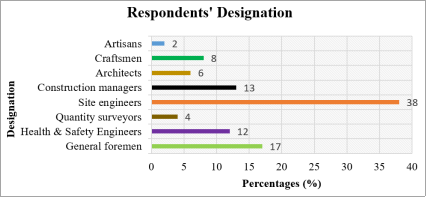
Figure 2 presents the designation held by respondents, which determines their exposure to various labour productivity factors that contribute to project schedule overruns in the building construction industry.
Figure 2. Respondents’ Designation.
The findings indicate that the majority held critical positions on the project sites hence they were able to comprehend and offer informed opinions on the factors that influence project schedule overruns in the construction projects in the regional cities of Uganda.
4.4. Respondents’ Work Experience
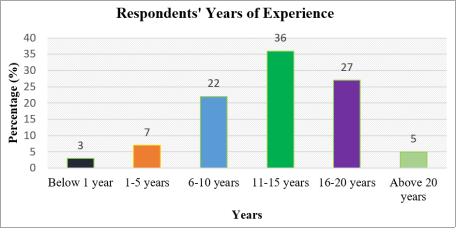
Figure 3 presents findings on respondents’ years of experience in the construction industry. Respondents with more years of experience possess a longitudinal understanding of labour productivity factors, enabling them to better identify the factors that most threaten project schedules.
Figure 3. Respondents’ years of experience in construction industry.
Findings indicate that the majority of respondents (36%, representing 95 individuals) had between 11 and 15 years of experience, followed closely by 71 respondents (27%) who had 16 to 20 years of experience. This suggests that most respondents possessed a sufficient level of industry exposure, which likely enhanced their understanding of the factors affecting project schedules in the building construction industry.
4.5. Ranking of LP Factors Contributing to Schedule Overruns
The results are presented in Table 2. Factors with a relative importance index (RII) above the overall average RII of 0.776 and a weighted mean score above 3.879 were considered significant and having the most influence on project schedule overruns. Those falling below these thresholds were deemed less significant.
As shown in Table 2, the technological factor (RII = 0.779, Mean =3.892) emerged as the most significant. This was attributed to the inability of contractors’ teams to understand drawing details. This was caused by poor drawing detail presentation and a lack of drawing interpretation skills. Additional contributing factors included rework and inappropriate use of modern construction methods. These factors are driven by poor coordination among the project team; the use of materials of inappropriate quality; lack of skilled labour and training; high initial investment cost; and limited government support. These findings are in line with Jagtap and Tidke , in India who argued that clarity of drawings and reworks are among the most critical factors influencing project schedules in India. However, they differ from findings by Van Tam et al. , in Malaysia, which indicate that the inappropriate use of modern construction methods are occasioned by high initial investment cost, lack of skilled labour and training was considered a less-significant factor and ranked number six in contributing to schedule overrun. This discrepancy can be explained by the fact that Ugandan construction teams are at a different stage of technological, economic and skills development than in Malaysia. Additionally, in Uganda construction is labour-intensive, characterized by skilled and unskilled labourers with limited exposure to formal technical education. Malaysia, on the other hand, has established vocational training infrastructure and their construction professionals are better prepared to adopt and effectively utilize modern construction techniques.
Management factor (RII =0.778, Mean = 3.887) was ranked as the second most significant factor that influences project schedules. It was mainly attributed to slow construction project progress as a result of untimely delivery of materials to site, the unavailability of materials on site and the absence of consultant teams at the project sites. An additional contributing factor was the inappropriate use of building materials, triggered by poor quality control and noncompliance to material specifications. These findings are consistent with Sha et al. , in Nepali, who concluded that the management factor significantly contributes to slow construction project progress, which subsequently leads to extensions in project duration. Similarly, a study by Faremi et al. , in Nigeria argues that non-compliance to material specifications and the lack of integrity of contractors’ teams were the leading cause of inappropriate use of building materials, which resulted in rework and ultimately schedule delays.
Table 2. LP related factors that cause project schedule overruns.

Labour Productivity Factors

Mean

RII

RANK

Technological factor

3.892

0.779

Contractor's team to understand construction project drawing details factors

3.952

0.791

Drawing detail presentation

4.138

0.828

1

Drawing interpretation skills

4.059

0.812

2

Drawings coordination among construction team members

4.036

0.808

3

Technical expertise

3.820

0.765

4

Quality of drawings on construction project

3.707

0.742

5

Reworks free on building construction projects factors

3.906

0.782

Coordination among the project team

4.093

0.819

1

Quality of material

4.036

0.808

2

Inconsistencies in drawings design

3.831

0.767

3

Approaches in workmanship

3.819

0.765

4

Communication system among the construction team

3.751

0.751

5

Inappropriate use of modern construction method factors

3.818

0.764

Lack of skilled labour and training

3.922

0.785

1

High initial investment cost

3.899

0.780

2

Limited government support

3.786

0.758

3

Resistance to change and traditional mindset

3.773

0.755

4

Lack of awareness

3.710

0.742

5

Management factor

3.887

0.778

Normal progress of building construction projects factors

3.890

0.779

Timely delivery of materials to site

3.977

0.795

1

Availability of materials on site

3.965

0.793

2

Availability of consultant team on the project site

3.909

0.782

3

Equipment and tools availability on project site

3.818

0.769

4

Technical skills and experience of a contractor’s team

3.781

0.756

5

Appropriate use of building materials on construction projects

3.884

0.777

Quality control of materials

4.023

0.805

1

Compliance to materials specification

3.875

0.776

2

Effective material management

3.853

0.772

3

Integrity of contractor’s team

3.851

0.768

4

Supervision of materials delivered at site

3.818

0.764

5

Total Average

3.879

0.776

4.6. Relationships Between LP Factors and Project Schedule Overruns
Correlation analysis quantifies the direction and strength of association between the variables, whereas regression analysis measures each labour productivity factor’s contribution to project schedule variance, revealing how a change in a specific factor would impact the schedule variance.
4.6.1. Correlation Analysis
The results presented in Table 3 reveal a linear relationship and a strong positive correlation between labour productivity factors and project schedule, all of which are statistically significant with P-values = 0.00. Based on the correlation coefficient analysis, management LP factor with (r= +0.947) and technological LP factor with (r=+0.939) indicate that, there is a strong positive relationship with project schedule performance. These findings align with studies by Jagtap and Tidke and Rauzana and Dharma , in Indonesia, which highlighted that labour productivity factors, particularly technological and management related factors, are the main drivers of project schedule overruns in the building construction industry.
Table 3. LP factors Rank correlation coefficient and project schedule.

Labour productivity Factors

Correlation coefficient(r)

P-values

Technological

0.939

.000

Management

0.947

.000

4.6.2. Regression Analysis
Regression analysis was conducted to determine the effect of labour productivity factors on schedule performance in building construction projects. The significant factors were considered in the analysis and a multiple linear regression analysis was performed in R-studio. Project schedule (PS) was treated as dependent variable, whereas technological and management labour productivity factors are independent variables.
Table 4. Summary of regression model coefficients for project schedule.

Coefficients

Estimate

Std. Error

t-value

Pr (>|t|)

(Intercept)

0.27857

0.10413

2.675

0.00957**

Technological

1.19639

0.18291

6.541

1.42e-08***

Management

0.42162

0.14073

2.996

0.00395 **

Significant codes

0 ‘***’ 0.001 ‘**’ 0.01 ‘*’ 0.05 ‘.’ 0.1 ‘’ 1

Residual standard error: 0.181 on 61 degrees of freedom

Multiple R-squared: 0.8763

Adjusted R-squared: 0.8720

F-statistics: 341.1 on 5 and 61 df, p-value: 2.2e-16

F- value critical: 2.3688 on 5 and 61 df

t-value critical: 1.9995

Equation of the multiple regression analysis for the project schedule (PS) from Table 4 is given by,
PS = 0.27857 + 1.19639 TS + 0.42162 MS (3)
Where:
PS = Project schedule
TS = Technological labour productivity factors
MS = Management labour productivity factors
Model coefficients indicated that the technological LP factor had a greater influence on the project schedule than management LP factors. The model’s adjusted R2 value was 0.872, which indicates that the variation of 87 percent is attributed to these labour productivity factors included in the model. This demonstrates strong model generalizability and only 13 percent of the total variation remains unexplained. Therefore, the model would serve as a good predictor of project schedule performance in building construction projects.
(i). Model Verification
The model was verified using both the F-statistic and p-value approach. As shown in Table 4, the observed F- statistic value of 341.10 exceeded the critical F- statistic value of 2.368 obtained from F-distribution Table 5, which indicates that the model explains a substantial amount of variation in the dependent variable relative to error. This finding is supported by the associated p-value of 2.2e-16. Combining the large F-statistic (341.10) with the small p-value (less than 0.05), it was concluded that the regression model is statistically significant at the 95% confidence level. This implies a significant relationship between labour productivity factors (Technological and management) and project schedule in the building construction projects in Uganda. This finding a aligns with the studies by Soham and Rajiv and Van Tam et al. , who argued that labour productivity factors should be prioritized by construction practitioners to improve schedule performance and complete projects as pre-planned.
Table 5. F-Distribution .

CRITICAL VALUES FOR THE F-DISTRIBUTION WITH =0.05

Denominator df2

1

2

3

4

5

6

7

1

161.447

199.500

215.707

224.583

230.161

233.986

236.768

2

18.512

19.000

19.164

19.246

19.296

19.329

19.353

3

10.128

9.552

9.276

9.117

9.013

8.94

8.886

30

4.170

3.315

2.922

2.689

2.533

2.420

2.334

40

4.084

3.231

2.838

2.608

2.449

2.335

2.249

60

4.001

3.150

2.758

2.525

2.368

2.254

2.166

120

3.920

3.071

2.680

2.447

2.289

2.175

2.086

(ii). Model Validity
Regression model was validated using a data-split approach. The dataset was randomly divided, with 75 percent allocated for training and the remaining data for validation. To assess predictive fit, the study utilized R squared value, comparing the adjusted R-squared from both the training and validation datasets. The adjusted R-squared was 0.8720 for the training model and 0.8536 for the validation model. The closeness of these values supports the model validity. Palmer and Connell and Arkes , note that no strict rule exists for interpreting R squared closeness. Kleinbaum et al. and Warner , suggest that a difference of less than 10 percent between training and validation R-squared indicates a stable model with close agreement and thereby confirming model validation. Regression model is shown in equation (3).
5. Conclusions and Recommendations
The main objective of this investigation was to examine the effect of labour productivity factors on project schedule in the building construction industry in Uganda. The relative importance index (RII) was computed for each factor and the resulting values were ranked to identify those with the greatest significance. Technological LP factors emerged as the most influential, ranked first, followed by management factors which were also found to have significant effect on project schedule overruns. These findings are supported by correlation coefficient analysis for each factor, which revealed that technological and management LP factors had a very strong positive correlation with project schedule overruns.
Additionally, the regression analysis considered only the significant factors, from which a multiple linear regression was developed. Results established that technological and management LP factors had a statistically significant impact on project schedule overruns. The effect of these factors is reflected in the adjusted R-squared value of 0.872, which indicates that 87 percent of the variation in the project schedule model is attributed to labour productivity factors. The study concluded that there is a significant relationship between project schedule and labour productivity factors in the building construction industry in Uganda.
The study recommended that construction practitioners prioritize technological factors by investing in modern construction tools and equipment, as well as software for scheduling and tracking the progress of construction projects. They should also invest in regular training programs that address technological and management competence to mitigate labour productivity bottlenecks and reduce project schedule overruns.
Abbreviations

LP

Labour productivity

UNABSEC

Uganda National Association of Builders Suppliers and Engineering Contractors

Author Contributions
Nathan Natukunda: Conceptualization, Data curation, Formal Analysis, Funding acquisition, Investigation, Visualization, Writing – original draft, Writing – review & editing
Bernadette Sabuni: Supervision, Validation
Samuel Waweru: Methodology, Software
Basil lro Ong’or: Project administration, Resources
Conflicts of Interest
The authors declare no conflicts of interest.
References
[1] Agu, N. N., & Ibe, B. O. (2016). Assessment of Factors Causing Delay on Building Construction Projects in Enugu, Nigeria. International Journal of Innovative Science, Engineering & Technology, 3(6), 544–558.
[2] Albtoush, A. F., Doh, S. I., Rahman, R. A., & Al-Momani, A. H. (2022). Critical success factors of construction projects in Jordan: An empirical investigation. Asian Journal of Civil Engineering, 23(7), 1087-1099.
[3] Al-mamlook, R., Bzizi, M., Al-kbisbeh, M., Ali, T., & Almajiri, E. (2020). Factors Affecting Labor Productivity in the Construction Industry Factors Affecting Labor Productivity in the Construction Industry. American Journal of Environmental Science and Engineering, 4(2), 24-30.
[4] Alaghbari, W., Kadir, M. R. A., Salim, A., & Ernawati. (2007). The significant factors causing delay of building construction projects in Malaysia. Engineering, Construction and Architectural Management, 14(2), 192–206.
[5] Alinaitwe, H. M., Mwakali, J. A., & Hansson, B. (2007). Factors affecting the productivity of building craftsmen-studies of Uganda. Journal of Civil Engineering and Management, 13(3), 169-176.
[6] Amin, M. E. (2005). Social Science Research: Conception, Methodology and Analysis. Makerere University Press, Kampala.
[7] Arkes, J. (2026). Regression Analysis; A Practical Introduction; Third Edition (3rd ed.). Routledge, Taylor and Francis.
[8] Bamwesigye, R., Nnadi, Ezekiel, O., & Mogaka, D. (2025). Investigating the dynamics of delays in public building projects in Uganda. Journal of Science, Engineering and Technology, 4(1), 20–27.
[9] BMAU. (2013). Budget Monitoring and Accountability Unit (BMAU) Ministry of Finance, Planning and Economic Development briefing paper (7/13) Fy2011/12, Uganda.
[10] BMAU. (2021). Budget Monitoring and Accountability Unit (BMAU) Ministry of Finance, Planning and Economic Development briefing paper (7/13) Fy2019/2020, Uganda.
[11] Chattamvelli, R., & Shanmugam, R. (2022). F Distribution. In Continuous Distributions in Engineering and the Applied Sciences–Part II. Cham: Springer International Publishing., 227–234.
[12] Creswell, J. W., & Creswell, D. J. (2018). Research Design; Qualitative, Quantitative and Mixed Methods Approaches (5th ed.). SAGE publications Ltd.
[13] Dubey, U. K. B., & Kothari, D. P. (2022). Research methodology: Techniques and Trends (1st ed.). Chapman and Hall/CRC Press.
[14] Enshassi, A., Mohamed, S., Mustafa, Z. A., & Mayer, P. E. (2007). Factors affecting labour productivity in building projects in the Gaza strip. Journal of Civil Engineering and Management, 13(4), 245–254.
[15] Faremi, O. J., Ajayi, O. O., & Faremi, O. E. (2020). Factors influencing the use of substandard materials in the construction of residential buildings. CSID Journal of Infrastructure Development, 3(1), 40–50.
[16] Gurgun, A. P., Koc, K., & Kunkcu, H. (2024). Exploring the adoption of technology against delays in construction projects. Engineering, Construction and Architectural Management, 31(3), 1222–1253.
[17] Jagtap, D., & Tidke, A. (2019). Factors affecting labour productivity in building construction. JETIR, 6(3), 162–166.
[18] Khursheed, S., Sharma, S., Paul, V. K., Alzubaidi, L. H., & Israilova, D. (2024). Review of the Factors Inducing Delay in Construction Project Material Management. ICESTE, 02044.
[19] Kleinbaum, D. G., Kupper, L. L., Muller, K. E., & Nizam, A. (2008). Applied Regression Analysis and Other Multivariable Methods (4th ed.). Cole Publishing Company.
[20] Kothari, C. R. (2014). Research Methodology: Methods and Techniques (3rd ed.). New Delhi: New Age International (P) Limited.
[21] Larsen, J. K., Shen, G. Q., Lindhard, S. M., & Brunoe, T. D. (2016). Factors Affecting Schedule Delays, Cost Overrun, and Quality Level in Public Construction Projects. Journal of Management in Engineering, 32(1), 04015032.
[22] Mahamid, I. (2020). Study of relationship between rework and labor productivity in Building Construction Projects : Revista de la construccion, 19(1), 30–40.
[23] Momade, M. H., Shahid, S., Rosli, M., Nashwan, M. S.,& Umar, A. T. (2020). Modelling labour productivity using SVM and RF: a comparative study on classifiers performance. International Journal of Construction Management, 22(10), 1924-1934.
[24] Muhwezi, L., Acai, J., & Otim, G. (2014). An Assessment of the Faactors Causing Delays on Building Construction projects in Uganda. International Journal of Construction Engineering and Management, 3(1), 13-23.
[25] Negesa, A. B. (2022). Assessing the Causes of Time Overrun in Building and Road Construction Projects : The Case of Addis Ababa City, Ethiopia. Journal of Engineering, 22(1), 1–14.
[26] Palmer, P., & Connell, D. O. (2009). Regression Analysis for Prediction : Understanding the Process. Journal of Cardiopulmonary Physical Therapy, 20(3), 21–26.
[27] Rauzana, A., & Dharma, W. (2022). Causes of delays in construction projects in the Province of Aceh, Indonesia. 17(1).
[28] Sha, M. K., Shahi, P. B., Pandit, R., & Pandey, A. (2017). Causes and Effects of Delays in Constrution Projets. IOSR Journal of Mechanical and Civil Engineering, 14(02), 52–58.
[29] Soham, M., & Rajiv, B. (2013). Critical FactorsAffecting Labour Productivity InConstruction Projects : Case Study Of South Gujarat Region Of India. International Journal of Engineering and Advanced Technology, 2(4), 583–591.
[30] Taherdoost, H. (2016). Sampling Methods in Research Methodology; How to Choose a Sampling Technique for Research. SSRN Electronic Journal, 5(2).
[31] UBOS. (2022). Uganda bureau of statistics 2022, Statistical Abstract.
[32] Van Tam, N., Quoc Toaan, N., Tuan Hai, D., & Le Dinh, N. (2021). Critical factors affecting construction labor productivity: A comparison between perceptions of project managers and contractors. Cogent Business & Management, 8(1), 1–17.
[33] Warner, R. M. (2020). Applied statistics II: Multivariable and multivariate techniques. Sage Publications.
[34] Yusuf, A. O. (2016). Relationship between time overrun and completion cost of construction projects in Lagos state, Nigeria. Dissertation submitted to the department of Quantity Surveying, Obafemi Awolowo University, Ile-Ife, Nigeria.
[35] Zadeh, M. T., & Kashef, R. (2022). The impact of IT projects complexity on cost overruns and schedule delays. pp. 1-6.
Cite This Article
  • APA Style

    Natukunda, N., Sabuni, B., Waweru, S., Ong’or, B. L. (2026). Investigation of the Effect of Labour Productivity Factors on Schedule Overruns in Building Construction Projects: Case Study in Uganda. Journal of Civil, Construction and Environmental Engineering, 11(4), 203-213. https://doi.org/10.11648/j.jccee.20261104.15

    Copy | Download

    ACS Style

    Natukunda, N.; Sabuni, B.; Waweru, S.; Ong’or, B. L. Investigation of the Effect of Labour Productivity Factors on Schedule Overruns in Building Construction Projects: Case Study in Uganda. J. Civ. Constr. Environ. Eng. 2026, 11(4), 203-213. doi: 10.11648/j.jccee.20261104.15

    Copy | Download

    AMA Style

    Natukunda N, Sabuni B, Waweru S, Ong’or BL. Investigation of the Effect of Labour Productivity Factors on Schedule Overruns in Building Construction Projects: Case Study in Uganda. J Civ Constr Environ Eng. 2026;11(4):203-213. doi: 10.11648/j.jccee.20261104.15

    Copy | Download

  • @article{10.11648/j.jccee.20261104.15,
      author = {Nathan Natukunda and Bernadette Sabuni and Samuel Waweru and Basil lro Ong’or},
      title = {Investigation of the Effect of Labour Productivity Factors on Schedule Overruns in Building Construction Projects: Case Study in Uganda},
      journal = {Journal of Civil, Construction and Environmental Engineering},
      volume = {11},
      number = {4},
      pages = {203-213},
      doi = {10.11648/j.jccee.20261104.15},
      url = {https://doi.org/10.11648/j.jccee.20261104.15},
      eprint = {https://article.sciencepublishinggroup.com/pdf/10.11648.j.jccee.20261104.15},
      abstract = {Productivity in the building construction industry in Uganda significantly contributes to economic development and the creation of employment opportunities for individuals. However, building construction projects in the country persistently face challenges of schedule overruns, delays and, in some cases, incompletion and abandonment. These challenges are largely attributed to labour productivity factors, which are dynamic and difficult to predict. There is, therefore, need for a better understanding of the major factors contributing to these challenges, in order to facilitate improvements in project schedules. The purpose of this study was to investigate the labour productivity factors that contribute to project schedule overruns and their effects on the completion of construction projects across cities in four regions of Uganda. The research employed a quantitative approach to collect data from 262 randomly selected respondents. The study concentrated on two categories of labour productivity factors that contribute to project schedule overruns. These were: technological and management labour productivity related factors. Data analysis was conducted using SPSS and R-studio. The study assessed significant factors contributing to project schedule overruns using relative importance index (RII), while their effect on schedule was examined through correlation and regression analysis. Findings revealed that the most significant factors contributing to schedule overruns were technological (RII= 0.770), followed by management with (RII =0.769) labour productivity factors. Correlation results indicated a very strong positive relationship between project schedule and labour productivity factors, technological related (r =+0.939) and management related (r = + 0.947). Regression model results indicate that adjusted= 0.87, further confirmed that these technological and management labour productivity factors were statistically significant contributors of project schedule overruns. It is recommended that contractors and construction professionals prioritize the identified significant factors and strengthen management practices through implementation of productivity monitoring and reward of hardworking workers in order to meet project time lines.},
     year = {2026}
    }
    

    Copy | Download

  • TY  - JOUR
    T1  - Investigation of the Effect of Labour Productivity Factors on Schedule Overruns in Building Construction Projects: Case Study in Uganda
    AU  - Nathan Natukunda
    AU  - Bernadette Sabuni
    AU  - Samuel Waweru
    AU  - Basil lro Ong’or
    Y1  - 2026/07/24
    PY  - 2026
    N1  - https://doi.org/10.11648/j.jccee.20261104.15
    DO  - 10.11648/j.jccee.20261104.15
    T2  - Journal of Civil, Construction and Environmental Engineering
    JF  - Journal of Civil, Construction and Environmental Engineering
    JO  - Journal of Civil, Construction and Environmental Engineering
    SP  - 203
    EP  - 213
    PB  - Science Publishing Group
    SN  - 2637-3890
    UR  - https://doi.org/10.11648/j.jccee.20261104.15
    AB  - Productivity in the building construction industry in Uganda significantly contributes to economic development and the creation of employment opportunities for individuals. However, building construction projects in the country persistently face challenges of schedule overruns, delays and, in some cases, incompletion and abandonment. These challenges are largely attributed to labour productivity factors, which are dynamic and difficult to predict. There is, therefore, need for a better understanding of the major factors contributing to these challenges, in order to facilitate improvements in project schedules. The purpose of this study was to investigate the labour productivity factors that contribute to project schedule overruns and their effects on the completion of construction projects across cities in four regions of Uganda. The research employed a quantitative approach to collect data from 262 randomly selected respondents. The study concentrated on two categories of labour productivity factors that contribute to project schedule overruns. These were: technological and management labour productivity related factors. Data analysis was conducted using SPSS and R-studio. The study assessed significant factors contributing to project schedule overruns using relative importance index (RII), while their effect on schedule was examined through correlation and regression analysis. Findings revealed that the most significant factors contributing to schedule overruns were technological (RII= 0.770), followed by management with (RII =0.769) labour productivity factors. Correlation results indicated a very strong positive relationship between project schedule and labour productivity factors, technological related (r =+0.939) and management related (r = + 0.947). Regression model results indicate that adjusted= 0.87, further confirmed that these technological and management labour productivity factors were statistically significant contributors of project schedule overruns. It is recommended that contractors and construction professionals prioritize the identified significant factors and strengthen management practices through implementation of productivity monitoring and reward of hardworking workers in order to meet project time lines.
    VL  - 11
    IS  - 4
    ER  - 

    Copy | Download

Author Information
  • Abstract
  • Keywords
  • Document Sections

    1. 1. Introduction
    2. 2. LP Factors that Influence Project Schedule Overrun
    3. 3. Methodologies
    4. 4. Results and Discussion
    5. 5. Conclusions and Recommendations
    Show Full Outline
  • Abbreviations
  • Author Contributions
  • Conflicts of Interest
  • References
  • Cite This Article
  • Author Information