
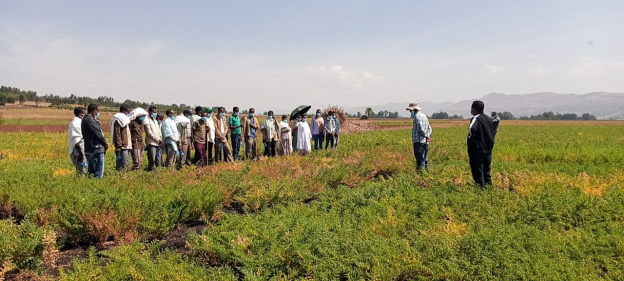
Chickpea variety selection is crucial for improving productivity, adaptability, and overall sustainability. Participatory varietal evaluation is used to identify farmer-preferred varieties that are high-yielding, resilient, and suited to local conditions and accelerate the adoption of improved varieties by involving end-users (farmers) early in the breeding pipeline. This experiment aimed to evaluate the performance of improved chickpea varieties for seed and seed-related traits. Seven released chickpea varieties, along with one local check for kabuli and desi types in two sets, were tested using a Randomized Complete Block Design with three replications. The mother trial with all three replications was carried out at the Farmers Training Center (FTC). The baby trial, on the other hand, was conducted on farmers’ fields. A farmer’s field was considered a replication. ANOVA results showed significant differences (p<0.05) among the tested varieties. Of the tested varieties, Natoli (38 qt ha-1) from the desi type and Shasho (18.8 qt ha-1) were superior in seed yield across the testing districts. The local variety had a lower yield than the kabuli type. Farmers evaluated and ranked the performance of chickpea varieties based on their selection criteria. Disease resistance, number of seeds pod-1 Number of pods plant-1, disease resistance, and Branch were the major farmers’ selection criteria. Based on these selection criteria, varieties Teketay, Girar, and Natoli were highly preferred by farmers from the desi type, and varieties Hora, Shasho, and Koka were highly preferred by farmers from the kabuli type. Based on farmers’ evaluation and selection criteria and biological data, Natoli and Shasho varieties were recommended to the midland areas of the West and North Gojam Zones. Therefore, these varieties are recommended for further popularization and scaling up in the study area and similar agroecologies.
| Published in | Journal of Plant Sciences (Volume 14, Issue 6) |
| DOI | 10.11648/j.jps.20261406.11 |
| Page(s) | 182-188 |
| Creative Commons |
This is an Open Access article, distributed under the terms of the Creative Commons Attribution 4.0 International License (http://creativecommons.org/licenses/by/4.0/), which permits unrestricted use, distribution and reproduction in any medium or format, provided the original work is properly cited. |
| Copyright |
Copyright © The Author(s), 2026. Published by Science Publishing Group |
Baby Trial, Mother Trial, Prticipatory Varietal Evaluation
Location | Latitude (N) | Longitude (E) | Altitude (m) | Soil type | Average To | annual RF |
|---|---|---|---|---|---|---|
Denbecha | 10°33′N | 37°29′E | 2083 | vertisols | 19.68°C | 1006 mm |
No | Desi type | Kabuli type | ||||||||||
|---|---|---|---|---|---|---|---|---|---|---|---|---|
Variety | PH | PPP | SPP | HSW (gm) | SY (qt ha-1) | Type | PH | PPP | SPP | HSW (gm) | SY (qt ha-1) | |
1 | Dalota | 41.6 | 30.7 | 1.1 | 20.1 | 10.6 | Akaki | 33.7 | 17.0 | 1.0 | 30.1 | 3.3 |
2 | Dimtu | 41.3 | 23.4 | 1.1 | 24.4 | 13.0 | Arerti | 42.8 | 29.8 | 1.2 | 31.0 | 17.4 |
3 | Eshetie | 34.2 | 30.4 | 1.3 | 17.3 | 10.1 | Dhera | 0.0 | 0.0 | 0.0 | 0.0 | |
4 | Geletu | 39.5 | 25.7 | 1.0 | 28.5 | 9.9 | Ejeri | 41.5 | 33.5 | 1.4 | 27.9 | 12.5 |
5 | Girare | 35.1 | 31.8 | 1.0 | 25.9 | 13.0 | Hora | 34.4 | 14.2 | 1.0 | 29.8 | 17.4 |
6 | Local | 32.2 | 18.6 | 1.2 | 18.3 | 2.1 | Koka | 33.3 | 16.7 | 1.0 | 35.1 | 4.2 |
7 | Natoli | 40.9 | 43.7 | 1.1 | 29.3 | 38.0 | Local | 41.2 | 35.9 | 1.3 | 27.6 | 3.1 |
8 | Teketay | 41.3 | 33.6 | 1.1 | 25.5 | 14.2 | Shasho | 37.1 | 22.5 | 1.3 | 27.3 | 18.8 |
Mean | 38.3 | 29.7 | 1.1 | 4.2 | 23.7 | mean | 37.7 | 24.2 | 1.2 | 29.8 | 10.9 | |
Criteria | No of seeds | Pod per plant | Disease resistance | No of branches | Total | rank |
|---|---|---|---|---|---|---|
No of seeds | No of seeds | Disease resistance | No of seeds | 2 | 2 | |
Pod per plant | Disease resistance | Pod per plant | 1 | 3 | ||
Disease resistance | Disease resistance | 3 | 1 | |||
No of branches | 0 | 4 |
Variety | Preference value (Sum of Scores X Weight) | Total preference value | Rank | |||
|---|---|---|---|---|---|---|
Number of seeds 2 | Pod per plant 3 | Disease resistance 1 | Branch 4 | |||
Natoli | 48 | 75 | 16 | 64 | 203 | 5 |
Eshetie | 64 | 96 | 25 | 80 | 265 | 8 |
Dimtu | 26 | 42 | 12 | 52 | 132 | 3 |
Geletu | 30 | 36 | 28 | 88 | 182 | 4 |
Dalota | 42 | 57 | 18 | 120 | 237 | 7 |
Girare | 16 | 27 | 17 | 60 | 120 | 2 |
Teketay | 14 | 21 | 9 | 24 | 68 | 1 |
Local | 48 | 78 | 19 | 88 | 233 | 6 |
Variety | Preference value (Sum of Scores X Weight) | Total preference value | Rank | |||
|---|---|---|---|---|---|---|
Number of seeds 2 | Pod per plant 3 | Disease Resistance 1 | Branch 4 | |||
Dhera | 40 | 48 | 22 | 88 | 196 | 4 |
Koka | 30 | 42 | 12 | 64 | 148 | 3 |
Hora | 10 | 24 | 8 | 36 | 78 | 1 |
Akaki | 34 | 54 | 32 | 96 | 216 | 5 |
Shasho | 14 | 45 | 4 | 32 | 95 | 2 |
Arerti | 60 | 84 | 19 | 60 | 223 | 6 |
Ejeri | 50 | 63 | 27 | 96 | 236 | 7 |
Local | 42 | 81 | 22 | 104 | 249 | 8 |
ANOVA | Analysis of Variance |
FTC | Farmer Training Center |
LSD | Least Significant Difference |
PVS | Participatory Variety Selection |
RCBD | Randomized Complete Block Design |
SAS | System Analysis Software |
| [1] | Woldeyohannes, A., Asfaw, A., & Abebe, T. 2023. Status and challenges of chickpea production in Ethiopia. Journal of Agricultural Research and Development, 43(1), 44–57. |
| [2] | Ayalew, M., Desta, T., & Bekele, A. 2024. The contribution of chickpea to soil fertility and household income in Ethiopia. Heliyon, 10(3), e15567. |
| [3] | Kumar, A., Sharma, R., & Meena, H. P. 2023. Climate resilience in chickpea: Advances in drought tolerance breeding. Environmental and Experimental Botany, 205, 105126. |
| [4] | Tadele, Y., Mengistu, B., & Degu, M. 2024. Genomic approaches in improving drought tolerance in legumes: A focus on chickpea. Frontiers in Plant Science, 15, 1529177. |
| [5] | Singh, S., Kaur, G., & Varshney, R. K. 2023. Root trait genetics in chickpea: Unlocking potential for drought resilience. Frontiers in Plant Science, 14, 1156606. |
| [6] | Alemu, B., & Tsegaye, D. 2024. Nutritional value and health benefits of chickpea: A review. International Journal of Food and Nutritional Sciences, 13(2), 115–123. |
| [7] |
ICRISAT. 2024. Chickpea yield in Ethiopia can be doubled by enhancing farmers' technical knowledge. ICRISAT Press room.
https://pressroom.icrisat.org/chickpea-yield-in-ethiopia-2024 |
| [8] | Gomez, K. A. and Gomez, A. A. 1984. Statistical Procedures for Agricultural Research. 2nd Edition, John Wiley and Sons, New York, 680 p. |
| [9] | SAS. 2013. System Analysis Software. Version 9.4, SAS Institute Inc., Cary, North. |
| [10] | Hartley H. O. 1950. The maximum F-ratio as a short-cut test for heterogeneity of variance. Biometrika, 37(3/4): 308–312. |
| [11] | Gebeyaw, M., Fikre, A., Abate, A., Alemu Setotaw, T., Bekele, N., Zeleke, B. and Gebremariam, T. (2024), Genotype by Environment (G × E) Interaction and Yield Stability of Chickpea (Cicer arietinum L.) Varieties across Agroecological Regions of Ethiopia. Legume Science, 6: e227. |
| [12] | Mohammed A, Sisay B, Abebe M, Abay D, Tadesse A. 2020. Evaluation of Desi Type Chickpea Varieties for Adapting under Irrigation at Kobo. Agrotechnology 9: 200. |
| [13] | Tadesse, M., Getahun, T., & Tefera, A. 2025. Participatory variety selection of chickpea (Cicer arietinum L.) for yield and disease resistance in northwestern Ethiopia. African Journal of Agricultural Research, 21(3), 241–253. |
| [14] | Yasin T. & Alamir A. 2023. Participatory Variety Selection for Released Kabuli Type Chickpea (Cicer arietinum L.) Varieties in South Gondar Zone, Ethiopia. American Journal of Applied Scientific Research, 9(2), 43-48. |
| [15] | Worku, B., & Mekonnen, H. 2026. Genotype-by-environment interaction and trait-preference modeling of pulse crops across the Amhara region. Ethiopian Journal of Agricultural Sciences, 36(1), 45–61. |
APA Style
Zeleke, B., Esimeal, J., Alem, C., Ahmed, S., Abebe, D. (2026). Performance Evaluation and Variety Selection for Enhanced Promotion of Improved Chick Pea (Cicer arietinum L.) Varieties in West Gojam. Journal of Plant Sciences, 14(6), 182-188. https://doi.org/10.11648/j.jps.20261406.11
ACS Style
Zeleke, B.; Esimeal, J.; Alem, C.; Ahmed, S.; Abebe, D. Performance Evaluation and Variety Selection for Enhanced Promotion of Improved Chick Pea (Cicer arietinum L.) Varieties in West Gojam. J. Plant Sci. 2026, 14(6), 182-188. doi: 10.11648/j.jps.20261406.11
@article{10.11648/j.jps.20261406.11,
  author = {Bantalem Zeleke and Jemale Esimeal and Cherinet Alem and Sied Ahmed and Dereje Abebe},
  title = {Performance Evaluation and Variety Selection for Enhanced Promotion of Improved Chick Pea (Cicer arietinum L.) Varieties in West Gojam},
  journal = {Journal of Plant Sciences},
  volume = {14},
  number = {6},
  pages = {182-188},
  doi = {10.11648/j.jps.20261406.11},
  url = {https://doi.org/10.11648/j.jps.20261406.11},
  eprint = {https://article.sciencepublishinggroup.com/pdf/10.11648.j.jps.20261406.11},
  abstract = {Chickpea variety selection is crucial for improving productivity, adaptability, and overall sustainability. Participatory varietal evaluation is used to identify farmer-preferred varieties that are high-yielding, resilient, and suited to local conditions and accelerate the adoption of improved varieties by involving end-users (farmers) early in the breeding pipeline. This experiment aimed to evaluate the performance of improved chickpea varieties for seed and seed-related traits. Seven released chickpea varieties, along with one local check for kabuli and desi types in two sets, were tested using a Randomized Complete Block Design with three replications. The mother trial with all three replications was carried out at the Farmers Training Center (FTC). The baby trial, on the other hand, was conducted on farmers’ fields. A farmer’s field was considered a replication. ANOVA results showed significant differences (p-1) from the desi type and Shasho (18.8 qt ha-1) were superior in seed yield across the testing districts. The local variety had a lower yield than the kabuli type. Farmers evaluated and ranked the performance of chickpea varieties based on their selection criteria. Disease resistance, number of seeds pod-1 Number of pods plant-1, disease resistance, and Branch were the major farmers’ selection criteria. Based on these selection criteria, varieties Teketay, Girar, and Natoli were highly preferred by farmers from the desi type, and varieties Hora, Shasho, and Koka were highly preferred by farmers from the kabuli type. Based on farmers’ evaluation and selection criteria and biological data, Natoli and Shasho varieties were recommended to the midland areas of the West and North Gojam Zones. Therefore, these varieties are recommended for further popularization and scaling up in the study area and similar agroecologies.},
 year = {2026}
}
TY  - JOUR
T1  - Performance Evaluation and Variety Selection for Enhanced Promotion of Improved Chick Pea (Cicer arietinum L.) Varieties in West Gojam
AU  - Bantalem Zeleke
AU  - Jemale Esimeal
AU  - Cherinet Alem
AU  - Sied Ahmed
AU  - Dereje Abebe
Y1  - 2026/11/24
PY  - 2026
N1  - https://doi.org/10.11648/j.jps.20261406.11
DO  - 10.11648/j.jps.20261406.11
T2  - Journal of Plant Sciences
JF  - Journal of Plant Sciences
JO  - Journal of Plant Sciences
SP  - 182
EP  - 188
PB  - Science Publishing Group
SN  - 2331-0731
UR  - https://doi.org/10.11648/j.jps.20261406.11
AB  - Chickpea variety selection is crucial for improving productivity, adaptability, and overall sustainability. Participatory varietal evaluation is used to identify farmer-preferred varieties that are high-yielding, resilient, and suited to local conditions and accelerate the adoption of improved varieties by involving end-users (farmers) early in the breeding pipeline. This experiment aimed to evaluate the performance of improved chickpea varieties for seed and seed-related traits. Seven released chickpea varieties, along with one local check for kabuli and desi types in two sets, were tested using a Randomized Complete Block Design with three replications. The mother trial with all three replications was carried out at the Farmers Training Center (FTC). The baby trial, on the other hand, was conducted on farmers’ fields. A farmer’s field was considered a replication. ANOVA results showed significant differences (p-1) from the desi type and Shasho (18.8 qt ha-1) were superior in seed yield across the testing districts. The local variety had a lower yield than the kabuli type. Farmers evaluated and ranked the performance of chickpea varieties based on their selection criteria. Disease resistance, number of seeds pod-1 Number of pods plant-1, disease resistance, and Branch were the major farmers’ selection criteria. Based on these selection criteria, varieties Teketay, Girar, and Natoli were highly preferred by farmers from the desi type, and varieties Hora, Shasho, and Koka were highly preferred by farmers from the kabuli type. Based on farmers’ evaluation and selection criteria and biological data, Natoli and Shasho varieties were recommended to the midland areas of the West and North Gojam Zones. Therefore, these varieties are recommended for further popularization and scaling up in the study area and similar agroecologies.
VL  - 14
IS  - 6
ER  -
Crop Department, Adet Agricultural Research Center, Bahir Dar, Ethiopia
ICARDA (International Center for Agricultural Research in the Dry Land Areas), Addis Ababa, Ethiopia

Information



 Share This Article
 Twitter
 Linked In
 Facebook

 Copy
 Download