
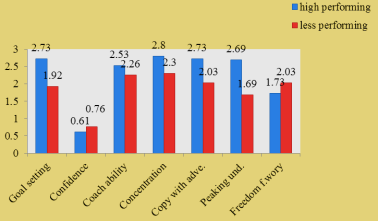
The present study examined the influence of selected psychological skills on competitive performance among male Ethiopian Premier League basketball players during the 2024–2025 season. The study investigated whether psycho-logical factors, including goal setting and mental preparation, confidence and achievement motivation, coachability, concentration, coping with adversity, peaking under pressure, and freedom from worry, were associated with team performance. A total of 105 male players from seven Ethiopian Premier League clubs participated in the study. Psy-chological skills were assessed using the Athletic Coping Skills Inventory-28 (ACSI-28), while team performance was determined according to the final league standings. The findings revealed that players from high-performing teams scored significantly higher in goal setting and mental preparation, concentration, coping with adversity, and peaking under pressure than players from low-performing teams. These results suggest that athletes who effectively plan, maintain focus, manage setbacks, and perform under competitive pressure are more likely to contribute to successful team performance. In contrast, confidence and achievement motivation, coachability, and freedom from worry did not differ significantly between high- and low-performing teams, indicating that these variables were not strong predictors of competitive success in this study. Overall, the findings highlight the importance of psychological preparedness in elite basketball and support the integration of psychological skills training into coaching programmes. Future research should include larger samples, mixed-method approaches, and broader competitive settings to further investigate the role of psychological skills in Ethiopian basketball.
| Published in | Psychology and Behavioral Sciences (Volume 15, Issue 4) |
| DOI | 10.11648/j.pbs.20261504.12 |
| Page(s) | 66-75 |
| Creative Commons |
This is an Open Access article, distributed under the terms of the Creative Commons Attribution 4.0 International License (http://creativecommons.org/licenses/by/4.0/), which permits unrestricted use, distribution and reproduction in any medium or format, provided the original work is properly cited. |
| Copyright |
Copyright © The Author(s), 2026. Published by Science Publishing Group |
Psychological Skills, Basketball Performance, Coping, Concentration, Ethiopia
Athletic Coping Skills Inventor -28 | Team log positions for the Ethiopian basketball premier league tournaments. | No | Mean | Std. Dev. | Group position team | |||
|---|---|---|---|---|---|---|---|---|
High-performing team (no 1) | Less-performing team (no 7) | |||||||
Me an | Std. Dev. | Me an | Std. Dev | |||||
Goal setting/ mental preparation | 1 Gambela Kenema | 15 | 2.63 | 0.60 | 2.29 | 0.67 | 1.91 | 0.78 |
2 Sheger City | 15 | 2.21 | 0.76 | |||||
3 Hawassa Kenema | 15 | 2.40 | 0.56 | |||||
4 Ethiopian Sport Academy | 15 | 1.90 | 0.74 | t- value = 4.00* p- value= 0.0003 | ||||
5 Wolkite Ketema | 15 | 1.92 | 0.68 | |||||
6 Wukro Kenema | 15 | 1.93 | 0.84 | |||||
7 Fasil Kenema | 15 | 1.89 | 0.78 | |||||
Confidence and achievement motivation | 1 Gambela Kenema | 15 | .71 | .49 | 0.86 | 0.76 | 0.57 | 0.53 |
2 Sheger City | 15 | 1.20 | .92 | |||||
3 Hawassa Kenema | 15 | .86 | .42 | |||||
4 Ethiopian Sport Academy | 15 | .76 | .90 | t-value= -1.00 p-value= 0.3286 | ||||
5 Wolkite Ketema | 15 | .23 | .50 | |||||
6 Wukro Kenema | 15 | .77 | .58 | |||||
7 Fasil Kenema | 15 | .75 | .52 | |||||
Coach ability | 1 Gambela Kenema | 15 | 2.63 | .58 | 2.67 | 0.53 | 2.36 | 0.64 |
2 Sheger City | 15 | 2.79 | .54 | |||||
3 Hawassa Kenema | 15 | 2.83 | .53 | |||||
4 Ethiopian Sport Academy | 15 | 2.83 | .45 | t-value = 1.59 p-value = 0.15 | ||||
5 Wolkite Ketema | 15 | 2.63 | .64 | |||||
6 Wukro Kenema | 15 | 2.26 | .72 | |||||
7 Fasil Kenema | 15 | 2.28 | .56 | |||||
Concentration | 1 Gambella Kenema | 15 | 2.80 | .40 | 2.65 | 0.63 | 2.47 | 0.71 |
2 Sheger City | 15 | 2.57 | .64 | |||||
3 Hawassa Kenema | 15 | 2.61 | .69 | |||||
4 Ethiopian Sport Academy | 15 | 2.61 | .75 | t-value = 2.90* p-value = 0.0054 | ||||
5 Wolkite Ketema | 15 | 2.5 | .58 | |||||
6 Wukiro Kenema | 15 | 2.30 | .78 | |||||
7 Fasil Kenema | 15 | 2.60 | .77 | |||||
Copy with adversity | 1 Gambela Kenema | 15 | 2.73 | .45 | 2.40 | 0.66 | 1.87 | 0.96 |
2 Sheger City | 15 | 2.5 | .70 | |||||
3 Hawassa Kenema | 15 | 2.57 | .57 | |||||
4 Ethiopian Sport Academy | 15 | 1.80 | .89 | |||||
5 Wolkite Ketema | 15 | 1.69 | 1.04 | t-value = 4.00* p-value = 0.0003 | ||||
6 Wukro Kenema | 15 | 2.03 | .77 | |||||
7 Fasil Kenema | 15 | 1.88 | .1.06 | |||||
Peaking under pressure | 1 Gambela Kenema | 15 | 2.69 | .54 | 2.24 | 0.56 | 1.61 | 0.83 |
2 Sheger City | 15 | 2.42 | .64 | |||||
3 Hawassa Kenema | 15 | 2.40 | .46 | t-value = 5.16* p-value = 0.0000 | ||||
4 Ethiopian Sport Academy | 15 | 1.46 | .58 | |||||
5 Wolkite Ketema | 15 | 1.65 | .84 | |||||
6 Wukro Kenema | 15 | 1.69 | .83 | |||||
7 Fasil Kenema | 15 | 1.48 | .82 | |||||
Freedom from worry | 1 Gambela Kenema | 15 | 1.83 | .82 | 1.97 | 0.83 | 2.05 | 0.92 |
2 Sheger City | 15 | 2.48 | .75 | |||||
3 Hawassa Kenema | 15 | 1.84 | .67 | t-value = -1.24 p-value = 0.18 | ||||
4 Ethiopian Sport Academy | 15 | 2.02 | .96 | |||||
5 Wolkite Ketema | 15 | 2.06 | 1.05 | |||||
6 Wukro Kenema | 15 | 2.04 | .80 | |||||
7 Fasil Kenema | 15 | 2.05 | .92 | |||||
Psychological Skill Subscale | Center (n = 14) Mean ± SD | Guard (n = 44) Mean ± SD | Forward (n = 47) Mean ± SD | F (2,102) | p-value | η2 |
|---|---|---|---|---|---|---|
Goal Setting & Mental Preparation | 0.75 ± 0.86 | 0.65 ± 0.76 | 0.71 ± 0.64 | 1.62 | .203 | .031 |
Confidence & Motivation | 0.75 ± 0.86 | 0.65 ± 0.76 | 0.71 ± 0.64 | 0.74 | .479 | .014 |
Concentration | 2.50 ± 0.67 | 2.50 ± 0.72 | 2.60 ± 0.63 | 0.58 | .562 | .011 |
Freedom from Worry | 1.80 ± 0.96 | 2.10 ± 0.94 | 2.00 ± 0.82 | 2.41 | .094 | .045 |
Coachability | 2.50 ± 0.67 | 2.60 ± 0.61 | 2.60 ± 0.57 | 1.09 | .341 | .021 |
Peaking under Pressure | 2.00 ± 0.72 | 2.10 ± 0.78 | 2.10 ± 0.86 | 0.29 | .751 | .006 |
Coping with Adversity | 2.17 ± 0.83 | 2.24 ± 0.82 | 2.19 ± 0.92 | 0.17 | .845 | .003 |
ACSI-28 | Athletic Coping Skills Inventory-28 ATG |
EBP | Ethiopian Basketball Premier League |
PST | Psychological Skills Training |
SMART | Specific, Measurable, Action-oriented, Realistic, Timely |
| [1] | S. MacGabhann, P. Newman, J. Witchalls, R. Dowse, G. Waddington, and S. Cobley, Why do Some Respond and Develop more from Coaching than Others? A Systematic Review of Coachability and Its Constituent Components, vol. 55, no. 9. Springer International Publishing, 2025. |
| [2] | Vernacchia, “Concentration and Attention in Sport What is concentration? Concentration and Attentional Control in Sport,” vol. 2, no. 1, p. 144, 2003, Available: |
| [3] | G. Teshome, A. Sahile, D. G. Walle, and T. Dessalegn, “Perceived ImpactInfluence of Leadership Styles on Team Cohesion: Evidence from Amhara’s National Football League,” Ethiop. J. Sport Sci., vol. 5, no. 1, pp. 181-195, 2024. |
| [4] | R. E. Smith, R. W. Schutz, F. L. Smoll, and J. T. Ptacek, “Development and Validation of a Multidimensional Measure of Sport-Specific Psychological Skills: The Athletic Coping Skills Inventory-28,” J. Sport Exerc. Psychol., vol. 17, no. 4, pp. 379-398, 1995, |
| [5] | V. Přidal and S. Priklerová, “Analysis of relation between team placing in tournament and selected indicators of playing performance in top-level volleyball,” J. Phys. Educ. Sport, vol. 18, no. 3, pp. 1501-1505, 2018, |
| [6] | J. Côté, S. Horton, D. J. MacDonald, and S. Wilkes, “The Benefits of Sampling Sports During Childhood,” Phys. Heal. Educ. J., vol. 74, no. January 2009, pp. 1-7, 2007. |
| [7] | D. Vella-Fondacaro and S. Romano-Smith, “The Impact of a Psychological Skills Training and Mindfulness-Based Intervention on the Mental Toughness, Competitive Anxiety, and Coping Skills of Futsal Players—A Longitudinal Convergent Mixed-Methods Design,” Sports, vol. 11, no. 9, 2023, |
| [8] | K. L. Crotts, “The Effects of Goal Setting on Sports Performance of Competitive Athletes: A Meta-Analytic Review,” 2025, [Online]. Available: |
| [9] | W. Liu, C. Zhou, L. Ji, and J. Watson, “The effect of goal setting difficulty on serving success in table tennis and the mediating mechanism of self-regulation,” J. Hum. Kinet., vol. 33, no. 1, pp. 173-185, 2012, |
| [10] | Weinberg and D. Gould, Foundations of Sport and Exercise Psychology Fifth Edition. 2011. |
| [11] | et al. Weinberg, “Goal setting in sport and exercise: Research and practical applications,” Rev. da Educ. Fis., vol. 24, no. 2, pp. 171-179, 2013, |
| [12] | S. G. Goddard, L. J. Reece, S. A. Vella, and C. Swann, “Goal setting in youth sport: are we unintentionally contributing to dropout?” Br. J. Sports Med., vol. 59, no. 19, pp. 1325-1327, 2025, |
| [13] | B. C. H. Huijgen, M. T. Elferink-Gemser, K. A. P. M. Lemmink, and C. Visscher, “Multidimensional performance characteristics in selected and deselected talented soccer players,” Eur. J. Sport Sci., vol. 14, no. 1, pp. 2-10, 2014, |
| [14] | O. Williamson et al., “The performance and psychological effects of goal setting in sport: A systematic review and meta-analysis,” Int. Rev. Sport Exerc. Psychol., vol. 17, no. 2, pp. 1050-1078, 2024, |
| [15] | J. Kostrna, “Effects of Time Constraints and Goal Setting on Basketball Shooting,” Front. Psychol., vol. 13, no. June, pp. 1-9, 2022, |
| [16] | W. Gould, Foundations of Sport and Exercise Psychology, Sixth Edit., vol. 32, no. 3. Human Kinetics, 2014. |
| [17] | S. Uludağ, F. Dorak, N. Vurgun, Y. Yüzbaşioğlu, and E. Ateş, “Effects of 10 weeks of imagery and concentration training on visual focus and free-throw performance in basketball players.,” J. Phys. Educ. Sport, vol. 21, no. 4, pp. 1761-1768, 2021, |
| [18] | F. A. Nanda and D. Dimyati, “The psychological skills of basketball athletes: Are there any differences based on the playing position?,” J. Keolahragaan, vol. 7, no. 1, pp. 74-82, 2019, |
| [19] | S. Kent, T. J. Devonport, A. M. Lane, W. Nicholls, and A. P. Friesen, “The effects of coping interventions on ability to perform under pressure,” J. Sport. Sci. Med., vol. 17, no. 1, pp. 40-55, 2018. |
APA Style
Habdollo, M. T., Narvaneni, V. M. (2026). The Influence of Psychological Skills on Competitive Performance Among Male Ethiopian Premier League Basketball Players. Psychology and Behavioral Sciences, 15(4), 66-75. https://doi.org/10.11648/j.pbs.20261504.12
ACS Style
Habdollo, M. T.; Narvaneni, V. M. The Influence of Psychological Skills on Competitive Performance Among Male Ethiopian Premier League Basketball Players. Psychol. Behav. Sci. 2026, 15(4), 66-75. doi: 10.11648/j.pbs.20261504.12
@article{10.11648/j.pbs.20261504.12,
  author = {Mulugeta Tagesse Habdollo and Vijay Mohan Narvaneni},
  title = {The Influence of Psychological Skills on Competitive Performance Among Male Ethiopian Premier League Basketball Players},
  journal = {Psychology and Behavioral Sciences},
  volume = {15},
  number = {4},
  pages = {66-75},
  doi = {10.11648/j.pbs.20261504.12},
  url = {https://doi.org/10.11648/j.pbs.20261504.12},
  eprint = {https://article.sciencepublishinggroup.com/pdf/10.11648.j.pbs.20261504.12},
  abstract = {The present study examined the influence of selected psychological skills on competitive performance among male Ethiopian Premier League basketball players during the 2024–2025 season. The study investigated whether psycho-logical factors, including goal setting and mental preparation, confidence and achievement motivation, coachability, concentration, coping with adversity, peaking under pressure, and freedom from worry, were associated with team performance. A total of 105 male players from seven Ethiopian Premier League clubs participated in the study. Psy-chological skills were assessed using the Athletic Coping Skills Inventory-28 (ACSI-28), while team performance was determined according to the final league standings. The findings revealed that players from high-performing teams scored significantly higher in goal setting and mental preparation, concentration, coping with adversity, and peaking under pressure than players from low-performing teams. These results suggest that athletes who effectively plan, maintain focus, manage setbacks, and perform under competitive pressure are more likely to contribute to successful team performance. In contrast, confidence and achievement motivation, coachability, and freedom from worry did not differ significantly between high- and low-performing teams, indicating that these variables were not strong predictors of competitive success in this study. Overall, the findings highlight the importance of psychological preparedness in elite basketball and support the integration of psychological skills training into coaching programmes. Future research should include larger samples, mixed-method approaches, and broader competitive settings to further investigate the role of psychological skills in Ethiopian basketball.},
 year = {2026}
}
TY  - JOUR
T1  - The Influence of Psychological Skills on Competitive Performance Among Male Ethiopian Premier League Basketball Players
AU  - Mulugeta Tagesse Habdollo
AU  - Vijay Mohan Narvaneni
Y1  - 2026/08/17
PY  - 2026
N1  - https://doi.org/10.11648/j.pbs.20261504.12
DO  - 10.11648/j.pbs.20261504.12
T2  - Psychology and Behavioral Sciences
JF  - Psychology and Behavioral Sciences
JO  - Psychology and Behavioral Sciences
SP  - 66
EP  - 75
PB  - Science Publishing Group
SN  - 2328-7845
UR  - https://doi.org/10.11648/j.pbs.20261504.12
AB  - The present study examined the influence of selected psychological skills on competitive performance among male Ethiopian Premier League basketball players during the 2024–2025 season. The study investigated whether psycho-logical factors, including goal setting and mental preparation, confidence and achievement motivation, coachability, concentration, coping with adversity, peaking under pressure, and freedom from worry, were associated with team performance. A total of 105 male players from seven Ethiopian Premier League clubs participated in the study. Psy-chological skills were assessed using the Athletic Coping Skills Inventory-28 (ACSI-28), while team performance was determined according to the final league standings. The findings revealed that players from high-performing teams scored significantly higher in goal setting and mental preparation, concentration, coping with adversity, and peaking under pressure than players from low-performing teams. These results suggest that athletes who effectively plan, maintain focus, manage setbacks, and perform under competitive pressure are more likely to contribute to successful team performance. In contrast, confidence and achievement motivation, coachability, and freedom from worry did not differ significantly between high- and low-performing teams, indicating that these variables were not strong predictors of competitive success in this study. Overall, the findings highlight the importance of psychological preparedness in elite basketball and support the integration of psychological skills training into coaching programmes. Future research should include larger samples, mixed-method approaches, and broader competitive settings to further investigate the role of psychological skills in Ethiopian basketball.
VL  - 15
IS  - 4
ER  -
Department of Physical Education & Sport Science, Andhra University, Visakhapatnam, India

Information



 Share This Article
 Twitter
 Linked In
 Facebook
 Copy
Copy Download