
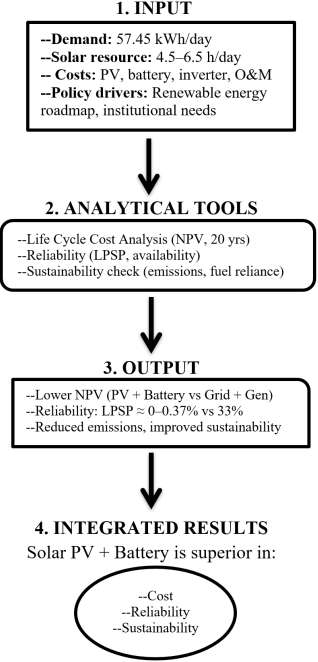
Energy unreliability and escalating operational costs continue to undermine the performance of institutional buildings in developing economies, particularly in Nigeria, where dependence on grid electricity and diesel generators remains widespread. Frequent power outages, rising fuel prices, and increasing maintenance costs negatively affect the quality of services, operational efficiency, and long-term sustainability of educational institutions. This study developed and applied a Life Cycle Improvement Framework (LCIM) to optimise renewable energy systems in institutional buildings by integrating Life Cycle Cost Analysis (LCCA), Loss of Power Supply Probability (LPSP), and sustainability assessment into a comprehensive decision-support framework. The student hostel at Auchi Polytechnic, Nigeria, was used as a case study. Empirical data were obtained through field energy audits, stakeholder surveys, and simulation-based performance modelling to evaluate and compare two energy configurations: Solar Photovoltaic (PV) + Battery and Grid + Diesel Generator over a 20-year life cycle. The findings reveal that the Solar PV + Battery system outperformed the conventional Grid + Diesel Generator configuration across economic, technical, and environmental indicators. Specifically, the renewable energy system achieved a life-cycle cost reduction of more than 35%, while maintaining a near-zero Loss of Power Supply Probability (0–0.37%), indicating a highly reliable electricity supply capable of meeting institutional energy demand. In addition, the environmental assessment demonstrated substantial reductions in greenhouse gas emissions, fossil fuel consumption, and overall environmental impact, contributing to improved sustainability performance. These results highlight the potential of renewable energy technologies to enhance energy security while reducing long-term operating costs in institutional buildings. The study concludes that the proposed LCIM is an effective and practical framework for evaluating and optimising renewable energy investments. It provides policymakers, institutional managers, and energy planners with a reliable tool for sustainable energy decision-making and supports the wider adoption of renewable energy systems for institutional infrastructure development in Nigeria and other developing countries facing similar energy challenges.
| Published in | Science Discovery Energy (Volume 1, Issue 2) |
| DOI | 10.11648/j.sdenergy.20260102.11 |
| Page(s) | 61-64 |
| Creative Commons |
This is an Open Access article, distributed under the terms of the Creative Commons Attribution 4.0 International License (http://creativecommons.org/licenses/by/4.0/), which permits unrestricted use, distribution and reproduction in any medium or format, provided the original work is properly cited. |
| Copyright |
Copyright © The Author(s), 2026. Published by Science Publishing Group |
Life Cycle Improvement Model (LCIM), Life Cycle Cost Analysis, LPSP, Renewable Energy Systems, Institutional Buildings, Energy Reliability, Sustainability
Parameter | Solar PV + Battery (Million) | Grid + Diesel (Million) |
|---|---|---|
Initial Capital | 15.68 | 5.00 |
Operation & Maintenance | 4.20 | 32.50 |
Replacement Costs | 16.46 | 24.38 |
Total NPV | 36.34 | 61.88 |
Metric | Value |
|---|---|
RMSE | 1.2 kWh/day |
MAPE | 9.1% |
LCIM | Life Cycle Improvement Model |
LPSP | Life Cycle Cost Analysis |
| [1] | Abass, T. and Popoola, S. (2025). Life-Cycle Cost Analysis of Utility-Scale Solar Power in Nigeria. ResearchGate. Available at: |
| [2] | Abdullahi, Y. and Kehinde, A. O. (2023). Drivers, Enablers, Barriers, and Technologies (DEBT) for Low-Energy Public Housing Delivery in Nigeria. Journal of Advanced Research in Applied Sciences and Engineering Technology, 29(3), 115–127. |
| [3] | Adaramola, M. S. (2015). Techno-economic analysis of an off-grid PV system in a Nigerian university. Renewable Energy 78, 913–922. |
| [4] | Adedeji, A. A. (2022). Sustainable Energy Systems in Nigerian Institutions. Energy Policy, 15(4), 102–118. |
| [5] | Akram, F. et al. (2023). Demand-side management of hybrid renewable energy systems. Applied Energy, 215, 54–62. |
| [6] | Akuru, N. U. and Okoro, O. O. (2023). Renewable Energy Integration in Sub-Saharan Africa: Challenges and Prospects. Renewable Energy Reviews, 10(3), 55–69. |
| [7] | Aliyu, A. S., Ramli, A. T. and Saleh, M. A. (2015). Nigeria’s electricity crisis: Power generation capacity expansion and environmental ramifications. Energy, 61, 354–367. |
| [8] | European Commission (2021). Energy Performance of Buildings Directive (EPBD): Towards a climate-neutral building stock. Energy and Buildings, 253, 111739. |
| [9] | Golobish, S., Yeganyan, R., Tan, N., Cannone, C., & Howells, M. (2025). The burden of the broken grid: Modelling power-sector reliability to support low carbon development in Nigeria. Energy Strategy Reviews, 60, 101784. |
| [10] | Ibrahim, H. J. (2022). Reliability Metrics in Renewable Systems: An Overview. International Journal of Energy Research, 45, 1340–1356. |
| [11] | International Energy Agency (2021). Global Status Report for Buildings and Construction: Towards a Zero-Emission, Efficient, and Resilient Building and Construction Sector. IEA. |
| [12] | Mohammed, A. et al. (2025). Hybrid systems in Nigerian universities. Energy Policy, 38(5), 333–341. |
| [13] | Murugaperumal, K. et al. (2023). Integrated biomass-wind-solar system for rural India. Renewable Energy, 170, 1166–1178. |
| [14] | Nittono, I. S. et al. (2023). Global energy transition and its implications for energy security in Nigeria: A critical review. EPRA International Journal of Climate Resource Economic Review, 11, 1–9. |
| [15] | Okoh, A. S., & Okpanachi, E. (2023). Transcending energy transition complexities in building a carbon-neutral economy: The case of Nigeria. Clean Energy Systems, 6, 100069. |
| [16] | Olanipekun, A., and Liu, J. (2021). Sustainable campus energy systems: A review of solar PV applications in higher education institutions. Renewable Energy, 170, 1166–1178. |
| [17] | Oyedepo, S. O. (2021). Energy and Sustainable Development in Nigeria: The Way Forward. Energy, Sustainability and Society, 2(15), 1–17. |
| [18] | Woldegiyorgis, T. et al. (2023). HOMER application in healthcare facilities. Journal of Advanced Research in Applied Sciences and Engineering Technology, 29(3), 115–127. |
| [19] | Yusuf, A. A., Dauda, M., and Lawal, R. A. (2020). Assessment of solar PV integration in university hostel buildings. Nigerian Journal of Renewable Energy, 25(2), 55–68. |
| [20] | Zhang, X., Shen, L. and Chan, S. Y. (2016). The role of solar energy in achieving sustainable building design. Energy and Buildings 116: 321–331. |
APA Style
Itaafo, I. V., John, W., Olayinka, I. A., Joseph, S. (2026). Life Cycle Improvement Framework for Optimizing Renewable Energy Systems in Institutional Buildings: A Case Study of Auchi Polytechnic Hostel. Science Discovery Energy, 1(2), 61-64. https://doi.org/10.11648/j.sdenergy.20260102.11
ACS Style
Itaafo, I. V.; John, W.; Olayinka, I. A.; Joseph, S. Life Cycle Improvement Framework for Optimizing Renewable Energy Systems in Institutional Buildings: A Case Study of Auchi Polytechnic Hostel. Sci. Discov. Energy 2026, 1(2), 61-64. doi: 10.11648/j.sdenergy.20260102.11
AMA Style
Itaafo IV, John W, Olayinka IA, Joseph S. Life Cycle Improvement Framework for Optimizing Renewable Energy Systems in Institutional Buildings: A Case Study of Auchi Polytechnic Hostel. Sci Discov Energy. 2026;1(2):61-64. doi: 10.11648/j.sdenergy.20260102.11
@article{10.11648/j.sdenergy.20260102.11,
  author = {Ivarah Vincent Itaafo and Wasiu John and Ibrahim Abudlrazaq Olayinka and Sule Joseph},
  title = {Life Cycle Improvement Framework for Optimizing Renewable Energy Systems in Institutional Buildings:
A Case Study of Auchi Polytechnic Hostel},
  journal = {Science Discovery Energy},
  volume = {1},
  number = {2},
  pages = {61-64},
  doi = {10.11648/j.sdenergy.20260102.11},
  url = {https://doi.org/10.11648/j.sdenergy.20260102.11},
  eprint = {https://article.sciencepublishinggroup.com/pdf/10.11648.j.sdenergy.20260102.11},
  abstract = {Energy unreliability and escalating operational costs continue to undermine the performance of institutional buildings in developing economies, particularly in Nigeria, where dependence on grid electricity and diesel generators remains widespread. Frequent power outages, rising fuel prices, and increasing maintenance costs negatively affect the quality of services, operational efficiency, and long-term sustainability of educational institutions. This study developed and applied a Life Cycle Improvement Framework (LCIM) to optimise renewable energy systems in institutional buildings by integrating Life Cycle Cost Analysis (LCCA), Loss of Power Supply Probability (LPSP), and sustainability assessment into a comprehensive decision-support framework. The student hostel at Auchi Polytechnic, Nigeria, was used as a case study. Empirical data were obtained through field energy audits, stakeholder surveys, and simulation-based performance modelling to evaluate and compare two energy configurations: Solar Photovoltaic (PV) + Battery and Grid + Diesel Generator over a 20-year life cycle. The findings reveal that the Solar PV + Battery system outperformed the conventional Grid + Diesel Generator configuration across economic, technical, and environmental indicators. Specifically, the renewable energy system achieved a life-cycle cost reduction of more than 35%, while maintaining a near-zero Loss of Power Supply Probability (0–0.37%), indicating a highly reliable electricity supply capable of meeting institutional energy demand. In addition, the environmental assessment demonstrated substantial reductions in greenhouse gas emissions, fossil fuel consumption, and overall environmental impact, contributing to improved sustainability performance. These results highlight the potential of renewable energy technologies to enhance energy security while reducing long-term operating costs in institutional buildings. The study concludes that the proposed LCIM is an effective and practical framework for evaluating and optimising renewable energy investments. It provides policymakers, institutional managers, and energy planners with a reliable tool for sustainable energy decision-making and supports the wider adoption of renewable energy systems for institutional infrastructure development in Nigeria and other developing countries facing similar energy challenges.},
 year = {2026}
}
TY  - JOUR
T1  - Life Cycle Improvement Framework for Optimizing Renewable Energy Systems in Institutional Buildings:
A Case Study of Auchi Polytechnic Hostel
AU  - Ivarah Vincent Itaafo
AU  - Wasiu John
AU  - Ibrahim Abudlrazaq Olayinka
AU  - Sule Joseph
Y1  - 2026/08/10
PY  - 2026
N1  - https://doi.org/10.11648/j.sdenergy.20260102.11
DO  - 10.11648/j.sdenergy.20260102.11
T2  - Science Discovery Energy
JF  - Science Discovery Energy
JO  - Science Discovery Energy
SP  - 61
EP  - 64
PB  - Science Publishing Group
SN  - 3142-8509
UR  - https://doi.org/10.11648/j.sdenergy.20260102.11
AB  - Energy unreliability and escalating operational costs continue to undermine the performance of institutional buildings in developing economies, particularly in Nigeria, where dependence on grid electricity and diesel generators remains widespread. Frequent power outages, rising fuel prices, and increasing maintenance costs negatively affect the quality of services, operational efficiency, and long-term sustainability of educational institutions. This study developed and applied a Life Cycle Improvement Framework (LCIM) to optimise renewable energy systems in institutional buildings by integrating Life Cycle Cost Analysis (LCCA), Loss of Power Supply Probability (LPSP), and sustainability assessment into a comprehensive decision-support framework. The student hostel at Auchi Polytechnic, Nigeria, was used as a case study. Empirical data were obtained through field energy audits, stakeholder surveys, and simulation-based performance modelling to evaluate and compare two energy configurations: Solar Photovoltaic (PV) + Battery and Grid + Diesel Generator over a 20-year life cycle. The findings reveal that the Solar PV + Battery system outperformed the conventional Grid + Diesel Generator configuration across economic, technical, and environmental indicators. Specifically, the renewable energy system achieved a life-cycle cost reduction of more than 35%, while maintaining a near-zero Loss of Power Supply Probability (0–0.37%), indicating a highly reliable electricity supply capable of meeting institutional energy demand. In addition, the environmental assessment demonstrated substantial reductions in greenhouse gas emissions, fossil fuel consumption, and overall environmental impact, contributing to improved sustainability performance. These results highlight the potential of renewable energy technologies to enhance energy security while reducing long-term operating costs in institutional buildings. The study concludes that the proposed LCIM is an effective and practical framework for evaluating and optimising renewable energy investments. It provides policymakers, institutional managers, and energy planners with a reliable tool for sustainable energy decision-making and supports the wider adoption of renewable energy systems for institutional infrastructure development in Nigeria and other developing countries facing similar energy challenges.
VL  - 1
IS  - 2
ER  -
Department of Civil Engineering, Edo State University, Iyamho, Nigeria
Department of Civil Engineering, Edo State University, Iyamho, Nigeria
Department of Civil Engineering, Edo State University, Iyamho, Nigeria

Information



 Share This Article
 Twitter
 Linked In
 Facebook
 Copy
Copy Download