
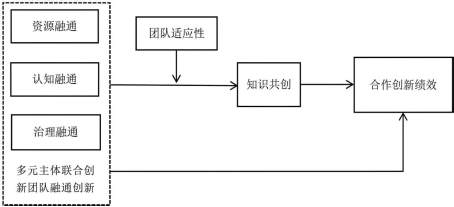
Against the backdrop of China’s full implementation of the innovation-driven development strategy and accelerated construction of a modern industrial system, breaking down innovation barriers among industry, universities, research institutes and end users to realize the sharing of innovation resources serves as a core measure to overcome key core technologies and advance the industrialization of scientific and technological achievements. Under such circumstances, integrative innovation within multi-actor collaborative innovation teams has become an important approach to promoting the deep integration of technological and industrial innovation. This study develops a theoretical model linking integrative innovation, knowledge co-creation, team adaptability, and collaborative innovation performance. Based on 148 valid questionnaires, multiple regression analysis and the Bootstrap method were employed for empirical testing. The results indicate that resource integration, cognitive integration, and governance integration all have significant positive effects on collaborative innovation performance, with governance integration exerting the strongest influence. Knowledge co-creation partially mediates the relationship between integrative innovation and collaborative innovation performance. However, the moderating effect of team adaptability on the relationship between integrative innovation and knowledge co-creation is not significant. The findings enrich the literature on integrative innovation and collaborative innovation performance.
| Published in | Science Innovation (Volume 14, Issue 4) |
| DOI | 10.11648/j.si.20261404.12 |
| Page(s) | 115-121 |
| Creative Commons |
This is an Open Access article, distributed under the terms of the Creative Commons Attribution 4.0 International License (http://creativecommons.org/licenses/by/4.0/), which permits unrestricted use, distribution and reproduction in any medium or format, provided the original work is properly cited. |
| Copyright |
Copyright © The Author(s), 2026. Published by Science Publishing Group |
Multi-actor Collaborative Innovation Team, Integrative Innovation, Knowledge Co-creation, Team Adaptability, Collaborative Innovation Performance
变量 | Cronbach α | KMO | 巴特利球体检验 | |
|---|---|---|---|---|
近似卡方 | 显著性 | |||
资源融通 | 0.872 | 0.825 | 288.321 | 0.000 |
认知融通 | 0.863 | 0.823 | 266.605 | 0.000 |
治理融通 | 0.861 | 0.826 | 263.181 | 0.000 |
知识共创 | 0.882 | 0.913 | 486.677 | 0.000 |
团队适应性 | 0.874 | 0.876 | 482.206 | 0.000 |
合作创新绩效 | 0.879 | 0.896 | 516.456 | 0.000 |
变量 | 均值 | 标准差 | 1 | 2 | 3 | 4 | 5 | 6 |
|---|---|---|---|---|---|---|---|---|
资源融通 | 5.416 | 1.078 | 1 | |||||
认知融通 | 5.475 | 1.014 | 0.658*** | 1 | ||||
治理融通 | 5.446 | 1.099 | 0.690*** | 0.637*** | 1 | |||
知识共创 | 5.492 | 0.849 | 0.694*** | 0.683*** | 0.771*** | 1 | ||
团队适应性 | 5.397 | 0.849 | 0.684*** | 0.714*** | 0.706*** | 0.832*** | 1 | |
合作创新绩效 | 5.486 | 0.817 | 0.703*** | 0.645*** | 0.769*** | 0.812*** | 0.820*** | 1 |
变量 | 非标准化系数B | 标准误 | 标准化系数β | t值 | p值 | VIF |
|---|---|---|---|---|---|---|
常数项 | 1.726 | 0.235 | — | 7.331 | 0.000*** | — |
资源融通 | 0.196 | 0.055 | 0.258 | 3.543 | 0.001*** | 2.258 |
认知融通 | 0.134 | 0.055 | 0.166 | 2.438 | 0.016** | 1.987 |
治理融通 | 0.361 | 0.053 | 0.485 | 6.830 | 0.000*** | 2.152 |
模型指标 | 数值 |
|---|---|
R² | 0.662 |
调整R² | 0.655 |
F值 | 94.035*** |
样本量N | 148 |
中介路径 | 总效应 | 间接效应 | 95%CI | 直接效应 | 结论 |
|---|---|---|---|---|---|
多元主体联合创新团队融通创新→知识共创→合作创新绩效 | 0.701*** | 0.333*** | [0.222, 0.439] | 0.368*** | 部分中介 |
变量 | 标准化系数β | t值 | P值 |
|---|---|---|---|
多元主体联合创新团队融通创新 | 0.414 | 6.044 | 0.000*** |
团队适应性 | 0.501 | 7.292 | 0.000*** |
多元主体联合创新团队融通创新×团队适应性 | -0.003 | -0.059 | 0.953 |
| [1] | 王晓旭, 赵立雨, 王成军. 政产学研协同创新对产业创新绩效的影响机制——以医药制造业为例 [J]. 科技管理研究, 2025, 45(1): 18-27. |
| [2] | BELDERBOS R, CARREE M, LOKSHIN B. CooperativeR&D and firm performance [J]. Research Policy, 2004, 33(10): 1477-1492. |
| [3] | WEBER B, HEIDENREICH S. When and with whom to cooperate? Investigating effects of cooperation stage and type on innovation capabilities and success [J]. Long Range Planning, 2018, 51(2): 334-350. |
| [4] | 周珊, 葛玉辉. 多元主体联合创新团队融通机制探究 [J]. 技术与创新管理, 2024, 45(4): 374-381. |
| [5] | 刘洲灿, 葛玉辉. 培育新质生产力的路径研究——以多元主体联合创新团队新技术成果转化为例 [J]. 上海理工大学学报 (社会科学版), 2026, 48(2): 196-208. |
| [6] | 蔡弘毅, 葛玉辉. 多元主体联合创新团队融通机制对合作创新绩效的影响 [J]. 技术与创新管理, 2026, 47(2): 176-186. |
| [7] | Ployhart R E, Bliese P D. Individual Adaptability (I-ADAPT) Theory: Conceptualizing the Antecedents, Consequences, and Measurement of Individual Differences in Adaptability [M]// Burke C S, Pierce L G, Salas E. Understanding Adaptability: A Prerequisite for Effective Performance Within Complex Environments. Amsterdam: Elsevier, 2006: 3-39. |
| [8] | 孙健慧, 赵黎明. 政府监管下产学研协同创新体系资源共享行为分析 [J]. 科技管理研究, 2017, 37(19): 22-30. |
| [9] | 王萍, 支凤稳, 张斌. 组织间竞争情报共享与合作创新绩效的关系研究 [J]. 情报理论与实践, 2015, 38(5): 12-18. |
| [10] | 王秀锋. 产学研协同创新合作伙伴知识共享及绩效评价研究 [D]. 哈尔滨工程大学, 2021. |
| [11] | 蔡湘杰, 贺正楚, 潘为华. 产学研协同对制造业全要素生产率的影响——基于创新能力中介效应和知识积累门限效应 [J]. 中国流通经济, 2023, 37(11): 115-127. |
| [12] | 张涑贤, 梁雅赟, 杨梦莹. BIM应用下项目主体间关系学习对合作创新绩效的影响研究 [J]. 土木建筑工程信息技术, 2025, 17(4): 99-104. |
| [13] | 陈蕾. 关系信任和数字信任对企业合作创新绩效的影响机制 [D]. 浙江师范大学, 2025. |
| [14] | 李丹, 杨建君. 联结强度、企业间信任和技术创新模式与合作创新绩效 [J]. 软科学, 2018, 32(6): 74-77. |
| [15] | 彭珍珍, 顾颖, 张洁. 动态环境下联盟竞合、治理机制与创新绩效的关系研究 [J]. 管理世界, 2020, 36(3): 205-220+235. |
| [16] | 张培, 杨迎. 服务创新中多主体参与的知识共创:一个整合的分析框架 [J]. 图书馆工作与研究, 2017, (7): 34-40. |
| [17] | 郑刚, 朱国浩, 邬爱其, 等. 专精特新企业产学研知识共创与工艺类关键核心技术突破——基于隶属集团型企业中集圣达因的案例研究 [J]. 管理世界, 2025, 41(4): 193-218. |
| [18] | 汪万, 蔡三发. 开放式创新平台知识共创机制: 随机演化博弈视角 [J]. 系统工程, 2024, 42(3): 11-22. |
| [19] | 易明, 许炜卓, 周阳, 等. 基于认知同化学习理论的在线健康社区知识共创机理研究 [J]. 情报学报, 2025, 44(2): 185-199. |
| [20] | 辛本禄, 耿晶晶. 服务创新网络中企业社会资本如何影响创新绩效——知识流耦合与知识共创的链式中介作用 [J]. 科技进步与对策, 2024, 41(10): 110-119. |
| [21] | 曹越, 毕新华. 开放式创新社区价值共创模式与知识治理机制 [J]. 科技管理研究, 2021, 41(6): 149-155. |
| [22] | 朱雪春, 佘雅月. “卡脖子”难题下创新联合体知识共创影响因素分析——基于二元语义-决策试验与评价实验室 (DEMATEL) 方法 [J]. 科技管理研究, 2024, 44(16): 151-161. |
| [23] | 范钧, 聂津君. 企业-顾客在线互动、知识共创与新产品开发绩效 [J]. 科研管理, 2016, 37(1): 119-127. |
| [24] | 周凌玥, 綦良群, 徐莹莹. 用户介入对装备制造企业服务创新绩效的影响研究——知识共创的中介效应与网络能力的调节效应 [J]. 管理评论, 2022, 34(4): 119-130. |
| [25] | Burke C S, Stagl K C, Salas E, Pierce L, Kendall D. Understanding Team Adaptation: A Conceptual Analysis and Model [J]. Journal of Applied Psychology, 2006, 91(6): 1189-1207. |
| [26] | 刘洲灿, 葛玉辉. 多元主体联合创新团队的团队适应性研究 [J]. 技术与创新管理, 2025, 46(1): 71-80. |
| [27] | 刘振宇, 葛玉辉. 多元主体联合创新团队适应性过程探究 [J]. 技术与创新管理, 2025, 46(5): 539-546. |
| [28] | 钱智超, 闻效仪. 数字技术应用对团队适应性绩效的影响研究 [J]. 当代财经, 2025, (7): 88-99. |
| [29] | 黄晓杏. 融通创新对数字经济与绿色经济协同水平的驱动效应: 基于粤港澳大湾区的实证分析 [J]. 科技与经济, 2023(01): 101-105. |
| [30] | 蒋楠, 赵嵩正, 吴楠. 服务型制造企业服务提供、知识共创与服务创新绩效 [J]. 科研管理, 2016(06): 57-64. |
| [31] | PULAKOS E D, ARAD S, DONOVAN M A, et al. Adaptability in the workplace: Development of a taxonomy of adaptive performance [J]. Journal of Applied Psychology, 2000, 85(4): 612-624. |
| [32] | 李玲. 技术创新网络中企业间依赖、企业开放度对合作绩效的影响 [J]. 南开管理评论, 2011, 14(4): 16-24. |
APA Style
Jingchen, D., Yuhui, G. (2026). Research on the Impact of Integrated Innovation of Multi-stakeholder Joint Innovation Teams on Collaborative Innovation Performance. Science Innovation, 14(4), 115-121. https://doi.org/10.11648/j.si.20261404.12
ACS Style
Jingchen, D.; Yuhui, G. Research on the Impact of Integrated Innovation of Multi-stakeholder Joint Innovation Teams on Collaborative Innovation Performance. Sci. Innov. 2026, 14(4), 115-121. doi: 10.11648/j.si.20261404.12
@article{10.11648/j.si.20261404.12,
  author = {Du Jingchen and Ge Yuhui},
  title = {Research on the Impact of Integrated Innovation of
Multi-stakeholder Joint Innovation Teams on Collaborative Innovation Performance},
  journal = {Science Innovation},
  volume = {14},
  number = {4},
  pages = {115-121},
  doi = {10.11648/j.si.20261404.12},
  url = {https://doi.org/10.11648/j.si.20261404.12},
  eprint = {https://article.sciencepublishinggroup.com/pdf/10.11648.j.si.20261404.12},
  abstract = {Against the backdrop of China’s full implementation of the innovation-driven development strategy and accelerated construction of a modern industrial system, breaking down innovation barriers among industry, universities, research institutes and end users to realize the sharing of innovation resources serves as a core measure to overcome key core technologies and advance the industrialization of scientific and technological achievements. Under such circumstances, integrative innovation within multi-actor collaborative innovation teams has become an important approach to promoting the deep integration of technological and industrial innovation. This study develops a theoretical model linking integrative innovation, knowledge co-creation, team adaptability, and collaborative innovation performance. Based on 148 valid questionnaires, multiple regression analysis and the Bootstrap method were employed for empirical testing. The results indicate that resource integration, cognitive integration, and governance integration all have significant positive effects on collaborative innovation performance, with governance integration exerting the strongest influence. Knowledge co-creation partially mediates the relationship between integrative innovation and collaborative innovation performance. However, the moderating effect of team adaptability on the relationship between integrative innovation and knowledge co-creation is not significant. The findings enrich the literature on integrative innovation and collaborative innovation performance.},
 year = {2026}
}
TY  - JOUR
T1  - Research on the Impact of Integrated Innovation of
Multi-stakeholder Joint Innovation Teams on Collaborative Innovation Performance
AU  - Du Jingchen
AU  - Ge Yuhui
Y1  - 2026/08/13
PY  - 2026
N1  - https://doi.org/10.11648/j.si.20261404.12
DO  - 10.11648/j.si.20261404.12
T2  - Science Innovation
JF  - Science Innovation
JO  - Science Innovation
SP  - 115
EP  - 121
PB  - Science Publishing Group
SN  - 2328-787X
UR  - https://doi.org/10.11648/j.si.20261404.12
AB  - Against the backdrop of China’s full implementation of the innovation-driven development strategy and accelerated construction of a modern industrial system, breaking down innovation barriers among industry, universities, research institutes and end users to realize the sharing of innovation resources serves as a core measure to overcome key core technologies and advance the industrialization of scientific and technological achievements. Under such circumstances, integrative innovation within multi-actor collaborative innovation teams has become an important approach to promoting the deep integration of technological and industrial innovation. This study develops a theoretical model linking integrative innovation, knowledge co-creation, team adaptability, and collaborative innovation performance. Based on 148 valid questionnaires, multiple regression analysis and the Bootstrap method were employed for empirical testing. The results indicate that resource integration, cognitive integration, and governance integration all have significant positive effects on collaborative innovation performance, with governance integration exerting the strongest influence. Knowledge co-creation partially mediates the relationship between integrative innovation and collaborative innovation performance. However, the moderating effect of team adaptability on the relationship between integrative innovation and knowledge co-creation is not significant. The findings enrich the literature on integrative innovation and collaborative innovation performance.
VL  - 14
IS  - 4
ER  -
School of Management, University of Shanghai for Science and Technology, Shanghai, China
School of Management, University of Shanghai for Science and Technology, Shanghai, China

Information



 Share This Article
 Twitter
 Linked In
 Facebook
 Copy
Copy Download