Research Article | | Peer-Reviewed

Teachers' Pedagogical Competence and Students' Learning Outcomes: Evidence from Selected Secondary Schools in Sierra Leone

Received: 23 July 2026     Accepted: 6 August 2026     Published: 2 September 2026
Views:       Downloads:
Abstract

This study explored how teachers’ pedagogical competence relates to students’ learning outcomes in selected secondary schools. The focus was on understanding whether strong teaching practices translate into improved academic performance, especially in a context where student achievement remains uneven. A descriptive research design was adopted. Data were gathered from students’ assessments of their teachers’ classroom practices as well as students’ academic records, including BECE results and recent test scores. The findings show that teachers were generally viewed as highly competent, with an average score of 3.52 (SD = 0.58). In fact, about 91.1% of students rated their teachers positively in terms of instructional effectiveness. Despite this, students’ overall academic performance was only moderate, with a composite mean score of 2.14 (SD = 1.18), and just 42.3% of students reaching high performance levels. When broken down by subject, students tended to perform better in Biology, while Mathematics recorded the lowest results. These results suggest a clear gap between how teaching is perceived and what students are actually achieving. It points to the idea that good classroom practice alone may not be enough to drive strong academic outcomes. Factors such as learning resources, student background, and school conditions likely play an important role in shaping performance. The findings indicate that student achievement is influenced not only by teacher quality but also by a combination of effective classroom practices and broader educational system factors, including the availability of teaching resources, supportive learning environments, and institutional support. The study recommends strengthening teacher professional development, with particular emphasis on enhancing Mathematics pedagogical skills through continuous in-service training and mentoring.

Published in Science Journal of Education (Volume 14, Issue 5)
DOI 10.11648/j.sjedu.20261405.11
Page(s) 124-130
Creative Commons

This is an Open Access article, distributed under the terms of the Creative Commons Attribution 4.0 International License (http://creativecommons.org/licenses/by/4.0/), which permits unrestricted use, distribution and reproduction in any medium or format, provided the original work is properly cited.

Copyright

Copyright © The Author(s), 2026. Published by Science Publishing Group

Keywords

Pedagogical Competence, Learning Outcomes, Secondary Schools, Teacher Effectiveness, Academic Achievement, Instructional Quality

1. Introduction
Education continues to be one of the strongest drivers of national development because it shapes the knowledge, skills, and attitudes people need to contribute meaningfully to society and the economy. Over the years, governments and education stakeholders have increasingly focused on improving what students actually learn in school, not just access to education . In this effort, the teacher remains central, as research consistently shows that what happens in the classroom is strongly influenced by teachers’ quality and instructional practices . Pedagogical competence refers to how well teachers are able to plan lessons, deliver instruction, manage classrooms, assess learning, and respond to the diverse needs of students. It goes beyond simply knowing a subject; it involves knowing how to make that subject understandable and engaging for learners. Shulman explains this through the idea of pedagogical content knowledge, which highlights the importance of combining subject expertise with effective teaching strategies. In practice, teachers with strong pedagogical competence are more likely to create lessons that are clear, interactive, and supportive of different learning abilities.
Across many education systems, improving teaching quality has become a priority because student learning outcomes remain a concern . Even though more children are enrolled in school than ever before, a significant number still struggle with basic literacy and numeracy skills. The World Bank describes this situation as a global “learning crisis,” where many learners complete schooling without acquiring foundational competencies. This has raised questions about how effectively classroom teaching is supporting actual understanding and skill development. Evidence from international studies suggests that effective teaching requires more than subject knowledge. It also involves the use of learner-centred approaches, ongoing assessment, classroom adaptation, and strategies that encourage participation and critical thinking . When teachers apply these approaches well, students tend to be more engaged and perform better academically. Hattie further notes that quality teaching has a measurable impact on student achievement, especially when instruction is intentional, structured, and responsive to learners’ needs.
In many African education systems, including Sierra Leone, challenges related to teacher effectiveness and student achievement remain persistent . Although reforms have been introduced in teacher training and curriculum development, performance in subjects such as Mathematics and Science is still generally low in several schools. UNESCO attributes some of these challenges to factors such as overcrowded classrooms, limited teaching resources, and inadequate opportunities for continuous professional development, all of which affect how effectively teachers can deliver instruction.
In Sierra Leone specifically, differences in student performance across secondary schools remain noticeable. While some schools perform relatively well, others continue to record low achievement levels, particularly in core academic subjects. These differences suggest that teacher-related factors, especially pedagogical competence, may play an important role in shaping student outcomes. However, it is also important to recognise that school environment, learner background, and resource availability may influence performance as well. Despite the growing attention given to teacher quality, there is still limited evidence in many developing contexts showing how teachers’ pedagogical competence directly relates to student learning outcomes. Much of the available research tends to focus on either teacher practices or student performance separately, rather than examining the relationship between the two within specific school settings. This makes it difficult to clearly understand how instructional practices translate into measurable academic results.
This study therefore focuses on examining teachers’ pedagogical competence and students’ learning outcomes in selected secondary schools. It seeks to assess how teachers apply instructional strategies in the classroom and how students perform academically across key subjects. By exploring this relationship, the study aims to provide a clearer understanding of how teaching practices influence learning in real school contexts.
2. Methodology
2.1. Research Design
This study used a descriptive research design to explore and describe existing conditions without manipulating any variables . This approach is commonly used in education research because it helps researchers understand real classroom situations as they naturally occur. According to Babbie , descriptive designs are particularly useful when the goal is to capture patterns, behaviours, and relationships as they exist in real-world settings. In this study, the design made it possible to examine teachers’ pedagogical competence and students’ academic performance in selected secondary schools in a clear and systematic way.
2.2. Study Area and Population
The study was carried out in selected secondary schools. The main population consisted of secondary school students, who are directly involved in classroom learning and are therefore well positioned to provide meaningful feedback on teaching practices. Students’ perspectives are increasingly recognised in educational research as valuable indicators of teaching quality because they experience instruction daily and over extended periods . Their responses were therefore considered appropriate for assessing aspects of teachers’ pedagogical competence.
2.3. Sampling Technique and Sample Size
A sampling approach was used to ensure that students from different schools and academic levels were fairly represented. In educational studies, stratified sampling is often recommended because it helps capture variation across groups such as classes, age levels, and school types . Based on this approach, students were selected from different classes to ensure that the sample reflected a wide range of academic experiences and learning conditions within the schools.
2.4. Data Collection Instruments
Data for the study were collected using structured questionnaires and students’ academic records.
The questionnaire was designed to capture students’ perceptions of their teachers’ pedagogical competence. It used a four-point Likert scale ranging from low to high agreement. The items focused on key areas of teaching practice such as clarity of explanation, lesson preparation, classroom interaction, student participation, and assessment methods. These areas reflect widely accepted dimensions of effective teaching practice, which emphasise instructional clarity, engagement, and learner-centred strategies . Students’ academic performance was measured using two sources:
1) Basic Education Certificate Examination (BECE) results, and
2) Recent classroom test scores obtained from school records.
Using more than one source of academic data helps improve the accuracy of measuring student performance, as it reduces over-reliance on a single form of assessment .
2.5. Validity and Reliability of Instruments
To ensure validity, the questionnaire items were developed based on established literature on effective teaching and pedagogical practice. The instrument was also reviewed by experts in education to confirm that it accurately reflected the intended constructs. Expert review is widely recommended in research methodology as a way of improving content validity .
Reliability was ensured by testing the internal consistency of the questionnaire using Cronbach’s alpha. This helped confirm that the items used in the instrument consistently measured the same underlying concept of pedagogical competence.
2.6. Data Collection Procedure
Data collection involved administering questionnaires to selected students in the participating schools. Students completed the questionnaires based on their experiences and perceptions of their teachers’ instructional practices. In addition, academic performance data were collected from official school records and examination results. Ethical considerations such as informed consent, confidentiality, and voluntary participation were strictly observed throughout the process to protect respondents and ensure the integrity of the study.
2.7. Data Analysis Techniques
The data were analysed using descriptive statistical tools, including mean, standard deviation, and frequency distribution. Mean scores were used to determine the overall level of teachers’ pedagogical competence and students’ academic performance, while standard deviation helped to show how responses varied among students. Frequency distribution was used to group responses into categories such as high, moderate, and low levels of competence or achievement. This method is commonly applied in educational research because it simplifies the interpretation of Likert-scale responses and academic performance data .
3. Results
3.1. Assessment of Teachers’ Pedagogical Competence Level
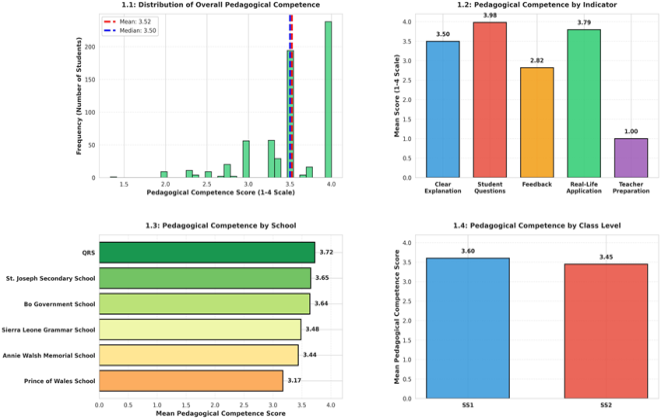
The findings indicate that teachers demonstrated a consistently high level of pedagogical competence across all assessed indicators, schools, and school types. The mean pedagogical competence score was 3.52 (SD = 0.58) on a four-point scale, with a median of 3.60, while 91.1% (n = 594) of students rated their teachers as highly competent, 8.1% (n = 53) as moderately competent, and only 0.8% (n = 5) as having low competence. These results suggest that teachers generally possess strong instructional skills, effective classroom management, and the ability to engage students in meaningful learning.
At the indicator level, clarity of lesson explanation received the highest rating (M = 3.66), followed by lesson preparation (M = 3.54) and encouraging students to ask questions (M = 3.52), indicating that teachers are well-prepared and promote active student participation. Across schools, QRS recorded the highest pedagogical competence (M = 3.72), followed by St. Joseph Secondary School (M = 3.65), while Prince of Wales School had the lowest mean (M = 3.17), although it still reflected a high level of competence. By school type, girls' schools achieved a slightly higher mean score (M = 3.61) than boys' schools (M = 3.36), suggesting modest differences in instructional practices and school learning environments.
The findings demonstrate that teachers exhibit strong pedagogical competence, characterized by effective lesson planning, clear instruction, and learner engagement. However, the observed variations among schools and school types indicate opportunities for strengthening school leadership, expanding continuous professional development, and promoting the sharing of best instructional practices to further enhance teaching quality and improve student learning outcomes. These findings are consistent with evidence that effective pedagogy, supportive school leadership, and positive learning environments contribute significantly to improved student achievement and educational quality .
Figure 1. Assessment of Teachers’ Pedagogical Competence Level.
3.2. Distribution of Teachers’ Pedagogical Competence
Table 1 shows that the vast majority of students perceived their teachers to possess high pedagogical competence, with 594 (91.1%) of respondents rating their teachers within the high competence category. Only 53 (8.1%) rated teachers as having moderate competence, while a very small proportion, 5 (0.8%), perceived their teachers to have low pedagogical competence. These findings indicate that teaching practices in the surveyed secondary schools are generally viewed positively by students, suggesting that most teachers demonstrate effective instructional skills, appropriate classroom management, and the ability to facilitate learning successfully.
The predominance of high pedagogical competence suggests that teachers are generally capable of planning lessons effectively, presenting subject content clearly, engaging students in classroom activities, and using appropriate teaching methods. Such competencies are essential for creating positive learning environments that promote student participation, motivation, and academic achievement. Effective pedagogical competence enables teachers to adapt instruction to learners' needs, provide constructive feedback, and encourage critical thinking, all of which contribute to improved educational outcomes. The relatively small proportion of teachers perceived as having moderate (8.1%) or low competence (0.8%) indicates that while teaching quality is generally satisfactory, there remain opportunities for continuous professional improvement. These teachers may require additional mentoring, classroom support, pedagogical training, or professional development to strengthen instructional effectiveness and ensure more consistent teaching quality across schools.
Table 1. Distribution of Teachers’ Pedagogical Competence.

Competence Level

Score Range

Frequency (n)

Percentage (%)

High

> 3.0

594

91.1

Moderate

2.0-3.0

53

8.1

Low

< 2.0

5

0.8

3.3. Evaluation of Pupils’ Learning Outcomes
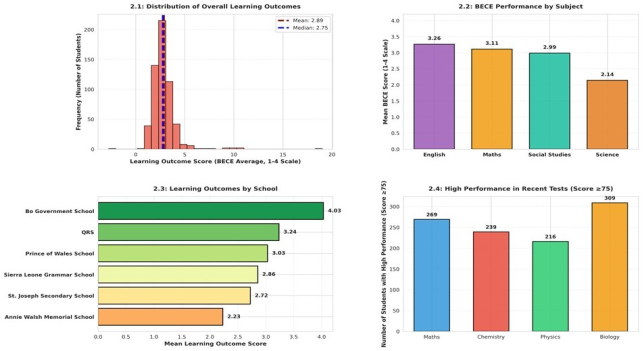
The findings indicate moderate learning outcomes with considerable variation across subjects and schools. The average composite score was 2.89 (median = 2.75) on a four-point scale, while 42.3% of students achieved high performance, suggesting that most students performed within the moderate range. The relatively high variation in scores indicates disparities in academic achievement among students, reflecting unequal learning opportunities and educational outcomes.
Performance differed across subjects, with English Language recording the highest mean score (M = 3.26), followed by Mathematics (M = 3.11) and Social Studies (M = 2.99), whereas Science had the lowest mean (M = 2.14). The weaker performance in Science may be attributed to limited laboratory facilities, inadequate instructional resources, and insufficient practical learning opportunities. Significant differences were also observed among schools. Bo Government School achieved the highest mean learning outcome (M = 4.03), followed by QRS (M = 3.24) and Prince of Wales School (M = 3.03), while Annie Walsh Memorial School recorded the lowest mean (M = 2.23), suggesting that school-level factors such as instructional quality, leadership, learning resources, and school climate influence student achievement.
Analysis of recent classroom tests further showed that Biology had the highest number of high-performing students (309), followed by Mathematics (269), Chemistry (239), and Physics (216), indicating variation in performance within science disciplines. Overall, the findings highlight moderate academic achievement with notable disparities across subjects and schools. They underscore the need to strengthen Science education through improved laboratory facilities, practical teaching approaches, and enhanced instructional support, while promoting the adoption of effective teaching practices and equitable resource allocation to improve student learning outcomes. These findings are consistent with evidence that disparities in teaching quality, school resources, and learning environments contribute to unequal educational outcomes, particularly in developing countries .
Figure 2. Evaluation of Pupils’ Learning Outcomes.
3.3.1. Performance by BECE Subject
Table 2 shows that students achieved moderate performance across all four BECE core subjects, with Science recording the highest mean score (M = 2.28), followed by English and Mathematics (M = 2.10 each), while Social Studies had the lowest mean score (M = 2.07). The small differences among subjects indicate relatively consistent academic performance across the curriculum. Overall, the findings suggest that students possess a satisfactory level of knowledge but have not attained high academic achievement, highlighting the need to strengthen instructional quality, learner support, teaching resources, and continuous assessment. Enhancing teacher professional development and adopting more learner-centered teaching strategies could further improve students' performance across all core subjects, consistent with evidence from OECD , UNESCO , and the World Bank .
Table 2. Mean BECE Scores by Subject.

Subject

Mean Score

Performance Level

Science

2.28

Moderate

English

2.10

Moderate

Mathematics

2.10

Moderate

Social Studies

2.07

Moderate

3.3.2. Recent Test Performance (High Achievers ≥ 75%)
Table 3 presents the distribution of students who achieved high performance in recent classroom tests across four subjects. The results show considerable variation in achievement levels. Biology recorded the highest number of high-performing students, with 309 (55.2%) attaining high scores, followed by Chemistry with 239 (41.9%), Physics with 216 (38.5%), while Mathematics recorded the lowest proportion of high-performing students, with only 148 (25.3%).
The strong performance in Biology suggests that students generally have a better understanding of biological concepts and may find the subject more accessible because it is closely related to everyday life and often emphasizes observation and explanation rather than complex numerical calculations. The relatively high achievement in Chemistry also indicates a satisfactory level of understanding, although fewer students attained high scores compared with Biology. Physics recorded moderate levels of high achievement, reflecting the greater conceptual and mathematical demands associated with the subject.
Mathematics exhibited the lowest proportion of high-performing students, indicating that it remains one of the most challenging subjects for many learners. Difficulties in Mathematics may be associated with weak foundational numeracy skills, mathematics anxiety, limited opportunities for individualized support, or instructional approaches that place insufficient emphasis on problem-solving and conceptual understanding. Since mathematical competence underpins learning in many science and technology disciplines, this relatively low performance is a concern for overall academic development.
The findings reveal important differences in students' achievement across subjects, with Biology showing the strongest performance and Mathematics the weakest. These results suggest the need for targeted interventions to strengthen Mathematics instruction while sustaining the positive performance observed in the science subjects. Enhancing teacher professional development, increasing the use of practical and learner-centred instructional methods, providing adequate teaching and learning materials, and implementing remedial support programmes could help improve achievement across all subjects. These findings are consistent with international evidence that effective teaching practices, adequate instructional resources, and supportive learning environments are essential for improving student academic performance .
Table 3. Recent Test Performance.

Subject

Frequency (n)

Percentage (%)

Biology

309

55.2

Chemistry

239

41.9

Physics

216

38.5

Mathematics

148

25.3

3.3.3. Key Observations
This gap between perceived and actual performance aligns with research showing that students sometimes overrate their academic abilities due to confidence or self-evaluation bias . Several key patterns emerged from the analysis:
1) Variation across subjects: Biology performed better than other subjects, while Mathematics remained the weakest area.
2) Differences between schools: Student performance varied significantly across schools, suggesting that school-level factors may influence achievement.
3) Mismatch in perception: A notable proportion of students rated their performance higher than what test results show, indicating possible overestimation of ability.
4. Conclusion
Overall, the study shows that teachers in the selected schools generally demonstrate strong pedagogical competence. However, students’ academic performance remains only moderate, and there are clear differences in achievement across both subjects and schools. This suggests that while good teaching practices are important, they do not by themselves guarantee high levels of student success. The results point to a more complex picture of learning, where student achievement is shaped by several interconnected factors rather than teacher competence alone. Issues such as the availability of learning materials, students’ home and social backgrounds, school environment, and broader education system conditions all play a role in shaping outcomes. Recent education studies have consistently highlighted this multi-layered nature of learning, showing that improvements in results require attention to both classroom practice and the wider learning environment .
Author Contributions
Victoria Olufemi Danke Kawa: Conceptualization, Data curation, Formal Analysis, Funding acquisition, Investigation, Methodology, Project administration, Resources, Software, Supervision, Validation, Visualization, Writing – original draft, Writing – review & editing
Samuel Joseph Bebeley: Conceptualization, Data curation, Formal Analysis, Funding acquisition, Investigation, Supervision, Validation, Visualization, Writing – original draft, Writing – review & editing
Prince Tongor Mabey: Conceptualization, Data curation, Formal Analysis, Funding acquisition, Investigation, Supervision, Validation, Visualization, Writing – original draft, Writing – review & editing
Joseph James Mbavai: Conceptualization, Data curation, Formal Analysis, Funding acquisition, Investigation, Supervision, Validation, Visualization, Writing – original draft, Writing – review & editing
Conflicts of Interest
The authors declare no conflict of interest.
References
[1] Bandura, A. (1997). Self-efficacy: The exercise of control. Freeman.
[2] Babbie, E. (2016). The practice of social research. Cengage Learning.
[3] Cohen, L., Manion, L., & Morrison, K. (2018). Research methods in education. Routledge.
[4] Clark, V. L. P. (2019). Meaningful integration within mixed methods studies: Identifying why, what, when, and how. Contemporary educational psychology, 57, 106-111.
[5] Danielson, C. (2013). The framework for teaching evaluation instrument. Danielson Group.
[6] Darojah, R., DZ, A. S., Subasman, I., Karim, A., & Ahyat, M. (2025). Analysis of total quality management in improving the quality of educational institutions. Nidhomul Haq: Jurnal Manajemen Pendidikan Islam, 10(1), 88-104.
[7] Darling-Hammond, L., Flook, L., Cook-Harvey, C., Barron, B., & Osher, D. (2020). Implications for educational practice of the science of learning and development. Applied Developmental Science, 24(2), 97-140.
[8] Field, A. (2018). Discovering statistics using IBM SPSS statistics. Sage.
[9] Fraenkel, J. R., Wallen, N. E., & Hyun, H. H. (2019). How to design and evaluate research in education. McGraw-Hill.
[10] Fischer, D., King, J., Rieckmann, M., Barth, M., Büssing, A., Hemmer, I., & Lindau-Bank, D. (2022). Teacher education for sustainable development: A review of an emerging research field. Journal of teacher education, 73(5), 509-524.
[11] Goe, L., Bell, C., & Little, O. (2008). Approaches to evaluating teacher effectiveness. National Comprehensive Center for Teacher Quality.
[12] Hattie, J. (2009). Visible learning: A synthesis of over 800 meta-analyses relating to achievement. Routledge.
[13] Hattie, J. (2023). Visible learning: The sequel on teaching and learning. Routledge.
[14] Leithwood, K. (2021). A review of evidence about equitable school leadership. Education sciences, 11(8), 377.
[15] OECD. (2023a). Education at a glance 2023: OECD indicators. OECD Publishing.
[16] OECD. (2023b). Teaching and learning international survey (TALIS) report. OECD Publishing.
[17] Shulman, L. S. (1987). Knowledge and teaching: Foundations of the new reform. Harvard Educational Review, 57(1), 1-22.
[18] UNESCO. (2023a). Global education monitoring report. UNESCO.
[19] UNESCO. (2023b). Global education monitoring report 2023: Technology in education - A tool on whose terms? UNESCO Publishing.
[20] UNESCO. (2024). Global education monitoring report. UNESCO.
[21] World Bank. (2018a). World development report 2018: Learning to realize education’s promise. World Bank.
[22] World Bank. (2018b). World development report: Learning to realize education’s promise. World Bank.
[23] World Bank. (2022a). World development report 2022: Education and learning recovery. World Bank.
[24] World Bank. (2022b). World development report: Learning poverty and education outcomes. World Bank.
[25] World Bank. (2022c). The state of global learning poverty update. World Bank.
Cite This Article
  • APA Style

    Kawa, V. O. D., Bebeley, S. J., Mabey, P. T., Mbavai, J. J. (2026). Teachers' Pedagogical Competence and Students' Learning Outcomes: Evidence from Selected Secondary Schools in Sierra Leone. Science Journal of Education, 14(5), 124-130. https://doi.org/10.11648/j.sjedu.20261405.11

    Copy | Download

    ACS Style

    Kawa, V. O. D.; Bebeley, S. J.; Mabey, P. T.; Mbavai, J. J. Teachers' Pedagogical Competence and Students' Learning Outcomes: Evidence from Selected Secondary Schools in Sierra Leone. Sci. J. Educ. 2026, 14(5), 124-130. doi: 10.11648/j.sjedu.20261405.11

    Copy | Download

    AMA Style

    Kawa VOD, Bebeley SJ, Mabey PT, Mbavai JJ. Teachers' Pedagogical Competence and Students' Learning Outcomes: Evidence from Selected Secondary Schools in Sierra Leone. Sci J Educ. 2026;14(5):124-130. doi: 10.11648/j.sjedu.20261405.11

    Copy | Download

  • @article{10.11648/j.sjedu.20261405.11,
      author = {Victoria Olufemi Danke Kawa and Samuel Joseph Bebeley and Prince Tongor Mabey and Joseph James Mbavai},
      title = {Teachers' Pedagogical Competence and Students' Learning Outcomes: Evidence from Selected Secondary Schools in Sierra Leone},
      journal = {Science Journal of Education},
      volume = {14},
      number = {5},
      pages = {124-130},
      doi = {10.11648/j.sjedu.20261405.11},
      url = {https://doi.org/10.11648/j.sjedu.20261405.11},
      eprint = {https://article.sciencepublishinggroup.com/pdf/10.11648.j.sjedu.20261405.11},
      abstract = {This study explored how teachers’ pedagogical competence relates to students’ learning outcomes in selected secondary schools. The focus was on understanding whether strong teaching practices translate into improved academic performance, especially in a context where student achievement remains uneven. A descriptive research design was adopted. Data were gathered from students’ assessments of their teachers’ classroom practices as well as students’ academic records, including BECE results and recent test scores. The findings show that teachers were generally viewed as highly competent, with an average score of 3.52 (SD = 0.58). In fact, about 91.1% of students rated their teachers positively in terms of instructional effectiveness. Despite this, students’ overall academic performance was only moderate, with a composite mean score of 2.14 (SD = 1.18), and just 42.3% of students reaching high performance levels. When broken down by subject, students tended to perform better in Biology, while Mathematics recorded the lowest results. These results suggest a clear gap between how teaching is perceived and what students are actually achieving. It points to the idea that good classroom practice alone may not be enough to drive strong academic outcomes. Factors such as learning resources, student background, and school conditions likely play an important role in shaping performance. The findings indicate that student achievement is influenced not only by teacher quality but also by a combination of effective classroom practices and broader educational system factors, including the availability of teaching resources, supportive learning environments, and institutional support. The study recommends strengthening teacher professional development, with particular emphasis on enhancing Mathematics pedagogical skills through continuous in-service training and mentoring.},
     year = {2026}
    }
    

    Copy | Download

  • TY  - JOUR
    T1  - Teachers' Pedagogical Competence and Students' Learning Outcomes: Evidence from Selected Secondary Schools in Sierra Leone
    AU  - Victoria Olufemi Danke Kawa
    AU  - Samuel Joseph Bebeley
    AU  - Prince Tongor Mabey
    AU  - Joseph James Mbavai
    Y1  - 2026/09/02
    PY  - 2026
    N1  - https://doi.org/10.11648/j.sjedu.20261405.11
    DO  - 10.11648/j.sjedu.20261405.11
    T2  - Science Journal of Education
    JF  - Science Journal of Education
    JO  - Science Journal of Education
    SP  - 124
    EP  - 130
    PB  - Science Publishing Group
    SN  - 2329-0897
    UR  - https://doi.org/10.11648/j.sjedu.20261405.11
    AB  - This study explored how teachers’ pedagogical competence relates to students’ learning outcomes in selected secondary schools. The focus was on understanding whether strong teaching practices translate into improved academic performance, especially in a context where student achievement remains uneven. A descriptive research design was adopted. Data were gathered from students’ assessments of their teachers’ classroom practices as well as students’ academic records, including BECE results and recent test scores. The findings show that teachers were generally viewed as highly competent, with an average score of 3.52 (SD = 0.58). In fact, about 91.1% of students rated their teachers positively in terms of instructional effectiveness. Despite this, students’ overall academic performance was only moderate, with a composite mean score of 2.14 (SD = 1.18), and just 42.3% of students reaching high performance levels. When broken down by subject, students tended to perform better in Biology, while Mathematics recorded the lowest results. These results suggest a clear gap between how teaching is perceived and what students are actually achieving. It points to the idea that good classroom practice alone may not be enough to drive strong academic outcomes. Factors such as learning resources, student background, and school conditions likely play an important role in shaping performance. The findings indicate that student achievement is influenced not only by teacher quality but also by a combination of effective classroom practices and broader educational system factors, including the availability of teaching resources, supportive learning environments, and institutional support. The study recommends strengthening teacher professional development, with particular emphasis on enhancing Mathematics pedagogical skills through continuous in-service training and mentoring.
    VL  - 14
    IS  - 5
    ER  - 

    Copy | Download

Author Information
  • Abstract
  • Keywords
  • Document Sections

    1. 1. Introduction
    2. 2. Methodology
    3. 3. Results
    4. 4. Conclusion
    Show Full Outline
  • Author Contributions
  • Conflicts of Interest
  • References
  • Cite This Article
  • Author Information