
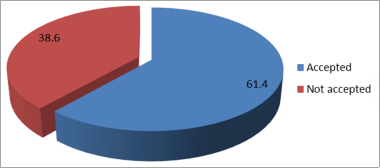
Background: The coronavirus killed millions of people globally and was deemed a public health emergency on March 11, 2020. Many nations have put strict regulations in place. Mass vaccinations to protect the public from COVID-19 have been in place since December 2020. To stop viruses from spreading, community immunizations against COVID-19 are crucial. However, there is currently no information available on Gilgel Beles town's community's adoption of the COVID-19 vaccination. Objective: The objective of this study is to assess the level of acceptance of COVID-19 vaccination and its associated factors among communities in Gilgel Beles town, Metekel zone, North West Ethiopia. Methodology: Community-based cross-sectional study was employed between April 20/2022, and May 20/ 2022, in Gilgel Beles town. A systematic random sampling technique was used to choose 418 households in the town. After obtaining the ethical clearance sheet, Data was gathered through face-to-face interviews at their home. Before being moved to SPSS version 22 for analysis, the data were coded, cleaned, recorded, and entered into Epidata 4. The relationship between independent and dependent variables was investigated using bivariate logistic regression analysis. A variable in the multiple logistic regression models with a p-value ≤0.05 was considered statistically significant. Results: Of 415 respondents, above half of them, 255 (61.4%), were accepted to take the COVID-19 vaccine if available. Age (P-value=0.000), History of vaccine adverse effects (AOR=.3.63, 95%, CI: 1.38, 9.55), Cigarette smoking practice (AOR=3.47, 95% CI: 1.45, 8.27), Friends have been diagnosed with COVID-19 (P-value=0.000) and type of media (P=0.016) were significantly associated with acceptance of COVID-19 vaccine. Conclusion: The prevalence of COVID-19 vaccination acceptance was not high enough. The engagement of religious organizations and religious leaders to promote the advantages of COVID-19 vaccination to their followers and promotion through community radio should be implemented to increase COVID-19 vaccination acceptance.
| Published in | Science Journal of Public Health (Volume 13, Issue 3) |
| DOI | 10.11648/j.sjph.20251303.11 |
| Page(s) | 106-113 |
| Creative Commons |
This is an Open Access article, distributed under the terms of the Creative Commons Attribution 4.0 International License (http://creativecommons.org/licenses/by/4.0/), which permits unrestricted use, distribution and reproduction in any medium or format, provided the original work is properly cited. |
| Copyright |
Copyright © The Author(s), 2025. Published by Science Publishing Group |
COVID-19, Vaccine, Acceptance, Gilgel Bless, Ethiopia
Socio-demographic characteristics of the respondent | Frequency | Percent |
|---|---|---|
Age | ||
18-29 | 206 | 49.6 |
30-49 | 147 | 35.5 |
>49 | 62 | 14.9 |
Sex | ||
Male | 191 | 46.0 |
Female | 224 | 54.0 |
Religion | ||
Orthodox | 256 | 61.7 |
Muslim | 92 | 22.2 |
Protestant | 56 | 13.5 |
Catholic | 11 | 2.7 |
Marital status | ||
Single | 125 | 30.1 |
Married | 290 | 69.9 |
Educational status | ||
Unable to read and write | 96 | 23.1 |
Able to read and write | 64 | 15.4 |
Primary education | 51 | 12.3 |
Secondary school | 75 | 18.1 |
College and above | 129 | 31.1 |
Occupation | ||
Student | 85 | 20.5 |
Employee | 70 | 16.9 |
Unemployed | 44 | 10.6 |
Homemaker | 94 | 22.7 |
Informal job | 113 | 27.2 |
Healthcare worker | 9 | 2.2 |
Health condition and vaccination history of the respondent | Frequency | Percentage |
|---|---|---|
Overall health status | ||
Healthy | 401 | 96.6 |
Not healthy | 14 | 3.4 |
History of previous vaccine rejection | ||
Yes | 34 | 8.2 |
No | 381 | 91.8 |
History of Vaccine severe adverse effects | ||
Yes | 24 | 5.8 |
No | 391 | 94.2 |
Chronic illness | ||
Yes | 62 | 14.9 |
No | 353 | 85.1 |
Vaccination during childhood | ||
Yes | 335 | 80.9 |
No | 80 | 19.1 |
Cigarette Smoking | ||
Yes | 29 | 7.0 |
No | 386 | 93.0 |
Respondent’s experience with COVID-19 infection | Frequency (N=415) | Percentage (%) |
|---|---|---|
Contact history with a COVID-19 patient | ||
Yes | 12 | 2.9 |
No | 403 | 97.1 |
Households have been diagnosed with COVID-19 | ||
Yes | 45 | 10.8 |
No | 370 | 89.2 |
Relatives have been diagnosed with COVID-19 | ||
Yes | 46 | 11.1 |
No | 369 | 88.9 |
Friends have been diagnosed with COVID-19 | ||
Yes | 65 | 15.7 |
No | 350 | 84.3 |
Have tested for COVID-19 | ||
Yes | 47 | 11.3 |
No | 368 | 88.7 |
COVID-19 test result (N=47) | ||
Positive | 39 | 82.9 |
Negative | 8 | 17.1 |
Heard about the COVID-19 vaccine | ||
Yes | 392 | 94.5 |
No | 23 | 5.5 |
Reasons for not taking the COVID-19 vaccine | Frequency (N=161) | Percentage |
|---|---|---|
Inadequate data about the safety of the vaccine | 27 | 16.8 |
Fear of the adverse effects of the vaccine | 44 | 27.3 |
A concern about the vaccine being ineffective | 1 | .6 |
The vaccine causing COVID-19 | 2 | 1.2 |
Prefer other ways of protection | 10 | 6.2 |
Prior adverse reaction to any vaccine | 27 | 16.8 |
Unreliable, due to short time for development | 8 | 5 |
Unreliable, due to religious reasons | 42 | 26.1 |
Variable | Category | Frequency (%) | COR with 95% CI | AOR with 95% CI | P-value |
|---|---|---|---|---|---|
Age | 18-29 | 206 (49.6%) | 4.99 (2.71, 9.19) | 0.68 (0.41, 1.13) | 0.135 |
30-49 | 147 (35.4%) | 3.31 (1.77, 6.21) | 0.2 (0.09, 0.43) | 0.000* | |
>49 | 62 (14.9%) | 1 | 1 | ||
History of vaccine adverse effects | No | 391 (94.2%) | 0.21 (0.10, 0.44) | 3.63 (1.38, 9.55) | 0.000* |
Yes | 24 (5.8%) | 1 | 1 | ||
Cigarette smoking | No | 386 (93%) | 1 | 1 | |
Yes | 29 (7%) | 2.81 (1.29, 6.12) | 3.47 (1.45, 8.27) | 0.005* | |
Friends have been diagnosed with COVID-19 | No | 350 (84.3%) | 1 | 1 | |
Yes | 75 (15.7%) | 0.21 (0.10, 0.44) | 0.19 (0.08, 0.43) | 0.000* | |
Type of media | Television | 242 (58.3%) | 0.28 (0.13, 0.58) | 0.63 (0.28, 1.43) | 0.273 |
Radio | 37 (8.9%) | 0.72 (0.44, 1.17) | 0.51 (0.30, 0.88) | 0.016* | |
Social media | 99 (23.9%) | 0.36 (0.18, 0.72) | 0.56 (0.26, 1.20) | 0.136 | |
Magazine | 37 (8.9%) | 1 | 1 |
COVID-19 | Coronavirus Disease 2019 |
CCO | Chief Clinical Officer |
CEO | Chief Executive Officer |
EC | Ethiopian Calendar |
HCPs | Health Care Providers |
JCVI | Joint Committee on Vaccination |
SARS | Severe Acute Respiratory Syndrome |
| [1] | Imran, M., A. S. Alshrari, and S. M. B. Asdaq, Trends in the development of remdesivir based inventions against COVID-19 and other disorders: A patent review. Journal of Infection and Public Health, 2021. 14(8): p. 1075-1086. |
| [2] | Team, E., The epidemiological characteristics of an outbreak of 2019 novel coronavirus diseases (COVID-19)—China, 2020. China CDC Weekly, 2020. 2(8): p. 113. |
| [3] | Adhikari, S. P., et al., Epidemiology, causes, clinical manifestation and diagnosis, prevention and control of coronavirus disease (COVID-19) during the early outbreak period: a scoping review. Infectious diseases of poverty, 2020. 9: p. 1-12. |
| [4] |
Coronavirus, W., Dashboard
https://covid19.who.int Accessed March, 2021. 15. |
| [5] | Bell, S., et al., COVID-19 vaccination beliefs, attitudes, and behaviours among health and social care workers in the UK: A mixed-methods study. PLoS One, 2022. 17(1): p. e0260949. |
| [6] | Mahase, E., and Covid-19: What do we know about the late stage vaccine candidates? 2020, British Medical Journal Publishing Group. |
| [7] | WHO, 2.2 million COVID-19 vaccines allocated by the COVAX Facility arrive in Ethiopia, marking the start of the country’s COVID-19 vaccination campaign? 2021. |
| [8] | Wassihun, Y., et al., Assessment of COVID-19 vaccine uptake and associated factors among healthcare workers in selected health facilities of the Somali Region, Eastern Ethiopia: a cross-sectional study conducted in 2021. BMJ Public Health, 2024. 2(1). |
| [9] | Mesele, M., COVID-19 vaccination acceptance and its associated factors in Sodo Town, Wolaita Zone, and Southern Ethiopia: cross-sectional study. Infection and Drug Resistance, 2021: p. 2361-2367. |
| [10] | Holmes, E. and Y. Novel, coronavirus genome, 2020 [cited 2020 Apr 5]. 2019, Available. |
| [11] | Gomes, C., Report of the WHO-China joint mission on coronavirus disease 2019 (COVID-19). Brazilian Journal of Implantology and Health Sciences, 2020. 2(3). |
| [12] | Wu, Z. and J. M. McGoogan, Characteristics of and important lessons from the coronavirus disease 2019 (COVID-19) outbreak in China: summary of a report of 72,314 cases from the Chinese Center for Disease Control and Prevention. Jama, 2020. 323(13): p. 1239-1242. |
| [13] | Liu, Y., et al., The reproductive number of COVID-19 is higher compared to SARS coronavirus. Journal of Travel Medicine, 2020. |
| [14] | Schuster, M., J. Eskola, and P. Duclos, Review of vaccine hesitancy: Rationale, remit and methods. Vaccine, 2015. 33(34): p. 4157-4160. |
| [15] | Yaqub, O., et al., Attitudes to vaccination: a critical review. Social science & medicine, 2014. 112: p. 1-11. |
| [16] | Fabry, P., A. Gagneur, and J.-C. Pasquier, Determinants of A (H1N1) vaccination: cross-sectional study in a population of pregnant women in Quebec. Vaccine, 2011. 29(9): p. 1824-1829. |
| [17] | McCarthy, E. M., et al., Knowledge, attitudes, and clinical practice of rheumatologists in vaccination of the at-risk rheumatology patient population. JCR: Journal of Clinical Rheumatology, 2012. 18(5): p. 237-241. |
| [18] | Betsch, C. and S. Wicker, E-health use, vaccination knowledge and perception of own risk: drivers of vaccination uptake in medical students. Vaccine, 2012. 30(6): p. 1143-1148. |
| [19] | Korber, B., et al., Tracking changes in SARS-CoV-2 spike: evidence that D614G increases infectivity of the COVID-19 virus. Cell, 2020. 182(4): p. 812-827. e19. |
| [20] | COVID, W. E., vaccine in a national launching ceremony. 2021. |
| [21] | Tang, X., et al., on the origin and continuing evolution of SARS-CoV-2. National Science Review, 2020. 7(6): p. 1012-1023. |
| [22] | Al-Qerem, W. A. and A. S. Jarab, COVID-19 vaccination acceptance and its associated factors among a Middle Eastern population. Frontiers in Public Health, 2021. 9: p. 632914. |
| [23] | Chen, D., et al., Recurrence of positive SARS-CoV-2 RNA in COVID-19: A case report. International Journal of Infectious Diseases, 2020. 93: p. 297-299. |
| [24] | Geoghegan, S., K. P. O’Callaghan, and P. A. Offit, Vaccine safety: myths and misinformation. Frontiers in microbiology, 2020. 11: p. 372. |
| [25] | Enitan, S. S., et al., Assessment of knowledge, perception, and readiness of Nigerians to participate in the COVID-19 vaccine trial. International Journal of Vaccines and Immunization, 2020. 4(1): p. 1-13. |
APA Style
Gashaye, D. G., Jemberu, T. B., Bekeko, S. D., Sedeta, B. E. (2025). COVID-19 Vaccine Acceptance and Associated Factors in Gilgel Beles Town, Metekel Zone, Benishangul-Gumuz Region, Northwest Ethiopia. Science Journal of Public Health, 13(3), 106-113. https://doi.org/10.11648/j.sjph.20251303.11
ACS Style
Gashaye, D. G.; Jemberu, T. B.; Bekeko, S. D.; Sedeta, B. E. COVID-19 Vaccine Acceptance and Associated Factors in Gilgel Beles Town, Metekel Zone, Benishangul-Gumuz Region, Northwest Ethiopia. Sci. J. Public Health 2025, 13(3), 106-113. doi: 10.11648/j.sjph.20251303.11
AMA Style
Gashaye DG, Jemberu TB, Bekeko SD, Sedeta BE. COVID-19 Vaccine Acceptance and Associated Factors in Gilgel Beles Town, Metekel Zone, Benishangul-Gumuz Region, Northwest Ethiopia. Sci J Public Health. 2025;13(3):106-113. doi: 10.11648/j.sjph.20251303.11
@article{10.11648/j.sjph.20251303.11,
  author = {Dereje Getahun Gashaye and Tamiru Bogale Jemberu and Solomon Debela Bekeko and Biratu Ebessa Sedeta},
  title = {COVID-19 Vaccine Acceptance and Associated Factors in Gilgel Beles Town, Metekel Zone, Benishangul-Gumuz Region, Northwest Ethiopia
},
  journal = {Science Journal of Public Health},
  volume = {13},
  number = {3},
  pages = {106-113},
  doi = {10.11648/j.sjph.20251303.11},
  url = {https://doi.org/10.11648/j.sjph.20251303.11},
  eprint = {https://article.sciencepublishinggroup.com/pdf/10.11648.j.sjph.20251303.11},
  abstract = {Background: The coronavirus killed millions of people globally and was deemed a public health emergency on March 11, 2020. Many nations have put strict regulations in place. Mass vaccinations to protect the public from COVID-19 have been in place since December 2020. To stop viruses from spreading, community immunizations against COVID-19 are crucial. However, there is currently no information available on Gilgel Beles town's community's adoption of the COVID-19 vaccination. Objective: The objective of this study is to assess the level of acceptance of COVID-19 vaccination and its associated factors among communities in Gilgel Beles town, Metekel zone, North West Ethiopia. Methodology: Community-based cross-sectional study was employed between April 20/2022, and May 20/ 2022, in Gilgel Beles town. A systematic random sampling technique was used to choose 418 households in the town. After obtaining the ethical clearance sheet, Data was gathered through face-to-face interviews at their home. Before being moved to SPSS version 22 for analysis, the data were coded, cleaned, recorded, and entered into Epidata 4. The relationship between independent and dependent variables was investigated using bivariate logistic regression analysis. A variable in the multiple logistic regression models with a p-value ≤0.05 was considered statistically significant. Results: Of 415 respondents, above half of them, 255 (61.4%), were accepted to take the COVID-19 vaccine if available. Age (P-value=0.000), History of vaccine adverse effects (AOR=.3.63, 95%, CI: 1.38, 9.55), Cigarette smoking practice (AOR=3.47, 95% CI: 1.45, 8.27), Friends have been diagnosed with COVID-19 (P-value=0.000) and type of media (P=0.016) were significantly associated with acceptance of COVID-19 vaccine. Conclusion: The prevalence of COVID-19 vaccination acceptance was not high enough. The engagement of religious organizations and religious leaders to promote the advantages of COVID-19 vaccination to their followers and promotion through community radio should be implemented to increase COVID-19 vaccination acceptance.
},
 year = {2025}
}
TY  - JOUR
T1  - COVID-19 Vaccine Acceptance and Associated Factors in Gilgel Beles Town, Metekel Zone, Benishangul-Gumuz Region, Northwest Ethiopia

AU  - Dereje Getahun Gashaye
AU  - Tamiru Bogale Jemberu
AU  - Solomon Debela Bekeko
AU  - Biratu Ebessa Sedeta
Y1  - 2025/05/29
PY  - 2025
N1  - https://doi.org/10.11648/j.sjph.20251303.11
DO  - 10.11648/j.sjph.20251303.11
T2  - Science Journal of Public Health
JF  - Science Journal of Public Health
JO  - Science Journal of Public Health
SP  - 106
EP  - 113
PB  - Science Publishing Group
SN  - 2328-7950
UR  - https://doi.org/10.11648/j.sjph.20251303.11
AB  - Background: The coronavirus killed millions of people globally and was deemed a public health emergency on March 11, 2020. Many nations have put strict regulations in place. Mass vaccinations to protect the public from COVID-19 have been in place since December 2020. To stop viruses from spreading, community immunizations against COVID-19 are crucial. However, there is currently no information available on Gilgel Beles town's community's adoption of the COVID-19 vaccination. Objective: The objective of this study is to assess the level of acceptance of COVID-19 vaccination and its associated factors among communities in Gilgel Beles town, Metekel zone, North West Ethiopia. Methodology: Community-based cross-sectional study was employed between April 20/2022, and May 20/ 2022, in Gilgel Beles town. A systematic random sampling technique was used to choose 418 households in the town. After obtaining the ethical clearance sheet, Data was gathered through face-to-face interviews at their home. Before being moved to SPSS version 22 for analysis, the data were coded, cleaned, recorded, and entered into Epidata 4. The relationship between independent and dependent variables was investigated using bivariate logistic regression analysis. A variable in the multiple logistic regression models with a p-value ≤0.05 was considered statistically significant. Results: Of 415 respondents, above half of them, 255 (61.4%), were accepted to take the COVID-19 vaccine if available. Age (P-value=0.000), History of vaccine adverse effects (AOR=.3.63, 95%, CI: 1.38, 9.55), Cigarette smoking practice (AOR=3.47, 95% CI: 1.45, 8.27), Friends have been diagnosed with COVID-19 (P-value=0.000) and type of media (P=0.016) were significantly associated with acceptance of COVID-19 vaccine. Conclusion: The prevalence of COVID-19 vaccination acceptance was not high enough. The engagement of religious organizations and religious leaders to promote the advantages of COVID-19 vaccination to their followers and promotion through community radio should be implemented to increase COVID-19 vaccination acceptance.

VL  - 13
IS  - 3
ER  -
Department of Public Health, Pawi Health Sciences College, Pawi, Ethiopia
Department of Nursing, Pawi Health Sciences College, Pawi, Ethiopia
Department of Public Health, Pawi Health Sciences College, Pawi, Ethiopia
Department of Nursing, Pawi Health Sciences College, Pawi, Ethiopia

Information



 Share This Article
 Twitter
 Linked In
 Facebook

 Copy
 Download