
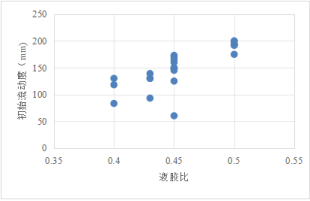
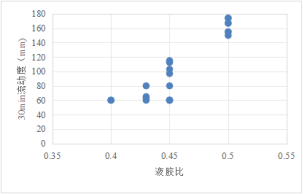
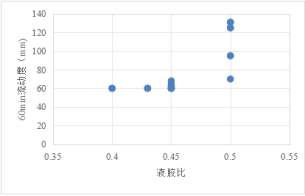
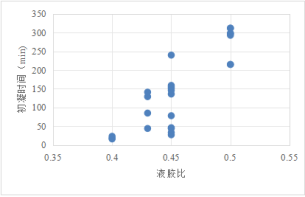
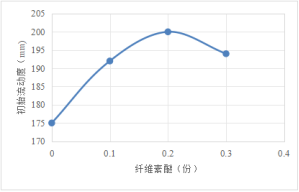
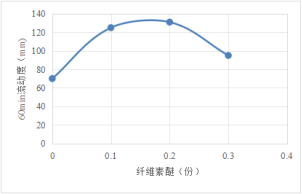
To develop an alkali-activated steel slag-slag based soft soil stabilizer meeting the requirements of the Chinese standard Soft Soil Stabilizer (CJT 526-2018), 22 mixture proportions were designed. The effects of water glass modulus (1.25–2.1), liquid-to-binder ratio (0.35–0.5), cellulose ether content (0–0.3 parts by mass), and steel slag/slag ratio (80:120–120:80) on the initial fluidity, 30 min fluidity, 60 min fluidity and initial setting time of the pastes were systematically investigated. The results show that only the mixtures with a liquid-to-binder ratio ≥0.5, water glass modulus ≥1.9 and cellulose ether content ≥0.1% fully meet the standard requirements. Among them, J21 (0.2% cellulose ether) exhibits the best performance: initial fluidity of 200 mm, 30 min fluidity of 174 mm, 60 min fluidity of 131 mm, and initial setting time of 298 min. At a liquid-to-binder ratio of 0.45, even with 0.2% cellulose ether, the 60 min fluidity remains below 65 mm; at a liquid-to-binder ratio of 0.5 without cellulose ether, the 60 min fluidity is only 70 mm; when the modulus is below 1.8, the initial setting time is always less than 45 min. Mechanism analysis indicates that a high modulus (≥1.9) prolongs the polycondensation induction period by providing polymerized silicate anions, thus ensuring a sufficient initial setting time; a high liquid-to-binder ratio (0.5) provides ample free water for lubrication and reaction buffering; cellulose ether synergistically maintains the integrity of the water film at 60 min through water retention and steric hindrance. This study provides a theoretical basis and an optimal mixture proportion for the engineering application of alkali-activated soft soil stabilizers.
| Published in | Science Research (Volume 14, Issue 5) |
| DOI | 10.11648/j.sr.20261405.25 |
| Page(s) | 375-381 |
| Creative Commons |
This is an Open Access article, distributed under the terms of the Creative Commons Attribution 4.0 International License (http://creativecommons.org/licenses/by/4.0/), which permits unrestricted use, distribution and reproduction in any medium or format, provided the original work is properly cited. |
| Copyright |
Copyright © The Author(s), 2026. Published by Science Publishing Group |
Steel Slag, Slag, Alkali-activated Stabilizer, Fluidity, Setting Time
材料 | 核心成分与性能 |
|---|---|
钢渣 | Fe₂O₃38.93%、SiO₂28.37%、CaO8.67% |
矿渣 | 39.29%CaO 、33.06%SiO2 、15.04%Al2O3 |
水玻璃 | 波美度38Be,模数3.2,SiO₂ 8%,Na₂O 25% |
氢氧化钠 | 20%浓度溶液 |
纤维素醚 | HPMC,4 万粘度 |
编号 | 钢渣 | 矿渣 | 水玻璃 | 水 | 氢氧化钠 | 纤维素醚 | 液胶比 | 模数 |
|---|---|---|---|---|---|---|---|---|
J1 | 100 | 100 | 29.7 | 26.1 | 24.2 | 0 | 0.4 | 1.25 |
J2 | 100 | 100 | 31.6 | 29.4 | 19 | 0 | 0.4 | 1.49 |
J3 | 100 | 100 | 33.4 | 31.5 | 15.1 | 0 | 0.4 | 1.72 |
J4 | 100 | 100 | 29.7 | 36.1 | 24.2 | 0 | 0.45 | 1.25 |
J5 | 100 | 100 | 31.6 | 39.4 | 19 | 0 | 0.45 | 1.49 |
J6 | 100 | 100 | 33.4 | 41.5 | 15.1 | 0 | 0.45 | 1.72 |
J7 | 100 | 100 | 36.8 | 40 | 13.2 | 0 | 0.45 | 1.9 |
J8 | 100 | 100 | 35.6 | 36 | 14.4 | 0 | 0.43 | 1.81 |
J9 | 100 | 100 | 39.2 | 36 | 10.8 | 0 | 0.43 | 2.1 |
J10 | 100 | 100 | 33 | 42 | 11.9 | 0 | 0.43 | 1.9 |
J11 | 100 | 100 | 40.5 | 31 | 14.5 | 0 | 0.43 | 1.9 |
J12 | 100 | 100 | 36 | 40 | 14 | 0 | 0.45 | 1.84 |
J13 | 100 | 100 | 20 | 62.8 | 7.2 | 0 | 0.45 | 1.90 |
J14 | 120 | 80 | 36.8 | 40 | 13.2 | 0 | 0.45 | 1.90 |
J15 | 120 | 80 | 36.8 | 40 | 13.2 | 0 | 0.45 | 1.90 |
J16 | 80 | 120 | 36.8 | 40 | 13.2 | 0 | 0.45 | 1.90 |
J17 | 100 | 100 | 36.8 | 40 | 13.2 | 0.1 | 0.45 | 1.90 |
J18 | 100 | 100 | 36.8 | 40 | 13.2 | 0.2 | 0.45 | 1.90 |
J19 | 100 | 100 | 36.8 | 50 | 13.2 | 0 | 0.5 | 1.90 |
J20 | 100 | 100 | 36.8 | 50 | 13.2 | 0.1 | 0.5 | 1.90 |
J21 | 100 | 100 | 36.8 | 50 | 13.2 | 0.2 | 0.5 | 1.90 |
J22 | 100 | 100 | 36.8 | 50 | 13.2 | 0.3 | 0.5 | 1.90 |
编号 | 流动度(mm) | 初凝时间(min) | ||
|---|---|---|---|---|
初始 | 30min | 60min | ||
J1 | 130 | 60 | 60 | 18 |
J2 | 118 | 60 | 60 | 23 |
J3 | 83 | 60 | 60 | 16 |
J4 | 173 | 60 | 60 | 27 |
J5 | 170 | 60 | 60 | 33 |
J6 | 150 | 60 | 60 | 44 |
J7 | 165 | 115 | 68 | 159 |
J8 | 130 | 60 | 60 | 44 |
J9 | 93 | 63 | 60 | 129 |
J10 | 139 | 80 | 60 | 85 |
J11 | 130 | 65 | 60 | 141 |
J12 | 150 | 112.5 | 65 | 78 |
J13 | 125 | 60 | 60 | 240 |
J14 | 148 | 80 | 60 | 155 |
J15 | 60 | 60 | 60 | 46 |
J16 | 160 | 113 | 62 | 151 |
J17 | 145 | 97 | 60 | 136 |
J18 | 148 | 103 | 63 | 146 |
J19 | 175 | 150 | 70 | 293 |
J20 | 192 | 167 | 125 | 215 |
J21 | 200 | 174 | 131 | 298 |
J22 | 194 | 155 | 95 | 312 |
| [1] | 迂晨. 固废胶凝材料固化土的制备与性能研究 [D]. 西安:西安科技大学, 2024. |
| [2] | 刘姝言. 多元固废复合固化剂固化高强度流态土试验研究. 太原:太原理工大学 [D]. 2023. |
| [3] | 刘帅, 徐玉飞, 詹进生等. 国内流态固化土的研究与应用进展 [J]. 新型建筑材料, 2022, 49(08): 167-71. |
| [4] | PROVIS J L, BERNAL S A. Geopolymers and related alkali-activated materials [J]. Annual Review of Materials Research, 2014, 44: 299-327. |
| [5] | 刘强, 邱敬贤, 何曦. 土壤固化剂的研究进展 [J]. 再生资源与循环经济, 2018, 11(02): 41-44. |
| [6] | SHI C, JIMÉNEZ A F, PALOMO A. New cements for the 21st century: The pursuit of an alternative to Portland cement [J]. Cement and Concrete Research, 2011, 41(7): 750-763. |
| [7] | 王海龙,邹烽,高生龙等. 碱激发矿粉制备流态固化土及其工程应用研究 [J]. 新型建筑材料, 2025, (7): 140-145. |
| [8] | PALACIOS M, PUERTAS F. Effect of superplasticizer and shrinkage-reducing admixtures on alkali-activated slag pastes and mortars [J]. Cement and Concrete Research, 2005, 35(7): 1358-1367. |
| [9] | 张云升, 孙伟, 沙建芳. 碱激发矿渣水泥的流变性和凝结时间研究 [J]. 硅酸盐学报, 2006, 34(4): 467-471. |
| [10] | 吴萌. 石灰基低碳胶凝材料的设计制备与水化机理研究 [D]. 东南大学, 2024. |
| [11] | 王奕博,唐正光, 杨玉龙. 矿粉土壤固化剂改良高原红粘土试验研究 [J]. 中北大学学报, 2020, 41(5): 7-11. |
| [12] | 中华人民共和国住房和城乡建设部. CJT 526-2018 软土固化剂 [S]. 北京: 中国标准出版社, 2018. |
| [13] | 钟维军, 赵雅雯, 陈雪梅等. 矿渣基复合固化剂对预拌流态固化土力学强度的影响 [J]. 新型建筑材料, 2023. 50(3): 46-50. |
| [14] | 王应富, 张树光, 黄啸等. 磷石膏-钢渣-矿渣固化低液限粉质黏土力学性能及耐久性能研究 [J]. 土木工程学报, 2023(S1): 12-23. |
| [15] | 中华人民共和国国家质量监督检验检疫总局. GB/T 1346一2011 水泥标准稠度用水量、凝结时间、安定性检验方法 [S]. 中国标准出版社出版, 2011. |
| [16] | 中华人民共和国国家质量监督检验检疫总局. GB/T 2419-2005水泥胶砂流动度测定方法 [S]. 中国标准出版社出版, 2005. |
APA Style
Fu, J. (2026). Experimental Study on Paste of Steel Slag-Slag Based Alkali-Activated Soft Soil Stabilizer. Science Research, 14(5), 375-381. https://doi.org/10.11648/j.sr.20261405.25
ACS Style
Fu, J. Experimental Study on Paste of Steel Slag-Slag Based Alkali-Activated Soft Soil Stabilizer. Sci. Res. 2026, 14(5), 375-381. doi: 10.11648/j.sr.20261405.25
AMA Style
Fu J. Experimental Study on Paste of Steel Slag-Slag Based Alkali-Activated Soft Soil Stabilizer. Sci Res. 2026;14(5):375-381. doi: 10.11648/j.sr.20261405.25
@article{10.11648/j.sr.20261405.25,
  author = {Jianbao Fu},
  title = {Experimental Study on Paste of Steel Slag-Slag Based Alkali-Activated Soft Soil Stabilizer},
  journal = {Science Research},
  volume = {14},
  number = {5},
  pages = {375-381},
  doi = {10.11648/j.sr.20261405.25},
  url = {https://doi.org/10.11648/j.sr.20261405.25},
  eprint = {https://article.sciencepublishinggroup.com/pdf/10.11648.j.sr.20261405.25},
  abstract = {To develop an alkali-activated steel slag-slag based soft soil stabilizer meeting the requirements of the Chinese standard Soft Soil Stabilizer (CJT 526-2018), 22 mixture proportions were designed. The effects of water glass modulus (1.25–2.1), liquid-to-binder ratio (0.35–0.5), cellulose ether content (0–0.3 parts by mass), and steel slag/slag ratio (80:120–120:80) on the initial fluidity, 30 min fluidity, 60 min fluidity and initial setting time of the pastes were systematically investigated. The results show that only the mixtures with a liquid-to-binder ratio ≥0.5, water glass modulus ≥1.9 and cellulose ether content ≥0.1% fully meet the standard requirements. Among them, J21 (0.2% cellulose ether) exhibits the best performance: initial fluidity of 200 mm, 30 min fluidity of 174 mm, 60 min fluidity of 131 mm, and initial setting time of 298 min. At a liquid-to-binder ratio of 0.45, even with 0.2% cellulose ether, the 60 min fluidity remains below 65 mm; at a liquid-to-binder ratio of 0.5 without cellulose ether, the 60 min fluidity is only 70 mm; when the modulus is below 1.8, the initial setting time is always less than 45 min. Mechanism analysis indicates that a high modulus (≥1.9) prolongs the polycondensation induction period by providing polymerized silicate anions, thus ensuring a sufficient initial setting time; a high liquid-to-binder ratio (0.5) provides ample free water for lubrication and reaction buffering; cellulose ether synergistically maintains the integrity of the water film at 60 min through water retention and steric hindrance. This study provides a theoretical basis and an optimal mixture proportion for the engineering application of alkali-activated soft soil stabilizers.},
 year = {2026}
}
TY  - JOUR
T1  - Experimental Study on Paste of Steel Slag-Slag Based Alkali-Activated Soft Soil Stabilizer
AU  - Jianbao Fu
Y1  - 2026/09/22
PY  - 2026
N1  - https://doi.org/10.11648/j.sr.20261405.25
DO  - 10.11648/j.sr.20261405.25
T2  - Science Research
JF  - Science Research
JO  - Science Research
SP  - 375
EP  - 381
PB  - Science Publishing Group
SN  - 2329-0927
UR  - https://doi.org/10.11648/j.sr.20261405.25
AB  - To develop an alkali-activated steel slag-slag based soft soil stabilizer meeting the requirements of the Chinese standard Soft Soil Stabilizer (CJT 526-2018), 22 mixture proportions were designed. The effects of water glass modulus (1.25–2.1), liquid-to-binder ratio (0.35–0.5), cellulose ether content (0–0.3 parts by mass), and steel slag/slag ratio (80:120–120:80) on the initial fluidity, 30 min fluidity, 60 min fluidity and initial setting time of the pastes were systematically investigated. The results show that only the mixtures with a liquid-to-binder ratio ≥0.5, water glass modulus ≥1.9 and cellulose ether content ≥0.1% fully meet the standard requirements. Among them, J21 (0.2% cellulose ether) exhibits the best performance: initial fluidity of 200 mm, 30 min fluidity of 174 mm, 60 min fluidity of 131 mm, and initial setting time of 298 min. At a liquid-to-binder ratio of 0.45, even with 0.2% cellulose ether, the 60 min fluidity remains below 65 mm; at a liquid-to-binder ratio of 0.5 without cellulose ether, the 60 min fluidity is only 70 mm; when the modulus is below 1.8, the initial setting time is always less than 45 min. Mechanism analysis indicates that a high modulus (≥1.9) prolongs the polycondensation induction period by providing polymerized silicate anions, thus ensuring a sufficient initial setting time; a high liquid-to-binder ratio (0.5) provides ample free water for lubrication and reaction buffering; cellulose ether synergistically maintains the integrity of the water film at 60 min through water retention and steric hindrance. This study provides a theoretical basis and an optimal mixture proportion for the engineering application of alkali-activated soft soil stabilizers.
VL  - 14
IS  - 5
ER  -
Tianjin Port Engineering Institute Co., Ltd. of CCCC First Harbor Engineering Co., Ltd., CCCC First Harbor Engineering Co., Ltd., Tianjin, China

Information



 Share This Article
 Twitter
 Linked In
 Facebook
 Copy
Copy Download