
Purpose: To compare prosthesis position, lower-limb reconstruction, and functional recovery after primary unilateral total hip arthroplasty (THA) via the modified Hardinge or SuperPATH approach, focusing on longitudinal changes in balance and joint position sense (JPS). Materials and Methods: This retrospective study included 93 patients who underwent primary unilateral THA between October 2022 and October 2025. Forty-six patients received the SuperPATH approach and 47 received the modified Hardinge approach. Baseline data, postoperative radiographic measures, 6-minute walking distance, activities of daily living, and hip range of motion at 6 months were collected. Berg Balance Scale (BBS) scores and JPS errors were assessed preoperatively and at 1, 3, and 6 months postoperatively. Two-way repeated-measures analysis of variance was used for longitudinal outcomes. Welch’s t test with Holm adjustment was used for single-time-point comparisons. Results: Baseline age, BMI, sex, operative side, and ASA grade were comparable. The SuperPATH group had a slightly lower preoperative BBS score and smaller JPS error (Bonferroni-adjusted P=0.026 and 0.011, respectively). Significant group-by-time interactions were found for BBS [F(2.506, 228.048)=40.554, P<0.001; partial η²=0.308] and JPS [F(2.658, 241.909)=387.809, P<0.001; partial η²=0.810]. The SuperPATH group had higher BBS scores at 1 and 6 months and smaller JPS errors at 1 and 3 months; the adjusted differences at 3 months for BBS and at 6 months for JPS were not significant. The side-to-side femoral offset difference was smaller in the SuperPATH group (Holm-adjusted P=0.029). At 6 months, walking distance, daily living function, external rotation, and flexion were comparable; internal rotation was 2.46° greater in the SuperPATH group (Holm-adjusted P=0.042). Conclusion: Both approaches achieved satisfactory prosthesis positioning and functional recovery. The SuperPATH approach may facilitate early sensorimotor recovery, but the retrospective design and small baseline differences require prospective confirmation.
| Published in | Science Research (Volume 14, Issue 6) |
| DOI | 10.11648/j.sr.20261406.13 |
| Page(s) | 406-418 |
| Creative Commons |
This is an Open Access article, distributed under the terms of the Creative Commons Attribution 4.0 International License (http://creativecommons.org/licenses/by/4.0/), which permits unrestricted use, distribution and reproduction in any medium or format, provided the original work is properly cited. |
| Copyright |
Copyright © The Author(s), 2026. Published by Science Publishing Group |
Total Hip Arthroplasty, SuperPATH Approach, Modified Hardinge Approach, Balance, Joint Position Sense
指标 | SuperPATH组(n=46) | 改良Hardinge组(n=47) | 统计值 | P值 |
|---|---|---|---|---|
年龄(岁) | 70.24±5.83 | 70.85±6.35 | t=−0.484 | 0.629 |
BMI(kg/m²) | 25.21±1.50 | 25.65±1.73 | t=−1.312 | 0.193 |
术前BBS(分) | 42.98±1.44 | 43.76±1.22 | t=−2.794 | 0.006 |
术前JPS误差(°) | 2.63±0.34 | 2.82±0.25 | t=−3.089 | 0.003 |
性别(男/女) | 20/26 | 20/27 | χ²=0.011 | 0.918 |
手术侧(左右) | 18/28 | 22/25 | χ²=0.621 | 0.431 |
ASA(分) | 2.33±0.52 | 2.27±0.45 | t=0.595 | 0.553 |
指标 | SuperPATH组(n=46) | 改良Hardinge组 (n=47) | 组间差值 (95%CI) | t(df)/ 统计量 | 原始 P值 | Holm P值 |
|---|---|---|---|---|---|---|
股骨柄对线角(°) | 1.75±0.67 | 1.66±0.68 | 0.10(−0.18~0.37) | 0.685(91.0) | 0.495 | 0.990 |
双下肢长度差(mm) | 2.68±1.42 | 2.84±1.33 | −0.17(−0.73~0.40) | −0.584(90.4) | 0.560 | 0.990 |
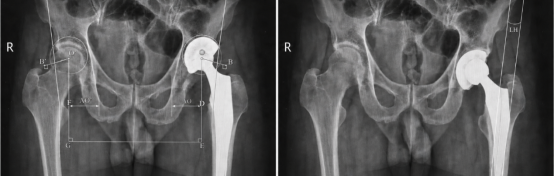
股骨偏心距差(cm) | 0.42±0.22 | 0.56±0.28 | −0.14(−0.24~−0.04) | −2.753(86.5) | 0.007 | 0.029 |
手术侧髋臼偏心距(mm) | 35.74±2.32 | 35.04±2.49 | 0.70(−0.30~1.69) | 1.394(90.8) | 0.167 | 0.500 |
股骨柄对线良好(≤3°), n(%) | 46(100.0) | 47(100.0) | — | Fisher确切概率法 | 1.000 | — |
双下肢长度差≤5 mm, n(%) | 45(97.8) | 47(100.0) | — | Fisher确切概率法 | 0.495 | — |
效应 | 分子df | 分母df | F值 | P值 | 备注 |
|---|---|---|---|---|---|
组别 | 1 | 91 | 19.879 | <0.001 | 组间效应 |
时间 | 2.506 | 228.048 | 2772.264 | <0.001 | Greenhouse-Geisser校正 |
组别×时间 | 2.506 | 228.048 | 40.554 | <0.001 | Greenhouse-Geisser校正 |
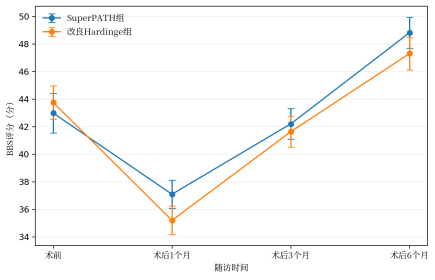
时间 | SuperPATH(n=46) | 改良Hardinge(n=47) | t值 | P值 | Bonferroni校正P值 |
|---|---|---|---|---|---|
术前 | 42.98±1.44 | 43.76±1.22 | −2.794 | 0.006 | 0.026 |
术后1个月 | 37.10±1.02 | 35.20±1.03 | 8.883 | <0.001 | <0.001 |
术后3个月 | 42.20±1.12 | 41.63±1.12 | 2.456 | 0.016 | 0.064 |
术后6个月 | 48.82±1.13 | 47.31±1.19 | 6.291 | <0.001 | <0.001 |
效应 | 分子df | 分母df | F值 | P值 |
|---|---|---|---|---|
组别 | 1 | 91 | 555.522 | <0.001 |
时间 | 2.658 | 241.909 | 2264.259 | <0.001 |
组别×时间 | 2.658 | 241.909 | 387.809 | <0.001 |
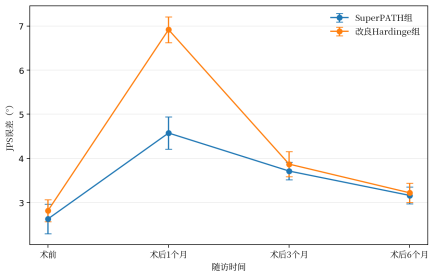
时间 | SuperPATH(n=46) | 改良Hardinge(n=47) | t值 | 原始P值 | Bonferroni校正P值 |
|---|---|---|---|---|---|
术前 | 2.63±0.34 | 2.82±0.25 | −3.089 | 0.003 | 0.011 |
术后1个月 | 4.57±0.37 | 6.92±0.29 | −33.994 | <0.001 | <0.001 |
术后3个月 | 3.71±0.20 | 3.87±0.28 | −3.115 | 0.003 | 0.010 |
术后6个月 | 3.16±0.19 | 3.22±0.22 | −1.391 | 0.168 | 0.670 |
指标 | SuperPATH组(n=46) | 改良Hardinge组(n=47) | 组间差值(95%CI) | t(df) | 原始 P值 | Holm P值 |
|---|---|---|---|---|---|---|
6分钟步行距离(m) | 356.04±22.00 | 350.81±27.78 | 5.23(−5.08~15.55) | 1.008(87.2) | 0.316 | 0.949 |
IADL评分(分) | 26.72±3.03 | 26.26±2.48 | 0.46(−0.68~1.60) | 0.804(86.8) | 0.424 | 0.949 |
髋关节外旋(°) | 34.41±3.15 | 35.70±4.18 | −1.29(−2.81~0.24) | −1.681(85.5) | 0.096 | 0.384 |
髋关节屈曲(°) | 115.46±9.24 | 114.40±8.11 | 1.05(−2.53~4.64) | 0.583(89.0) | 0.561 | 0.949 |
髋关节内旋(°) | 37.76±4.79 | 35.30±3.96 | 2.46(0.65~4.28) | 2.699(87.2) | 0.008 | 0.042 |
| [1] | Learmonth ID, Young C, Rorabeck C. The operation of the century: total hip replacement. Lancet. 2007; 370(9597): 1508-1519. |
| [2] | Chiang LY, Lin PC. [Follow-Up Study of Joint Function and Quality of Life in Patients After Total Hip Arthroplasty]. Hu Li Za Zhi. 2021; 68(3): 44-53. |
| [3] | Campagner A, Millella F, Guida S, et al. Assessment of Fast-Track Pathway in Hip and Knee Replacement Surgery by Propensity Score Matching on Patient-Reported Outcomes. Diagnostics (Basel). 2023; 13(6): 1189. |
| [4] | Korytkin AA, El Moudni YM, Novikova YS, et al. A prospective randomised comparison of earlier function after total hip arthroplasty with a mini posterior approach or supercapsular percutaneous-assisted total hip approach: a gait analysis study. Hip Int. 2023; 33(2): 169-177. |
| [5] | Cakmak MF, Bayram S, Birişik F. The effects of modified hardinge approach on hip muscle strength in patients with primary hip arthroplasty: a patient evaluation with isokinetic strength test and gait analyses. Eur J Orthop Surg Traumatol. 2024; 34(2): 1209-1218. |
| [6] | Ansari S, Singh SK, Regmi A. Difference in Muscle Strength and Functional Outcome in Direct Lateral Approach versus Posterior Approach in Total Hip Arthroplasty: A Prospective Cohort Study. J West Afr Coll Surg. 2023; 13(1): 6-14. |
| [7] | Kushwaha NS, Kumar A, Shukla R, et al. Functional Outcomes and Gait Analysis of Total Hip Arthroplasty Through Lateral Hardinge Approach and Gluteus Medius-Sparing Approach: A Prospective Study. Cureus. 2024; 16(2): e54323. |
| [8] | Obada B, Iliescu DM, Popescu IA. Clinical outcomes of modified direct lateral approach of Hardinge for total hip arthroplasty. Acta Orthop Belg. 2023; 89(4): 625-633. |
| [9] | Hagio K, Aikawa K. Minimally invasive surgery supercapsular percutaneous-assisted total hip (SuperPath) arthroplasty. Acta Biomed. 2023; 94(3): e2023069. |
| [10] | 孙付杰, 邹士东, 汪明星. SuperPATH入路与后外侧入路全髋关节置换术对患者炎性反应、髋关节功能及生活质量的影响. 中国基层医药. 2022; 29(2): 271-275. |
| [11] | 谢光文, 罗加龙, 张俊. SuperPATH微创技术在全髋关节置换术中的应用及近期疗效分析. 中华解剖与临床杂志. 2019; 24(5): 470-476. |
| [12] | Flevas DA, Tsakotos GA, Benakis LN, et al. The Supercapsular Percutaneously Assisted Total Hip (SuperPATH) Approach Revisited: Technique Improvements after the Perioperative Experience of 344 Cases. Life (Basel). 2022; 12(7): 981. |
| [13] | 李荣群, 吴铭洲, 周家旺, 等. SuperPATH入路微创全髋关节置换术67例观察. 中华骨与关节外科杂志. 2018; 11(10): 736-741. |
| [14] | 孙茂淋, 何锐, 张颖, 等. SuperPATH入路微创全髋关节置换术与加速康复. 中华骨与关节外科杂志. 2019; 12(4): 316-320. |
| [15] | 孙彦平, 刘月坤, 崔晓亮, 等. Superpath全髋置换与全髋关节置换术的疗效、疼痛程度及髋关节功能分析. 中华骨与关节外科杂志. 2017; 10(4): 305-307. |
| [16] | Shen J, Ji W, Shen Y, et al. Comparison of the early clinical efficacy of the SuperPath approach versus the modified Hardinge approach in total hip arthroplasty for femoral neck fractures in elderly patients: a randomized controlled trial. J Orthop Surg Res. 2023; 18(1): 215. |
| [17] | Ramadanov N. An Updated Meta-Analysis of Randomized Controlled Trials on Total Hip Arthroplasty through SuperPATH versus Conventional Approaches. Orthop Surg. 2022; 14(5): 807-823. |
| [18] | 颜廷题, 田少奇, 王远贺. SuperPATH与Hardinge入路全髋关节置换术早期临床疗效比较. 中国修复重建外科杂志. 2017; 31(1): 17-24. |
| [19] | Tottas S, Tsigalou C, Ververidis A, et al. Supercapsular Percutaneously Assisted total hip arthroplasty versus lateral approach in Total Hip Replacement. A prospective comparative study. J Orthop. 2020; 21: 406-415. |
| [20] | Jiang H, Wang LH, Jin YX, et al. Supercapsular percutaneously assisted total hip arthroplasty versus conventional posterior approach: Comparison of early functional results. Acta Orthop Traumatol Turc. 2020; 54(5): 511-515. |
| [21] | Yan L, Ge L, Dong S. Evaluation of Comparative Efficacy and Safety of Surgical Approaches for Total Hip Arthroplasty: A Systematic Review and Network Meta-analysis. JAMA Netw Open. 2023; 6(1): e2253942. |
| [22] | Kawano T, Nankaku M, Murao M. Recovery of Muscle Atrophy and Fatty Infiltration in Patients With Acetabular Dysplasia After Total Hip Arthroplasty. J Am Acad Orthop Surg. 2022; 30(3): e317-e326. |
| [23] | 张兴, 徐中华, 谢华, 等. 高龄股骨颈骨折SuperPATH入路髋关节置换的短期随访. 中国组织工程研究. 2019; 23(36): 5777-5781. |
| [24] | Reichert JC, von Rottkay E, Roth F. A prospective randomized comparison of the minimally invasive direct anterior and the transgluteal approach for primary total hip arthroplasty. BMC Musculoskelet Disord. 2018; 19(1): 241. |
| [25] | Chen IJ, Chou YC, Lai PJ, et al. The modified Hardinge approach is not inferior to trochanteric flip osteotomy for Pipkin type IV femoral head fractures: a comparative study in 40 patients. Eur J Trauma Emerg Surg. 2024; 50(4): 1859-1867. |
| [26] | Macheras G, Stasi S, Sarantis M, et al. Direct anterior approach vs Hardinge in obese and nonobese osteoarthritic patients: A randomized controlled trial. World J Orthop. 2021; 12(11): 877-890. |
| [27] | Ramadanov N, Bueschges S, Liu K, et al. Comparison of short-term outcomes between direct anterior approach (DAA) and SuperPATH in total hip replacement: a systematic review and network meta-analysis of randomized controlled trials. J Orthop Surg Res. 2021; 16(1): 324. |
| [28] | Joseph VM, Nagy M, Board TN. Systematic review and meta-analysis on SuperPATH approach versus conventional approaches for hip arthroplasty. Hip Int. 2023; 33(4): 655-663. |
| [29] | Lei P, Liao Z, Peng J, et al. Assessment of the Learning Curve of Supercapsular Percutaneously Assisted Total Hip Arthroplasty in an Asian Population. Biomed Res Int. 2020; 2020: 5180458. |
| [30] | 许瀚, 石波, 代卓君. 髋关节置换术不同入路早期疗效的系统评价. 中华关节外科杂志(电子版). 2019; 13(5): 567-574. |
| [31] | 李科伟, 张乾龙, 孙博. 直接前方入路与改良Hardinge入路保留关节囊全髋关节置换术治疗老年股骨颈骨折的效果比较. 中华创伤骨科杂志. 2025; 27(12): 1027-1033. |
| [32] | 张海宁, 孙一, 丁昌荣. 改良比基尼微创入路与直接外侧入路人工全髋关节置换术的围术期效果. 中华老年医学杂志. 2019; 38(8): 875-879. |
| [33] | 陈余庆. 直接前侧入路与改良Hardinge入路初次全髋关节置换术的早期疗效对比研究. 苏州: 苏州大学; 2020. |
| [34] | von Elm E, Altman DG, Egger M, et al. The Strengthening the Reporting of Observational Studies in Epidemiology (STROBE) statement: guidelines for reporting observational studies. J Clin Epidemiol. 2008; 61(4): 344-349. |
| [35] | Benchimol EI, Smeeth L, Guttmann A, et al. The REporting of studies Conducted using Observational Routinely-collected health Data (RECORD) Statement. PLoS Med. 2015; 12(10): e1001885. |
| [36] | Elibol N, Unver B, Karatosun V. The effects of balance training in patients with total hip arthroplasty: a randomized controlled pilot study. Orthopadie (Heidelberg). 2024; 53(12): 955-965. |
| [37] | Ulivi M, Orlandini L, Vitale JA. Direct superior approach versus posterolateral approach in total hip arthroplasty: a randomized controlled trial on early outcomes on gait, risk of fall, clinical and self-reported measurements. Acta Orthop. 2021; 92(3): 274-279. |
| [38] | Qu H, Zhen Q, Li H. Effects of Balance and Proprioceptive Training on Rehabilitation After Total Knee and Total Hip Replacement: A Systematic Review and Meta-Analysis. J Aging Phys Act. 2026; 34(1): 82-90. |
| [39] | Jo S, Park SB, Kim MJ. Comparison of balance, proprioception and skeletal muscle mass in total hip replacement patients with and without fracture: a pilot study. Ann Rehabil Med. 2016; 40(6): 1064-1070. |
| [40] | 张壮壮. SuperPATH入路和后外侧入路全髋关节置换术后功能及本体感觉的临床对比研究 [D]. 兰州: 甘肃中医药大学; 2024. |
| [41] | Li C, Ji ML, Zhang WS, et al. [Evaluation and treatment strategy of limb length discrepancy after total hip arthroplasty]. Zhonghua Wai Ke Za Zhi. 2023; 61(2): 95-99. |
| [42] | Sato H, Maezawa K, Gomi M. Effect of femoral offset and limb length discrepancy on hip joint muscle strength and gait trajectory after total hip arthroplasty. Gait Posture. 2020; 77: 276-282. |
| [43] | Mahmood SS, Mukka SS, Crnalic S. Association between changes in global femoral offset after total hip arthroplasty and function, quality of life, and abductor muscle strength. Acta Orthop. 2016; 87(1): 36-41. |
| [44] | Ryan NS, Kowalski E, Beaulé PE, et al. The Effect of Surgical Approach and Hip Offset Reconstruction on Gait Biomechanics Following Total Hip Arthroplasty. J Arthroplasty. 2024; 39(2): 402-408.e1. |
| [45] | Chung C, Bin Hazzaa I, Hakim R, et al. Techniques and Technologies for the Intraoperative Assessment of Component Positioning, Leg Lengths, and Offset in Total Hip Arthroplasty: A Systematic Review. Arthroplasty Today. 2024; 27: 101361. |
| [46] | Kikuchi N, Kawamura H, Nishino T, et al. Relationship of Pelvic Positional Change with Leg Length and Offset Measurement in Experimental Total Hip Arthroplasty. Orthop Surg. 2023; 15(6): 1664-1669. |
| [47] | Scholes CJ, Fatima M, Schwagli T, et al. Imageless navigation system (Naviswiss) provides accurate component position in total hip arthroplasty with lateral decubitus position for end-stage hip osteoarthritis: a prospective cohort study with CT-validation. Arthroplasty. 2024; 6(1): 3. |
| [48] | Shimizu A, Murakami S, Tamai T. Comparing cup placement, leg length, and offset discrepancy after total hip arthroplasty between CT-based robotic arm-assisted and navigation systems. Bone Jt Open. 2025; 6(1): 3-11. |
| [49] | Matsuo H, Kubota M, Watabe Y, et al. Association between dynamic hip motion during gait and passive hip range of motion and muscle strength before and after total hip arthroplasty. Orthop Traumatol Surg Res. 2026; 112(3): 104419. |
| [50] | Kay A, Klavas D, Haghshenas V, et al. Two year follow up of supercapsular percutaneously assisted total hip arthroplasty. BMC Musculoskelet Disord. 2021; 22(1): 478. |
APA Style
Wang, Z., Wang, B., Liu, R., Huang, W., Ji, W. (2026). Comparison of Prosthesis Position and Lower-Limb Functional Recovery After Total Hip Arthroplasty via the Modified Hardinge and SuperPATH Approaches. Science Research, 14(6), 406-418. https://doi.org/10.11648/j.sr.20261406.13
ACS Style
Wang, Z.; Wang, B.; Liu, R.; Huang, W.; Ji, W. Comparison of Prosthesis Position and Lower-Limb Functional Recovery After Total Hip Arthroplasty via the Modified Hardinge and SuperPATH Approaches. Sci. Res. 2026, 14(6), 406-418. doi: 10.11648/j.sr.20261406.13
@article{10.11648/j.sr.20261406.13,
  author = {Zhichao Wang and Bo Wang and Run Liu and Wei Huang and Weiping Ji},
  title = {Comparison of Prosthesis Position and Lower-Limb Functional Recovery After Total Hip Arthroplasty via the Modified Hardinge and SuperPATH Approaches},
  journal = {Science Research},
  volume = {14},
  number = {6},
  pages = {406-418},
  doi = {10.11648/j.sr.20261406.13},
  url = {https://doi.org/10.11648/j.sr.20261406.13},
  eprint = {https://article.sciencepublishinggroup.com/pdf/10.11648.j.sr.20261406.13},
  abstract = {Purpose: To compare prosthesis position, lower-limb reconstruction, and functional recovery after primary unilateral total hip arthroplasty (THA) via the modified Hardinge or SuperPATH approach, focusing on longitudinal changes in balance and joint position sense (JPS). Materials and Methods: This retrospective study included 93 patients who underwent primary unilateral THA between October 2022 and October 2025. Forty-six patients received the SuperPATH approach and 47 received the modified Hardinge approach. Baseline data, postoperative radiographic measures, 6-minute walking distance, activities of daily living, and hip range of motion at 6 months were collected. Berg Balance Scale (BBS) scores and JPS errors were assessed preoperatively and at 1, 3, and 6 months postoperatively. Two-way repeated-measures analysis of variance was used for longitudinal outcomes. Welch’s t test with Holm adjustment was used for single-time-point comparisons. Results: Baseline age, BMI, sex, operative side, and ASA grade were comparable. The SuperPATH group had a slightly lower preoperative BBS score and smaller JPS error (Bonferroni-adjusted P=0.026 and 0.011, respectively). Significant group-by-time interactions were found for BBS [F(2.506, 228.048)=40.554, PConclusion: Both approaches achieved satisfactory prosthesis positioning and functional recovery. The SuperPATH approach may facilitate early sensorimotor recovery, but the retrospective design and small baseline differences require prospective confirmation.},
 year = {2026}
}
TY  - JOUR
T1  - Comparison of Prosthesis Position and Lower-Limb Functional Recovery After Total Hip Arthroplasty via the Modified Hardinge and SuperPATH Approaches
AU  - Zhichao Wang
AU  - Bo Wang
AU  - Run Liu
AU  - Wei Huang
AU  - Weiping Ji
Y1  - 2026/11/10
PY  - 2026
N1  - https://doi.org/10.11648/j.sr.20261406.13
DO  - 10.11648/j.sr.20261406.13
T2  - Science Research
JF  - Science Research
JO  - Science Research
SP  - 406
EP  - 418
PB  - Science Publishing Group
SN  - 2329-0927
UR  - https://doi.org/10.11648/j.sr.20261406.13
AB  - Purpose: To compare prosthesis position, lower-limb reconstruction, and functional recovery after primary unilateral total hip arthroplasty (THA) via the modified Hardinge or SuperPATH approach, focusing on longitudinal changes in balance and joint position sense (JPS). Materials and Methods: This retrospective study included 93 patients who underwent primary unilateral THA between October 2022 and October 2025. Forty-six patients received the SuperPATH approach and 47 received the modified Hardinge approach. Baseline data, postoperative radiographic measures, 6-minute walking distance, activities of daily living, and hip range of motion at 6 months were collected. Berg Balance Scale (BBS) scores and JPS errors were assessed preoperatively and at 1, 3, and 6 months postoperatively. Two-way repeated-measures analysis of variance was used for longitudinal outcomes. Welch’s t test with Holm adjustment was used for single-time-point comparisons. Results: Baseline age, BMI, sex, operative side, and ASA grade were comparable. The SuperPATH group had a slightly lower preoperative BBS score and smaller JPS error (Bonferroni-adjusted P=0.026 and 0.011, respectively). Significant group-by-time interactions were found for BBS [F(2.506, 228.048)=40.554, PConclusion: Both approaches achieved satisfactory prosthesis positioning and functional recovery. The SuperPATH approach may facilitate early sensorimotor recovery, but the retrospective design and small baseline differences require prospective confirmation.
VL  - 14
IS  - 6
ER  -
Lishui People's Hospital, Lishui, China;The Third People's Hospital of Lishui, Lishui, China

Information


 Share This Article
 Twitter
 Linked In
 Facebook

 Copy
 Download