Research Article | | Peer-Reviewed

Assessment of the Physico-chemical Quality of Surface Water in the Bolo and Niouniourou Rivers for Drinking Water Supply in the City of Fresco, Côte d’Ivoire

Received: 27 November 2025     Accepted: 16 December 2025     Published: 26 January 2026
Views:       Downloads:
Abstract

Access to safe drinking water remains a critical challenge in coastal West African urban centers, particularly in resource-limited settings such as Fresco, Côte d'Ivoire. This study evaluates the potabilization potential of the Bolo and Niouniourou rivers to inform sustainable water supply strategies in hydrogeologically complex estuarine environments. Water samples were collected from 20 stations during the peak flood period (July 2025) and analyzed for 24 physico-chemical parameters. Results revealed contrasting hydrochemical patterns between the two rivers driven by differential hydrodynamic forcing. The Bolo River maintained a freshwater facies (mean conductivity: 1,141µS/cm; dissolved oxygen: 6.28mg/L) under fluvial dominance, where high flood discharge effectively repelled saltwater intrusion through hydraulic flushing mechanisms. Conversely, the Niouniourou River exhibited severe mineralization (conductivity: 3,308µS/cm; chlorides: 912mg/L), attributable to tidal inertia and saltwater trapping that persists despite elevated discharge during the monsoon season. Compliance assessment against WHO drinking water guidelines confirmed the Bolo River's suitability for conventional treatment pathways, whereas the Niouniourou River's chronic salinity burden renders it unsuitable for potabilization without prohibitively expensive desalination technologies. These findings underscore the fundamental importance of hydrodynamic forcing in governing coastal water resource quality and accessibility. The study demonstrates that site-specific hydrodynamic assessment is essential for evidence-based water supply planning in estuarine contexts.

Published in Journal of Water Resources and Ocean Science (Volume 15, Issue 1)
DOI 10.11648/j.wros.20261501.12
Page(s) 8-15
Creative Commons

This is an Open Access article, distributed under the terms of the Creative Commons Attribution 4.0 International License (http://creativecommons.org/licenses/by/4.0/), which permits unrestricted use, distribution and reproduction in any medium or format, provided the original work is properly cited.

Copyright

Copyright © The Author(s), 2026. Published by Science Publishing Group

Keywords

Drinking Water Supply, Hydrochemistry, Physicochemical Parameters, River Bolo, River Niouniourou, Fresco (Côte d'Ivoire), Coastal Water Potabilization

1. Introduction
Coastal West African urban regions face an acute water crisis driven by rapid demographic expansion, climate variability, infrastructure deterioration, and groundwater salinization. Projected population increases from 36 million (2020) to over 80 million (2050) substantially escalate freshwater demand. Climate change reduces precipitation predictability and alters hydrological cycles. Aging infrastructure cannot meet expanding needs. Coastal aquifer salinization through saltwater intrusion diminishes freshwater availability. Irregular seasonal rainfall compromises supply sustainability. These converging pressures threaten the viability of conventional water supply systems across West Africa . Millions of city dwellers are therefore in a situation of permanent water stress, where access to drinking water becomes increasingly precarious. The city of Fresco, located on the Ivorian coast, perfectly illustrates this issue. The city has faced a shortage of drinking water for several years, causing concern among residents and local authorities. This situation results in frequent water cuts affecting all neighborhoods in the municipality. According to the Water Distribution Company of Côte d’Ivoire (SODECI), water supply is managed according to a rotating distribution schedule: some neighborhoods receive water two days a week, others only once, or sometimes not at all. This alternating management is due to only one of the three available boreholes functioning, and even then at only 60% capacity, which is insufficient to cover the population’s needs. Faced with this situation, residents of the least-served neighborhoods often have to travel to the city center or resort to private suppliers, who sell water at high prices. Local authorities advocate the construction of a water tower to permanently address this crisis . Rapid urbanization has led to a decrease in pressure from the only water tower that originally supplied the city. This infrastructure has proven insufficient to meet the growing needs of the population. Although new boreholes with capacities of 12 and 14 m3 have recently been acquired, a more ambitious project to reinforce the potable water supply system is being studied. This project aims to use the Bolo River, located 5 km north of Fresco, as a source of supply . However, utilizing these coastal rivers for drinking water production raises complex scientific questions related to their specific hydrodynamics. The Bolo and Niouniourou rivers are tropical estuarine systems subject to a dual antagonistic influence: continental hydrological forcing (monsoon floods) and oceanic forcing (tides). Water quality in these land-sea interfaces is governed by the precarious balance between freshwater inputs, which act as dilution factors, and saltwater intrusion, which mineralizes the water and alters physico-chemical equilibria . While these rivers support local economic activities, their suitability for treatment for human consumption remains poorly documented, particularly regarding the impact of these mixing mechanisms on potability parameters.
To date, there is a critical lack of data on the physico-chemical characteristics of these two rivers and their respective responses to saltwater intrusion. The present study therefore aims to assess the surface water quality of the Bolo and Niouniourou rivers with a view to their use for drinking water supply. The objective is to characterize the dominant hydrochemical facies and analyze the influence of estuarine dynamics on the compliance of these waters with drinking water standards.
2. Materials and Methods
Study Area
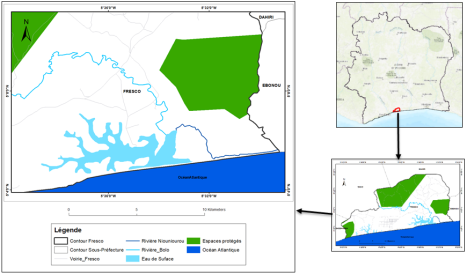
The Niouniourou River (140 km) and the Bolo River (84 km) are located between longitudes 6°0’0’’ W -- 5°30’0’’ W and latitudes 5°0’0’’ N -- 5°50’0’’ N in southwestern Côte d’Ivoire (Figure 1).
Figure 1. Study Area.
These rivers flow into the Fresco lagoon, a site classified under the Ramsar Convention. The climate is humid tropical, characterized by four seasons: two wet seasons—a major one (April-July) and a minor one (October-November), and two less rainy (or dry) seasons—a major one (December-March) and a minor one (August-September) . The study area presents an undulating relief divided into forest and lagoon zones, with numerous plateaus, marshy lowlands, valleys, and some hills. The Bolo and Niouniourou rivers are part of this complex hydrographic network characteristic of the Ivorian coastal zone, where many watercourses flow into lagoons before reaching the sea . The coastal zone of Côte d’Ivoire has a particular geological configuration, contrasting sharply with the interior of the country. This region provides an exceptional window into the country’s geological history, characterized by the presence of a coastal sedimentary basin in sharp contrast to the Precambrian bedrock that dominates most of the territory.
Sampling Strategy and Analysis Techniques.
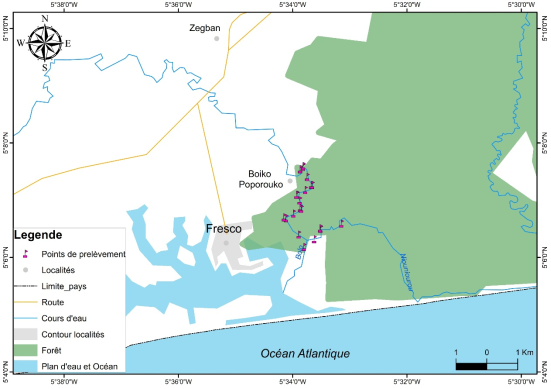
Analyses were conducted on water samples collected from the Bolo and Niouniourou rivers during the flood period in July 2025 at 20 stations distributed across both rivers as shown in the Figure 2.
Figure 2. Sampling Sites.
Twenty sampling stations were positioned in transition zones downstream of meander apexes to mitigate hydraulic asymmetry caused by helical flows and ensure cross-sectional homogeneity . Temporally, the study targets the flood period (July 2025) as a worst-case scenario. This approach assesses the system's resilience to saltwater intrusion during peak dilution and quantifies the maximum contaminant load. Chemical analyses were performed on 20 samples taken a few centimeters below the water surface. Temperature (T°C), pH, dissolved oxygen (DO), redox potential (Eh), electrical conductivity (EC), salinity, and total dissolved solids (TDS) were measured in situ using a portable multiparameter waterproof device hi 98194, ph/ec/od, HANNA®. Suspended solids were analyzed by centrifugation (NF, 1978). Analysis of nitrogen parameters and phosphorus was performed by colorimetric spectrophotometry using standardized HACH methods. Nitrates were determined by the cadmium reduction method (HACH 8192). Nitrites were analyzed directly by the diazotization method (HACH 8507). Ammonium was determined by Nessler’s method (HACH 8038). Phosphates were analyzed by the ascorbic acid method (HACH 8048). Sulfates were measured by the turbidimetric method using spectrophotometry at 420-450 nm. Chlorides (HACH 8206) were analyzed by mercuric nitrate titration using a digital titrator. Calcium hardness (HACH 8204) was measured by acid ethylenediaminetetraacetic (EDTA) titration. Total hardness (HACH 8213) used EDTA titration. Alkalinity (HACH 8203) was determined by titration with sulfuric acid. Potassium (HACH 8049) was analyzed by the tetraphenylborate method with multi-range turbidimetric measurement (0.1-7.0mg/L, 1.0-70mg/L, and 10-700mg/L K). Chemical oxygen demand (COD) (HACH 8000) was measured using dichromate digestion. Biochemical oxygen demand over 5 days (BOD₅), according to NF EN 1899-1, used the dilution method with seeding and nitrification inhibition.
Hydrochemical data obtained were evaluated for normality using the Shapiro-Wilk test, defined as (1):
W= i=1naixi2i=nnxi- x̅2(1)
at (α = 0.05), parameters with p > 0,05 were classified as normal. Variance homogeneity was verified using Levene's test, expressed as (2):
W= N-ki=1kniZi-Z..2k-1i=1kj=1niZij-Zi2(2)
before parametric analyses. Inter-river comparisons employed Student's t-tests formulated as (3):
t = x̅1-x̅2sp21n1+1n2(3)
with pooled variance calculated as (4):
Sp2=n1-1s12+n2-1s22n1+n2-2(4)
for the 9 parameters with normal distributions and Mann-Whitney U tests calculated as (5):
U=minn1n2+n1n1+12-R1,n1n2+n2n2+12-R2(5)
for the 15 parameters with at least one non-normal distribution. All tests were two-tailed with p < 0.05 considered significant. Statistical analyses were performed using STATA 17.0, employing built-in functions for normality assessment, variance homogeneity testing, and parametric and non-parametric comparisons.
3. Results
3.1. Statistical Analysis of Bolo River
Statistical analysis of the physico-chemical parameters of the Bolo River reveals characteristics typical of a tropical coastal river system with marked spatial heterogeneity. The mean pH is 6.90 ± 0.68, ranging from 5.7 to 7.82. Electrical conductivity shows strong spatial variability, averaging 1,141 ± 941µS/cm (range 198-3,480µS/cm). The temperature remains stable at 28.5 ± 0.5°C (range 27.5-29.5°C). Dissolved oxygen averages 6.28 ± 0.28mg/L (range 5.59-6.71mg/L). Average salinity of 0.58 ± 0.53 g/L labels this system as fresh to slightly brackish water. Average TDS is 1,138 ± 937mg/L. Nitrates have an average value of 2.2 ± 1.3mg/L. Phosphates average 0.306 ± 0.121mg/L. Organic pollution remains moderate with mean values of suspended solids (14.3 ± 11.9mg/L), COD (7.2 ± 2.2mg/L), and BOD₅ (3.0 ± 0.9mg/L), in ranges typical of anthropized tropical rivers (Table 1).
Table 1. Statistics of the Bolo River.

Min

Max

Average

SD

Median

CV

IC 95%

Skewness

P95

pH

5,7

7,82

6,9

0,68

6,95

9,8

[6,53; 7,27]

-0,564

7,73

Cond

216

3480

1355,62

917,01

1212

67,6

[801,47; 1909,76]

0,977

2982

TDS

196

3450

1138,5

936,62

1090

82,3

[639,41; 1637,59]

1,047

2850

NTU

1,5

27,6

9,28

6,19

7,64

66,7

[5,54; 13,02]

2,04

18,84

Temp

27,9

29,5

28,59

0,48

28,7

1,7

[28,30; 28,88]

0,148

29,26

ORP

-81

40,1

-29,73

37,62

-37,55

-126,5

[-49,78; -9,69]

0,669

36,2

DO

5,59

6,71

6,28

0,28

6,31

4,5

[6,13; 6,43]

-1,014

6,65

Res

0,28

0,75

0,46

0,16

0,43

35,5

[0,36; 0,56]

0,708

0,74

Sal

0

1,8

0,58

0,53

0,5

90,4

[0,30; 0,86]

0,951

1,5

% Sat

71,2

87,4

80,78

3,88

81,3

4,8

[78,71; 82,84]

-0,786

86,42

MES

1

35

14,31

11,86

10,5

82,9

[7,99; 20,63]

0,544

33,5

Ca2+

6,4

24,4

14,862

4,885

14,8

32,9

[11,91; 17,81]

0,534

23,68

Mg2+

3,2

62,8

22,615

16,437

18,8

72,7

[12,68; 32,55]

1,216

50,62

Na+

8,5

144,3

57,462

38,842

49,1

67,6

[33,99; 80,93]

1,046

129,18

K+

1,6

26,6

10,615

7,155

9,1

67,4

[6,29; 14,94]

1,045

23,84

HCO3-

28

36,6

33,224

2,506

33,52

7,5

[31,889; 34,559]

-0,82

36,6

Cl-

34

888

293,938

249,279

266,5

84,8

[161,106; 426,769]

1,06

771,75

SO₄²⁻

0

138

41,438

40,405

38

97,5

[19,907; 62,968]

1,372

131,25

BOD₅

1,5

4,4

2,95

0,89

2,95

30,2

[2,48; 3,42]

-0,025

4,25

COD

4

11

7,19

2,17

7

30,1

[6,03; 8,34]

0,157

10,25

PO₄³⁻

0,12

0,63

0,306

0,121

0,285

39,5

[0,241; 0,370]

1,26

0,51

3.2. Statistical Analysis of Niouniourou River
Statistical analysis of the physico-chemical parameters of the Niouniourou River reveals a coastal tropical aquatic system under strong marine influence and anthropogenic pressure. Mean pH is 6.76 ± 0.44 (range 6.50-7.42). Electrical conductivity is high, averaging 3,308 ± 611µS/cm (range 2,420-3,760µS/cm). Temperature remains homogeneous at 27.9 ± 0.4°C (range 27.3-28.3°C). Dissolved oxygen shows concerning levels at 5.09 ± 1.08mg/L (range 4.26-6.67mg/L) with strong spatial variability, with minimum values approaching the critical threshold of 4mg/L for tropical aquatic fauna. Salinity is elevated and homogeneous (1.70 ± 0.28 g/L), categorizing this system as slightly brackish water under permanent marine influence. Average TDS is (3,300 ± 609mg/L). The mean suspended solids are 15.2 ± 12.1mg/L; COD: 6.2 ± 1.7mg/L; BOD₅: 2.9 ± 1.4mg/L (Table 2).
Table 2. Statistics of the Niouniourou River.

Min

Max

Average

SD

Median

CV

IC 95%

Skewness

P95

pH

6,5

7,42

6,76

0,44

6,56

6,52

[6.33; 7.19]

1,14

7,29

Cond

2420

3760

3307,5

610,54

3525

18,46

[2709.17; 3905.83]

-0,96

3743,5

TDS

2420

3760

3300

609,21

3510

18,46

[2702.98; 3897.02]

-0,92

3743,5

NTU

12,8

20,3

15,575

3,26

14,6

20,95

[12.38; 18.77]

0,91

19,46

Temp

27,3

28,3

27,875

0,42

27,95

1,50

[27.46; 28.29]

-0,58

28,25

ORP

-58,3

-6,7

-21,075

24,86

-9,65

-117,97

[-45.44; 3.29]

-1,14

-7,03

DO

4,26

6,67

5,0925

1,08

4,72

21,24

[4.03; 6.15]

0,97

6,40

CE

333

3730

2348,25

1434,52

2665

61,09

[942.42; 3754.08]

-0,71

3575,5

Res

269

382

305

53,19

284,5

17,44

[252.88; 357.12]

0,94

369,55

Sal

1,3

1,9

1,7

0,28

1,8

16,64

[1.42; 1.98]

-0,82

1,9

% Sat

53,7

82,6

63,475

12,99

58,8

20,46

[50.75; 76.20]

1,03

79,13

MES

7

33

15,25

12,12

10,5

79,48

[3.37; 27.13]

1,00

30

NO3-

1,9

3,8

2,5

0,88

2,15

35,02

[1.64; 3.36]

1,08

3,56

NO2-

0,108

0,136

0,122

0,01

0,122

10,19

[0.11; 0.13]

0,00

0,13

NH3

0,54

0,68

0,61

0,06

0,61

10,19

[0.55; 0.67]

0,00

0,67

Ca2+

20

31,2

26,9

4,82

28,2

17,90

[22.18; 31.62]

-0,84

30,78

Mg2+

45,7

70,1

59,775

11,06

61,65

18,50

[48.94; 70.61]

-0,39

69,62

HCO3-

30,5

36,6

32,94

2,99

32,33

9,07

[30.01; 35.87]

0,31

36,23

Cl-

667

1022

912,25

166,39

980

18,24

[749.19; 1075.31]

-1,04

1020,05

Na+

108,4

166,1

148,25

27,04

159,25

18,24

[121.75; 174.75]

-1,04

165,78

K+

20

30,7

27,375

5,01

29,4

18,30

[22.47; 32.28]

-1,03

30,64

SO₄²⁻

66

101

86,5

16,62

89,5

19,22

[70.21; 102.79]

-0,33

100,7

DCO

4

8

6,25

1,71

6,5

27,33

[4.58; 7.92]

-0,43

7,85

DBO5

1,2

4,3

2,925

1,44

3,1

49,18

[1.52; 4.33]

-0,24

4,24

3.3. Hydrochemical Facies
Hydrochemical facies analysis shows a distinct chlorinated-sodium signature between the two rivers. The Bolo River shows a moderate chlorinated-sodium facies with mean chloride concentrations of 294mg/L and sodium of 48mg/L. The Niouniourou River develops a pronounced chlorinated-sodium facies with much higher chloride (912mg/L) and sodium (148mg/L) levels.
Comparative analyses reveal significant differences between the two systems for 9 out of 14 tested parameters (p < 0.05). The Niouniourou River shows significantly higher mineralization (conductivity: p = 0.0029; chlorides: p = 0.0017; sodium: p = 0.0017). Conversely, the Bolo River is characterized by higher dissolved oxygen (p = 0.0006) and reduced mineralization.
4. Discussion
Temperature measurements indicate stable tropical conditions with an average of 28.53 ± 0.54°C for the Bolo River (range 27.50-29.50°C) and 27.88 ± 0.42°C for Niouniourou (27.30-28.30°C). This low thermal variability reflects tropical coastal climate regulation.
A physico-chemical study of the Ezu River in Nigeria noted temperatures of 27.97 ± 1.32°C under similar conditions, comparable to those of the Bolo and Niouniourou Rivers. Similar observations were made in the coastal waters of Miri. Conversely assessement of physico-chemical parameters in the coastal surface waters of Al-Hoceima, Morocco, and reported seasonal temperatures of 15.59-21.8°C with summer peaks reaching 21.57°C . These temperature ranges are suitable for conventional surface water treatment processes.
The pH analysis reveals slightly acidic to neutral conditions with an average of 6.90 ± 0.68 for Bolo (5.70-7.82) and 6.76 ± 0.44 for Niouniourou (6.50-7.42). This spatial variability reflects local geochemical processes and organic decomposition in the tropical environment. pH evaluation by of Lake Albert in the Democratic Republic of Congo reports a mean pH of 7.2 ± 0.4, close to these values . Assessments in southwest coastal Bangladesh shows pH ranging between 7.8-8.4 , slightly higher than the pH observed in the Bolo and Niouniourou Rivers but in the same range. The values comply with WHO drinking water guidelines (6.5-8.5), with 80% of Bolo samples and 100% of Niouniourou samples compliant.
Conductivity shows strong spatial heterogeneity at 1,141 ± 941µS/cm for Bolo and 3,308 ± 611µS/cm for Niouniourou. This variability reflects a differential saline intrusion gradient between the two systems. Analysis of saline intrusion in Lagos notes conductivities >2,500µS/cm in zones of strong intrusion, similar to the maximum observed values here. According to WHO standards (≤2,500µS/cm), 87.5% of Bolo samples are compliant versus only 25% for Niouniourou. Furthermore, salinity measurements show a sharp hydrochemical contrast: 0.58 ± 0.53 g/L for Bolo vs 1.70 ± 0.28 g/L for Niouniourou. This difference reflects the variable intensity of marine influence across the two river systems.
Oxygenation levels are satisfactory at 6.28 ± 0.28mg/L for Bolo and 5.09 ± 1.08mg/L for Niouniourou. This difference suggests a higher self-purification capacity for Bolo. According to aquatic life protection thresholds (≥5mg/L), 100% of Bolo samples are compliant versus 75% for Niouniourou.
The hydrochemical heterogeneity observed between the Bolo and Niouniourou rivers suggests a differential response of these estuarine systems to hydrological forcing during the monsoon. Water quality in these interfaces is governed by the competition between freshwater inputs (pluvial and fluvial) and tidal prism intrusion. On the Bolo River, low salinity and conductivity values downstream testify to the efficiency of a hydraulic flushing mechanism. The freshwater signature indicateshat outgoing flow successfully counteracts saltwater intrusion. This dynamic is corroborated by high dissolved oxygen levels, characteristic of rapid water mass renewal limiting stratification. Conversely, on the Niouniourou River, the persistence of high mineralization despite the rainy season reveals marked hydrodynamic inertia. These chemical indicators suggest that freshwater inputs are insufficient to fully repel marine waters, favoring brackish water trapping by the tide. This partial confinement explains quality degradation and lower dissolved oxygen.
Turbidity values are 9.25 ± 5.98 NTU for the Bolo River and 15.57 ± 3.26 NTU for the Niouniourou River. These high levels indicate the influence of tropical erosion and sediment inputs. With the WHO threshold at 5 NTU, only 12.5% of Bolo samples and 0% of Niouniourou samples are compliant. Analysis of major anions reveals marked chloride dominance at 293.9 ± 249.3mg/L for Bolo (34-888mg/L) vs 912.2 ± 166.4mg/L for Niouniourou (667-1,022mg/L). The Cl⁻/HCO₃⁻ ratio is 8.8 for Bolo and 27.7 for Niouniourou, indicative of differential saline intrusion intensity. Global river analysis notes an 81% increase in chloride flux to oceans, validating the observations of saline enrichment here. Bicarbonates are stable (33.2 ± 2.5mg/L Bolo, 32.9 ± 3.0mg/L Niouniourou) due to HCO₃⁻ is buffering role in tropical environments. Moderate sulfates (41.4 ± 40.4mg/L Bolo, 86.5 ± 16.6mg/L Niouniourou) fit in with carbonate weathering processes that establish geogenic sources as dominant in crystalline contexts.
Cation composition shows sodium dominance (47.8 ± 40.5mg/L Bolo vs 148.2 ± 27.0mg/L Niouniourou) in the order Na⁺ > Mg²⁺ > Ca²⁺, typical of systems under marine influence. This cationic signature translates the hydrochemical evolution from natural calcium bicarbonate facies towards chlorinated sodium facies under increasing marine influence. Moderate calcium (13.5 ± 5.2mg/L in Bolo, 26.9 ± 4.8mg/L in Niouniourou) reflect carbonate weathering processes. Variable magnesium (18.9 ± 16.7mg/L Bolo with a factor 52.3×, 59.8 ± 11.1mg/L Niouniourou) reveals geochemical heterogeneity.
5. Conclusions
The study of physico-chemical parameters of surface waters in the Bolo and Niouniourou rivers reveals distinct hydrochemical features driven by contrasting estuarine dynamics. Statistical analysis of 24 parameters across 20 sampling stations highlights significant geochemical differentiation (p < 0.05 for 64% of parameters). The Bolo River is characterized by a freshwater facies (pH 6.90 ± 0.68; O₂ 6.28 ± 0.28mg/L) maintained by an apparent strong fluvial dominance. The low salinity levels observed downstream testify to the efficiency of the hydraulic flushing mechanism during the flood period, which effectively repels saltwater intrusion. This hydrochemical resilience makes it a viable candidate for drinking water supply with conventional treatment (coagulation-filtration). Conversely, the Niouniourou River exhibits systemic excessive mineralization (Conductivity: 3,308 ± 611µS/cm; Chlorides: 912mg/L) resulting from tidal inertia and saltwater trapping. This chronic salinity confirms its unsuitability for standard potabilization without desalination processes. The treatability of these coastal resources is governed by the hydrodynamic balance between fluvial inputs and tidal forcing. Given climate challenges, future research must prioritize modeling these freshwater-saltwater interfaces to design resilient and sustainable treatment strategies.
Abbreviations

SODECI

Water Distribution Company of Côte D’Ivoire

Conflicts of Interest
The authors declare no conflicts of interest.
References
[1] OECD. Water Governance in African Cities. Studies on Water, OECD Publishing, Paris. 2021, 113 p.
[2] Ocean & Climate Platform. Adapting Coastal Cities and Territories to Sea Level Rise in West Africa: Challenges and Leading. Practices. 2023, 60 p.
[3] Olusegun A. D., Rafael A., Pierre M., Erwin W. J., Donatus B. A. And Philip S. J. M.. Future socioeconomic development along the West African coast forms a larger hazard than sea level rise. Commun Earth Environ. 2023, 4, 150.
[4] Brou, F. N. Recurrent Drinking Water Shortage Worries Residents and Local Authorities in Fresco. Society Article. Côte d’Ivoire-AIP. November 14, 2024.
[5] ONEP. Project to Strengthen the Drinking Water Supply System of the City of Fresco from Surface Water. Preliminary Project Summary Report (PPS). 2024, 9 p.
[6] Wu, J., Xu, N., Wang, Y., Zhang W., Borthwick G. L. Ni Jinren. Global syndromes induced by changes in solutes of the world’s large rivers. Nat Commun 12, 5940. 2021.
[7] Mikhailov V. & Isupova M. Hypersalinization of river estuaries in West Africa. Water Resources. 2008. 35.367-385.
[8] Egnankou W. M. Rehabilitation of Mangroves between Fresco and Grand-Lahou in Côte d'Ivoire: Important Zones for Fishing. FAO Regional Office for Africa. Nature and Fauna. 2004, Vol. 24, No. 1, 85–92.
[9] Berron H. The Lagoonal Coastal Zone of Côte d'Ivoire: Physical Environment, Settlement and Anthropogenic Modifications. Cahiers d'Outre-Mer. 1991, No. 176, Vol. 44, October–December 1991, 345–363.
[10] Le Loeuff, P., Marchal, E. Coastal Geography. In: Environment and Aquatic Resources of Côte d'Ivoire: The Marine Environment; ORSTOM: 1993, 15–22.
[11] AFNOR. AFNOR – NF EN 25667-2 (T 90-512). Water Quality. Sampling. Part 2: General Guidance on Sampling Techniques. 1993, 10 p.
[12] Loire-Bretagne Water Agency. Water Sampling in Rivers: Sampling Techniques for Physico-Chemical Analysis. Technical Guide. 2006, 134 p.
[13] Okeke P. A, Ohaturuonye SO, Amachree D, Nwosu PO, Obodoaku CA. Studies on the Physicochemical Properties and Heavy Metals Concentration in Water and Sediment of Ezu River, Awka North Local Government Area of Anambra State, Nigeria. Adv in Hydro and Meteorol. 2025, 2(4), 8 p.
[14] Inez N. N., Prasanna M. V. Assessment onurban lakes along the coastal region of Miri, NW Borneo: implication for hydrochemistry, water quality, and pollution risk. Environmental Science and Pollution Research. 2024. 31. 41306 – 41328.
[15] Zakaryae K., Bouchra O., Mounia T., Mohammed T., Rachida H., Hinde C. D. Characterization of the physico-chemical parameters of the surface water in Al-Hoceima Bay, Morocco. E3S Web of Conferences 502, 02001. 2024, 4 p.
[16] Matunguru J. M., Okito, G. M., Lubembe S., Uvon, J. J., Lutili, F., Mashimango, J.-J. B., Sibomana, C., Mbalassa, M., Lina, A., Muderhwa, V. N., Micha, J.-C., Ntakimazi, G. Assessment of Physicochemical Parameters in Relation with Ecology of Bagrus bayad (Fabricius, 1775, Bagridae) in Lake Albert, Ituri, Democratic Republic of the Congo (DRC). Open Access Library Journal. 2022, 9. 1-18.
[17] Ashrafuzzaman M, Artemi C, Santos Fd, Schmidt L. Current and Future Salinity Intrusion in the South-Western Coastal Region of Bangladesh. Span. J. Soil Sci. 2022, 12: 10017.
[18] Callistus, O., Daniel, A. D., Pelumi, A. O., Somtobe, O., Kunle, O., Echezona, O. S., Chinenye, O. J. An Assessment of Saltwater Intrusion in Coastal Regions of Lagos, Nigeria. Journal of Geoscience and Environment Protection. 2024, 12. 93-119.
Cite This Article
  • APA Style

    Martial, K. N., Gbombele, S., Nagnin, S. (2026). Assessment of the Physico-chemical Quality of Surface Water in the Bolo and Niouniourou Rivers for Drinking Water Supply in the City of Fresco, Côte d’Ivoire. Journal of Water Resources and Ocean Science, 15(1), 8-15. https://doi.org/10.11648/j.wros.20261501.12

    Copy | Download

    ACS Style

    Martial, K. N.; Gbombele, S.; Nagnin, S. Assessment of the Physico-chemical Quality of Surface Water in the Bolo and Niouniourou Rivers for Drinking Water Supply in the City of Fresco, Côte d’Ivoire. J. Water Resour. Ocean Sci. 2026, 15(1), 8-15. doi: 10.11648/j.wros.20261501.12

    Copy | Download

    AMA Style

    Martial KN, Gbombele S, Nagnin S. Assessment of the Physico-chemical Quality of Surface Water in the Bolo and Niouniourou Rivers for Drinking Water Supply in the City of Fresco, Côte d’Ivoire. J Water Resour Ocean Sci. 2026;15(1):8-15. doi: 10.11648/j.wros.20261501.12

    Copy | Download

  • @article{10.11648/j.wros.20261501.12,
      author = {Koffi N'guessan Martial and Soro Gbombele and Soro Nagnin},
      title = {Assessment of the Physico-chemical Quality of Surface Water in the Bolo and Niouniourou Rivers for Drinking Water Supply in the City of Fresco, Côte d’Ivoire},
      journal = {Journal of Water Resources and Ocean Science},
      volume = {15},
      number = {1},
      pages = {8-15},
      doi = {10.11648/j.wros.20261501.12},
      url = {https://doi.org/10.11648/j.wros.20261501.12},
      eprint = {https://article.sciencepublishinggroup.com/pdf/10.11648.j.wros.20261501.12},
      abstract = {Access to safe drinking water remains a critical challenge in coastal West African urban centers, particularly in resource-limited settings such as Fresco, Côte d'Ivoire. This study evaluates the potabilization potential of the Bolo and Niouniourou rivers to inform sustainable water supply strategies in hydrogeologically complex estuarine environments. Water samples were collected from 20 stations during the peak flood period (July 2025) and analyzed for 24 physico-chemical parameters. Results revealed contrasting hydrochemical patterns between the two rivers driven by differential hydrodynamic forcing. The Bolo River maintained a freshwater facies (mean conductivity: 1,141µS/cm; dissolved oxygen: 6.28mg/L) under fluvial dominance, where high flood discharge effectively repelled saltwater intrusion through hydraulic flushing mechanisms. Conversely, the Niouniourou River exhibited severe mineralization (conductivity: 3,308µS/cm; chlorides: 912mg/L), attributable to tidal inertia and saltwater trapping that persists despite elevated discharge during the monsoon season. Compliance assessment against WHO drinking water guidelines confirmed the Bolo River's suitability for conventional treatment pathways, whereas the Niouniourou River's chronic salinity burden renders it unsuitable for potabilization without prohibitively expensive desalination technologies. These findings underscore the fundamental importance of hydrodynamic forcing in governing coastal water resource quality and accessibility. The study demonstrates that site-specific hydrodynamic assessment is essential for evidence-based water supply planning in estuarine contexts.},
     year = {2026}
    }
    

    Copy | Download

  • TY  - JOUR
    T1  - Assessment of the Physico-chemical Quality of Surface Water in the Bolo and Niouniourou Rivers for Drinking Water Supply in the City of Fresco, Côte d’Ivoire
    AU  - Koffi N'guessan Martial
    AU  - Soro Gbombele
    AU  - Soro Nagnin
    Y1  - 2026/01/26
    PY  - 2026
    N1  - https://doi.org/10.11648/j.wros.20261501.12
    DO  - 10.11648/j.wros.20261501.12
    T2  - Journal of Water Resources and Ocean Science
    JF  - Journal of Water Resources and Ocean Science
    JO  - Journal of Water Resources and Ocean Science
    SP  - 8
    EP  - 15
    PB  - Science Publishing Group
    SN  - 2328-7993
    UR  - https://doi.org/10.11648/j.wros.20261501.12
    AB  - Access to safe drinking water remains a critical challenge in coastal West African urban centers, particularly in resource-limited settings such as Fresco, Côte d'Ivoire. This study evaluates the potabilization potential of the Bolo and Niouniourou rivers to inform sustainable water supply strategies in hydrogeologically complex estuarine environments. Water samples were collected from 20 stations during the peak flood period (July 2025) and analyzed for 24 physico-chemical parameters. Results revealed contrasting hydrochemical patterns between the two rivers driven by differential hydrodynamic forcing. The Bolo River maintained a freshwater facies (mean conductivity: 1,141µS/cm; dissolved oxygen: 6.28mg/L) under fluvial dominance, where high flood discharge effectively repelled saltwater intrusion through hydraulic flushing mechanisms. Conversely, the Niouniourou River exhibited severe mineralization (conductivity: 3,308µS/cm; chlorides: 912mg/L), attributable to tidal inertia and saltwater trapping that persists despite elevated discharge during the monsoon season. Compliance assessment against WHO drinking water guidelines confirmed the Bolo River's suitability for conventional treatment pathways, whereas the Niouniourou River's chronic salinity burden renders it unsuitable for potabilization without prohibitively expensive desalination technologies. These findings underscore the fundamental importance of hydrodynamic forcing in governing coastal water resource quality and accessibility. The study demonstrates that site-specific hydrodynamic assessment is essential for evidence-based water supply planning in estuarine contexts.
    VL  - 15
    IS  - 1
    ER  - 

    Copy | Download

Author Information
  • Department of Applied Geology, Félix Houphouët-Boigny University, Abidjan, Côte d'Ivoire

  • Department of Applied Geology, Félix Houphouët-Boigny University, Abidjan, Côte d'Ivoire

  • Department of Applied Geology, Félix Houphouët-Boigny University, Abidjan, Côte d'Ivoire