
Discharging untreated emulsified oily wastewater directly into the environment may present potential hazards to both ecological stability and human health. Therefore, the development of efficient and recyclable demulsification materials for the treatment of emulsified oily wastewater is of considerable importance. In this study, Fe3O4 particles were selected as the substrate, and chitosan (CS) was grafted onto their surface via a cross-linking method. Poly (ionic liquids) were then stably anchored onto the chitosan-modified Fe3O4 through the synergistic effects of hydrogen bonding and electrostatic interactions. As a result, a magnetic-responsive poly (ionic liquid) composite particle, denoted as Fe3O4@CS@P[VEIm]Br, was successfully fabricated. The demulsification performance of the prepared composite particles was systematically evaluated. The experimental results showed that, under the conditions of an oil–water ratio of 10:90 and a salinity of 50 g/L, Fe3O4@CS@P[VEIm]Br at a dosage of 40 g/L achieved a demulsification efficiency of 99.0% within 10 min. In addition, after 10 consecutive reuse cycles, the demulsification efficiency remained above 93.0%, demonstrating excellent demulsification performance, salt tolerance, and recycling stability. Combined with the characterization results obtained from optical microscopy, contact angle measurements, and FT-IR analysis, a possible demulsification mechanism was proposed. The amphiphilic demulsifier can rapidly migrate to and accumulate at the oil-water interface, where it undergoes anion exchange with dodecylbenzene sulfonate in the surfactant. This process disrupts the original oil-water interfacial balance, promotes the rupture and coalescence of emulsion droplets, and thereby enables efficient emulsion separation. The results of this study indicate that Fe3O4@CS@P[VEIm]Br has promising application potential for the efficient treatment of emulsified oily wastewater, and the proposed mechanism provides useful insight into the design of magnetic-responsive poly (ionic liquid) demulsifiers with high efficiency, salt tolerance, and good reusability.
| Published in | American Journal of Environmental Science and Engineering (Volume 10, Issue 4) |
| DOI | 10.11648/j.ajese.20261004.15 |
| Page(s) | 150-163 |
| Creative Commons |
This is an Open Access article, distributed under the terms of the Creative Commons Attribution 4.0 International License (http://creativecommons.org/licenses/by/4.0/), which permits unrestricted use, distribution and reproduction in any medium or format, provided the original work is properly cited. |
| Copyright |
Copyright © The Author(s), 2026. Published by Science Publishing Group |
Magnetic Poly Ionic Liquids, Ion Exchange, Amphiphilicity, Oil-water Emulsion Separation
Demulsifiers | Demulsifying Mechanism | Oil: Water | Time | Demulsification Efficiency | Reuse Performance (frequency) | Ref. |
|---|---|---|---|---|---|---|
Fe3O4@CPAM | Coupling and Synergy | 7:3 | 30 min | 99.10% | [37] | |
Fe3O4@CS@NaOL | Electrostatic Adsorption | 1:99 | 91% | 80% (8) | [34] | |
CuFe2O4/MWCNT | π-π Bond Bonding | viscous oil | 30 min | 95% | 90% (7) | [38] |
MPCs@PVA | Adsorption-bridging | 1:200 | 1 h | 95.13% | 80% (6) | [39] |
P[IL]@MCs | Adsorption Displacement | 3:7 | 2 h | 99.5% | 89% (5) | [33] |
Fe3O4@PDA-EDEP | Ion Exchange | 5:95 | 80 min | 99.55% | 99% (8) | [40] |
PPBD and PPBH(IL) | Adsorption Displacement | 3:7 | 2 h | 96.34% | [41] | |
DEBIL | Electrostatic Attraction | 3:7 | 2 h | 98.5% | [42] | |
Y6/Y12/Y18 | Electrostatic Attraction | 90 min | 100% | [43] | ||
PE-CL(Gemini) | Adsorption Displacement | 1:1 | 3 h | 100% | [44] | |
Fe3O4@β-CD@[Im-Cn][Br] | Adsorption Displacement | 3:7 | 24 h | 92% | 82% (5) | [25] |
Fe3O₄@CS@P[VEIm]Br | Electrostatic Attraction | 10:90 | 10 min | 98.1% | 93.2% (10) | This work |
ILs | Ionic Liquids |
PILs | Poly Ionic Liquids |
W/O | Water-in-oil |
O/W | Oil-in-water |
WCA | Water Contact Angle |
OCA | Oil Contact Angle |
| [1] | Rozhkova Y, Lekomtsev A, Lisin V. Comprehensive review of demulsifiers based on magnetic nanoparticles for oil-water and water-oil separation. International Journal of Engineering, Transactions B: Applications, 2024, 37(5): 904-919. https://doi.org/10.5829/ije.2024.37.05b.09 |
| [2] | Zhang T, Li Z, Lü Y. Recent progress and future prospects of oil-absorbing materials. Chinese Journal of Chemical Engineering, 2019, 27(6): 1282-1295. |
| [3] | Xiang B, Sun Q, Zhong Q. Current research situation and future prospect of superwetting smart oil/water separation materials. Journal of Materials Chemistry A, 2022, 10(38): 20190-20217. |
| [4] | Mao J, Deng W, Zhao M. Recent advances in waste-derived sorbents for oil sorption and oil-water separation: progress and future prospects. Separation and Purification Technology, 2026, 402. |
| [5] | Zhang W, Liu Y, Tao F. An overview of biomass-based Oil/Water separation materials. Separation and Purification Technology, 2023, 316: 123767. |
| [6] | Li B, Qi B, Guo Z. Recent developments in the application of membrane separation technology and its challenges in oil-water separation: A review. Chemosphere, 2023, 327: 138528. |
| [7] | Pi P, Ren Z, Yang Y. A review of various dimensional superwetting materials for oil–water separation. Nanoscale, 2024, 16(37): 17248-17275. |
| [8] | Wang B, Feng S, Wang C. Nanostructure-based oil–water separation: mechanism and status. Separations, 2023, 10(11): 569. |
| [9] | Fan Q, Lu T, Deng Y. Bio-based materials with special wettability for oil-water separation. Separation and Purification Technology, 2022, 297: 121445. |
| [10] | Li J J, Zhou Y N, Luo Z H. Polymeric materials with switchable superwettability for controllable oil/water separation: A comprehensive review. Progress in Polymer Science, 2018, 87: 1-33. |
| [11] | Tian Y, Zhou J, He C. The formation, stabilization and separation of oil–water emulsions: A review. Processes, 2022, 10(4): 738. |
| [12] | Sankaranarayanan S, Lakshmi D S, Vivekanandhan S. Biocarbons as emerging and sustainable hydrophobic/oleophilic sorbent materials for oil/water separation. Sustainable Materials and Technologies, 2021, 28: e00268. |
| [13] | Kovaleva L, Zinnatullin R, Musin A. Influence of radio-frequency and microwave electromagnetic treatment on water-in-oil emulsion separation. Colloids and Surfaces A: Physicochemical and Engineering Aspects, 2021, 614: 126081. |
| [14] | Liu Y, Lin Z, Luo Y. Superhydrophobic MOF based materials and their applications for oil-water separation. Journal of Cleaner Production, 2023, 420: 138347. |
| [15] | Yang W J, Yuen A C Y, Li A. Recent progress in bio-based aerogel absorbents for oil/water separation. Cellulose, 2019, 26(11): 6449-6476. |
| [16] | Georgios D, John B. Separation of oil/water emulsions in continuous flow using microwave heating. 2013. |
| [17] | Usha R Z. Surface-modified polymeric membrane-based separation technology with super-wetting properties for sustainable oily wastewater separation: A cutting-edge review. Separation and Purification Technology, 2026, 380(P1): 135219-135244. |
| [18] | Mao T, Xiao R, Liu P. Facile fabrication of durable superhydrophobic fabrics by silicon polyurethane membrane for oil/water separation. Chinese Journal of Chemical Engineering, 2023, 55: 73-83. |
| [19] | Stack L J, Carney P A, Malone H B. Factors influencing the ultrasonic separation of oil-in-water emulsions. Ultrasonics sonochemistry, 2005, 12(3): 153-160. |
| [20] | Huang X F, Xiong Y J, Yin W. Demulsification of a new magnetically responsive bacterial demulsifier for water-in-oil emulsions. Energy & Fuels, 2016, 30(6): 5190- 5197. |
| [21] | Sun N, Dong H, Liu J. Study on the effect of modified magnetic nanoparticles Co3O4@ HPAM monomer ratio on viscosity reduction of thick oil emulsification. Chinese Journal of Chemical Engineering, 2026. |
| [22] | Yan S, Jiang P, Zhang X. Advancing oil-water separation: Design and efficiency of amphiphilic hyperbranched demulsifiers. Journal of Colloid and Interface Science, 2025, 677: 583-596. |
| [23] | Ahmadi M, Aliabadian E, Liu B. Comprehensive review of the interfacial behavior of water/oil/surfactant systems using dissipative particle dynamics simulation. Advances in Colloid and Interface Science, 2022, 309: 102774. |
| [24] | Hassanshahi N, Hu G, Li J. Application of ionic liquids for chemical demulsification: A review. Molecules, 2020, 25(21): 4915. |
| [25] | Bentis A, Boukhriss A, Zahouily M. Functionalization of cotton fabrics by sol-gel method using ionic liquids with high-hydrophobic, excellent water repellent, oil/water separation, and self-cleaning properties. Cellulose, 2023, 30(10): 6719-6740. |
| [26] | Abdullah M M S, Faqihi N A, Al-Lohedan H A. Application of new oleate-based ionic liquids for effective breaking of water in oil emulsions. Fluid Phase Equilibria, 2023, 568: 113737. |
| [27] | Xiaohua L, RA K S, Boelo S. Efficiency and mechanism of demulsification of oil-in-water emulsions using ionic liquids. Energy Fuels, 2016, 30, 7622-7628. |
| [28] | Sadighian H, Ahmadi E, Mohamadnia Z. Application of imidazolium based ionic liquids grafted on microcrystalline cellulose as demulsifiers for water in crude oil (W/O) emulsions. Carbohydrate Polymers, 2023, 302: 120406. |
| [29] | Atta A M, Al-Lohedan H A, Ezzat A O. Synthesis and application of geminal dicationic ionic liquids and poly (ionic liquids) combined imidazolium and pyridinium cations as demulsifiers for petroleum crude oil saline water emulsions. Journal of Molecular Liquids, 2021, 325: 115264. |
| [30] | Sadighian H, Mohamadnia Z, Ahmadi E. Nanomagnetic cyclodextrin decorated with ionic liquid as green and reversible demulsifier for breaking of crude oil emulsions. Carbohydrate Polymers, 2024, 327: 121697. |
| [31] | Liu F, Yang X, Wu X. A dispersive magnetic solid phase microextraction based on ionic liquid-coated and cyclodextrin-functionalized magnetic core dendrimer nanocomposites for the determination of pyrethroids in juice samples. Food chemistry, 2018, 268: 485-491. |
| [32] | Cheng G, Yuan H, Deng X. Swelling poly (ionic liquid) s for demulsifying oil‐in‐water emulsion by anion exchange. Polymers for Advanced Technologies, 2022, 33(9): 2798-2806. |
| [33] | Ahmadi L, Ahmadi E, Mohamadnia Z. Demulsification of water in crude oil emulsions through magnetic nanocomposites decorated with poly (ionic liquid) s. Journal of Molecular Liquids, 2022, 357: 119162. |
| [34] | Xu Z, Zhu Q, Bian J. Preparation of a recyclable demulsifier for the treatment of emulsified oil wastewater by chitosan modification and sodium oleate grafting Fe3O4. Journal of Environmental Chemical Engineering, 2021, 9(4): 105663. |
| [35] | Treder N, Roszkowska A, Oledzka I. Effects of Fe3O4 magnetic nanoparticle functionalization with ionic liquids and a double-chained surfactant on the pretreatment of plasma samples during drug extraction. Analytical Chemistry, 2022, 94(48): 16587-16595. |
| [36] | Lewandowska K. Effect of an ionic liquid on the physicochemical properties of chitosan/poly (vinyl alcohol) mixtures. International Journal of Biological Macromolecules, 2020, 147: 1156-1163. |
| [37] | Sun N N, Ma Y L, Hu J B. Promotion effect of Fe3O4@CPAM with different monomer ratios on microwave demulsification of heavy oil. Acta Petrolei Sinica, 2024, 45(08): 1257-1269. |
| [38] | Wu D, Peng M G, Gu Y. Preparation of magnetic nano-demulsifier and its demulsification performance on heavy oil emulsion. Chemical Industry and Engineering Progress, 2025, 44(01): 436-444. |
| [39] | Li Y Y, Ma H R, Meng Z C. Preparation and performance of magnetic carbon based nanodemulsifier. Contemporary Chemical Industry, 2025, 54(03): 582-588. |
| [40] | Cai M M, Du J Z. Preparation of novel bionic magnetic nano-demulsifier and study on its properties. Modern Chemical Industry, 2025, 45(05): 171-174. |
| [41] | Qu Q, Li H, Li S. Synthesis and demulsification mechanism of an ionic liquid with four hydrophobic branches and four ionic centers. Chemosphere, 2023, 340: 139802-139812. |
| [42] | Shen L, Liu S, He J. Synthesis of a low temperature ionic liquid demulsifier and its demulsification mechanism. Fuel, 2023, 338: 127343. |
| [43] | Ding Y, Ai G, Du J. Synthesis and demulsification performance of a gemini ionic liquid with dual cationic active centers. Separation and Purification Technology, 2024, 330: 125242. |
| [44] | Liu Y G, Yan Y Z, Guo B. Synthesis and demulsification performance of a gemini-type ionic liquid demulsifier. Chemistry & Bioengineering, 2025, 42(06): 62-28. |
APA Style
Zheng, M., Wu, L., Gao, L., Wu, R., Shuai, Y., et al. (2026). Magneto-responsive Poly (Ionic Liquid) Fe3O4@CS@P[VEIm]Br Nanoparticles for High-Efficiency Separation of Oil-Water Emulsions. American Journal of Environmental Science and Engineering, 10(4), 150-163. https://doi.org/10.11648/j.ajese.20261004.15
ACS Style
Zheng, M.; Wu, L.; Gao, L.; Wu, R.; Shuai, Y., et al. Magneto-responsive Poly (Ionic Liquid) Fe3O4@CS@P[VEIm]Br Nanoparticles for High-Efficiency Separation of Oil-Water Emulsions. Am. J. Environ. Sci. Eng. 2026, 10(4), 150-163. doi: 10.11648/j.ajese.20261004.15
@article{10.11648/j.ajese.20261004.15,
  author = {Mingxin Zheng and Lei Wu and Liwen Gao and Ruxue Wu and Yueting Shuai and Ning Zhang and Ping Cui},
  title = {Magneto-responsive Poly (Ionic Liquid) Fe3O4@CS@P[VEIm]Br Nanoparticles for High-Efficiency Separation of Oil-Water Emulsions},
  journal = {American Journal of Environmental Science and Engineering},
  volume = {10},
  number = {4},
  pages = {150-163},
  doi = {10.11648/j.ajese.20261004.15},
  url = {https://doi.org/10.11648/j.ajese.20261004.15},
  eprint = {https://article.sciencepublishinggroup.com/pdf/10.11648.j.ajese.20261004.15},
  abstract = {Discharging untreated emulsified oily wastewater directly into the environment may present potential hazards to both ecological stability and human health. Therefore, the development of efficient and recyclable demulsification materials for the treatment of emulsified oily wastewater is of considerable importance. In this study, Fe3O4 particles were selected as the substrate, and chitosan (CS) was grafted onto their surface via a cross-linking method. Poly (ionic liquids) were then stably anchored onto the chitosan-modified Fe3O4 through the synergistic effects of hydrogen bonding and electrostatic interactions. As a result, a magnetic-responsive poly (ionic liquid) composite particle, denoted as Fe3O4@CS@P[VEIm]Br, was successfully fabricated. The demulsification performance of the prepared composite particles was systematically evaluated. The experimental results showed that, under the conditions of an oil–water ratio of 10:90 and a salinity of 50 g/L, Fe3O4@CS@P[VEIm]Br at a dosage of 40 g/L achieved a demulsification efficiency of 99.0% within 10 min. In addition, after 10 consecutive reuse cycles, the demulsification efficiency remained above 93.0%, demonstrating excellent demulsification performance, salt tolerance, and recycling stability. Combined with the characterization results obtained from optical microscopy, contact angle measurements, and FT-IR analysis, a possible demulsification mechanism was proposed. The amphiphilic demulsifier can rapidly migrate to and accumulate at the oil-water interface, where it undergoes anion exchange with dodecylbenzene sulfonate in the surfactant. This process disrupts the original oil-water interfacial balance, promotes the rupture and coalescence of emulsion droplets, and thereby enables efficient emulsion separation. The results of this study indicate that Fe3O4@CS@P[VEIm]Br has promising application potential for the efficient treatment of emulsified oily wastewater, and the proposed mechanism provides useful insight into the design of magnetic-responsive poly (ionic liquid) demulsifiers with high efficiency, salt tolerance, and good reusability.},
 year = {2026}
}
TY  - JOUR
T1  - Magneto-responsive Poly (Ionic Liquid) Fe3O4@CS@P[VEIm]Br Nanoparticles for High-Efficiency Separation of Oil-Water Emulsions
AU  - Mingxin Zheng
AU  - Lei Wu
AU  - Liwen Gao
AU  - Ruxue Wu
AU  - Yueting Shuai
AU  - Ning Zhang
AU  - Ping Cui
Y1  - 2026/11/10
PY  - 2026
N1  - https://doi.org/10.11648/j.ajese.20261004.15
DO  - 10.11648/j.ajese.20261004.15
T2  - American Journal of Environmental Science and Engineering
JF  - American Journal of Environmental Science and Engineering
JO  - American Journal of Environmental Science and Engineering
SP  - 150
EP  - 163
PB  - Science Publishing Group
SN  - 2578-7993
UR  - https://doi.org/10.11648/j.ajese.20261004.15
AB  - Discharging untreated emulsified oily wastewater directly into the environment may present potential hazards to both ecological stability and human health. Therefore, the development of efficient and recyclable demulsification materials for the treatment of emulsified oily wastewater is of considerable importance. In this study, Fe3O4 particles were selected as the substrate, and chitosan (CS) was grafted onto their surface via a cross-linking method. Poly (ionic liquids) were then stably anchored onto the chitosan-modified Fe3O4 through the synergistic effects of hydrogen bonding and electrostatic interactions. As a result, a magnetic-responsive poly (ionic liquid) composite particle, denoted as Fe3O4@CS@P[VEIm]Br, was successfully fabricated. The demulsification performance of the prepared composite particles was systematically evaluated. The experimental results showed that, under the conditions of an oil–water ratio of 10:90 and a salinity of 50 g/L, Fe3O4@CS@P[VEIm]Br at a dosage of 40 g/L achieved a demulsification efficiency of 99.0% within 10 min. In addition, after 10 consecutive reuse cycles, the demulsification efficiency remained above 93.0%, demonstrating excellent demulsification performance, salt tolerance, and recycling stability. Combined with the characterization results obtained from optical microscopy, contact angle measurements, and FT-IR analysis, a possible demulsification mechanism was proposed. The amphiphilic demulsifier can rapidly migrate to and accumulate at the oil-water interface, where it undergoes anion exchange with dodecylbenzene sulfonate in the surfactant. This process disrupts the original oil-water interfacial balance, promotes the rupture and coalescence of emulsion droplets, and thereby enables efficient emulsion separation. The results of this study indicate that Fe3O4@CS@P[VEIm]Br has promising application potential for the efficient treatment of emulsified oily wastewater, and the proposed mechanism provides useful insight into the design of magnetic-responsive poly (ionic liquid) demulsifiers with high efficiency, salt tolerance, and good reusability.
VL  - 10
IS  - 4
ER  -
School of Chemistry and Chemical Engineering, Anhui University of Technology, Ma’anshan, China
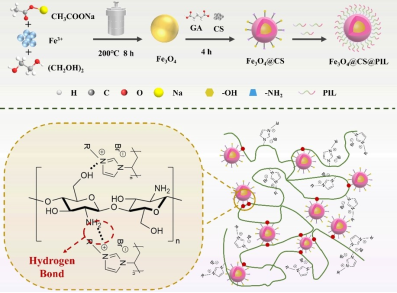
Figure 1. Preparation procedure forFe3O4@CS@P[VEIm]Br demulsifier particles.
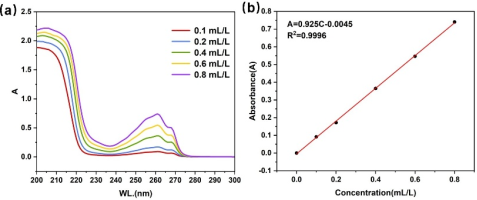
Figure 2. (a) UV absorption profiles of toluene emulsions with varying concentrations. (b) Calibration curve of toluene emulsion.
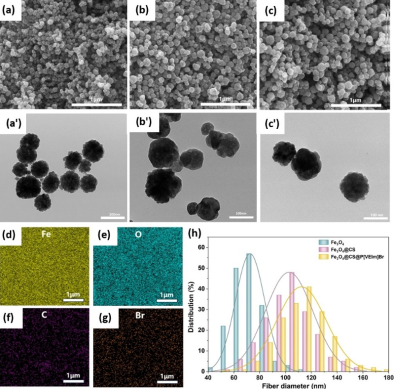
Figure 3. The TEM and SEM images of three demulsifier particles (a, a') Fe3O4. (b, b') Fe3O4@CS, (c, c') Fe3O4@CS@P[VEIm]Br were obtained. (d-g) EDS scanning image of Fe3O4@CS@P[VEIm]Br. (h) Particle size distribution of Fe3O4, Fe3O4@CS, Fe3O4@CS@P[VEIm]Br.
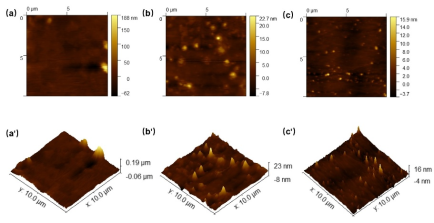
Figure 4. (a, a') Fe3O4, (b, b') Fe3O4@CS, (c, c') Fe3O4@CS@P[VEIm]Br AFM images.
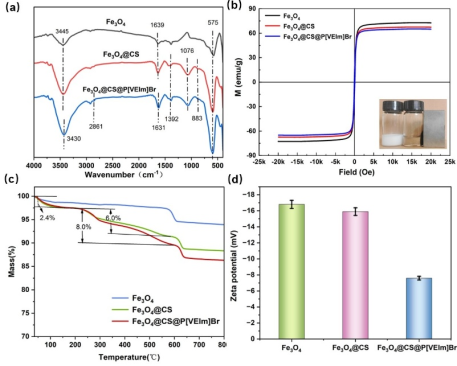
Figure 5. Fe3O4、Fe3O4@CS和Fe3O4@CS@P[VEIm]Br demulsifier particles (a) FT-IR; (b) VSM (illustrated as image of original emulsion and emulsion after demulsification). (c) TGA analysis. (d) Zeta potential test.
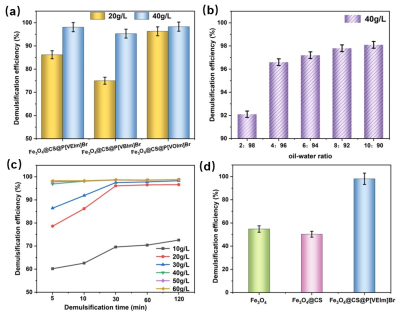
Figure 6. (a) The demulsification efficiency of Fe3O4@CS@P[VEIm]Br、Fe3O4@CS@P[VBIm]Br and Fe3O4@CS@P[VOIm]Br at 10 min. (b) The demulsification efficiency of Fe3O4@CS@P[VEIm]Br for O/W emulsions at different concentrations. (c) The demulsification efficiency of Fe3O4@CS@P[VEIm]Br with different dosage and demulsification time. (d) Demulsification efficiency of Fe3O4、Fe3O4@CS and Fe3O4@CS@P[VEIm]Br.
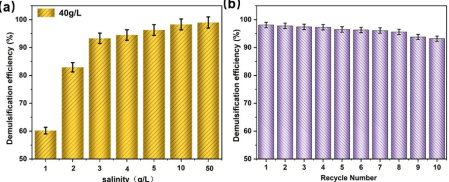
Figure 7. The demulsification efficiency of Fe3O4@CS@P[VEIm]Br demulsifier particles (a) at different salinities. (b) Recycling performance.
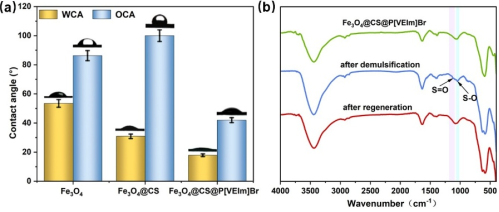
Figure 8. (a) The water and oil contact angles of Fe3O4, Fe3O4@CS and Fe3O4@CS@P[VEIm]Br were tested. (b) FT-IR test of Fe3O4@CS@P[VEIm]Br before demulsification, after demulsification and after regeneration.
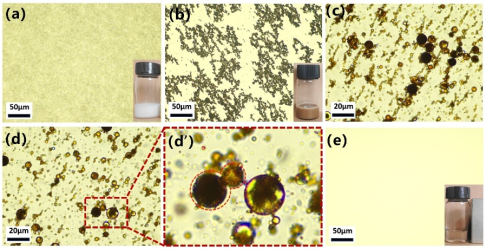
Figure 9. The optical microscope of O/W emulsion at different demulsification stages (a) The microscope of the original emulsion. (b) Add 40 g/L Fe₃O₄@CS@P[VEIm]Br to the emulsion and shake the microscope after 5 min. (c, d) is the enlarged microscope image of Figure (b). (d') is the further enlarged graph of Figure (d). (e) Microscopic image of emulsion after magnetic separation.
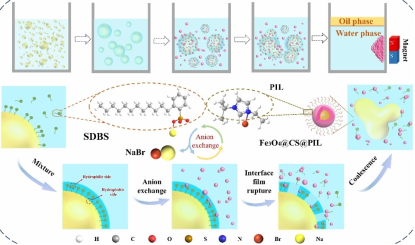
Figure 10. Demulsification separation process and demulsification mechanism of Fe3O4@CS@P[VEIm]Br towards emulsified oil wastewater.

Information


 Share This Article
 Twitter
 Linked In
 Facebook

 Copy
 Download