
The sluggish kinetics of the anodic oxygen evolution reaction (OER) in water electrolysis for hydrogen production and its heavy dependence on noble metal catalysts restrict the large-scale application of green hydrogen energy. In this work, we designed and prepared a self-supported dual-phase high-entropy layered double hydroxide/spinel (HELDH/HESO) heterostructured oxygen evolution electrocatalyst, (K)-NiCoFeCrCe-HELDH/HESO@NF, synergistically driven by alkali metal potassium (K). Through a one-step hydrothermal method, six metal salts containing K, Ni, Co, Fe, Cr, and Ce were co-deposited on a nickel foam (NF) substrate, yielding a self-supported electrode with a three-dimensional nanosheet structure and moderate pore size. The introduction of catalytically inactive alkali metal K into the lattice induces lattice expansion and distortion, optimizes the electronic density of states of adjacent transition metals (Ni, Co, Fe), and regulates the d-band center position, thereby optimizing the adsorption free energies of oxygen-containing intermediates (OH*, O*, OOH*) and significantly enhancing the intrinsic OER activity. The dual-phase LDH/spinel heterointerfaces provide high-density defects and unsaturated coordination sites, strengthening interfacial electronic regulation. In 1 M KOH electrolyte, (K)-NiCoFeCrCe-HELDH/HESO@NF requires only overpotentials of 279 mV and 355 mV to achieve current densities of 100 mA cm-2 and 1000 mA cm-2, respectively, outperforming the K-free counterpart electrode. In an anion exchange membrane (AEM) electrolyzer under simulated industrial conditions, the electrode operated continuously at a constant current of 1 A for 100 h with only about 6.4% voltage increase, demonstrating excellent long-term stability. The preparation process is simple, reproducible, cost-controllable, and environmentally friendly, offering a new strategy for the development of efficient, stable, and low-cost non-noble-metal OER catalysts.
| Published in | American Journal of Environmental Science and Engineering (Volume 10, Issue 4) |
| DOI | 10.11648/j.ajese.20261004.16 |
| Page(s) | 164-171 |
| Creative Commons |
This is an Open Access article, distributed under the terms of the Creative Commons Attribution 4.0 International License (http://creativecommons.org/licenses/by/4.0/), which permits unrestricted use, distribution and reproduction in any medium or format, provided the original work is properly cited. |
| Copyright |
Copyright © The Author(s), 2026. Published by Science Publishing Group |
Oxygen Evolution Reaction, High-entropy Materials, Heterostructures, Water Electrolysis for Hydrogen Production, Anion Exchange Membrane Electrolyzer
OER | Oxygen Evolution Reaction |
AEM | Anion Exchange Membrane |
| [1] | Y. Xun, Z. Wei, M. Li, S. Zhou, Y. Ma, W. Liu, S. Chang, J. Ding, Digital light processing of Zr-doped NiFe self-supported electrodes for efficient and stable high-current-density oxygen evolution, Virtual Phys. Prototyping 21 (2026) e2607267. |
| [2] | J. He, Y. Zhao, Y. Li, Q. Yuan, Y. Wu, K. Wang, K. Sun, J. Wu, J. Jiang, B. Zhang, L. Wang, M. Fan, Joule heating-driven sp2-C domains modulation in biomass carbon for high-performance bifunctional oxygen electrocatalysis, Nano Micro Lett. 17 (2025). |
| [3] | Y. Zhai, X. Ren, T. Gan, L. She, Q. Guo, N. Yang, B. Wang, Y. Yao, S. (Frank) Liu, Deciphering the synergy of multiple vacancies in high-entropy layered double hydroxides for efficient oxygen electrocatalysis, Adv. Energy Mater. 15 (2025) 2502065. |
| [4] | E. Wallnöfer-Ogris, I. Grimmer, M. Ranz, M. Höglinger, S. Kartusch, J. Rauh, M.-G. Macherhammer, B. Grabner, A. Trattner, A review on understanding and identifying degradation mechanisms in PEM water electrolysis cells: Insights for stack application, development, and research, Int J Hydrogen Energy 65 (2024) 381–397. |
| [5] | Q. Hu, A. Li, Y. Sun, L. Liu, T. Liu, C. Li, H. Han, Tailor control of neodymium doping sites in γ‐MnO2 for stable oxygen evolution reaction in acidic electrolyte, Adv. Funct. Mater. (2025) 2423709. |
| [6] | C. Feng, Y. Zhou, M. Chen, L. Zou, X. Li, X. An, Q. Zhao, P. Xiaokaiti, A. Abudula, K. Yan, G. Guan, High-entropy spinel (FeCoNiMnAl)3O4 with three-dimensional microflower structure for stable seawater oxidation, Appl. Catal. B Environ. Energy 349 (2024) 123875. |
| [7] | Y. Song, J. Qian, S. Li, Z. Zhao, H. Chen, K. Zou, Z. Han, Z. Li, H. Li, H. Zhou, M. Shao, Stabilizing lattice oxygen to enable durable MnO2 electrocatalyst for simultaneous acidic hydrogen production and biomass valorization, Angew. Chem. Int. Ed. 64 (2025). |
| [8] | Z. Ji, J. Sun, Y. Jin, H. Guo, H. Cheng, X. Lang, L. Chen, Y. Zhu, Q. Jiang, Charge self-modulation of the NiCo-OH/FeOOH heterostructure for industrial-current-density oxygen evolution reaction, Chemical Engineering Journal 538 (2026) 176823. |
| [9] | J. Sun, N. Zhao, J. Xin, M. Yu, C. Lv, Y. Jiao, X. Wang, Orbital hybridization and adsorption modulating in Mo/P Co-doped Ni3S2 enables superior urea-assisted water electrolysis at industrial current density, Appl Catal, B 386 (2026) 126446. |
| [10] | G. Shi, J. Li, T. Lu, C. Yang, Q. Xu, H. Gu, H. Tong, S. Zhao, C. Zhu, Y. Shen, J. Wu, X. Lao, P.-C. Chen, J. Li, S. Zhang, J. Shi, K.H.L. Zhang, Y.-F. Li, Z.-P. Liu, L. Zhang, Lattice O–O ligands in Fe-incorporated hydroxides enhance water oxidation electrocatalysis, Nat. Chem. 17 (2025) 1607–1614. |
| [11] | J. Baek, K.S. Hamkins, Y. Li, A.T. Garcia-Esparza, T. Liu, C.-T. Kuo, J.-S. Lee, A.W. Potter, S. Kim, Y. Wang, H. Ding, J. Li, Z. Zhuo, J. Guo, M. Bajdich, X. Zheng, Modulating coordinate site occupancy in high-entropy spinel electrocatalysts, Nat Commun 17 (2026) 3540. |
| [12] | F. Lu, G. Feng, H. Qi, Q. Li, L. Su, Z. Kang, Y. Hou, Z. Huang, D. Xia, Structurally ordered high-entropy intermetallics for electrocatalysis, Adv. Energy Mater. 15 (2025) e03306. |
| [13] | M. Coduri, L.R. Magnaghi, M. Fracchia, R. Biesuz, U. Anselmi-Tamburini, Assessing phase stability in high-entropy materials by design of experiments: The case of the (Mg, Ni, Co, Cu, Zn)O system, Chem. Mater. 36 (2024) 720–729. |
| [14] | Z. Wang, S. Chen, R. Chen, H. Jiang, Y. Jiang, Q. Wei, W. Wu, J. Zhong, N. Cheng, Charge competition enhancing Ru-based high entropy oxide nanosheet for efficient and stable oxygen evolution, Applied Catalysis B: Environment and Energy 383 (2026) 126034. |
| [15] | Q. Lu, J. Liu, X. Zou, B. Huang, W. Wu, J. Yin, Z. Liu, Y. Wang, Breaking the activity‐stability trade‐off of RuO2 via metallic Ru bilateral regulation for acidic oxygen evolution reaction, Angew. Chem. Int. Ed. 64 (2025) e202503733. |
| [16] | Y. Gao, M. Yan, H. Zhong, M. Li, J. Yao, B. Zhang, Compressed Co–O bonds resist chlorine corrosion to enhance the stability of chlorine‐involved anodic reactions, Angew. Chem. Int. Ed. 65 (2026) e19520. |
| [17] | N. Sun, Z. Zheng, L. Jiang, G. Liu, Y. Qin, W.-H. Huang, C.-W. Pao, Z. Hu, M. Lei, T. Ying, R. Yu, K. Huang, Entropy-stabilized cation–anion vacancies coupling in high-entropy two-dimensional crystals for efficient oxygen evolution, Adv. Funct. Mater. 36 (2026) e75186. |
| [18] | L. Tang, T. Zhang, Z. Cao, L. Li, X. Li, F. Wang, H. Cong, Oxophilic regulation drives the mechanism transition of NiOOH toward the oxide pathway for water oxidation, Adv Funct Materials (2026) e77785. |
| [19] | W. Guan, C. Zhang, Y. Zhang, Y. Feng, Y. Mei, Q. Qi, Y. Song, J. Hu, High-entropy heterostructures modulated by oxyphilic transition metals for efficient oxygen evolution reaction, Nano Energy 134 (2025) 110528. |
| [20] | Z. Li, Y. Jin, Z. Ji, H. Kang, X. Lang, L. Chen, Y. Zhu, Local electronic environment regulation of crystalline/amorphous NiSe/NiFe(OH)x heterostructure enhancing catalytic activity of alkaline oxygen evolution reaction, Small 22 (2026) e14445. |
| [21] | H. Yang, F. Chen, X. Wang, J. Qian, J. Wang, J. Li, C. Lv, L. Li, S. Bandaru, J. Gao, Self-reconstructed spinel with enhanced SO42− adsorption and highly exposed Co3+ from heterostructure boosts activity and stability at high current density for overall water splitting, Adv. Funct. Mater. 35 (2025) 2419978. |
| [22] | Z. Liu, F. Ren, M. Li, R. He, Activating inert bismuth atoms via interfacial p–d orbital hybridization: A robust strategy for efficient oxygen evolution reaction, J. Colloid Interface Sci. 727 (2027) 141556. |
| [23] | J. Li, L. Liu, D. Guan, H. Liang, Z. Lu, H. Wang, Y. Zhang, J. Tang, S. Chen, G. Feng, L. Zeng, R.V. Kumar, J. Xu, S. Ding, Y.-L. He, K. Xi, d-p Orbital Hybridization Tailoring for Boosted Redox Kinetics in Li-CO2 Batteries, Advanced Functional Materials 36 (2026) e14223. |
| [24] | F. Wang, L. Feng, M. Zhang, H. Cong, Engineering oxygen nonbonding states in high entropy hydroxides for scalable water oxidation, Nat. Commun. 16 (2025) 6624. |
| [25] | R. Zhang, X. Ji, Y. Fan, F. Yang, S. Lin, X. Lu, Local coordination engineering of NiFe-LDH catalyst with carboxylate and sodium for durable seawater oxygen evolutionNiFe-LDH, Applied Catalysis B: Environment and Energy 381 (2026) 125850. |
APA Style
Li, X., Dong, B., Chai, Y. (2026). Alkali Metal Potassium-Synergistically Driven Dual-Phase High-Entropy Layered Double Hydroxide/Spinel Heterostructure for Efficient Oxygen Evolution Reaction. American Journal of Environmental Science and Engineering, 10(4), 164-171. https://doi.org/10.11648/j.ajese.20261004.16
ACS Style
Li, X.; Dong, B.; Chai, Y. Alkali Metal Potassium-Synergistically Driven Dual-Phase High-Entropy Layered Double Hydroxide/Spinel Heterostructure for Efficient Oxygen Evolution Reaction. Am. J. Environ. Sci. Eng. 2026, 10(4), 164-171. doi: 10.11648/j.ajese.20261004.16
@article{10.11648/j.ajese.20261004.16,
  author = {Xin Li and Bin Dong and Yong-Ming Chai},
  title = {Alkali Metal Potassium-Synergistically Driven Dual-Phase High-Entropy Layered Double Hydroxide/Spinel Heterostructure for Efficient Oxygen Evolution Reaction},
  journal = {American Journal of Environmental Science and Engineering},
  volume = {10},
  number = {4},
  pages = {164-171},
  doi = {10.11648/j.ajese.20261004.16},
  url = {https://doi.org/10.11648/j.ajese.20261004.16},
  eprint = {https://article.sciencepublishinggroup.com/pdf/10.11648.j.ajese.20261004.16},
  abstract = {The sluggish kinetics of the anodic oxygen evolution reaction (OER) in water electrolysis for hydrogen production and its heavy dependence on noble metal catalysts restrict the large-scale application of green hydrogen energy. In this work, we designed and prepared a self-supported dual-phase high-entropy layered double hydroxide/spinel (HELDH/HESO) heterostructured oxygen evolution electrocatalyst, (K)-NiCoFeCrCe-HELDH/HESO@NF, synergistically driven by alkali metal potassium (K). Through a one-step hydrothermal method, six metal salts containing K, Ni, Co, Fe, Cr, and Ce were co-deposited on a nickel foam (NF) substrate, yielding a self-supported electrode with a three-dimensional nanosheet structure and moderate pore size. The introduction of catalytically inactive alkali metal K into the lattice induces lattice expansion and distortion, optimizes the electronic density of states of adjacent transition metals (Ni, Co, Fe), and regulates the d-band center position, thereby optimizing the adsorption free energies of oxygen-containing intermediates (OH*, O*, OOH*) and significantly enhancing the intrinsic OER activity. The dual-phase LDH/spinel heterointerfaces provide high-density defects and unsaturated coordination sites, strengthening interfacial electronic regulation. In 1 M KOH electrolyte, (K)-NiCoFeCrCe-HELDH/HESO@NF requires only overpotentials of 279 mV and 355 mV to achieve current densities of 100 mA cm-2 and 1000 mA cm-2, respectively, outperforming the K-free counterpart electrode. In an anion exchange membrane (AEM) electrolyzer under simulated industrial conditions, the electrode operated continuously at a constant current of 1 A for 100 h with only about 6.4% voltage increase, demonstrating excellent long-term stability. The preparation process is simple, reproducible, cost-controllable, and environmentally friendly, offering a new strategy for the development of efficient, stable, and low-cost non-noble-metal OER catalysts.},
 year = {2026}
}
TY  - JOUR
T1  - Alkali Metal Potassium-Synergistically Driven Dual-Phase High-Entropy Layered Double Hydroxide/Spinel Heterostructure for Efficient Oxygen Evolution Reaction
AU  - Xin Li
AU  - Bin Dong
AU  - Yong-Ming Chai
Y1  - 2026/11/10
PY  - 2026
N1  - https://doi.org/10.11648/j.ajese.20261004.16
DO  - 10.11648/j.ajese.20261004.16
T2  - American Journal of Environmental Science and Engineering
JF  - American Journal of Environmental Science and Engineering
JO  - American Journal of Environmental Science and Engineering
SP  - 164
EP  - 171
PB  - Science Publishing Group
SN  - 2578-7993
UR  - https://doi.org/10.11648/j.ajese.20261004.16
AB  - The sluggish kinetics of the anodic oxygen evolution reaction (OER) in water electrolysis for hydrogen production and its heavy dependence on noble metal catalysts restrict the large-scale application of green hydrogen energy. In this work, we designed and prepared a self-supported dual-phase high-entropy layered double hydroxide/spinel (HELDH/HESO) heterostructured oxygen evolution electrocatalyst, (K)-NiCoFeCrCe-HELDH/HESO@NF, synergistically driven by alkali metal potassium (K). Through a one-step hydrothermal method, six metal salts containing K, Ni, Co, Fe, Cr, and Ce were co-deposited on a nickel foam (NF) substrate, yielding a self-supported electrode with a three-dimensional nanosheet structure and moderate pore size. The introduction of catalytically inactive alkali metal K into the lattice induces lattice expansion and distortion, optimizes the electronic density of states of adjacent transition metals (Ni, Co, Fe), and regulates the d-band center position, thereby optimizing the adsorption free energies of oxygen-containing intermediates (OH*, O*, OOH*) and significantly enhancing the intrinsic OER activity. The dual-phase LDH/spinel heterointerfaces provide high-density defects and unsaturated coordination sites, strengthening interfacial electronic regulation. In 1 M KOH electrolyte, (K)-NiCoFeCrCe-HELDH/HESO@NF requires only overpotentials of 279 mV and 355 mV to achieve current densities of 100 mA cm-2 and 1000 mA cm-2, respectively, outperforming the K-free counterpart electrode. In an anion exchange membrane (AEM) electrolyzer under simulated industrial conditions, the electrode operated continuously at a constant current of 1 A for 100 h with only about 6.4% voltage increase, demonstrating excellent long-term stability. The preparation process is simple, reproducible, cost-controllable, and environmentally friendly, offering a new strategy for the development of efficient, stable, and low-cost non-noble-metal OER catalysts.
VL  - 10
IS  - 4
ER  -
College of Chemistry and Chemical Engineering, China University of Petroleum (East China), Qingdao, China
College of Chemistry and Chemical Engineering, China University of Petroleum (East China), Qingdao, China
College of Chemistry and Chemical Engineering, China University of Petroleum (East China), Qingdao, China
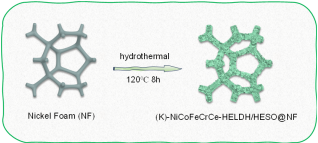
Figure 1. Schematic diagram of the synthesis of the (K)-NiCoFeCrCe-HELDH/HESO@NF.
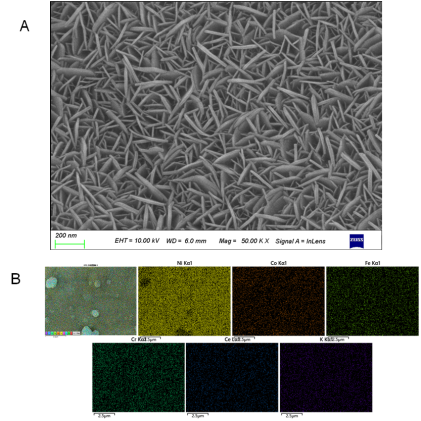
Figure 2. (A) SEM images of (K)-NiCoFeCrCe-HELDH/HESO@NF. (B) Elemental distribution maps of (K)-NiCoFeCrCe-HELDH/HESO@NF.
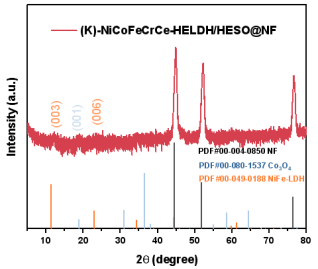
Figure 3. XRD images of (K)-NiCoFeCrC-HELDH/HESO@NF.

Figure 4. A) LSV curves of (K)-NiCoFeCrCe-HELDH/HESO@NF. (B) Overpotentials in ŋ100 and ŋ1000.
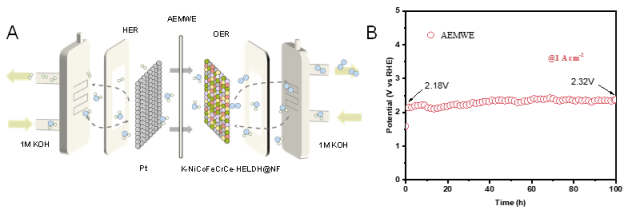
Figure 5. (A) Schematic illustration of the AEM electrolyzer configuration of (K)-NiCoFeCrCe-HELDH/HESO@NF. (B) Long-term durability measurement was carried out for the AWE at 1 A cm-2.

Information



 Share This Article
 Twitter
 Linked In
 Facebook

 Copy
 Download