Sm3+ doped PbO–Sb2O3 glasses containing varying concentrations of Sm2O3 (0–1.0 mol%) were synthesized using the conventional melt-quenching technique to investigate their structural, optical, and luminescent properties. The prepared glass samples were characterized through density measurements, optical absorption spectroscopy, photoluminescence, and infrared spectral studies. Density analysis revealed a gradual increase with increasing Sm3+ concentration, accompanied by a decrease in interionic distance and an increase in field strength, indicating significant modifications in the local glass structure. Optical absorption spectra exhibited several well-defined bands in the visible and near-infrared regions corresponding to the characteristic f–f transitions of Sm3+ ions, with absorption intensity increasing systematically with dopant concentration. Photoluminescence studies under 401 nm excitation showed intense emission bands originating from the 4G5/2 excited state of Sm3+ ions, and the luminescence intensity was found to enhance with increasing Sm2O3 content. Infrared spectral analysis confirmed the presence of SbO3 pyramidal structural units along with PbO4 groups, suggesting that PbO plays a dual role as both a network former and a network modifier within the glass matrix. The combined structural and spectroscopic results demonstrate that Sm3+ doped lead antimonate glasses possess favorable optical and luminescent characteristics, making them promising materials for photonic and luminescent device applications.
This is an Open Access article, distributed under the terms of the Creative Commons Attribution 4.0 International License (http://creativecommons.org/licenses/by/4.0/), which permits unrestricted use, distribution and reproduction in any medium or format, provided the original work is properly cited.
Antimony oxide (Sb2O3) glasses are considered promising materials for various advanced optical applications due to their remarkable physical and optical properties. These glasses are particularly suitable for non-linear optical devices such as ultrafast optical switches, power limiters, and broadband optical amplifiers operating near 1.5 μm. Their usefulness in several solid-state ionic devices is mainly attributed to the large third-order non-linear optical susceptibility (χ3) coefficient they possess
[1]
M. Nalin, M. Poulain, J. L. Ribeiro, Y. Messaddeq, J. Non-Cryst. Solids, 284 (2001) 110.
[2]
M. Nalin, M. Poulain, M. Poulain, S. J. L. Ribeiro, Y. Messaddeq, J. Non-Cryst. Solids 284 (2001) 117.
[3]
E. Fargin, A. Berthereau, T. Cardinal, G. Le Flem, L. Ducasse, L. Canioni, P. Segonds, L. Sarger, A. Ducasse, J. Non-Cryst. Solids 203 (1996) 96.
[4]
K. Terashima, T. Hashimoto, T. Uchino, T. Yoko, J. Ceram. Soc. Japan 104 (1996) 1008.
[1-4]
. Antimony trioxide is a highly stable oxide that remains insoluble in water as well as in nitric and sulphuric acids
[5]
F. A. Cotton, G. Wilkinson, C. A. Murillo, M. Bochmann, Advanced Inorganic Chemistry, John Wiley & Sons, 1999.
[5]
. Within the glass network, Sb2O3 participates through SbO3 structural units, which can be visualized as distorted tetrahedral arrangements where oxygen atoms occupy three corners, while a lone pair of electrons associated with the Sb3+ ion occupies the fourth position in the equatorial direction of the antimony atom. The high deformability of this lone electron pair is believed to play a significant role in enhancing the non-linear optical susceptibility of these glasses
[6]
J. C. Sabadel, P. Armand, D. Cachau-Herreillat, P. Baldeck, O. Doclot, A. Ibanez, E. Philippot, J. Solid State Chem. 132 (1997) 411.
[6]
. In addition, PbO-containing glasses have attracted considerable technological interest because of their potential applications in ultra-low-loss waveguides, glass-to-metal seals, infrared transmitting devices, and optical gratings
[7]
C. C. Wang, Phys. Rev. B 2 (1970) 2045.
[8]
J. L. Wiza, Nucl. Instrum. Methods 62 (1979) 587.
[7, 8]
.
2. Methods of Preparation of Glasses
The glass samples investigated in the present study were prepared with the following compositions (in mol%):
S0: 40PbO–60 Sb2O3
S2: 40PbO–59.8Sb2O3–0.2Sm2O3
S5: 40PbO–59.5Sb2O3–0.5Sm2O3
S10: 40PbO–59Sb2O3–1.0 Sm2O3
The glass samples investigated in the present study were prepared using the conventional melt-quenching technique. Analytical reagent grade chemicals (99.9% purity) of PbO, Sb2O3, and Sm2O3 were employed as the starting materials. The required proportions of the constituent compounds were accurately weighed, thoroughly mixed in an agate mortar, and melted in a platinum crucible using a PID temperature-controlled furnace. The melting process was carried out at approximately 1400°C for about 1 h until a homogeneous and bubble-free melt was obtained. The molten liquid was then poured into a rectangular brass mould with a smooth polished inner surface maintained at room temperature. The prepared glass samples were subsequently annealed at 450°C in a separate furnace to remove internal stresses. Finally, the samples were ground and optically polished. The approximate dimensions of the polished glass specimens used for optical and electrical measurements were 1 cm × 1 cm × 0.2 cm.
The density (d) of the prepared glasses was measured by the standard Archimedes principle using high-purity o-xylene (99.99%) as the immersion liquid. A high-precision direct-reading balance with a capacity of 100 g and a readability of 0.1 mg was employed for the weight measurements. Optical absorption spectra of the glass samples were recorded in the wavelength range of 250–800 nm using a JASCO V-670 UV–Vis spectrophotometer. Infrared transmission spectra were obtained in the spectral range 400–2000 cm-1 with a resolution of 0.1 cm-1 using the KBr (potassium bromide) pellet technique. For this purpose, finely powdered glass samples (1.5 mg) were mixed with 300 mg of potassium bromide and pressed into pellets under a vacuum die at a pressure of approximately 680 MPa. The infrared spectra were recorded using a Jasco FT/IR-5300 spectrophotometer.
The photoluminescence spectra of the samples were recorded at room temperature on a Thermo Scientific Lumina spectrofluorometer. It is a computer controlled spectrofluorimeter for measuring steady state luminescence spectra in the 200-900 nm spectral range with single photon counting sensitivity.
3. Results
3.1. Physical Parameters
Various physical parameters such as total Sm3+ ion concentration Ni, mean Sm3+ ion separation Ri, have been evaluated with the measured values of density d and the calculated average molecular weight for the present these glasses and are presented in Table 1.
Table 1. Various physical parameters of Sm3+ doped PbO<i></i>Sb2O3 glasses.
Glass
Avg. Mol. Wt. M
Density d (g/cm3)
Sm3+ ion Conc. Ni(1019/cm3)
Inter ionic distance of Sm3+ ions ri(nm)
Polaron radius rp (nm)
Field strength Fi (1013 cm-2)
Refractive index n
S0
264.19
3.12
–
–
–
–
1.642
S2
264.31
3.54
1.62
3.95
1.018
2.891
1.644
S5
264.47
3.71
4.23
2.86
1.403
1.522
1.648
S10
264.76
4.64
10.57
2.12
1.905
8.262
1.651
3.2. Optical Absorption Studies
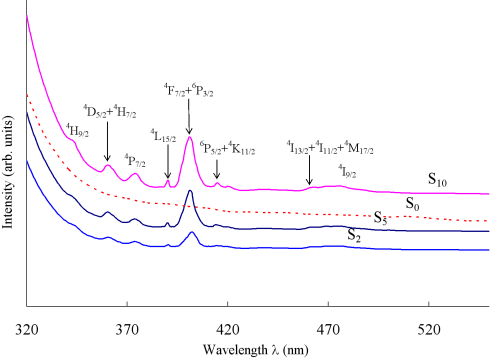
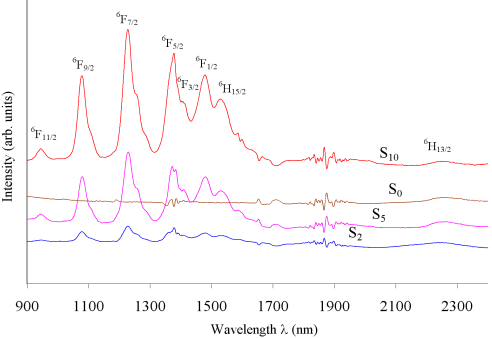
Figures 1 and 2 represents the optical absorption spectra of PbOSb2O3: Sm2O3 glassesrecorded at room temperature in the visible region and NIR region respectively. The spectrum of Sm2O3 free glass has not exhibited any absorption bands.
The spectra of Sm3+ doped glasses exhibited the bands due to the following transitions of Sm3+ ions:
6H5/24H9/2, 4D5/2 + 4H7/2, 4P7/2, 4L15/2, 4F7/2 + 6P3/2, 6P5/2 + 4K11/2, 4I13/2 +4I11/2 + 4M17/2 and 4I9/2 (in the visible region) and 6F11/2, 6F9/2, 6F7/2, 6F5/2, 6F3/2, 6F1/2, 6H15/2 and 6H13/2 (in NIR region)
With increase in the concentration of Sm2O3 an increase in the intensity of all absorption bands of all the glasses is observed.
Figure 2. Optical absorption spectra of lead antimony glasses doped with different concentrations of Sm2O3 in the NIR region.
3.3. Photoluminescence (PL) Spectra
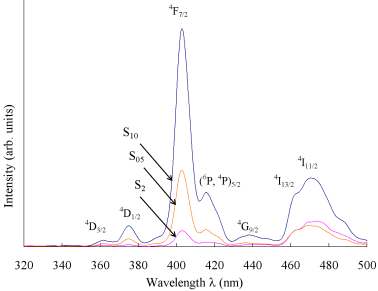
The excitation and emission spectra of Sm3+ doped PbO–Sb2O3 glasses were recorded at room temperature under 401 nm excitation. The emission spectra (Figure 3) exhibited several characteristic bands corresponding to the transitions from the 4G5/2 excited state to the 6H5/2, 6H7/2, 6H9/2, and 6H11/2 energy levels. Among these transitions, the emission bands corresponding to 4G5/2 → 6H7/2 and 4G5/2 → 6H9/2 were found to be more intense, whereas the bands associated with the 4G5/2 → 6H5/2 and 4G5/2 → 6H11/2 transitions appeared relatively weak. Furthermore, the intensity of all the observed emission bands increased progressively with increasing Sm2O3 concentration in the glass matrix.
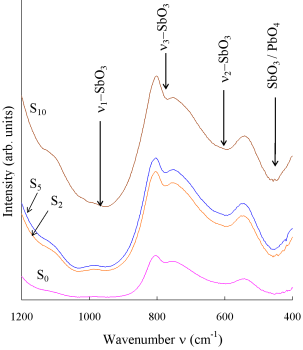
Figure 4. IR spectra of PbO<i></i>Sb2O3: Sm2O3 glass system.
Figure 4 shows the IR spectra of PbO–Sb2O3: Sm2O3 glasses recorded at room temperature in the spectral region 400–2000 cm-1. All the glass samples exhibit a characteristic band around 930 cm-1, which is attributed to the ν1 symmetric stretching vibrations of SbO3 structural units. Another prominent band observed near 610 cm-1 corresponds to the ν2 bending vibrations of Sb–O bonds associated with SbO3 pyramidal groups. In addition, weak double-degenerate stretching (ν3) and bending (ν4) vibrational bands of SbO3 units are identified around 770 and 450 cm-1, respectively
[9]
G. Little Flower, G. Sahaya Baskaran, N. Krishna Mohan, N. Veeraiah, Mater. Chem. Phys. 100 (2006) 211.
[9]
. In the ν4 vibrational region of SbO3 groups, the presence of a band related to the vibrations of PbO4 structural units is also expected
[10]
Ch. Srinivasa Rao, T. Srikumar, Y. Gandhi, V. Ravi Kumar, N. Veeraiah, Philos. Mag. 91 (2011) 958.
[10]
. The overall band profiles and spectral features remain nearly unchanged for all the investigated glass compositions.
4. Discussion
Sb2O3 is a weak glass former because the Sb3+ ion has a lone pair of electrons that occupies more space, which makes the local structure around the Sb3+ ions less symmetric. Hence, strain energy in the Sb2O3 glass network is much higher when compared when compared with that in the traditional borate, silicate and phosphate glass networks. However, in the presence of modifiers such as PbO, Sb2O3 becomes an active part of the glass network through the formation of SbO3 structural units, where oxygen atoms occupy three corners and the lone pair of electrons resides at the fourth corner. In several glass systems, the Sb–O bond length in these SbO3 units has been reported to lie between 2.0 and 2.6 Å. Within the glass matrix, the SbO3 polyhedra are interconnected through corner sharing, resulting in the formation of double infinite chains with the lone pair electrons directed outward. The secondary weak Sb–O bonds that link these chains are generally longer than 2.6 Å
[11]
B. Dubois, J. J. Videau, J. Portier J. Non-Cryst. Solids 88 (1986) 355–65.
[12]
P. J. Miller, C. A. Cody, Spectrochim. Acta A 38 (1982) 555–9.
[13]
B. V. Raghavaiah, N. Veeraiah, Phys. Status Solidi a199 (2003) 389–402.
[11-13]
.
PbO generally behaves as a network modifier and enters the glass structure by disrupting the Sb–O–Sb linkages. According to the conventional understanding of modifying oxides in glass networks, oxygen ions reduce the local symmetry, whereas Pb²+ ions occupy interstitial sites and generate coordination defects such as dangling bonds and non-bridging oxygen ions. Such behavior requires Pb to adopt sp3d² hybridization involving the 6s, 6p, and 6d orbitals. Nevertheless, PbO can also participate directly in the glass network through the formation of [PbO4/2] pyramidal units arranged in puckered layers, in which Pb ions are covalently bonded to four oxygen atoms
[14]
L. Srinivasa Rao, M. Srinivasa Reddy, M. V. Ramana Reddy, N. Veeraiah, Physica B: Condensed Matter 403(2008): 2542-2556.
[15]
P. Syam Prasad, B. V. Raghavaiah, R. Balaji Rao, C. Laxmikanth, N. Veeraiah, Solid State Commun. 132 (2004) 35-240.
[14, 15]
. Evidence supporting the existence of PbO4 units in the present glass system has been obtained from the IR spectral studies (Figure 4).
The luminescence spectra of Sm3+ ions observed in the present work are comparable to those reported for several other glass systems
[16]
M. Molinowiski, R. Wolski, Z. Frukacz, T. Lukasiewicz, Z. Luczynski, J. Appl. Spectro. 62 (1995) 49.
[17]
A. Herrmann, D. Ehrt, J. Non-Cryst. Solids 354 (2008) 916.
[18]
E. Malchukova B. Boizot, G. Petite, D. Ghaleb, J. Non-Cryst. Solids 353 (2007) 2397.
[16-18]
. The intensity, or quantum yield, of the luminescence bands increases with increasing Sm3+ concentration in the glasses. This behavior suggests that cross-relaxation processes are relatively weak in these glasses. In other words, the transfer of energy from an excited Sm3+ ion to a neighboring Sm3+ ion in the ground state through electric multipole interactions, particularly dipole–dipole or dipole–quadrupole interactions, is comparatively less significant, even at higher Sm2O3 concentrations.
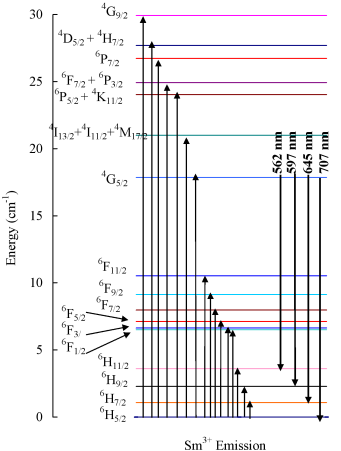
The energy level diagram representing various absorption and emission transitions of Pr3+ ions is shown in Figure 5.
Figure 5. The detailed energy level diagram involving all absorption and emission transitions of Sm3+ ions in lead antimony glass system.
5. Conclusions
The analysis of the results of various studies viz. optical absorption, luminescence and infrared spectra of PbOSb2O3: Sm2O3 glasses were systematically investigated. The increase in Sm3+ concentration leads to enhanced density, reduced interionic separation, and increased field strength, indicating a more compact glass network. Optical absorption and photoluminescence studies confirm the presence of characteristic Sm3+ transitions, with intensities increasing as a function of dopant concentration. The enhanced luminescence suggests reduced non-radiative losses and relatively low cross-relaxation effects at higher concentrations. Infrared spectral analysis verifies that the glass structure is primarily composed of SbO3 units, while PbO contributes both as a modifier and as a network former through PbO4 units. Overall, the improved optical and luminescent properties demonstrate that Sm3+ doped lead antimonate glasses are suitable for applications in optical amplifiers, solid-state lighting, and photonic devices.
Reddy, A. S. S., Pushpalatha, K., Sriramudu, B., Chandrakala, C., Mohan, T. V. R. (2026). Spectroscopic and Luminescence Properties of Sm3+ Doped Lead Antimonate Glasses. American Journal of Modern Physics, 15(3), 109-114. https://doi.org/10.11648/j.ajmp.20261503.16
Reddy, A. S. S.; Pushpalatha, K.; Sriramudu, B.; Chandrakala, C.; Mohan, T. V. R. Spectroscopic and Luminescence Properties of Sm3+ Doped Lead Antimonate Glasses. Am. J. Mod. Phys.2026, 15(3), 109-114. doi: 10.11648/j.ajmp.20261503.16
Reddy ASS, Pushpalatha K, Sriramudu B, Chandrakala C, Mohan TVR. Spectroscopic and Luminescence Properties of Sm3+ Doped Lead Antimonate Glasses. Am J Mod Phys. 2026;15(3):109-114. doi: 10.11648/j.ajmp.20261503.16
@article{10.11648/j.ajmp.20261503.16,
  author = {Annapreddy Siva Sesha Reddy and Kavuluri Pushpalatha and Barre Sriramudu and Ch. Chandrakala and Talla Venkata Rama Mohan},
  title = {Spectroscopic and Luminescence Properties of Sm3+ Doped Lead Antimonate Glasses},
  journal = {American Journal of Modern Physics},
  volume = {15},
  number = {3},
  pages = {109-114},
  doi = {10.11648/j.ajmp.20261503.16},
  url = {https://doi.org/10.11648/j.ajmp.20261503.16},
  eprint = {https://article.sciencepublishinggroup.com/pdf/10.11648.j.ajmp.20261503.16},
  abstract = {Sm3+ doped PbO–Sb2O3 glasses containing varying concentrations of Sm2O3 (0–1.0 mol%) were synthesized using the conventional melt-quenching technique to investigate their structural, optical, and luminescent properties. The prepared glass samples were characterized through density measurements, optical absorption spectroscopy, photoluminescence, and infrared spectral studies. Density analysis revealed a gradual increase with increasing Sm3+ concentration, accompanied by a decrease in interionic distance and an increase in field strength, indicating significant modifications in the local glass structure. Optical absorption spectra exhibited several well-defined bands in the visible and near-infrared regions corresponding to the characteristic f–f transitions of Sm3+ ions, with absorption intensity increasing systematically with dopant concentration. Photoluminescence studies under 401 nm excitation showed intense emission bands originating from the 4G5/2 excited state of Sm3+ ions, and the luminescence intensity was found to enhance with increasing Sm2O3 content. Infrared spectral analysis confirmed the presence of SbO3 pyramidal structural units along with PbO4 groups, suggesting that PbO plays a dual role as both a network former and a network modifier within the glass matrix. The combined structural and spectroscopic results demonstrate that Sm3+ doped lead antimonate glasses possess favorable optical and luminescent characteristics, making them promising materials for photonic and luminescent device applications.},
 year = {2026}
}
TY  - JOUR
T1  - Spectroscopic and Luminescence Properties of Sm3+ Doped Lead Antimonate Glasses
AU  - Annapreddy Siva Sesha Reddy
AU  - Kavuluri Pushpalatha
AU  - Barre Sriramudu
AU  - Ch. Chandrakala
AU  - Talla Venkata Rama Mohan
Y1  - 2026/06/18
PY  - 2026
N1  - https://doi.org/10.11648/j.ajmp.20261503.16
DO  - 10.11648/j.ajmp.20261503.16
T2  - American Journal of Modern Physics
JF  - American Journal of Modern Physics
JO  - American Journal of Modern Physics
SP  - 109
EP  - 114
PB  - Science Publishing Group
SN  - 2326-8891
UR  - https://doi.org/10.11648/j.ajmp.20261503.16
AB  - Sm3+ doped PbO–Sb2O3 glasses containing varying concentrations of Sm2O3 (0–1.0 mol%) were synthesized using the conventional melt-quenching technique to investigate their structural, optical, and luminescent properties. The prepared glass samples were characterized through density measurements, optical absorption spectroscopy, photoluminescence, and infrared spectral studies. Density analysis revealed a gradual increase with increasing Sm3+ concentration, accompanied by a decrease in interionic distance and an increase in field strength, indicating significant modifications in the local glass structure. Optical absorption spectra exhibited several well-defined bands in the visible and near-infrared regions corresponding to the characteristic f–f transitions of Sm3+ ions, with absorption intensity increasing systematically with dopant concentration. Photoluminescence studies under 401 nm excitation showed intense emission bands originating from the 4G5/2 excited state of Sm3+ ions, and the luminescence intensity was found to enhance with increasing Sm2O3 content. Infrared spectral analysis confirmed the presence of SbO3 pyramidal structural units along with PbO4 groups, suggesting that PbO plays a dual role as both a network former and a network modifier within the glass matrix. The combined structural and spectroscopic results demonstrate that Sm3+ doped lead antimonate glasses possess favorable optical and luminescent characteristics, making them promising materials for photonic and luminescent device applications.
VL  - 15
IS  - 3
ER  -
Reddy, A. S. S., Pushpalatha, K., Sriramudu, B., Chandrakala, C., Mohan, T. V. R. (2026). Spectroscopic and Luminescence Properties of Sm3+ Doped Lead Antimonate Glasses. American Journal of Modern Physics, 15(3), 109-114. https://doi.org/10.11648/j.ajmp.20261503.16
Reddy, A. S. S.; Pushpalatha, K.; Sriramudu, B.; Chandrakala, C.; Mohan, T. V. R. Spectroscopic and Luminescence Properties of Sm3+ Doped Lead Antimonate Glasses. Am. J. Mod. Phys.2026, 15(3), 109-114. doi: 10.11648/j.ajmp.20261503.16
Reddy ASS, Pushpalatha K, Sriramudu B, Chandrakala C, Mohan TVR. Spectroscopic and Luminescence Properties of Sm3+ Doped Lead Antimonate Glasses. Am J Mod Phys. 2026;15(3):109-114. doi: 10.11648/j.ajmp.20261503.16
@article{10.11648/j.ajmp.20261503.16,
  author = {Annapreddy Siva Sesha Reddy and Kavuluri Pushpalatha and Barre Sriramudu and Ch. Chandrakala and Talla Venkata Rama Mohan},
  title = {Spectroscopic and Luminescence Properties of Sm3+ Doped Lead Antimonate Glasses},
  journal = {American Journal of Modern Physics},
  volume = {15},
  number = {3},
  pages = {109-114},
  doi = {10.11648/j.ajmp.20261503.16},
  url = {https://doi.org/10.11648/j.ajmp.20261503.16},
  eprint = {https://article.sciencepublishinggroup.com/pdf/10.11648.j.ajmp.20261503.16},
  abstract = {Sm3+ doped PbO–Sb2O3 glasses containing varying concentrations of Sm2O3 (0–1.0 mol%) were synthesized using the conventional melt-quenching technique to investigate their structural, optical, and luminescent properties. The prepared glass samples were characterized through density measurements, optical absorption spectroscopy, photoluminescence, and infrared spectral studies. Density analysis revealed a gradual increase with increasing Sm3+ concentration, accompanied by a decrease in interionic distance and an increase in field strength, indicating significant modifications in the local glass structure. Optical absorption spectra exhibited several well-defined bands in the visible and near-infrared regions corresponding to the characteristic f–f transitions of Sm3+ ions, with absorption intensity increasing systematically with dopant concentration. Photoluminescence studies under 401 nm excitation showed intense emission bands originating from the 4G5/2 excited state of Sm3+ ions, and the luminescence intensity was found to enhance with increasing Sm2O3 content. Infrared spectral analysis confirmed the presence of SbO3 pyramidal structural units along with PbO4 groups, suggesting that PbO plays a dual role as both a network former and a network modifier within the glass matrix. The combined structural and spectroscopic results demonstrate that Sm3+ doped lead antimonate glasses possess favorable optical and luminescent characteristics, making them promising materials for photonic and luminescent device applications.},
 year = {2026}
}
TY  - JOUR
T1  - Spectroscopic and Luminescence Properties of Sm3+ Doped Lead Antimonate Glasses
AU  - Annapreddy Siva Sesha Reddy
AU  - Kavuluri Pushpalatha
AU  - Barre Sriramudu
AU  - Ch. Chandrakala
AU  - Talla Venkata Rama Mohan
Y1  - 2026/06/18
PY  - 2026
N1  - https://doi.org/10.11648/j.ajmp.20261503.16
DO  - 10.11648/j.ajmp.20261503.16
T2  - American Journal of Modern Physics
JF  - American Journal of Modern Physics
JO  - American Journal of Modern Physics
SP  - 109
EP  - 114
PB  - Science Publishing Group
SN  - 2326-8891
UR  - https://doi.org/10.11648/j.ajmp.20261503.16
AB  - Sm3+ doped PbO–Sb2O3 glasses containing varying concentrations of Sm2O3 (0–1.0 mol%) were synthesized using the conventional melt-quenching technique to investigate their structural, optical, and luminescent properties. The prepared glass samples were characterized through density measurements, optical absorption spectroscopy, photoluminescence, and infrared spectral studies. Density analysis revealed a gradual increase with increasing Sm3+ concentration, accompanied by a decrease in interionic distance and an increase in field strength, indicating significant modifications in the local glass structure. Optical absorption spectra exhibited several well-defined bands in the visible and near-infrared regions corresponding to the characteristic f–f transitions of Sm3+ ions, with absorption intensity increasing systematically with dopant concentration. Photoluminescence studies under 401 nm excitation showed intense emission bands originating from the 4G5/2 excited state of Sm3+ ions, and the luminescence intensity was found to enhance with increasing Sm2O3 content. Infrared spectral analysis confirmed the presence of SbO3 pyramidal structural units along with PbO4 groups, suggesting that PbO plays a dual role as both a network former and a network modifier within the glass matrix. The combined structural and spectroscopic results demonstrate that Sm3+ doped lead antimonate glasses possess favorable optical and luminescent characteristics, making them promising materials for photonic and luminescent device applications.
VL  - 15
IS  - 3
ER  -





 Share This Article
 Twitter
 Linked In
 Facebook
 Copy
Copy Download