Abstract
This study investigates the mechanical performance and synergistic optimization of hybrid composites reinforced with alkaline-treated Enset and bamboo fibers within an unsaturated polyester matrix. To enhance interfacial adhesion, both natural fibers were subjected to a 55% sodium hydroxide (NaOH) surface treatment to remove amorphous impurities and expose reactive cellulose hydroxyl groups. Bamboo provides exceptional stiffness and tensile strength due to its high cellulose content and dense vascular bundles, while Enset fibers contribute enhanced impact resistance, flexibility, and elongation at break. Hybridization synergistically balances brittleness and flexibility. Both Enset and bamboo are rapidly renewable, eco-friendly plant resources. Unlike synthetic glass or carbon fibers, which are petroleum derived and persist in landfills, the natural fibers in this hybrid composite significantly reduce the carbon footprint and enhance the end-of-life biodegradability of the material. Utilizing a Taguchi-based Design of Experiments (DoE) coupled with Grey Relational Analysis (GRA) and Analysis of Variance (ANOVA), the study evaluates the influence of key fabrication parameters such as fiber weight fractions and stacking configurations on ultimate tensile strength, flexural modulus, impact resistance, and moisture absorption. From Taguchi analysis the optimized multi-response enset-bamboo/polyester fiber hybrid composite parameters was achieved by using the parameters are enset fiber (25%), bamboo fiber (20%), and polyester (55%) and the optimized hybrid composite formulation demonstrates superior multi-objective performance, highlighting its viability as an eco-friendly, lightweight structural substitute for traditional synthetic composites in engineering applications.
Keywords
Bamboo Fiber, Enset Fibers, Hybrid Composite, Natural Fiber, Polyester
1. Introduction
The global construction and manufacturing industries are currently undergoing a paradigm shift, moving away from carbon-intensive synthetic materials toward sustainable, bio-based alternatives. In the pursuit of "circular material utilization," agricultural waste streams are increasingly viewed as valuable feedstocks for high-performance composites. Among these, the combination of Enset (Enset ventricosum) a culturally and economically vital plant in Ethiopia and bamboo fibers presents a compelling opportunity to create a sustainable, high-strength, and lightweight hybrid material reinforced with a polyester matrix.
Enset fiber, often referred to as "false banana," is renowned for its excellent mechanical strength, low density, and abundance as an agricultural by product in the Ethiopian Highlands. However, like many natural fibers, its structural performance can be limited by its hydrophilic nature and susceptibility to moisture absorption when used in isolation. To overcome these limitations, the strategic integration of bamboo fibers, which possess high tensile strength and stiffness, creates a hybrid architecture that optimizes the mechanical properties of the final composite, mitigating the individual weaknesses of each fiber type
| [13] | Chigbu, U. E., Atiku, S. O., & Plessis, C. C. Du. (2023). The Science of Literature Reviews : Searching, Identifying, Selecting, and Synthesising. MDPI (Multidisciplinary Digital Publishing Institute). |
[13]
.
The selection of polyester as a matrix material is driven by its versatility, cost-effectiveness, and excellent compatibility with natural fibers during the curing process. When integrated into a polyester matrix, both Enset and bamboo fibers act as reinforcing agents that transfer stress effectively, resulting in a composite material with an improved strength-to-weight ratio. This synergy not only enhances the load-bearing capacity of the final product but also significantly reduces the overall reliance on traditional, non-biodegradable synthetic additives, aligning the material with modern eco-design standards
.
Technological advancements in fiber treatment and surface modification have been critical to the development of these composites. Natural fibers possess a naturally occurring wax and hemicellulose layer that often prevents strong interfacial bonding with hydrophobic resins like polyester. Through chemical treatments such as alkalization the surface morphology of the Enset and bamboo fibers can be optimized, creating a roughened surface that facilitates superior mechanical interlocking and chemical adhesion. This bond is essential for ensuring the structural integrity of the composite under varying mechanical loads.
Beyond the laboratory, the implementation of Enset-Bamboo fiber-reinforced composites offers profound socio-economic benefits, particularly within the Wolaita Zone and broader Ethiopian contexts. By transforming agricultural residues into high-value construction components such as ceiling fan blades, panels, or structural roofing elements this research fosters local industrialization and creates new value chains for small-scale farmers. It turns a previously underutilized waste stream into a robust engineering resource, directly addressing the demand for affordable and sustainable building materials. Ultimately, this study explores the fabrication and characterization of these hybrid composites to validate their viability for real-world application. By analysing the mechanical, physical, and thermal properties of various fiber ratios, the research establishes the foundational data necessary for scaling production. As the industry continues to prioritize the integration of renewable resources, the Enset-Bamboo hybrid composite stands as a testament to how traditional agricultural wealth can be engineered to solve modern infrastructure challenges
| [9] | B. S. U. R. Ao and Arayana, K. S. A. N. (2017). Composite Material Analysis of Axial Flow Fans. IJSETR., 06, n, 5859-5865. |
[9]
.
Using recycled cellulose fibers in polymer composites leads to significant thermal degradation at temperatures required for thermoplastic processing, severely limiting the range of viable matrix materials available for manufacturing. Vast fiber composites are highly susceptible to long-term degradation when exposed to outdoor environments, as their high moisture absorption leads to dimensional swelling and the loss of internal fiber-matrix bonding over time. Sisal fibers often contain high concentrations of natural impurities and waxy layers that require aggressive chemical treatments, which can weaken the cellulose backbone of the fiber if the treatment parameters are not strictly controlled. Although Basalt is a superior eco-friendly alternative to glass fiber, the lack of widespread availability and localized production facilities makes it an economically non-viable option for regional construction projects in developing economies.
2. Objectives
2.1. General Objective
The general objective of the study was to investigate and analysis the mechanical properties of synergistic of an alkaline treated enset-bamboo/ polyester hybrid composite
2.2. Specific Objectives
1) To extract and treat an enset and bamboo fibers using NaOH treatment
2) To mix volume fractions of an enset and bamboo fibers within an unsaturated polyester matrix.
3) To fabricate the hybrid composite samples using hand lay-up method.
4) To design an experiment using Taguchi method.
5) To evaluate the tensile and compression strength.
6) To optimize the responses using grey relational analysis.
3. Materials and Methods
3.1. Materials Used
An experimental study utilized bamboo fiber, enset fiber, polyester resin, and a corresponding hardener as the primary constituent materials.
3.1.1. Bamboo Fiber
Bamboo fiber was selected for this investigation owing to its distinct advantages over alternative natural reinforcements, including superior mechanical and tensile properties, a high elastic modulus, low specific density, and ready regional availability.
In natural fiber taxonomies, bamboo is categorized under the grass and reed family, complementing leaf-derived fibers such as Enset. Specifically, highland bamboo (Yushania alpina) was chosen for this study because of its exceptional tensile strength, stiffness, lightweight nature, and outstanding fatigue resistance essential characteristics for dynamic structural elements like ceiling fan blades
| [4] | Al., A. A. et. (2018). Hydrophobic treatment of natural fibers and their composites—A review. Journal of Industrial Textiles, 47, n (SAGE Publications Ltd), 2153-2183. |
[4]
.
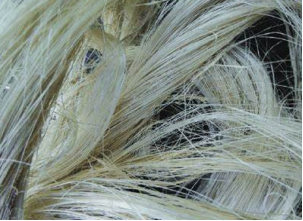
When contrasted with other natural fibers, it delivers a superior strength-to-weight ratio and establishes robust interfacial adhesion with polyester resin. To ensure maximum mechanical efficacy, higher fiber strength, and minimized moisture levels, mature culms aged between two and three years were exclusively harvested. Sourced from a highland region characterized by stable environmental conditions, the raw material was manually extracted by skilled technicians under controlled conditions to maintain consistent fiber quality. Together, these attributes confirm that the chosen bamboo is an ideal, dependable reinforcement for developing high-performance hybrid composites.
Figure 1. Bamboo Extraction Procedure.
3.1.2. Enset Fiber
For numerous Ethiopian smallholder households, Enset (Ensete ventricosum Welw. Cheesman) holds profound economic, cultural, and nutritional value. Serving as a vital staple and co-staple food source alongside traditional medicine, Enset sustains over 20% to 25% of the Ethiopian population. Processing techniques vary across different cultivating regions, relying heavily on the community's accumulated indigenous knowledge
| [11] | Behera, D., Pattnaik, S. S., Nanda, D., Mishra, P. P., & Manna, S. (2024). A review on bamboo fiber reinforced composites and their potential applications. Emergent Materials, 0123456789. https://doi.org/10.1007/s42247-024-00832-9 |
[11]
.
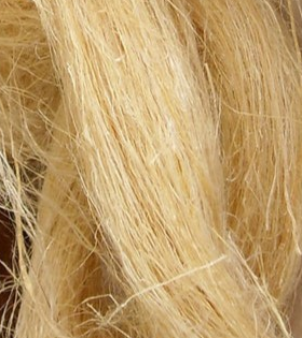
Enset fiber was chosen as a reinforcement material due to its favourable toughness, eco-friendly biodegradability, and widespread regional availability. To guarantee optimal tensile strength, mature plants harvested at four years of age were utilized. The extraction process was performed by experienced local artisans using traditional scraping techniques, carefully monitoring the condition of the sharp-edged bamboo extraction tool ensuring it remained sharp and well-maintained to minimize operational variability and achieve uniform fiber quality.
Figure 2. Enset Extraction Process.
3.1.3. Polyester Resin
Polyester resins enjoy widespread application across the composite manufacturing sector, primarily valued for their cost-effectiveness relative to high performance alternatives like epoxies. As noted unsaturated polyester resins feature ester linkages and carbon-carbon double bonds formed through poly-condensation reactions, properties that facilitate intricate casting operations
| [2] | Adier, M. F. V., Sevilla, M. E. P., Valerio, D. N. R., & Ongpeng, J. M. C. (2023). Bamboo as Sustainable Building Materials: A Systematic Review of Properties, Treatment Methods, and Standards. Buildings, 13(10).
https://doi.org/10.3390/buildings13102449 |
[2]
.
During fabrication, methyl ethyl ketone acts as an accelerator while cobalt naphthenate serves as a catalyst to drive the curing cycle. Readily available and economical, polyester resins stand out for offering favourable mechanical performance within the thermosetting polymer group. Their versatile chemistry allows formulations to be easily tailored to specific engineering requirements, making them exceptionally well-suited as matrix materials for polymer composites
| [7] | Ayele, A., & Sahu, O. (2014). Extension of Enset Plant Product for Rural Development in Ethiopia. Journal of Agricultural Economics, 2(3), 31-40. |
[7]
.
These polyester-based natural fiber composites are frequently fabricated via manual hand lay-up procedures. Furthermore, chemical alkalization pre-treatment enhances interfacial adhesion between the natural fibers and the polyester matrix, leading to marked improvements in overall composite strength.
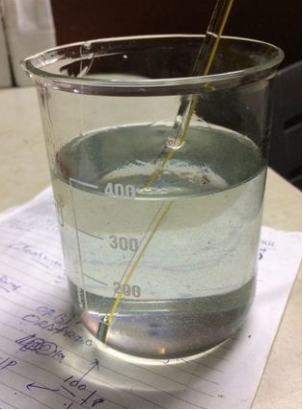
Figure 3. Polyester general purpose resin.
3.2. The Size of Sample
Sample dimensions for this investigation were initially determined by standard ASTM constraints governing mechanical testing equipment. Mold cavities were fabricated to match these specified volumetric requirements, and the resulting composite panels were subsequently machined to precise testing standards prior to evaluation
| [12] | Bernard Miranda Campos, Serge Bourbigot, Gaëlle Fontaine, Bonnet, F. (2022). Thermoplastic matrix-based composites produced by resin transfer molding: A review. Polymer Composites. |
[12]
.
The selected sample compositions reflect established formulations in composite engineering. Because fibers serve as the primary load-bearing constituents while the resin matrix facilitates load transfer and structural cohesion, these varying proportions span low, moderate, and high fiber fractions. This range is widely utilized in experimental research to identify the ideal trade-off between mechanical strength, rigidity, and proper matrix impregnation across both alkali-treated and untreated sample sets. Supported by precedent from prior literature, these volume fractions consistently yield specimens with strong mechanical properties.
Based on these established mix ratios, comprehensive analytical computations were performed to determine the density, fiber volume, fiber weight, matrix volume, and matrix weight of the developed composite materials.
Table 1. The volume fraction of fibers and matrix for each piece.
Sample | Designation (Samples) | Volume fraction (%) |
EF | BF | P |
1 | 15 EF+10 BF+75 EF | 14.66 | 16.06 | 72.3 |
2 | 15 EF+15 BF+70 EF | 13.68 | 22.48 | 62.97 |
3 | 15 EF+20 BF+65 EF | 13.68 | 29.97 | 58.49 |
4 | 20 EF+10 BF+70 EF | 19.27 | 15.81 | 66.49 |
5 | 20 EF+15BF +65 EF | 18.68 | 23.02 | 59.88 |
6 | 20 EF+20 BF+60 EF | 18.23 | 29.97 | 53.98 |
7 | 25 EF+10 BF+65 EF | 22.81 | 14.97 | 58.49 |
8 | 25 EF+15 BF+60 EF | 14.66 | 16.06 | 72.3 |
9 | 25 EF+20 BF+55 EF | 13.68 | 22.48 | 62.97 |
3.3. Processing Technique
Hand lay-up stands out as the most straightforward technique for composite manufacturing. To begin, the inner surfaces of the custom-built mold were thoroughly cleaned and coated with a release wax or discharge gel to prevent the polyester resin from sticking. Furthermore, smooth polyethylene plastic sheets were positioned against both the top and bottom mold plates to ensure an immaculate, high-quality surface finish on the molded part
| [3] | Akter, M., Uddin, M. H., & Anik, H. R. (2024a). Plant fiber-reinforced polymer composites: a review on modification, fabrication, properties, and applications. In Polymer Bulletin (Vol. 81, Issue 1). Springer Berlin Heidelberg.
https://doi.org/10.1007/s00289-023-04733-5 |
[3]
.
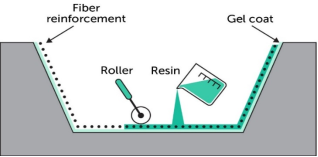
The Enset-bamboo fiber-reinforced polyester composite panels were manufactured using the hand lay-up method, following the systematic procedure outlined below:
Mold Preparation: The interior mold surfaces were treated with a releasing agent to prevent the resin mixture from bonding to the tooling during the curing cycle.
Initial Layering: A base sheet of aluminum foil was laid down within the mold, followed by an initial ply of reinforcement. The layer was thoroughly wetted out with a uniform application of the resin mixture to ensure complete matrix impregnation, after which a bamboo layer was positioned and saturated similarly.
Sequential Stacking: The layup process continued by alternating the designated fiber layers in a precise stacking sequence, ensuring proper fiber orientation throughout the laminate.
Compression and Bonding: The upper mold section was secured over the stacked plies. To guarantee structural integrity, eliminate trapped air, and promote strong interfacial bonding between the reinforcement and the matrix, a steady, uniform load was applied using a sand-bag weighting technique.
Curing: The consolidated assembly remained undisturbed for 24 to 48 hours to allow the polyester matrix to cure completely at room temperature.
Finishing: Once fully cured, the Enset-bamboo hybrid composite was carefully demolded. Any flash, excess material, and irregular borders were trimmed, filed, and sanded down to attain the final required dimensions and a refined surface finish.
3.4. Mold Configuration
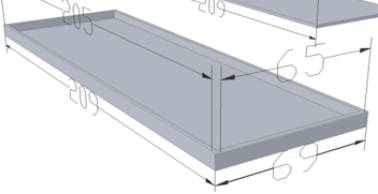
The mold dimensions and configuration were engineered in accordance with ASTM testing equipment specifications. It was digitally drafted using AutoCAD and subsequently fabricated to prepare for the composite manufacturing process.
Figure 5. Mold Configuration.
Subsequently, a second layer of unidirectional bamboo fiber was positioned over the resin-coated surface. A hand roller was then gently passed across the enset-fiber and resin matrix to eliminate any trapped air pockets resulting from the resin volume. This procedural cycle was repeated sequentially to build up the required number of plies, ultimately forming the structured sandwich laminate.
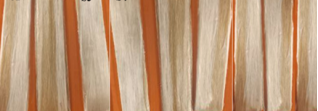
Figure 6. Test Specimen Preparation.
The testing procedures were conducted at standard ambient room temperatures ranging from 21°C to 23°C, following the protocol outlined below:
Initial Weighing: An analytical electronic balance was utilized to record the dry weight of each composite specimen prior to testing.
Water Immersion: The samples were fully submerged in a water bath for a continuous duration of 48 hours.
Post-Immersion Weighing: After completing the two-day exposure period, the specimens were extracted, surface moisture was gently wiped away, and their wet weights were measured to evaluate water absorption characteristics.
4. Response Evaluation
4.1. Tensile Test
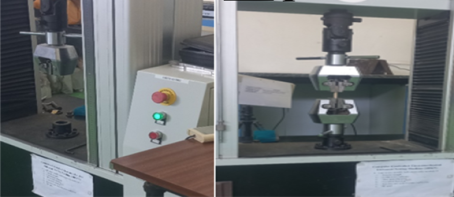
Tensile testing was conducted to evaluate the mechanical performance of the prepared composite samples. Tensile strength defined as the maximum stress a material can withstand before failure when subjected to pulling forces was measured to assess the in-plane tensile characteristics of the glass/enset fiber/bagasse ash hybrid composites. Following ASTM D3039 standards, the tests were performed at room temperature using a Universal Testing Machine (UTM), applying an axial load to both ends of the specimens until ultimate failure. The crosshead speed was kept constant at 2 mm/min, which is standard for polymer matrix composites.
Figure 7. Universal Testing Machine.
4.2. Compression Test
To guarantee even load distribution, the specimen was first fabricated with flat, parallel end faces, measured, and centered on the lower platen of the compression testing machine. The upper platen was then lowered to establish full contact, followed by a minor preload to secure proper alignment. Once positioned, the required testing parameters such as crosshead speed, maximum load, and strain limits were configured in the machine's control software. Upon initiation, the apparatus applied a continuous compressive force at the specified rate, while load cells and displacement sensors recorded real-time stress-strain and load-displacement data. The test concluded automatically when the specimen yielded, fractured, or reached the designated limit, after which the system computed critical properties including compressive strength, yield strength, and the modulus of elasticity.
Figure 8. Universal Testing Machine.
5. Results and Discussion
Table 2. Design summary.
Taguchi Array | L9 (3^3) |
Factors: | 3 |
Runs: | 9 |
Columns of L9 (3^4) array: 1 2 3
Table 3. Experimental result of TS and CS.
EF | BF | P | Composite variants | TS (MPa) | CS, (Mpa) |
15 | 10 | 75 | 15 EF+10 BF+75 EF | 59.9 | 69.7 |
15 | 15 | 70 | 15 EF+15 BF+70 EF | 60.2 | 70.3 |
15 | 20 | 65 | 15 EF+20 BF+65 EF | 61.2 | 71.1 |
20 | 1 | 70 | 20 EF+10 BF+70 EF | 59.8 | 69.7 |
20 | 15 | 65 | 20 EF+15BF +65 EF | 60.6 | 70.5 |
20 | 20 | 60 | 20 EF+20 BF+60 EF | 61.8 | 71.7 |
25 | 10 | 65 | 25 EF+10 BF+65 EF | 61.3 | 71.2 |
25 | 15 | 60 | 25 EF+15 BF+60 EF | 61.9 | 71.8 |
25 | 20 | 55 | 25 EF+20 BF+55 EF | 62.8 | 72.8 |
5.1. Tensile Strength
Signal-to-Noise (S/N) Ratio Analysis
Main effect plot for tensile strength
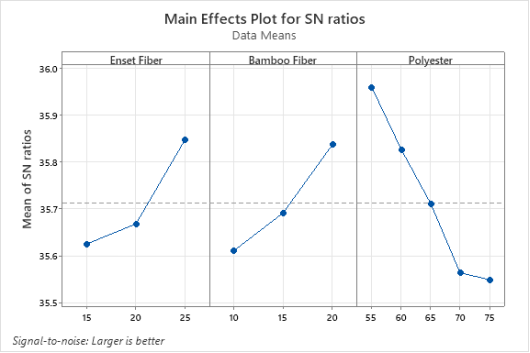
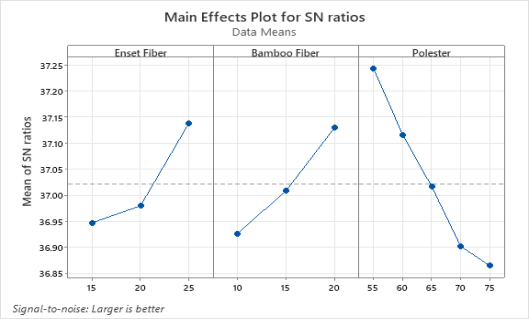
The main effect plots for the tensile strength obtained from S/N ratio values of the enset-bamboo/ polyester hybrid composite at different levels are shown in below
Figure 9. The plot of the main effect of S/N ratio as shown in
Figure 9 was used for optimum value determination for each input parameters during enset-bamboo/ polyester hybrid composite operation for the tensile strength. For tensile strength response, the larger the better characteristics was chosen as shown
Figure 9. The objective of this study was to maximize tensile strength. Therefore, the focus was on determining the factor levels that would maximize the signal-to-noise ratio (S/N Ratio). These identified factor levels were considered as the optimum factors. Based on the analysis of
Figure 9, it is evident that the maximizing tensile strength, indicating optimal conditions, was achieved with specific factor levels. Specifically, a 25% proportion of enset fiber at level 3, bamboo fiber of 20% at level 3, and polyester of 55% at level 1 were found to yield the best results. The findings from the analysis suggest that the 55% of polyester has a more significant impact on tensile strength compared to other proportions of the same bamboo fiber. In other words, this particular factor level has a greater influence on achieving the desired outcome of maximizing tensile strength. Overall, this study highlights the importance of carefully selecting the appropriate factor levels to optimize tensile strength and achieve the desired results.
Figure 9. Main effects plot for SN ratios of tensile strength.
Table 4. Analysis of Variance.
Source | DF | Adj SS | Adj MS | F-Value | % of C | P-Value | Hypothesis |
Enset Fiber | 2 | 4.14 | 2.07 | 57.45 | 50.24 | 0.001 | Significant |
Bamboo Fiber | 2 | 3.94 | 1.97 | 54.68 | 47.81 | 0.001 | Significant |
Error | 4 | 0.14 | 0.03 | | 0.36 | | |
Total | 8 | 8.24 | | | | | |
ANOVA analysis
The ANOVA result was used to study the significance of the input parameters on the tensile strength. It is another way of understanding the importance of enset-bamboo/ polyester hybrid composite on tensile strength in this study. The ANOVA for tensile strength shown in
Table 4, a percentage error of 0.36% while 50.24% of enset fiber and 47.81% of the bamboo fiber. The ANOVA table generated using Minitab software version 19 reveals that all input parameters with P-values less than 0.05 have validated a significant impact on the variability of tensile strength. Therefore, ANOVA table shows that 50.24% of enset fiber has highest significance and have most important factor affecting tensile strength during the enset-bamboo/ polyester hybrid composite operation compared to other input parameters on the tensile strength. Hence, the results indicated that the enset fiber has the highest significance on the tensile strength, followed by the bamboo fiber. This is in agreement with the study finding showed that the tensile strength is dependent on enset fiber.
ANOVA Model Summary
The coefficient of determination (
), or R-squared, measures the proportion of data variability and typically ranges from 0 to 1 (or represents a correlation strength mapped from -1 to +1). Furthermore, the findings presented in
Table 5 indicate the specific correlation coefficient associated with the tensile strength, R-sq (98.25%). It indicates that the regression equations developed from tensile strength are statistically significant. It observed that adjusted R-sq and Predicated R-sq are in the good agreement. An observation has been made indicating that the adjusted R-squared and predicted R-squared values are in good agreement.
Table 5. Model summary.
S | R-sq | R-sq (adj) | R-sq (pred) |
0.190029 | 98.25% | 96.50% | 91.13% |
5.2. Compression Strength
Main effect plot for compression strength
The main effect plots for the compression strength obtained from S/N ratio values of the enset-bamboo/ polyester hybrid composite at different levels are shown in below
Figure 10. The plot of the main effect of S/N ratio as shown in
Figure 10 was used for optimum value determination for each input parameters during enset-bamboo/ polyester hybrid composite operation for the compression strength. For compression strength response, the larger the better characteristics was chosen as shown
Figure 10. The objective of this study was to maximize compression strength. Therefore, the focus was on determining the factor levels that would maximize the signal-to-noise ratio (S/N Ratio). These identified factor levels were considered as the optimum factors. Based on the analysis of
Figure 10, it is evident that the maximizing compression strength, indicating optimal conditions, was achieved with specific factor levels. Specifically, a 25% proportion of enset fiber at level 3, bamboo fiber of 20% at level 3, and polyester of 55% at level 1 were found to yield the best results. The findings from the analysis suggest that the 55% of polyester has a more significant impact on compression strength compared to other proportions of the same bamboo fiber. In other words, this particular factor level has a greater influence on achieving the desired outcome of maximizing compression strength. Overall, this study highlights the importance of carefully selecting the appropriate factor levels to optimize compression strength and achieve the desired results.
Figure 10. Main effects plot for SN ratios of compression strength.
ANOVA analysis
The ANOVA result was used to study the significance of the input parameters on the compression strength. It is another way of understanding the importance of enset-bamboo/ polyester hybrid composite on compression strength in this study. The ANOVA for compression strength shown in
Table 6, a percentage error of 1.05% while 49.35% of enset fiber and 86.36% of the bamboo fiber. The ANOVA table generated using Minitab software version 19 reveals that all input parameters with P-values less than 0.05 have validated a significant impact on the variability of compression strength. Therefore, ANOVA table shows that 49.47% of bamboo fiber has highest significance and have most important factor affecting compression strength during the enset-bamboo/ polyester hybrid composite operation compared to other input parameters on the compression strength. Hence, the results indicated that the bamboo fiber has the highest significance on the compression strength, followed by the enset fiber. This is in agreement with the study finding showed that the compression strength is dependent on bamboo fiber.
Table 6. Analysis of Variance.
Source | DF | Adj SS | Adj MS | F-Value | % of C | P-Value | Hypothesis |
Enset Fiber | 2 | 4.21 | 2.10 | 86.23 | 49.35 | 0.001 | Significant |
Bamboo Fiber | 2 | 4.22 | 2.11 | 86.36 | 49.47 | 0.001 | Significant |
Error | 4 | 0.09 | 0.02 | | 1.05 | | |
Total | 8 | 8.53 | | | | | |
ANOVA Model Summary
The R-squared (
) is a correlation coefficient determination which measures the variation proportion in the data points ranging from -1 to +1. The results obtained on the
Table 7 also showed that the correlation coefficient of compression strength, R-sq (98.85%). It indicates that the regression equations developed from compression strength are statistically significant. It observed that adjusted R-sq and Predicated R-sq are in the good agreement. An observation has been made indicating that the adjusted R-squared and predicted R-squared values are in good agreement.
Table 7. Model summary.
S | R-sq | R-sq (adj) | R-sq (pred) |
0.156347 | 98.85% | 97.71% | 94.20% |
5.3. Multi Response Optimization
Grey relational analysis (GRA)
This analysis was performed on the response values to consolidate multiple performance characteristics into a unified metric. By integrating the Taguchi method with Grey Relational Analysis (GRA), multi-response optimization was conducted to determine the ideal process parameters
| [1] | Adeeb, E., Sohn, C. H., Maqsood, A., & Afaq, M. A. (2018). Design optimization of ceiling fan blades with nonlinear sweep profile. Journal of Applied Fluid Mechanics, 11(5), 1153-1162. https://doi.org/10.29252/jafm.11.05.27857 |
[1]
.
GRA simplifies complex, multi-objective problems into an equivalent single-response framework by computing a grey relational grade, thereby merging various performance measures into a single representative value for optimization.
Table 8. Response with replication.
Factors | A | B | C | Response |
Trail no | Column | |
EF | BF | P | TS (MPa) | CS |
1 | 15 | 10 | 75 | 59.9 | 69.7 |
2 | 15 | 15 | 70 | 60.2 | 70.3 |
3 | 15 | 20 | 65 | 61.2 | 71.1 |
4 | 20 | 10 | 70 | 59.8 | 69.7 |
5 | 20 | 15 | 65 | 60.6 | 70.5 |
6 | 20 | 20 | 60 | 61.8 | 71.7 |
7 | 25 | 10 | 65 | 61.3 | 71.2 |
8 | 25 | 15 | 60 | 61.9 | 71.8 |
9 | 25 | 20 | 55 | 62.8 | 72.8 |
| Maximum | 62.8 | 72.8 |
| Minimum | 59.8 | 69.7 |
| Maximum-Minimum | 3 | 3.1 |
Normalization
During this stage, the available response data is normalized onto a consistent scale ranging from 0 to 1.
Higher the better.
= [](1)
Where: - an experimental run of tensile, and compression strength
-is an experimental run of tensile, and compression strength before preprocessing.
Max (.- Maximum value of original data.
Min. (.-Minimum value of original data, i=1, 2, 3…m
Table 9. Normalized table for the response of TS and CS.
Factors | TS | CS |
Trail no |
1 | 0.0333333 | 0 |
2 | 0.1333333 | 0.1935484 |
3 | 0.4666667 | 0.4516129 |
4 | 0 | 0 |
5 | 0.2666667 | 0.2580645 |
6 | 0.6666667 | 0.6451613 |
7 | 0.5 | 0.483871 |
8 | 0.7 | 0.6774194 |
9 | 1 | 1 |
Absolute difference
After normalizing the responses, the next step is to calculate the deviations from the reference sequence
| [6] | Andrew, J. J., & Dhakal, H. N. (2022). Composites Part C : Open Access Sustainable biobased composites for advanced applications : recent trends and future opportunities - A critical review. Composites Part C: Open Access, 7, 100220.
https://doi.org/10.1016/j.jcomc.2021.100220 |
[6]
.
Table 10. Absolute value of .
Factors | TS | CS |
Trail no |
1 | 0.9666667 | 1 |
2 | 0.8666667 | 0.8064516 |
3 | 0.5333333 | 0.5483871 |
4 | 1 | 1 |
5 | 0.7333333 | 0.7419355 |
6 | 0.3333333 | 0.3548387 |
7 | 0.5 | 0.516129 |
8 | 0.3 | 0.3225806 |
9 | 0 | 0 |
| 0 | 0 |
| 1 | 1 |
Grey's relational coefficient
After pre-processing and normalization of the original data, grey relational coefficients (GRC) are calculated for each run of experiment. The Grey relational coefficient is calculated by normalizing all responses between 0 and 1. The Grey grade is obtained by calculating the average of the Grey relational coefficients of the selected response. Initially, the responses are normalized using equation (
1) based on the larger -better criterion and this is called Grey relational generations. Standard test values are compared to normalized values to determine GRC.
Table 11 displays the Grey relational coefficients and Grey relational grade, which were calculated using equations (
4). The highest Grey relational grade was assigned a rank of 1. Consequently, experiment number 9 is identified as the optimal combination of composite parameters for achieving the best results in terms of TS and CS among all 9 experiments conducted. By utilizing Grey relational analysis, the multi-objective optimization problem is transformed into a single equivalent objective function optimization problem. The Taguchi technique is then employed to identify the best combination of process parameters based on the highest Grey relational grade (1). The Grey relational grade (GRG) was computed as the average Grey relational coefficient (GRC) of all output responses within a single experimental trial, as described in equation (
4). This calculation allows for the comparative ranking of all 9 experimental input parameters on a unified scale, with a grade output response of experiment number 9 was rank 1 with the result of GRG was 1 indicating the best performance.
Calculation of the grey relational coefficient. To compute the GRC use below equation (
4)
| [8] | Ayyappa Atmakuri, A. P. & G. J. (2025). Properties of Natural Fiber-Reinforced Epoxy Hybrid Composites. Fiber-Based HYbrid Composites for Engineering. |
[8]
.
γ()=[(4)
ζ -Coefficient of distinguishing and its range 0 to 1 but acceptable value was 0.5.
Table 11. Grey relational coefficient and grey relational grade.
Exp. No | TS | CS | Total of GRC | Grey relational grade | Grey relational rank |
1 | 0.340909 | 0.333333 | 0.674242 | 0.337121 | 8 |
2 | 0.365854 | 0.382716 | 0.74857 | 0.374285 | 7 |
3 | 0.483871 | 0.476923 | 0.960794 | 0.480397 | 5 |
4 | 0.333333 | 0.333333 | 0.666667 | 0.333333 | 9 |
5 | 0.405405 | 0.402597 | 0.808003 | 0.404001 | 6 |
6 | 0.6 | 0.584906 | 1.184906 | 0.592453 | 3 |
7 | 0.5 | 0.492064 | 0.992064 | 0.496032 | 4 |
8 | 0.625 | 0.607843 | 1.232843 | 0.616422 | 2 |
9 | 1 | 1 | 2 | 1 | 1 |
Grey Relational Grade
The GRG evaluation involves analyzing the relationship between the reference sequence and the comparability sequences to select the optimal experimental outcome based on maximum similarity. When multiple responses are considered simultaneously, a composite grey relational grade is derived by multiplying each output by its respective weight and aggregating the results.
Table 12. Grey Relational Grade.
Factors | A | B | C | Grey relational grade |
Trail no | Column |
| 1 | 2 | 3 |
1 | 1 | 1 | 1 | 0.3371212 |
2 | 1 | 2 | 2 | 0.374285 |
3 | 1 | 3 | 3 | 0.480397 |
4 | 2 | 1 | 2 | 0.333333 |
5 | 2 | 2 | 3 | 0.404001 |
6 | 2 | 3 | 1 | 0.592453 |
7 | 3 | 1 | 3 | 0.496032 |
8 | 3 | 2 | 1 | 0.616422 |
9 | 3 | 3 | 2 | 1 |
Analysis of S/N ratio of Grey Rational Grade (GRG)
The means of the Grey relational grade were calculated for each level of composite parameters using data from
Table 12 and then it’s summarized in the
Table 13.
Table 13. Response table for mean Grey relational grade (GRG).
Level | Input parameters |
Enset Fiber | Bamboo Fiber | Polyester |
Level 1 | 0.397267 | 0.388828 | 0.515332 |
Level 2 | 0.443262 | 0.464902 | 0.569206 |
Level 3 | 0.704151 | 0.69095 | 0.460143 |
Max-Min | 0.306884 | 0.302122 | 0.109063 |
Rank | 1 | 3 | 2 |
Table 13 shows that the range between the maximum and minimum Grey Relational Grade (GRG) values is greater for enset fiber than for bamboo fiber and polyester. According to equation (
4), a higher GRG signifies superior multiple quality characteristics, with optimal parameter values highlighted in bold. This indicates that enset fiber exerts a more significant influence on overall performance than the other parameters. Consequently, the optimized parameter mix is established as 25% enset fiber, 20% bamboo fiber, and 55% polyester.
6. Conclusion and Recommendation
6.1. Conclusion
This study investigates the experimental evaluation and Taguchi-based optimization of tensile and compressive strengths for alkaline-treated enset-bamboo/polyester hybrid composites. Initially, the composite materials were formulated and thoroughly characterized to prepare for performance testing. Using a digital Universal Testing Machine for mechanical evaluation and Minitab 19 for Taguchi experimental design, the number of experimental runs was efficiently minimized to achieve optimal response outcomes. The Taguchi method was subsequently employed to analyze the impact of input parameters on individual performance metrics and to optimize the hybrid composite formulation. Based on the experimental results, the key conclusions are outlined below:
Optimal Tensile Parameters: The Taguchi-based orthogonal optimization identified the ideal mix for maximizing tensile strength as 25% enset fiber (Level 3), 20% bamboo fiber (Level 3), and 55% polyester (Level 1).
Optimal Compressive Parameters: Similarly, the optimal configuration for achieving peak compressive strength consists of 25% enset fiber (Level 3), 20% bamboo fiber (Level 3), and 55% polyester (Level 1).
Tensile Strength Contributions (ANOVA): Analysis of variance indicates that both enset fiber (50.24%) and bamboo fiber (47.81%) significantly influence tensile strength, with enset fiber serving as the most dominant factor for enhancement.
Compressive Strength Contributions (ANOVA): ANOVA results also demonstrate that enset fiber (49.35%) and bamboo fiber (49.47%) significantly impact compressive performance, with bamboo fiber showing the highest level of influence.
Broader Practical Implications: The findings highlight that enset-bamboo hybrid composites offer a high-performance, cost-effective, and sustainable alternative that helps minimize industrial health hazards and reduce waste treatment burdens compared to traditional composites.
Multi-Response Optimization: Overall multi-response Taguchi optimization confirms that the ultimate composite formulation consists of 25% enset fiber, 20% bamboo fiber, and 55% polyester.
Based on the above results, it was determined that the optimized of enset fiber (25%), bamboo fiber (20%), and polyester (55%) composite material was the best material when compared to the other composite material. Bamboo provides exceptional stiffness and tensile strength due to its high cellulose content and dense vascular bundles, while Enset fibers contribute enhanced impact resistance, flexibility, and elongation at break. Hybridization synergistically balances brittleness and flexibility. Both Enset and bamboo are rapidly renewable, eco-friendly plant resources. Unlike synthetic glass or carbon fibers, which are petroleum derived and persist in landfills, the natural fibers in this hybrid composite significantly reduce the carbon footprint and enhance the end-of-life biodegradability of the material. In regions like East Africa, Enset and various bamboo species are locally abundant and inexpensive. Utilizing these locally sourced fibers drastically lowers the raw material acquisition and processing costs compared to importing synthetic reinforcement fibers. Additionally, it is environmentally friendly, non-hazardous, and cost-effective. Therefore, it can be concluded that the main objectives of this research, were to study the effect of synergistic of alkaline treated enset-bamboo/ polyester hybrid composite on tensile strength and compression strength, have been achieved.
6.2. Recommendations
1) Utilize smooth polyethylene plastic sheets on both upper and lower mold plates during hand lay-up or compression molding, ensuring tight resin impregnation to lower void content.
2) Employ Taguchi method frameworks to map out multi-factor variations (such as fiber loading percentages, layer orientation, and treatment duration) during experimental prototyping.
3) Place smooth-surfaced polyethylene plastic sheets on both the upper and lower portions of the mold during hand lay-up or compression molding.
Abbreviations
ANOVA | Analysis of Variance |
B | Bamboo Fiber |
BF | Bamboo Fiber |
CAD | Computer-Aided Design |
CM | Composite Material |
CS | Compression Strength |
DoE | Design of Experiments |
EF | Enset Fiber |
FRCM | Fiber Reinforced Composite Materials |
NaOH | Sodium Hydro-oxide |
NF | Natural Fibers |
P | Polyester |
SNR | Signal-to-Noise Ratio |
TS | Tensile Strength |
UTS | Ultimate Tensile Strength |
°C | Degree Celsius |
| Coefficient of Determination |
Author Contributions
Abera Ayza Anebo: Conceptualization, Funding acquisition, Investigation, Methodology, Project administration, Resources, Software, Validation, Writing – original draft, Writing – review & editing
Mubarek Sebre: Methodology
Temesgen Hailegiorgis: Methodology, Visualization
Conflicts of Interest
The authors declare no conflicts of interest.
References
| [1] |
Adeeb, E., Sohn, C. H., Maqsood, A., & Afaq, M. A. (2018). Design optimization of ceiling fan blades with nonlinear sweep profile. Journal of Applied Fluid Mechanics, 11(5), 1153-1162.
https://doi.org/10.29252/jafm.11.05.27857
|
| [2] |
Adier, M. F. V., Sevilla, M. E. P., Valerio, D. N. R., & Ongpeng, J. M. C. (2023). Bamboo as Sustainable Building Materials: A Systematic Review of Properties, Treatment Methods, and Standards. Buildings, 13(10).
https://doi.org/10.3390/buildings13102449
|
| [3] |
Akter, M., Uddin, M. H., & Anik, H. R. (2024a). Plant fiber-reinforced polymer composites: a review on modification, fabrication, properties, and applications. In Polymer Bulletin (Vol. 81, Issue 1). Springer Berlin Heidelberg.
https://doi.org/10.1007/s00289-023-04733-5
|
| [4] |
Al., A. A. et. (2018). Hydrophobic treatment of natural fibers and their composites—A review. Journal of Industrial Textiles, 47, n (SAGE Publications Ltd), 2153-2183.
|
| [5] |
Amjad, A. I. (2024). Advances in Bamboo Science Bamboo fibre : A sustainable solution for textile manufacturing. Advances in Bamboo Science, 7 (January), 100088.
https://doi.org/10.1016/j.bamboo.2024.100088
|
| [6] |
Andrew, J. J., & Dhakal, H. N. (2022). Composites Part C : Open Access Sustainable biobased composites for advanced applications : recent trends and future opportunities - A critical review. Composites Part C: Open Access, 7, 100220.
https://doi.org/10.1016/j.jcomc.2021.100220
|
| [7] |
Ayele, A., & Sahu, O. (2014). Extension of Enset Plant Product for Rural Development in Ethiopia. Journal of Agricultural Economics, 2(3), 31-40.
|
| [8] |
Ayyappa Atmakuri, A. P. & G. J. (2025). Properties of Natural Fiber-Reinforced Epoxy Hybrid Composites. Fiber-Based HYbrid Composites for Engineering.
|
| [9] |
B. S. U. R. Ao and Arayana, K. S. A. N. (2017). Composite Material Analysis of Axial Flow Fans. IJSETR., 06, n, 5859-5865.
|
| [10] |
Barman, P., Dutta, P. P., Bardalai, M., & Dutta, P. P. (2023). Experimental investigation on bamboo fiber reinforced epoxy polymer composite materials developed through two different techniques. Proceedings of the Institution of Mechanical Engineers, Part C: Journal of Mechanical Engineering Science, 238(6), 2185-2204.
https://doi.org/10.1177/09544062231195474
|
| [11] |
Behera, D., Pattnaik, S. S., Nanda, D., Mishra, P. P., & Manna, S. (2024). A review on bamboo fiber reinforced composites and their potential applications. Emergent Materials, 0123456789.
https://doi.org/10.1007/s42247-024-00832-9
|
| [12] |
Bernard Miranda Campos, Serge Bourbigot, Gaëlle Fontaine, Bonnet, F. (2022). Thermoplastic matrix-based composites produced by resin transfer molding: A review. Polymer Composites.
|
| [13] |
Chigbu, U. E., Atiku, S. O., & Plessis, C. C. Du. (2023). The Science of Literature Reviews : Searching, Identifying, Selecting, and Synthesising. MDPI (Multidisciplinary Digital Publishing Institute).
|
Cite This Article
-
APA Style
Anebo, A. A., Sebre, M., Hailegiorgis, T. (2026). Experimental Analysis on Synergistic of Alkaline Treated Enset-Bamboo/ Polyester Hybrid Composite Using Grey Relational Analysis. American Journal of Polymer Science and Technology, 12(2), 38-50. https://doi.org/10.11648/j.ajpst.20261202.11
 Copy
|
Copy
|
 Download
ACS Style
Anebo, A. A.; Sebre, M.; Hailegiorgis, T. Experimental Analysis on Synergistic of Alkaline Treated Enset-Bamboo/ Polyester Hybrid Composite Using Grey Relational Analysis. Am. J. Polym. Sci. Technol. 2026, 12(2), 38-50. doi: 10.11648/j.ajpst.20261202.11
Copy
|
Download
AMA Style
Anebo AA, Sebre M, Hailegiorgis T. Experimental Analysis on Synergistic of Alkaline Treated Enset-Bamboo/ Polyester Hybrid Composite Using Grey Relational Analysis. Am J Polym Sci Technol. 2026;12(2):38-50. doi: 10.11648/j.ajpst.20261202.11
Copy
|
Download
-
@article{10.11648/j.ajpst.20261202.11,
  author = {Abera Ayza Anebo and Mubarek Sebre and Temesgen Hailegiorgis},
  title = {Experimental Analysis on Synergistic of Alkaline Treated Enset-Bamboo/ Polyester Hybrid Composite Using Grey Relational Analysis},
  journal = {American Journal of Polymer Science and Technology},
  volume = {12},
  number = {2},
  pages = {38-50},
  doi = {10.11648/j.ajpst.20261202.11},
  url = {https://doi.org/10.11648/j.ajpst.20261202.11},
  eprint = {https://article.sciencepublishinggroup.com/pdf/10.11648.j.ajpst.20261202.11},
  abstract = {This study investigates the mechanical performance and synergistic optimization of hybrid composites reinforced with alkaline-treated Enset and bamboo fibers within an unsaturated polyester matrix. To enhance interfacial adhesion, both natural fibers were subjected to a 55% sodium hydroxide (NaOH) surface treatment to remove amorphous impurities and expose reactive cellulose hydroxyl groups. Bamboo provides exceptional stiffness and tensile strength due to its high cellulose content and dense vascular bundles, while Enset fibers contribute enhanced impact resistance, flexibility, and elongation at break. Hybridization synergistically balances brittleness and flexibility. Both Enset and bamboo are rapidly renewable, eco-friendly plant resources. Unlike synthetic glass or carbon fibers, which are petroleum derived and persist in landfills, the natural fibers in this hybrid composite significantly reduce the carbon footprint and enhance the end-of-life biodegradability of the material. Utilizing a Taguchi-based Design of Experiments (DoE) coupled with Grey Relational Analysis (GRA) and Analysis of Variance (ANOVA), the study evaluates the influence of key fabrication parameters such as fiber weight fractions and stacking configurations on ultimate tensile strength, flexural modulus, impact resistance, and moisture absorption. From Taguchi analysis the optimized multi-response enset-bamboo/polyester fiber hybrid composite parameters was achieved by using the parameters are enset fiber (25%), bamboo fiber (20%), and polyester (55%) and the optimized hybrid composite formulation demonstrates superior multi-objective performance, highlighting its viability as an eco-friendly, lightweight structural substitute for traditional synthetic composites in engineering applications.},
 year = {2026}
}
Copy
|
Download
-
TY  - JOUR
T1  - Experimental Analysis on Synergistic of Alkaline Treated Enset-Bamboo/ Polyester Hybrid Composite Using Grey Relational Analysis
AU  - Abera Ayza Anebo
AU  - Mubarek Sebre
AU  - Temesgen Hailegiorgis
Y1  - 2026/09/18
PY  - 2026
N1  - https://doi.org/10.11648/j.ajpst.20261202.11
DO  - 10.11648/j.ajpst.20261202.11
T2  - American Journal of Polymer Science and Technology
JF  - American Journal of Polymer Science and Technology
JO  - American Journal of Polymer Science and Technology
SP  - 38
EP  - 50
PB  - Science Publishing Group
SN  - 2575-5986
UR  - https://doi.org/10.11648/j.ajpst.20261202.11
AB  - This study investigates the mechanical performance and synergistic optimization of hybrid composites reinforced with alkaline-treated Enset and bamboo fibers within an unsaturated polyester matrix. To enhance interfacial adhesion, both natural fibers were subjected to a 55% sodium hydroxide (NaOH) surface treatment to remove amorphous impurities and expose reactive cellulose hydroxyl groups. Bamboo provides exceptional stiffness and tensile strength due to its high cellulose content and dense vascular bundles, while Enset fibers contribute enhanced impact resistance, flexibility, and elongation at break. Hybridization synergistically balances brittleness and flexibility. Both Enset and bamboo are rapidly renewable, eco-friendly plant resources. Unlike synthetic glass or carbon fibers, which are petroleum derived and persist in landfills, the natural fibers in this hybrid composite significantly reduce the carbon footprint and enhance the end-of-life biodegradability of the material. Utilizing a Taguchi-based Design of Experiments (DoE) coupled with Grey Relational Analysis (GRA) and Analysis of Variance (ANOVA), the study evaluates the influence of key fabrication parameters such as fiber weight fractions and stacking configurations on ultimate tensile strength, flexural modulus, impact resistance, and moisture absorption. From Taguchi analysis the optimized multi-response enset-bamboo/polyester fiber hybrid composite parameters was achieved by using the parameters are enset fiber (25%), bamboo fiber (20%), and polyester (55%) and the optimized hybrid composite formulation demonstrates superior multi-objective performance, highlighting its viability as an eco-friendly, lightweight structural substitute for traditional synthetic composites in engineering applications.
VL  - 12
IS  - 2
ER  -
Copy
|
Download






 Share This Article
 Twitter
 Linked In
 Facebook