Research Article | | Peer-Reviewed

Digital and Behavioural Nudge Interventions to Improve Postpartum Visit Attendance: A Systematic Review and Meta-analysis

Received: 13 October 2026     Accepted: 28 October 2026     Published: 12 November 2026
Views:       Downloads:
Abstract

Background: Approximately 40–50% of women miss the comprehensive postpartum visit, leading to missed detection of postpartum hypertension, depression, diabetes and infection. Digital and behavioural “nudge” interventions are low-cost candidate solutions, but, to our knowledge, no systematic review has quantitatively pooled their effect on postpartum visit attendance. Methods: We searched PubMed/MEDLINE, Embase, Cochrane Central Register of Controlled Trials (CENTRAL), CINAHL (Cumulative Index to Nursing and Allied Health Literature), Scopus, Web of Science, ClinicalTrials.gov and the World Health Organization International Clinical Trials Registry Platform (WHO ICTRP) (inception to May 2026) for randomised and controlled studies of postpartum women receiving at least one digital or behavioural nudge versus usual care. The primary outcome was comprehensive postpartum visit attendance. Study selection, data extraction and risk-of-bias assessment were performed by a single reviewer; this limitation is acknowledged. Risk of bias was assessed with Risk of Bias 2 (RoB 2) and Risk Of Bias In Non-randomized Studies of Interventions (ROBINS-I), certainty with Grading of Recommendations Assessment, Development and Evaluation (GRADE), and information sufficiency with trial sequential analysis (TSA). Risk ratios (RRs) were pooled using DerSimonian–Laird random-effects meta-analysis with pre-specified subgroup and sensitivity analyses. Results: Eight studies were included in the review; five randomised controlled trials (RCTs; n = 2,208) contributed to the quantitative synthesis. Nudges increased postpartum visit attendance (pooled RR 1.33, 95% confidence interval (CI) 1.07–1.65; I2 = 52.8%; τ2 = 0.029; 95% prediction interval 0.70–2.53; p = 0.009). Results were stable across sensitivity analyses (RR 1.32–1.35). Point estimates were largest for bundled default scheduling (RR 1.82, one trial), intermediate for patient navigation (RR 1.20, one trial) and 1.25 (95% CI 0.91–1.73) for short message service (SMS) reminders (three trials). Certainty of evidence was low; TSA indicated that the accrued information size was below the required information size. Secondary maternal outcomes (depression screening, blood-pressure testing, contraception and readmission) were reported in single trials only and were not pooled. Conclusions: Digital and behavioural nudges, particularly friction-reducing strategies such as default scheduling and patient navigation, may improve postpartum visit attendance, although the evidence is of low certainty and the prediction interval crosses the null. The evidence base is small, heterogeneous and geographically skewed; a definitive multicentre trial, ideally in low- and middle-income settings, is warranted.

Published in Biomedical Sciences (Volume 12, Issue 4)
DOI 10.11648/j.bs.20261204.11
Page(s) 80-88
Creative Commons

This is an Open Access article, distributed under the terms of the Creative Commons Attribution 4.0 International License (http://creativecommons.org/licenses/by/4.0/), which permits unrestricted use, distribution and reproduction in any medium or format, provided the original work is properly cited.

Copyright

Copyright © The Author(s), 2026. Published by Science Publishing Group

Keywords

Postpartum Care, Visit Attendance, mHealth, Text Messaging, Default Scheduling, Patient Navigation, Meta-analysis

1. Introduction
The postpartum period, often called the “fourth trimester”, is a critical window for detecting and managing conditions that drive maternal morbidity and mortality, including hypertensive disorders, postpartum depression, diabetes and sepsis Professional bodies recommend a comprehensive postpartum visit within 12 weeks of birth; however, roughly 40–50% of women do not attend, with disproportionately lower attendance among low-income, minority and rural populations
Barriers to attendance are predominantly operational and behavioural (forgetting, unclear scheduling, transportation, childcare and low perceived need) rather than purely biomedical . This makes them amenable to low-cost “nudge” interventions grounded in behavioural economics: automated short message service (SMS) or text reminders, patient-portal messages, default (opt-out) scheduling, tailored messaging and lay patient navigation.
Although individual trials report large effects and broader reviews address postpartum care delivery in general, to our knowledge no systematic review has isolated and quantitatively pooled digital and behavioural nudge interventions to estimate a generalisable effect and to determine which mechanism works best. This review addresses that gap.
The consequences of inadequate postpartum follow-up extend beyond a missed scheduled appointment. The early weeks and months after childbirth represent an important period during which previously unrecognized complications may emerge, chronic conditions may require reassessment, and mental health problems may become apparent. Postpartum contacts also provide opportunities to review recovery from pregnancy and childbirth, assess blood pressure and other clinical parameters, address contraception and breastfeeding, and identify social or psychosocial needs. Consequently, improving attendance at postpartum care is not simply a matter of increasing healthcare utilization; it may strengthen timely detection and management of conditions that contribute to preventable maternal morbidity
Digital communication offers a potentially scalable approach to overcoming several barriers to postpartum follow-up. Mobile-phone ownership and access to text messaging have expanded substantially, including in settings where conventional healthcare infrastructure and follow-up systems remain limited. Automated reminders can be delivered at predefined intervals and can reduce the cognitive burden of remembering appointments, while two-way messaging may allow women to clarify appointment information or communicate emerging concerns
Behavioural nudges may complement digital communication by addressing the decision-making processes that contribute to delayed or missed postpartum care. Rather than relying solely on education, nudges can make the desired action easier, more salient, timely, or convenient. Examples include repeated reminders, personalized messages, explicit appointment instructions, advance scheduling, default appointments, and prompts that emphasize the benefits of timely postpartum assessment . Evidence from other healthcare contexts also indicates that interventions designed to change care delivery can affect professional practice and health outcomes .
Despite increasing interest in technology-enabled maternal healthcare, the evidence remains difficult to translate into practice because interventions vary considerably in their content, delivery, intensity, target populations, and measured outcomes. A focused synthesis of digital and behavioural nudge interventions is therefore needed to determine their overall effectiveness, explore potential sources of variation, and assess the strength of evidence for improvements in postpartum attendance .
Contribution of this review. This systematic review and meta-analysis synthesizes evidence on digital and behavioural nudge interventions intended to improve postpartum visit attendance, evaluates their effects on attendance, and summarises reported secondary maternal outcomes. It examines different intervention mechanisms to identify promising approaches while making clear where evidence remains uncertain or insufficient.
Implications. The findings may help researchers prioritize well-designed trials and support health services in evaluating scalable reminders and other behavioural strategies for postpartum follow-up, particularly where missed visits are common. Any implementation should account for local barriers and the low certainty of the current evidence; the review also identifies gaps to guide future research and policy.
Objective. To estimate the pooled effect of digital and behavioural nudge interventions on postpartum visit attendance (primary outcome) and to summarise available data on downstream screening, morbidity and utilisation outcomes (secondary), and to explore which mechanism appears most effective.
2. Methods
This review is reported according to the Preferred Reporting Items for Systematic Reviews and Meta-Analyses (PRISMA) 2020 statement and was registered on the Open Science Framework (OSF) Registries (OSF Registration https://doi.org/10.17605/OSF.IO/9MFZS).
2.1. Eligibility (Population, Intervention, Comparator, Outcomes, and Study design [PICOS])
Population: postpartum women (any mode of birth), followed for up to one year, in any setting.
Intervention: at least one digital or behavioural nudge (SMS or portal reminders, default/opt-out scheduling, tailored messaging, telephone reminders or patient navigation; alone or bundled).
Comparator: usual care.
Primary outcome: comprehensive postpartum visit attendance.
Secondary outcomes: depression, blood pressure and glucose screening; contraception initiation; emergency department visits; readmission; severe maternal morbidity; cost; satisfaction.
Designs: randomised controlled trials (RCTs; primary analysis) and controlled quasi-experimental studies (sensitivity analysis). No language restriction.
Exclusions: no comparator; non-quantitative design; intervention not targeting attendance or screening; paediatric-only outcomes.
2.2. Search Strategy
We searched PubMed/MEDLINE, Embase, Cochrane CENTRAL, CINAHL, Scopus and Web of Science, with ClinicalTrials.gov, WHO ICTRP and grey literature, from inception to May 2026. The core PubMed strategy was:
(postpartum OR postnatal OR “post-natal”) AND (attendance OR “follow-up” OR visit OR “check-up” OR checkup) AND (reminder* OR nudge* OR schedul* OR “text messag*” OR SMS OR “patient portal” OR app OR telemedicine OR “default scheduling” OR “opt-out” OR navigat*) AND (randomized OR randomised OR trial OR “quasi-experimental” OR “controlled trial”)
2.3. Selection, Data Extraction and Risk of Bias
A single reviewer (Habtamu Fekadu Andeta [HFA]) screened titles/abstracts and full texts and extracted data using a piloted standardised form that captured study identifiers, setting, design, population and risk, mechanism/channel/dose, comparator, outcome event data and risk-of-bias domains. This single-reviewer process is acknowledged as a methodological limitation. Risk of bias was assessed with RoB 2 (randomised trials) and ROBINS-I (non-randomised studies); certainty of evidence was assessed using GRADE. Review methods were also informed by the Cochrane Handbook.
2.4. Statistical Analysis
Binary outcomes were pooled as risk ratios (RRs) using DerSimonian–Laird random-effects models. We report τ2, I2 and the 95% prediction interval (t-distribution with k − 2 degrees of freedom). Pre-specified subgroups were mechanism (simple reminders, bundled scheduling, navigation), region and risk level; with five RCTs, subgroup analyses are exploratory. Sensitivity analyses comprised fixed-effect, leave-one-out, exclusion of high risk-of-bias studies, exclusion of quasi-experimental designs, and alternative assumptions for the trial reporting failure-to-attend. Trial sequential analysis (TSA) used α = 0.05, power 80%, control event proportion 70%, anticipated RR 1.20 and diversity adjustment. Analyses used R (meta, metafor), RevMan and TSA software.
2.5. Handling of Failure-to-attend Data
Oramisi 2019 reported failure-to-attend (FTA) rather than attendance. Because attendance = 1 − FTA, the attendance RR = (1 − r·f)/(1 − f), where r is the FTA risk ratio and f the control-group FTA proportion. As f was not reported, the primary analysis assumed f = 0.30 (RR 1.26), with sensitivity analyses at f = 0.20 and f = 0.40.
3. Results
3.1. Study Selection
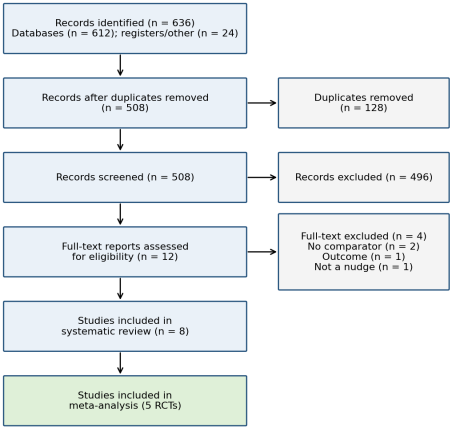
The search identified 636 records (databases n = 612; registers and other sources n = 24). After removal of 128 duplicates, 508 records were screened and 496 excluded. Of 12 full-text reports assessed, 4 were excluded (no comparator, n = 2; outcome, n = 1; not a nudge, n = 1), leaving 8 studies in the review (Figure 1; Table 1). Five randomised controlled trials (RCTs) with extractable attendance data entered the meta-analysis; the remaining three (Peri-urban Kenya 2020, Addis Ababa 2019 and the Johannesburg 2019 cohort) were synthesised narratively because pooled-ready event data were not available or, for the cohort, because of the non-randomised design.
Figure 1. PRISMA 2020 flow diagram.
3.2. Characteristics of Included Studies
Table 1. Characteristics of the eight included studies. Five RCTs contributed quantitative data on attendance.

Study (year)

Design

Country / setting

Mechanism

N (int/ctrl)

Primary outcome

Clapp 2024

RCT

USA, multi-site

Default opt-out scheduling + tailored messaging

184/176

PCP visit ≤4 months

Yee 2026

RCT

USA (Medicaid)

Lay patient navigation (1 year)

203/202

Postpartum visit

Sarmiento 2019

RCT

Philippines

SMS reminders (2×/week)

154/154

Follow-up/OGTT ≤12 weeks

Nyanza HIV 2021

RCT

Kenya

Two-way SMS

194/187

Postpartum clinic attendance

Oramisi 2019

RCT

Kenya (Pumwani)

SMS reminders

377/377

Postnatal attendance (FTA)

Peri-urban Kenya 2020

RCT

Kenya

SMS series

NR

Postnatal attendance

Addis Ababa 2019

Cluster RCT

Ethiopia

SMS/voice reminders

NR

Postnatal attendance

Johannesburg 2019

Cohort

South Africa

Twice-weekly SMS

NR

Postnatal visits

NR, not reported / not extracted; OGTT, oral glucose tolerance test; PCP, primary care provider.
3.3. Primary Outcome
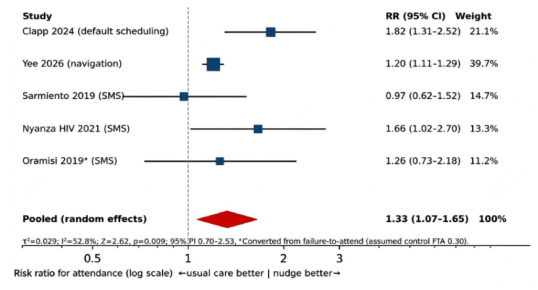
Pooling five RCTs (n = 2,208), nudges increased postpartum visit attendance: RR 1.33 (95% CI 1.07–1.65; I2 = 52.8%; τ2 = 0.029; 95% prediction interval (PI) 0.70–2.53; Z = 2.62, p = 0.009) (Figure 2); Table 2). Moderate heterogeneity (I2 = 52.8%) was observed. The prediction interval crosses 1, indicating that a null or even unfavourable effect cannot be excluded in a new setting. TSA indicated that the accrued information size remained below the required information size for a conclusive result.
Figure 2. Forest plot of postpartum visit attendance (5RCTs, n=2,208).
Table 2. Attendance effects in the five randomised controlled trials included in the meta-analysis.

Study

Intervention vs control, n/N (%)

RR (95% CI)

lnRR

SE

Weight

Clapp 2024

74/184 (40.2%) vs 39/176 (22.2%)

1.82 (1.31–2.52)

0.596

0.167

21.1%

Yee 2026

195/203 (96.1%) vs 162/202 (80.2%)

1.20 (1.11–1.29)

0.180

0.038

39.7%

Sarmiento 2019

30/154 (19.5%) vs 31/154 (20.1%)

0.97 (0.62–1.52)

−0.033

0.229

14.7%

Nyanza HIV 2021

38/194 (19.6%) vs 22/187 (11.8%)

1.66 (1.02–2.70)

0.510

0.248

13.3%

Oramisi 2019*

FTA RR 0.4 (0.2–0.6); f = 0.30

1.26 (0.73–2.18)

0.229

0.280

11.2%

Pooled (random effects)

—

1.33 (1.07–1.65)

0.286

0.109

100%

*Converted from failure-to-attend. Subgroup by mechanism: bundled default scheduling RR 1.82 (one trial); patient navigation RR 1.20 (one trial); short message service (SMS) reminders RR 1.25 (95% CI 0.91–1.73; I2 = 23%; three trials).
3.4. Sensitivity Analyses
Table 3. Sensitivity analyses of the pooled effect on postpartum visit attendance.

Analysis

Studies

Pooled RR (95% CI)

I2

Main (5 RCTs; Oramisi f = 0.30)

5

1.33 (1.07–1.65)

52.8%

Oramisi f = 0.20

5

1.32 (1.06–1.63)

53.0%

Oramisi f = 0.40

5

1.35 (1.09–1.68)

54.0%

Excluding Oramisi (direct attendance only)

4

1.35 (1.04–1.74)

64.5%

Leave-one-out (range)

4 each

1.20–1.42

—

The lowest leave-one-out estimate (RR 1.20, 95% CI 1.12–1.29) followed exclusion of Clapp 2024; the highest (RR 1.42, 95% CI 1.05–1.91) followed exclusion of Yee 2026. Results were stable across assumptions.
3.5. Secondary Outcomes
Secondary maternal outcomes were reported in individual trials only and were not pooled because of heterogeneity in definitions, timing and incomplete reporting of denominators. In the largest trials, nudges increased depression screening (86% vs 72%), blood-pressure testing (85% vs 62%), contraception use (65% vs 43%) and one-year primary-care attendance (57% vs 30%), and reduced readmission (1.7% vs 5.8%). Mobile WACh XY increased highly effective contraception (69.9% vs 57.4%) and Heart Safe Motherhood increased postpartum blood-pressure ascertainment (92.2% vs 43.7%). These findings are hypothesis-generating and derive from single trials; complete supporting data and consistent denominators were not uniformly available across studies.
3.6. Risk of Bias

Study

D1

D2

D3

D4

D5

Overall

Clapp 2024

Low

Some concerns

Low

Low

Low

Some concerns

Yee 2026

Low

Some concerns

Low

Low

Low

Some concerns

Sarmiento 2019

Low

Some concerns

Some concerns

Low

Low

Some concerns

Nyanza HIV 2021

Some concerns

Some concerns

Some concerns

Low

Low

Some concerns

Oramisi 2019

Some concerns

Some concerns

Some concerns

Low

Some concerns

Some concerns

D1, randomisation process; D2, deviations from intended interventions; D3, missing outcome data; D4, outcome measurement; D5, selection of the reported result. All trials were rated as having some concerns overall.
3.7. Certainty of Evidence (GRADE)
Table 5. GRADE assessment of certainty for the primary outcome.

Domain

Assessment

Downgrade

Certainty

Risk of bias

Some concerns in all trials

0

Inconsistency

I2 = 52.8%

−1

Indirectness

Direct

0

Imprecision

95% PI crosses 1; TSA below required information size

−1

Publication bias

<10 studies; not assessable

0

Overall

LOW (⊕⊕◯◯)

4. Discussion
4.1. Summary of Findings
Digital and behavioural nudges increased postpartum visit attendance (RR 1.33, 95% CI 1.07–1.65). The estimate was stable across sensitivity analyses. Moderate heterogeneity (I2 = 52.8%) was present, and the 95% prediction interval (0.70–2.53) crosses the null, indicating substantial uncertainty about the effect in a new setting. TSA confirmed that the current information size is insufficient for a definitive conclusion. Point estimates were largest for bundled default scheduling, intermediate for patient navigation and modest and imprecise for SMS reminders, which is consistent with the hypothesis that reducing friction (defaults, human contact) outperforms information alone. Because each of the first two mechanisms is represented by a single trial, between-mechanism comparisons are hypothesis-generating only.
4.2. Comparison with Existing Literature
Broader reviews cover postpartum care delivery in general ; this review, to our knowledge, is the first to isolate nudge mechanisms and provide a mechanism-stratified pooled estimate. Our SMS-specific estimate is compatible with, but larger than, prior sub-Saharan African SMS meta-analyses of appointment attendance (RR ≈ 1.03) ; that earlier estimate refers to general appointment attendance rather than postpartum care. A more recent meta-analysis of SMS reminders for maternal care in low- and middle-income countries (LMICs) reported a larger effect on postnatal care (RR 1.51) , supporting the potential value of messaging interventions while underscoring residual heterogeneity across contexts.
4.3. Mechanistic Interpretation
Default (opt-out) scheduling removes the initiation burden; navigation addresses structural barriers (transport, childcare); messaging alone appears weakest, especially where supply-side barriers dominate or the required visit is complex or diagnostic (for example, an OGTT).
4.4. Implications for Practice
Health-system managers in high- and low-resource settings may prioritise friction-reducing strategies (default scheduling, navigation) over information-only reminders, particularly where baseline attendance is low. Given the low certainty of evidence, local evaluation is advisable before widespread adoption.
4.5. Implications for Research
The prediction interval (0.70–2.53) and TSA indicate that the evidence is not yet sufficient. A large pragmatic multicentre RCT, ideally in low- and middle-income settings, is warranted and should report attendance (not only failure-to-attend) to facilitate pooling. Future trials should also collect standardised secondary maternal outcomes with clear denominators.
4.6. Strengths and Limitations
Strengths include a mechanism-stratified synthesis, PRISMA-guided reporting, use of RoB 2, GRADE and TSA, extensive sensitivity analyses, and inclusion of high- and low-resource settings. Limitations: only five randomised trials contributed to the pooled estimate, with single-trial subgroups; outcome definitions varied (for example, Sarmiento 2019 measured follow-up/OGTT completion); blinding of participants and providers is infeasible; one trial required conversion from failure-to-attend with an assumed control proportion; heterogeneity was moderate; the strongest mechanisms derive mainly from high-income settings; three eligible studies could not be pooled; the review was conducted by a single author with extraction from published reports only (no dual independent extraction or resolution of disagreements); secondary maternal outcomes were sparsely and inconsistently reported and could not be pooled; and publication bias could not be assessed with fewer than ten studies. These limitations reduce the certainty of the findings and warrant cautious interpretation.
5. Conclusions
Digital and behavioural nudges, particularly bundled default scheduling and patient navigation, may increase postpartum visit attendance. The pooled effect is statistically significant but imprecise and of low certainty, reflecting a small, heterogeneous and geographically skewed evidence base. The wide prediction interval and insufficient information size indicated by TSA further underscore that a definitive multicentre trial is warranted before firm recommendations can be made.
The findings suggest that interventions addressing the practical and behavioural barriers to postpartum care may be more useful than approaches that rely on information provision alone. In particular, strategies that reduce the need for women to initiate or organize follow-up themselves—such as default appointment scheduling, timely reminders, and patient navigation—may improve continuity of care by making the desired behaviour easier and more immediate. However, the available evidence does not establish that any single digital platform, messaging strategy, or behavioural technique is definitively superior to others.
Importantly, increased postpartum visit attendance should be regarded as an intermediate outcome rather than an endpoint in itself. Attendance creates an opportunity for blood-pressure assessment, identification of infection and other complications, mental health screening, contraception counselling, breastfeeding support, and management of ongoing maternal health conditions. Future studies should therefore determine whether digital and behavioural interventions that increase attendance also improve the quality and timeliness of care received during the postpartum contact and ultimately reduce maternal morbidity or other clinically important outcomes.
Overall, digital and behavioural nudges represent a promising and potentially scalable complement to routine postpartum services, but they should not be considered a substitute for accessible, high-quality maternal healthcare. The current evidence supports further rigorous evaluation rather than widespread adoption of any specific intervention as definitively effective.
Abbreviations

CENTRAL

Cochrane Central Register of Controlled Trials

CI

confidence interval

CINAHL

Cumulative Index to Nursing and Allied Health Literature

FTA

Failure-to-attend

GRADE

Grading of Recommendations Assessment, Development and Evaluation

HFA

Habtamu Fekadu Andeta I2, I-squared Statistic

LMICs

Low- and Middle-income Countries

OGTT

Oral Glucose Tolerance Test

OSF

Open Science Framework

PCP

Primary Care Provider

PI

Prediction Interval

PRISMA

Preferred Reporting Items for Systematic Reviews and Meta-Analyses

RCT

randomised controlled trial

ROBINS-I

Risk of Bias in Non-randomized Studies of Interventions

RoB 2

Risk of Bias 2

RR

Risk Ratio

SMS

Short Message Service

TSA

Trial Sequential Analysis

WHO

World Health Organization

WHO ICTRP

World Health Organization International Clinical Trials Registry Platform

Author Contributions
Habtamu Fekadu Andeta: Conceptualization, Data curation, Formal Analysis, Investigation, Methodology, Writing – original draft, Writing – review & editing
Data Availability Statement
Extracted data and analysis code are available from the corresponding author on reasonable request.
Conflicts of Interest
The author declares no conflicts of interest.
References
[1] American College of Obstetricians and Gynecologists. Committee Opinion No. 736: Optimizing postpartum care. Obstet Gynecol. 2018; 131(5): e140–e150.
[2] World Health Organization. WHO recommendations on maternal and newborn care for a positive postnatal experience. Geneva: WHO; 2022.
[3] Clapp MA, Ray A, Liang P, James KE, Ganguli I, Cohen JL. Postpartum primary care engagement using default scheduling and tailored messaging: a randomized clinical trial. JAMA Netw Open. 2024; 7(7): e2422500.
[4] Yee LM, Feinglass J, Williams BR, et al. Patient navigation and postpartum health care outcomes: a randomized clinical trial. JAMA Health Forum. 2026; 7(10): e263338.
[5] Sarmiento AJ, Bernardo DC, Isip-Tan IT. Effect of short message service (SMS) reminders on compliance with postpartum oral glucose tolerance testing among women with gestational diabetes mellitus: a randomized controlled trial. J ASEAN Fed Endocr Soc. 2019; 34(2).
[6] Oramisi VA, Were E, Oyugi E, et al. Effect of short message service reminders on postnatal care attendance among mothers in Pumwani Maternity Hospital, Kenya. J Interv Epidemiol Public Health. 2019; 2(4).
[7] Gurol-Urganci I, de Jongh T, Vodopivec-Jamsek V, Atun R, Car J. Mobile phone messaging reminders for attendance at healthcare appointments. Cochrane Database Syst Rev. 2013; (12): CD007458.
[8] Free C, Phillips G, Watson L, et al. The effectiveness of mobile-health technologies to improve health care service delivery processes: a systematic review and meta-analysis. PLoS Med. 2013; 10(1): e1001363.
[9] Thaler RH, Sunstein CR. Nudge: Improving Decisions About Health, Wealth, and Happiness. Yale University Press; 2008.
[10] World Health Organization. WHO recommendations on postnatal care of the mother and newborn. Geneva: WHO; 2013.
[11] Schwebel FJ, Larimer ME. Using text message reminders in health care services: a narrative literature review. Internet Interv. 2018; 13: 82–104.
[12] Mekonnen ZA, Tilahun B, Alemu K, et al. Effect of short message service reminders in improving optimal antenatal care, skilled birth attendance and postnatal care in low-and middle-income countries: a systematic review and meta-analysis. BMC Med Inform Decis Mak. 2024; 24: 383.
[13] Guyatt GH, Oxman AD, Vist GE, et al. GRADE: an emerging consensus on rating quality of evidence and strength of recommendations. BMJ. 2008; 336(7650): 924–926.
[14] Sterne JAC, Savović J, Page MJ, et al. RoB 2: a revised tool for assessing risk of bias in randomised trials. BMJ. 2019; 366: l4898.
[15] Page MJ, McKenzie JE, Bossuyt PM, et al. The PRISMA 2020 statement: an updated guideline for reporting systematic reviews. BMJ. 2021; 372: n71.
[16] Wetterslev J, Jakobsen JC, Gluud C. Trial sequential analysis in systematic reviews with meta-analysis. BMC Med Res Methodol. 2017; 17: 39.
[17] Higgins JPT, Thomas J, Chandler J, et al. Cochrane Handbook for Systematic Reviews of Interventions. 2nd ed. John Wiley & Sons; 2019.
[18] O’Brien MA, Rogers S, Jamtvedt G, et al. Educational outreach visits: effects on professional practice and health care outcomes. Cochrane Database Syst Rev. 2007;(4): CD000409.
Cite This Article
  • APA Style

    Andeta, H. F. (2026). Digital and Behavioural Nudge Interventions to Improve Postpartum Visit Attendance: A Systematic Review and Meta-analysis. Biomedical Sciences, 12(4), 80-88. https://doi.org/10.11648/j.bs.20261204.11

    Copy | Download

    ACS Style

    Andeta, H. F. Digital and Behavioural Nudge Interventions to Improve Postpartum Visit Attendance: A Systematic Review and Meta-analysis. Biomed. Sci. 2026, 12(4), 80-88. doi: 10.11648/j.bs.20261204.11

    Copy | Download

    AMA Style

    Andeta HF. Digital and Behavioural Nudge Interventions to Improve Postpartum Visit Attendance: A Systematic Review and Meta-analysis. Biomed Sci. 2026;12(4):80-88. doi: 10.11648/j.bs.20261204.11

    Copy | Download

  • @article{10.11648/j.bs.20261204.11,
      author = {Habtamu Fekadu Andeta},
      title = {Digital and Behavioural Nudge Interventions to Improve Postpartum Visit Attendance: A Systematic Review and Meta-analysis},
      journal = {Biomedical Sciences},
      volume = {12},
      number = {4},
      pages = {80-88},
      doi = {10.11648/j.bs.20261204.11},
      url = {https://doi.org/10.11648/j.bs.20261204.11},
      eprint = {https://article.sciencepublishinggroup.com/pdf/10.11648.j.bs.20261204.11},
      abstract = {Background: Approximately 40–50% of women miss the comprehensive postpartum visit, leading to missed detection of postpartum hypertension, depression, diabetes and infection. Digital and behavioural “nudge” interventions are low-cost candidate solutions, but, to our knowledge, no systematic review has quantitatively pooled their effect on postpartum visit attendance. Methods: We searched PubMed/MEDLINE, Embase, Cochrane Central Register of Controlled Trials (CENTRAL), CINAHL (Cumulative Index to Nursing and Allied Health Literature), Scopus, Web of Science, ClinicalTrials.gov and the World Health Organization International Clinical Trials Registry Platform (WHO ICTRP) (inception to May 2026) for randomised and controlled studies of postpartum women receiving at least one digital or behavioural nudge versus usual care. The primary outcome was comprehensive postpartum visit attendance. Study selection, data extraction and risk-of-bias assessment were performed by a single reviewer; this limitation is acknowledged. Risk of bias was assessed with Risk of Bias 2 (RoB 2) and Risk Of Bias In Non-randomized Studies of Interventions (ROBINS-I), certainty with Grading of Recommendations Assessment, Development and Evaluation (GRADE), and information sufficiency with trial sequential analysis (TSA). Risk ratios (RRs) were pooled using DerSimonian–Laird random-effects meta-analysis with pre-specified subgroup and sensitivity analyses. Results: Eight studies were included in the review; five randomised controlled trials (RCTs; n = 2,208) contributed to the quantitative synthesis. Nudges increased postpartum visit attendance (pooled RR 1.33, 95% confidence interval (CI) 1.07–1.65; I2 = 52.8%; τ2 = 0.029; 95% prediction interval 0.70–2.53; p = 0.009). Results were stable across sensitivity analyses (RR 1.32–1.35). Point estimates were largest for bundled default scheduling (RR 1.82, one trial), intermediate for patient navigation (RR 1.20, one trial) and 1.25 (95% CI 0.91–1.73) for short message service (SMS) reminders (three trials). Certainty of evidence was low; TSA indicated that the accrued information size was below the required information size. Secondary maternal outcomes (depression screening, blood-pressure testing, contraception and readmission) were reported in single trials only and were not pooled. Conclusions: Digital and behavioural nudges, particularly friction-reducing strategies such as default scheduling and patient navigation, may improve postpartum visit attendance, although the evidence is of low certainty and the prediction interval crosses the null. The evidence base is small, heterogeneous and geographically skewed; a definitive multicentre trial, ideally in low- and middle-income settings, is warranted.},
     year = {2026}
    }
    

    Copy | Download

  • TY  - JOUR
    T1  - Digital and Behavioural Nudge Interventions to Improve Postpartum Visit Attendance: A Systematic Review and Meta-analysis
    AU  - Habtamu Fekadu Andeta
    Y1  - 2026/11/12
    PY  - 2026
    N1  - https://doi.org/10.11648/j.bs.20261204.11
    DO  - 10.11648/j.bs.20261204.11
    T2  - Biomedical Sciences
    JF  - Biomedical Sciences
    JO  - Biomedical Sciences
    SP  - 80
    EP  - 88
    PB  - Science Publishing Group
    SN  - 2575-3932
    UR  - https://doi.org/10.11648/j.bs.20261204.11
    AB  - Background: Approximately 40–50% of women miss the comprehensive postpartum visit, leading to missed detection of postpartum hypertension, depression, diabetes and infection. Digital and behavioural “nudge” interventions are low-cost candidate solutions, but, to our knowledge, no systematic review has quantitatively pooled their effect on postpartum visit attendance. Methods: We searched PubMed/MEDLINE, Embase, Cochrane Central Register of Controlled Trials (CENTRAL), CINAHL (Cumulative Index to Nursing and Allied Health Literature), Scopus, Web of Science, ClinicalTrials.gov and the World Health Organization International Clinical Trials Registry Platform (WHO ICTRP) (inception to May 2026) for randomised and controlled studies of postpartum women receiving at least one digital or behavioural nudge versus usual care. The primary outcome was comprehensive postpartum visit attendance. Study selection, data extraction and risk-of-bias assessment were performed by a single reviewer; this limitation is acknowledged. Risk of bias was assessed with Risk of Bias 2 (RoB 2) and Risk Of Bias In Non-randomized Studies of Interventions (ROBINS-I), certainty with Grading of Recommendations Assessment, Development and Evaluation (GRADE), and information sufficiency with trial sequential analysis (TSA). Risk ratios (RRs) were pooled using DerSimonian–Laird random-effects meta-analysis with pre-specified subgroup and sensitivity analyses. Results: Eight studies were included in the review; five randomised controlled trials (RCTs; n = 2,208) contributed to the quantitative synthesis. Nudges increased postpartum visit attendance (pooled RR 1.33, 95% confidence interval (CI) 1.07–1.65; I2 = 52.8%; τ2 = 0.029; 95% prediction interval 0.70–2.53; p = 0.009). Results were stable across sensitivity analyses (RR 1.32–1.35). Point estimates were largest for bundled default scheduling (RR 1.82, one trial), intermediate for patient navigation (RR 1.20, one trial) and 1.25 (95% CI 0.91–1.73) for short message service (SMS) reminders (three trials). Certainty of evidence was low; TSA indicated that the accrued information size was below the required information size. Secondary maternal outcomes (depression screening, blood-pressure testing, contraception and readmission) were reported in single trials only and were not pooled. Conclusions: Digital and behavioural nudges, particularly friction-reducing strategies such as default scheduling and patient navigation, may improve postpartum visit attendance, although the evidence is of low certainty and the prediction interval crosses the null. The evidence base is small, heterogeneous and geographically skewed; a definitive multicentre trial, ideally in low- and middle-income settings, is warranted.
    VL  - 12
    IS  - 4
    ER  - 

    Copy | Download

Author Information
  • Abstract
  • Keywords
  • Document Sections

    1. 1. Introduction
    2. 2. Methods
    3. 3. Results
    4. 4. Discussion
    5. 5. Conclusions
    Show Full Outline
  • Abbreviations
  • Author Contributions
  • Data Availability Statement
  • Conflicts of Interest
  • References
  • Cite This Article
  • Author Information