Research Article | | Peer-Reviewed

Assessment of Milk Yield and Quality Among Trained and Untrained Smallholder Dairy Cattle Farmers in Muheza District, Tanzania

Received: 29 December 2025     Accepted: 12 January 2026     Published: 27 January 2026
Views:       Downloads:
Abstract

Smallholder dairy farming plays a crucial role in Tanzania’s agricultural sector. However, their milk productivity remains low. Therefore, the study aimed at examining how training affects milk productivity, quality, and safety. The study adopted a quasi-experimental design, whereby data and milk samples were collected from 70 randomly selected smallholder dairy farmers (35 trained and 35 untrained) with lactating dairy cows. The study also involved direct measurement of daily milk yield and laboratory analysis of physical-chemical characteristics and hygienic quality. The data were analyzed using R software version 4.5.1, whereby both descriptive and inferential statistics were determined. Findings show that trained farmers reported higher milk yields (P<0.001), averaging 12.07 ± 2.02 L/day, compared to 6.56 ± 1.4 L/day for untrained farmers. Additionally, milk from trained farmers demonstrated superior physicochemical properties, recording a higher mean pH (6.65 ± 0.1) and specific gravity (1.026 ± 0.85 g/cc) compared to untrained farmers (6.49 ± 0.13; 1.024 ± 1.09 g/cc). Hygienic parameters also showed better results for trained farmers, whose milk had lower mean somatic cell counts 5.04 vs. 5.51 log cells/ml), total plate counts 5.08 vs. 5.30 log CFU/ml), and Escherichia coli loads 2.49 vs. 2.81 log CFU/ml). Additionally, Staphylococcus aureus mean counts were lower in milk from trained farmers 4.34 vs. 4.59 log CFU/ml). The mean contamination of aflatoxin M1 (AFM1) was lower in trained farmers compared to their untrained counterparts. Findings also show that training had a highly significant (p< 0.001) effect on aflatoxin M1 contamination. Overall, it can be concluded that training enhanced smallholder dairy farmers' milk yield and quality through better management and hygiene. Therefore, there is a need for expanding extension services and training programs as these boost smallholder dairy farmers' productivity and livelihoods and general food safety.

Published in International Journal of Animal Science and Technology (Volume 10, Issue 1)
DOI 10.11648/j.ijast.20261001.12
Page(s) 14-30
Creative Commons

This is an Open Access article, distributed under the terms of the Creative Commons Attribution 4.0 International License (http://creativecommons.org/licenses/by/4.0/), which permits unrestricted use, distribution and reproduction in any medium or format, provided the original work is properly cited.

Copyright

Copyright © The Author(s), 2026. Published by Science Publishing Group

Keywords

Raw Milk, Microbiological Count, Milk Quality, Somatic Cell Count, Aflatoxin M1 Contamination

1. Introduction
Smallholder dairy farming plays a crucial role in Tanzania's agricultural sector, accounting for approximately 80% of the country's milk production and providing support for rural livelihoods and food security . In Tanzania, smallholder dairy farming has experienced significant growth over the past three decades . This development has played a crucial role in poverty alleviation by meeting the rising demand for milk and milk products . Additionally, it has created job opportunities throughout the value chain and provided income from the sale of milk and its by-products. Furthermore, smallholder dairy farming allows families to build assets, thus contributing to their overall economic stability . Despite ongoing difficulties, smallholder dairy farming continues to be vital for the growth of Tanzania’s livestock industry and its strategies for national food security .
As a result of rapid urbanization, the rise of the middle class, and changing dietary preferences, Tanzania’s per capita milk consumption is expected to double from 50 to 100 kg/annum by 2030 . Furthermore, research in sub-Saharan Africa has shown a rise in dairy product consumption, linked to rapid population growth, urbanization, and increased per capita income . Currently, the country meets parts of its domestic demand through the importation of liquid milk and milk powder from neighboring and regional countries . Despite Tanzania's potential for dairy production, many challenges exist . These include low productivity due to poor animal health, low genetic potential, less productive livestock breeds, low-quality feeds and poor market linkages . According to Mukasafiri , the productivity of dairy cattle in tropical regions remains low due to the scarcity of feed, both in terms of quantity and quality, particularly during the dry season.
Approximately 60 to 90 percent of Tanzania’s milk within formal marketing channels comes from smallholder farming systems with both exotic dairy cattle and local breeds . Exotic breeds, often managed under improved systems, yield 6 to 12 litres per cow per day, significantly higher than the 1 to 2 litres produced by local breeds in the traditional systems, which dominate smallholder operations . Nonetheless, Tanzania’s milk production increased slightly, from approximately 1.3 billion litres in 2005/2006 to 3.97 billion litres in 2023/24 . Tanzania’s national average milk consumption stands at 67.5 litres per person per year .
Milk is a highly nutritious and valuable source of fats, amino acids, minerals, and vitamins that form part of the recommended daily intake for humans . Nonetheless, to meet the demand for milk and prevent stunting, both milk quality and production must be improved . Milk composition and quality are influenced by several factors, including animal breed, stage of lactation, parity and management practices such as feeds and feeding systems . Factors such as using dirty milking equipment, inadequate hygiene in the cattle shed and the absence of high-quality water for cleaning affect the quantity and variety of microorganisms present in milk right after it's been milked and therefore its quality .
According to Garcia , farm hygiene has a significant impact on milk quality, with poor cleaning of cow shelters increasing the pressure of infections on the farm; therefore, leading to disease incidence that affects udder health . Furthermore, potential pathogens associated with intramammary infections, such as Staphylococcus spp., Escherichia coli, Campylobacter jejuni, etc., can cause food poisoning . The quality of milk is indicated by its microbial load, which also reflects the level of hygiene in the milk production process .
According to Ivetić , contaminated animal feeds can lead to a decrease in milk quality due to the presence of aflatoxin B1 (AFB1) in the feed. When metabolized by cows, AFB1 transforms into aflatoxin M1 (AFM1), which is secreted in raw milk. Aflatoxins negatively impact milk quality because, after cows metabolize AFB1, the resulting AFM1 is highly resistant to thermal treatments such as pasteurization and freezing . According to Rama , pasteurization processes, even those using UHT techniques, do not drastically affect AFM1 concentration due to heat stability. The synthesis of AFM1 occurs in the mammalian organism after the intake of contaminated feed with AFB1 . Animal feed contaminated with aflatoxins can cause different acute and chronic diseases in animals: refusal of food, weight loss, decreased immunity, cancer, decreased reproductive capacity, reduced production, and death . The presence of AFM1 in milk and milk products is of huge concern for human health . Enhancing the quality of dairy production in smallholder farms within tropical regions presents one of the most fundamental challenges in livestock management .
However, despite previous research in Tanzania and other developing countries underscoring the significance of training, yet it often focuses more on the adoption of practices than on the actual outcomes related to yield and quality. Consequently, there is a lack of empirical evidence in particularly when it comes to the Muheza district, as to whether trained farmers can produce greater quantities and better-quality milk than their untrained counterparts. Therefore, the study aimed to assess how the training offered by the Livestock Training Agency (LITA) Buhuri Campus in collaboration with Tanzania Livestock Research Institute (TALIRI) under the Maziwa Faida Project has improved milk yield and quality among trained and untrained smallholder dairy cattle farmers in Muheza District. Additionally, the study assessed aflatoxin M1 contamination in the raw milk produced by the smallholder dairy cattle farmers. The study tests two key hypotheses: first, that training smallholder dairy farmers does not significantly impact milk productivity; and that the quality of raw milk (i.e., somatic cell count, Escherichia coli loads, Staphylococcus aureus mean counts and detectable levels of aflatoxin M1) does not significantly differ between trained and untrained farmers.
1.1. Theoretical Framework
The study was guided by three interrelated theories: the Theory of Planned Behavior (TPB), Human Capital Theory (HCT) and Rogers’ Diffusion of Innovations Theory (DIT). Collectively, the theories provide a comprehensive lens through which to examine the impact of training on smallholder dairy farmers' milk production and quality.
1.2. Theory of Planned Behavior (TPB)
The Theory of Planned Behavior posits that individual behavior is guided by intentions, which are shaped by three core elements: attitudes, subjective norms, and perceived behavioral control . The study applied the TPB to explain how dairy farmers' perception in relation to hygienic practices, use of contemporary dairy technologies, advice from peers and extension agents, and their self-efficacy in applying improved dairy production practices, influences their actual behaviors . Generally, it is expected that farmers who participate in training are more likely to develop more favorable attitudes toward hygienic milking and feed management. Moreover, their experience as enhanced by community support, and their strong belief in their ability to implement the knowledge they have acquired, can also be critical in how they produce their milk. Therefore, the above confluence of factors is expected to result in improved milk yield and a reduction in contamination risks.
1.3. Human Capital Theory (HCT)
The Human Capital Theory (HCT) posits that investments in education and training enhance individuals' skills, productivity and overall efficiency . Through educational programs, farmers gain increased proficiency in critical areas such as feeding, breeding, housing, and hygiene management . Based on the HCT, smallholder dairy farmers are expected to use their accumulated human capital to bolster their managerial competencies, consequently enhancing both the milk yield and quality while concurrently mitigating health risks associated with aflatoxin contamination. As a result, it is expected that trained farmers will demonstrate superior performance in milk production and safety metrics compared to their untrained counterparts. However, Human capital theory lacks realism due to several methodological weaknesses, such as dependence on a singular theoretical approach and closed system modeling, misuse of mathematical techniques, and the analysis of multiple interrelated variables . The theory imposes a straightforward linear model on the complex dynamics between various forms of education and employment. It does not adequately explain how education increases productivity, the reasons for rising income inequality, or the impact of social status .
1.4. Rogers’ Diffusion of Innovations Theory (DIT)
Rogers’ Diffusion of Innovations Theory (DIT) elucidates the processes by which innovations are disseminated and adopted over time. In the context of this study, training serves as a crucial vehicle for the dissemination of advanced dairy practices (innovations), such as hygienic milking techniques, proper feed storage methods and effective quality assessment procedures. Participants in training are likely to emerge as early adopters of these innovations, thereby influencing their peers through practical demonstration . The adoption of these best practices is considered essential for enhancing milk yield and reducing levels of aflatoxin contamination. The limitations of Rogers' Diffusion of Innovations (DIT) theory include the assumption that every innovation is advantageous, a tendency to focus on the individual shortcomings of adopters instead of identifying systemic obstacles, and the presence of cultural bias. Furthermore, the theory simplifies the complex adoption processes by presuming a straightforward progression and neglecting to address structural elements, organizational context, or long-term sustainability .
Therefore, based on the weaknesses of the three theories that guided the study, it was necessary to harness the strengths of each, which enabled the study to have a robust theoretical framework that allowed the study to properly address the study’s objective. For example, while the TPB addresses the psychological and socio-cultural determinants of smallholder dairy farmers' behavior, the HCT underscores the critical role of training as a form of investment in productivity and lastly, Rogers’ DIT focuses on the mechanisms underlying the diffusion of optimal practices. Collectively, these theories suggest that farmers who engage in training programs are likely to achieve enhanced milk yield and quality, as well as a reduction in aflatoxin contamination, in contrast to their untrained counterparts.
1.5. Conceptual Framework
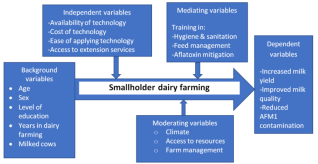
The study’s conceptual framework (Figure 1) summarizes how training interacts with smallholder dairy farmers' background and independent variables to impact milk yield, quality, and AFM1 contamination. Training serves as a pivotal intervention that shapes farmers’ knowledge, attitudes and practices in dairy management. Generally, trained farmers are more likely to cultivate positive intentions and implement hygienic practices in both milking and feed handling, which significantly influence milk yield and quality. Furthermore, training enhances farmers’ technical competencies, thereby boosting their productivity and efficiency in managing dairy herds. Similarly, training accelerates the adoption of innovations such as improved feeding systems, hygienic milk handling and strategies to mitigate aflatoxin risk. As a result, trained farmers are expected to achieve higher milk yield and quality while reducing aflatoxin M1 contamination in raw milk compared to their untrained peers.
Figure 1. Conceptual framework showing the effects of training on milk yield and quality.Conceptual framework showing the effects of training on milk yield and quality.
2. Materials and Methods
2.1. Description of the Study Area
The study was conducted in Muheza District, Tanga Region, between January and October 2025. The district is situated between latitudes 5°10’0.01” and 5°10’54” S and longitudes 38°46’59.99” and 38°4’18” E. The district’s elevation ranges from 195.4 meters to 1,050 meters above sea level and is bordered by the City of Tangato to the East, Mkinga District to the North, Pangani District to the South and Korogwe District to the West . The district encompasses a total land area of 1,498 square kilometers and supports a population of 238,260 inhabitants .
The district has a tropical climate with bimodal rainfall: long rains (March to early June) and short rains (October to December). Peak rainfall is in April, where it averages 238.46 mm. Temperatures vary seasonally, with February's average at 31.53°C and July's at 22.8°C. These conditions support an agricultural economy that employs about 75% of the population . The combination of fertile soils and adequate rainfall enables the cultivation of diverse crops, including food staples such as bananas, rice, cassava and maize, alongside cash crops including sisal, tea, rubber, cashew nuts, coconuts, citrus fruits and various spices, notably black pepper, cloves and cinnamon .
Muheza District was chosen for the study due to its substantial cohort of smallholder dairy farmers trained in modern dairy production technologies through initiatives by the Livestock Training Agency and the Tanzania Livestock Research Institute under the Maziwa Faida (Milk for Profit) Project. The project aims at transforming Tanzania's dairy value chain into an inclusive, competitive, and climate-resilient system, enhancing food security, increasing incomes, and addressing climate change . The project’s Key objectives included strengthening institutional capacity for research innovations, improving dairy value chain efficiency, building capabilities among participants and developing a sustainable partnership funding strategy .
2.2. Sample Size and Sampling Design
The estimation of the sample size of smallholder dairy cattle farmers was done using Cochran’s formula for a finite population (N=3000) , assuming a 95% confidence level and p=0.5.
=Z2.(1-p)e2
Were
Z = 1.96 (for 95% confidence)
p = 0.5 (max variability)
e = 0.1172 (11.7%, sampling error)
=1.962 x 0.5 (1-0.5)0.11722= 69.919 ≈ 70
Therefore, taking a 95% confidence level, n=70 (35 trained farmers and 35 untrained farmers)
2.3. Data Collection
A simple random sampling method was employed to select households from a population of 3,000 smallholder dairy cattle farmers identified by the ‘Maziwa Faida Project’ for milk sample collection . In this study, a total of 70 Milk samples were collected from Mkuzi (9 samples), Kilulu (9 samples), Genge (9 samples), Pande Darajani (9 samples), Ngomeni (9 samples), Amani (8 samples), Mbomole (9 samples) and Misarai (8 samples) wards. Before sampling, a comprehensive assessment was conducted focusing on various factors, including environmental hygiene, personnel hygiene, the equipment utilized for milk collection and storage, the conditions under which storage occurs and the quality of water employed in sanitation and milking procedures. Milk yield per cow per day was measured and recorded. From each farmer, approximately 40 cc of pooled raw milk was sampled after being thoroughly mixed from storage containers and stored in a 50 cc Falcon tube. Each sample tube was labeled with an identification number and then placed in an ice box. The samples were transported to the Livestock Training Agency, Buhuri Campus, before being sent to the Nelson Mandela African Institute of Science and Technology in Arusha for analysis. The milk samples were stored at −20°C until they were analyzed. Analysis of somatic cell counts (SCC), microbiological contamination, and the occurrence of aflatoxin M1 was conducted at the microbiology and toxicology laboratories (NM-AIST). The methodology employed for data collection adhered to established trends within the field as follows.
2.4. Chemicals and Reagents Used During Laboratory Analysis
Different types of chemicals, working standards and reagents from various manufacturers were utilized in the laboratory analysis of somatic cells, total plate count, Escherichia coli enumeration, Staphylococcus aureus enumeration and the assessment of aflatoxin M1 (AFM1) in raw cow's milk samples (Table 1).
Table 1. Chemicals and reagents used during laboratory analysis.Chemicals and reagents used during laboratory analysis.Chemicals and reagents used during laboratory analysis.

Chemical/Reagents

Manufacturer

Sofia green reagent

Milkotrocnic Ltd, Bulgaria

Plate count agar (RDM-TGYA-01)

HiMedia Laboratories Pvt. Ltd, India

Hicrome™ E. coli Agar

HiMedia Laboratories Pvt. Ltd, India

Baird-Parker Agar

HiMedia Laboratories Pvt. Ltd, India

Egg Yolk Tellurite

TM media, India

Distilled water

TALIRI, Tanzania

Ethanol

HPCL Biofuels Limited, India

Gram stain

TM media, India

2.5. Laboratory Equipment Used During the Analysis of Samples
Various instruments and equipment from different manufacturers were used in the laboratory analysis of somatic cells, total plate count, Escherichia coli enumeration, Staphylococcus aureus enumeration and the assessment of aflatoxin M1 (AFM1) in samples of raw cow's milk (Table 2).
Table 2. Laboratory equipment used during the analysis of the samples.Laboratory equipment used during the analysis of the samples.Laboratory equipment used during the analysis of the samples.

Equipment

Manufacturer

Petri dishes

Zhejiang Bioland Biotechnology Co., Ltd. China

Falcon tubes (50 cc)

Corning Science, Mexico S.A de C.V

Tissue roll

Shalimar Packaging Industry, India

Gloves (Powder-free)

Hunan Dingguan Industry & Trade Co., Ltd, China

Sterile tips

Zhejiang Bioland Biotechnology Co., Ltd. China

Agar plate spreader

Hunan BKMaM International Trade Co, Ltd, China

Ice Park

Guangzhou Cold Chain Technology Co., Ltd, China

Cool box

Guangzhou Cold Chain Technology Co., Ltd, China

Lactometer

Milkman Dairy Equipment, Tanzania

Ph meter

Thermo Fisher Scientific, USA

Digital thermometer

Milkman Dairy Equipment, Tanzania

Enzyme-linked immunosorbent assay (ELISA) kit

Creative Diagnostic Co Ltd, USA

Colony counter

Fisher Scientific, USA

Lactoscan

Milkotronic Ltd, Bulgaria

Disposable microfluidic camera

Milkotronic Ltd, Bulgaria

Disposable pipettes

Zhejiang Bioland Biotechnology Co., Ltd. China

Analytical balance

OHAUS Europe GmbH, 8606 Nänikon, Switzerland

Vortex mix

Thermo Fisher Scientific, USA

Macro-pipette

Eppendorf, Germany

2.6. Determination of Raw Milk Properties: Temperature, Specific Gravity (Density) and pH of Milk
The temperature of the raw milk samples was determined using a digital thermometer. Determination of pH was done using a pH meter, and the pH of 6.5–6.8 for raw cow milk was used as the standard. For normal milk, the cut-off pH is between 6.6 and 6.8 as recommended in the East African Standards . The specific gravity of raw milk was determined using a Lactometer at a standardized temperature of 20°C, with a density range of 1.026 to 1.032 g/cc, as recommended by the East African Standard .
2.7. Determination of Somatic Cell Count
Somatic cell count was done using Lactoscan. About 30 mL of raw milk was used for the somatic cell count for each raw milk sample. Samples were prepared by adhering to international standards . Milk samples were mixed with the Sofia green reagent, and then 8 μl of the stained sample was pipetted into the chamber of a disposable microfluidic camera of the LACTOCHIP. In analyzing the somatic cells, the LACTOCHIP was inserted into the Lactoscan somatic cell count. A portable Lactoscan for estimating milk somatic cell count has been developed by many companies . The device automatically focuses on the chip and captures images of the stained cells with a sensitive camera. The built-in algorithm analyzes the images and determines the number and size of somatic cells per milliliter of milk. The results were then transferred to the computer for further analysis.
2.8. Enumeration of Total Plate Count (TPC)
It was done using plate count agar reagent (RDM-TGYA-01). The media was prepared by dissolving 24.0 grams in 1,000 milliliters of distilled water, boiled to dissolve the medium completely, and then sterilized by autoclaving at 15 lbs. pressure (121°C) for 15 minutes. Cooled to 42°C and distributed aseptically in petri dishes. One milliliter (1 ml) of milk sample was added to 9 milliliters of distilled water. Tenfold serial dilution of the milk sample in sterile normal saline solution was done, using disposable pipettes, and then inoculated into growth media. Both samples were inoculated for 24 hours together with a negative control. Thereafter, only plates with 30–300 colonies were considered in calculating the colony-forming units per ml of sample. TPC in raw milk at 42°C was performed according to the protocol described by and ISO . Microbial colon counts on the plates used a protocol described by ISO 7218 .
2.9. Enumeration of Escherichia Coli and Staphylococcus Aureus
Milk samples were assessed for E. coli using Hicrome™ E. coli Agar. It was done by suspending 36.57 grams in 1000 mL of purified/distilled water. The solution was then heated to a boiling point to dissolve the medium completely. Thereafter, the milk was sterilized by autoclaving at 15 lbs. pressure (121°C) for 15 minutes, and then it was cooled to 45-50°C, mixed well, and poured into sterile Petri plates aseptically. One milliliter of the milk sample was added to 9 milliliters of distilled water. Ten serial dilutions were done using a disposable pipette. Samples were inoculated for 24 hours. It was followed by reading the results using a colony counter. The Microbial colony count on the plates adopted the protocol established by ISO 7218 .
The samples were also, assessed for Staphylococcus aureus using Baird-Parker Agar mixed with Egg Yolk Tellurite enrichment, as per the protocol described by ISO (2008). About 63.0 grams were suspended in 950 milliliters of distilled water and heated to boiling, to dissolve the medium. Then the same was sterilized by autoclaving for 15 minutes at 121°C. Cooled to 45°C – 50°C, then added 50 milliliters of EY Tellurite emulsion (FD046), mixed well and poured into sterile petri dishes. 1 milliliter of the sample was added to 9 milliliters of distilled water. Ten serial dilutions were done using a disposable pipette. After 24 hours, inoculation was followed by colony counting. Microbial colony counting adopted the protocol established by ISO 7218 .
2.10. Laboratory Analysis of Aflatoxin M1 in Raw Milk
Aflatoxin M1 concentration was determined from 60 sub-sampled raw milk samples (30 from trained farmers, 30 from untrained farmers). Defatted milk samples were used for the quantitative analysis of Aflatoxin M1 in skim milk, with 200 μL applied per well directly for the assay. The concentration of Aflatoxin M1 in the milk was determined using an enzyme-linked immunosorbent assay (ELISA) kit and reagents provided by Helica (Helica: Santa Ana, CA, USA, 2016). The detection limit was established at 0.005 µg/L. Each test was performed in duplicate (Two 96-well kits were utilized). To remove milk fat, the samples were centrifuged for 5 minutes at 2000 g, following the manufacturer's instructions. After aspirating the upper cream layer, the lower phase was utilized for quantitative testing.
Standards and samples (200 μl each) were distributed in duplicates onto pre-coated plates. Following a 2-hour incubation and subsequent wash, 100 μl of the conjugate was added. After 15 minutes of incubation and another wash, 100 μl of enzyme substrate was introduced to each well and incubated for an additional 15 minutes before adding 100 μl of stop solution. To ensure quality control, careful handling and storage of reagents, precise measurements, calibration of the microplate reader and adherence to safety protocols were strictly observed. The optical density of each well was measured using a microplate reader set to 450 nm and the concentration of AFM1 in each well was calculated using a logarithmic standard curve. The average of the duplicates was recorded as the final result. Detailed methodologies have been previously documented . The complete assay protocol (#961AFLM01M – 96) provided by the manufacturer was followed for the quantification of AFM1 .
3. Data Analysis
The data were analyzed using R software, version 4.5.1. Descriptive statistics, including frequencies, percentages, means, ranges, and standard deviations, were computed. An independent t-test was conducted to examine whether a significant difference existed in daily milk production per cow between trained and untrained farmers. Regression analysis was also performed to identify additional factors beyond training that contributed to the observed differences between the two groups. To assess the effects of training on multiple milk quality indicators simultaneously, a one-way multivariate analysis of variance (MANOVA) was employed. Furthermore, Analysis of variance (ANOVA) followed by post hoc comparison using Bonferroni adjustment was applied to evaluate differences in aflatoxin M1 contamination in raw milk.
4. Ethical Clearance
Ethical clearance for the study was obtained from the Tanzania Livestock Research Institute (TALIRI) under reference TLRI/CC.21/066. Approval was also granted by the Department of Animal Aquaculture and Range Sciences (DAARS) and Sokoine University of Agriculture (SUA). The Tanga Region Administrative Secretary (RAS) approved the study after discussion with the head of Agriculture, Livestock and Fisheries in Tanga and the Muheza District Executive Director (DED). Livestock Field Officers were informed to provide necessary support.
5. Results
5.1. Physical-Chemical Properties of Raw Milk
The findings from the physical-chemical analysis of raw cow's milk are summarized in Table 3. The East African Standards were used as reference benchmarks for the recommended quality levels of milk. Regarding pH levels, the mean value for trained smallholder dairy farmers was 6.65 ± 0.1, in contrast to 6.49 ± 0.13 for untrained farmers. Trained farmers displayed pH levels that ranged from a minimum of 6.49 to a maximum of 6.85, while untrained farmers had pH levels ranging from 6.22 to 6.82. Lactometer readings of raw milk indicated that the average specific gravity for trained farmers was 1.026 ± 0.85 g/cc, with a range from 1.025 g/cc to 1.028 g/cc. In comparison, untrained farmers had a mean lactometer reading of 1.024 ± 1.09 g/cc, with values ranging from 21 g/cc to 27 g/cc.
5.2. Milk Yield Among Smallholder Dairy Cattle Farmers
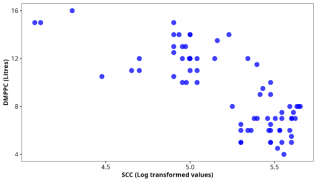
The findings regarding milk productivity (litres per cow per day) are presented in Table 3. Trained farmers had an average production of 12.07 ± 2.02 litres, whereas untrained farmers produced an average of 6.56 ± 1.4 litres per cow per day. Specifically, trained smallholder dairy cattle farmers experienced milk production that varied from a minimum of 7 litres to a maximum of 16 litres per cow daily. In comparison, untrained farmers recorded a minimum of 4 litres and a maximum of 10 liters per cow per day. The t-test revealed a significant difference in average daily milk production per cow between the two groups of smallholder dairy cattle farmers (those trained and those without) (p-value < 0.001). Furthermore, a regression analysis was performed, as presented in Table 5, to pinpoint factors unrelated to training that affect the discrepancy in milk yield between trained and untrained farmers. The results of the regression indicate a negative correlation between somatic cell counts (SCC) and daily milk production per cow per day.
Table 3. Means for Milk temperature, pH, Density, production per cow per day, somatic cell counts (SCC), Total plate count (TPC), Escherichia coli and Staphylococcus aureus (n=70).Means for Milk temperature, pH, Density, production per cow per day, somatic cell counts (SCC), Total plate count (TPC), Escherichia coli and Staphylococcus aureus (n=70).Means for Milk temperature, pH, Density, production per cow per day, somatic cell counts (SCC), Total plate count (TPC), Escherichia coli and Staphylococcus aureus (n=70).

Variable

Category

P-value

Trained

Untrained

(Mean ± sd)

Min-Max

(Mean ± sd)

Min-Max

Milk production per cow (Litres)

12.07 ± 2.02

7.00-16.00

6.56 ± 1.40

4.00-10.00

<0.001

Milk temperature (oC)

35.15 ± 1.43

30.50-36.80

35.60 ± 1.02

33.50-37.50

0.1420

pH

6.65 ± 0.10

6.49-6.85

6.49 ± 0.13

6.22-6.82

<0.001

Density (g/cc)

1.026 ± 0.85

1.025-1.028

1.024 ± 1.09

1.021-1.026

<0.001

SCC (log cells/mil)

5.037 ± 4.854

5.079-5.505

5.509 ± 4.883

5.301-5.653

<0.001

TPC (log CFU/ml)

5.079 ± 4.968

4.000-5.491

5.301 ± 4.944

4.826-5.531

0.0006

E. coli (log CFU/ml)

2.491 ± 2.690

1.623-3.230

2.806 ± 2.580

1.973-3.176

0.0025

S. aureus (log CFU/ml)

4.342 ± 4.342

2.301-4.863

4.591 ± 4.580

3.301-5.176

0.0216

5.3. Factors Influencing Milk Yield Differences Among Smallholder Dairy Farmers
The analysis of variance (ANOVA) Table 4 revealed that the training received by smallholder dairy farmers was highly and significantly associated with milk yield (p < 0.001), underscoring the critical role of farmer training in enhancing milk productivity. In addition, the logarithm of somatic cell count was statistically significant (p < 0.01), indicating a strong association between milk quality parameters and yield performance. Farmer’s age exhibited a marginal effect (p = 0.065). In contrast, other variables, namely ward location, sex, level of education, herd size, and years of dairy farming experience, did not demonstrate statistically significant relationships with milk yield (p > 0.05).
Table 4. Analysis of Variance (ANOVA) for Multiple Independent Variables affecting milk yield.Analysis of Variance (ANOVA) for Multiple Independent Variables affecting milk yield.Analysis of Variance (ANOVA) for Multiple Independent Variables affecting milk yield.

Variable

Df

Sum Sq

Mean Sq

F value

Pr(>F)

significance

Category /Training

1

532.13

532.13

204.0146

< 2e-16

***

Ward

7

19.68

2.81

1.0776

0.39069

Age

1

9.28

9.28

3.5597

0.06468

.

Log SCC

1

23.14

23.14

8.8723

0.00436

**

Sex

1

2.84

2.84

1.0888

0.30147

Level of education

3

5.11

1.7

0.6532

0.58449

Number of cows

1

1.79

1.79

0.6854

0.41146

Years in dairy farming

1

5.88

5.88

2.2533

0.13927

Residuals

53

138.24

2.61

Moreover, the regression analysis presented in Table 5 clarifies the determinants influencing milk yield among smallholder dairy farmers, distinguishing between those who have received training and those who have not. Notably, training emerged as the most significant predictor (p < 0.001) of disparities in milk yield between trained farmers and their untrained counterparts.
Table 5. Regression results highlighting factors influencing milk yield differences between trained and untrained smallholder farmers (n = 70).Regression results highlighting factors influencing milk yield differences between trained and untrained smallholder farmers (n = 70).Regression results highlighting factors influencing milk yield differences between trained and untrained smallholder farmers (n = 70).

Estimate

Std. Error

t value

Pr(>|t|)

significance

(Intercept)

17.89245

5.66623

3.158

0.00262

**

Category (Trained)

3.98225

0.67998

5.856

0.00000

***

Ward (Genge)

0.32288

0.89070

0.363

0.71842

Ward (Kilulu)

0.98559

0.83352

1.182

0.24231

Ward (Mbomole)

1.12828

0.86020

1.312

0.19529

Ward (Misalai)

0.33498

0.79964

0.419

0.67697

Ward (Mkuzi)

0.46251

0.83485

0.554

0.58190

Ward (Ngomeni)

1.07418

0.79400

1.353

0.18184

.

Ward (Pande-Darajani)

-1.06093

0.99781

-1.063

0.29249

Age

-0.01121

0.03715

-0.302

0.76403

Log SCC

-2.40211

0.92446

-2.598

0.01210

*

SexMale

0.70932

0.45283

1.566

0.12320

No formal education

-0.85299

0.82075

-1.039

0.30340

Secondary education

0.34946

0.47933

0.729

0.46917

Tertiary education

-0.66588

0.80730

-0.825

0.41317

Milked cows

0.13934

0.21153

0.659

0.51293

Years in dairy farming

0.07407

0.04872

1.520

0.13435

Significance codes: 0 '***' 0.001 '**' 0.01 '*' 0.05 '.' 0.1 ' ' 1; Residual standard error: 1.612 on 53 degrees of freedom; Multiple R-squared: 0.8134; Adjusted R-squared: 0.757; F-statistic: 14.44 on 16 and 53 DF, p-value < 0.001.
Additionally, the somatic cell count, which serves as an indicator of udder health and mastitis, was found to exert a significant negative impact on milk productivity (p = 0.012) per cow per day, as shown in Figure 2. When somatic cell count levels were below 5.30 log cells/mL, cows generally remained healthy, and their milk yield was unaffected. However, once the somatic cell count exceeds this threshold, subclinical mastitis can develop, resulting in reduced yields. As somatic cell count levels continued to rise, especially beyond 5.60–5.70 log cells/mL, the impact on milk production became increasingly evident, often leading to losses of 1 to 2 liters per cow per day. Conversely, factors pertaining to farmer demographics, including age, sex, educational attainment and farming experience, along with the geographic variable of ward location, did not demonstrate statistically significant associations with milk yield.
Figure 2. Relationship between Milk production per cow per day among smallholder dairy farmers (Litres) and Somatic cell counts (Count/ml). Relationship between Milk production per cow per day among smallholder dairy farmers (Litres) and Somatic cell counts (Count/ml).
5.4. Microbiological Quality of Milk Among Smallholder Dairy Cattle Farmers
5.4.1. Somatic Cell Count
The results regarding somatic cell counts for both trained and untrained smallholder dairy cattle farmers are summarized in Table 3. The average somatic cell count was found to be 5.037 ± 4.854 log cells/ml for trained farmers, compared to 5.509 ± 4.883 log cells/ml for untrained farmers. Among trained smallholder dairy farmers, somatic cell counts varied from a low of 5.079 log cells/ml to a high of 5.505 log cells/ml. In contrast, untrained farmers exhibited counts ranging from a minimum of 5.301 log cells/ml to a maximum of 5.653 log cells/ml. The analysis of variance (ANOVA) Table 6 shows that udder health, measured by log Somatic Cell Counts, significantly (p< 0.001) influenced milk quality between trained and untrained farmers.
5.4.2. Total Plate Count (TPC)
The findings concerning the total plate count among smallholder dairy cattle farmers in Muheza District are presented in Table 3. For trained farmers, the average total plate count was 5.079 ± 4.968 log CFU/ml compared to 5.301 ± 4.944 log CFU/ml for untrained farmers. The minimum total plate count documented for these trained farmers was 4.000 log CFU/ml, while the maximum reached 5.491 log CFU/ml. In contrast, untrained smallholder dairy cattle farmers exhibited a minimum total plate count of 4.826 log CFU/ml, with a maximum total plate count of 5.531 log CFU/ml. The analysis of variance Table 6 show that total plate counts significantly (p< 0.001) influenced milk quality between trained and untrained smallholder dairy farmers.
5.4.3. Escherichia coli and Staphylococcus Aureus
The results for Escherichia coli and Staphylococcus aureus in the raw milk from both the trained and untrained smallholder dairy cattle farmers are summarized in Table 3. The mean of Escherichia coli for trained farmers was recorded at 2.491 ± 2.690 log CFU/ml, while untrained farmers had a higher mean of 2.806 ± 2.580 log CFU/ml. For trained farmers, Escherichia coli ranged from a minimum of 1.623 log CFU/ml to a maximum of 3.230 log CFU/ml. In contrast, untrained farmers showed a minimum concentration of 1.973 log CFU/ml and a maximum of 3.176 log CFU/ml. With respect to Staphylococcus aureus, trained farmers had a mean of 4.342 ± 4.342 log CFU/ml, while untrained farmers reported a mean of 4.591 ± 4.580 log CFU/ml. The range for Staphylococcus aureus among trained farmers varied from 2.301 log CFU/ml to 4.863 log CFU/ml. For untrained farmers, the range extended from 3.301 log CFU/ml to 5.176 log CFU/ml. The analysis of variance Table 6 shows that training significantly exhibited a large effect on Escherichia coli counts (F = 29.95, p < 0.001, ηp² = 0.31) and a moderate effect on Staphylococcus aureus (F = 9.80, p = 0.003, ηp² = 0.13).
5.4.4. The One-way Multivariate Analysis of Variance (MANOVA) on the Influence of Training on Quality Indicators of Raw Milk
A one-way multivariate analysis of variance to assess whether training category (trained, untrained) influenced milk quality indicators: pH, density, log-transformed S. aureus count (log SA), plate count (log PC), E. coli count (log EC), and Somatic cell counts (Log SCC). The multivariate test was significant, Pillai’s Trace = 0.75868, F (6,63) =33.01, p < 0.001 and ηp² = 0.211, indicating that milk quality profiles differed among trained and untrained smallholder dairy farmers.
Table 6. The Analysis of Variance (ANOVA) Results for Individual dependent variable with Partial Eta Squared (ηp²) (n = 70). The Analysis of Variance (ANOVA) Results for Individual dependent variable with Partial Eta Squared (ηp²) (n = 70). The Analysis of Variance (ANOVA) Results for Individual dependent variable with Partial Eta Squared (ηp²) (n = 70).

DV

F-Value

P-value

ηp²

Interpretation

pH

34.52

<0.001

0.34

Large effect: training strongly affects milk pH

Density

66.53

<0.001

0.50

Very large effect: training strongly affects milk density

Log S. aureus

9.8

0.003

0.13

Moderate effect on S. aureus levels

Log TPC

16.89

<0.001

0.2

Moderate-to-large effect on plate counts

Log E. coli

29.95

<0.001

0.31

Large effect on E. coli counts

Log SCC

92.86

<0.001

0.58

Very large effect: training strongly affects somatic cell counts (linked to hygiene)

All dependent variables are significantly affected by training, with effect sizes ranging from moderate (0.126) to very large (0.577).
Furthermore, post hoc analyses employing Bonferroni adjustments indicated that farmers who underwent training recorded significantly higher milk density, more stable pH levels and reduced bacterial loads when compared to their untrained counterparts.
Table 7. Post-hoc tests (Bonferroni adjusted).Post-hoc tests (Bonferroni adjusted).Post-hoc tests (Bonferroni adjusted).

DV

Contrast

Estimate

SE

df

t-ratio

P-value

pH

Untrained - Trained

-1.15

0.2

68

-5.88

< 0.001

Density

Untrained - Trained

-1.4

0.17

68

-8.16

< 0.001

Log SA

Untrained - Trained

0.7

0.23

68

3.13

0.003

Log PC

Untrained - Trained

0.89

0.22

68

4.11

< 0.001

Log EC

Untrained - Trained

1.1

0.2

68

5.47

< 0.001

Log SCC

Untrained - Trained

1.51

0.16

68

9.64

< 0.001

5.4.5. Aflatoxin M1 Contamination in Raw Milk Among Smallholder Dairy Cattle Farmers
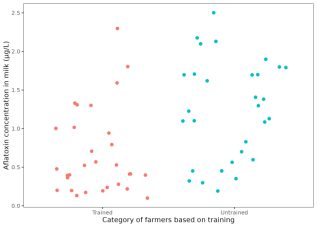
The mean Aflatoxin M1 contamination for trained farmers was 0.68 ± 0.56 µg/L, with minimum and maximum contamination levels recorded at 0.12 µg/L and 1.24 µg/L, respectively. In comparison, untrained farmers exhibited a higher mean Aflatoxin M1 contamination of 1.24 ± 0.65 µg/L, with minimum and maximum levels of 0.59 µg/L and 1.89 µg/L, respectively. The analysis of variance (ANOVA) results presented in Table 8 revealed that training had a statistically significant effect on Aflatoxin M₁ levels (p < 0.001), indicating that trained farmers had significantly lower Aflatoxin M₁ concentrations compared to untrained farmers. Conversely, the effects of geographical location (ward) (p = 0.19), daily milk yield (p = 0.37), and number of cows (p = 0.92) on Aflatoxin M₁ concentration were not statistically significant.
Table 8. The analysis of variance (ANOVA) of aflatoxin M1 concentration in relation to training, ward, daily milk yield and the number of cows.The analysis of variance (ANOVA) of aflatoxin M1 concentration in relation to training, ward, daily milk yield and the number of cows.The analysis of variance (ANOVA) of aflatoxin M1 concentration in relation to training, ward, daily milk yield and the number of cows.

Term

Df

Sum Sq

Mean Sq

F-value

P-value

Significance

Training

1

10.89

10.89

13.68

0.0005

**

Ward/Location

7

8.41

1.2

1.51

0.19

Daily milk yield

1

0.66

0.66

0.83

0.37

Number of cows

1

0.01

0.01

0.01

0.92

Residuals

49

39.03

0.8

Furthermore, the post hoc comparison using Bonferroni-adjusted means indicated that milk from trained farmers had a significantly lower Aflatoxin M₁ concentration than that from untrained farmers, with an average difference of 0.57 log units (t = –3.62, p = 0.0006, df = 58). (t-ratio = -3.623884, p = 0.0006124, df = 58). This substantial reduction highlights the crucial role of training smallholder dairy farmers in mitigating Aflatoxin M₁ contamination in raw milk. The results further emphasize the importance of targeted capacity-building interventions focused on feed management, hygienic handling, and mycotoxin awareness as essential strategies for improving milk safety and public health outcomes. The correlation between Aflatoxin M1 contamination in raw milk and the training status of smallholder farmers is quantitatively demonstrated in Figure 3. The findings indicate that smallholder dairy farmers who have received training exhibited significantly lower concentrations of Aflatoxin M1 (AFM1) in their milk, consistently remaining below the established permissible limit of 0.5 µg/L. Conversely, untrained smallholder dairy farmers, who largely rely on traditional storage methods and have limited knowledge of mycotoxin management strategies, produce milk with higher Aflatoxin M1 (AFM1) levels that often exceed regulatory thresholds of 0.5 µg/L.
Figure 3. Correlation of Aflatoxin M1 contamination levels in raw milk between trained and untrained smallholder dairy farmers.Correlation of Aflatoxin M1 contamination levels in raw milk between trained and untrained smallholder dairy farmers.

6. Discussion
6.1. Physical-Chemical Properties of Raw Milk
The outcomes of the physical-chemical analysis of raw cow's milk show significant disparities between trained and untrained smallholder dairy farmers in Muheza District, which affect both the quality and safety of the milk produced. The mean pH for trained farmers was closer to the normal range for fresh cow’s milk compared to untrained farmers, suggesting a positive effect of training on hygiene, handling and management practices, which together minimized microbial contamination and preserved milk’s natural chemical balance, consistent with the findings of and , where lower values suggest possible bacterial activity or mastitis-related changes, in agreement with and . An elevated pH level in raw milk sourced from trained smallholder farmers correlated with enhanced quality, attributable to a reduction in acidity, in agreement with .
Similarly, the mean specific gravity among trained farmers was within the recommended range, while untrained farmers had a lower mean specific gravity, falling outside acceptable limits. Such deviations for untrained farmers reflect adulteration, poor hygiene, or feeding-related compositional differences, in agreement with and . The study’s findings suggest that Farmers' training enhanced milk integrity by maintaining optimal pH and density, supporting compliance with market standards. In agreement with , who reported that training improves milk quality and reduces post-harvest losses in smallholder systems.
6.2. Smallholder Dairy Cattle Farmers Milk Yield
The findings show that trained smallholder dairy farmers produced significantly higher mean daily milk yields than their untrained counterparts, largely attributable to improved feeding practices, enhanced herd health management, and the adoption of better husbandry techniques acquired through training. In line with the findings of and . The analysis of variance (ANOVA) results confirms this difference is statistically significant (p-value < 0.001), highlighting the impact of training on milk production. The finding is in agreement with Khode , who reported that trained farmers were generating twice the net annual income from dairy farming than the untrained dairy farmers. These findings underscore the importance of education and support for untrained farmers, which could lead to improved overall agricultural output and enhanced livelihoods within the community.
Furthermore, regression analysis results show a negative correlation between somatic cell counts and milk production per cow per day. High somatic cell count suggests potential udder infections, such as mastitis, which can reduce milk yield and quality. This is consistent with the results of Kul , who reported that an increase in somatic cell count was associated with a decrease in both milk yield and its components. According to Kul , cows’ milk with high somatic cell count (>5.30 log cells/mL) had a lower total daily milk yield than milk with lower somatic cell count (<5.00 and 2.00-2.30 log cells/mL). The finding highlights the critical role of bovine health in optimizing production outcomes, indicating that enhancements in animal health are vital, irrespective of previous training experiences, in agreement with the findings of .
6.3. Microbial Quality Among Smallholder Dairy Cattle Farmers
6.3.1. Somatic Cell Count (SCC)
The study found a significant difference in somatic cell counts between trained and untrained smallholder dairy farmers. Somatic cell counts for trained smallholder dairy farmers ranged from 4.08 to 5.51 log cells/ml, reflecting better udder health, while for untrained farmers, it was between 5.30 and 5.65 log cells/ml. These results align with those by Martin , who associate somatic cell count below 5.30 log cells/ml with healthy udders and counts above 5.48 log cells/ml with subclinical mastitis, impacting milk quality and yield.
The wider somatic cell count range among untrained farmers suggests inconsistent hygiene and mastitis prevention practices. According to Mphahlele , training in milking hygiene significantly lowers somatic cell count. The analysis of variance revealed that training had a highly significant effect (p< 0.001) on the log-transformed somatic cell count, implying that training improved milk hygiene practices. This is consistent with , who link udder washing and mastitis training to reduced somatic cells. High somatic cell counts in milk from untrained farmers raise food safety concerns, as elevated counts correlate with bacterial contamination consistent with Thongkam and Sukanya , who noted a 61.5% mastitis prevalence in high somatic cell count farms, emphasizing the need for better management. Thus, suggesting that training programs are crucial for improving milk quality and safety.
6.3.2. Total Plate Count (TPC)
The mean total plate count for trained farmers was substantially lower than that of untrained farmers due to adherence to hygienic milking procedures, effective equipment sanitations, and proper milk storage. The analysis of variance showed that training had a significant effect (p< 0.001) on log-transformed total plate count. These findings are consistent with Ndambi , who reported that farmer training on hygienic milking and milk handling practices significantly reduces microbial contamination in raw milk. Even though milk sourced from trained farmers demonstrated comparatively lower microbial loads, the mean total plate count surpassed the internationally established threshold of 5.00 log CFU/ml, as mandated by the European Union for raw milk designated for processing . Similarly, some untrained farmers recorded counts above 5.48 log CFU/ml, which indicates poor hygienic practices and potential risks to consumer health. This is in agreement with the findings of Fadaei , who reported that elevated bacterial levels in raw milk are frequently linked to contamination during the milking process, the utilization of unclean containers and delays in the cooling process.
Furthermore, the comparatively lower total plate count among trained farmers suggests that knowledge transfer programs improve adherence to good hygienic practices (GHPs), thereby mitigating contamination risks. This aligns with Kivaria , who argues that training on hygiene and mastitis control strategies plays a crucial role in improving milk safety and extending its shelf life. However, the persistence of relatively high bacterial counts, even among trained farmers, highlights the need for complementary interventions such as improved access to cold-chain facilities, regular farmer follow-ups and adoption of simple preservation technologies to safeguard milk quality, consistent with .
6.3.3. Escherichia Coli and Staphylococcus Aureus Contamination in Raw Milk
The study findings show that milk from trained farmers have a significantly lower mean count of Escherichia coli compared to the untrained farmers. Training had a significant effect (p < 0.001) on log-transformed Escherichia coli levels, indicating that farmers who received training showed lower contamination levels. This suggests that training improved hygienic practices, which reduced the proliferation of bacteria. This finding is consistent with that of Keba , who reported that trained farmers in Ethiopia exhibited reduced Escherichia coli levels due to improved milking hygiene and equipment sanitation. The broader range of Escherichia coli for trained farmers versus untrained farmers further highlights variability, potentially linked to inconsistent adherence to protocols among trained farmers, in agreement with .
For Staphylococcus aureus, the mean for trained farmers was lower compared to that of the untrained farmers, indicating a similar trend, with trained farmers maintaining lower contamination levels by adhering to sanitation and hygienic practices. The wider range for trained farmers compared to the untrained farmers suggests that while training reduces overall bacterial load, some trained farmers may still face challenges in controlling this pathogen, possibly due to udder health issues or environmental factors, in agreement with Kivaria and Mdegela , who found that Staphylococcus aureus prevalence was linked to poor udder hygiene and lack of training, contributing to higher counts for untrained farmers.
The statistically significant effect of training on Staphylococcus aureus (p < 0.03) reinforces the importance of training programs in improving hygiene standards, corroborating the findings of in Bangladesh, who reported a 13.8% reduction in bacterial load among trained farmers compared to their untrained counterparts. These results underscore the importance of targeted training and regional interventions to enhance milk safety. Elevated Staphylococcus aureus levels, particularly for the untrained farmers, pose public health risks due to their association with mastitis and foodborne illness, as documented in African dairy studies, consistent with the findings of .
6.3.4. Aflatoxin M1 Contamination in Raw Milk among Smallholder Dairy Cattle Farmers
The results of the analysis of variance (ANOVA), presented in Table 8, indicated a highly significant effect (p< 0.001) of the training intervention on Aflatoxin M1 (AFM1) concentrations. Notably, the mean concentrations of Aflatoxin M1 (AFM1) in milk produced by farmers who underwent training were significantly lower, due to improved feed management, storage and sourcing. These findings are consistent with , who found that the transfer of knowledge, alongside the implementation of straightforward practical measures at the farm level, such as enhanced feed selection, optimized storage practices, and the judicious use of binders, can significantly reduce aflatoxin M1 (AFM1) residues in milk.
Alarmingly, contamination levels for both groups often exceeded permissible regulatory thresholds of 0.5 µg/L, especially in Mkuzi and Kilulu wards, thus reflecting the effects of the environment where the cows were kept. These findings are consistent with those of for Singida, where it was reported that 83.8% of the samples (31 out of 37) contained Aflatoxin M1 (AFM1), with concentrations varying from the limit of detection (LOD) to 2.007 µg/L, that exceeded the regulatory thresholds established by both the European Commission (EC) and the Tanzania Food and Drug Authority (TFDA), which set the permissible limit at 0.05 µg/L and 0.5 µg/L respectively. Similarly, , in a study conducted in three agro-ecological zones of Tanzania, found that 30.7% of cow raw milk contained aflatoxin M1 (AFM1). Approximately 27.9% of these samples surpassed the European Union's maximum regulatory limit of 0.05 μg/L around 19.9% exceeded the maximum regulatory limits of 0.5 μg/L set by Tanzania and the East African Community.
The primary source of AFM₁ in milk is the ingestion of aflatoxin B₁ (AFB₁) contaminated feed, making feed management and storage practices critical. The findings are in agreement with , who highlighted the strong association between contaminated feed and elevated AFM₁ in milk, while emphasized the importance of long-term monitoring programs to minimize consumer exposure.
7. Conclusion
The study aimed at evaluating the contribution of training on smallholder dairy farmers’ milk productivity and quality. Based on the study findings, it can generally be concluded that training smallholder dairy farmers enables them to raise their milk productivity and production of good-quality milk. It is also concluded that farmers who received training exhibited improved consistency in key physicochemical properties, such as pH and specific gravity, aligning more closely with recommended standards. It is further concluded that microbial indicators, including somatic cell counts, total plate counts and bacterial contaminants, were markedly lower for the trained farmers compared to their untrained counterparts, highlighting the critical role of training in promoting hygienic practices, effective udder health management and proper handling post-milking, ultimately reducing contamination risks and ensuring better compliance with market standards. Lastly, it is concluded that trained farmers exhibited significantly lower levels of aflatoxin M1 contamination in raw milk, highlighting the critical role of effective feed storage and management practices in safeguarding consumer health.
8. Recommendations
Based on the study findings and conclusions, the following are recommended
1) There is a pressing need for the Ministry of Livestock and Fisheries Development, in collaboration with Muheza District Council, to enhance dairy extension services by providing ongoing training and refresher courses to smallholder farmers on best dairy farming practices.
2) There is a need for Muheza District Council to work with other development partners to establish milk collection centers with cold storage facilities to ensure raw milk from smallholder dairy farmers is promptly collected and stored in the right conditions, thus ensuring its safety and maintenance of quality. In addition, the centers should be supplied with affordable testing kits for somatic cell counts and aflatoxin residues so as to improve quality assurance.
3) Lastly, policies that promote the formation of farmer cooperatives, facilitate access to credit, and offer affordable veterinary services should be prioritized to support sustainable dairy production.
Abbreviations

AFB1

Aflatoxin B1

AFM1

Aflatoxin M1

ANOVA

Analysis of Variance

DAARS

Department of Animal, Aquaculture and Range Sciences

DIT

Diffusion of Innovation Theory

EAC

East African Community

HCT

Human Capital Theory

IFAD

International Fund for Agricultural Development

LITA

Livestock Training Agency

MANOVA

Multivariate Analysis of Variance

NM-AIST

Nelson Mandela African Institute of Science and Technology

SCC

Somatic Cell Counts

SUA

Sokoine University of Agriculture

TALIRI

Tanzania Livestock Research Institute

TDB

Tanzania Dairy Board

TPB

Theory of Planned Behaviour

TPC

Total Plate Count

UHT

Ultra High Temperature

URT

United Republic of Tanzania

Acknowledgments
The authors would like to convey their appreciation to the Livestock Training Agency (LITA) and the Tanzania Livestock Research Institute (TALIRI) for their assistance, along with the Agriculture and Food Development Authority of Ireland (Teagasc-Ireland), which made this research feasible through the Maziwa Faida Project. We are also thankful for the dedicated collaboration from smallholder dairy farmers and the invaluable support from Livestock Field Officers in Muheza district, LITA, and TALIRI.
Author Contributions
Christian Elizei Kalinga: Conceptualization, Data curation, Formal Analysis, Investigation, Methodology, Validation, Visualization, Writing – original draft
Justin Kalisti Urassa: Data Curation, Formal Analysis, Investigation, Methodology, Supervision, Validation, Visualiziation, Writing – review & editing
Athuman Shabani Nguruma: Formal Analysis, Methodology, Supervision, Validation, Visualization, Writing – review & editing
Zabron Cuthibert Nziku: Methodology, Validation, Visualization
Padraig French: Methodology, Validation, Visualization
Funding
Authors express gratitude for the generous financial support from the Tanzania Livestock Research Institute (TALIRI) and the Agriculture and Food Development Authority of Ireland (Teagasc-Ireland) through the Maziwa Faida Project.
Conflict of Interest
The authors declare no conflicts of interest.
References
[1] Mwakasungula. (2023). Smallholder dairy farming in Tanzania: Opportunities and constraints. African Journal of Agricultural Research, 19(2), 201-210. 0716317423.
[2] Chawala, A. R. (2020). Investigation of farmer-led breeding goals and strategies in smallholder dairy farming systems to cope with variation in feed sources and quality.
[3] Lyatuu, E., Msalya, G., Kimera, S. I., Shirima, G., & Mdegela, R. H. (2023). Productivity and constraints of smallholder dairy systems in Tanzania: A review. Tanzania Journal of Agricultural Sciences, 22(2), 45-58.
[4] Maleko, D., Msalya, G., Mwilawa, A., Pasape, L., & Mtei, K. (2018). Smallholder dairy cattle feeding technologies and practices in Tanzania: failures, successes, challenges and prospects for sustainability. International Journal of Agricultural Sustainability, 16(2), 201-213.
[5] Enahoro, D., Mason-D’Croz, D., Mul, M., Rich, K. M., Robinson, T. P., Thornton, P., & Staal, S. S. (2019). Supporting sustainable expansion of livestock production in South Asia and Sub-Saharan Africa: Scenario analysis of investment options. In Global Food Security (Vol. 20, pp. 114-121). Elsevier B. V.
[6] IFAD. (2022). The United Republic of Tanzania, Country Strategic Opportunities Programme. Report No. EB-2022-135-R-20.
[7] Mwema, E., Gwladys Boukpessi, I., Mangesho, I. W., Ricardo González, I., Omore, | Amos, & Notenbaert, I. A. (2022). Environmental footprints of smallholder dairy systems at the landscape level: A case study of Tanga and Kilimanjaro regions in Tanzania CLEANED out-scaling report.
[8] Mukasafari, M. A., Mpatswenumugabo, J. P., Ndahetuye, J. B., Wredle, E., & Båge, R. (2025). Management factors affecting milk yield, composition, and quality on smallholder dairy farms. Tropical Animal Health and Production, 57(2), 41.
[9] Njombe, A. P., & Msanga, Y. N. (2024). Productivity gaps in Tanzania’s dairy sector: A review. East African Journal of Animal Science, 12(1), 33-41.
[10] Tanzania Dairy Board (TDB). (2021). Tanzania Dairy Board achievements report for the year 2005/06 to 2020/21 (pp. 25). Dodoma, Tanzania.
[11] URT. (2024). The United Republic of Tanzania. The Minister of Livestock and Fisheries Hon. Abdallah Hamis Ulega (MP) Speech on the Expected Expenditure financial year 2022/23 of the Ministry of Livestock and Fisheries. Dodoma, Tanzania. 216pp.
[12] Gustavsson, F., Buitenhuis, A. J., Johansson, M., Bertelsen, H. P., Glantz, M., & Poulsen, N. A. (2014). Effects of breed and casein genetic variants on protein profile in milk from Swedish Red, Danish Holstein and Danish Jersey cows. 3866-3877.
[13] Kashongwe, O. B., Bebe, B. O., Matofari, J. W., & Huelsebusch, C. G. (2017). Effects of feeding practices on milk yield and composition in peri-urban and rural smallholder dairy cow and pastoral camel herds in Kenya. 4-9.
[14] Mayberry, D., Ash, A., Prestwidge, D., Godde, C. M., Henderson, B., Duncan, A., Blummel, M., Reddy, Y. R., & Herrero, M. (2017). Yield gap analyses to estimate attainable bovine milk yields and evaluate options to increase production in Ethiopia and India. Agricultural Systems, 155(September 2016), 43-51.
[15] Ali, A. A., Abdelgadir, & North, K. (2011). Incidence of Escherichia coli in Raw Cow’s Milk in Khartoum State. 2(1), 23-26.
[16] Garcia, S. N., Pierre, J., Mpatswenumugabo, M., Ntampaka, P., Nandi, S., & Cullor, J. S. (2023). A one health framework to advance food safety and security : An on-farm case study in the Rwandan dairy sector. One Health, 16(January), 100531.
[17] Ndahetuye, J. B., Artursson, K., Båge, R., Ingabire, A., Karege, C., Djangwani, J., Nyman, A., Ongol, M. P., Tukei, M., & Persson, Y. (2020). MILK Symposium review : Microbiological quality and safety of milk from farm to milk collection centers in Rwanda *. 9730-9739.
[18] Etter, E. M. C. (2017). Validity of somatic cell count as an indicator of pathogen-specific intramammary infections. 1-10.
[19] Gillah, K. A., Kifaro, G. C., & Madsen, J. (2014). Effects of management practices on yield and quality of milk from smallholder dairy units in urban and peri-urban Morogoro, Tanzania. Tropical animal health and production, 46, 1177-1183.
[20] Ivetić, A., Ganter, V., Stojanović, B., Bajagić, M., Ćosić, M., Stanković, S., Beskorovajni, R., & Stojković, B. (2025). Ensiling and presence of aflatoxin M1 in cow’s milk. 212-221.
[21] Rama, A., Latifi, F., Bajraktari, D., & Ramadani, N. (2015). Assessment of Aflatoxin M1 Levels in Pasteurized and UHT Milk Consumed in Prishtina, Kosovo, Food Control, 57, 351-354.
[22] Jakšić, S., Baloš, M. Ž., Radulović, J. P., Jajić, I., Krstović, S., Stojanov, I., & Mašić, Z. (2017). Aflatoxin M1 in milk and assessing the possibility of its occurrence in milk products. 10(1), 37-49.
[23] Ajzen, I. (1991). The theory of planned behavior. Organizational behavior and human decision processes, 50(2), 179-211.
[24] Hall, A., Turner, L., & Kilpatrick, S. (2019). Using the theory of planned behaviour framework to understand Tasmanian dairy farmer engagement with extension activities to inform future delivery. The Journal of Agricultural Education and Extension, 25(3),.
[25] Strober, M. H. (1990). Human capital theory: Implications for HR managers. Industrial Relations: A Journal of Economy and Society, 29(2), 214-239.
[26] Jena, A., Chander, M., & Bardhan, D. (2022). Assessing the impact of training programmes for dairy farmers by Krishi Vigyan Kendra, Farm Science Centre, India. JAPS: Journal of Animal & Plant Sciences, 32(6).
[27] Marginson, S. (2019). Limitations of human capital theory. Studies in higher education, 44(2), 287-301.
[28] Rogers, E. M. (2002). Diffusion of preventive innovations. Addictive behaviors, 27(6), 989-993.
[29] MacVaugh, J., & Schiavone, F. (2010). Limits to the diffusion of innovation: A literature review and integrative model. European journal of innovation management, 13(2), 197-221.
[30] Mangesho, W., Mukiri, J., Mwema, E., Godfrey, N., Omore, A., Paul, B., & Notenbaert, A. (2021). Assessing the environmental impacts of intervention packages in dairy systems in Tanzania.
[31] URT. (2022). The United Republic of Tanzania (URT), Ministry of Finance and Planning, Tanzania National Bureau of Statistics and President’s Office - Finance and Planning, Office of the Chief Government Statistician, Zanzibar. The 2022 Population and Housing Census: A.
[32] Muheza District council. (2017). Muheza District Strategic Plan and Operational Plan for the Year2018 / 19-2012 / 23.
[33] Butler, D. (2021). Greening the Dairy Value Chain in Tanzania: Institutional Relationships and Innovations for Sustainable Milk Production 2021 to 2025.
[34] Cochran, W. G. (1977). Sampling techniques. john wiley & sons.
[35] Gwandu, S. H., Nonga, H. E., Mdegela, R. H., Katakweba, A. S., Suleiman, T. S., & Ryoba, R. (2018). Assessment of Raw Cow Milk Quality in Smallholder Dairy Farms in Pemba Island Zanzibar, Tanzania. 2018.
[36] EAC. (2006). East African Community (EAC), East African Standard, Raw cow Milk Specification, 2006.
[37] ISO. (2008). INTERNATIONAL STANDARD PREVIEW. 2008.
[38] Alhussien, M. N., & Dang, A. K. (2018). Milk somatic cells, factors influencing their release, prospects, and practical utility in dairy animals : An overview. 11, 562-577.
[39] TBS. (2007). TBS (Tanzania Bureau of Standards), “Microbiology of food and animal feeding stuffs-method for enumeration of microorganisms—colony count technique at 30∘C,” Tanzania Standards Specification, vol. 118, 2007.
[40] ISO. (2007). ISO7218:2007,“(International Standards Organisation): Microbiology of food and animal feedingstuffs-general requirements and guidance for microbiological examination”, No. 7218; pp. 8-15, 2007.
[41] Lindahl, J. (2016). Prevalence of aflatoxin in feeds and cow milk from five counties in Kenya.
[42] Helica. (2020). Aflatoxin M1 in milk (high sensitivity): Cat.No. 961AFLM01M-96.
[43] Elbagermi, M., Edwards, H., & Alajtal, A. (2014). A Comparative Study on the Physicochemical Parameters and Trace Elements in Raw Milk Samples Collected from Misurata, Libya. SOP Transactions on Analytical Chemistry, 1(2), 15-23.
[44] Nemati, M., & Khajeali, E. (2025). Evaluation of pH, Microbial Contamination, and Aflatoxin M1 Levels in Raw Milk: A Health Risk Assessment. Journal of Nutrition and Food Security, 10(3), 453-466.
[45] Khan, S. U., Hassan, M. N., Khan, M. S., & Bhatti, J. A. (2008). Influence of somatic cell counts on milk pH and its relation with mastitis. Pakistan Veterinary Journal, 28(3), 144-146.
[46] Claeys, W. L., Verraes, C., Cardoen, S., De Block, J., Huyghebaert, A., Raes, K., Dewettinck, K., & Herman, L. (2014). Consumption of raw or heated milk from different species: An evaluation of the nutritional and potential health benefits. Food Control.
[47] Gemechu, T., Beyene, F., & Eshetu, M. (2015). Physical and chemical quality of raw cows milk produced and marketed in Shashemene Town, Southern Ethiopia. ISABB Journal of Food and Agricultural Sciences, 5(2), 7-13.
[48] Pandey, G. S., & Voskuil, G. C. J. (2011). Manual on milk safety, quality, and hygiene. Golden Valley Agricultural Research Trust, Lusaka, Zambia.
[49] Fadaei, R. (2014). Bacteriological quality of raw cow milk in Shahrekord, Iran. Veterinary World, 7(4), 240-243.
[50] Ndambi, O. A., Hemme, T., & Latacz-Lohmann, U. (2019). Milk quality improvement in sub-Saharan Africa: Impact of farmer training on milk quality. Tropical Animal Health and Production, 51, 989-997.
[51] Seble, Wongel Getachew, Kubota Satoko, Kanayama Toshihisa, T. N., & Randrianantoandro, and H. K. (2020). ‘Impact of Training of Small-Scale Dairy Farmers on Milk Production and Income in Ethiopia’. Journal of Agricultural Extension 24 (3): 1-6.
[52] Khode, N., Singh, B. P., Chander, M., Bardhan, D., Verma, M. R., & Awandkar, S. P. (2021). Effects of dairy farm training: A path analysis. Indian Journal of Extension Education, 57(4), 7-12.
[53] Kul, E., Şahin, A., Atasever, S., Uğurlutepe, E., & Soydaner, M. (2019). The effects of somatic cell count on milk yield and milk composition in Holstein cows. Veterinarski arhiv, 89(2), 143-154.
[54] Popescu, A., & Angel, E. (2019). Cow raw milk quality and its factors of influence in relation to milk price. Scientific Papers Series Management, Economic Engineering in Agriculture & Rural Development, 19(1).
[55] Martin, N., Looper, M., & Lormore, M. (2023). Somatic Cell Counts (SCC) Impact on Dairy Farmers. QualiTru Sampling Systems.
[56] Mphahlele, M., Oluwatoyin, O., & Msimang, V. (2024). Dairy production: microbial safety of raw milk. The Microbiology, Pathogenesis and Zoonosis of Milk Borne Diseases, 135-150.
[57] Suradi, K., Mulyani, S., & Susanti, R. (2023). Factors associated with bulk milk somatic cell count in Indonesian smallholder dairy farms. Frontiers in Veterinary Science, 10, 1234567.
[58] Thongkam, S., & Sukanya, P. (2022). Economic analysis of high milk somatic cell counts in Thailand. Frontiers in Veterinary Science, 9, 987654.
[59] Commission, E. (2004). Regulation (EC) No 853/2004 of the European Parliament and of the Council laying down specific hygiene rules for food of animal origin. Official Journal of the European Union, L 226, 22-82.
[60] Kivaria, F. M., Noordhuizen, J. P., & Msami, H. M. (2020). Risk factors associated with poor milk hygiene in smallholder dairy farms in sub-Saharan Africa. Tropical Animal Health and Production, 52, 1819-1830.
[61] Chambers, J. V. (2020). Post-harvest milk losses in sub-Saharan Africa and opportunities for reduction. Food Control, 115, 107298.
[62] Keba, A., Tola, A., Kaylegian, K. E., Kebede, M., & Zewdu, A. (2024). Impact of Hygienic Milk Production Training on Microbial Loads in Ethiopia. Journal of Dairy Research, 91(1), 34-47.
[63] Ndungu, T., Muliro, P., Omwamba, M., Oosterwijk, G., & Jansen, T. (2016). Quality Control of Raw Milk in Kenyan Smallholder Systems. African Journal of Food Science, 17(6), 89-102.
[64] Kivaria, F. M., Noordhuizen, J. P. T. M., & Kapaga, A. M. (2023). Prevalence of Staphylococcus aureus in Tanzanian Dairy Farms. Tropical Animal Health and Production, 55(5), 210-225.
[65] Mdegela, R. H., Ryoba, R., & Karimuribo, E. D. (2024). Microbial Quality of Milk in Smallholder Farms. Veterinary Microbiology, 189, 45-58.
[66] Islam, M., Rahman, M., & Hossain, M. (2024). Impact of Farmer Training on Milk Quality in Bangladesh. Food Microbiology, 45(3), 567-578.
[67] Nonga, H. E., Mdegela, R. H., & Kambarage, D. M. (2024). Public Health Risks of Staphylococcus aureus in African Dairy Systems. Food Safety and Hygiene, 10(2), 89-100.
[68] Anyango, G., Kagera, I., Mutua, F., et al. (2021). Effectiveness of training and use of NovaSil® binder in mitigating aflatoxins in cow milk produced in smallholder farms in urban and peri-urban areas of Kenya. Toxins, 13(4), 281.
[69] Mohammed, S., Munissi, J. J., & Nyandoro, S. S. (2016). Aflatoxin M1 in raw milk and aflatoxin B1 in feed from household cows in Singida, Tanzania. Food Additives & Contaminants: Part B, 9(2), 85-90.
[70] Kitigwa, S. (2023). Occurrence of aflatoxins and associated risk factors in dairy value chain in selected districts of three agro-ecological zones in Tanzania (Doctoral dissertation, NM-AIST).
[71] Puga-Torres, B., Medina, J., Vinueza, R. L., & Carrera, E. (2022). Dietary aflatoxin B₁-related risk factors for the presence of aflatoxin M₁ in raw milk of cows from Ecuador. Open Veterinary Journal, 12(5), 658-664.
[72] Ferrari, L., Cavallini, A., Pizzamiglio, V., Dossi, N., & Campagnoli, A. (2021). Eight-year survey (2013-2021) of aflatoxin M₁ in raw milk in Northern Italy: implications for monitoring programs. Toxins, 15(3), 168.
Cite This Article
  • APA Style

    Kalinga, C. E., Nguluma, A. S., Nziku, Z. C., Urassa, J. K., French, P. (2026). Assessment of Milk Yield and Quality Among Trained and Untrained Smallholder Dairy Cattle Farmers in Muheza District, Tanzania. International Journal of Animal Science and Technology, 10(1), 14-30. https://doi.org/10.11648/j.ijast.20261001.12

    Copy | Download

    ACS Style

    Kalinga, C. E.; Nguluma, A. S.; Nziku, Z. C.; Urassa, J. K.; French, P. Assessment of Milk Yield and Quality Among Trained and Untrained Smallholder Dairy Cattle Farmers in Muheza District, Tanzania. Int. J. Anim. Sci. Technol. 2026, 10(1), 14-30. doi: 10.11648/j.ijast.20261001.12

    Copy | Download

    AMA Style

    Kalinga CE, Nguluma AS, Nziku ZC, Urassa JK, French P. Assessment of Milk Yield and Quality Among Trained and Untrained Smallholder Dairy Cattle Farmers in Muheza District, Tanzania. Int J Anim Sci Technol. 2026;10(1):14-30. doi: 10.11648/j.ijast.20261001.12

    Copy | Download

  • @article{10.11648/j.ijast.20261001.12,
      author = {Christian Elizei Kalinga and Athuman Shabani Nguluma and Zabron Cuthibert Nziku and Justin Kalisti Urassa and Padraig French},
      title = {Assessment of Milk Yield and Quality Among Trained and Untrained Smallholder Dairy Cattle Farmers in Muheza District, Tanzania},
      journal = {International Journal of Animal Science and Technology},
      volume = {10},
      number = {1},
      pages = {14-30},
      doi = {10.11648/j.ijast.20261001.12},
      url = {https://doi.org/10.11648/j.ijast.20261001.12},
      eprint = {https://article.sciencepublishinggroup.com/pdf/10.11648.j.ijast.20261001.12},
      abstract = {Smallholder dairy farming plays a crucial role in Tanzania’s agricultural sector. However, their milk productivity remains low. Therefore, the study aimed at examining how training affects milk productivity, quality, and safety. The study adopted a quasi-experimental design, whereby data and milk samples were collected from 70 randomly selected smallholder dairy farmers (35 trained and 35 untrained) with lactating dairy cows. The study also involved direct measurement of daily milk yield and laboratory analysis of physical-chemical characteristics and hygienic quality. The data were analyzed using R software version 4.5.1, whereby both descriptive and inferential statistics were determined. Findings show that trained farmers reported higher milk yields (PStaphylococcus aureus mean counts were lower in milk from trained farmers 4.34 vs. 4.59 log CFU/ml). The mean contamination of aflatoxin M1 (AFM1) was lower in trained farmers compared to their untrained counterparts. Findings also show that training had a highly significant (p< 0.001) effect on aflatoxin M1 contamination. Overall, it can be concluded that training enhanced smallholder dairy farmers' milk yield and quality through better management and hygiene. Therefore, there is a need for expanding extension services and training programs as these boost smallholder dairy farmers' productivity and livelihoods and general food safety.},
     year = {2026}
    }
    

    Copy | Download

  • TY  - JOUR
    T1  - Assessment of Milk Yield and Quality Among Trained and Untrained Smallholder Dairy Cattle Farmers in Muheza District, Tanzania
    AU  - Christian Elizei Kalinga
    AU  - Athuman Shabani Nguluma
    AU  - Zabron Cuthibert Nziku
    AU  - Justin Kalisti Urassa
    AU  - Padraig French
    Y1  - 2026/01/27
    PY  - 2026
    N1  - https://doi.org/10.11648/j.ijast.20261001.12
    DO  - 10.11648/j.ijast.20261001.12
    T2  - International Journal of Animal Science and Technology
    JF  - International Journal of Animal Science and Technology
    JO  - International Journal of Animal Science and Technology
    SP  - 14
    EP  - 30
    PB  - Science Publishing Group
    SN  - 2640-1312
    UR  - https://doi.org/10.11648/j.ijast.20261001.12
    AB  - Smallholder dairy farming plays a crucial role in Tanzania’s agricultural sector. However, their milk productivity remains low. Therefore, the study aimed at examining how training affects milk productivity, quality, and safety. The study adopted a quasi-experimental design, whereby data and milk samples were collected from 70 randomly selected smallholder dairy farmers (35 trained and 35 untrained) with lactating dairy cows. The study also involved direct measurement of daily milk yield and laboratory analysis of physical-chemical characteristics and hygienic quality. The data were analyzed using R software version 4.5.1, whereby both descriptive and inferential statistics were determined. Findings show that trained farmers reported higher milk yields (PStaphylococcus aureus mean counts were lower in milk from trained farmers 4.34 vs. 4.59 log CFU/ml). The mean contamination of aflatoxin M1 (AFM1) was lower in trained farmers compared to their untrained counterparts. Findings also show that training had a highly significant (p< 0.001) effect on aflatoxin M1 contamination. Overall, it can be concluded that training enhanced smallholder dairy farmers' milk yield and quality through better management and hygiene. Therefore, there is a need for expanding extension services and training programs as these boost smallholder dairy farmers' productivity and livelihoods and general food safety.
    VL  - 10
    IS  - 1
    ER  - 

    Copy | Download

Author Information
  • Abstract
  • Keywords
  • Document Sections

    1. 1. Introduction
    2. 2. Materials and Methods
    3. 3. Data Analysis
    4. 4. Ethical Clearance
    5. 5. Results
    6. 6. Discussion
    7. 7. Conclusion
    8. 8. Recommendations
    Show Full Outline
  • Abbreviations
  • Acknowledgments
  • Author Contributions
  • Funding
  • Conflict of Interest
  • References
  • Cite This Article
  • Author Information
  • Figure 1

    Figure 1. Conceptual framework showing the effects of training on milk yield and quality.

  • Figure 2

    Figure 2. Relationship between Milk production per cow per day among smallholder dairy farmers (Litres) and Somatic cell counts (Count/ml).

  • Figure 3

    Figure 3. Correlation of Aflatoxin M1 contamination levels in raw milk between trained and untrained smallholder dairy farmers.