
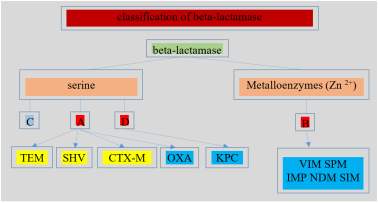
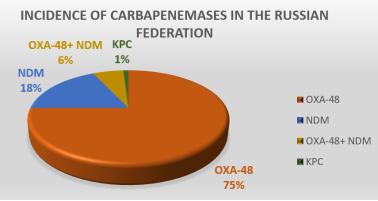
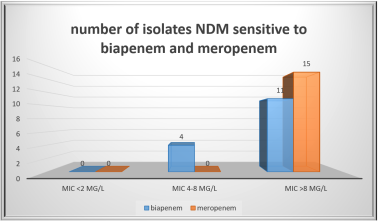
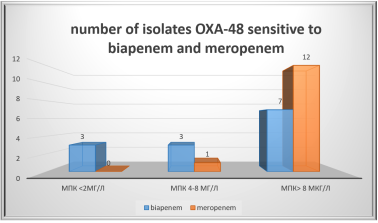
Carbapenem antibiotics continue to hold a leading position in the treatment of hospital-acquired infections. However, since the mid-2000s, the importance of this group of antibiotics has gradually declined due to the spread of resistance to them. Although resistance to carbapenems is mediated by various factors, the most important is the production of β–lactamases, in particular carbapenemases. All beta-lactamases are divided into four classes. In the Russian highest percentages are for OXA-48 and NDM, at 75% and 18%, respectively. In 6% of cases, both carbapenemases OXA-48+NDM were detected, and the frequency of KPC carbapenemase was 1%. Data on the sensitivity of bacteria producing carbapenemases to biapenem and meropenem is contradictory. In this regard, the purpose of this study was to compare the activity of bipenem and meropenem against Enterobacterales (Klebsiella pneumonia and Escherichia coli) that produce carbapenemases. The study included 32 isolates of gram-negative flora of the enterobacterales family. Sensitivity testing for biapenem and meropenem was performed using the method of microdilution in a liquid culture medium in accordance with GOST R ISO 20776-1-2022, with determination of the minimum inhibitory concentration (MIC). The identified carbapenemases in enterobacterales were distributed as follows: NDM carbapenemase producers-15 isolates, OXA-48 carbapenemase producers-13 isolates, NDM+OXA-48 carbapenemase producers-1 isolates and KPC carbapenemase producers-3 isolate. Four of the fifteen NDM-producing isolates, the MIC for biapenem was in the intermediate zone, i.e. less than 8 mg/L, while the MIC for meropenem was in the non-sensitive zone for all fifteen isolates, i.e. more than 8 mg/L. Among the OXA-48-producing isolates, three of the thirteen showed susceptibility to biapenem, with an MIC of less than 2 mg/L, while only one isolate showed susceptibility to meropenem, with an MIC in the intermediate zone (4-8 mg/L). For the NDM+OXA-48 and KPC -producing isolates the MIC of both antibiotics were in the non-susceptible zone, i.e. > 8 mg/L. Biapenem is a new member of the carbapenem antibiotics, showing good activity against Enterobacteriaceae producing carbapenemases NDM and OXA-48 types. Given the greater sensitivity to it among the isolates of this type of bacteria, this drug may have an advantage among other members of the carbapenems.
| Published in | International Journal of Pharmacy and Chemistry (Volume 12, Issue 2) |
| DOI | 10.11648/j.ijpc.20261202.12 |
| Page(s) | 24-28 |
| Creative Commons |
This is an Open Access article, distributed under the terms of the Creative Commons Attribution 4.0 International License (http://creativecommons.org/licenses/by/4.0/), which permits unrestricted use, distribution and reproduction in any medium or format, provided the original work is properly cited. |
| Copyright |
Copyright © The Author(s), 2026. Published by Science Publishing Group |
Biapenem, Meropenem, Enterobacterales, Carbapenemase
PBP | Penicillin-Binding Protein |
OMP | Outer Membrane Porin |
MIC | Minimum Inhibitory Concentration |
PCR | Polymerase Chain Reaction |
DNA | DeoxyriboNucleic Acid |
| [1] | Patel G., Bonomo R. «Stormy waters ahead»: global emergence of carbapenemases. Front Microbiol. 2013; 4: 48-51. |
| [2] | Walsh T. R., Toleman M. A., Poirel L., Nordmann P. Metallo-β-Lactamases:the quiet before the storm? Clin Microbiol Rev. 2005; 18: 306–325. |
| [3] | Timofeeva OG, Polikarpova SV. Local microbiological monitoring of carbapenemases-producing Enterobacterales. Laboratory Service. 2019; 8(3): 14-19. |
| [4] | Laible G., Spratt B. G., Hakenbeck R. Interspecies recombinational events during the evolution of altered PBP 2x genes in penicillin-resistant clinical isolates of Streptococcus pneumoniae. Mol. Microbiol. 1991; 5: 1993–2002. |
| [5] | Mussi M. A., Limansky A. S., Viale A. M. Acquisition of resistance to carbapenems in multidrugresistant clinical strains of Acinetobacter baumannii: natural insertional inactivation of a gene encoding a member of a novel family of beta-barrel outer membrane proteins. Antimicrob. Agents Chemother. 2005; 49: 1432–40. |
| [6] | Doumith M., Ellington M. J., Livermore D. M., Woodford N. Molecular mechanisms disrupting porin expression in ertapenem-resistant Klebsiella and Enterobacter spp. clinical isolates from the UK. J. Antimicrob. Chemother. 2009; 63: 659–67. |
| [7] | Poole K. Efflux-mediated multiresistance in Gram-negative bacteria. Clin. Microbiol. Infect. 2004; 10: 12–26. |
| [8] | Srikumar R., Paul C. J., Poole K. Influence of mutations in the mexR repressor gene on expression of the MexA-MexB-oprM multidrug efflux system of Pseudomonas aeruginosa. J. Bacteriol. 2000; 182: 1410–14. |
| [9] | Ageevets V. A., Lazareva I. V. S. V. The problem of resistance to carbapenem antibiotics: the spread of carbapenemases in the world and in Russia, epidemiology, diagnostics, and treatment options. Farmateka, 2015; 14: 9-16 [russian]. |
| [10] | Elshamy AA, Aboshanab KM. A review on bacterial resistance to carbapenems: Epidemiology, detection and treatment options. Future Sci OA. 2020; 6: 3. |
| [11] | Yakovlev S. V., Suvorova M. P. Infections caused by carbapenem-resistant enterobacteria: epidemiology, clinical significance, and opportunities for optimizing antibacterial therapy. Antibiotics and Chemotherapy. 2022; 67: 8–29. |
| [12] | Lazareva I. V., Ageevets V. A. Distribution and antibacterial resistance of gram-negative bacteria producing carbapenemases in St. Petersburg and some other regions of the Russian Federation. Antibiotics and Chemotherapy. 2016; 61: 28–38. [russian]. |
| [13] | Edelstein M. V., Zhuravlev V. S., Shek E. A. Prevalence of Nosocomial Strains Enterobacteriaceae Have Carbapenemases in Russia. Izv. Saratov Univ. (N. S.), Ser. Chemistry. Biology. Ecology, 2017, vol. 17, iss. 1, pp. 36–41. |
| [14] | Livermore D. M., Mushtaq S., Morinaka A., Ida T., Maebashi K., Hope R. Activity of carbapenems with ME1071 (disodium 2,3-diethylmaleate) against Enterobacteriaceae and Acinetobacter spp. with carbapenemases, including NDM enzymes. J Antimicrob Chemother. 2013; 68(1): 153–158. |
| [15] | Gordina E. M. Activity of Biapenem against Meropenem-Resistant Klebsiella pneumoniae Pseudomonas aeruginosa. Antibiotics and Chemotherapy. 2022; 67: 23 |
| [16] | Kozlov R. S., Azizov I. S. In vitro sensitivity to bipenem and other carbapenems of clinical isolates of Pseudomonas aeruginosa, Acinetobacter spp., and representatives of the Enterobacterales order isolated from hospitalized patients in various regions of Russia. Clinical Microbiology and Antimicrobial Chemotherapy. 2021; 23(3): 280-291. |
| [17] | Susceptibility testing of infectious agents and evaluation of performance of antimicrobial susceptibility test devices. NATIONAL STANDARD OF THE RUSSIAN FEDERATION. 2022; 1-20. [russian]. |
| [18] | Ageevets V. A., Sulyan O. S. Comparative activity of carbapenem antibiotics against gram-negative carbapenemase producers of various groups. Antibiotics and Chemotherapy. 2022; 67: 9-15. |
| [19] | Gotoh K., Miyoshi M., Mayura I. P. B., Iio K., Matsushita O., Otsuka F., Hagiya H. In vitro effectiveness of biapenem against IMP-producing Enterobacteriaceae. J Med Microbiol. 2021 Oct; 70(10). |
APA Style
Petrovich, D. D. (2026). Comparative Activity of Carbapenems (Biapenem/Merapenem) in the Therapy of Carbapenemase-Producing Enterobacterales. International Journal of Pharmacy and Chemistry, 12(2), 24-28. https://doi.org/10.11648/j.ijpc.20261202.12
ACS Style
Petrovich, D. D. Comparative Activity of Carbapenems (Biapenem/Merapenem) in the Therapy of Carbapenemase-Producing Enterobacterales. Int. J. Pharm. Chem. 2026, 12(2), 24-28. doi: 10.11648/j.ijpc.20261202.12
@article{10.11648/j.ijpc.20261202.12,
  author = {Doev Denis Petrovich},
  title = {Comparative Activity of Carbapenems (Biapenem/Merapenem) in the Therapy of
Carbapenemase-Producing Enterobacterales},
  journal = {International Journal of Pharmacy and Chemistry},
  volume = {12},
  number = {2},
  pages = {24-28},
  doi = {10.11648/j.ijpc.20261202.12},
  url = {https://doi.org/10.11648/j.ijpc.20261202.12},
  eprint = {https://article.sciencepublishinggroup.com/pdf/10.11648.j.ijpc.20261202.12},
  abstract = {Carbapenem antibiotics continue to hold a leading position in the treatment of hospital-acquired infections. However, since the mid-2000s, the importance of this group of antibiotics has gradually declined due to the spread of resistance to them. Although resistance to carbapenems is mediated by various factors, the most important is the production of β–lactamases, in particular carbapenemases. All beta-lactamases are divided into four classes. In the Russian highest percentages are for OXA-48 and NDM, at 75% and 18%, respectively. In 6% of cases, both carbapenemases OXA-48+NDM were detected, and the frequency of KPC carbapenemase was 1%. Data on the sensitivity of bacteria producing carbapenemases to biapenem and meropenem is contradictory. In this regard, the purpose of this study was to compare the activity of bipenem and meropenem against Enterobacterales (Klebsiella pneumonia and Escherichia coli) that produce carbapenemases. The study included 32 isolates of gram-negative flora of the enterobacterales family. Sensitivity testing for biapenem and meropenem was performed using the method of microdilution in a liquid culture medium in accordance with GOST R ISO 20776-1-2022, with determination of the minimum inhibitory concentration (MIC). The identified carbapenemases in enterobacterales were distributed as follows: NDM carbapenemase producers-15 isolates, OXA-48 carbapenemase producers-13 isolates, NDM+OXA-48 carbapenemase producers-1 isolates and KPC carbapenemase producers-3 isolate. Four of the fifteen NDM-producing isolates, the MIC for biapenem was in the intermediate zone, i.e. less than 8 mg/L, while the MIC for meropenem was in the non-sensitive zone for all fifteen isolates, i.e. more than 8 mg/L. Among the OXA-48-producing isolates, three of the thirteen showed susceptibility to biapenem, with an MIC of less than 2 mg/L, while only one isolate showed susceptibility to meropenem, with an MIC in the intermediate zone (4-8 mg/L). For the NDM+OXA-48 and KPC -producing isolates the MIC of both antibiotics were in the non-susceptible zone, i.e. > 8 mg/L. Biapenem is a new member of the carbapenem antibiotics, showing good activity against Enterobacteriaceae producing carbapenemases NDM and OXA-48 types. Given the greater sensitivity to it among the isolates of this type of bacteria, this drug may have an advantage among other members of the carbapenems.},
 year = {2026}
}
TY  - JOUR
T1  - Comparative Activity of Carbapenems (Biapenem/Merapenem) in the Therapy of
Carbapenemase-Producing Enterobacterales
AU  - Doev Denis Petrovich
Y1  - 2026/07/28
PY  - 2026
N1  - https://doi.org/10.11648/j.ijpc.20261202.12
DO  - 10.11648/j.ijpc.20261202.12
T2  - International Journal of Pharmacy and Chemistry
JF  - International Journal of Pharmacy and Chemistry
JO  - International Journal of Pharmacy and Chemistry
SP  - 24
EP  - 28
PB  - Science Publishing Group
SN  - 2575-5749
UR  - https://doi.org/10.11648/j.ijpc.20261202.12
AB  - Carbapenem antibiotics continue to hold a leading position in the treatment of hospital-acquired infections. However, since the mid-2000s, the importance of this group of antibiotics has gradually declined due to the spread of resistance to them. Although resistance to carbapenems is mediated by various factors, the most important is the production of β–lactamases, in particular carbapenemases. All beta-lactamases are divided into four classes. In the Russian highest percentages are for OXA-48 and NDM, at 75% and 18%, respectively. In 6% of cases, both carbapenemases OXA-48+NDM were detected, and the frequency of KPC carbapenemase was 1%. Data on the sensitivity of bacteria producing carbapenemases to biapenem and meropenem is contradictory. In this regard, the purpose of this study was to compare the activity of bipenem and meropenem against Enterobacterales (Klebsiella pneumonia and Escherichia coli) that produce carbapenemases. The study included 32 isolates of gram-negative flora of the enterobacterales family. Sensitivity testing for biapenem and meropenem was performed using the method of microdilution in a liquid culture medium in accordance with GOST R ISO 20776-1-2022, with determination of the minimum inhibitory concentration (MIC). The identified carbapenemases in enterobacterales were distributed as follows: NDM carbapenemase producers-15 isolates, OXA-48 carbapenemase producers-13 isolates, NDM+OXA-48 carbapenemase producers-1 isolates and KPC carbapenemase producers-3 isolate. Four of the fifteen NDM-producing isolates, the MIC for biapenem was in the intermediate zone, i.e. less than 8 mg/L, while the MIC for meropenem was in the non-sensitive zone for all fifteen isolates, i.e. more than 8 mg/L. Among the OXA-48-producing isolates, three of the thirteen showed susceptibility to biapenem, with an MIC of less than 2 mg/L, while only one isolate showed susceptibility to meropenem, with an MIC in the intermediate zone (4-8 mg/L). For the NDM+OXA-48 and KPC -producing isolates the MIC of both antibiotics were in the non-susceptible zone, i.e. > 8 mg/L. Biapenem is a new member of the carbapenem antibiotics, showing good activity against Enterobacteriaceae producing carbapenemases NDM and OXA-48 types. Given the greater sensitivity to it among the isolates of this type of bacteria, this drug may have an advantage among other members of the carbapenems.
VL  - 12
IS  - 2
ER  -
North Caucasus Multidisciplinary Medical Center, Beslan, Russian Federation

Information



 Share This Article
 Twitter
 Linked In
 Facebook
 Copy
Copy Download