
In developing countries, access to drinking water in urban areas is limited. People living in certain neighbourhoods rely on wells (W) and boreholes (B) for their water needs. The aim of this study was to assess the physico-chemical and biological quality, and in particular the diversity of enteropathogenic protozoa present in this commonly used water in the city of Douala. Bi-monthly water samples were collected at 12 water points from July 2023 to March 2024. The physicochemical analyses consisted of measuring temperature, pH, salinity and total dissolved solids using a Water quality tester (WQT) multimeter model EZ-9909SP. Protozoans were isolated by direct slide staining, tube staining and concentration methods before observation under a light microscope at 40X magnification. The results show that the groundwater studied is acidic (pH =5.6±0.07 UC), with a salinity of up to 0.3 USP and rich in Total dissolved solids (TDS) (86 to 400 ppm). Biological analyses revealed the presence of 4 groups of protozoa and 11 species. Enteric protozoan cysts were mainly represented by rhizopods, with mean densities of 116 ± 23 cysts/L in well W1 and 96 ± 37 cysts/L in well W3. In well W6, flagellates reached a peak of 40 ± 6 cysts/L. In the well water, ciliates were virtually absent, while rhizopod cysts were more abundant in B1 (60 cysts/L) and B6 (34 cysts/L). Sporulated forms were present in the borehole water with an average density ranging from 14 (B1) cysts/L to 32 cysts/L (B5). On a time plan, the highest abundance was recorded in the dry season. Significant positive correlations were observed between flagellate viability and TDS (r= 0.324; p=0.000). Ciliates were significantly and positively correlated with salinity (r= 0.324; p=0.000). Rhizopods are inversely correlated to TDS (r= -0.181; p=0.030). The exogenous matter brought in by pollution considerably increases the adherence of cysts in biofilms and hence their abundance. Analysis has identified pH non-compliance as a critical and widespread water quality issue affecting all sampled wells and boreholes during both the rainy and dry seasons As recommendation, to suspend use of W3 for direct drinking water until pH correction is implemented. W3 recorded the lowest pH (~4.0–4.5), representing the highest health risk. Advise boiling and pH correction prior to consumption until permanent treatment is in place. Deploy pH correction units as an emergency measure at W1–W5 and all borehole sites.
| Published in | International Journal of Sustainable Development Research (Volume 12, Issue 2) |
| DOI | 10.11648/j.ijsdr.20261202.14 |
| Page(s) | 124-132 |
| Creative Commons |
This is an Open Access article, distributed under the terms of the Creative Commons Attribution 4.0 International License (http://creativecommons.org/licenses/by/4.0/), which permits unrestricted use, distribution and reproduction in any medium or format, provided the original work is properly cited. |
| Copyright |
Copyright © The Author(s), 2026. Published by Science Publishing Group |
Cysts, Protozoa, Physicochemical, Groundwater, Douala, Cameroon
GPS coordinates and altitudes of the water points | |||||||
|---|---|---|---|---|---|---|---|
Wells | Latitude (°N) | Longitude (°E) | Altitude (m) | Borehole | Latitude (°N) | Longitude (°E) | Altitude (m) |
W1 | 4°3’39.2’’ | 9°44’30.5’’ | 9 | B1 | 4°3’36.6’’ | 9°44’31.5’’ | 12 |
W2 | 4°3’34.6’’ | 9°44’27.3’’ | 19 | B2 | 4°1’31.1’’ | 9°44’8.5’’ | 10 |
W3 | 4°3’33.6’’ | 9°44’27.5’’ | 19 | B3 | 3°59’4.2’’ | 9°47’16.5’’ | 26 |
W4 | 4°3’24.7’’ | 9°44’23.4’’ | 13 | B4 | 3°59’4.3’’ | 9°47’17.1’’ | 26 |
W5 | 4°3’21.0’’ | 9°44’24.9’’ | 21 | B5 | 3°59’1.4’’ | 9°47’8.6’’ | 32 |
W6 | 4°3’22.0” | 9°44’25.9” | 23 | B6 | 3°59’0.0’’ | 9°47’13.4’’ | 35 |
Parameters | W1 | W2 | W3 | W4 | W5 | W6 |
|---|---|---|---|---|---|---|
Height of curbstone (m) | 1 | 0.68 | 1.81 | 0.43 | 0.45 | 0.61 |
Piezometric level (m) | 2.2 | 5.1 | 6.84 | 2.2 | 1.06 | 0.97 |
Water colon (m) | 3.4 | 3.79 | 3.23 | 1.19 | 0.6 | 0.65 |
Diameter/Side (m) | 0.9 | 1.35 | 1.24 | 0.8 | 0.98 | 0.97 |
Parameters | B1 | B2 | B3 | B4 | B5 | B6 |
|---|---|---|---|---|---|---|
Depth (m) | 36 | 23 | 48 | 51 | 47 | 69 |
Height (m) | 0.30 | 0.26 | 0.94 | 0.67 | 0.10 | 0.05 |
Protozoa groups | Species (cell/L) | W1 | W2 | W3 | W4 | W5 | W6 |
|---|---|---|---|---|---|---|---|
Rhizopods | Entamoeba sp. | 55± 11 | 6± 1.5 | 47± 19.1 | 4±1.1 | 24±14.5 | 11±8 |
Endolimax sp. | 11± 3 | 3± 2.2 | 9± 4.1 | 2±0.12 | 6±2.7 | 0 | |
Iodamoeba sp. | 47± 7.5 | 4± 0.3 | 23±11.5 | 3±1.9 | 3±0.5 | 2±1.1 | |
Blastocystis sp. | 3± 2.1 | 2± 1.02 | 17±3.1 | 5±0.1 | 2±0.5 | 6±4.1 | |
Flagellates | Giardia sp. | 14± 3 | 2± 0.3 | 6±1.5 | 3±0.7 | 9±3.6 | 12±5.7 |
Chilomastix sp. | 12± 2.1 | 0 | 4±0.1 | 3±0.3 | 8±1.9 | 28±10.8 | |
Ciliates | Balantidium sp. | 8± 1.8 | 0 | 0 | 1±0.2 | 7±1.4 | 9±4.3 |
Sporulates | Cyclospora sp. | 0 | 2± 2.2 | 7±3.2 | 2±0.1 | 11± 5.4 | 2±0.3 |
Isospora sp. | 4± 1.2 | 2± 1.2 | 16±3.1 | 0 | 13±2.3 | 21±7.3 |
Protozoa | Boreholes | ||||||
|---|---|---|---|---|---|---|---|
Groups | Species (cell/L) | B1 | B2 | B3 | B4 | B5 | B6 |
Rhizopodes | Entamoeba sp. | 11± 5.7 | 4±1.33 | 13±5.9 | 1±0.1 | 0 | 4±1 |
Endolimax sp. | 17± 6.62 | 6±2.14 | 7±1.9 | 0 | 0 | 7±3 | |
Iodamoeba sp | 12± 5.06 | 4±1.32 | 6±0.1 | 1± 0.7 | 1±1.4 | 5±1.8 | |
Blastocystis sp. | 3± 0.6 | 1±0.6 | 0 | 3±1.21 | 4±2 | 0 | |
Flagellates | Giardia sp. | 4±2.8 | 7±2.4 | 3±0.3 | 5±2.1 | 6±2.1 | 5±2.01 |
Chilomastis sp. | 13±6.96 | 1±0.76 | 8±3.2 | 7±2.9 | 3±1.1 | 4±1.7 | |
Ciliates | Balantidium sp. | 2± 0.51 | 5±2.1 | 1±0.13 | 6± 2.7 | 9±4.2 | 3±1.6 |
Sporulates | Cyclospora sp. | 16±5.41 | 21±11.3 | 9±4.1 | 13±7.1 | 11±5.3 | 16±9 |
Isospora sp. | 12±5.87 | 6±2.3 | 8±3.3 | 3±1.3 | 13±4.3 | 4±1 | |
Bi | Borehole |
EU | European Union |
TDS | Total Dissolved Solids |
USEPA | United State Environnement Protection Agency |
Wi | Well |
WQT | Water Quality |
| [1] | Zoungrana Tibi D. (2021). The determinants of the choice of drinking water supply for rural households in the commune of Koudougou in Burkina Faso; Rural Economy, 2021, 377: 65-81. |
| [2] | DSCE Strategy Document for Growth and Employment). (2009). Cameroon). (2009). p. 174. |
| [3] | INS–BGR (Institut National de la Statistique Institut Fédérale des Géosciences et des Ressources Naturelles). (2013). Pilot study on surface and groundwater pollution in Yaoundé and its impact on the health of riverside populations (EPESS). Technical report of the project. BMZ PN 2002.3510.1 BGR 05-2203-54, p. 194. Yaoundé, Hanovre, Bonn. |
| [4] | Moussima Yaka D., A., Tiemeni A. A., Zing Zing B., Jokam Nenkam T. L. L., Aboubakar A., Nzeket A. B., Fokouong Tcholong B. H., Mfopou Mewouo Y. C. (2020). Physico-chemical and bacteriological quality of groundwater and health risks in some neighborhoods of Yaoundé VII, Cameroon. Int. J. Biol. Chem. Sci. 14(5): 1902-1920, June 2020. |
| [5] | UNESCO (2017). Education for the purposes of sustainable development goals, Paris, Unesco, 2017, 62p. |
| [6] | Kouam Kenmogne G.-R., (2004): Contribution to the study of the vulnerability of superficial aquifers in tropical urban areas: case of the Mingoa-Yaounde watershed. DEA thesis, Earth Sciences, University of Yaounde thesis of DEA, Earth Science, Univ. Yaounde I, 114p. |
| [7] |
WHO (2019). Bench aids for the diagnosis of intestinal parasites, 2nd ed. Available at
https://www.who.int/publications/i/item/9789241515344 (accessed 02 january 2024). |
| [8] | Mpakam H. G., Kamgang Kabeyene B. V., Kouam Kenmogne G. R., Bemmo N., Ekodeck G. E., (2006): Access to drinking water and sanitation in cities of developing countries (case of Bafoussam in Cameroon). Ver-tigo, Journal of Environmental Sciences, Vol 7 n°2, Art 12, Septembre 2006, 10p. |
| [9] | Poda, J. N., (2007). Water-related diseases in the Volta Basin: status and perspectives. Volta Basin Focal Project Report No 4. IRD, Montpellier, France, and CPWF, Colombo, Sri Lanka, 87 p. |
| [10] | Veyret, Y., Laganier, R. & Scarwell, H. (2017). Chapter 3. Water, aquatic environments, and socio-environmental challenges. (Ed.), The environment: Concepts, issues, and territories (pp. 63-85). Paris: Armand Colin. |
| [11] | Manezeu Tonleu EO, Nana PA, Onana FM, Nyamsi Tchatcho NL, Tchakonté S, Nola M, Sime-Ngando T, Ajeagah Aghaindum G. (2021). Evaluation of the health risks linked to two swimming pools regularly frequented from the city of Yaounde in Cameroon (Central Africa). Environmental Monitoring and Assessment 193, 36. |
| [12] | Ahouanse Senan D. M., Agossou Noukpo, Houssou Segbe C. (2020). Drinking water and waterborne diseases in the commune of Lokossa in the southwest of the Republic of Benin (West Africa);European Scientific Journal. May 2020 edition Vol. 16, No. 15. |
| [13] | Bonadonna L, Briancesco R, Suffredini E, Coccia A, Della Libera S, Carducci A, Verani M, Federigi I, Iaconelli M, Bonanno Ferraro G, Mancini P, Veneri C. Ferretti E, Lucentini L, Gramaccioni L, La Rosa G. (2019), Enteric viruses, somatic coliphages and Vibrio species in marine bathing and nonbathing waters in Italy. Marine Pollution Bulletin 149, 110570. |
| [14] | Olivry, J. C. (1986). Fleuves et Rivières du Cameroun; Coll. Monog. Hydro. 9 ORSTOM: Paris, France, 1986; 733p. |
| [15] | Dzana, J. G.; Ndam, J. R. N.; Tchawa, P. (2011). The Sanaga discharge atthe Edea Catchment outlet (Cameroon): An example of hydrologic responses of a tropical rain-fed river system to changes inprecipitation and groundwater inputs and to flow regulation. River Res. Appl. 2011, 27, 754–771. |
| [16] | Djuikom E; Louis B. Jugnia, Nola M. (2011). Assessment of the quality of water in wells at Bépanda quarter, Douala-Cameroon, by use of the indicator bacteria of faecal contamination. Journal of Applied Biosciences 37: 2434 – 2440. |
| [17] | APHA (2017). Standard Methods for the Examination of Water and Wastewater, 22nd edn. Washington, DC: American Public Health Association. |
| [18] | Rodier J., Merlet N., Lugube B. (2009). L’analyse de l’eau. 9e édition, Dunod, Paris, 1526 p. |
| [19] | Ajeagah, G. A.; Njine, T.; Bilong Bilong, C. F.; Foto, S. M.; Wouafo, N. M.; Nola, M.; Di, G. G. D.; Huw, S. (2010). Seasonal distribution of enteric opportunistic cryptosporidium spp. Oocysts and Giardia spp. Cysts in a tropical water basin, Cameroon. Waters 2010, 2, |
| [20] | Ajeagah, G. A., Mbondo Biyong S., Kapso Tchouankep M. (2018). Dynamics of resistance forms of enteropathogenic amoebae in polluted aquatic environments (Yaounde, Cameroon). Ecology Review, 2018, 73(3): 242-254. HALId: hal-03532554 |
| [21] | Petithory J. C., Ardoin-Guidon F., Chaumeil C. (1998c). Intestinal amoebas and flagellates: ocular amoebas, their microscopic diagnosis. Training notebook - Medical biology, 11: 237. |
| [22] | Rousset J. (1993). Copro-parasitologie pratique Intérêt et méthodologie. ESTEM, Paris, 89 p. |
| [23] | WHO (World Health Organisation). (1994). Plates for the Diagnosis of Intestinal Parasites; WHO: Geneva, Switzerland, 1994; 29p. |
| [24] | Williams W. T., Lance G. N., Dale M. B., Clifford H. T. (1971). Controversy concerning the criteria for taxonometric strategies. Computer Journal, 14: 1-162. |
| [25] | Mbawala A., Abdou., Ngassoum M. B. & Ouendo. (2010 Physicochemical and microbiological pollution of well water in Deng-Ngaoundéré, Cameroon. International Journal of Biological and Chemical Sciences, 4(6): 1962-1975. |
| [26] | NC (Norme Camerounaise). (2014), Norme pour l’eau destinée à la consommation humaine. 2014. ANOR. |
| [27] | Nana PA, Pahane Mbiada M, Tchakonté S, Moche K, Mouchili Palena RS, Nola M, Sime-Ngando T. (2023a). Influence of seasons and tides on the distribution of enteric protozoa on the shores of the Atlantic Ocean in Kribi (South Region of Cameroon): Health risks related to bathing. Pollutants 3, 2, 243– 254. |
| [28] | Chippaux JP, Houssier S, Gross P, Bouvier C, Brissaud F. (2002). Étude de la pollution de l’eau souterraine de la ville de Niamey. Niger. Bull. Soc. Pathol. Exot., 94(2): 119-123. |
| [29] | Kapso Tchouankep M., Ajeagah G. A., Nkeng Elambo G., Ngassam P. (2018). Bio-characterization of some free-living amoebae in the surface water of the city of Yaounde: relationship to physico-chemical parameters of the medium. Journal of Applied Biotechnology, 2018, 6(1): 27- 40. |
| [30] | Kashosi MT, Muhandule BA, Mwenebitu LD, Mihuhi N, Mutendela KJ, Mubagwa K. (2018). Antibiotic resistance of Salmonella spp strains isolated from blood cultures in Bukavu, DR Congo. Pan African Medical Journal, 29(42): 1-8. |
| [31] | WHO (World Health Organisation) (2019). Progress on drinking water, sanitation and hygiene: 2017 update and SDG baselines. Geneva: World Health Organization (WHO) and the United Nations Children’s Fund (UNICEF), 2017. |
APA Style
Mireille, K. T., Diazine, M. T., Belengfe, C. S., Ernest, K., Gilbert, N., et al. (2026). Physico-chemical Quality and Diversity of Cysts of Enteropathogenic Protozoa in Water from Wells and Boreholes in the City of Douala, Cameroon. International Journal of Sustainable Development Research, 12(2), 124-132. https://doi.org/10.11648/j.ijsdr.20261202.14
ACS Style
Mireille, K. T.; Diazine, M. T.; Belengfe, C. S.; Ernest, K.; Gilbert, N., et al. Physico-chemical Quality and Diversity of Cysts of Enteropathogenic Protozoa in Water from Wells and Boreholes in the City of Douala, Cameroon. Int. J. Sustain. Dev. Res. 2026, 12(2), 124-132. doi: 10.11648/j.ijsdr.20261202.14
AMA Style
Mireille KT, Diazine MT, Belengfe CS, Ernest K, Gilbert N, et al. Physico-chemical Quality and Diversity of Cysts of Enteropathogenic Protozoa in Water from Wells and Boreholes in the City of Douala, Cameroon. Int J Sustain Dev Res. 2026;12(2):124-132. doi: 10.11648/j.ijsdr.20261202.14
@article{10.11648/j.ijsdr.20261202.14,
  author = {Kapso Tchouankep Mireille and Mbog Therese Diazine and Chinche Sylvie Belengfe and Koji Ernest and Nguepidjo Gilbert and Teukam Soh Willy and Tonmeu Douyong Chimene Sandrine and Teufack Elisabeth and Tindo Maurice and Ajeagah Gideon and Lehman Leopold Gustave and Akono Ntonga Patrick},
  title = {Physico-chemical Quality and Diversity of Cysts of Enteropathogenic Protozoa in Water from Wells and Boreholes in the City of Douala, Cameroon},
  journal = {International Journal of Sustainable Development Research},
  volume = {12},
  number = {2},
  pages = {124-132},
  doi = {10.11648/j.ijsdr.20261202.14},
  url = {https://doi.org/10.11648/j.ijsdr.20261202.14},
  eprint = {https://article.sciencepublishinggroup.com/pdf/10.11648.j.ijsdr.20261202.14},
  abstract = {In developing countries, access to drinking water in urban areas is limited. People living in certain neighbourhoods rely on wells (W) and boreholes (B) for their water needs. The aim of this study was to assess the physico-chemical and biological quality, and in particular the diversity of enteropathogenic protozoa present in this commonly used water in the city of Douala. Bi-monthly water samples were collected at 12 water points from July 2023 to March 2024. The physicochemical analyses consisted of measuring temperature, pH, salinity and total dissolved solids using a Water quality tester (WQT) multimeter model EZ-9909SP. Protozoans were isolated by direct slide staining, tube staining and concentration methods before observation under a light microscope at 40X magnification. The results show that the groundwater studied is acidic (pH =5.6±0.07 UC), with a salinity of up to 0.3 USP and rich in Total dissolved solids (TDS) (86 to 400 ppm). Biological analyses revealed the presence of 4 groups of protozoa and 11 species. Enteric protozoan cysts were mainly represented by rhizopods, with mean densities of 116 ± 23 cysts/L in well W1 and 96 ± 37 cysts/L in well W3. In well W6, flagellates reached a peak of 40 ± 6 cysts/L. In the well water, ciliates were virtually absent, while rhizopod cysts were more abundant in B1 (60 cysts/L) and B6 (34 cysts/L). Sporulated forms were present in the borehole water with an average density ranging from 14 (B1) cysts/L to 32 cysts/L (B5). On a time plan, the highest abundance was recorded in the dry season. Significant positive correlations were observed between flagellate viability and TDS (r= 0.324; p=0.000). Ciliates were significantly and positively correlated with salinity (r= 0.324; p=0.000). Rhizopods are inversely correlated to TDS (r= -0.181; p=0.030). The exogenous matter brought in by pollution considerably increases the adherence of cysts in biofilms and hence their abundance. Analysis has identified pH non-compliance as a critical and widespread water quality issue affecting all sampled wells and boreholes during both the rainy and dry seasons As recommendation, to suspend use of W3 for direct drinking water until pH correction is implemented. W3 recorded the lowest pH (~4.0–4.5), representing the highest health risk. Advise boiling and pH correction prior to consumption until permanent treatment is in place. Deploy pH correction units as an emergency measure at W1–W5 and all borehole sites.},
 year = {2026}
}
TY  - JOUR
T1  - Physico-chemical Quality and Diversity of Cysts of Enteropathogenic Protozoa in Water from Wells and Boreholes in the City of Douala, Cameroon
AU  - Kapso Tchouankep Mireille
AU  - Mbog Therese Diazine
AU  - Chinche Sylvie Belengfe
AU  - Koji Ernest
AU  - Nguepidjo Gilbert
AU  - Teukam Soh Willy
AU  - Tonmeu Douyong Chimene Sandrine
AU  - Teufack Elisabeth
AU  - Tindo Maurice
AU  - Ajeagah Gideon
AU  - Lehman Leopold Gustave
AU  - Akono Ntonga Patrick
Y1  - 2026/06/26
PY  - 2026
N1  - https://doi.org/10.11648/j.ijsdr.20261202.14
DO  - 10.11648/j.ijsdr.20261202.14
T2  - International Journal of Sustainable Development Research
JF  - International Journal of Sustainable Development Research
JO  - International Journal of Sustainable Development Research
SP  - 124
EP  - 132
PB  - Science Publishing Group
SN  - 2575-1832
UR  - https://doi.org/10.11648/j.ijsdr.20261202.14
AB  - In developing countries, access to drinking water in urban areas is limited. People living in certain neighbourhoods rely on wells (W) and boreholes (B) for their water needs. The aim of this study was to assess the physico-chemical and biological quality, and in particular the diversity of enteropathogenic protozoa present in this commonly used water in the city of Douala. Bi-monthly water samples were collected at 12 water points from July 2023 to March 2024. The physicochemical analyses consisted of measuring temperature, pH, salinity and total dissolved solids using a Water quality tester (WQT) multimeter model EZ-9909SP. Protozoans were isolated by direct slide staining, tube staining and concentration methods before observation under a light microscope at 40X magnification. The results show that the groundwater studied is acidic (pH =5.6±0.07 UC), with a salinity of up to 0.3 USP and rich in Total dissolved solids (TDS) (86 to 400 ppm). Biological analyses revealed the presence of 4 groups of protozoa and 11 species. Enteric protozoan cysts were mainly represented by rhizopods, with mean densities of 116 ± 23 cysts/L in well W1 and 96 ± 37 cysts/L in well W3. In well W6, flagellates reached a peak of 40 ± 6 cysts/L. In the well water, ciliates were virtually absent, while rhizopod cysts were more abundant in B1 (60 cysts/L) and B6 (34 cysts/L). Sporulated forms were present in the borehole water with an average density ranging from 14 (B1) cysts/L to 32 cysts/L (B5). On a time plan, the highest abundance was recorded in the dry season. Significant positive correlations were observed between flagellate viability and TDS (r= 0.324; p=0.000). Ciliates were significantly and positively correlated with salinity (r= 0.324; p=0.000). Rhizopods are inversely correlated to TDS (r= -0.181; p=0.030). The exogenous matter brought in by pollution considerably increases the adherence of cysts in biofilms and hence their abundance. Analysis has identified pH non-compliance as a critical and widespread water quality issue affecting all sampled wells and boreholes during both the rainy and dry seasons As recommendation, to suspend use of W3 for direct drinking water until pH correction is implemented. W3 recorded the lowest pH (~4.0–4.5), representing the highest health risk. Advise boiling and pH correction prior to consumption until permanent treatment is in place. Deploy pH correction units as an emergency measure at W1–W5 and all borehole sites.
VL  - 12
IS  - 2
ER  -
Department of Animal Biology, University of Douala, Douala, Cameroon
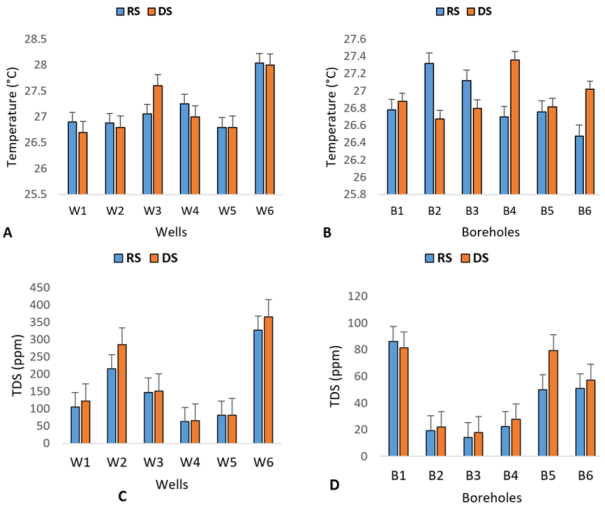
Figure 1. Spatial and temporal variations in temperature (A and B) and total dissolved solids (C and D) in well and borehole water.
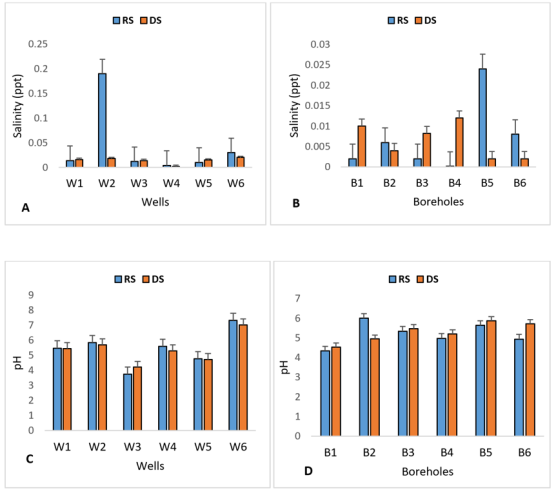
Figure 2. Spatial and temporal variations in salinity (A and B) and pH (C and D) of well and borehole water.
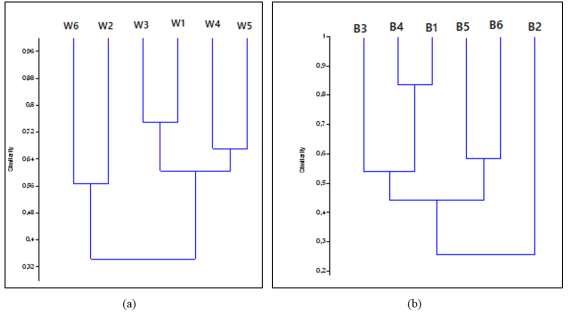
Figure 3. Hierarchical classification analysis (A) wells (B) boreholes.

Information



 Share This Article
 Twitter
 Linked In
 Facebook
 Copy
Copy Download