Abstract
Research and Development (R&D) has remained the engine of green growth and innovation globally. This study examines how R&D contributes to green innovation, focusing on renewable electricity generation in Canada between 1996 and 2023. The datasets on renewable electricity generation and the R&D indicators from the World Bank, UNESCO, and the National Science Foundation's Science and Engineering Indicators were analysed using summary statistics, cointegration tests, the least squares and residual diagnostic tests. The findings indicate that research and development expenditure has a significant positive effect on renewable electricity generation in the long run. This finding highlights the effectiveness of research and development funding in driving green innovation in Canaba, especially in the energy sector. Similarly, the results showed that researchers in R&D per million people have a positive and significant effect on long-run renewable electricity generation. However, the results showed that the number of scientific and technical journal articles per million people has a significant negative effect on renewable electricity generation in the long run. The short-run dynamics showed that the error correction coefficient (-1.0554) is negative and significant at the 5% level, indicating that the model can adjust toward the long-run equilibrium position. Given the findings, this study concludes that R&D expenditure and the availability of R&D researchers enable green innovation by promoting renewable electricity generation in Canada. Thus, we recommend that the Canadian government prioritise green, innovation-driven R&D investments to create more opportunities to improve renewable electricity generation in the country.
Keywords
Research and Development, Green Innovation, Renewable Electricity, R&D Researchers, Canada
1. Introduction
Green innovation is generally understood to be innovation that conserves resources, reduces pollution, improves energy efficiency, and supports low-carbon development
| [16] | Wang, Y., Yang, Y., Fu, C., Fan, Z., & Zhou, X. (2021). Environmental regulation, environmental responsibility, and green technology innovation: Empirical research from China. Plos one, 16 (9), e0257670. |
| [21] | Zhang, Y., Chen, H., & He, Z. (2022). Environmental regulation, R&D investment, and green technology innovation in China: Based on the PVAR model. Plos one, 17 (10), e0275498. |
[16, 21]
. The transition to a low-carbon, environmentally sustainable economy has become a key policy focus for both developed and developing nations. In this context, green innovation involves the development and implementation of eco-friendly products, processes, technologies, and organisational methods, and has become a vital element in promoting sustainable development. It enhances energy efficiency, reduces greenhouse gas emissions, minimises waste, and fosters new economic opportunities within emerging green industries. Across the broader literature, R&D usually supports green innovation, but the effect is often conditional on policy design, firm capabilities, and regional innovation capacity.
| [14] | Sarpong, D., Boakye, D., Ofosu, G., & Botchie, D. (2023). The three pointers of research and development (R&D) for growth-boosting sustainable innovation system. Technovation, 122, 102581. |
[14]
argue that R&D is widely treated as the engine of sustainable and green innovation because it supports technology creation, knowledge accumulation, learning, and commercialisation capacity. It is also argued that R&D has the potential to stimulate the transition to renewable energy by spurring innovation in associated technologies, increasing individuals' education about the necessity and opportunity of this transition, and helping to create an effective institutional framework for this objective.
Over the years, Canada has adopted numerous regulations, mostly centred around technology and performance standards, to enhance environmental quality. Given Canada's commitment to global environmental goals and climate action, it is crucial for policymakers, researchers, and business leaders to understand how R&D investments translate into tangible green innovation outcomes. As a developed G7 economy rich in natural resources and with an established innovation infrastructure, Canada serves as a strong example for studying the link between R&D and green innovation. Various levels of government offer incentives, such as cash rebates and tax credits, to motivate stakeholders to adopt more environmentally friendly practices. Simultaneously, government agencies enforce compliance with environmental standards. Spending on pollution control includes costs for both incentivising positive change and enforcement, embodying a stick-and-carrot strategy to meet environmental objectives. These expenditures primarily aim to prevent, reduce, and eliminate pollution from production processes and the consumption of goods and services
| [12] | Rubashkina, Y., Galeotti, M., & Verdolini, E. (2015). Environmental regulation and competitiveness: Empirical evidence on the Porter Hypothesis from European manufacturing sectors. Energy policy, 83, 288-300. |
[12]
.
Despite Canada’s initiatives towards environmental sustainability, it still encounters major environmental and economic challenges. Its economy heavily relies on resource-intensive industries such as oil and gas, mining, and heavy manufacturing, all of which significantly emit greenhouse gases. Therefore, exploring how increased R&D funding can accelerate green innovation is crucial to driving sustainable economic change without compromising global competitiveness
| [10] | OECD. (2023). OECD Environmental Performance Reviews: Canada. Paris: OECD Publishing. |
[10]
. While previous research has advocated consistent R&D investment to unlock more advanced and sustainable innovations
| [12] | Rubashkina, Y., Galeotti, M., & Verdolini, E. (2015). Environmental regulation and competitiveness: Empirical evidence on the Porter Hypothesis from European manufacturing sectors. Energy policy, 83, 288-300. |
| [18] | Xu, J., Liu, F., & Shang, Y. (2021). R&D investment, ESG performance and green innovation performance: evidence from China. Kybernetes, 50 (3), 737-756. |
| [20] | Zhang, D., & Jin, Y. (2021). R&D and environmentally induced innovation: Does financial constraint play a facilitating role?. International Review of Financial Analysis, 78, 101918. |
[12, 18, 20]
, the magnitude and direction of the link between R&D and green innovation in Canada remain underexplored. Against this background, this study seeks to provide evidence on how R&D contributes to green innovation, focusing on renewable electricity generation in Canada to inform policy and investment decisions regarding resource allocation for environmental sustainability. The following sections focus on the related literature, methodology, results, conclusion, and policy insights.
2. Literature Review
2.1. Theoretical Literature
This study is anchored in the resource-based theory (RBT), developed by
| [17] | Wernerfelt, B. (1984). A resource‐based view of the firm. Strategic Management Journal, 5 (2), 171–180. |
[17]
and further expanded by
| [4] | Barney, J. (1991). Firm resources and sustained competitive advantage. Journal of Management, 17 (1), 99–120. |
[4]
, which emphasises the identification of critical resources and capabilities within a firm. These resources include government funding for R&D, expertise in green technology, access to sustainable innovation practices, and established networks for technology transfer. This involves assessing how R&D support and effective green technology transfer can lead to sustained competitive advantages, such as cost efficiency, market positioning, or superior sustainable innovations. Additionally, R&D is recognised as a strategic competency, as highlighted by the RBT. Investing in R&D enables firms to build technological expertise, develop unique innovations, enhance human capital, and foster organisational learning. These knowledge-driven assets improve a firm's capacity to develop new products, refine production methods, and adapt to changing market and regulatory conditions
| [6] | Grant, R. M. (1996). Toward a knowledge-based theory of the firm. Strategic Management Journal, 17 (Winter Special Issue), 109–122. |
[6]
. As a result, firms that regularly invest in R&D tend to develop unique technological capabilities that drive ongoing innovation and long-term growth. The popularity of RBT has grown significantly within environmental sustainability and green innovation. Achieving green innovation involves firms creating eco-friendly products, adopting cleaner production techniques, utilising energy-efficient technologies, and developing sustainable business models. These efforts rely heavily on internal capabilities such as scientific expertise, technological knowledge, and ongoing learning, driven by continuous R&D investments
| [7] | Hart, S. L. (1995). A natural-resource-based view of the firm. Academy of Management Review, 20 (4), 986–1014. |
[7]
. The extension of the RBT into the Natural Resource-Based View (NRBV) by
| [7] | Hart, S. L. (1995). A natural-resource-based view of the firm. Academy of Management Review, 20 (4), 986–1014. |
[7]
further emphasises the association between research and development (R&D) and environmentally sustainable innovation. The NRBV asserts that environmental capabilities are strategic organisational resources that help firms improve environmental performance and maintain competitiveness. The RBT is considered highly relevant to this study because it identifies R&D as a strategic organisational capability that generates valuable technological knowledge and innovation competencies necessary for green innovation. Accordingly, the theory supports the proposition that increased investment in R&D enhances firms' capacity to generate green innovations, improve environmental performance, and strengthen long-term competitiveness.
2.2. Empirical Review
Empirical evidence presents mixed findings on the magnitude and direction of the relationship between R&D investment and green innovation.
| [1] | Adomako, S., & Tran, M. D. (2024). Exploring the effect of R&D support, green technology transfer, sustainable innovation. Sustainable Development, 32 (5), 4758-4769. |
[1]
examine how R&D support contributes to sustainable innovation, with green technology transfer acting as a mediator, using data from 220 firms in Vietnam. The findings indicate that R&D support positively affects green technology transfer, which in turn mediates the relationship between R&D support and sustainable innovation, underscoring the critical role of government R&D funding in shaping sustainable innovation in emerging markets. Similarly,
| [3] | Bai, Y., Zhang, X., & Wang, D. (2025). Maximizing green innovation: the impact of government subsidies and R&D in digital supply chains. Kybernetes, 54 (11), 6794-6819. |
[3]
employed a mixed-methods approach, combining analytical models and empirical analyses to examine the curvilinear relationship between green innovation and firm performance. They also investigated how government subsidies and digital transformation R&D investments act as moderating factors. The results show that both government subsidies and digital transformation R&D investments notably strengthen the positive effects of green innovation up to an optimal point and help reduce negative impacts.
Using panel data on Chinese A-share-listed companies from 2011 to 2022,
| [2] | An, J., He, G., Ge, S., & Wu, S. (2025). The impact of government green subsidies on corporate green innovation. Finance Research Letters, 71, 106378. |
[2]
empirically examine the mechanism through which government green subsidies affect corporate green innovation. The findings indicate that government green subsidies have a significant positive impact on corporate green innovation, and that further increases in them promote it. Furthermore,
| [13] | Sánchez-Sellero, P., & Bataineh, M. J. (2022). How R&D cooperation, R&D expenditures, public funds and R&D intensity affect green innovation? Technology Analysis & Strategic Management, 34 (9), 1095-1108. |
[13]
examined the nexus between green innovation and research and development (R&D) practices inside and outside firms over time. The results indicate that internal and external R&D efforts enhance green innovation activities. This finding highlights the role of R&D investments in promoting environmental sustainability. Additionally,
| [5] | Fan, J., & Teo, T. (2022). Will China’s R&D investment improve green innovation performance? An empirical study. Environmental Science and Pollution Research, 29 (26), 39331-39344. |
[5]
used data from various regions in China from 2015 to 2019 to investigate the relationship between R&D investment and green innovation performance. The findings indicate that R&D investment has a significant double-threshold effect on the lagging three-phase green innovation performance. The findings further indicate that at high levels of technological innovation, the influence of regional R&D investment on green innovation performance is sub-optimal. Using a panel linear and nonlinear autoregressive distributed lag (ARDL) analysis of EU-27 data from 2009 to 2020,
| [9] | Mushafiq, M. (2023). Towards green development: Role of researchers. Innovation and Green Development, 2 (4), 100075. |
[9]
examines the link between the number of researchers and greenhouse gas emissions. The study revealed that an increase in the number of researchers can lead to both a long-term increase in greenhouse gas emissions and a short-term decrease.
2.3. Stylised Facts on Dynamics of R&D Indicators in Canada
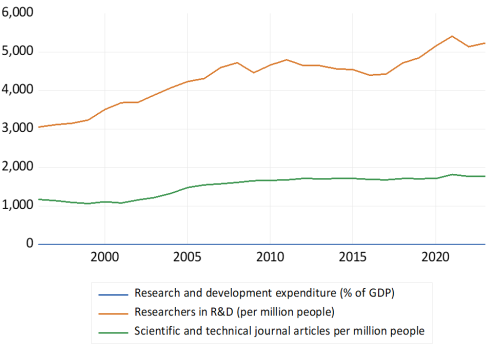
The stylised facts on R&D expenditure (% of GDP), researchers in R&D (per million people) and scientific and technical journal articles per million people are presented in
Figure 1 below:
Figure 1. Sylised facts on dynamics of R&D indicators in Canada.
The trends in the three variables [R&D expenditure (% of GDP), Researchers in R&D (per million people) and Scientific and technical journal articles per million people] indicate that Canada's R&D ecosystem improved over the study period. In particular, R&D expenditure as a percentage of GDP remained relatively stable. This suggests that Canada's R&D expenditure, measured as a share of GDP, did not change substantially during the period under review, although modest year-to-year variations are evident. The trend in Canada's R&D expenditure indicates a fairly consistent level of investment relative to the size of the economy. The number of researchers engaged in R&D per million people shows a strong long-term upward trend. From the late 1990s to around 2007, this figure steadily increased, indicating consistent growth in Canada's research workforce. A slight dip occurred around 2008–2009, but the number recovered and peaked again around 2011. Between 2012 and 2017, there was a moderate decline, followed by relative stability before a renewed rise from 2018 onward. The indicator reached its highest point in 2021, surpassing 5,300 researchers per million people, then slightly declined and stabilised in recent years. Overall, the trend reflects significant growth in Canada's human capital dedicated to research and innovation, despite some short-term fluctuations. It was further observed that scientific and technical journal articles per million people also showed an overall upward trend throughout the study period. Starting in 1990, Canada saw about 1,100 articles per million people, with slight fluctuations in the late 1990s. Between 2003 and 2007, it increased quickly to 1,500 articles, then grew slowly, reaching around 1,650 to 1,700 by the early 2010s. From 2013 to 2018, the number remained stable with minor variations, suggesting steady research activity. A moderate increase occurred between 2020 and 2021, followed by a slight decline. In sum, despite short-term fluctuations, Canada's research productivity has shown significant long-term growth, indicating continuous strengthening.
3. Methodology
3.1. Data and Variable Description
This study utilised time-series data on green innovation and R&D indicators for Canada. In particular, green innovation is measured by the share of electricity generated from renewable sources in Canada. This is expressed as a percentage of total electricity production, including solar, wind, hydropower, bioenergy, geothermal, wave, and tidal. The data were sourced from the Statistical Review of World Energy. The R&D indicators used in this study include Canada’s R&D expenditure (% of GDP), researchers in R&D (per million people), and scientific and technical journal articles (per million people). The datasets for R&D expenditure (% of GDP) in Canada are obtained from the World Bank, while the datasets for researchers in R&D (per million people) and scientific and technical journal articles (per million people) are obtained from UNESCO and the National Science Foundation Science and Engineering Indicators, respectively.
3.2. Model Specification
As outlined in the variable description, green innovation is measured by the share of electricity generated from renewable sources in Canada, while R&D indicators were measured using Canada’s R&D expenditure (% of GDP), researchers in R&D (per million people), and scientific and technical journal articles (per million people). Accordingly, the functional specification of the model is as follows:
RENEW = f (RDEX,RIRD,STJA)(1)
Where: RENEW = renewable electricity generation, RDEX = R&D expenditure (% of GDP), RIRD = researchers in R&D (per million people) and STJA = scientific and technical journal articles (per million people).
The vector error correction model (VECM) representation of equation (
1) is as follows:
(2)
(3)
(4)
(5)
Where:

-

= vector of constant parameters, β
11 - β
44 = slope parameters, θ
1 - θ
4 = error correction coefficients (speed of adjustments), ECT = error correction term, U
1t - U
4t = slope parameters, In = natural log notation,

= first difference notation and K = optimal lag notation.
3.3. Estimation Techniques
The least squares method was used to estimate the VECM, providing insights into the long-run relationships and short-run dynamics. The motivation for estimating a VECM followed the evidence of cointegration among the I(1) series. It also provides an error correction coefficient, which measures how quickly variables return to equilibrium after a shock. Summary statistics were also employed to analyse the distribution of each variable during the study period. Additionally, the
| [11] | Phillips, P. C., & Perron, P. (1988). Testing for a unit root in time series regression. Biometrika, 75 (2), 335-346. |
[11]
unit root test was applied in this study, while the Johansen (1988) cointegration test served as the basis for the long-run relationship test. Residual diagnostics, including tests for serial correlation and heteroskedasticity, were applied to validate the reliability and efficiency of the estimated VECM.
4. Results and Discussion
4.1. Summary Statistics
The summary statistics provide insights into the distribution of each variable over the study period. The results are presented in
Table 1.
Table 1. Summary statistics for the variables.
Statistic | RENEW | RDEX | RIRD | STJA |
Mean | 366.3883 | 1.811035 | 4320.533 | 1515.462 |
Median | 368.1550 | 1.780090 | 4506.055 | 1665.805 |
Maximum | 397.7300 | 2.021170 | 5411.827 | 1822.291 |
Minimum | 330.8699 | 1.606820 | 3055.672 | 1068.820 |
Std. Dev. | 20.10673 | 0.121363 | 668.9288 | 263.5330 |
Jarque-Bera | 1.873823 | 1.809969 | 1.767118 | 3.943606 |
Probability | 0.391836 | 0.404548 | 0.413309 | 0.139206 |
Observations | 28 | 28 | 28 | 28 |
Source: E-views 12 output
Table 1 presents the descriptive statistics for each variable. The results showed that renewable electricity generation averaged terawatt-hours during the study period. It ranged from 330.87 to 397.73 terawatt-hours. The standard deviation of 20.106 indicates that the observations for renewable electricity generation clustered around the mean. The results also showed that research and development expenditure averaged 1.811% of GDP between 1996 and 2023. The minimum and maximum research and development expenditure are 1.606% and 2.0211% of GDP, respectively. The results further showed that researchers in R&D and in scientific and technical journal articles averaged 4,320.533 and 1,515.462 per million people, respectively. The standard deviation showed that the observations for researchers in R&D and in scientific and technical journal articles converged around their respective means. The probability values of the Jarque-Bera statistics are greater than 0.05, indicating the variables are normally distributed at the 5% level. This finding further indicates that the data distribution is free of outliers.
4.2. Unit Root Test
The Phillips-Perron (PP) method was applied for the unit root test at the 5% level. The results are shown in
Table 2.
Table 2. PP unit root test results.
Variable | PP stat. at levels | PP stat. at first difference | 5% critical value | Order of Integration |
LOG (RENEW) | -1.798 | -8.055*** | -2.981 | I(1) |
LOG (RDEX) | -2.030 | -4.308*** | -2.981 | I(1) |
LOG (RIRD) | -1.877 | -4.326*** | -2.981 | I(1) |
LOG (STJA) | -0.886 | -3.236** | -2.981 | I(1) |
Source: E-views 12 output
The results showed that all the variables are nonstationary, as the PP statistics at levels are less than the 5% critical value in absolute terms. Consequently, the null hypothesis of unit cannot be rejected. However, the results showed that the variables became stationary at first difference, indicating that they are integrated of order one I(1). This finding necessitates conducting a cointegration test using the
| [8] | Johansen, S. (1988). Statistical analysis of cointegration vectors. Journal of economic dynamics and control, 12 (2-3), 231-254. |
[8]
method.
4.3. Cointegration Test
The cointegration followed the evidence of all I(1) series. The results are presented in
Table 3.
Table 3. Summary of Johansen cointegration test results.
Series: LOG (RENEW) LOG (RDEX) LOG (RIRD) LOG (STJA) |
Lags interval (in first differences): 1 to 2 |
No. of CE(s) | Eigenvalue | Statistic | Critical Value | Prob.** |
Hypothesized | | Trace | 0.05 | |
None * | 0.825282 | 67.86776 | 47.85613 | 0.0002 |
At most 1 | 0.499276 | 24.25324 | 29.79707 | 0.1899 |
At most 2 | 0.206190 | 6.960741 | 15.49471 | 0.5822 |
At most 3 | 0.046407 | 1.187952 | 3.841465 | 0.2757 |
Hypothesized | | Max-Eigen | 0.05 | |
None * | 0.825282 | 43.61452 | 27.58434 | 0.0002 |
At most 1 | 0.499276 | 17.29250 | 21.13162 | 0.1586 |
At most 2 | 0.206190 | 5.772789 | 14.26460 | 0.6425 |
At most 3 | 0.046407 | 1.187952 | 3.841465 | 0.2757 |
Source: E-views 12 output
Note: * denotes rejection of the hypothesis at the 0.05 level
The Johansen cointegration results shown in
Table 3 provide evidence of one cointegrating equation based on the Trace test. Similarly, there is a cointegrating equation from the maximum eigenvalue test results. These findings indicate that a long-run relationship exists among the variables. In other words, renewable electricity generation has a long-run relationship with research and development expenditure, researchers in R&D, and scientific and technical journal articles per million people.
4.4. Model Estimation
The estimated VECM is presented in
Tables 4 and 5.
Table 4. VECM long-run results.
Dependent variable: RENEW |
Standard errors in ( ) & t-statistics in [ ] |
Variable | Coefficient | t-statistic |
LOG(RDEX(-1)) | 0.420625*** | 3.51928 |
LOG(RIRD(-1)) | 0.223944** | 2.07213 |
LOG(STJA(-1)) | -0.444874*** | -4.86249 |
C | -4.778918 | |
Source: E-views 12 output
Note: ***, ** and * indicate significant at 1%, 5% and 10% levels, respectively
The long-run results showed that research and development expenditure has a significant positive effect on renewable electricity generation in Canada. The estimated parameter showed that a 1% increase in research and development expenditure leads to a 0.4206% increase in long-term renewable electricity generation. This finding highlights the effectiveness of research and development funding in driving green innovation in Canada, especially in the energy sector. The significant positive contribution of research and development expenditure to renewable electricity generation is consistent with the findings of
| [7] | Hart, S. L. (1995). A natural-resource-based view of the firm. Academy of Management Review, 20 (4), 986–1014. |
| [13] | Sánchez-Sellero, P., & Bataineh, M. J. (2022). How R&D cooperation, R&D expenditures, public funds and R&D intensity affect green innovation? Technology Analysis & Strategic Management, 34 (9), 1095-1108. |
| [18] | Xu, J., Liu, F., & Shang, Y. (2021). R&D investment, ESG performance and green innovation performance: evidence from China. Kybernetes, 50 (3), 737-756. |
[7, 13, 18]
, who reported that such expenditure is critical for boosting green innovation. At the same time, the results showed that researchers in R&D per million people have a positive and significant effect on renewable electricity generation. The results showed that a percentage increase in researchers in R&D per million people is associated with a 0.224% increase in renewable electricity generation. This finding corroborates the results of
| [9] | Mushafiq, M. (2023). Towards green development: Role of researchers. Innovation and Green Development, 2 (4), 100075. |
| [15] | Song, W., & Yu, H. (2018). Green innovation strategy and green innovation: The roles of green creativity and green organizational identity. Corporate Social Responsibility and Environmental Management, 25 (2), 135-150. |
| [19] | Yu, G. J., & Rhee, S. Y. (2015). Effect of R&D collaboration with research organizations on innovation: The mediation effect of environmental performance. Sustainability, 7 (9), 11998-12016. |
[9, 15, 19]
, who highlighted the significant role of researchers in fostering innovation. However, the results showed that the number of scientific and technical journal articles per million people has a significant negative effect on long-run renewable electricity generation. This finding contradicts the theoretical expectations, indicating that scientific and technical journal articles published have not created the intended and desired opportunities for green innovation in the energy.
Table 5. VECM short-run dynamics.
Variable | Coefficient | t-statistic |
CointEq1 | -1.055451*** | -3.49546 |
D(LOG(RENEW(-1))) | -0.003685 | -0.01263 |
D(LOG(RENEW(-2))) | -0.081764 | -0.36535 |
D(LOG(RDEX(-1))) | 0.250276 | 1.15864 |
D(LOG(RDEX(-2))) | 0.435224** | 1.82914 |
D(LOG(RIRD(-1))) | 0.398011** | 1.95186 |
D(LOG(RIRD(-2))) | 0.272841 | 1.15865 |
D(LOG(STJA(-1))) | -0.043329 | -0.19918 |
D(LOG(STJA(-2))) | 0.259952 | 1.08219 |
C | -0.017462 | -1.81314 |
R-squared | 0.672855 | |
Adj. R-squared | 0.476568 | |
Sum sq. Resids | 0.013502 | |
S.E. equation | 0.030002 | |
F-statistic | 3.427913 | |
Log likelihood | 58.57404 | |
Akaike AIC | -3.885924 | |
Schwarz SC | -3.398373 | |
Source: E-views 12 output
Note: ***, ** and * indicate significant at 1%, 5% and 10% levels, respectively
The short-run dynamics showed that the error correction coefficient (-1.0554) is negative and significant at the 5% level, indicating that the model can adjust toward the long-run equilibrium position. The results showed that R&D expenditure has a significant positive effect on renewable electricity generation in the short run. A percentage increase in R&D expenditure is associated with a 0.435% increase in renewable electricity generation. Similarly, the results showed that researchers in R&D per million people have a positive and significant effect on short-run renewable electricity generation. A 1% increase in researchers in R&D per million people leads to a 0.398% increase in renewable electricity generation. However, the short-run results showed that scientific and technical journal articles published do not significantly affect renewable electricity generation. The R-squared (0.6728) showed that about 67.28% of the total variation in renewable electricity generation was explained by changes in R&D indicators. This finding attests to the statistical reliability of the estimated model. The statistical reliability of the short-run results is also evidenced in the F-statistic (3.4279), which highlights that the R&D indicators are jointly significant in explaining changes in renewable electricity generation.
Table 6. Residual diagnostics test results.
a. VEC Residual Serial Correlation LM Tests |
Lag | LRE* stat | Df | Prob. | Rao F-stat | df | Prob. |
1 | 11.76 | 16 | 0.7599 | 0.694481 | (16, 25.1) | 0.7733 |
2 | 36.77 | 32 | 0.2572 | 1.140261 | (32, 16.3) | 0.4001 |
b. VEC Residual Heteroskedasticity Tests (Levels and Squares) |
Joint test: |
Chi-sq | Df | Prob. |
186.41 | 180 | 0.3559 |
c. VEC Residual Normality Tests |
Chi-sq | Df | Prob. |
3.0072 | 4 | 0.5566 |
Source: E-views 12 output
The residual diagnostics test focused on the Lagrange Multiplier (LM) serial correlation test, the VEC homoscedasticity test, and the VEC normality test. The LM serial correlation test results showed the probability values at lag 1 (0.7599) and lag 2 (0.2572) are greater than 0.05, indicating that the null hypothesis cannot be rejected at the 5% level. This implies the absence of serial correlation in the residuals for the VEC model. The heteroskedasticity test also has a p-value of 0.3559, which exceeds 0.05; therefore, the null hypothesis of homoskedasticity cannot be rejected. Additionally, the normality test results indicated that the residuals were normally distributed, as the corresponding p-value (0.5566) is greater than 0.05. This finding suggests that the VEC model satisfies the normality assumption, making statistical inference more valid.
5. Conclusion and Recommendations
This study provides insight into the long-term and short-run dynamic effects of R&D on green innovation in Canada, using renewable electricity generation as a proxy for green innovation. The findings revealed that R&D expenditure as a percentage of GDP significantly improved renewable electricity generation. This finding indicates that funding of R&D is critical for promoting green innovation in Canada. Evidence of a positive and significant effect of researchers in R&D on renewable electricity generation in Canada highlights the contribution of researchers and skilled professionals to green innovation in the country. However, the study revealed that the number of scientific and technical journal articles per million people has a significant negative effect on long-run renewable electricity generation. This outcome contradicts theoretical expectations that scientific publications contribute positively to enhancing innovation and technological advancement. Given the findings, this study concludes that R&D expenditure and the availability of R&D researchers enable green innovation by promoting renewable electricity generation in Canada. The findings also indicate that academic research outputs have not translated into green innovation in Canada. Therefore, this study recommends that the Canadian government prioritise green, innovation-driven R&D investments to create more opportunities to improve renewable electricity generation in the country. Regulatory authorities should strive to improve the academic research outputs to enhance their impact factor, especially in promoting green innovation in Canada.
Author Contributions
Chimezie Ebere Onyewuchi: Data curation, Formal Analysis
Dennis Brown Ewubare: Conceptualisation
Patience Daniel: Methodology
Conflicts of Interest
The authors declare no conflicts of interest.
References
| [1] |
Adomako, S., & Tran, M. D. (2024). Exploring the effect of R&D support, green technology transfer, sustainable innovation. Sustainable Development, 32 (5), 4758-4769.
|
| [2] |
An, J., He, G., Ge, S., & Wu, S. (2025). The impact of government green subsidies on corporate green innovation. Finance Research Letters, 71, 106378.
|
| [3] |
Bai, Y., Zhang, X., & Wang, D. (2025). Maximizing green innovation: the impact of government subsidies and R&D in digital supply chains. Kybernetes, 54 (11), 6794-6819.
|
| [4] |
Barney, J. (1991). Firm resources and sustained competitive advantage. Journal of Management, 17 (1), 99–120.
|
| [5] |
Fan, J., & Teo, T. (2022). Will China’s R&D investment improve green innovation performance? An empirical study. Environmental Science and Pollution Research, 29 (26), 39331-39344.
|
| [6] |
Grant, R. M. (1996). Toward a knowledge-based theory of the firm. Strategic Management Journal, 17 (Winter Special Issue), 109–122.
|
| [7] |
Hart, S. L. (1995). A natural-resource-based view of the firm. Academy of Management Review, 20 (4), 986–1014.
|
| [8] |
Johansen, S. (1988). Statistical analysis of cointegration vectors. Journal of economic dynamics and control, 12 (2-3), 231-254.
|
| [9] |
Mushafiq, M. (2023). Towards green development: Role of researchers. Innovation and Green Development, 2 (4), 100075.
|
| [10] |
OECD. (2023). OECD Environmental Performance Reviews: Canada. Paris: OECD Publishing.
|
| [11] |
Phillips, P. C., & Perron, P. (1988). Testing for a unit root in time series regression. Biometrika, 75 (2), 335-346.
|
| [12] |
Rubashkina, Y., Galeotti, M., & Verdolini, E. (2015). Environmental regulation and competitiveness: Empirical evidence on the Porter Hypothesis from European manufacturing sectors. Energy policy, 83, 288-300.
|
| [13] |
Sánchez-Sellero, P., & Bataineh, M. J. (2022). How R&D cooperation, R&D expenditures, public funds and R&D intensity affect green innovation? Technology Analysis & Strategic Management, 34 (9), 1095-1108.
|
| [14] |
Sarpong, D., Boakye, D., Ofosu, G., & Botchie, D. (2023). The three pointers of research and development (R&D) for growth-boosting sustainable innovation system. Technovation, 122, 102581.
|
| [15] |
Song, W., & Yu, H. (2018). Green innovation strategy and green innovation: The roles of green creativity and green organizational identity. Corporate Social Responsibility and Environmental Management, 25 (2), 135-150.
|
| [16] |
Wang, Y., Yang, Y., Fu, C., Fan, Z., & Zhou, X. (2021). Environmental regulation, environmental responsibility, and green technology innovation: Empirical research from China. Plos one, 16 (9), e0257670.
|
| [17] |
Wernerfelt, B. (1984). A resource‐based view of the firm. Strategic Management Journal, 5 (2), 171–180.
|
| [18] |
Xu, J., Liu, F., & Shang, Y. (2021). R&D investment, ESG performance and green innovation performance: evidence from China. Kybernetes, 50 (3), 737-756.
|
| [19] |
Yu, G. J., & Rhee, S. Y. (2015). Effect of R&D collaboration with research organizations on innovation: The mediation effect of environmental performance. Sustainability, 7 (9), 11998-12016.
|
| [20] |
Zhang, D., & Jin, Y. (2021). R&D and environmentally induced innovation: Does financial constraint play a facilitating role?. International Review of Financial Analysis, 78, 101918.
|
| [21] |
Zhang, Y., Chen, H., & He, Z. (2022). Environmental regulation, R&D investment, and green technology innovation in China: Based on the PVAR model. Plos one, 17 (10), e0275498.
|
Cite This Article
-
-
@article{10.11648/j.ijsdr.20261203.14,
  author = {Chimezie Ebere Onyewuchi and Dennis Brown Ewubare and Patience Daniel},
  title = {Research and Development (R&D) and Green Innovation in Canada},
  journal = {International Journal of Sustainable Development Research},
  volume = {12},
  number = {3},
  pages = {187-195},
  doi = {10.11648/j.ijsdr.20261203.14},
  url = {https://doi.org/10.11648/j.ijsdr.20261203.14},
  eprint = {https://article.sciencepublishinggroup.com/pdf/10.11648.j.ijsdr.20261203.14},
  abstract = {Research and Development (R&D) has remained the engine of green growth and innovation globally. This study examines how R&D contributes to green innovation, focusing on renewable electricity generation in Canada between 1996 and 2023. The datasets on renewable electricity generation and the R&D indicators from the World Bank, UNESCO, and the National Science Foundation's Science and Engineering Indicators were analysed using summary statistics, cointegration tests, the least squares and residual diagnostic tests. The findings indicate that research and development expenditure has a significant positive effect on renewable electricity generation in the long run. This finding highlights the effectiveness of research and development funding in driving green innovation in Canaba, especially in the energy sector. Similarly, the results showed that researchers in R&D per million people have a positive and significant effect on long-run renewable electricity generation. However, the results showed that the number of scientific and technical journal articles per million people has a significant negative effect on renewable electricity generation in the long run. The short-run dynamics showed that the error correction coefficient (-1.0554) is negative and significant at the 5% level, indicating that the model can adjust toward the long-run equilibrium position. Given the findings, this study concludes that R&D expenditure and the availability of R&D researchers enable green innovation by promoting renewable electricity generation in Canada. Thus, we recommend that the Canadian government prioritise green, innovation-driven R&D investments to create more opportunities to improve renewable electricity generation in the country.},
 year = {2026}
}
 Copy
|
Copy
|
 Download
-
TY  - JOUR
T1  - Research and Development (R&D) and Green Innovation in Canada
AU  - Chimezie Ebere Onyewuchi
AU  - Dennis Brown Ewubare
AU  - Patience Daniel
Y1  - 2026/08/20
PY  - 2026
N1  - https://doi.org/10.11648/j.ijsdr.20261203.14
DO  - 10.11648/j.ijsdr.20261203.14
T2  - International Journal of Sustainable Development Research
JF  - International Journal of Sustainable Development Research
JO  - International Journal of Sustainable Development Research
SP  - 187
EP  - 195
PB  - Science Publishing Group
SN  - 2575-1832
UR  - https://doi.org/10.11648/j.ijsdr.20261203.14
AB  - Research and Development (R&D) has remained the engine of green growth and innovation globally. This study examines how R&D contributes to green innovation, focusing on renewable electricity generation in Canada between 1996 and 2023. The datasets on renewable electricity generation and the R&D indicators from the World Bank, UNESCO, and the National Science Foundation's Science and Engineering Indicators were analysed using summary statistics, cointegration tests, the least squares and residual diagnostic tests. The findings indicate that research and development expenditure has a significant positive effect on renewable electricity generation in the long run. This finding highlights the effectiveness of research and development funding in driving green innovation in Canaba, especially in the energy sector. Similarly, the results showed that researchers in R&D per million people have a positive and significant effect on long-run renewable electricity generation. However, the results showed that the number of scientific and technical journal articles per million people has a significant negative effect on renewable electricity generation in the long run. The short-run dynamics showed that the error correction coefficient (-1.0554) is negative and significant at the 5% level, indicating that the model can adjust toward the long-run equilibrium position. Given the findings, this study concludes that R&D expenditure and the availability of R&D researchers enable green innovation by promoting renewable electricity generation in Canada. Thus, we recommend that the Canadian government prioritise green, innovation-driven R&D investments to create more opportunities to improve renewable electricity generation in the country.
VL  - 12
IS  - 3
ER  -
Copy
|
Download





 Share This Article
 Twitter
 Linked In
 Facebook