1. Introduction and Background
Water is not only fundamental for life and health but also for livelihoods and food security worldwide. An enormous number of households globally depend on water access for income-generating activities – from irrigating kitchen gardens and watering livestock to small-scale agro-processing. In rural regions especially, community-managed water services (CMWS) have become a vital mode of supply where formal utilities are absent
| [2] | Adank, M., Butterworth, J., & Smits, S. (2013). Beyond the household: A review of small‑scale productive uses of water at the community level in sub‑Saharan Africa. Water Alternatives, 6(3), 463–482. |
| [21] | Harvey, P. A., & Reed, R. A. (2007). Community-managed water supplies in Africa: Sustainable or dispensable? Community Development Journal.
http://dx.doi.org/bsl001 |
[2, 21]
. Estimates suggest that hundreds of millions of rural people – possibly on the order of one to two billion – experience inadequate water supply and must rely on local community sources
. Many of these community water sources are used not just for drinking and hygiene but also “productive uses” that support livelihoods
| [54] | Tsegai, D., McClain, M., & Welling, R. (2009). Understanding the linkages between domestic water use and livelihoods: Evidence from Ethiopia. ZEF Discussion Papers on Development Policy, No. ___, Center for Development Research (ZEF), University of Bonn. |
[54]
. For instance, smallholder farmers and family producers, who collectively grow the majority of the world’s food, often use community-managed wells or irrigation schemes to water their crops and animals
| [14] | Food and Agriculture Organization of the United Nations. (2017). The future of food and agriculture: Trends and challenges (Agricultural Development Economics Technical Study). Food and Agriculture Organization of the United Nations.
https://doi.org/10.22004/ag.econ.319843 |
[14]
.
Reliable water from such services enables kitchen gardening, dairy farming, and other activities that bolster household incomes and nutrition. Conversely, lacking access to water can undermine these livelihood efforts – scarce or polluted supplies mean families cannot grow a garden, raise healthy livestock, or safely prepare food
| [22] | Howard, G., Bartram, J., Williams, A., Overbo, A., Fuente, D., & Geere, J.-A. (2020). Domestic water quantity, service level and health (2nd ed.). World Health Organization.
https://www.who.int/publications/i/item/9789240015241 |
| [23] | Hope, R., Whittington, D., & Tiwari, D. (2007). The economic value of water supply improvements in the developing world: A case study from Kenya. World Bank Policy Research Working Paper. https://openknowledge.worldbank.org/ |
[22, 23]
. In this way, water security and food security are intimately linked at the household level.
Community-based water systems serve a significant share of the two billion people living in rural areas of low- and middle-income countries
. In these communities, water points operated by local user committees or cooperatives often provide the only source of irrigation and livestock water. Studies indicate that millions of households use domestic water sources for small-scale farming and enterprises. For example, irrigation-based agriculture (much of it on small farms) now contributes about 40% of global crop production, highlighting how water access underpins food supply
| [26] | Jambo, Y., Alemu, A., & Tasew, W. (2021). Impact of small‑scale irrigation on household food security: evidence from Ethiopia. Agriculture & Food Security, 10(21).
https://doi.org/10.1186/s40066‑021‑00294‑w |
[26]
.
Multiple-use water service programs – which explicitly design community water systems for both domestic and productive purposes – have been implemented across Asia, Africa, and Latin America to enhance food and water security for rural households
| [56] | van Koppen, B., Rautanen, S.-L., & Wagle, N. (2014). Community-driven multiple-use water services: Lessons learned by the Rural Village Water Resources Management Project in Nepal. Water Alternatives, 7(1), 160–177. |
[56]
. These initiatives recognize that when communities can access sufficient water, they can improve their livelihoods and resilience to hunger. Indeed, smallholder irrigation and other water-enabled livelihood activities are credited with making millions of households more food secure worldwide
| [14] | Food and Agriculture Organization of the United Nations. (2017). The future of food and agriculture: Trends and challenges (Agricultural Development Economics Technical Study). Food and Agriculture Organization of the United Nations.
https://doi.org/10.22004/ag.econ.319843 |
| [35] | Mekonnen, M. M., & Hoekstra, A. Y. (2016). Four billion people facing severe water scarcity. Science Advances, 2(2), e1500323. https://doi.org/10.1126/sciadv.1500323 |
| [36] | Merrey, D. J. (2015). Water scarcity, livelihoods and food security: Research and innovation for development. International Journal of Water Resources Development, 31(4), 1–5.
https://doi.org/10.1080/07900627.2015.1010195 |
[14, 35, 36]
. For instance, family farmers with secure water access are far less likely to experience seasonal food shortages, having additional harvests from irrigated plots and improved diets from home gardens
| [14] | Food and Agriculture Organization of the United Nations. (2017). The future of food and agriculture: Trends and challenges (Agricultural Development Economics Technical Study). Food and Agriculture Organization of the United Nations.
https://doi.org/10.22004/ag.econ.319843 |
[14]
.
From a sustainable livelihoods perspective, water is a productive asset that must be combined with other forms of capital – financial, physical, human, social, and natural – to generate benefits
| [54] | Tsegai, D., McClain, M., & Welling, R. (2009). Understanding the linkages between domestic water use and livelihoods: Evidence from Ethiopia. ZEF Discussion Papers on Development Policy, No. ___, Center for Development Research (ZEF), University of Bonn. |
[54]
. For example, households with physical assets like pumps, pipes, or storage tanks can more effectively utilize communal water for irrigation
. Financial assets are equally important – families with sufficient income or savings can pay water user fees, invest in rainwater harvesting structures, or contribute to operation and maintenance costs, thus securing more reliable service
| [62] | Whittington, D., Davis, J., Prokopy, L., et al. (2002). How well is the demand-driven, community management model for rural water supply systems doing? Evidence from Bolivia, Peru and Ghana. https://doi.org/10.2166/wp.2009.310 |
[62]
. Human capital (knowledge, education, skills) also plays a role: more educated or trained households are better positioned to adopt improved irrigation techniques or participate effectively in water management, leading to more consistent water availability
| [26] | Jambo, Y., Alemu, A., & Tasew, W. (2021). Impact of small‑scale irrigation on household food security: evidence from Ethiopia. Agriculture & Food Security, 10(21).
https://doi.org/10.1186/s40066‑021‑00294‑w |
[26]
. Additionally, social and institutional assets – such as being active in water user associations or having social networks for cooperation – enable households to influence water governance and ensure fair, sustained access
| [34] | Marks, S. J., Davis, J., & Bhattarai, R. (2014). Social networks and the maintenance of community water systems in rural Nepal. Water Resources Research.
https://doi.org/10.1002/2013WR014662 |
[34]
.
Community water systems (from village irrigation tanks in South Asia to communal wells in Africa) are helping households grow additional crops, diversify diets, and buffer against droughts. Smallholder farmers produce a large share of the world’s food calories and an even larger share of nutrient-rich foods, and water access is often the limiting factor for their production
| [14] | Food and Agriculture Organization of the United Nations. (2017). The future of food and agriculture: Trends and challenges (Agricultural Development Economics Technical Study). Food and Agriculture Organization of the United Nations.
https://doi.org/10.22004/ag.econ.319843 |
[14]
. FAO has noted that future gains in food output must largely come from irrigated agriculture, especially in the face of climate change
| [14] | Food and Agriculture Organization of the United Nations. (2017). The future of food and agriculture: Trends and challenges (Agricultural Development Economics Technical Study). Food and Agriculture Organization of the United Nations.
https://doi.org/10.22004/ag.econ.319843 |
[14]
In this context, Research in Asia and Africa shows that households with access to reliable irrigation consume more calories and are less frequently hungry than those depending solely on rainfed agriculture
| [27] | Jonah, C., Maitho, T., & Omware, Q. (2015b). Water access and sustainable rural livelihoods: A case of Elementaita Division in Nakuru County, Kenya. International Journal of Science, Technology and Society, 3(1), 9–23.
https://doi.org/10.11648/j.ijsts.20150301.12 |
[27]
. In Ethiopia, one study found that participation in a small-scale irrigation scheme increased household daily calorie intake by around 600 kcal compared to non-irrigators – a significant boost in nutrition and food security outcomes
| [26] | Jambo, Y., Alemu, A., & Tasew, W. (2021). Impact of small‑scale irrigation on household food security: evidence from Ethiopia. Agriculture & Food Security, 10(21).
https://doi.org/10.1186/s40066‑021‑00294‑w |
[26]
. On a broader scale, irrigation (much of it managed at community or farmer level) supports about 60% of additional food production needed to meet global demand
| [14] | Food and Agriculture Organization of the United Nations. (2017). The future of food and agriculture: Trends and challenges (Agricultural Development Economics Technical Study). Food and Agriculture Organization of the United Nations.
https://doi.org/10.22004/ag.econ.319843 |
[14]
.
1.1. Sub-Saharan Africa: Water, Livelihoods, and Sustainability Challenges
Sub-Saharan Africa (SSA) has the lowest water service coverage and some of the highest rates of reliance on rain-fed agriculture globally
. About 95% of agriculture in SSA is rain-fed, meaning rural households are highly vulnerable to rainfall variability and drought
. In this context, access to water for livelihoods – whether through small-scale irrigation, livestock watering, or other uses – is a lifeline for millions of African families. Reliance on community-managed water services: Community-managed sources are the backbone of rural water supply in SSA. Over the past two decades, virtually every country in the region adopted community-based management as the default model for rural water schemes
| [21] | Harvey, P. A., & Reed, R. A. (2007). Community-managed water supplies in Africa: Sustainable or dispensable? Community Development Journal.
http://dx.doi.org/bsl001 |
[21]
. Tens of millions of households thus depend on boreholes, hand-pumps, wells, and small piped systems maintained by local committees or user groups. Many of these households use water not only for domestic consumption but also for farming and income generation
| [26] | Jambo, Y., Alemu, A., & Tasew, W. (2021). Impact of small‑scale irrigation on household food security: evidence from Ethiopia. Agriculture & Food Security, 10(21).
https://doi.org/10.1186/s40066‑021‑00294‑w |
[26]
. From Ghana to Ethiopia, households engage in productive uses of water, such as backyard gardening, brick-making, and livestock rearing
| [56] | van Koppen, B., Rautanen, S.-L., & Wagle, N. (2014). Community-driven multiple-use water services: Lessons learned by the Rural Village Water Resources Management Project in Nepal. Water Alternatives, 7(1), 160–177. |
[56]
.
Household assets influencing sustainability: Financial capacity is paramount. Poorer households often struggle to pay for repairs or water fees, while households with stable income can sustain service
| [15] | Foster, T., & Hope, R. (2017). Evaluating waterpoint sustainability and access implications of revenue collection approaches in rural Kenya. Water Resources Research, 53(2), 1473–1490.
https://doi.org/10.1002/2016WR019632 |
| [24] | Hope, R., Foster, T., Money, A., & Rouse, M. (2020). Water service sustainability and governance in rural Africa. (In Rethinking the economics of rural water in Africa). Oxford University Press.
https://doi.org/10.1093/oxrep/grz036 |
[15, 24]
. Natural assets such as land and livestock also matter; those with more land or animals have greater incentive to maintain access. Human capital (education, training, labor availability) significantly influences whether households can engage in small-scale irrigation or improved water practices
| [26] | Jambo, Y., Alemu, A., & Tasew, W. (2021). Impact of small‑scale irrigation on household food security: evidence from Ethiopia. Agriculture & Food Security, 10(21).
https://doi.org/10.1186/s40066‑021‑00294‑w |
[26]
. Social and gender dynamics play a role too: women often shoulder water collection and farming responsibilities but may lack voice in water governance. Where women’s participation is strengthened, household-level livelihood benefits from water tend to be higher
.
Contribution to food security: Despite only 5% of cultivated land in SSA being irrigated, community-based irrigation schemes significantly improve food security locally and crop diversification
. In Zimbabwe, smallholder irrigation improved dietary diversity and household meal frequencies
| [41] | Mupaso, N., Makombe, G., Mugandani, R., & Mafongoya, P. L. (2024). Assessing the contribution of smallholder irrigation to household food security in Zimbabwe. Agriculture, 14(4), 617. https://doi.org/10.3390/agriculture14040617 |
[41]
. In Ethiopia, irrigation users consumed substantially more calories than non-users, demonstrating direct links between water access and nutrition
| [26] | Jambo, Y., Alemu, A., & Tasew, W. (2021). Impact of small‑scale irrigation on household food security: evidence from Ethiopia. Agriculture & Food Security, 10(21).
https://doi.org/10.1186/s40066‑021‑00294‑w |
[26]
.
Kenya illustrates both the promise and challenges of community-managed water for livelihoods
. Nationally, about 68% of Kenyans had access to at least basic drinking water as of 2022, but rural coverage was only 56% compared to 91% in urban areas
| [63] | WHO/UNICEF Joint Monitoring Programme. (2022). Progress on household drinking water, sanitation and hygiene 2000‑2022: Special focus on equity. https://washdata.org |
[63]
. Roughly 41% of Kenyans live outside the service coverage of formal utilities, relying instead on small community systems or self-supply
. Reliance on water for livelihoods: Agriculture employs about 60–70% of rural Kenyans, most of whom are smallholders (Kenya National Bureau of Statistics
. Kenya has around 3,000 smallholder irrigation schemes, many community-managed, covering about 47,000 hectares. These schemes represent 42% of irrigated land and produce much of the horticultural food consumed in cities
| [32] | Mati, B. M. (2017). Irrigation development and management in Kenya: Challenges and opportunities. Government of Kenya. |
[32]
. Households also use domestic community water projects for kitchen gardens, livestock watering, and small businesses
| [52] | Speelman, S., D’Haese, L., Ochieng, C. M. O., & Vandermeulen, V. (2006). Productive water uses at household level in rural Kenya: case study of the Ukambani district. In Proceedings of the International Association of Agricultural Economists. https://doi.org/10.22004/ag.econ.25325 |
[52]
. In Ukambani, for example, 37.5% of households in a community project engaged in productive water use such as gardening and cattle rearing
| [49] | Ochieng, N. C. (2005). Improved domestic water utilization and livelihood in rural Kenya: A case of Ukambani, Eastern Province (Unpublished master’s thesis). Ghent University. Data summarized in Multiple Use Water Services Group report. Retrieved from https://www.musgroup.net/node/131 |
| [52] | Speelman, S., D’Haese, L., Ochieng, C. M. O., & Vandermeulen, V. (2006). Productive water uses at household level in rural Kenya: case study of the Ukambani district. In Proceedings of the International Association of Agricultural Economists. https://doi.org/10.22004/ag.econ.25325 |
[49, 52]
.
In Kenya, households with private water connections, storage facilities, or financial capacity are more likely to use water productively
. In Machakos and Makueni, 92% of households with private water sources irrigated vegetables compared to 51% relying on communal points
. Inadequate income constrained some families from irrigating even when water was available
. Gender dynamics matter – women often direct water to kitchen gardens that improve nutrition, while men may focus on cash crops
. Education and extension services also influence adoption of innovations like drip irrigation
| [39] | Muluki, K. M., Rasugu, H. M., Mugwe, J. N., & Nyarindo, I. H. (2022). Factors influencing adoption of irrigation technologies among smallholder farmers in Machakos County, Kenya. Journal of Agricultural Extension, 26(3), 44–59.
https://doi.org/10.4314/jae.v26i3.5 |
[39]
.
In Kenya, community water projects improve incomes and diets for millions of households. In Ukambani, project households earned on average KES 13,600 per month, compared to KES 6,500 for non-project households, mainly from irrigated crops
. Such extra income and food production improve household food security. At scale, Kenya’s 3,000 schemes likely support 150,000–300,000 households directly with irrigated farming
| [32] | Mati, B. M. (2017). Irrigation development and management in Kenya: Challenges and opportunities. Government of Kenya. |
[32]
. Many more benefit from supplementary gardens. In Nakuru County specifically, officials highlight that community water projects support livelihoods and nutrition, especially in semi-arid wards
.
1.2. Statement of the Research Problem
Despite their importance, CMWS worldwide face sustainability challenges. It is estimated that a substantial fraction of community water points become non-functional only a few years after installation. Approximately one-third of rural water supply systems in developing regions are non-operational at any given time
| [16] | Foster, T., Furey, S., Banks, B., & Willetts, J. (2019). Risk factors associated with rural water supply failure: A 30-year retrospective study of handpumps in Liberia. Environmental Science & Technology.
https://doi.org/10.1021/acs.est.9b00082 |
| [19] | Geere, J. A., Hunter, P. R., & Jagals, P. (2018). Domestic water carrying and its implications for health: A review and mixed methods pilot study in Limpopo Province, South Africa. Environmental Health, 17(1), 1–16. |
[16, 19]
. A World Bank review similarly found that around 30–40% of hand-pumps in sub-Saharan Africa were broken at any moment
| [62] | Whittington, D., Davis, J., Prokopy, L., et al. (2002). How well is the demand-driven, community management model for rural water supply systems doing? Evidence from Bolivia, Peru and Ghana. https://doi.org/10.2166/wp.2009.310 |
[62]
Globally, thousands of community-managed schemes have fallen into disrepair due to deficits in financing, spare parts, or management capacity. These failures directly translate into lost livelihood opportunities for households. Reports note that across Africa, water scarcity and service failures have “caused many to lose their source of income, diminishing their quality of life”
. Without external support, many volunteer-run schemes struggle to perform all the functions of a professional utility, leading to high failure rates
| [61] | Whaley, L., & Cleaver, F. (2017). Can “functionality” save the community management model of rural water supply? Water Resources and Rural Development, 9, 56–66.
https://doi.org/10.1016/j.wrr.2017.04.001 |
[61]
. Roughly one-third of rural water systems in SSA are non-functional at any given time
| [22] | Howard, G., Bartram, J., Williams, A., Overbo, A., Fuente, D., & Geere, J.-A. (2020). Domestic water quantity, service level and health (2nd ed.). World Health Organization.
https://www.who.int/publications/i/item/9789240015241 |
[22]
. This implies millions of households have experienced livelihood setbacks due to breakdowns. Studies document pastoralists losing livestock when boreholes fail, or farmers abandoning irrigated plots when pumps break
| [50] | Rockström, J., et al. (2014). A global and regional perspective of rainwater harvesting in sub‑Saharan Africa’s rainfed farming systems. Physics and Chemistry of the Earth, Parts A/B/C, 72-75, 43-53. https://doi.org/10.1016/j.pce.2014.09.009 |
[50]
. Thousands of schemes collapse due to insufficient fee collection, lack of technical skills, or governance challenges
| [61] | Whaley, L., & Cleaver, F. (2017). Can “functionality” save the community management model of rural water supply? Water Resources and Rural Development, 9, 56–66.
https://doi.org/10.1016/j.wrr.2017.04.001 |
| [62] | Whittington, D., Davis, J., Prokopy, L., et al. (2002). How well is the demand-driven, community management model for rural water supply systems doing? Evidence from Bolivia, Peru and Ghana. https://doi.org/10.2166/wp.2009.310 |
[61, 62]
. In practical terms, about 50,000 rural water points in SSA were reported non-functional in 2015, reflecting both household-level and systemic sustainability challenges
| [16] | Foster, T., Furey, S., Banks, B., & Willetts, J. (2019). Risk factors associated with rural water supply failure: A 30-year retrospective study of handpumps in Liberia. Environmental Science & Technology.
https://doi.org/10.1021/acs.est.9b00082 |
[16]
.
Failures of CMS in Kenya amongst the top water sustainability challenges. During the 2021–2022 droughts, malfunctioning community water points contributed to the death of 1.5 million livestock nationally
. In Baringo, irrigated farms faced challenges due to drought that caused rives to dry up, therefore disrupting the farming activities and threatening livelihoods
. A WASREB audit showed that in 31 counties, rural providers (mostly community-run) failed to recover even operational costs, leading to breakdowns
. About 15% of rural water points fail within the first year, and 25% are non-functional by year four
| [22] | Howard, G., Bartram, J., Williams, A., Overbo, A., Fuente, D., & Geere, J.-A. (2020). Domestic water quantity, service level and health (2nd ed.). World Health Organization.
https://www.who.int/publications/i/item/9789240015241 |
[22]
. Governance problems, weak fee collection, and lack of technical skills are recurring issues
| [61] | Whaley, L., & Cleaver, F. (2017). Can “functionality” save the community management model of rural water supply? Water Resources and Rural Development, 9, 56–66.
https://doi.org/10.1016/j.wrr.2017.04.001 |
| [62] | Whittington, D., Davis, J., Prokopy, L., et al. (2002). How well is the demand-driven, community management model for rural water supply systems doing? Evidence from Bolivia, Peru and Ghana. https://doi.org/10.2166/wp.2009.310 |
[61, 62]
. The purpose of the study was to evaluate the influence of household experiences with livelihood benefits on sustained access to water from a community-managed water service in Nakuru County, Kenya.
3. Materials and Methods
3.1. Study Design and Sites
The study used a cross-sectional survey design with a mixed method approach in Nakuru County. The design was the most appropriate for the study as opposed to longitudinal design, since it made explanation of the current conditions in water services possible and it allowed the measurement of multiple variables at one point. The method combined both the quantitative questionnaires and qualitative focus group discussion. These methods were suitable since they facilitated capturing the statistical patterns, contextual and experiential insights
| [12] | Creswell, J. W., & Creswell, J. D. (2018). Research design: Qualitative, quantitative, and mixed methods approaches (5th ed.). SAGE Publications.
https://spada.uns.ac.id/pluginfile.php/510378/mod_resource/content/1/creswell.pdf |
| [13] | Daniel, E. (2016). The Usefulness of Qualitative and Quantitative Approaches and Methods in Researching Problem-Solving Ability in Science Education Curriculum. Journal of Education and Practice, 10. Retrieved from
https://eric.ed.gov/?id=EJ1103224 |
| [36] | Merrey, D. J. (2015). Water scarcity, livelihoods and food security: Research and innovation for development. International Journal of Water Resources Development, 31(4), 1–5.
https://doi.org/10.1080/07900627.2015.1010195 |
[12, 13, 36]
. The approach agree with the pragmatic paradigm that support integration of qualitative and quantitative methods according to the nature of the research problem and the evidence required to address it
.
The study focused on Njoro and Murindat Wards, rural and peri-urban areas in Njoro and Gilgil Sub-Counties, respectively. This was based on the premise that water governance in Nakuru County is significantly influenced by the population growth rate as well as institutional flaws, considering that annual rainfall ranges at 669mm annually
. As a result, many households depend on rainwater collecting systems, boreholes, protected springs, and small-scale piped networks, mostly managed by local user associations and community-managed organizations. The two types of communities differ significantly in terms of household income, access to infrastructure and population density. The selection of both peri-urban and rural areas in Nakuru County was intentional to capture various socio-economic factors that influence households' sustained access to community-managed water services. Rural areas are predominantly agrarian, with low physical infrastructure. At the same time, peri-urban districts function as transitional zones between urban and rural environments, with more diverse livelihoods, higher population density and rising service expectations
| [3] | Allen, A., Dávila, J. D., & Hofmann, P. (2006). Governance of water and sanitation services for the peri-urban poor: A framework for understanding and action in metropolitan regions. Development Planning Unit, University College London.
https://discovery.ucl.ac.uk/id/eprint/52345/1/Allen_Davila_Hofmann_2006_WSS_PUI_book |
| [53] | Tacoli, C., McGranahan, G., & Satterthwaite, D. (2015). Urbanisation, rural–urban migration and urban poverty. International Institute for Environment and Development (IIED). Retrieved from https://www.iied.org/10725iied |
[3, 53]
. The study was conducted in specific wards (Njoro and Murindat), which enhanced the inclusion of both the peri-urban and rural context that reflects Kenya's broader socio-economic factors as well as cultural diversities within Nakuru County. By incorporating multiple contexts (per-urban and rural) that are densely and sparsely populated, the researcher aimed at ensuring variability in source of income, education level, service accessibility water access and user practices.
3.2. Research Participant Selection and Enrolment
A sample size of 135 households were selected using multistage sampling as guided by the Krejce and Morgan sampling table
, which is most appropriate when the population size is known. Consequently, two stage stratified sampling strategy was employed to enhance representatives across both services access and geographical dimensions. In the first stage, the three water projects’ areas (Erithia, Karunga and Ngewacho) served as primary strata that allowed the research to capture most potential context differences in the community-managed water services implementation. In the second stage, the households within each project area were further stratified according to their piped-water connections status. The study population was stratified into three distinct yet mutually exclusive groups based on their community-managed water system connection history. The researcher created separate list for each connection status stratum. The first stratum comprised of households that had never been disconnected from the main pipe since the initial connection. The second stratum included the household who experienced disconnection at least ones but they were later reconnected and continued with access to water services. The third stratum comprised of household that were disconnected and never connected, which means thy no longer receive water services from a community-managed water supply. The approach ensured that all households including the disconnected or never reconnected households were included in the study. The researcher ensured that each household fell into only one category since the strata were fully distinct and not overlapping. The approach ensured geographical context and service continuity were categorically represented in the sample while ensuring mutually exclusivity of the strata and non-overlapping. The researcher employed the random selection of respondents from each stratum in order to reduce choice and coverage biases, and thereafter, random number tables to select participants from the water projects list of water users, therefore giving every participant an equal chance in the study
.
3.3. Data Collection Method
Structured household questionnaires were used to collect quantitative data, while the qualitative data were obtained through focus group discussions (FGDs). The discussions were conducted in the Kikuyu language and later translated into English for analysis. A pilot test was conducted in the Subukia constituency to enhance the reliability and validity of the instrument.
3.4. Operational Definition of Sustained Access to Service from a Community-Managed Water Supply
Sustained access refers to the continued reliable affordable and acceptable provision of water to households over time through a water system operated and maintained and governed by local communities
.
The dependent variable of the study is sustainable water access to service from community-managed supply which is a binary variable Y (0 or 1). It is anchored on two separate concepts: piped-to-household water services sustainable access to service and the unsustainable access to service of piped-to household community-managed water services.
To create the binary variable, sustainable access to water service from community-managed supply, Principal Component Analysis (PCA) on 3 questions “If your household has piped water, is the water running NOW”; “If your household has piped water, has the water been running for the last 7 days”; and “If your household has piped water, has the water been running for the last 1 month” to create a single indicator Y (coded as 0 or 1), was applied. First, before performing PCA, a reliability test of the 3 questions was conducted, and the 3 questions were found reliable based on Cronbach’s alpha (α = 0.905) as shown below.
Table 1. Reliability Statistics of Water Service Sustainable access to service.
Reliability Statistics of Water Service Sustainable access to service |
Cronbach's Alpha | N of Items |
0.905 | 3 |
The researcher then proceeded to create a composite variable using PCA and selected the first PCA which explains 84% of total variations in the original data (See Table below).
Table 2. Total Variance Explained.
Component | Initial Eigenvalues | Extraction Sums of Squared Loadings |
Total | % of Variance | Cumulative % | Total | % of Variance | Cumulative % |
1 | 2.523 | 84.087 | 84.087 | 2.523 | 84.087 | 84.087 |
2 | .461 | 15.373 | 99.460 | | | |
3 | .016 | .540 | 100.000 | | | |
Extraction Method: Principal Component Analysis.
By extracting the first principal component, values above 0 were indicators of sustainable access to service water services (Y = 1) while values below 0 were indicators of unstained use water services (Y = 0). It was found that 80 (61.5%) of users were found to have sustained the service while 50 (38.5%) of users found to have been unable to sustain the service. It was found out that there a significant (p<.001) association between water services sustainable access to service and water project as shown in the table below. With regard to households' experiences and expectations of CMWS, peri-urban populations had higher expectations for piped systems, reliability and customer assistance, most likely due to the proximity of water services to urban areas and more exposure to formal services. These findings corroborate prior research indicating that peri-urban areas have a mix of informal jobs and expectations for formal services. The varied sustainability drivers support the requirement of context-specific solutions in water service planning and delivery. On the other hand, rural households valued the convenience of water services, cost and local governance arrangements.
3.5 Data Analysis
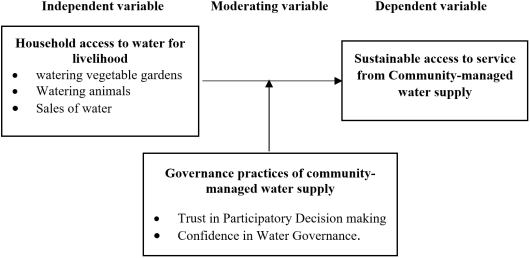
The quantitative data were analyzed using descriptive, cross-tabulation, and chi-square test at a 95% confidence level. Binary logistic regression was used to assess the factors influencing a household's sustainable access to services from a community-managed water supply. Trust in participatory decision making and water users' confidence in water governance (moderating variables) was measured through interaction terms in multivariate logistic models. The Root Mean Square Error (RMSE) was employed to evaluate model fitness.
3.6. Ethics Statement
Data was collected in strict compliance with the principles of the National Commission of Science and Technology (NACOSTI) and the St Paul's University Ethical Review Board (SPU-ERB). Consequently, the process of enhancing the confidentiality of the data provided by the respondents, either through the questionnaire or interview recording, was strictly observed. Participation was voluntary, and written informed consent was obtained from all the research participants; they received no compensation for participation.
4. Results and Discussion
4.1. Descriptive Analysis of Influence of Access to Water Service for Livelihood on Sustained Access to Community-Managed Supply
The second objective was to assess Influence of household access to water for livelihood on sustainable access to Community-managed water supply. The livelihood practices considered in this study includes household keeping livestock, household watering animals during the dry season, household watering vegetables and household selling water for income.
Table 3 below summarizes the descriptive results.
Table 3. Descriptive statistics: Household Access to water for livelihood.
Variable Description | Response | Frequency | Percent |
Household keeps Goats, Cows, sheep or Pigs | Yes | 86 | 66.2% |
No | 44 | 33.8% |
During the Dry season, household waters these animals | Yes | 79 | 91.9% |
No | 7 | 8.1% |
Household waters Vegetable or Crops | Yes | 80 | 62.5% |
No | 48 | 37.5% |
Type of Vegetable or Crops watered | Vegetables & Potatoes | 20 | 25.3% |
Vegetables | 13 | 16.5% |
Onions, Vegetables & Tomatoes | 12 | 15.2% |
Vegetables & Onion | 12 | 15.2% |
Sukumawiki | 7 | 8.9% |
Onions | 4 | 5.1% |
Kales | 4 | 5.1% |
Others | 7 | 8.9% |
During dry season household sell piped water for income | Yes | 83 | 63.8% |
No | 47 | 36.2% |
Source: Field Data (2025)
The findings indicate that a significant proportion of households engage in small-scale livestock keeping as part of their livelihood strategies. Specifically, 66.2% of households reported keeping animals such as goats, cows, sheep, or pigs, while 33.8% did not engage in any form of livestock rearing. Among those keeping livestock, an overwhelming 91.9% indicated that they water their animals during the dry season, highlighting the critical role that consistent water access plays in maintaining livestock health and productivity during periods of water scarcity. The results of this study are consistent with study findings of
who reports that livestock requires substantial water inputs therefore making water access as an essential resources helps in maintain heard health. On the same
| [59] | Wasonga, J., & Oduor, P. (2023). Socio-economic factors. determinants of participation in community water projects in Kenya. Journal of Environmental Planning and Management, 66(9), 1685–1703. |
[59]
, revealed that livestock watering is key driver of household water demand especially during the dry season. Furthermore, the authors
| [6] | Bosire, C. K., Mtimet, N., Enahoro, D., Ogutu, J. O., Krol, M. S., de Leeuw, J., & Ndiwa, N. (2022). Livestock water and land productivity in Kenya and their implications for future resource use. Heliyon, 8(3), e09006.
https://doi.org/10.1016/j.heliyon.2022.e09006 |
[6]
revealed that smallholder farmers integrate livestock into livelihood systems and that water availability is linked to livestock productivity and survival.
In addition to livestock rearing, a substantial number of households (62.5%) reported using water for irrigating vegetables or crops, demonstrating the importance of community-managed water supply in supporting subsistence and small-scale commercial farming. Conversely, 37.5% of households did not engage in crop irrigation. A closer examination of the types of crops watered reveals a diversity of produce, with the most common being a combination of vegetables and potatoes (25.3%), followed by vegetables alone (16.5%), and mixed combinations such as onions, vegetables, and tomatoes (15.2%) or vegetables and onions (15.2%). Less common were single crops like kales (8.9%), onions (5.1%), and kales (5.1%). A further 8.9% of households irrigated other unspecified crops, indicating some degree of agricultural diversification. The findings are consistent with the earlier research of
| [33] | Mango, N., Makate, C., Mapemba, L., et al. (2018). The role of crop diversification in improving household food security in central Malawi. Agriculture & Food Security, 7(7).
https://doi.org/10.1186/s40066-018-0160-x |
| [47] | Njenga, M., Mutua, J., & Karanja, N. (2019). Smallholder vegetable production and food security in peri-urban Kenya. Agriculture & Food Security, 8(1), 1–12.
https://doi.org/10.1234/jrws.2019.56789 |
| [39] | Muluki, K. M., Rasugu, H. M., Mugwe, J. N., & Nyarindo, I. H. (2022). Factors influencing adoption of irrigation technologies among smallholder farmers in Machakos County, Kenya. Journal of Agricultural Extension, 26(3), 44–59.
https://doi.org/10.4314/jae.v26i3.5 |
[33, 47, 39]
showing that when households have dependable water supply they are able to engage in crop irrigation as well as diversifying their agricultural production. The studies suggest that community-managed water systems are fundamental in sustaining agricultural livelihoods, which therefore enhance household resilience and food security.
Moreover, water supply also serves as a source of income for some households. About 63.8% of respondents reported selling piped water during the dry season, suggesting that access to water infrastructure not only supports household needs but also presents a livelihood opportunity through informal water vending. However, 36.2% of households do not engage in this practice, potentially due to limited infrastructure or water availability. these results are consistent with previous study findings of
| [7] | Cain, A. (2018). Informal water markets and community management in peri-urban Luanda, Angola. Water International, 43(2), 205–216.
https://doi.org/10.1080/02508060.2018.1434958 |
| [10] | Collignon, B., & Vézina, M. (2000). Independent water and sanitation providers in African cities: Full report of a ten-country study. UNDP–World Bank Water and Sanitation Program, Washington, DC, USA. |
[7, 10]
who documented informal water selling as a widespread livelihood practice specifically when the water infrastructure allows commercial use which enhances household economic resilience among rural household. Evidence from FGDs suggests that households maximise use of water as contributing source of income by either growing vegetables for sale and at some point the water is helpful since its availability and affordability determines the household capacity to rear animals and later sell them at profit.
One of the participants observed that;
“One is able to plant onions, kales and when it is supplied, you are able to water them and have something to eat. You can also sell the kales” (FGD2)
Another one noted that:
“I can say that water is good. It really helps us in farming, giving water to cows and to plant kales and onions things like that. The challenges come in when they disconnect the water. You see you even lack drinking water and also the money making is reduced” (FGD2)
Another one noted:
“I sell water to neighbors who haven’t connected. If mine is disconnected, 10 households are affected.” (FGD4)
The findings are consistent with the findings
| [5] | Brooks, R., Adams, E. A., & Kanyoka, P. (2020). Reliability and performance of community- managed water systems in rural East Africa. Water Resources Research, 56(7), 1–15. |
| [61] | Whaley, L., & Cleaver, F. (2017). Can “functionality” save the community management model of rural water supply? Water Resources and Rural Development, 9, 56–66.
https://doi.org/10.1016/j.wrr.2017.04.001 |
[5, 61]
whose study confirmed that among the various livelihood, agriculture remains the backbone for the rural houseolds.
In overall, the data illustrates that the sustainable access to service from a community-managed water supply in Nakuru County is closely tied to its utility in supporting key livelihood activities, particularly livestock rearing, crop irrigation, and informal water trade, especially during dry periods. These findings underline the significance of reliable water access in promoting economic resilience and sustaining community water schemes.
Table 4. Cross-tabulation - Access to water for Livelihoods Vs sustained service from community-managed water supply.
Variable | Sustainable access to Service | Unsustainable access to Service | P-Value |
Household keeps Goats, Cows, sheep or Pigs | | | <.001 |
Yes | 41 (47.7%) | 45 (52.3%) | |
No | 39 (88.6%) | 5 (11.4%) | |
During the Dry season, household waters these animals | | | 0.447 |
Yes | 37 (46.8%) | 42 (53.2%) | |
No | 4 (57.1%) | 3 (42.9%) | |
Household waters Vegetable or Crops | | | |
Yes | 58 (72.5%) | 22 (27.5%) | <.001 |
No | 20 (41.7%) | 28 (58.3%) | |
Type of Vegetable or Crops watered | | | 0.055 |
Vegetables and potatoes | 13 (65%) | 7 (35%) | |
Vegetables | 8 (61.5%) | 5 (38.5%) | |
Vegetables, onion | | | |
Onions, vegetables, tomatoes | 11 (91.7%) | 1 (8.3%) | |
Kales | 3 (42.9%) | 4 (57.1%) | |
Kales | | | |
Onions | 3 (75%) | 1 (25%) | |
Others | 4 (57.1%) | 3 (42.9%) | |
During dry season household sell piped water for income | | | 0.278 |
Yes | 49 (59%) | 34 (41%) | |
No | 31 (66%) | 16 (34%) | |
Source: Field Data (2025)
The cross-tabulation analysis explores the association between sustainable access to service for livelihoods and community-managed water supply in the two stud locations. The findings reveal statistically significant relationships between certain livelihood practices and household’s experiences.
A highly significant relationship (p < 0.001) was found between livestock keeping and sustainable access to service. Among households with sustainable water services, 47.7% reported keeping livestock such as goats, cows, sheep, or pigs, while a higher proportion (52.3%) of those with unsustainable access reported keeping livestock. In contrast, households that did not keep livestock were far more likely to report sustainable access (88.6%) compared to only 11.4% reporting unsustainable access. This pattern suggests that livestock keeping is associated with a greater likelihood of experiencing unsustainable water service. The additional demand placed on water systems by livestock may increase pressure on already constrained supply systems, thereby contributing to service unreliability. These findings align with previous study finding of
| [6] | Bosire, C. K., Mtimet, N., Enahoro, D., Ogutu, J. O., Krol, M. S., de Leeuw, J., & Ndiwa, N. (2022). Livestock water and land productivity in Kenya and their implications for future resource use. Heliyon, 8(3), e09006.
https://doi.org/10.1016/j.heliyon.2022.e09006 |
| [46] | Ngigi, M. W., Mueller, U., & Birner, R. (2018). Livestock water productivity in Kenya’s semi-arid regions: Implications for community water management. Agricultural Water Management, 206, 48–56. |
[6, 46]
who show that livestock keeping is more common among households with reliable and sustainable water services access. the cross-tabulation highlights the pressure effect while the regression analysis captures behavioral and governance mediated effects. together the findings emphasize that keeping livestock one must consider a conditional relationship with community managed-water services sustainability dependent on institutional and management context rather than water use alone. This is so because livestock keeping pressures poorly managed systems but under effective governance and cost recovery structures can instead incentivize households engagement that enhances service access sustainability. They as well show that livestock keeping is more common among households with reliable and sustainable water services access. the cross-tabulation highlights the pressure effect while the regression analysis captures behavioral and governance mediated effects. together the findings emphasize that keeping livestock one must consider a conditional relationship with community managed-water services sustainability dependent on institutional and management context rather than water use alone this so because livestock keeping pressures poorly managed systems but under effective governance and cost recovery structures it can instead incentivize households engagement that enhances service access sustainability.
Regarding the watering of animals during the dry season, the relationship with service sustainability was not statistically significant (p = 0.447). Among households that reported watering animals, 46.8% experienced sustainable access while 53.2% experienced unsustainable access. Among those who did not water animals during the dry season, 57.1% reported sustainable access compared to 42.9% reporting unsustainable access. These differences are relatively small and statistically insignificant, indicating that watering livestock during dry periods does not meaningfully distinguish between households with sustainable and unsustainable water access. This suggests that while livestock ownership may influence water demand, watering animals during dry seasons is a common necessity across households regardless of service reliability. These findings align with the study findings of
| [18] | GC, R. K., Ranganathan, S., & Hall, R. P. (2019). Does rural water system design matter? A study of productive use of water in rural Nepal. Water (Switzerland), 11(10), 1978.
https://doi.org/10.3390/w11101978 |
[18]
who documented that, owning livestock may influence water service sustainability, but the act of watering the livestock is not a distinguished rationale between households with different levels of services reliability.
A more compelling association was observed with crop or vegetable irrigation The types of vegetables or crops watered varied across households, although the association with service sustainability was not statistically significant (p = 0.055). Households with sustainable access showed higher proportions in diversified cropping patterns, such as onions, vegetables, and tomatoes (91.7%), vegetables and potatoes (65%), and onions only (75%). In contrast, households with unsustainable access were more represented in less consistent or limited patterns such as kales (57.1% unsustainable) and mixed “other” categories (42.9% unsustainable). While these differences suggest that reliable water access may support crop diversification, the lack of statistical significance indicates that these patterns should be interpreted with caution. It suggests that sustainable water systems enable households to extend water use beyond basic domestic needs to productive activities. since unsustainable system deny households development opportunities, previous study findings of
| [58] | Van Koppen, B., Moriarty, P., & de Carvalho, M. (2020). Multiple-use water services: A pathway to community resilience. Water Alternatives, 13(3), 667–686. |
[58]
aligns with findings of the current study, since they consistently affirm that, sustainable water access enables productive use including irrigation.
The type of vegetables or crops watered showed some differences, although this association was not statistically significant (p = 0.055). Households with sustainable access to services displayed more diversity, with relatively higher percentages engaging in mixed cultivation like vegetables and potatoes (22.41%), vegetables and onions (20.69%), and onions, vegetables, and tomatoes (18.97%). In contrast, households with unsustainable access to service leaned more toward single-crop watering like kales (19.05%) or vegetables alone (23.81%), perhaps due to limited or inconsistent water access that discourages crop diversification although the p-value (0.055) narrowly misses the threshold for statistical significance. The findings align with the previous study findings of
| [18] | GC, R. K., Ranganathan, S., & Hall, R. P. (2019). Does rural water system design matter? A study of productive use of water in rural Nepal. Water (Switzerland), 11(10), 1978.
https://doi.org/10.3390/w11101978 |
[18]
who revealed that reliable water facilitates diversification while unreliable access discourages it.
Lastly, selling piped water for income during the dry season showed no statistically significant association with sustainable access to services (p = 0.278). Among households that reported selling water, 59% experienced sustainable access while 41% experienced unsustainable access. Similarly, among those who did not sell water, 66% reported sustainable access compared to 34% reporting unsustainable access. These relatively similar proportions indicate that water vending is practiced across both groups regardless of service reliability. This suggests that selling water is primarily a livelihood strategy driven by opportunity and demand rather than the stability of the water system itself. The finding is consistent with previous study’s findings of
| [17] | Gichuki, F. N. (2019). Water stress, smallholder farming, and livelihood resilience in Nakuru County, Kenya. Journal of Environmental Sustainability, 7(2), 113–125 |
[17]
who emphasized that households always exploit water access to supplement their income, therefore demonstrating livelihood strategies that influence opportunity rather than system reliability. This suggests that, selling water is a common livelihood strategy regardless of the reliability of the water system, possibly influenced by demand during scarcity and informal market dynamics.
In general, the analysis demonstrates that crop irrigation and livestock keeping are central to how households utilize water for livelihoods, but these activities can have complex effects on the sustainability of community-managed supply systems. Particularly, irrigation appears more compatible with sustained water service, while intensive livestock keeping results to overuse and pressure on the system. These findings are essential for guiding policies and interventions aimed at promoting sustainable water management in rural communities.
4.2. Binary Logistic Regression Model Results
Table 5. Binary Logistic regression model on influence of water for livelihood on sustained service from Community-managed water supply.
Variable | Beta | Std. Error | Wald | Odds Ratio | P value |
(Intercept) | -0.482 | 0.391 | 1.520 | 0.617 | 0.218 |
Household keeps goats, cows, sheep or pigs (Ref: No) |
Yes | 0.736 | 0.284 | 6.718 | 2.089 | 0.009 |
Household waters vegetables or crops (Ref: No) |
Yes | -0.725 | 0.442 | 2.690 | 0.484 | 0.101 |
During dry season, household sells piped water for income (Ref: No) |
Yes | 0.823 | 0.438 | 3.531 | 2.277 | 0.06 |
Source: Field Data (2025)
The binary logistic regression analysis conducted in three sequential models in assessing the relationship between household livelihood practices and the likelihood of sustainable access to service from community-managed water systems. The dependent variable was the sustainability status of water service (sustainable access to services vs. unsustainable access to service), while the independent variables reflected key livelihood activities that rely on access to water.
The results show that livestock keeping was the strongest and most consistent predictor of sustained access to water services. Households that kept goats, cows, sheep, or pigs had about two times higher odds of reporting sustained access than households that did not keep livestock (OR = 2.089, p = 0.009). In simple terms, households that depend on water for animals were more likely to maintain reliable water service access. This effect was also significant in the earlier models, indicating that it is stable rather than accidental.
A plausible explanation is that livestock-owning households have stronger incentives to ensure water availability because water directly affects animal survival, milk production, market value, and household income. Such households may therefore be more willing to pay user fees, participate in maintenance, monitor breakdowns, or pressure management committees to keep systems functional. This suggests that households that rear animals are over twice as likely to report sustainable access to service, possibly because they ensure the reliability and management of community water systems due to their dependency on water for livestock. The study findings corroborate with the study findings of
| [4] | Al-Zubaidi, M. S., & Smith, E. (2025). Review of community-managed water supply — factors affecting its long?term sustainability. Water (Switzerland), 14, 2209.
https://doi.org/10.3390/w14142209 |
[4]
on the notion that livestock keeping not only increases household water demand but also incentivizes proactive participation in the community-managed water schemes, therefore contributing to services access sustainability.
From a Capability Theory perspective, livestock functions as an economic asset that expands household choices and resilience. Water access is not only for consumption but also for protecting productive assets. From a Socio-Technical Systems Theory perspective, households with higher productive dependence on water may become more active users within the institutional system, thereby indirectly supporting technical sustainability.
Households that used water for watering vegetables or crops showed lower odds of reporting sustained access (OR = 0.484, p = 0.101), although this relationship was not statistically significant. In practical terms, irrigating households were somewhat less likely to report reliable service, but the evidence is not strong enough to conclude that irrigation independently reduces sustainability. This finding may appear different because the cross-tabulation suggested that irrigation households often had better access. However, once other livelihood practices are considered simultaneously, especially livestock keeping and water vending, the independent effect of irrigation weakens. The findings of this study are consistent with the study results of
| [1] | Adams, E. A., Stoler, J., & Adams, Y. (2019). Water insecurity and rural water sustainability: A review of evidence from sub-Saharan Africa. Water Research, 159, 394–404.
https://doi.org/10.1016/j.watres.2019.05.010 |
| [18] | GC, R. K., Ranganathan, S., & Hall, R. P. (2019). Does rural water system design matter? A study of productive use of water in rural Nepal. Water (Switzerland), 11(10), 1978.
https://doi.org/10.3390/w11101978 |
[1, 18]
who observed that livestock keeping exerts a consistent influence on water service use and its sustainability This suggests that irrigation may be more of a result of good water access rather than a direct cause of sustainability. In other words, households irrigate because water is available, but irrigation alone does not necessarily sustain the system. Another plausible explanation is that crop watering can increase water demand, particularly in dry seasons, and may create competition between domestic and productive uses where supply is limited.
Selling piped water for income during the dry season showed a positive and marginally significant association with sustained access (OR = 2.277, p = 0.060). This means that households engaged in water vending were more than twice as likely to report sustainable service access, although the evidence falls just short of conventional significance thresholds. We could also argue that households that earn income from selling water are more likely to be connected to functioning and reliable systems. This is logical because informal water vending depends on having regular supply, storage capacity, or advantageous access points. These households may also have stronger financial motivation to support repairs, maintain relations with water committees, or invest in access infrastructure. The study findings concur with the study findings of broader argument of [23] broader argument that improved and reliable water service enhances significant economic value to households I the developing countries, and
| [59] | Wasonga, J., & Oduor, P. (2023). Socio-economic factors. determinants of participation in community water projects in Kenya. Journal of Environmental Planning and Management, 66(9), 1685–1703. |
[59]
who found out that households leveraging water for economic purpose were found to be more likely adopt proactive coping initiatives to enhance long-term continuous service access. However, including the moderating variables in model four marginally decreases the significance level of previous variables.
These findings show that how households use water matters for whether they experience sustainable service. Water is not merely a domestic necessity. It is also tied to livestock production, irrigation, and income generation. Households with stronger productive dependence on water appear more motivated or better positioned to maintain reliable access. Possible policy implications may include:
1) community-managed water systems should be designed with recognition that users have multiple water needs, not only drinking and cooking. Ignoring livelihood uses can lead to under-designed systems and hidden pressures on infrastructure.
2) productive users such as livestock keepers and small-scale vendors may be important partners in sustainability because they have strong incentives to keep systems functioning. Their participation in governance structures could strengthen maintenance and cost recovery.
3) productive water use must be managed carefully to avoid elite capture or overuse. Systems that favour commercial users while neglecting vulnerable households may deepen inequality. This is where Socio-Technical Systems Theory is especially useful: technical reliability depends not only on pumps and pipes, but also on fair rules, inclusive governance, and demand management.
4) from a Capability Theory perspective, water access should be seen as enabling livelihoods, food security, and resilience. Policies that separate domestic water from economic wellbeing may underestimate the true developmental value of rural water systems.
The Root Mean Square Error (RMSE) values improved across the models, decreasing from 0.39 in Model one to 0.36 in Model 2 and finally 0.33 in Model 3 and finally 0.31 in Model 4. This progressive reduction in RMSE indicates improved model fit as additional variables were introduced, although the improvements are modest.
In summary, the regression analysis highlights livestock keeping as the strongest and most consistent predictor of sustainable access to service of community-managed water supply across all three models. While water vending shows some potential as a contributing factor, crop irrigation, surprisingly, does not emerge as a significant predictor in this model. These findings suggest that livelihood activities that create a strong dependence on water, particularly animal husbandry may motivate greater engagement in maintaining community-managed systems, thereby contributing to sustainability.
Table 6. Moderating Effect on the Influence of Water for Livelihood on Sustained Access.
Variable | (Governance Moderation) |
Livestock Keeping | 1.79*** (0.60) |
Vegetable / Crop Watering | −0.58 (0.46) |
Selling Water in Dry Season | 0.94* (0.47) |
Governance (Main Effects) | |
Trust in Participatory Decision-Making | 2.38*** (0.70) |
Confidence in Water Governance | 2.71*** (0.76) |
Interaction Terms | |
Livestock × Trust | 1.81* (0.72) |
Livestock × Confidence | 1.64* (0.69) |
Livelihood Use × Trust | 1.56* (0.67) |
Livelihood Use × Confidence | 1.73* (0.74) |
Analysis presented in
Table 6 shows that livelihood-related uses of water such as livestock keeping and seasonal water sales, remain significant predictors of sustained access after accounting for governance effects. Livestock keeping continues to show a strong positive association with sustained access, while vegetable and crop watering remains statistically non-significant. Selling piped water during the dry season shows a modest but statistically significant positive effect. Both governance variables show strong main effects, with trust in participatory decision-making and confidence in water governance substantially increasing the likelihood of sustained access. The interaction terms between livelihood-related variables and governance are statistically significant, confirming that governance moderates the relationship between livelihood use and sustained service access.
The results suggest that livelihood dependence on water increases households’ incentives to maintain access; however, this relationship is significantly strengthened in contexts characterized by strong governance. Households that rely on water for livestock or income generation are more likely to remain connected when they trust decision-making processes and perceive water institutions as credible. On the other hand, where governance confidence is low, livelihood dependence may not consistently translate into sustained access. Governance therefore determines whether livelihood reliance becomes a stabilizing force or a source of tension and disengagement.
These findings reinforce the importance of governance in sustaining community-managed water services. From a capability perspective, water access supports productive capabilities such as income generation and food security. Governance failure undermines these capabilities by increasing uncertainty and perceived risk. These study findings are consistent with the study findings of
who observed that when governance institutions are credible and can be trusted then the livelihood reliance translates into sustained water service access.
4.3. Conclusions
The findings demonstrate that community-managed water services extend beyond their conventional domestic function and play a critical role in supporting household livelihoods, food security, and economic resilience. Households utilized water for livestock keeping, irrigation of vegetables and crops, and income-generating activities such as selling water during periods of scarcity. These productive uses underscore the centrality of water as a livelihood asset within rural and peri-urban communities. The study established that livestock keeping is the most important livelihood activity associated with sustained access to community-managed water services. Households that kept livestock were significantly more likely to maintain sustained access to piped water services than those without livestock. This suggests that when water directly supports productive assets such as cattle, goats, sheep, and pigs, households develop stronger incentives to remain connected to the water system, comply with payment obligations, and participate in activities that support service continuity. Livestock ownership therefore emerges not only as a water-dependent livelihood strategy but also as a factor that reinforces service sustainability.
A particularly important contribution of the study is the demonstration that governance conditions significantly shape the relationship between livelihood dependence and sustained access to water services. Trust in participatory decision-making processes and confidence in water governance institutions were found to have strong positive effects on sustained access. Moreover, governance significantly moderated the influence of livelihood uses of water, indicating that productive dependence on water translates into long-term service sustainability only when supported by credible, inclusive, and trusted governance arrangements. Overall, the study concludes that sustained access to community-managed water services is not solely a technical or infrastructural issue but is fundamentally linked to household livelihood dependence and the quality of governance systems. Community-managed water schemes are more likely to remain sustainable when they recognize and accommodate productive water uses while simultaneously strengthening participatory governance, accountability, and institutional trust. Consequently, policies and interventions aimed at improving rural water sustainability should adopt an integrated approach that treats water as both a basic service and a strategic livelihood resource capable of enhancing household resilience, food security, and rural development.
4.4. Policy Recommendations
The findings of this study demonstrate that community-managed water services play a much broader role than simply providing water for domestic consumption. They function as critical livelihood-support systems that enable livestock production, small-scale irrigation, food production, and income-generating activities among rural and peri-urban households. In light of these findings, there is a need for national and county-level water policies to move beyond the traditional focus on domestic water provision and explicitly recognize productive water use as an integral component of rural water service delivery. Community-managed water projects should therefore be planned, financed, and designed with sufficient infrastructure capacity to support both household consumption and livelihood activities such as livestock watering and crop irrigation. Such an approach would enhance household food security, strengthen rural livelihoods, and increase household commitment to maintaining water service connections, thereby improving the long-term sustainability of community-managed water systems.
4.5. Recommendations for Further Research
The present study found that livestock keeping was the strongest predictor of sustained access to community-managed water services, with livestock-owning households being significantly more likely to maintain continuous access than non-livestock-owning households. While the findings suggest that livestock dependence creates incentives for households to remain connected and actively support water systems, the mechanisms through which livestock ownership influences service sustainability remain insufficiently understood. Future research should therefore investigate how livestock-related water demand affects household participation in water governance, willingness to pay water tariffs, contribution to maintenance activities, and compliance with water management regulations. Such studies would provide a deeper understanding of whether livestock ownership strengthens sustainability through increased user commitment or whether it may eventually place excessive pressure on community-managed water infrastructure.





 Share This Article
 Twitter
 Linked In
 Facebook
 Copy
Copy Download