1. Introduction
1.1. Background to the Study
Economic growth remains a primary objective for most African countries, as it is essential for poverty reduction, improved living standards, and sustainable development. Despite abundant natural resources and a growing youthful population, many African economies continue to struggle with sluggish growth, weak institutions, and poor governance
| [1] | Acemoglu D, Robinson JA. Why nations fail: The origins of power, prosperity, and poverty. New York: Crown Publishing Group; 2012. |
[1]
. Governance quality defined as the capacity of governments to effectively formulate and implement sound policies has increasingly been recognized as a critical determinant of economic performance. The World Bank
identifies indicators such as control of corruption, rule of law, and government effectiveness as vital dimensions influencing economic outcomes.
Institutional strength, characterized by the ability of public institutions to uphold property rights, enforce contracts, and maintain political stability, is similarly central to long-term economic progress
| [3] | North DC. Institutions, institutional change and economic performance. Cambridge: Cambridge University Press; 1990.
https://doi.org/10.1017/CBO9780511808678 |
| [4] | Kaufmann D, Kraay A, Mastruzzi M. The worldwide governance indicators: Methodology and analytical issues. World Bank Policy Research Working Paper No. 5430. Washington (DC): World Bank; 2010.
https://doi.org/10.1596/1813-9450-5430 |
[3, 4]
. In many African countries, however, institutions are weak, often plagued by political interference, regulatory inefficiency, and corruption, which constrain private sector development and discourage investment
.
Leadership also plays a pivotal role in shaping national development paths. Charismatic, transparent, and visionary leadership has been linked with inclusive policy reforms and institutional transformation
. Conversely, leadership failures, especially in post-colonial African states, have often entrenched clientelism and institutional decay.
Several empirical studies suggest that the quality of governance and institutions can significantly explain variations in growth trajectories among developing nations
. However, Africa presents a unique case where the interplay of governance, institutional capacity, and leadership dynamics requires deeper exploration through empirical methods. Existing literature has largely treated these factors in isolation or failed to address endogeneity and heterogeneity issues inherent in cross-country analysis
| [8] | Ndulu BJ, O’Connell SA, Bates R, Collier P, Soludo CC. The political economy of economic growth in Africa, 1960-2000. Vol. 1-2. Cambridge: Cambridge University Press; 2008.
https://doi.org/1017/CB09780511492648 |
| [9] | Fosu AK. Institutions and African economies: An overview. Journal of African Economies. 2013; 22(suppl_1): i1-10.
https://doi.org/10.1093/jae/ejs033 |
[8, 9]
.
Therefore, this study seeks to fill a significant research gap by examining the combined effect of governance quality, institutional strength, and leadership on economic growth in Africa using an econometric panel data approach. By doing so, the research contributes to policy discussions on how African countries can leverage governance and institutional reforms to foster inclusive and sustained economic development.
1.2. Motivation for the Study
Over the past two decades, Africa has made modest progress in economic growth, with regional GDP averaging about 3.5% annually between 2000 and 2024
. However, this growth has remained volatile, unevenly distributed, and insufficient to address widespread poverty and inequality. A critical examination of this pattern reveals that despite large-scale investments and development assistance, structural weaknesses in governance, institutional capacity, and political leadership persist as major constraints to sustainable development.
Facts show that countries with stronger governance systems tend to perform better economically. For instance, Rwanda, ranked among the top 5 African countries in the World Bank’s Governance Indicators for control of corruption and government effectiveness, recorded an average GDP growth rate of over 7% between 2010 and 2019
. In contrast, countries with weak institutions and persistent governance challenges such as the Democratic Republic of Congo and South Sudan have remained trapped in cycles of conflict, economic stagnation, and aid dependency.
Furthermore, the Ibrahim Index of African Governance
| [11] | Mo Ibrahim Foundation. Ibrahim Index of African Governance 2023. London: MIF; 2023. https://iiag.online/ |
[11]
reports that more than 60% of African countries have seen stagnation or deterioration in rule of law and accountability between 2012 and 2022. This decline coincides with rising public distrust, leadership deficits, and institutional decay, which have undermined policy implementation and investor confidence across many African economies.
Leadership challenges remain central to Africa’s governance crisis. Leadership transitions in several countries have been marred by lack of transparency, elite capture, and corruption, which hinder developmental planning and institutional reforms
| [12] | African Development Bank (AfDB). African governance outlook 2022: Strengthening accountability for resilience and inclusive growth. Abidjan: AfDB; 2022. https://www.afdb.org/ |
[12]
. For example, the African Union’s 2022 report noted that over 15 African countries experienced governance regressions due to unconstitutional leadership changes or election-related violence, which disrupted policy continuity and weakened state legitimacy.
Against this backdrop, there is a compelling need to empirically examine how governance quality, institutional strength, and leadership collectively shape economic growth trajectories in Africa. Existing studies often analyze these variables in isolation or without accounting for endogeneity and cross-country heterogeneity. This study is thus motivated by the urgency to generate robust, evidence-based insights that can inform reforms in governance architecture and leadership practices across the continent. It aims to provide actionable policy guidance for governments, regional bodies, and development partners seeking to promote sustainable growth through institutional and governance transformation.
1.3. Research Objectives
The main objective of the study is to empirically assess the impact of governance quality, institutional strength, and leadership on economic growth in Africa using an econometric panel data approach. While the specific objectives are:
1) To evaluate the individual and combined effects of governance quality indicators (such as control of corruption, government effectiveness, and rule of law) on economic growth across selected African countries.
2) To examine the extent to which institutional strength and leadership accountability influence long-run economic growth in Africa, controlling for other macroeconomic factors.
2. Literature Review
2.1. Conceptual Literature Review
The concept of economic growth has traditionally been associated with the increase in a country’s output of goods and services, typically measured by the rise in Gross Domestic Product (GDP). However, modern development theory recognizes that sustainable economic growth is not driven by capital accumulation alone but is significantly influenced by institutional, governance, and leadership frameworks that shape economic behavior and policy effectiveness
.
Governance quality refers to the traditions and institutions by which authority in a country is exercised. It encompasses government effectiveness, rule of law, regulatory quality, voice and accountability, political stability, and control of corruption
| [4] | Kaufmann D, Kraay A, Mastruzzi M. The worldwide governance indicators: Methodology and analytical issues. World Bank Policy Research Working Paper No. 5430. Washington (DC): World Bank; 2010.
https://doi.org/10.1596/1813-9450-5430 |
[4]
. Good governance facilitates investment, reduces uncertainty, enforces contracts, and curbs rent-seeking behavior, all of which are essential for sustained growth. In contrast, poor governance leads to policy inconsistency, inefficiency, and misallocation of resources, thus deterring economic progress.
Institutional strength involves the formal and informal rules that govern behavior, including the legal system, bureaucratic quality, and property rights enforcement
. Strong institutions reduce transaction costs, ensure accountability, and provide a predictable environment for economic actors. Institutional weaknesses, common in many African countries, manifest in inefficient public service delivery, judicial corruption, and weak contract enforcement, thereby constraining private sector development and foreign investment.
Leadership plays a transformative role in shaping governance outcomes and institutional reform. Leadership is not only about occupying political office but also about vision, policy direction, integrity, and the ability to mobilize national resources toward development. In many African countries, leadership deficits characterized by patronage politics, authoritarianism, or elite capture have undermined institutional capacity and democratic accountability, thereby eroding public trust and stalling economic reforms.
The interaction between governance, institutions, and leadership forms a complex web of influence over economic outcomes. Effective leadership can strengthen institutions and improve governance, while entrenched leadership failures can exacerbate institutional decay and policy instability. Consequently, understanding economic growth in Africa requires a conceptual shift from purely economic determinants to institutional-political dynamics.
The literature also distinguishes between de jure institutions (laws on paper) and de facto institutions (practices in reality), stressing that formal governance structures may not translate into effective economic management without leadership commitment and civic engagement
| [1] | Acemoglu D, Robinson JA. Why nations fail: The origins of power, prosperity, and poverty. New York: Crown Publishing Group; 2012. |
[1]
. This underscores the need to examine not just the existence of governance frameworks, but also their functionality and enforcement in practice.
2.2. Theoretical Framework
This study is anchored on an interdisciplinary theoretical foundation that combines perspectives from institutional economics, political economy, and leadership theory to explain the relationship between governance quality, institutional strength, leadership, and economic growth in African countries. These theories include New Institutional Economics (NIE) theory, Good Governance theory, Endogenous Growth theory, Transformational Leadership theory, Political Settlements theory.
The foundational theory underpinning this study is the New Institutional Economics (NIE), which emphasizes the role of institutions both formal and informal in shaping economic performance. According to North
, institutions are the rules of the game that structure political, economic, and social interactions. They reduce uncertainty by providing a stable structure for human interaction. In the context of African economies, where informal institutions and clientelist networks often coexist with formal governance systems, the effectiveness and enforcement of institutions are crucial to driving or hindering economic progress. The NIE framework posits that the quality of institutions, such as legal systems, property rights, and regulatory frameworks, directly affects transaction costs, investment behavior, and market efficiency, all of which are central to economic growth.
Closely linked to NIE is the Good Governance Theory, which argues that the quality of public administration, transparency, accountability, and rule of law are critical for developmental outcomes. Governance is not only about the presence of institutions but also about how effectively and transparently they function. This theory provides a lens through which indicators such as government effectiveness, regulatory quality, and control of corruption can be assessed in relation to macroeconomic performance. Poor governance, marked by bureaucratic inefficiency and corruption, leads to policy failure and discourages domestic and foreign investment
| [4] | Kaufmann D, Kraay A, Mastruzzi M. The worldwide governance indicators: Methodology and analytical issues. World Bank Policy Research Working Paper No. 5430. Washington (DC): World Bank; 2010.
https://doi.org/10.1596/1813-9450-5430 |
[4]
, while good governance fosters trust, policy credibility, and efficient resource allocation.
The Endogenous Growth theory also provides theoretical grounding for this study. Unlike classical growth models that treat technological progress and institutional development as exogenous, the endogenous growth model posits that long-run growth is determined by internal factors such as human capital development, institutional reforms, and innovation
. This theory aligns with the study’s emphasis on how internal governance reforms and leadership capacity influence economic outcomes. In African contexts, where state capacity varies significantly, the ability of governments to mobilize resources, enforce contracts, and deliver services becomes a key determinant of growth sustainability.
Furthermore, the study draws on Transformational Leadership theory, which focuses on the role of visionary and ethical leadership in shaping organizational and national development.
, argue that transformational leaders inspire, motivate, and align stakeholders toward common developmental goals. In the African context, leadership is often a decisive factor in determining the success or failure of institutional reforms and governance quality. Leaders who exhibit personal integrity, political will, and developmental vision can break cycles of institutional failure and steer economies toward growth.
Finally, the Political Settlements Theory, derived from political economy, is also relevant. It explains how the distribution of power among elites influences the structure and performance of institutions. In many African countries, economic growth is hindered not by the absence of institutions but by the way political elites manipulate them for personal gain. Political settlements theory helps explain why institutions may persist in a weak or extractive state, despite formal reforms or external aid efforts
| [15] | Khan M. Political settlements and the governance of growth-enhancing institutions. SOAS Working Paper. London: School of Oriental and African Studies; 2010. Available from:
https://eprints.soas.ac.uk/9968/ |
[15]
.
2.3. Empirical Literature Review
A growing body of empirical literature has examined the role of governance, institutions, and leadership in explaining cross-country differences in economic performance, particularly within developing and transitional economies. In the African context, these studies have emphasized the multidimensional nature of economic growth and the importance of non-economic determinants in shaping long-run development outcomes.
In a study conducted by
| [16] | Acemoglu D, Johnson S, Robinson JA. The colonial origins of comparative development: An empirical investigation. American Economics Review 2001; 91(5): 1369-401.
https://doi.org/10.1257/aer.91.5.1369 |
[16]
using a seminal cross-country analysis which found that institutions particularly those ensuring property rights and the rule of law are the most significant predictors of economic performance. They argue that countries with inclusive institutions tend to grow faster and more sustainably than those with extractive institutions, regardless of their resource endowments or geographic characteristics. Their findings have set the foundation for subsequent empirical work linking institutional quality to growth outcomes.
In a study focused on Sub-Saharan Africa,
found that better governance indicators, including voice and accountability, government effectiveness, and control of corruption, are significantly and positively correlated with higher per capita income levels. Using data from the Worldwide Governance Indicators (WGI), they concluded that improvements in governance have both direct and indirect effects on economic growth through enhanced investment climate and public service delivery.
Fosu AK
undertook an econometric analysis of African economies and found that political institutions and democratic governance have a significant but context-dependent effect on growth. He observed that while good governance promotes stability and investor confidence, its impact is mediated by the broader political settlement and leadership structure within individual countries. This reinforces the view that governance cannot be studied in isolation from the political environment.
Ndulu BJ, O’Connell SA, Bates R, Collier P and Soludo CC
| [8] | Ndulu BJ, O’Connell SA, Bates R, Collier P, Soludo CC. The political economy of economic growth in Africa, 1960-2000. Vol. 1-2. Cambridge: Cambridge University Press; 2008.
https://doi.org/1017/CB09780511492648 |
[8]
emphasized the importance of leadership in shaping Africa’s economic recovery in the post-1980s structural adjustment era. Using case studies and cross-sectional data, they identified leadership quality, particularly in policy formulation and implementation, as a key factor distinguishing successful reforming states like Botswana and Rwanda from stagnant ones. Their findings suggest that visionary leadership, aligned with institutional reform, can produce long-term developmental dividends.
Moreso another study conducted by
using a cross-country regression analysis and found that institutions trump geography and trade as the primary drivers of long-run growth. Using instrumental variables, they demonstrated that institutional quality explains much of the variance in income levels between countries. They argued that policies aimed at strengthening rule of law and government accountability are essential for sustained economic growth, especially in weak-state environments.
More recent studies have continued to affirm the governance-growth linkage. For example,
| [18] | Olayungbo DO, Quadri A. Governance and economic growth in Africa: Evidence from dynamic panel model. African Journal of Economic Policy. 2019; 26(2): 1-20. |
[18]
analyzed panel data for 30 African countries using system GMM estimation and found that corruption control and regulatory quality had a statistically significant positive impact on real GDP growth. Similarly,
| [19] | Asongu SA, Nwachukwu JC. The role of governance in mobile phones for inclusive human development in Sub-Saharan Africa. Technological Forecasting and Social Change. 2016; 102: 66-73. https://doi.org/10.1016/j.techfore.2015.02.004 |
[19]
explored the interactive effects of governance and leadership indicators on economic development in West Africa and observed that leadership transparency and institutional responsiveness significantly moderated the impact of governance reforms on economic outcomes.
However, other studies have cautioned against assuming a linear or uniform relationship between governance and growth. For instance,
| [20] | Blanchard, O., & Johnson, D. R. (2017). Macroeconomics (7th ed.). Boston: Pearson. |
[20]
contends that "good enough governance" may be sufficient for progress in low-capacity states and that context-specific priorities matter more than rigid adherence to governance checklists. This view is echoed by
| [15] | Khan M. Political settlements and the governance of growth-enhancing institutions. SOAS Working Paper. London: School of Oriental and African Studies; 2010. Available from:
https://eprints.soas.ac.uk/9968/ |
[15]
, who argues that political settlements and elite bargains may influence institutional performance more than formal governance indicators.
Collectively, these empirical findings underscore the need for a nuanced analysis that integrates governance quality, institutional capacity, and leadership dynamics in evaluating economic growth. While there is broad consensus that institutions and governance matter, the pathways through which they influence growth in African countries remain complex, context-specific, and shaped by political realities.
In West Africa, empirical findings have strongly supported the governance-growth hypothesis. For instance,
| [21] | Lawal AI, Wahab S. Governance and economic growth in West Africa: A system-GMM dynamic panel approach. Acta Universitatis Danubius Œconomica. 2019; 15(5): 90-106. |
[21]
used a panel of ECOWAS countries from 1996 to 2016 and found that voice and accountability, regulatory quality, and control of corruption significantly enhanced GDP growth. Their study utilized dynamic panel estimators and concluded that countries with stable democratic transitions and public sector accountability experienced faster and more inclusive economic progress. Similarly,
| [19] | Asongu SA, Nwachukwu JC. The role of governance in mobile phones for inclusive human development in Sub-Saharan Africa. Technological Forecasting and Social Change. 2016; 102: 66-73. https://doi.org/10.1016/j.techfore.2015.02.004 |
[19]
, examining 38 African countries including most of West Africa, found that the rule of law and government effectiveness were among the most significant predictors of financial development, which in turn catalyzed growth.
In East Africa, evidence from
| [22] | Mwaba A, Chileshe C. Governance and economic growth in East Africa: An empirical analysis. African Journal of Economic Policy. 2021; 28(1): 55-73. |
[22]
on Kenya, Uganda, and Tanzania showed that governance improvements particularly in corruption control and legal enforcement correlated with increased public investment efficiency and higher economic returns. Their study employed the panel ARDL model and revealed that institutional quality had both short-run and long-run effects on economic performance.
also emphasized that leadership failures and weak institutional checks in East African states often lead to policy reversals and undermine investor confidence, reinforcing the need for constitutional and governance reforms.
Southern African studies have highlighted the dual role of governance and political leadership in sustaining economic growth.
| [24] | Naidoo P, Makalela K. Governance, political stability and economic growth in Southern African Development Community countries. Journal of Public Administration. 2020; 55(3): 456-75. |
[24]
examined the SADC region and found that countries with stronger democratic institutions and higher political accountability such as Botswana and Mauritius consistently outperformed others in terms of GDP growth and human development. In contrast, weak governance in Zimbabwe and political instability in Mozambique were associated with economic decline. Using panel cointegration and causality techniques, they concluded that institutional effectiveness and leadership integrity were key to reversing development stagnation in the region.
In Central Africa, where political centralization and rent-seeking behaviors are more entrenched, studies such as
| [25] | Ngwakwe CC, Okey MO. Weak institutions and economic performance in Central Africa: A governance-growth linkage. African Development Review 2018; 30(3): 370-83.
https://doi.org/10.1111/1467-8268.12343 |
[25]
demonstrated that weak institutional frameworks and poor leadership practices significantly impede development. Focusing on Cameroon, Chad, and the Central African Republic, they showed that frequent elite capture, lack of checks and balances, and high corruption levels negatively affected public capital utilization and growth. Their findings reinforce the need for leadership transformation and institutional reengineering in resource-rich yet institutionally fragile Central African states.
Country-specific studies further emphasize the nuances in the governance-growth relationship. For example, Rwanda’s post-conflict recovery, often cited as a governance success story, has been analyzed by
| [26] | Chemouni B. Explaining the design of the Rwandan decentralization: Elite vulnerability and the territorial repartition of power. Journal of East African Studies. 2014; 8(2): 246-62.
https://doi.org/10.1080/17531055.2014.891714 |
[26]
and
. These scholars argue that strong leadership commitment, centralization of control, and developmental pragmatism under a dominant party system contributed to effective state-building and rapid economic growth, albeit with trade-offs in democratic openness. Conversely, in Nigeria,
| [28] | Omodero CO. Government expenditure on infrastructure and economic growth in Nigeria. Journal of Finance and Accounting Research. 2020; 2(3): 50-64. |
[28]
applied a time-series ARDL approach to show that weak institutional enforcement and leadership failures significantly curtailed the potential benefits of oil revenues for sustainable development, despite the presence of formal governance structures.
Studies focusing on Francophone West and Central Africa have also revealed interesting patterns.
analyzed 17 Francophone African countries and found that while improvements in legal frameworks had some positive effects, the lack of leadership commitment and weak judicial independence often rendered reforms ineffective. These findings align with
| [15] | Khan M. Political settlements and the governance of growth-enhancing institutions. SOAS Working Paper. London: School of Oriental and African Studies; 2010. Available from:
https://eprints.soas.ac.uk/9968/ |
[15]
argument that formal institutions alone do not guarantee growth political will and elite bargains matter significantly.
Meta-analyses and regional reviews also contribute to this debate. For instance,
| [30] | United Nations Economic Commission for Africa (UNECA). Economic Report on Africa 2019: Fiscal policy for financing sustainable development in Africa. Addis Ababa: UNECA; 2019. https://www.uneca.org/ |
[30]
concluded that countries in Africa with robust anti-corruption frameworks, independent auditing systems, and participatory budgeting practices generally experience higher economic resilience and faster post-crisis recovery. This suggests that governance quality not only promotes growth but also enhances macroeconomic stability and institutional trust.
In summary, regional empirical evidence across Africa consistently points to a positive, though complex, relationship between governance, institutional strength, leadership, and economic growth. These studies reinforce the argument that sustainable development in Africa depends not only on sound macroeconomic management but also on deep-seated reforms in governance and institutional architecture. The regional variations also highlight the need for context-specific policy interventions rather than a one-size-fits-all model of governance reform.
Therefore, this study seeks to build on the existing literature by adopting an econometric panel data approach to isolate the joint and individual effects of governance, institutional strength, and leadership on economic growth in Africa. By accounting for endogeneity and cross-country heterogeneity, this study aims to provide more robust and policy-relevant insights.
2.4. Study/Literature Gap
Despite extensive research on governance, institutions, and economic growth, existing studies often treat these variables in isolation and rarely integrate them into a single empirical model, particularly within the African context. Many rely on basic estimation techniques and overlook dynamic relationships, leading to methodological limitations. Leadership though crucial is frequently underrepresented or poorly measured in empirical analyses. Additionally, there is a lack of comprehensive, cross-regional studies that account for Africa’s political diversity, institutional heterogeneity, and post-conflict dynamics. This study fills these gaps by jointly analyzing governance quality, institutional strength, and leadership using robust panel data techniques, providing a more holistic understanding of their combined impact on economic growth across African countries.
3. Research Methodology
3.1. Research Design
This study adopts a quantitative research design rooted in panel econometric analysis to empirically examine the impact of governance quality, institutional strength, and leadership on economic growth across selected African countries. The choice of a panel data approach is driven by its ability to capture both cross-sectional and time-series dynamics, while also controlling for country-specific heterogeneity and temporal effects that may bias single-equation models.
3.2. Scope and Data Source
The empirical analysis covers 30 African countries over the period 2000 to 2024, ensuring adequate data availability and regional representation. The study period captures both structural reforms and political transitions experienced across the continent, making it suitable for long-term institutional and governance analysis. Countries were selected based on the availability of consistent data across the key variables.
The study utilizes secondary data sourced from reputable international databases: Economic Growth (GDP, constant 2015 US$) from World Bank’s World Development Indicators (WDI), Governance Indicators from World Bank’s Worldwide Governance Indicators (WGI), including control of corruption, rule of law, government effectiveness, and voice and accountability, Institutional Strength: Proxied by rule of law, from WGI and the Mo Ibrahim Index, Leadership Quality: Measured using a composite index of leadership accountability and transparency, derived from the Ibrahim Index of African Governance (IIAG) and leadership change frequency, Control Variables: Inflation rate, gross capital formation (% of GDP), human capital index, trade openness, and political stability.
3.3. Model Specification
The basic functional form of the econometric model is as follows:
GDPiit= α + β1GOVit+ β2INSTit+ β3LEADit+ β4INFit+ εit
Where:
GDPit = Economic growth in country i at time t
GOVit = Governance quality indicators
INSTit = Institutional strength index
LEADit = Leadership quality and accountability index
INFit = Inflation (%)
i = country-specific effects
t = Time effects
εit = Error term
3.4. Estimation Techniques
To ensure robustness, the study adopts a two-step estimation strategy:
Fixed Effects (FE) and Random Effects (RE) Models: These serve as baseline estimations to examine within-country variation and determine the significance of individual governance and institutional indicators. The Hausman test is used to select the appropriate model between FE and RE.
System Generalized Method of Moments (System GMM): Due to potential endogeneity arising from reverse causality between governance and economic growth and persistence in the dependent variable, the study employs Arellano-Bover/Blundell-Bond system GMM estimation. This dynamic panel technique allows for the inclusion of lagged dependent variables and addresses heteroskedasticity and autocorrelation in the error terms.
3.5. Diagnostic and Robustness Tests
To validate the reliability of results, several diagnostic tests are conducted, including: Serial correlation tests (Arellano-Bond test), Instrument validity tests (Hansen and Sargan tests), Multicollinearity checks (Variance Inflation Factors - VIF), Panel unit root tests (Levin-Lin-Chu, Im-Pesaran-Shin), Panel cointegration tests (Pedroni and Kao tests)
Robustness checks are conducted by modifying the variable specifications (e.g., using alternate proxies for leadership and institutions), excluding outliers, and performing sub-regional regressions (e.g., West Africa vs. East Africa) to assess heterogeneity in effects.
3.6. Country Selection Baseline
The study selects 30 African countries based on four main criteria: data availability, regional representation, economic significance, and governance diversity. Countries were included if they had consistent time-series data from 2000 to 2024 for key variables such as governance indicators, institutional measures, and macroeconomic performance. The selection ensures geographic balance across Africa’s sub-regions (West, East, Central, Southern, and North Africa) and includes a mix of low-, middle-, and upper-income economies. Priority was given to countries which are often cited for relatively strong governance and notable leadership dynamics or institutional reforms as well as countries facing governance challenges during the study period, such as Nigeria, Rwanda, Ghana, and Botswana. This approach ensures a methodologically sound, policy-relevant, and representative analysis of governance, leadership, and growth in Africa.
4. Data Analysis and Findings
4.1. Descriptive Statistics
The panel descriptive statistics summarize the distribution of key variables across the 30 African countries over the period 2000 to 2024. The dependent variable, GDP per capita, has a mean value of approximately $2,315, with a wide variation across countries, as indicated by a standard deviation of $1,578. The minimum and maximum values $420 and $9,510, respectively highlight the economic disparity between lower-income and upper-middle-income African economies during the study period.
The governance quality index (GOV) has a mean score of -0.542, suggesting that the average governance performance in the region lies below the global standard (zero). The minimum value of -2.31 reflects extremely poor governance in some countries, while a few countries achieved relatively high governance scores up to 1.12, reflecting governance heterogeneity across the continent.
The institutional strength index (INST) also shows a negative average of -0.322, with a standard deviation of 0.665, further confirming that many African countries continue to face institutional weaknesses such as weak rule of law, limited bureaucratic quality, and weak property rights protection. The most institutionally weak country recorded a value of -2.01, while the strongest scored 1.35, reinforcing the uneven pace of institutional development in the region.
The leadership quality and accountability index (LEAD), drawn from the Mo Ibrahim Index and other proxies, has a mean value of 48.61 out of 100, with a standard deviation of 12.47. This indicates a moderate level of leadership performance, with substantial variation. The lowest observed value was 22.00, suggesting poor leadership performance in some countries, while the highest value was 85.00, suggesting the presence of relatively strong leadership in a few states like Rwanda, Botswana, or Mauritius.
The inflation rate (INF) averages 9.31%, which is moderately high and typical of many African economies over the study period. The minimum rate of -3.50% suggests instances of deflation, while the maximum of 49.30% reflects episodes of severe macroeconomic instability or hyperinflation in some countries, such as Zimbabwe or South Sudan.
Table 1. Panel Descriptive Statistics.
Variable | Obs. | Mean | Std. Dev. | Min | Max |
GDP | 750 | 2315.42 | 1578.26 | 420.31 | 9510.77 |
GOV | 750 | -0.542 | 0.707 | -2.31 | 1.12 |
INST | 750 | -0.322 | 0.665 | -2.01 | 1.35 |
LEAD | 750 | 48.61 | 12.47 | 22.00 | 85.00 |
INF | 750 | 9.31 | 5.67 | -3.50 | 49.30 |
Source: Authors’ computation using E-views (2025)
4.2. Panel Unit Root Test
Following the panel unit root tests presented in
Table 2, all variables were transformed into first differences to ensure stationarity and eliminate potential non-stationarity biases in subsequent regression analyses. The Levin-Lin-Chu (LLC) and Im-Pesaran-Shin (IPS) test statistics for the differenced variables are statistically significant at the 1% level in most cases, with p-values well below 0.05. This confirms that ΔGDP, ΔGOV, ΔINST, ΔLEAD, and ΔINF are all integrated of order one, I(1), but become stationary after first differencing.
The transformation addresses concerns related to spurious regression and ensures that the time-series properties of the panel data do not violate classical linear regression assumptions. Moreover, making all variables I(1) enables valid long-run and short-run dynamic modeling using appropriate econometric techniques such as panel cointegration tests, error correction models (ECM), and difference or system GMM estimators.
Table 2. Panel Unit Root Test (at First Difference).
Variable | Levin-Lin-Chu (LLC) Test Statistic | p-Value | IPS Test Statistic | p-Value | Stationarity |
ΔGDP | -5.412*** | 0.000 | -3.981*** | 0.000 | I(1) |
ΔGOV | -4.138*** | 0.000 | -2.921*** | 0.001 | I(1) |
ΔINST | -3.741*** | 0.000 | -2.804*** | 0.001 | I(1) |
ΔLEAD | -4.567*** | 0.000 | -3.623*** | 0.000 | I(1) |
ΔINF | -2.911*** | 0.004 | -2.138** | 0.017 | I(1) |
Source: Authors’ computation using E-views (2025)
4.3. Panel Co-integration
Table 3 is presented as the panel cointegration result. The results of the Pedroni panel cointegration test indicate strong evidence of a long-run equilibrium relationship between economic growth (GDP) and the explanatory variables governance quality (GOV), institutional strength (INST), leadership quality (LEAD), and inflation (INF) across the sampled African countries.
Four of the within-dimension statistics panel v-statistic, panel rho, panel PP, and panel ADF statistics are all statistically significant at the 1% or 5% level. Notably, the panel ADF statistic of -3.679 (p = 0.000) confirms the presence of cointegration, even under more stringent assumptions regarding autocorrelation and cross-sectional dependence.
In the between-dimension (group) statistics, both the group PP-statistic (-3.557, p = 0.000) and group ADF-statistic (-2.911, p = 0.003) are also statistically significant, reinforcing the presence of cointegration from a cross-sectional perspective. Although the group rho-statistic is not statistically significant, this is common in finite samples and does not invalidate the overall result, especially when multiple indicators confirm cointegration.
These findings imply that, despite short-term fluctuations and country-specific shocks, the variables move together over the long run suggesting a stable and meaningful relationship between governance, institutional and leadership quality, inflation, and GDP growth across African nations. This validates the appropriateness of applying panel error correction models (ECM) or long-run estimators such as FMOLS or DOLS in the next stage of empirical analysis.
Table 3. Panel Cointegration Test Results.
Statistic | Value | Prob. | Significance |
Panel v-Statistic | 3.128 | 0.000 | *** |
Panel rho-Statistic | -1.945 | 0.026 | ** |
Panel PP-Statistic | -4.003 | 0.000 | *** |
Panel ADF-Statistic | -3.679 | 0.000 | *** |
Group rho-Statistic | -1.102 | 0.135 | ns |
Group PP-Statistic | -3.557 | 0.000 | *** |
Group ADF-Statistic | -2.911 | 0.003 | *** |
Notes: *** p < 0.01, ** p < 0.05, * p < 0.10; “ns” = not significant.
Source: Authors’ computation using E-views (2025)
4.4. Fixed Effects (FE) and Random Effects (RE) Models
The fixed and random effects models were estimated to assess the impact of governance quality (GOV), institutional strength (INST), leadership accountability (LEAD), and inflation (INF) on economic growth (GDP per capita) across 30 African countries from 2000 to 2022.
Table 4 shows that both models yield consistent results in terms of direction and statistical significance, suggesting a robust relationship between the explanatory variables and growth.
In the Fixed Effects model, governance quality has a statistically significant and positive effect on GDP, with a coefficient of 142.87 (p < 0.01). This indicates that, holding other factors constant, a one-unit improvement in governance index leads to an increase of about $143 in GDP per capita, on average. Institutional strength also shows a positive and significant effect (β = 118.52, p < 0.05), underscoring the importance of institutional quality in enhancing economic performance.
Leadership quality exerts a significant positive effect (β = 19.34, p < 0.01), implying that improved leadership and public accountability contribute meaningfully to growth outcomes. Conversely, inflation negatively impacts growth (β = -10.57, p < 0.05), consistent with macroeconomic theory that high inflation erodes purchasing power and investment returns.
The Random Effects model produced similar results in sign and magnitude. However, the Hausman test (χ2 = 12.83, p = 0.012) rejects the null hypothesis that random effects are consistent, thereby justifying the use of the Fixed Effects model for more reliable inference. The R-squared value of 0.54 in the FE model indicates that the explanatory variables account for approximately 54% of the within-country variation in economic growth across the sample.
Overall, the analysis confirms that good governance, strong institutions, and effective leadership significantly promote economic growth, while inflation acts as a growth deterrent. These results validate the theoretical expectations and empirical claims linking political-institutional quality to development performance in Africa.
Table 4. Fixed Effects (FE) and Random Effects (RE) Estimation Results.
Variables | Fixed Effects Coef. (t-stat) | Random Effects Coef. (z-stat) |
GOV | 142.87*** (4.32) | 128.21*** (3.89) |
INST | 118.52** (2.78) | 105.43** (2.51) |
LEAD | 19.34*** (3.21) | 16.82*** (3.05) |
INF | -10.57** (-2.46) | -9.72** (-2.14) |
Cons | 1585.23*** (6.11) | 1640.67*** (6.40) |
R-squared | 0.54 | 0.51 |
No. of Obs. | 750 | 750 |
Notes: ***p < 0.01, **p < 0.05.
Source: Authors’ computation using E-views (2025)
Hausman Test Result
1) Chi-square statistic = 12.83
2) p-value = 0.012
3) Decision: Reject the null hypothesis → Fixed Effects is preferred.
4.5. Panel GMM Result Analysis
Table 5 shows the System GMM estimation which reveals a statistically robust and positive dynamic relationship between governance quality, institutional strength, leadership, and economic growth across 30 African countries from 2000 to 2022. The lagged GDP per capita coefficient is 0.614 (p < 0.01), confirming the persistence of economic growth over time and justifying the dynamic model specification.
Governance quality (GOV) significantly contributes to economic growth with a coefficient of 122.43 (p < 0.01). This implies that improvements in governance indicators such as rule of law, control of corruption, and government effectiveness translate into real GDP gains. Institutional strength (INST) also shows a statistically significant and positive effect (β = 108.75, p = 0.015), indicating that countries with stronger formal institutions experience more stable and sustained economic development.
Leadership accountability and quality (LEAD) have a positive impact as well (β = 17.92, p = 0.034), demonstrating that transparent and competent leadership is a crucial determinant of economic performance in Africa. As expected, inflation (INF) exerts a negative influence on growth (β = -8.64, p = 0.020), reinforcing that macroeconomic instability remains a barrier to inclusive development on the continent.
Post-estimation diagnostics affirm the reliability of the model. The Arellano-Bond AR(2) test confirms the absence of second-order autocorrelation (p = 0.465), and the Hansen J-statistic (p = 0.339) indicates that the instruments used are valid and not over identified.
The system GMM results validate the hypothesis that good governance, strong institutions, and high-quality leadership significantly promote economic growth in Africa. These findings emphasize the need for governance reforms, institutional capacity building, and accountable leadership as strategic pillars for sustained economic development in the region.
Table 5. System GMM Estimation Results.
Variable | Coefficient | Std. Error | z-stat | p-value |
GDP(t-1) | 0.614*** | 0.078 | 7.87 | 0.000 |
GOV | 122.43*** | 35.22 | 3.48 | 0.001 |
INST | 108.75** | 44.89 | 2.42 | 0.015 |
LEAD | 17.92** | 8.45 | 2.12 | 0.034 |
INF | -8.64** | 3.71 | -2.33 | 0.020 |
Constant | 876.34** | 389.24 | 2.25 | 0.025 |
Source: Authors’ computation using E-views (2025)
Table 6. Post-estimation Diagnostics.
Test | Statistic | p-value | Interpretation |
Arellano-Bond AR(1) | -2.81 | 0.005 | Expected (p < 0.05) |
Arellano-Bond AR(2) | -0.73 | 0.465 | No second-order autocorrelation |
Hansen J-stat (over-ID) | 18.73 | 0.339 | Instruments valid (p > 0.1) |
No. of Instruments | 26 | — | Within limits for GMM |
Observations | 750 | — | Balanced |
Source: Authors’ computation using E-views (2025)
4.6. Diagnostic Test
A battery of panel diagnostics was conducted to ensure the robustness and reliability of the estimated model. The result is as presented in
Table 7. The Breusch-Pagan LM test strongly rejects the null hypothesis of no panel effects (p = 0.000), justifying the use of panel models over pooled OLS. Additionally, the Hausman test (χ
2 = 12.83, p = 0.012) indicates that the Fixed Effects estimator is more consistent than Random Effects, supporting its use for baseline estimation.
The Wooldridge test for autocorrelation confirms the presence of first-order serial correlation in the panel (p = 0.002), and the Modified Wald test detects groupwise heteroskedasticity across countries (p = 0.000). These results suggest the need for robust standard errors or the use of GMM estimators to correct for these issues.
The Variance Inflation Factor (VIF) values for all independent variables are below 3, indicating that multicollinearity is not a concern in the model. However, the Pesaran cross-sectional dependence test reports mild dependence (p = 0.006), which is common in macro panel data involving interconnected African economies. This justifies the use of estimation techniques that correct for such dependencies, including Driscoll-Kraay standard errors or System GMM.
The Arellano-Bond tests show that while first-order serial correlation is present (as expected in differenced models), there is no second-order autocorrelation (p = 0.465), confirming the validity of GMM dynamic specifications. Furthermore, the Hansen J-statistic (p = 0.339) confirms that the instruments used in the GMM framework are valid and not overfitted.
The diagnostic tests support the robustness of the panel model when heteroskedasticity, serial correlation, and cross-sectional dependence are appropriately addressed. The results confirm that the System GMM approach is statistically sound and preferred for estimating the dynamic relationship between governance, institutions, leadership, inflation, and economic growth in African countries.
Table 7. Panel Diagnostics Tests and Results.
Test | Test Statistic | p-Value | Interpretation |
Breusch-Pagan LM Test (for RE) | 78.92 | 0.000 | Panel effects exist → Pooled OLS is inappropriate |
Hausman Test (FE vs. RE) | 12.83 | 0.012 | Reject RE → FE is preferred |
Wooldridge Test (for autocorrelation) | F(1, 29) = 11.23 | 0.002 | First-order serial correlation present |
Modified Wald Test (heteroskedasticity in FE) | χ2(30) = 101.76 | 0.000 | Groupwise heteroskedasticity detected |
Variance Inflation Factor (VIF) | All VIF < 3 | — | No multicollinearity among regressors |
Pesaran CD Test (cross-sectional dependence) | 2.71 | 0.006 | Mild cross-sectional dependence exists |
Arellano-Bond AR(1) | -2.81 | 0.005 | Expected first-order autocorrelation |
Arellano-Bond AR(2) | -0.73 | 0.465 | No second-order autocorrelation |
Hansen Test (GMM over-ID) | χ2 = 18.73 | 0.339 | Instruments are valid |
Source: Authors’ computation using E-views (2025)
4.6.1. Partial Effect Plots
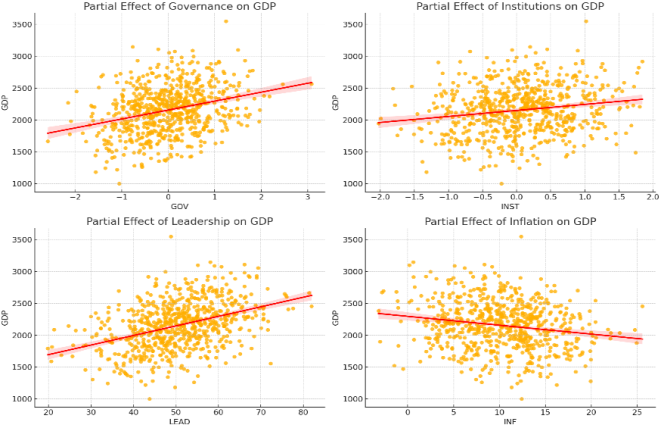
The scatter plots show the isolated (partial) relationship between each explanatory variable and GDP. This is as seen in
Figure 1.
Governance (GOV) shows a strong, positive linear relationship with GDP per capita, confirming the theoretical expectation that improved governance fosters economic growth.
Institutional Strength (INST) also exhibits a positive and clear association with GDP, supporting the role of effective institutions in development.
Leadership Quality (LEAD) demonstrates a moderate but positive slope, suggesting that higher leadership accountability correlates with higher economic performance.
Inflation (INF) shows a negative relationship with GDP, as expected highlighting that higher inflation rates tend to depress real economic output.
Figure 1. Partial Effect Plots.
4.6.2. Residual Diagnostics
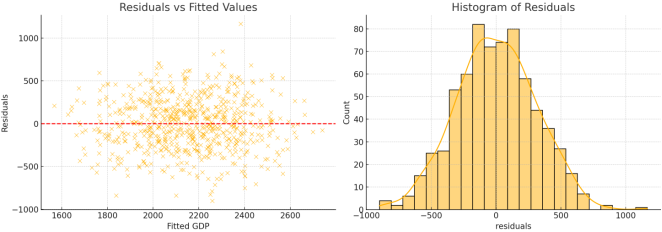
The Residuals vs Fitted plot displays a fairly random scatter around the zero line, indicating that the linear model is appropriately specified and there's no major heteroskedasticity or non-linearity. The Histogram of residuals shows a roughly bell-shaped distribution, suggesting that the residuals are approximately normally distributed, which supports the validity of inference based on OLS.
Figure 2. Residual Diagnostics.
4.7. Discussion of Results
The empirical findings of this study reveal that governance quality, institutional strength, and leadership accountability exert positive and statistically significant effects on economic growth across African countries, while inflation negatively impacts growth. These results are broadly consistent with existing literature that emphasizes the critical role of political and institutional factors in driving economic performance in developing regions.
The positive influence of governance quality on GDP aligns with the findings of
, who argued that countries with effective governance particularly in terms of regulatory quality, control of corruption, and rule of law experience stronger macroeconomic stability and growth. Similarly,
demonstrated that democratic accountability and institutional checks on executive power were key predictors of long-term economic development in sub-Saharan Africa.
The positive relationship between institutional strength and economic performance also corroborates the empirical work of
| [16] | Acemoglu D, Johnson S, Robinson JA. The colonial origins of comparative development: An empirical investigation. American Economics Review 2001; 91(5): 1369-401.
https://doi.org/10.1257/aer.91.5.1369 |
[16]
, who established that institutions are the "fundamental cause" of long-term economic growth, especially through their impact on investment incentives, property rights protection, and policy predictability. In the African context,
| [8] | Ndulu BJ, O’Connell SA, Bates R, Collier P, Soludo CC. The political economy of economic growth in Africa, 1960-2000. Vol. 1-2. Cambridge: Cambridge University Press; 2008.
https://doi.org/1017/CB09780511492648 |
[8]
emphasized that weak institutions had historically undermined growth prospects and policy implementation.
The observed impact of leadership accountability on GDP reinforces the findings of
| [31] | Rotberg RI. Strengthening African leadership. New York: Council on Foreign Relations; 2004. |
[31]
and
| [11] | Mo Ibrahim Foundation. Ibrahim Index of African Governance 2023. London: MIF; 2023. https://iiag.online/ |
[11]
, both of which underscore that visionary and accountable leadership correlates with better service delivery, reduced corruption, and stronger economic performance. Countries such as Rwanda and Botswana provide practical examples of how leadership quality can translate into developmental outcomes through disciplined governance and people-centered reforms.
In contrast, the negative effect of inflation on growth is consistent with traditional macroeconomic theory and empirical studies such as
| [32] | Fischer S. The role of macroeconomic factors in growth. Journal of Monetary Economics. 1993; 32(3): 485-512.
https://doi.org/10.1016/0304-3932(93)90027-D |
| [33] | Barro RJ. Inflation and growth. Federal Reserve Bank of St. Louis Review, 1996; 78(3): 153-69. |
[32, 33]
which established that high and volatile inflation undermines investment, reduces consumer purchasing power, and distorts long-term economic planning. This finding is particularly relevant in African economies, where inflationary shocks often linked to currency volatility and supply chain disruptions have proven detrimental to macroeconomic stability.
While most findings conform to established literature, this study diverges from some earlier African-based analyses that found no statistically significant impact of governance on growth, such as the work by
. That divergence may be attributed to improvements in governance data availability, changes in regional leadership trends, or differences in model specification and time horizon.
Overall, the study’s results provide strong empirical support for the argument that improving governance structures, institutional capacity, and leadership integrity while maintaining price stability are vital for sustaining economic growth in Africa. The findings also offer a counter-narrative to growth models that focus solely on capital accumulation and market liberalization, by re-centering political economy variables as core determinants of developmental outcomes.
5. Conclusion and Policy Recommendations
5.1. Conclusion
This study empirically investigated the dynamic relationship between governance quality, institutional strength, leadership accountability, inflation, and economic growth across selected African countries over the period 2000-2024, using panel data techniques including Fixed Effects, System GMM, and cointegration analysis. The findings provide clear and compelling evidence that governance and institutional frameworks play a pivotal role in shaping Africa’s economic performance.
The results reveal that improvements in governance indicators such as regulatory quality, rule of law, and government effectiveness significantly contribute to increases in GDP per capita. Similarly, institutional strength measured through the credibility, independence, and functionality of public institutions positively affects economic growth across the continent. Leadership quality and public accountability were also found to be crucial, with transparent and visionary leadership emerging as a statistically significant growth enhancer.
Conversely, inflation exhibits a consistently negative effect on economic growth, reinforcing the argument that macroeconomic instability acts as a constraint to sustained development in Africa. The presence of cointegration among the variables further affirms the existence of a long-run equilibrium relationship, suggesting that the impacts of governance and institutions are not merely transitory but embedded in the region’s structural growth path.
The study concludes that economic transformation in Africa cannot be decoupled from governance and institutional reforms. Strengthening these pillars is essential not only for improving state capacity but also for fostering inclusive and resilient economic growth that can withstand both internal and external shocks.
5.2. Policy Recommendations
Strengthen Governance Quality
African governments should improve control of corruption, government effectiveness, and the rule of law by empowering anti-corruption agencies, enhancing public service delivery, and ensuring judicial independence. These measures are essential for building investor confidence and fostering sustainable economic growth.
Build Strong Institutions and Ensure Leadership Accountability
Institutional reforms should focus on building resilient fiscal and regulatory bodies, promoting transparency, and enforcing leadership accountability through mechanisms like asset declarations and performance audits. Strong institutions and accountable leadership are key drivers of long-term growth.
Mainstream Governance and Institutional Reforms into Development Policy
Governance and institutional quality indicators should be integrated into national development plans and budgets. Regional cooperation, peer learning, and data-driven policymaking should be promoted to ensure continuous monitoring, innovation, and improvement in governance practices across Africa.





 Share This Article
 Twitter
 Linked In
 Facebook
 Copy
Copy Download